

1. Introduction
Corrosion of reinforced concrete reinforcement is a process that leads to the gradual destruction of building structures. Progressive degradation is particularly important for structures strongly exposed to the external environment (bridges, viaducts, or seaport quays) (Moravčík et al., 2016), (Ponechal et al., 2021). The main factor initiating the corrosion process is chloride diffusion and gradual carbonation of the concrete cover, which is an issue addressed by a wide range of researchers (Arredondo-Rea et al., 2019), (Bazant, 1979), (Xi & Bazant, 1999), (Tang Bui et al., 2022), (Maekawa et al., 2003), (Černý & Rovnaníková, 2002), (Caijun et al., 2019), (Nicolás et al., 2024), (Flores-Nicolás et al., 2025). The evolution of electrode processes and the growth of corrosion products on the reinforcement surface leads, among others, to This can lead to cracking of the concrete cover (Michel et al., 2014), (Krykowski et al., 2020), (Šavija et al., 2013), (Jamshidi & Dehestani, 2020), (Chen et al., 2020), changes in the adhesion forces at the steel-concrete interface (Capozucca, 1995), (Fischer, 2012), (El Alami et al., 2022), (Lee et al., 2002) and a reduction in the mechanical parameters of the reinforcement (yield strength and Young's modulus) (Almusallam, 2001), (Zhou et al., 2022), (Moreno et al., 2014), (Andrade, 2018), (Benjamin et al., 2021), (Zhu et al., 2017), (Lee & Cho, 2009), (Recha, Łuczak, et al., 2025), (Bahleda et al., 2023), (Zahuranec et al., 2023). The combined effects of corrosion result in a reduction in the load-bearing capacity and performance of structural elements within a safe range (Negrutiu et al., 2016), (Shen et al., 2019), (Kotes & Vican, 2016), (Strieška et al., 2018), (Koteš et al., 2020). Furthermore, degradation of the reinforcement and concrete structure causes increased deflection of the spans (Recha, 2023), (Grandić et al., 2011) and additional displacements of individual structure nodes (Jin et al., 2018), (Ye et al., 2018). The need to analyse issues related to corrosion damage is fully justified by the increased maintenance costs (De Sitter, 1983), (Li et al., 2022) and the safe operation of the entire structure. In this regard, it is crucial to properly estimate corrosion parameters, which fully illustrate the need to take remedial measures at an early stage of structural damage development. One of the basic parameters describing the state of corrosion is the corrosion current density of the reinforcement, which is currently measured point-by-point using specialized equipment. One of the diagnostic challenges is the appropriate measurement of damage to the reinforcement and concrete structure in the corrosion site (Jin et al., 2018). Current knowledge primarily concerns the analysis of deflection during ongoing corrosion processes. This knowledge allows for the application of the so-called inverse problem, which is based on determining the causes that cause specific effects (in this case, structural deformation). This paper proposes an alternative method that allows for estimating the corrosion current level based on a non-invasive measurement, i.e., the gradual increase in element deflection. Due to the complexity of the corrosion phenomenon, the paper proposes expanding the existing innovative methodology to include an analysis that considers the uncertainty of model parameters. To account for uncertainty, the Monte Carlo method was used for selected parameters with linear distributions at 5, 10, 15, and 20 %. The entire analysis is presented using the example of the verification of the proposed method performed in (Recha, Raczkiewicz, et al., 2025). Accounting for the uncertainty of model parameters is crucial for highly complex processes influenced by several external factors. The application of parameter dispersion methods constitutes an original part of the work, which is part of a broader issue concerning the development and implementation of a method for estimating corrosion current intensity based on the analysis of structural deformation.
2. Theoretical Model
The total analysis of changes in the deflection of a reinforced concrete element should be considered over time. The first stage is the migration of aggressive substances and their diffusion through the concrete cover. The arrival of the aggressive substances at the reinforcement surface gradually reduces the protective properties of the reinforcement through the disappearance of the oxide layer (so-called depassivation of the reinforcing steel). Once the oxide layer is completely penetrated, the second stage begins, known as the initiation of the electrode process on the reinforcement surface. The next, third stage involves the development of corrosion processes on the reinforcement surface, micro-damage within the transition layer at the steel-concrete interface, which ultimately causes damage to the structure (including cracking of the concrete cover, reduced adhesion of steel to concrete, and reduced mechanical parameters of the reinforcement). These coupled phenomena are widely described in the literature (Arredondo-Rea et al., 2019), (Bazant, 1979), (Xi & Bazant, 1999), (Tang Bui et al., 2022), ( Maekawa et al., 2003), (Černý & Rovnaníková, 2002), (Caijun et al., 2019) , but are not the direct subject of this article. Deflections of reinforced concrete beam and slab spans strongly depend on a number of phenomena, including the effects of mechanical impacts, cross-section cracking, concrete creep, and the described complex interactions of corrosion processes. Deflection increases associated with corrosion phenomena are mainly caused by a decrease in the stiffness of the reinforced concrete cross-section due to a change in Young's modulus (Zhu et al., 2017), (Lee & Cho, 2009), (Recha, Raczkiewicz, et al., 2025) and a loss of reinforcement mass (Michel et al., 2014), (Krykowski et al., 2020), (Šavija et al., 2013), (Jamshidi & Dehestani, 2020), (Chen et al., 2020). The direct connection between electrode processes on the reinforcement surface and the progressive deflection of the structural element is the starting point for the described analysis. A detailed description of the estimation model for the basic corrosion parameter, i.e., the corrosion current intensity, was presented in (Recha, 2022), (Recha, 2023), (Recha, 2024), (Recha, Raczkiewicz, et al., 2025). Research work related to the described method to date has included a theoretical model numerical verification (Recha, 2023), application of the model for analytical calculations on real structures (Recha, 2024), and finally experimental verification of the model under laboratory conditions on reinforced concrete beams (Recha, Raczkiewicz, et al., 2025). However, all this work was based on a deterministic approach, which treats individual assumptions and parameters as constant numerical quantities or functions of variability without considering the dispersion of its coefficients. Due to serval external factors that play a significant role in the initiation and subsequent evolution of the corrosion process, corrosion phenomena should be treated as complex processes. Considering the complexity of these processes is crucial in modelling the degradation of reinforced concrete elements, so that the prediction models are as close to the actual state as possible.
2.1. Application of the Monte Carlo Method
To account for the uncertainty of individual parameters, probabilistic methods are used, including the Monte Carlo method (Metropolis & Ulam, 1949) and affine number algebra (Bilotta, 2008). However, these methods have been successfully used to determine the cracking time and crack width of the concrete cover of corroded reinforcement (Krykowski, 2020b), (Recha, 2021), (Recha et al., 2023). To date, no attempt has been made to apply these methods to the estimation of corrosion current based on element deflection. In the aforementioned analysis, which takes into account computational uncertainties, the uncertain parameters were treated as uniformly distributed random variables and determined for deviations of ζ = 5, 10, 15 and 20 % according to the relationship (Krykowski, 2020b), (Recha, 2021), (Recha et al., 2023):
where:A - the parameter under consideration, while the function rand(0,1) means random selection in the range from 0 to 1. Therefore, the minimum values Amin (lower limit) and the maximum values Amax (upper limit) of a given parameter A can be determined as follows:
where:
Δ - A0 - the width of the interval, determined as:
The main uncertain parameter was assumed to be the measured deflection of the element due to measurement inaccuracies in the actual state of the structure. Other uncertain parameters were assumed to relate to corrosion phenomena (changes in the Young's modulus of the reinforcing steel and mass loss of the reinforcement) and rheological phenomena of the concrete (creep coefficient). Selected elements are directly related to the electrochemical process occurring on the reinforcement surface, making them the most uncertain elements of the entire model and exposed to the variable influence of external factors such as humidity and temperature.
2.2. Model for Estimating the Corrosion Current Intensity Considering the Uncertainty
The coupling of mechanical and corrosive phenomena is a process fraught with significant uncertainty due to the wide range of factors influencing the development and evolution of these processes. The deterministic model assumes that cracking occurs in the structure's loaded state and before the initiation of corrosion processes, due to the necessary time required for the migration of aggressive substances and the depassivation of the reinforcement. Similarly to the deterministic model, the uncertainty-based model also considers two phases of the structure's operation: the aggressive effects of the external environment on steel and the effects of concrete rheology. The diagram of the possible deflection areas, considering the uncertainty of deflection over time, is presented graphically in the graph (Figure 1). The corrosion processes affecting the deflection of the element, considering the uncertainty for the assumed parameter dispersion, are indicated in the Figure 1 by region C, bounded by lines C− and C+, which correspond to the lower and upper limits of the deflection, respectively. The phenomena included in region C include the loss of reinforcement mass and a decrease in Young's modulus. The increase in deflection due to mechanical impacts is indicated in the Figure 1 by region B, bounded by the lower and upper limits, respectively, by lines B− and B+ The range of region B is dictated by the assumed dispersion of uncertainty for the creep coefficient, representing the rheology of the concrete, and external loads. The model assumes that self-weight is not subject to uncertainty. By applying the principle of superposition, it is possible to determine the sum of regions C and B as the resulting region D, which represents the possible occurrence of deflection of the corrosion element, considering the uncertainty of the initial parameters. According to the proposed model, the influence of uncertainty begins only after corrosion processes develop, and over time, considering concrete rheology and load changes. The model assumes that these processes occur in the second phase of the reinforced concrete element's operation, after cracking. Up to this time limit, the entire evolution of deflection changes results solely from deflection due to mechanical impacts. When corrosion initiation and rheological processes begin, deflections gradually increase. The above theoretical assumptions provide the basis for deriving functional relationships describing the analytical approach to estimating corrosion current density, considering the uncertainty of the proposed model's parameters.
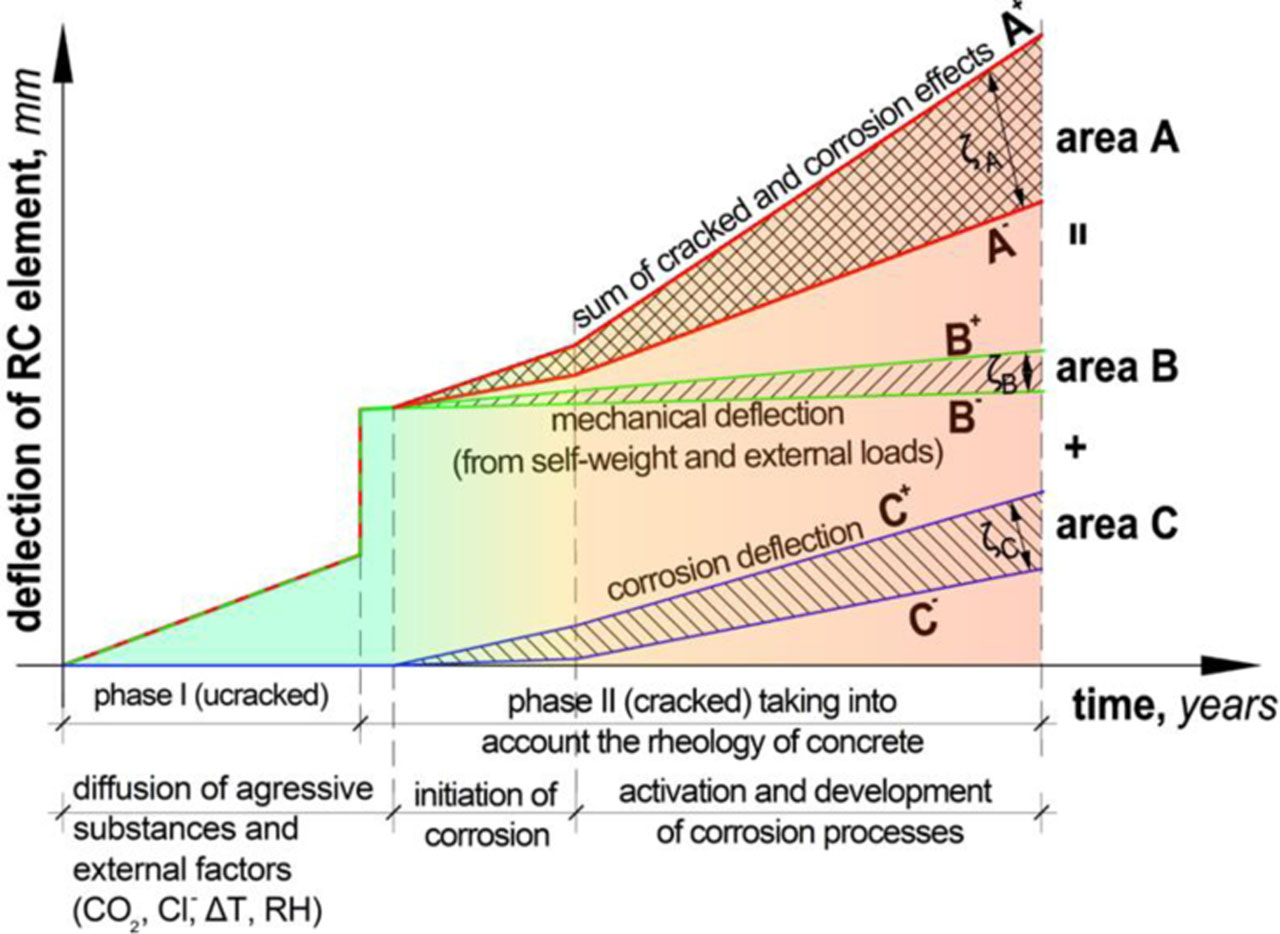
Figure 1:
Diagram of the changes in the deflection of a reinforced concrete element over time, considering uncertain parameters
2.3. Computational Approach Considering the Uncertainty of Model Parameters
The basis of the analysis is precise monitoring of the element's deflection, which allows for determining the range of changes in its curvature k(t)−/+ with assumed uncertainties. This value is directly related to the range of time-varying stiffness of the element Bcorr(t)−/+ caused by the development of electrochemical processes on the reinforcement surface. The values of curvature and stiffness after adapting the uncertain parameters should be presented in the form of ranges:
where:Icr(t)−, Ecorr(t)−, Icr(t)+, Ecorr(t)+ are the lower (−) and upper (+) limits of the modulus of inertia and Young's modulus of the corroded reinforced concrete cross-section, respectively, which vary over time, while MEk is the characteristic bending moment. Assuming that MEk is constant over time (unchanging) in accordance with equation (3), the relationship between the curvature of the element deflection and the stiffness is inversely proportional. The maximum curvature will occur for the minimum stiffness, while the minimum curvature will occur for the maximum stiffness of the element:
According to the generalized assumptions of the model (Figure 1), it was assumed that the initiation and evolution of the corrosion process occur in the second phase of the reinforced concrete cross-section operation - after the structure has cracked. Therefore, after considering the progressive curvature of the corroded element (3), the generalized form of the corrosion current density icorr(t)−/+ as a function of time increment ∆t, derived using Faraday's law, takes the form of the interval:
where:icorr(t)− and icorr(t)+ - the lower and upper limits of the corrosion current intensity, respectively, the limits of which are defined by the following functions:
In equations (6) the following constant (deterministic) quantities were assumed: y as the distance from the center of gravity of the cross-section to the extreme tensile fibers, ρFe – density of the reinforcing steel, leff – invariable effective span of the element (Polish Committee of Normalization:, 2008), Ab – surface area of the reinforcement side, identical to the corrosive active surface, i.e. the surface on which electrochemical processes take place. The remaining values were assumed in an interval manner (lower and upper limits), thanks to which it is possible to take into account the uncertainty of the model parameters, namely: keff−, keff+ effective, electrochemical equivalent of reinforcement (Recha, Raczkiewicz, et al., 2025), (Krykowski et al., 2020), k(t)−, k(t)+ – time-progressive curvature of the element, Ec.eff(t)−, Ec.eff(t)+ Young's modulus of concrete taking into account the rheology phenomenon based on the upper and lower limits of the creep coefficient φ(t) and a constant, deterministic value of the mean secant Young's modulus Ecm (Polish Committee of Normalization:, 2008), (FIB, 2013) in accordance with equation (7):
The lower and upper limits of the moment of inertia of the entire cross-section in the cracked state Icr(t)−/+ refer directly to the extreme values of curvature after cracking k(t)−/+ in the form of the following relationship:
By definition, the modulus of inertia of a plane figure being the product of the cross-sectional area Acorr(t)−/+ and the square of the distance from the center of gravity to the extreme tensile fibers y2 after applying the theory of uncertain parameters can be determined in the form:
After substituting the relations (9) to (8) it is possible to derive the limits of the lower and upper cross-sectional area of the corroded element Acorr(t)−/+ based on the curvature of the element in the form:
The calculated surface area of the corroded reinforced concrete element Acorr(t)−/+ includes the sum of the areas of the constant concrete surface Ac and the reinforcement cross-section changing over time ΔAs(t)−/+, which is also affected by the uncertainty (11):
where:Es(t)−/+ - the lower and upper limits, respectively, changing as a result of ongoing corrosion processes and considering the assumed uncertainties of the Young's modulus of the reinforcing steel. By substituting the values in equation (11) into equations (10), it is possible to derive the lower and upper limits for changes in the reinforcement cross-sectional area As(t)−/+ as a function of the element curvature k(t)−/+:
Taking into account the changes in the reinforcement cross-sectional area in the form of lower and upper limits As(t)−/+ defined by equations (12) in the functions of the lower and upper limits of the changes in the corrosion current density (6) provides a basis for estimating the corrosion areas according to the model (Figure 1) based on the increase in curvature, rheological changes of the concrete and the reduction of the Young's modulus of the reinforcement, taking into account the uncertainty of these parameters. Finally, the functions describing the boundaries of the estimated corrosion current area Icorr(t)−/+ will take the form:
3. Calculation Example
The calculation example uses the research results presented in (Recha, Raczkiewicz, et al., 2025), where presented the methods, including data collection procedures, analysis techniques, and all tools used, along with experimental verification of the proposed model, which allows for applying the method that takes into account the uncertainties of model parameters to a real structure tested in laboratory conditions. The following elements were treated as uncertain elements in the analyses:
○ Element curvature k(t) determined from measurements.
○ Effective electrochemical equivalent of reinforcing steel keff.
○ Young's modulus of reinforcing steel under the influence of corrosion Es(t).
○ Concrete creep coefficient φ(t).
For the above parameters, the assumed dispersion was 5, 10, 15, and 20 %. The obtained results for the lower (infimum “−“) and upper (supremum “+”) limits determined according to equations (1–3) are summarized in the Table 1. The exception was the value of Young's modulus, which, despite the assumed upper limit (supremum) of the dispersion of 15 and 20%, was assumed at the maximum level, not exceeding 200 GPa.
Table 1:
List of uncertain parameters adopted for calculations
| Parameter | Base value | Interval 5% | Interval 10% | Interval 15% | Interval 20% | ||||
| inf. 5% (−) | sup. 5% (+) | inf. 10% (-) | sup. 10% (+) | inf. 15% (-) | sup. 15% (+) | inf. 20% (-) | sup. 20% (+) | ||
| k(t), 1/mm | 0.000041 | 0.000039 | 0.000043 | 0.000037 | 0.000045 | 0.000035 | 0.000047 | 0.000033 | 0.000049 |
| 0.000124 | 0.000117 | 0.000130 | 0.000111 | 0.000136 | 0.000105 | 0.000142 | 0.000099 | 0.000148 | |
| 0.000106 | 0.000101 | 0.000111 | 0.000095 | 0.000117 | 0.000090 | 0.000122 | 0.000085 | 0.000127 | |
| 0.00652 | 0.00619 | 0.00685 | 0.00587 | 0.00717 | 0.00554 | 0.00750 | 0.00522 | 0.00782 | |
| Es(t), GPa | 180 | 171 | 189 | 162 | 198 | 153 | 200* | 144 | 200* |
| φ(t), - | 2.5 | 2.375 | 2.625 | 2.25 | 2.75 | 2.125 | 2.875 | 2.00 | 3.00 |
Based on the assumed uncertainties for individual measurements, the corrosion current intensity was determined using the relationships (7–13). The obtained results are presented in the form of a graph (Figure 2), which is superimposed with the results of deterministic calculations and the results obtained during laboratory tests (Recha, Raczkiewicz, et al., 2025). To more clearly present the calculation results for all quantities within the individual uncertainty ranges, exponential trend lines were determined, which also serve as boundaries for the specific scatter of uncertain parameters. The graphical interpretation should be treated as an estimate of the corrosion current level based on the physically measured deflection increase. The reading method, considering the assumed uncertainties, is shown in the Figure 3.
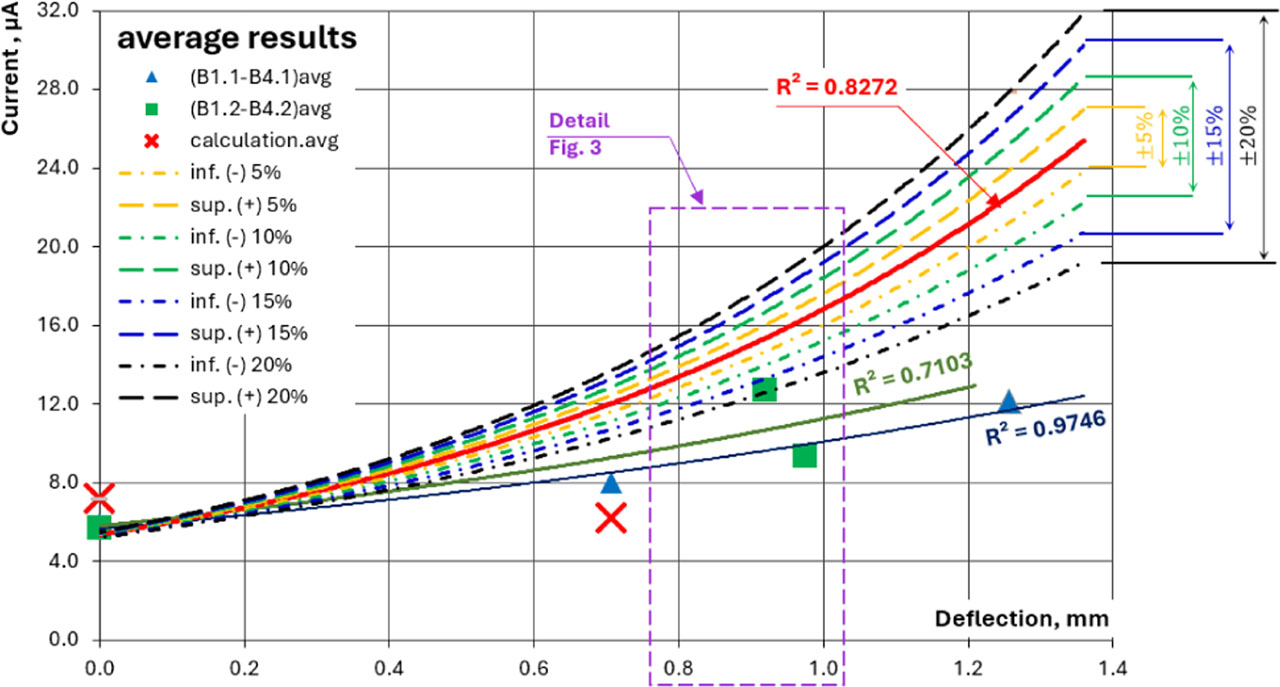
Figure 2:
Calculation results of the corrosion current intensity waveform considering the uncertainty of the model parameters
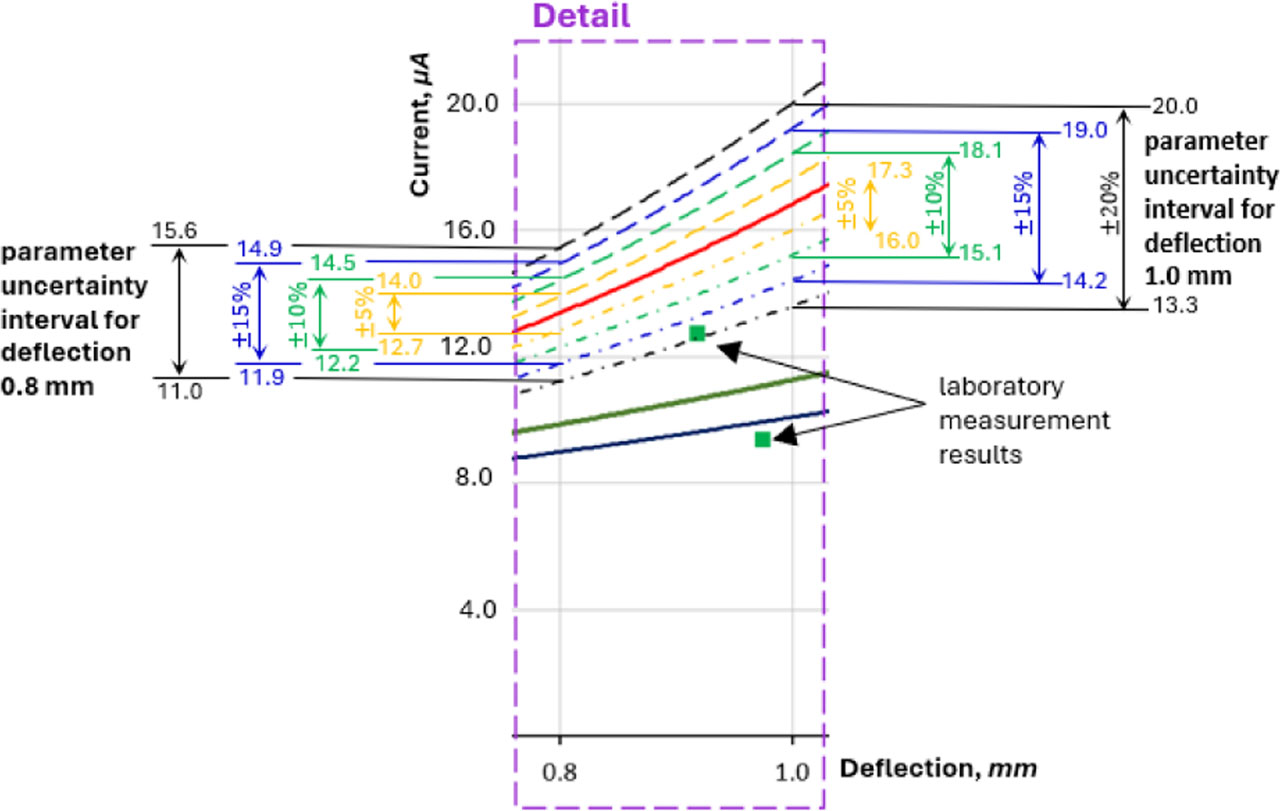
Figure 3:
Detail of determining corrosion current intensity ranges considering the uncertainty of model parameters
Nomenclature: (B1.1-B4.1)avg; (B1.2-B4.2)avg - average value of corrosion current intensity obtained from samples B1.1-B1.2; B1.2-B4.2 respectively, according to the work (Recha, Raczkiewicz, et al., 2025), calculation.avg - average value according to deterministic calculations in accordance with the proposed model, inf.(−); sup.(+) - upper and lower limits with marked percentage spread, respectively.
The detailed graph (Figure 3) shows how corrosion current levels can be estimated based on changes in component deflection while considering the percentage dispersion of model parameters. Using the example presented, the obtained results can be analysed assuming that the component deflected by 0.2 mm within a range of 0.8 to 1.0 mm. After relating the deflection limits to the trend lines describing the calculated quantities, estimated corrosion current ranges can be determined for individual uncertainties. For the described case, the corrosion current ranges for uncertainties of 5, 10, 15, and 20%, respectively, will take the following forms:
The increments for individual uncertainty cases are calculated by considering the extremes: minimum and maximum, which can occur. The lower and upper limits of the increment are determined as follows:
where:Icorr(t=0)−, Icorr(t=0)+ - the lower (−) and upper (+) limits of the calculated corrosion current intensity in the initial situation of time increase, for t = 0, respectively,
Icorr(t)−, Icorr(t)+ - the lower (−) and upper (+) limits of the calculated corrosion current after time t, respectively,
ΔIcorr(t)−, ΔIcorr(t)+ are the lower (−) and upper (+) limits of the possible increase in corrosion current intensity estimated based on the deflection increase.
For the analysed case, in the range of deflection increase from 0.8 to 1.0 mm, the increases in the corrosion current intensity level are as follows:
4. Discussion and Conclusion
This paper attempts to apply the Monte Carlo method to estimate the corrosion current intensity based on the deflections of a reinforced concrete element subject to reinforcement corrosion. A set of parameters was adopted that determine the decrease in element stiffness, with uncertainties of 5, 10, 15, and 20%. The results of the computational analysis using actual laboratory test results (Recha, Raczkiewicz, et al., 2025) allow for the formulation of the following results:
The proposed application of the Monte Carlo method is suitable for the analysis of structures subject to external environmental influences. Corrosion processes are subject to significant uncertainty, caused by the combined diffusion of aggressive agents, the influence of moisture, and ambient temperature. Additionally, the results of estimating the corrosion product using the proposed method are influenced by the accuracy of deformation measurements, rheological phenomena, and changes in the Young's modulus of the reinforcement. Described the complexity of external factors and the mechanism of the corrosion process are subject to significant uncertainties, making the proposed solution suitable for the described phenomena.
In the analysed calculation case, the 15% and 20% scatter are particularly important, as they include the actual results obtained during laboratory tests in (Recha, Raczkiewicz, et al., 2025) for the average value of the first measurement. On this basis, it can be concluded that the proposed method can be used to estimate the corrosion parameter with an accuracy of 15–20 %.
Previous analyses that took into account the uncertainty of model parameters were applied exclusively to the cracking of concrete cover (Krykowski, 2020a), (Recha, 2021), (Recha et al., 2023). Adapting the Monte Carlo method assumptions can also be successfully applied to the estimation of corrosion current intensity based on measured structural deformations.
The presented computational problem is part of a broader research project and is a continuation of the issues covered in the works (Recha, 2022), (Recha, 2023), (Recha, 2024), (Recha, Raczkiewicz, et al., 2025). The next element is the verification of the method considering uncertainty based on structural elements operating under actual operating conditions.
Notes
[2] Contributed by Author Contributions
Author critically reviewed and approved the final version of the manuscript and agreed to be accountable for all aspects of the work.