

1. Introduction
Construction schedule is a critical factor affecting the delivery time and cost control of civil engineering projects (Ajayi & Chinda, 2022). During construction, disruptive events such as natural disasters, on-site safety incidents, and material supply delays occur frequently (Milat et al., 2021), disrupting project plans, causing significant fluctuations in the critical path, and severely constraining construction efficiency and resource utilization (Yap et al., 2021). Consequently, developing schedule management methods with dynamic responsiveness has become a research priority to enhance project resilience (She et al., 2024).
Time-cost optimization methods, rooted in the critical path method (CPM), have seen widespread application in the construction sector for many years. However, CPM is typically based on fixed task durations and sequences, making it difficult to adapt flexibly under disruptive conditions (Hasan et al., 2024).
Early research established that task durations are subject to influential factors creating uncertainty that cascades through project schedules (Patanakul et al., 2010). With the evolution of schedule management research, the Critical Path Method (CPM) has emerged as a key tool in construction scheduling and has been widely developed and applied in recent years. For example, Calp and Akcayol (2018) demonstrated genetic algorithms for automated critical path identification in CPM/PERT networks (Calp & Akcayol, 2018). Nur Yaqin et al. (2023) employed a schedule acceleration method based on the CPM model to analyse cost variations resulting from adjusted project durations, by evaluating the impact of shortened task durations on the construction network. Kim (2020) proposed the extended Resource-Constrained CPM (eRCPM), which integrates multi-resource constraints into CPM and automatically identifies “resource-dependent links” using RCS outcomes, thereby enhancing scheduling reliability. Perrucci et al. (2025) applied CPM to post-disaster temporary housing production and allocation, highlighting the use of node-based critical path analysis to reduce project duration.
In summary, although CPM effectively identifies the logical sequence and critical paths of construction tasks, it faces several limitations when confronted with disruptive events: First, it assumes fixed task durations, lacking a mechanism to respond to disturbances (Fu et al., 2012); Second, it focuses solely on individual task paths and cannot capture the synergistic effects of multiple task combinations under disturbances; Third, it struggles to simultaneously evaluate the dynamic trade-offs between schedule and cost under volatile resource pricing conditions . The aim of the construction teams is to be able to finish the project on time, and need to be more productive (Aldhamad et al., 2024).
To address these challenges, this paper proposes a construction schedule management model based on combinatorial thinking. Combinatorial thinking, originating from the field of operations research, focuses on identifying the most valuable combinations from a finite set of elements. In construction scheduling, each task node not only affects project objectives individually but also forms complex temporal and resource-based interdependencies with other tasks (Dytczak & Ginda, 2014). Combinatorial thinking enumerates, filters, and evaluates clusters of tasks to identify “combinatorial bottlenecks” in progress control under dynamic disturbance scenarios, thereby overcoming the linear limitations of single-path or single-task analyses and offering refined control strategies for nonlinear and complex networks (Xie et al., 2022). Figure 1 illustrates the simulated target response patterns under various multi-task interference scenarios. It demonstrates the potential differences that different task combinations may bring in terms of time arrangement and cost impact, thereby enabling the intuitive identification of highly sensitive clusters.
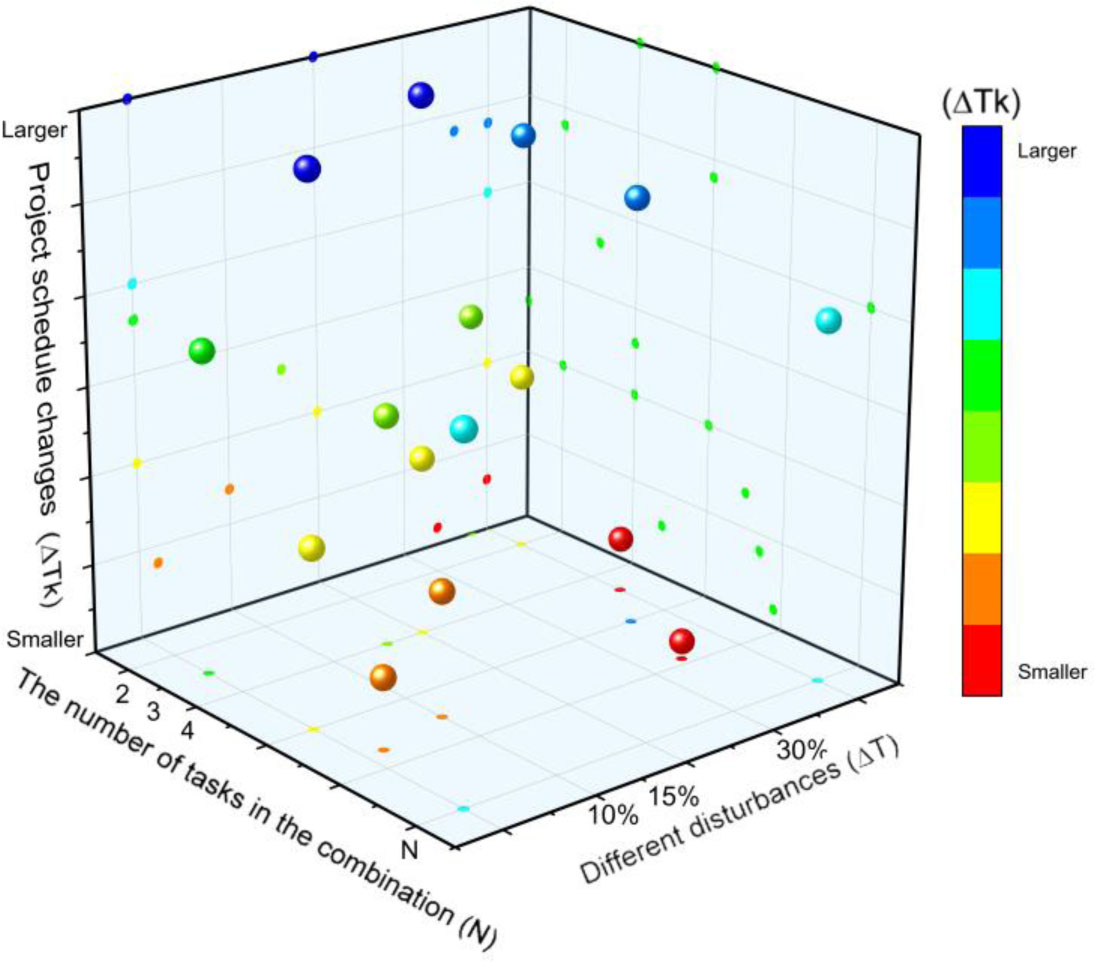
Figure 1:
The target response under multi-task perturbation is simulated with a scatter distribution
This study provides a proof-of-concept demonstration using a simulated case; generalizability and operational feasibility will be examined through subsequent empirical validation.
2. Methodology
Traditional Critical Path Method (CPM) techniques focus on single-path analysis, limiting their ability to assess collective task delays under uncertainty. To address this limitation, this study incorporates combinatorial thinking into project scheduling by analysing multi-task disturbance combinations. This enables more robust identification of critical task clusters under disruptive conditions.
The proposed methodology includes four key steps: defining core concepts, modelling the task network, evaluating sensitivity under disturbances, and simulating scenario-based responses. The following section begins with the explanation of key terms used throughout the model.
2.1. Definition of Key Concepts
To support the development of the proposed combinatorial sensitivity framework, this section defines the core terms and parameters used throughout the methodology.
Disturbance refers to any unexpected event that disrupts task execution during construction, such as delays, resource shortages, or schedule interruptions. In this study, disturbances are modelled as proportional extensions of task durations to reflect time-based uncertainty.
Disturbing Task Combination denotes a set of construction tasks that are simultaneously subjected to disturbance within a simulation scenario. Each combination represents all tasks affected under a given disturbance event, with the number of tasks in the set determined by the perturbation parameter.
Multi-task Perturbation describes a disturbance scenario in which multiple tasks within a selected combination are subjected to specified changes in duration. These changes can be uniform or task-specific, depending on the simulation design or the nature of disturbances observed in actual engineering projects.
Perturbation Parameter defines the number of tasks selected from the entire set of construction activities in the CPM-based network. Each combination represents one simulation unit in the sensitivity analysis.
These conceptual definitions ensure consistent terminology and provide the contextual background for the mathematical formulations presented in the following sections.
2.2. Matrix-Based Modelling Method for the Construction Network
To efficiently represent the logical dependencies among construction tasks, this study formalizes the Critical Path Method (CPM) network structure into a matrix-based model. Let the project consist of n construction tasks; two core matrices are constructed as follows:
The core of representing a construction schedule network via matrices lies in capturing the dependencies between activities (Maheswari & Varghese, 2005). This is commonly achieved using a task dependency matrix, denoted as D. Given n tasks, D is an n × n matrix where Dij indicates whether task i depends on task j. If task i must start only after task j is completed, then Dij= 1; otherwise, Dij = 0 (Uma Maheswari et al., 2006).
The matrix is represented as follows:
In construction projects, task durations determine execution length and influence inter-task dependencies as well as the overall project duration. The task duration matrix T is typically an n × 1 vector, where n is the total number of tasks in the project. Each element Ti in the matrix denotes the duration of task I (Ma et al., 2019).
The matrix is represented as:
Let ti denote the start time of task i, tj the start time of task j, and dj the duration of task j. Based on the above, the following scheduling constraint must be satisfied:
In construction schedule management, the cost constraint matrix C is used to represent the cost incurred by each task when consuming resources over specific time periods. Let n denote the total number of tasks, m the total number of resource types, and T the number of time periods. During task and resource allocation, the cost matrix C is an n × m matrix, where each element Cij represents the unit cost incurred by task i for utilizing resource j.
The matrix is represented as:
Assuming that task i is allocated resource j during time t, the incurred cost is calculated as:
To enable automatic identification and dynamic adjustment of the critical path, this study integrates the D, T and C matrices with an improved Floyd algorithm to accumulate path weights and trace the longest path, thereby accommodating path reconfiguration under disturbances (Ding et al., 2023). After the structured modelling of the task network is completed, the next step is to identify critical tasks and quantify their impact on the project timeline.
2.3. Combinatorial Sensitivity Assessment Method for Multiple Tasks
Based on combinatorial thinking, this study models multiple tasks as an integrated disturbance unit and develops a dual-index sensitivity framework—covering schedule and cost—to identify task clusters with significant influence on project objectives (Hammad et al., 2020). To quantitatively evaluate the impact of task-level disturbances on project objectives, two categories of sensitivity indicators are proposed in this study:
The Schedule Sensitivity Index (SSI) quantifies the extent to which a multi-task combination disturbance impacts the overall project duration.
Where:
ΔTₖ - the amount of change in the total duration of the project caused by the disturbance combination k [days],
T - original project duration before disturbance [days],
ΔTi - applied disturbance for task i [days],
Ti - original duration of task i [days],
k - task combination.
The Cost Sensitivity Index (CSI) reflects the joint impact of schedule disturbances on project cost and duration across multiple task combinations:
Where:
ΔCk - total cost increment caused by disturbing task combination k [CNY],
C - original total project cost [CNY],
wi - resource weighting factor of task i, defined as:
Where:Ci - unit cost per time of task i,
∑j∈Ck TjCj - the total resource cost of all tasks within the disturbed task combination k,
wi - represents the relative resource weight of task i, determined by its time-cost contribution within the combination.
To ensure consistent interpretation of the Schedule Sensitivity Index (SSI) and Cost Sensitivity Index (CSI), both indices are categorized into three levels-High, Medium, and Low-using the same classification method.
Specifically, a percentile-based segmentation approach is applied: all simulation results are sorted in ascending order for each index, and the 33.33rd percentile (P33) and 66.67th percentile (P66) are selected as threshold points to divide the results into three segments. To reduce the uncertainty in classification near the percentile threshold values, after obtaining the results, the original P33 and P66 boundary points were slightly adjusted according to the distribution density of adjacent data points. This smoothing processing method enhances the interpretability while retaining the classification framework based on percentile values.
This data-driven method allows the classification scheme to remain consistent in logic while flexibly adapting to the distributional characteristics of each index. The exact numerical ranges for each sensitivity level are presented in Section 3 based on the actual value distributions observed in the case study.
To further reveal the sensitivity of different resource types to project cost changes under multi-task disturbances, this study decomposes the cost increment of each task into subcomponents for each resource type and introduces corresponding resource weights. The Cost Sensitivity Index is thus formulated as follows:
where:m - the total number of resource types,
ΔCij - the cost increment of task i for resource type j after the disturbance,
λj - the weight assigned to resource type j (which can be determined based on its importance or volatility at different project stages).
2.4. Framework for Schedule-Cost Sensitivity Integration and Task Prioritization
By integrating schedule and cost sensitivity indices, this study introduces a CPM-based management model enhanced by combinatorial scanning. A parameterized task grouping algorithm is used to apply structured perturbations and evaluate dual-index responses across task combinations. The resulting sensitivity values serve as the basis for prioritization in schedule planning. The specific process is shown in the Figure 2.
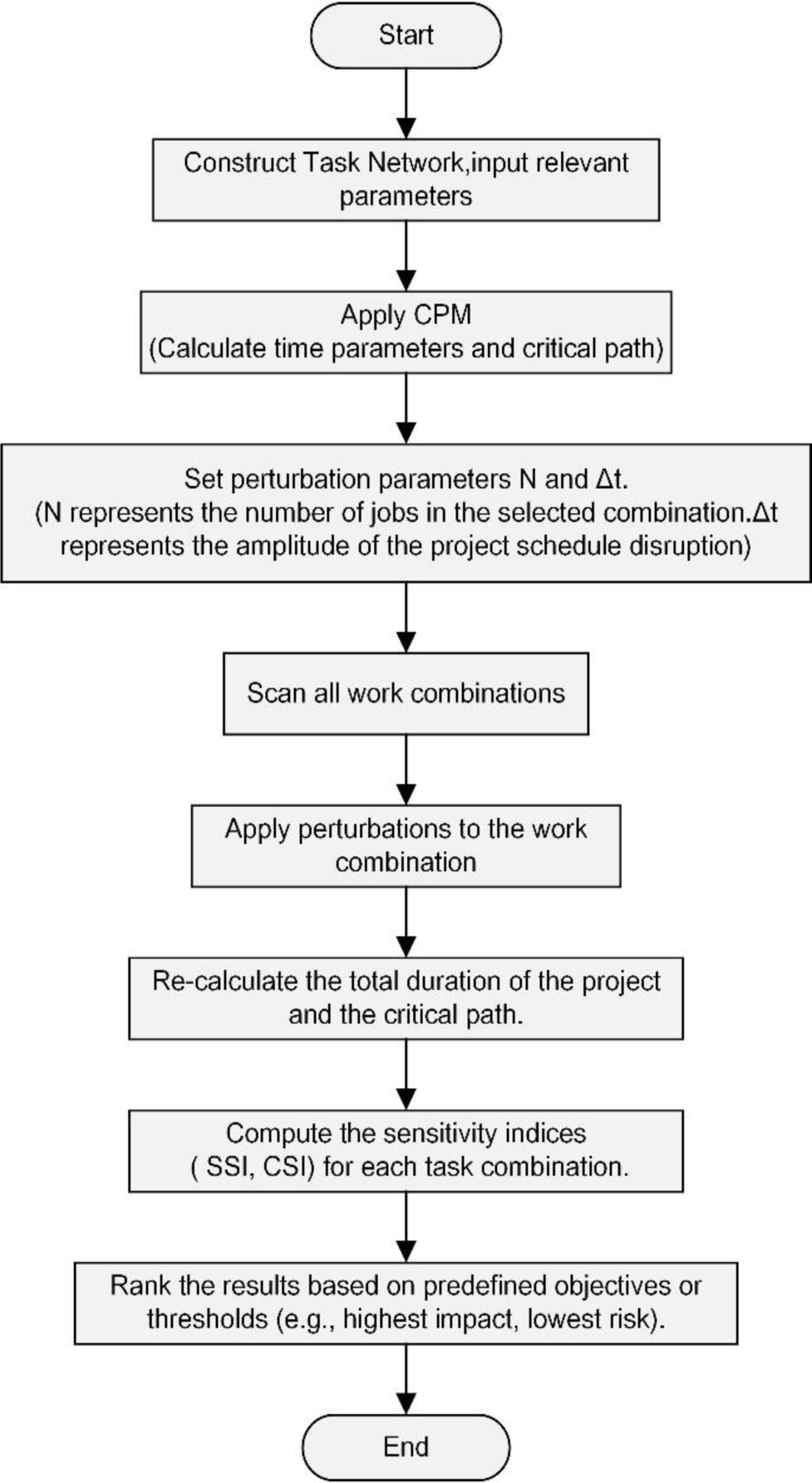
Figure 2:
Flowchart of schedule control using combinatorial scanning and dual-index sensitivity evaluation
The disturbance levels adopted in this study were primarily determined based on two considerations: (1) In real construction environments, external disruptions such as weather delays or resource constraints often affect multiple tasks simultaneously and with comparable impact; and (2) applying uniform disturbances across task combinations allows for comparative evaluation of their relative schedule and cost sensitivities, thus helping to identify structurally vulnerable task groups.
As shown in Table 1, the improved model based on combinatorial thinking surpasses the traditional CPM in task analysis granularity, responsiveness to disturbances, and resource optimization.
Table 1:
Comparative analysis between the traditional CPM and the improved model based on combinatorial thinking
| Comparison dimension | Traditional critical path method (CPM) | Improved model (Combinatorial thinking) |
|---|---|---|
| Analysis unit | Single task, single path | Multi-task combinations |
| Disturbance handling | No support for disturbance simulation | Simulates various combinations and disturbance scenarios |
| Resource & cost evaluation | Considers only time-related factors | Evaluates both schedule and cost sensitivity |
| Schedule adaptability under disruptions | Passive adjustment with manual intervention | Proactive optimization via early identification of high-sensitivity combinations |
3. Case Study and Simulation Analysis
To validate the practicality and effectiveness of the proposed combinatorial thinking-based improvement to the Critical Path Method, a case study was conducted on a bridge engineering through task combination disturbance simulation experiments. The sensitivity levels of task combinations were systematically evaluated from both schedule and cost perspectives and differentiated scheduling recommendations were developed accordingly.
3.1. Project Background and Critical Path Identification
The case project involves a bridge engineering, from which the primary construction workflow was extracted to generate a construction task network diagram (Figure 3) and a detailed task schedule (Table 2). Based on construction logic, the task dependency matrix D and the task duration vector T were established. An improved Floyd algorithm was then applied to identify the critical path.
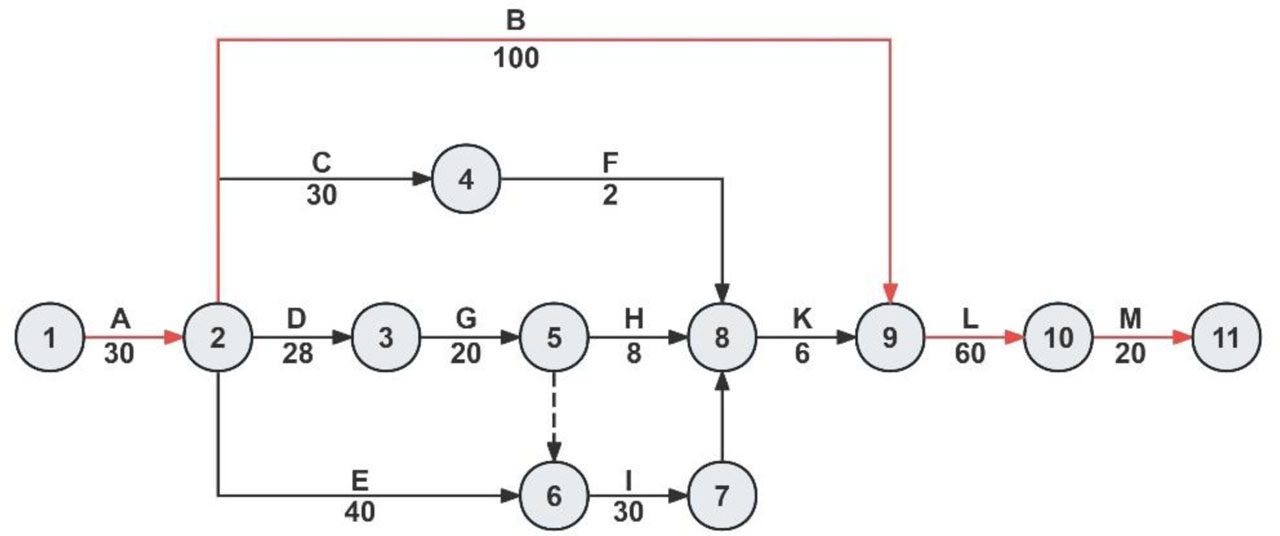
Figure 3:
Construction double code arrow diagram
Table 2:
Process details.
| Cost per unit time [CNY/day] | Duration | Activity | Process |
|---|---|---|---|
| 4500 | 30 | A | Construction preparation |
| 4000 | 100 | B | Pavement |
| 6500 | 30 | C | Prefabricated beam |
| 6500 | 28 | D | South bridge platform Foundation South bridge platform Foundation |
| 5000 | 40 | E | North bridge pier foundation |
| 7000 | 2 | F | Transport beam |
| 7000 | 20 | G | South bridge terrace |
| 3000 | 8 | H | Backfill soil of the southern bridge platform |
| 3000 | 30 | I | North bridge platform |
| 5000 | 10 | J | Backfill soil of the northern bridge platform |
| 4000 | 15 | K | Bridge erection |
| 2000 | 60 | L | Road surface |
| 1000 | 20 | M | Completion of work |
The results indicate that the critical path of the project is A→B→L→M, with an original total duration of 210 days; tasks on the critical path play a decisive role in schedule control.
3.2. Simulation Analysis of Schedule Sensitivity
A parameterized scenario simulation approach was adopted, and based on Pareto analysis, N = 4 tasks were selected to cover key nodes on the critical path. A complete enumeration method was employed to generate all possible task combinations. Perturbations of 10% and 20% were applied to each combination, and the total project duration was recalculated to derive the corresponding Schedule Sensitivity Index (SSI). Table 5 presents the simulation results for a selection of representative task combinations.
These perturbation levels and uniform resource weights are adopted for simulation clarity and comparability; future studies will incorporate heterogeneous task-specific disturbances, stochastic duration/cost variations, and empirically calibrated resource weights.
3.2.1. Illustrative SSI Computation
This example demonstrates the calculation of the Schedule Sensitivity Index (SSI) for the task combination (B, C, G, J), with a simulated disturbance of ∆Ti = 21 days applied uniformly across all tasks.
Step 1: Sum Disturbance Ratios
The total task-level disturbance is:
Step 2: Apply SSI Formula
The project-level normalized delay is:
3.2.2. SSI Distribution and Schedule Risk Patterns
To distinguish the influence levels of different task combinations on schedule performance, the Schedule Sensitivity Index (SSI) is categorized based on percentile thresholds from the simulation dataset. The classification criteria are presented in Table 3.
Table 3:
Classification Criteria for Schedule Sensitivity Index (SSI)
| SSI (%) Range | Interpretation | Sensitivity level |
|---|---|---|
| SSI ≤2.30 | Limited impact on total schedule | Low |
| 2.30 < SSI <6.10 | Impact proportional to task delay | Medium |
| SSI ≥6.10 | Disproportionately large impact on project duration | High |
Table 4 classified all 715 task combinations under the two disturbance scenarios of 10% and 20% based on their "time sensitivity index" (SSI) values. Among them, 479 combinations were in the high sensitivity range (SSI ≥ 6.10%), 495 were classified as medium sensitivity, and the remaining 456 were classified as low sensitivity. As shown in Table 4, high-sensitivity combinations such as ADLM and BIJK demonstrate SSI values far exceeding the median, indicating a disproportionate schedule impact. Conversely, combinations like CEGF and CBGJ remain in the low-sensitivity range even under 20% disturbance, suggesting resilience to time-based disruptions.
Table 4:
Analysis of the duration impact on task combinations
| Impact scope | Duration impact | ||||
|---|---|---|---|---|---|
| Task | Duration variation | Schedule sensitivity index [%] | Sensitivity level | ||
| Multiple tasks (N=4) | 10% Change (21d) | (CEGF) | 223 | 0.48 | Low |
| (BCGJ) | 226 | 1.88 | Medium | ||
| (HIJK) | 289 | 5.51 | Medium | ||
| (ADLM) | 294 | 14.04 | High | ||
| 20% Change (42d) | (CBGF) | 247 | 0.71 | Low | |
| (DBGF) | 252 | 0.8 | Low | ||
| (BIJK) | 373 | 8.8 | High | ||
| (ADLM) | 378 | 14.04 | High | ||
3.3. Integrated Schedule-Cost Sensitivity Analysis (CSI Perspective)
Under resource constraints, schedule control often requires trade-offs with cost allocation. This study introduces the Cost Sensitivity Index (CSI) within a combinatorial thinking framework to quantify the joint schedule-cost impact caused by multi-task combination disturbances. For the case of N = 3, C = 1, 000, 000 a full enumeration approach was used to generate all task combinations. Schedule-cost perturbations were applied to each task combination, and the variations in bi-objective outcomes were analysed. The results are presented in Table 6.
3.3.1. Illustrative CSI Computation
This example illustrates the calculation of the Cost Sensitivity Index (CSI) for the task combination (C, H, I) under the same disturbance scenario.
Step 1: calculate the resource weights wi or each task:
Step 2: Compute Weighted Duration
The total resource-weighted task duration is:
Step 3: Apply CSI Formula
3.3.2. CSI Result Patterns and Combined Risk Evaluation
Based on the distribution of simulation results, the Cost Sensitivity Index (CSI) is categorized into three levels using percentile thresholds. Table 5 summarizes the classification criteria used to interpret the cost impact of task combinations under disturbance scenarios.
Table 5:
Data-driven classification criteria for cost sensitivity index (CSI)
| CSI Range | Interpretation | Sensitivity level |
|---|---|---|
| CSI ≤0.222 | Minimal impact on cost under disturbance | Low |
| 0. 222 < CSI < 0. 442 | Moderate cost sensitivity | Medium |
| CSI ≥0.442 | Significant cost variation; requires intervention | High |
As shown in Table 6, among the 286 evaluated three-task combinations, 95 exhibit high-cost sensitivity (CSI ≥ 0.442), 90 fall into the medium range, and 101 show low-cost sensitivity. Multi-task combinations show greater variation and higher risk. For example, combinations such as CEH, EGF, and DHI yield significantly higher CSI values, indicating these groupings are highly susceptible to cost overruns even when project duration changes are moderate.
Table 6:
Analysis of duration-Cost impact on task combinations
| Impact scope | Integrated duration-Cost impact | ||||||
|---|---|---|---|---|---|---|---|
| Duration variation | Task | Cost | CSI | Sensitivity level (CSI) | SSI [%] | Sensitivity level (SSI) | |
| 10% Change (21d) (N=3) | 223 | CEH | 336000 | 0.72 | High | 1.61 | Low |
| EGF | 430500 | 0.78 | High | 0.51 | Low | ||
| 226 | CHI | 262500 | 0.46 | High | 1.89 | Low | |
| BGF | 399000 | 0.76 | High | 0.65 | Low | ||
| 231 | DHI | 210000 | 0.83 | High | 2.45 | Medium | |
| AGF | 388500 | 1.39 | High | 0.82 | Low | ||
| 244 | EHM | 220500 | 0.16 | Low | 3.85 | Medium | |
| AEF | 378000 | 0.29 | Medium | 1.38 | Low | ||
| 247 | HIM | 147000 | 0.1 | Low | 4.03 | Medium | |
| BFJ | 357000 | 0.28 | Medium | 1.38 | Low | ||
| 252 | DHM | 168000 | 0.37 | Medium | 4.52 | Medium | |
| ADG | 325500 | 0.62 | High | 8 | High | ||
| 268 | ILM | 126000 | 0.1 | Low | 13.15 | High | |
| ABJ | 304500 | 0.17 | Low | 9.18 | High | ||
| 273 | DLM | 147000 | 0.21 | Low | 13.95 | High | |
| ADL | 220500 | 0.27 | Medium | 16.67 | High | ||
As shown in Table 6, among the 286 evaluated three-task combinations, 95 exhibit high-cost sensitivity (CSI ≥ 0.442), 90 fall into the medium range, and 101 show low-cost sensitivity. Multi-task combinations show greater variation and higher risk. For example, combinations such as CEH, EGF, and DHI yield significantly higher CSI values, indicating these groupings are highly susceptible to cost overruns even when project duration changes are moderate.
3.4. Sensitivity-Based Scheduling Recommendations
Based on the classification results of the Schedule Sensitivity Index (SSI) and Cost Sensitivity Index (CSI) in sections 3.2 and 3.3, the following scheduling recommendations are proposed for different management priorities under the simulated disturbance scenarios. These recommendations are derived from controlled simulation conditions with uniform disturbance levels and resource weights and should be interpreted within the scope of these assumptions:
(1) For schedule-driven scenarios: Priority should be given to task combinations with high Schedule Sensitivity Index (SSI), such as ADLM and BIJK. These combinations have the greatest potential to delay project completion under disruptions and thus require proactive management and resource protection. Recommended actions include allocating schedule buffers, securing critical resources in advance, and monitoring progress milestones for early warnings.
(2) For cost-constrained scenarios: Combinations with high-Cost Sensitivity Index (CSI)—such as AGF and EGF— should be closely monitored and managed, even if they do not significantly affect the overall schedule. Early intervention is essential to avoid disproportionate cost escalation.
(3) For combinations with both high SSI and high CSI—such as ADG and DHI— adopt integrated strategies that combine schedule protection with cost control, such as phased resource allocation and contingency planning. Combinations with low SSI and CSI values (e.g., AEF, EHM) can be used for flexible resource reallocation to support higher-risk tasks without compromising key objectives.
4. Discussion
This study proposes a combinatorial thinking-based dual-index sensitivity model to support construction schedule management under disruptive conditions. The simulation results show that not all tasks on the critical path exhibit the highest sensitivity; for example, the combination BIJK, which lies partially outside the critical path, causes substantial project delays. This highlights a key insight: traditional single-path or single-task analysis may overlook critical vulnerabilities embedded in multi-task interactions.
The introduction of the Schedule Sensitivity Index (SSI) and Cost Sensitivity Index (CSI) offers a structured framework to quantify the schedule and cost impacts of task combinations. This dual-index approach enables project managers to prioritize high-risk clusters and to balance control efforts between schedule-critical and cost-sensitive tasks. To enhance reproducibility, this study formalizes key terms and provides detailed walkthroughs of representative calculations.
Despite its advantages, the model has several limitations. It assumes fixed disturbance levels and uniform resource weights, which may not reflect the variability of real-world projects. This case study is based on simulation and aims to conduct controlled verification of the core mechanisms of the model under clearly defined conditions. Future research should extend the framework to real construction projects, enabling comparison between predicted and actual outcomes, and testing adaptability under diverse disturbance patterns and resource constraints. Such empirical validation will be essential to assess the robustness, scalability, and practical feasibility of the approach, as well as to benchmark it against CPM and RCPSP models.
5. Conclusion
This study develops a combinatorial thinking–based dual-index sensitivity framework that integrates matrix-based CPM modelling with exhaustive disturbance scanning, enabling joint evaluation of schedule and cost risks for multi-task disruptions.
Results from the simulated case confirm that schedule–cost impacts are highly combination-dependent, and that high-risk task groups are not necessarily confined to the critical path. This insight provides a more nuanced basis for buffer allocation, resource prioritization, and disruption-resilient planning.
The framework’s applicability is currently limited by fixed disturbance levels, uniform resource weights, and simulation-based validation. Future work should incorporate stochastic and resource-constrained conditions, validate with empirical project data, and explore integration with adaptive scheduling tools such as BIM-based platforms.
Acknowledgements
This work was supported by the 2024 Qinghai “Kunlun Talents·High-End Innovation and Entrepreneurship Talent” Project (QHKLYC-GDCXCY-2024-102), the 2025 Basic Research Plan Project in Qinghai Province (2025-ZJ-712), the Graduate Innovation Project of Qinghai Minzu University (66M2024025), and the 2023 University-Level Planning Project of Qinghai Minzu University (23GH10).
Notes
[3] Contributed by Author Contributions
J.C. designed the study and drafted the manuscript. Z.M. provided useful discussions and insights, while other authors contributed to data interpretation and literature collation. All authors critically revised the manuscript and approved the final version. The manuscript has been revised, and all authors agree to take full responsibility for the entire research work.