
INTRODUCTION
Intercropping has long been integral to traditional farming systems across rain-fed agricultural regions worldwide. It is notably characterised by crop diversification, manifested through various crop combinations across spatial and temporal dimensions. This practice stems from the inherent vulnerability of subsistence farming systems to the vagaries of nature and the diverse needs of farming households (Asfaw et al., 2021). Smallholder farmers, seeking to achieve multiple production objectives simultaneously, habitually adopt intercropping as an agro-ecological strategy to sustainably intensify crop production on limited landholdings. For instance, cultivation of different crops on the same land ensure security against the potential risks of total crop failure associated with monoculture, promotes adequate ground cover thus minimizing evaporative water losses from soil (especially with prevailing climatic variability) and ecological weed control; while enhancing productivity per unit land due to efficient use of growth resources (Huss et al., 2022; Megersa, Banjaw, 2024). Therefore, in recent decades, research has focused on adapting improved crop varieties to intercropping systems to enhance adoption by farmers. This farming system effort has been deployed for kenaf (Hibiscus cannabinus L.) production in Nigeria.
Kenaf (Hibiscus cannabinus L.), a rapidly growing annual crop with prolific biomass yield, has garnered significant research and industrial interest for its stem components (An et al., 2017; Yang et al., 2025). The bast fibre found in kenaf bark is a biodegradable and eco-friendly material with versatile applications in the textile, cordage, biocomposite, and civil engineering industries (Solahuddin, 2022; Shanar et al., 2022; Austin et al., 2024). The ligneous wood-like core in the inner part of the kenaf stem can be used as biosorbent materials in oil spillage and as bedding substrates for domesticated animals (Siwayanan et al., 2019; Yang et al., 2025). Additionally, its potential for paper and pulp production has been ascertained (An et al., 2017; Jasmani, Ainun, 2023), presenting an enhanced opportunity for environment conservation and reduced deforestation. As an efficient photosynthetic plant, kenaf also contributes to carbon sequestration and reduction of carbon prints, outperforming the carbon dioxide absorption capacity of trees by 4 to 5 times (An et al., 2017; Adole et al., 2019). Kenaf biomass is also a source of livestock feed (Yang et al., 2025) and a raw material for producing biogas for power generation (Austin et al., 2024; Muhammad et al., 2025). Despite its numerous economic and environmental benefits, kenaf cultivation in Nigeria has been limited by low adoption rates among farmers (Atta et al., 2023). This is partly attributable to farmers’ prioritisation of food security over industrial crops such as kenaf. Consequently, the farmers’ primary interest in staple food crops presents an opportunity to introduce kenaf through intercropping with widely grown staples like maize (Zea mays).
Maize and humans have shared a long history of domestication and agricultural development dating back to ancient times (Ajala et al., 2017). Maize is also a dominant component of intercropping systems in many developing countries, where it plays a vital role in smallholder farming systems (Adeniyan, 2016). According to Sasu (2023), maize holds a pivotal position in the Nigerian farming system, with approximately 50% of the nation’s farming households engaged in its cultivation. This prominence can be attributed to its diverse uses, broad environmental adaptability, and the ease and low cost of its production (Sanodiya et al., 2023; Biswas et al., 2025). Integrating kenaf into existing maize-based intercropping systems could leverage the established cultivation practices of maize to shift farmers’ perceptions about kenaf, increase its popularity among maize producers, enhance income diversity, and revitalise national kenaf production, while simultaneously addressing food security concerns. However, in Nigeria, only a few research efforts in this regard have been documented in the literature.
Kuchinda and Ogunwole (2000) examined suitable sowing dates and spatial row arrangements for kenaf-maize under intercropping in the Northern Guinea Savannah of Nigeria. Investigating productivity outcomes of a kenaf–maize intercrop combined with African yam bean, Adeniyan et al. (2007) and Saka et al. (2007) reported higher productivity for the intercrops than the monocultures. Eruola et al. (2014) found that rainfall in southwestern Nigeria provides sufficient water to support the kenaf–maize intercropping system. Following a study on the cropping system, Amujoyegbe et al. (2016) recommended early-season sowing with row arrangements of 1:2 and 2:2 (maize to kenaf). Notably, Adeniyan (2016) reported that kenaf is well adapted to relay cropping with maize in a cassava–maize intercrop system; either as the first component crop in the early season, which favours bast fibre production, or as the second in the late season, which is ideal for optimal seed production. Kassim et al. (2019) using an agro-climatic feasibility approach, assessed the suitability of Nigeria’s forest–savannah transition agroecology zone for kenaf–maize intercropping and concluded that the region is suitable for the cropping system.
Population pressure is a fundamental feature of inter-cropping systems, resulting from biological interactions among component crops growing in close proximity on the same piece of land. The simultaneous demand for growth resources highlights the inherent intra- or inter-specific competition within such systems, which critically influences crop performance and productivity relative to monoculture (Ajala et al., 2017). According to Egbe (2010) and Amujoyegbe et al. (2016), the intensity of competition is influenced by the proximity of component crops, which reflects the sowing spacing. Specifically, Agbaje et al. (2011) and Mollah et al. (2015) reported significant influence of spacing on kenaf seed yield and quality, while Reta-Sanchez et al. (2015) observed notable variations in kenaf forage potential under different row spacings. In addition, Masnira et al. (2019) recorded significant varietal and spacing effects on kenaf growth and bast fibre production, validating the earlier assertion of Paridah et al. (2017) on the significant effect of varietal difference on kenaf growth. To date, three improved kenaf varieties ARTKEN 211, IFEKEN 400 and IFEKEN DI 400 developed and released by the Institute of Agricultural Research and Training, Ibadan, Nigeria, have no documented inter-cropping history. Moreover, no study have evaluated the performance of these elite varieties under different spacing when intercropped with maize. This study was therefore conducted to address these knowledge gaps.
MATERIALS AND METHODS
The two-season field study was conducted at the experimental site of the Institute of Agricultural Research and Training, Obafemi Awolowo University, Moor Plantation, Ibadan in 2023 and 2024 under rainfed condition. Weather information of the experimental site during the study is presented in Table 1. The land at the site was ploughed, harrowed and partitioned into plots of dimension 3 m × 3 m. Subsequently, seeds of the improved kenaf varieties ARTKEN 211, IFEKEN 400 and IFEKEN DI 400, were sown using constant inter-row spacing of 0.50 m and two different intra-row dimension of 0.15 m and 0.25 m. Simultaneously, seeds of maize variety BR9928DMRSY-Y were sown in intercrop with the kenaf varieties at a spacing of 0.50 m × 0.75 m. Kenaf and maize were also sown as sole crops in delineated plots. The study was a 3×2×2 factorial experiment fitted into a randomised complete block design with three replications. The factors were: (i) Variety (ARTKEN 211, IFEKEN 400 and IFEKEN DI 400) (ii) Cropping system (sole and intercrop) and (iii) intrarow plant spacing (0.15 m and 0.25 m). Weeding was done when due. In the maize-kenaf intercropping system, a basal application of 250 kg/ha of NPK 15:15:15 fertilizer was done at 4 WAS while maize received a top-dressing of 136 kg/ha of urea at 7 WAS. Fortnightly from four (4) weeks after sowing (WAS), data were collected on plant height, stem diameter and number of leaves of both crops; and leaf area of maize till 10 WAS. For kenaf a vernier caliper was employed to measure stem diameter at 5 cm above the soil surface while stem diameter of maize was measured by placing a Vernier caliper around the stem at the midpoint of the first internode above the adventitious roots.
Table 1.
Weather information of the study area during the study (July-December).
| Parameters | 2023 | 2024 |
|---|---|---|
| Mean maximum temperature [ºC] | 31.4 | 31.5 |
| Mean minimum temperature [ºC] | 23.5 | 3.0 |
| Mean precipitation [mm/day] | 3.6 | 2.9 |
| Mean relative humidity [%] | 81.7 | 77.6 |
| Total precipitation [mm] | 582.0 | 509.5 |
[i] Source: https://www.visualcrossing.com
Selective harvesting of six non-border kenaf plants was done at ten (10) WAS by cutting the stems 20 cm above ground level. The stems were retted in water for fourteen (14) days to facilitate easy separation of the bast fibre from the core. Subsequently, the bast fibre and core obtained were washed in clean water, air dried and weighted. After drying of matured capsules on plants, data were collected on the number of capsules per plant and the number of seeds per capsule from another 6 kenaf plants within a plot, while seed yield in ton per hectare (t/ha) was estimated. In addition, data on maize yield in t/ha and weight of 100 seeds (kg) were collected after harvesting five maize plants per plot at 12 WAS.
All data were subjected to analysis of variance using SAS (version 9.0). The significant means were separated using Least Significant Difference (LSD) and Duncan Multiple Range Test (DMRT) as appropriate at 5% probability level.
RESULTS
Significant variety, spacing and cropping system effects were observed for plant height and stem diameter (Table 2). Spacing also had significant influence on number of seeds per capsule, bast fibre and core yield (Table 2). Similarly, seasonal variation was significant for all evaluated agronomic trait except number of leaves and bast fibre yield (Table 2). The interaction variety × season and cropping system × spacing effects were significant for only plant height while spacing × season significantly influenced plant height, number of leaves, seed yield and number of capsules per plant (Table 2). In addition, the effect of the interaction of variety × cropping system × spacing on the number of capsules per plant was significant (Table 2). Core yield and bast fibre yield were not significantly influenced by any interaction effect (Table 2). On the average, ARTKEN 211 had the highest plant height and stem diameter which differed statistically from stem dimensions recorded for IFEKEN 400 (Table 3). The number of leaves of the kenaf were statistically at par but IFEKEN DI 400 had the greatest quantity (42.27) while IFEKEN 400 had the least (38.12).
Table 2.
Mean square values from the analysis of variance for growth and yield parameters of kenaf varieties intercropped with maize under two spacing dimensions in two seasons.
| Sources of variation | Degree of freedom | Plant height | Stem diameter | Number of leaves | Number of seeds/capsule | Seed yield | Number of capsules/plant | Core yield | Bast fibre yield |
|---|---|---|---|---|---|---|---|---|---|
| Variety (V) | 2 | 621.87** | 0.40** | 491.67 ns | 2.52 ns | 1.88 ns | 70.29 ns | 0.16 ns | 0.53 ns |
| Cropping system (CS) | 1 | 1817.96*** | 0.42** | 157.04 ns | 9.50 ns | 0.46 ns | 78.13 ns | 0.87 ns | 0.87 ns |
| Season (S) | 1 | 4303.21*** | 3.63*** | 296.06 ns | 244.02*** | 106.95*** | 3396.25*** | 99.55*** | 0.18 ns |
| Spacing (SP) | 1 | 500.20* | 0.48** | 1042.72 ns | 81.06** | 0.47 ns | 14.67 ns | 36.11*** | 7.54** |
| V × CS | 2 | 37.97 ns | 0.10 ns | 17.23 ns | 0.92 ns | 4.46 ns | 43.16 ns | 0.50 ns | 0.71 ns |
| V × S | 2 | 482.69* | 0.01 ns | 747.27 ns | 1.62 ns | 1.58 ns | 85.68 ns | 0.01 ns | 1.35 ns |
| V × SP | 2 | 2.23 ns | 0.04 ns | 142.27 ns | 7.42 ns | 2.54 ns | 3.67 ns | 1.01 ns | 1.37 ns |
| CS × S | 1 | 302.20 ns | 0.15 ns | 370.52 ns | 1.76 ns | 0.08 ns | 39.01 ns | 0.60 ns | 0.67 ns |
| CS × SP | 1 | 835.21** | 0.03 ns | 126.23 ns | 31.67 ns | 0.94 ns | 105.13 ns | 1.96 ns | 0.24 ns |
| S × SP | 1 | 3158.47*** | 0.11 ns | 3222.26** | 0.01 ns | 11.12* | 243.84* | 17.61 ns | 0.15 ns |
| V × CS × S | 2 | 51.29 ns | 0.02 ns | 90.48 ns | 14.19 ns | 5.66 ns | 119.21 ns | 1.49 ns | 1.48 ns |
| V × CS × SP | 2 | 37.95 ns | 0.01 ns | 375.40 ns | 0.12 ns | 1.69 ns | 73.26* | 2.70 ns | 2.16 ns |
| V × S × SP | 2 | 13.61 ns | 0.05 ns | 210.87 ns | 2.97 ns | 2.67 ns | 32.67 ns | 0.42 ns | 0.80 ns |
| CS × S × SP | 1 | 84.34 ns | 0.08 ns | 36.13 ns | 0.002 ns | 0.53 ns | 70.01 ns | 0.68 ns | 0.89 ns |
The numerical variation in yield components of the kenaf varieties were not significant, though variety IFEKEN DI 400 had the highest seed and bast fibre yield; while ARTKEN 211 had the greatest core yield (Table 3). Notably, the lowest stem components yield (core and bast) were obtained from IFEKEN 400, while ARTKEN 211 had the least seed yield. Irrespective of the growth and yield parameter, significantly higher values were recorded in the first season relative to the second with the exception of significantly broader stem and higher core yield in the second season; and statistically identical number of leaves and bast fibre in both season (Table 3). The inter-cropped kenaf were statistically at par with sole kenaf for all evaluated traits except plant height and stem diameter (Table 3). Meanwhile, kenaf in mixed plots with maize were taller, had wider stem, produced higher foliage and greater quantity of capsules per plant, and had higher seed and bast fibre yield than those in pure stands. Using the spacing dimension of 0.50 m × 0.15 m for sowing kenaf resulted to significantly higher plant height, stem diameter, number of seeds per capsule, bast and core fibre yield (Table 3). The numerically superior seed yield and number of capsules per plant recorded from kenaf sown using 0.50 m × 0.25 m were significantly comparable to values obtained from 0.50 m × 0.15 m spacing dimension for these traits (Table 3).
Table 3.
Effect of season, variety, cropping system and spacing on growth, yield and yield components of three kenaf (Hibiscus cannabinus L.) varieties intercropped with maize at two spacing dimensions in two seasons.
| Treatments | Plant height [cm] | Number of leaves | Stem diameter [cm] | Number of capsules/plant | Number of seeds/capsule | Seed yield [t/ha] | Core yield [t/ha] | Bast fibre yield [t/ha] |
|---|---|---|---|---|---|---|---|---|
| average over 4–10 WAS# | at 10 WAS | |||||||
| Kenaf varieties | ||||||||
| ARTKEN 211 | 50.158 a | 41.764 a | 0.853 a | 22.729 a | 17.817 a | 1.815 a | 2.229 a | 0.812 a |
| IFEKEN 400 | 45.090 b | 38.124 a | 0.723 b | 22.271 a | 18.073 a | 1.961 a | 2.077 a | 0.744 a |
| IFEKEN DI 400 | 48.041 a | 42.273 a | 0.787 a | 25.438 a | 17.429 a | 2.355 a | 2.100 a | 1.028 a |
| Season | ||||||||
| First | 51.628 a | 41.734 a | 0.675 b | 30.347 a | 19.614 a | 3.262 a | 0.959 b | 0.811 a |
| Second | 43.897 b | 39.706 a | 0.900 a | 16.611 b | 15.932 b | 0.825 b | 3.311 a | 0.912 a |
| Cropping system | ||||||||
| Sole | 45.250 b | 39.981 a | 0.749 b | 22.438 a | 18.136 a | 1.963 a | 2.245 a | 0.777 a |
| Intercrop | 50.275 a | 41.458 a | 0.826 a | 24.521 a | 17.410 a | 2.123 a | 2.025 a | 0.947 a |
| Spacing | ||||||||
| 0.50 m × 0.15 m | 49.081 a | 42.623 a | 0.828 a | 23.028 a | 18.838 a | 1.963 a | 2.843 a | 1.185 a |
| 0.50 m × 0.25 m | 46.445 b | 38.817 a | 0.747 b | 23.931 a | 16.708 b | 2.124 a | 1.427 b | 0.538 b |
Across the plant sampling ages, increase in stem dimensions was observed with upsurge in plant ages (Figures 1–4). Variety ARTKEN 211 sown using dimension of 0.50 m × 0.15 m had the highest plant height at each plant age of evaluation and compared favourably with only ARTKEN 211 at 0.50 m × 0.25 m and IFEKEN DI 400 sown using 0.50 m × 0.15 m at 6 and 8 weeks after sowing (WAS); IFEKEN DI 400 at 0.50 m × 0.25 m at 8 WAS; all varieties under the two spacing dimensions at 10 WAS except ARTKEN 211 and IFEKEN 400 under 0.50 m × 0.25 m (Figure 1). Similarly, stem diameter of ARTKEN 211 at 0.50 m × 0.15 m were broadest from 4 to 8 WAS and differed statistically from stem diameter of ARTKEN 211 sown using 0.50 m × 0.25 m at 4 WAS, IFEKEN 400 under 0.50 m × 0.25 m from 4 to 8 WAS and IFEKEN DI 400 under 0.50 m × 0.25 m at 8 WAS (Figure 2). From the result summarized in Figures 3 and 4, ARTKEN 211 intercropped with maize had the highest plant height and stem diameter across the sampling stages which varied significantly from stem dimensions of other varieties and cropping system combination except height of intercropped IFEKEN DI 400 at 8 and 10 WAS, sole ARTKEN 211 at 10 WAS; and stem diameter of sole ARTKEN 211, and IFEKEN DI 400 under both cropping systems at 4 WAS.
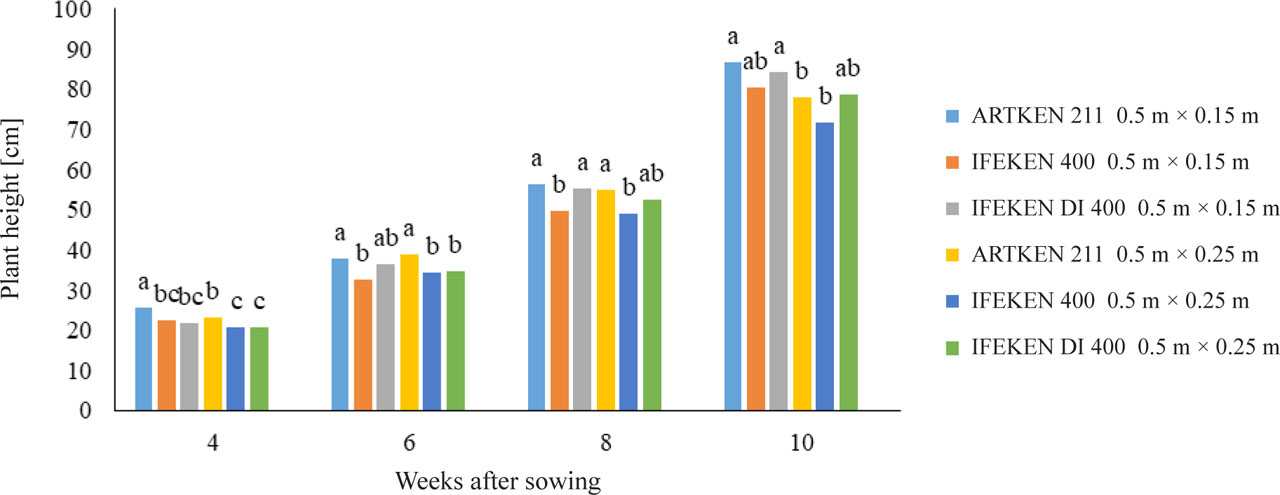
Figure 1.
Plant height of three kenaf (Hibiscus cannabinus L.) varieties at different plant ages as influenced by spacing of sowing.
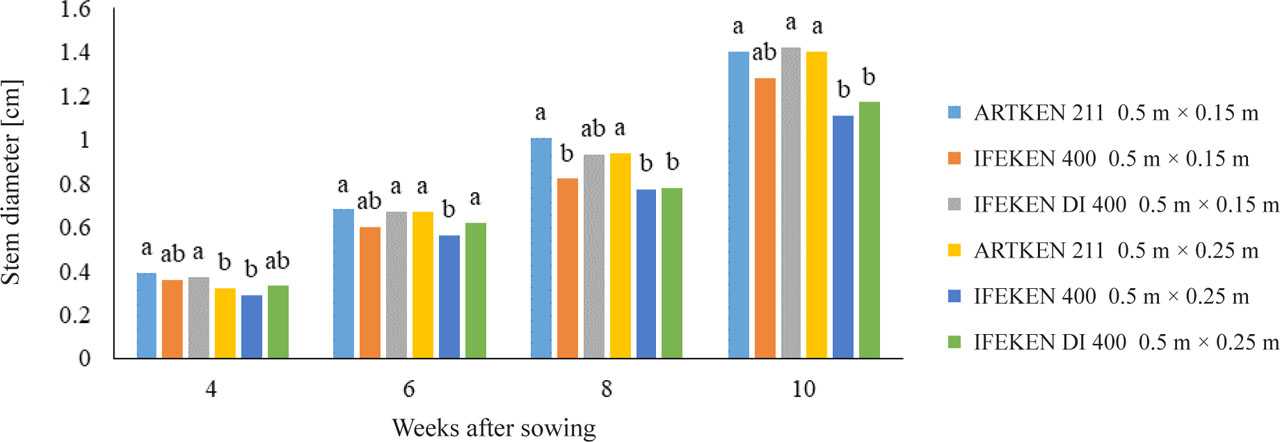
Figure 2.
Stem diameter of three kenaf (Hibiscus cannabinus L.) varieties at different plant ages as influenced by spacing of sowing.
Cropping system, season and spacing had no significant effect on maize performance except for the observed significant season effect for plant height, number of leaves and grain yield; and spacing effect for plant height (Table 4). The interaction between cropping system and season; and cropping system and spacing were significant for only number of leaves.
Table 4.
Mean square values from the analysis of variance for growth and yield components of maize intercropped with three kenaf varieties under two spacing in two seasons.
| Sources of variation | Degree of freedom | Plant height | Stem diameter | Number of leaves | Leaf area | Grain yield | 100-seed weight |
|---|---|---|---|---|---|---|---|
| Cropping system (CS) | 3 | 177.81 ns | 0.12 ns | 0.12 ns | 9243.86 ns | 0.52 ns | 0.001 ns |
| Season (S) | 1 | 14763.36*** | 0.09 ns | 8.83*** | 1952.52 ns | 7.04*** | 0.001 ns |
| Spacing (SP) | 2 | 823.85* | 0.02 ns | 1.78 ns | 14662.04 ns | 0.18 ns | 0.006* |
| CS × S | 3 | 109.07 ns | 0.36 ns | 2.67** | 10453.80 ns | 0.84 ns | 0.001 ns |
| CS × SP | 3 | 108.09 ns | 0.31 ns | 2.59** | 7703.12 ns | 0.21 ns | 0.004 ns |
| SP× S | 1 | 3740.18*** | 0.58 ns | 6.44** | 66852.76*** | 0.24 ns | 0.002 ns |
| CS × SP× S | 3 | 386.31 ns | 0.21 ns | 0.58 ns | 38549.98 ns | 0.22 ns | 0.000 ns |
Meanwhile, all evaluated maize growth and yield traits (except stem diameter, grain yield and 100-seed weight) were significantly influenced by interaction of spacing and season (Table 4). Conversely, the numerical variation in growth and yield parameters across the cropping systems were not significant (Table 5).
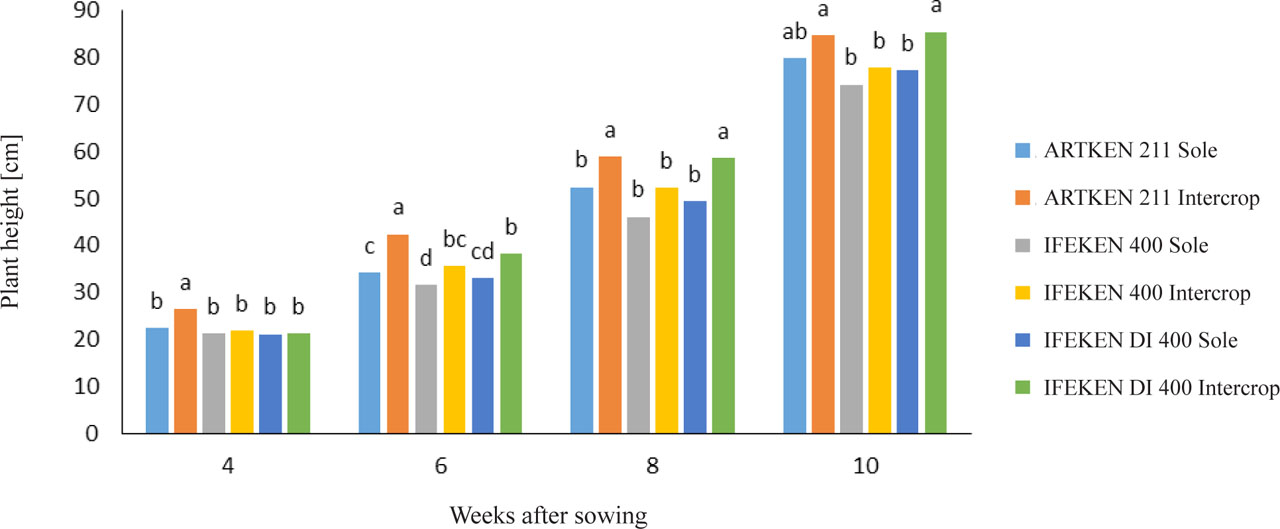
Figure 3.
Plant height of three kenaf (Hibiscus cannabinus L.) varieties at different plant ages as influenced by cropping system.
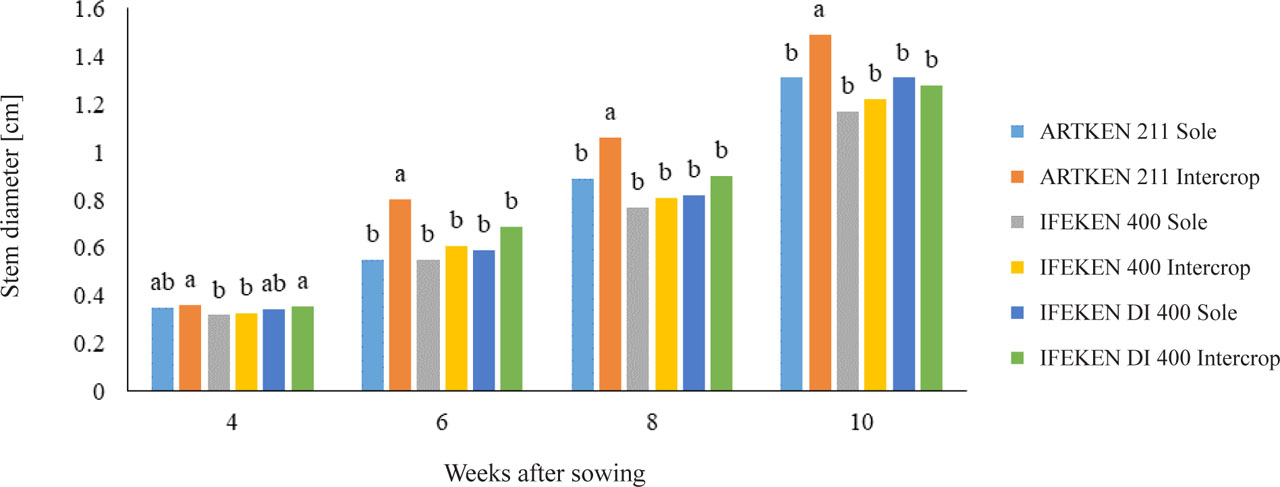
Figure 4.
Stem diameter of three kenaf (Hibiscus cannabinus L) varieties at different plant ages as influenced by cropping system.
Table 5.
Growth (across different plant ages) and yield of maize as influenced by the cropping system.
| Cropping systems | Plant height [cm] | Number of leaves | ||||||
|---|---|---|---|---|---|---|---|---|
| 4 WAS | 6 WAS | 8 WAS | 10 WAS | 4 WAS | 6 WAS | 8 WAS | 10 WAS | |
| Sole | 25.43 a | 55.19 a | 81.33 a | 108.48 a | 6.42 a | 7.47 a | 9.81 a | 10.63 a |
| Maize + ARTKEN 211 | 25.28 a | 51.52 a | 80.73 a | 112.71 a | 6.08 a | 7.61 a | 9.92 a | 10.83 a |
| Maize + IFEKEN 400 | 26.47 a | 53.96 a | 83.37 a | 121.84 a | 6.28 a | 7.33 a | 9.83 a | 10.56 a |
| Maize + IFEKEN 400 DI | 27.06 a | 54.19 a | 78.94 a | 120.63 a | 6.4 a | 7.34 a | 9.76 a | 10.75 a |
| Leaf area [cm2] | Stem diameter [cm] | |||||||
| 4 WAS | 6 WAS | 8 WAS | 10 WAS | 4 WAS | 6 WAS | 8 WAS | 10 WAS | |
| Sole | 55.10 a | 232.26 a | 349.59 a | 435.36 a | 0.61 a | 1.22 a | 1.37 a | 1.97 a |
| Maize + ARTKEN 211 | 50.72 a | 186.90 a | 316.45 a | 466.77 a | 0.51 a | 1.21 a | 1.37 a | 1.63 a |
| Maize + IFEKEN 400 | 45.51 a | 198.35 a | 310.68 a | 406.11 a | 0.54 a | 1.19 a | 1.37 a | 1.64 a |
| Maize + IFEKEN 400 DI | 52.94 a | 187.20 a | 310.66 a | 403.91 a | 0.57 a | 1.23 a | 1.42 a | 1.63 a |
| Grain yield [t/ha] | 100-seed weight [kg] | |||||||
| 12 WAS | 12 WAS | |||||||
| Sole | 1.11 a | 0.014 a | ||||||
| Maize + ARTKEN 211 | 1.25 a | 0.012 a | ||||||
| Maize + IFEKEN 400 | 1.40 a | 0.013 a | ||||||
| Maize + IFEKEN 400 DI | 1.60 a | 0.013 a | ||||||
Table 6.
Mean effect of seasonal and spacing variation on growth and yield of maize intercropped with kenaf under two spacing in two seasons.
| Sources of variation | Plant height [cm] | Number of leaves | Leaf area [cm2] | Stem diameter [cm] | Grain yield [t/ha] | 100-seed weight [kg] |
|---|---|---|---|---|---|---|
| average over 4–10 WAS | at 12 WAS | |||||
| Spacing | ||||||
| 50 cm × 15 cm | 67.124 b | 8.472 a | 241.79 a | 1.226 a | 1.402 a | 0.014 a |
| 50 cm × 25 cm | 71.267 a | 8.665 a | 259.27 a | 1.208 a | 1.278 a | 0.012 b |
| Season | ||||||
| First | 77.965 a | 8.354 b | 247.34 a | 1.239 a | 0.957 b | 0.014 a |
| Second | 60.427 b | 8.783 a | 253.72 a | 1.195 a | 1.723 a | 0.013 a |
Plant height, leaf area and number of leaves of maize in the wider kenaf spacing (0.50 m × 0.25 m) were higher than values observed for similar maize traits in the narrower kenaf spacing (0.50 m × 0.15 m) though, only significantly different for plant height (Table 6). In contrast, numerically greater maize stem diameter and grain yield, and significantly higher 100-seed weight were obtained from the closer kenaf spacing. Higher stem dimensions (plant height and stem diameter) were observed in the first season while the leaf parameters (number of leaves and leaf area) and grain yield were greater in the second seasons (Table 6).
DISCUSSION
The low production potential of kenaf among food crop farmers necessitates the application of farming system research strategies to facilitate its integration into existing cropping systems. The significant effects of variety, spacing, cropping system and season on the kenaf stem dimensions indicate that the stem elongation and thickness varied with changes in these factors. This highlight the influence of the genetic make-up of the kenaf varieties and environmental factors during the growth period on the kenaf stem height and diameter. This finding underscores the importance of varietal selection and optimisation of agronomic conditions in enhancing kenaf stem height and diameter. In contrast, number of leaves was not significantly affected by any of the factors suggesting that although foliage quantity varied numerically across sampling stages, it did not differ statistically with respect to variety, cropping system, season, or spacing. This reveals a possible stability in this kenaf trait, irrespective of genetic or environmental factors, and suggests that the observed numerical differences were likely due to chance. This finding corroborates the recent observation of Muhammad et al. (2025), who reported a non-significant varietal effect on the number of kenaf leaves despite statistically significant differences in plant height among the varieties. Kenaf is a resilient crop with broad adaptability to diverse environments; however, its agronomic performance remains highly responsive to prevailing environmental conditions (Debnath et al., 2022; Al-Mamun et al., 2023; Yang et al., 2025). This responsiveness is evident in the significant effect of season on all agronomic parameters, except number of leaves and bast fibre yield. These findings highlight the sensitivity of kenaf’s growth and yield traits to seasonal variations in weather conditions during the cropping period. Meanwhile, the statistically identical bast fibre yield suggests that the environmental conditions in the two seasons favoured bast fibre production to the same extent. The observation of higher stem elongation, foliage production, capsules and seeds traits in the first season could be linked to more clement weather condition in this season. Al-Mamun et al. (2023) reiterated that taller kenaf plants blooms earlier. This reason might have been responsible for the production of more capsules and seeds during the kenaf crop cycle in the first cropping season. However, the earlier blooming and flowering in this first season resulted in less carbon assimilation and biomass accumulation which was evident in lower bast fibre and core yield as well as stem diameter (as both yield components are inherent in the stem) in this season. This outcome is possibly due to the translocation of photosynthate to reproductive organs during flowering at the detriment of the vegetative parts of the plant.
The continuous process of cell division and enlargement in kenaf during its growth period accounts for the increased stem elongation, stem thickness, and the number and size of leaves as the plants age advanced (Lastdrager et al., 2014). The observation that ARTKEN 211, when sown at narrower spacing and intercropped with maize, exhibited superior stem elongation and thickness reflects its strong genetic potential to utilise moderate competition for enhanced stem development. This performance also highlights its adaptability and compatibility with maize in a mixed cropping system. Malik et al. (2023) earlier reported a positive correlation between kenaf plant height and fibre length. Thus, the considerable height observed in ARTKEN 211 suggests its potential to produce longer fibres, which are desirable for industrial applications. The kenaf plant heights recorded in the study also fall within the range reported by Muhammad et al. (2025) for kenaf. The significantly similar bast and core yields among the three kenaf varieties indicate comparable accumulation of these stem components, corroborating the findings of Kassim et al. (2019) in another kenaf-maize intercropping study. Nonetheless, the numerically highest core yield recorded for ARTKEN 211 highlights its superior potential as a raw material for paper and pulp production. Kenaf’s productivity is estimated to be 300–400% higher than that of traditional forest sources, due to its rapid growth cycle and substantial height (An et al., 2017). This attribute makes it a viable alternative that supports environmental conservation and contributes to carbon footprint reduction by mitigating deforestation. Moreover, record of highest bast fibre yield from IFEKEN DI 400 might be linked to it greatest foliage production (which could have enhanced assimilate production) and superior efficient assimilate partitioning to the bast. In contrast, the lowest core and bast fibre yield from IFEKEN 400 might not be unconnected to it least growth (stem dimensions and foliage production) which could have constrained photosynthetic activities and assimilate production for subsequent translocation to the yield components.
Kenaf has a deep tap root (Vayabari et al., 2023) while maize possesses a fibrous shallow root system (Adjei, Sarkodie-Addo, 2021). The relatively superior performance of kenaf under maize intercropping compared to sole cropping may be attributed to complementary root architectures of the two species, which promoted more efficient uptake of soil nutrients and moisture, thereby reducing below-ground competition (Kassim et al., 2019). Additionally, Eruola et al. (2014) reported that intercropping improves water use efficiency in maize–kenaf systems compared to sole stands, which is especially important given kenaf’s high water demand. Moreover, the maize canopy could have also helped to moderate soil temperature and reduce evaporation losses, creating a favourable microclimate that supports kenaf growth. The observed taller plants in the intercrops could also result from shade avoidance adaptive mechanism developed by the kenaf to escape shading by the maize canopy, which led to elongation of stems in an attempt to capture light. Earlier, Ziblim et al., (2016), established a positive relationship between plant height and number of leaves of kenaf. Hence, the enhanced light interception of the taller plants in the intercrops and in tandem improved photosynthetic activities, could have been responsible for higher foliage production observed in this mixed cropping system. Moreover, the higher bast fibre yield from the intercropping system could also be linked to the longer and wider stems of kenaf under this system. However, the greater core yield from kenaf in pure stands could be due to absence of interspecific competition from companion crop which reduce assimilate partitioning for stem elongation and strengthening but enhanced carbon accumulation. Notably, intercropping remains the preferred cropping system of most small-scale farmers, who serve as the primary custodians of crop diversity conservation, a key component of agroecology. The benefits of intercropping are substantial, and range from food security, income diversification, to multiple ecological services such as improved resource use efficiency, water conservation, soil fertility, biodiversity, and microclimatic regulation.
The significant influence of sowing spacing on kenaf stem elongation and width, core and bast fibre yields and number of seeds per capsule highlights the effect of plant population density on these agronomic traits. Cultivating at higher densities (narrower spacing) increases intraspecific competition, activating growth hormone pathways and promoting early development, vertical growth, and biomass accumulation (Shimizu et al., 2007). This practice might have been responsible for the better agronomic performance of kenaf spaced at 0.15 m × 0.50 m apart, except number of capsules per plant and seed yield. This result corroborates the earlier finding of Shimizu et al. (2007) from a separate study who reported higher stem dimensions and bast fibre yield from narrower spacing with higher plant population density relative to lower density. Conversely, wider spacing (0.25 m × 0.50 m) may weaken growth signal intensity, slowing growth and reducing yield per area while encouraging greater branching. This branching likely contributed to the numerically higher capsule count and seed yield observed under wider spacing, although these differences were not statistically significant. Accordingly, the numerical differences appear to be due to chance, indicating that narrower spacing can achieve comparable seed and capsule outcomes.
The statistically comparable growth and yield of maize in sole and kenaf intercropping systems highlights the high adaptability and compatibility of the crop with kenaf while suggesting that its agronomic performance was not hampered by the presence of kenaf. This finding offers a strong basis for promoting kenaf among maize farmers, considering maize remains one of the world’s most widely cultivated cereal crops (Asfaw et al., 2024). Syeda et al. (2017) reiterated that maize cultivation leads among staple food crops due to its multifaceted uses for food, livestock feed, and industrial raw materials. Integrating kenaf into well-established maize farming systems can therefore optimize production resources, diversify farmers’ income, enhance livelihoods, and improve ground cover for environmental conservation. This strategy ultimately supports the scaling up of kenaf. Meanwhile, the observation of numerically higher maize plant height and lower stem diameter from maize in mixture with kenaf relative to pure stands can be attributed to etiolation, a morphological response to shading in which plants elongate their stems to capture more light. This often result in thinner stems due to altered carbon partitioning under low light intensity. Such trend have been earlier documented in literature on maize in mixed cropping systems (Fu et al., 2023; Zhang et al., 2023).
In narrower spacing, kenaf plants were closer, forming a denser canopy, which can reduce sunlight and maize photosynthesis. Conversely, wider kenaf spacing (0.25 m × 0.50 m) enhanced light interception, resource availability and spatial complementarity for maize, providing the crop with more horizontal and vertical space to grow. This culminated in the observed significantly better plant height and numerically greater leaf area and number of leaves of maize in plots where kenaf was spaced by 0.25 m × 0.50 m apart relative to those sown using 0.15 m × 0.50 m. Maize is a moisture-sensitive crop (Aslam et al., 2015) and water availability significantly affects cell elongation, nutrient transport and photosynthetic activities, which are crucial for height development. Increased rainfall during the first season therefore promoted taller plants by improving water availability for cell expansion and nutrient uptake. This finding affirms the earlier documentation in literature of a significant increase in maize height with higher rainfall and better soil moisture availability compared to drier conditions (Adeniyan, Ojeniyi, 2005). The significantly higher grain yield in the second season could be linked to higher foliage production and leaf area in this season which enhanced photosynthetic activities and ultimately improved yield.
CONCLUSION
The findings of this study demonstrates that the three kenaf varieties are adapted to intercropping with maize with comparable yield outcomes for both crops. Kenaf variety ARTKEN 211 had superior plant height and core yield which can support the extraction of longer fibres and greater core for versatile industrial applications. IFEKEN DI 400 however produced the highest bast fibre and seed yield, with its intercropping system accounting for the highest maize grain yield. Meanwhile, the lowest kenaf growth, core and bast fibre yield were obtained from IFEKEN 400. Enhanced kenaf growth, bast fibre and core yield; grain yield and 100-seed weight of maize were observed from narrower spacing dimension (0.15 m × 0.50 m), while wider spacing improved kenaf number of capsules per plant and seed yield. Similarly, intercropping enhanced kenaf growth, seed and bast fibre yield; and maize grain yield while sole cropping improved core yield and 100-seeds weight of maize. The optimum planting pattern is dependent on the farmers’ production goal. The kenaf-maize intercropping system is however recommended to maize farmers for enhance productivity, income and crop diversification, and improve livelihood. Although adoption of maize-kenaf intercropping systems involving any of the three kenaf varieties is encouraged because of their similar yield potentials, intercropping of maize with IFEKEN DI 400 will maximize kenaf bast fibre, seed yield and maize grain yield, while maize mixed cropping system involving ARTKEN 211 can optimize stem elongation (and in tandem longer fibre) and core yield production. Future studies should focus on the evaluation of the effect of the cropping system on weed, pest control and soil properties.