

1. Introduction
The evolution of competitive sport has consistently reflected a pursuit of marginal advantages derived from advances in science, technology, and organizational practice. From early applications of performance metrics to contemporary analytics platforms, technological innovation has served as both a catalyst and a constraint, shaping how teams train, compete, and manage uncertainty (Zhou et al., 2025; Li et al., 2025; Welch & Burrell, 2025). In recent years, artificial intelligence (AI) has emerged as a particularly influential development, extending beyond traditional statistical analysis to encompass image recognition, automated pattern detection, and predictive modeling. These capabilities have significantly expanded the analytical horizon of sports science, coaching, and fan engagement, enabling insights that were previously inaccessible through human observation alone (Zhou et al., 2025; Li et al., 2025).
However, the growing prominence of AI in sports cannot be understood independently of the broader economic and organizational context in which it is deployed. Escalating financial commitments, driven by NIL agreements in collegiate athletics, exponential growth in professional player salaries, and the intensification of broadcast and streaming markets, have increased both the risks and rewards associated with competitive decision-making (Lewis, 2023). In this environment, organizational leaders are under pressure to justify technological investments not merely on the basis of innovation, but on their alignment with strategic goals, cultural values, and long-term sustainability. AI-powered image recognition, while often promoted as a revolutionary tool, therefore raises critical questions about purpose, integration, and governance that extend well beyond its technical performance (Medium, 2024).
2. Problem Statement
Despite widespread enthusiasm for AI adoption in sports organizations, significant challenges persist that stem from misalignment between technological capability and organizational readiness. A central problem is that AI-powered image recognition systems are frequently introduced as standalone innovations rather than as components of broader sociotechnical systems. While these technologies promise enhanced precision in performance evaluation and tactical analysis, their effectiveness is constrained by issues of model transferability, data bias, and contextual validity. For instance, machine learning models trained within one sport or competitive context often struggle to generalize across others, exposing limitations in how training data reflects the diversity of movement patterns, tactical structures, and environmental conditions found in real-world competition (White, 2022; Medium, 2024).
Equally problematic are the cultural and ethical tensions that accompany AI integration. Biases embedded in training datasets can reinforce inequities, while the expanded collection of biometric and performance data raises acute privacy concerns for athletes and staff (Welch & Burrell, 2025). These issues are compounded when AI systems disrupt established hierarchies and challenge intuition-based coaching traditions, generating resistance among practitioners who perceive data-driven insights as threats to professional autonomy. Without careful attention to organizational culture, incentives, and trust, the introduction of AI risks fragmenting decision-making processes rather than enhancing them. Thus, the core challenge facing sports organizations is not simply how to implement AI, but how to integrate it in ways that are ethically responsible, interoperable with existing systems, and aligned with human workflows and institutional norms.
3. Purpose Statement
The purpose of this paper is to critically examine the integration of AI-powered image recognition technologies within sports organizations through the lens of organizational alignment and sociotechnical design. Rather than evaluating AI solely in terms of technical sophistication, this inquiry emphasizes how such technologies reshape leadership decision-making, organizational culture, and interprofessional collaboration. By focusing on image recognition systems, the paper explores how AI alters the distribution of authority between coaches, analysts, and data scientists, and how these shifts necessitate new competencies and governance structures within sports organizations (Medium, 2024).
In addition, this paper seeks to assess how principles of interoperability, scalability, and user-centered design influence the sustainability of AI adoption. Technologies that fail to integrate seamlessly with existing data infrastructures or that impose excessive cognitive and operational burdens on users are unlikely to achieve lasting impact, regardless of their analytical power. Drawing on interdisciplinary scholarship and applied examples, such as AI-enabled shot analytics in professional basketball and film analysis in football, this paper aims to bridge theoretical insight and practical application. Ultimately, the study aspires to inform leaders, technologists, and scholars about how AI can be deployed not as an end in itself, but as a purpose-driven tool that complements human expertise and strengthens organizational cohesion.
4. Significance of the Inquiry and Nature of the Study
There is very limited research on this topic. The significance of examining AI integration in sports extends well beyond the boundaries of athletic competition, offering broader insights into how organizations navigate digital transformation under conditions of high visibility and high stakes. Sports organizations manage substantial financial investments, safeguard athlete well-being, and operate within intensely scrutinized public environments, making them a revealing context for studying the interaction between technology, leadership, and culture. The financial implications of NIL agreements, expanding player contracts, and global media rights have heightened the demand for technologies that promise efficiency and strategic clarity, yet these same pressures amplify the consequences of poor technological alignment or governance (Medium, 2024).
By foregrounding the human and organizational dimensions of AI adoption, this inquiry contributes to a more nuanced understanding of technological change. Image recognition systems do not merely generate data; they reshape how knowledge is produced, how authority is negotiated, and how trust is maintained within organizations. Moreover, because sports often function as a cultural microcosm, lessons drawn from AI integration in this domain have relevance for other sectors confronting similar challenges of interoperability, scalability, and ethical responsibility. The significance of this research therefore lies in its potential to reframe AI not as a disruptive force to be managed reactively, but as a sociotechnical system whose value depends on deliberate alignment with organizational purpose, user needs, and long-term sustainability.
The nature of this study is qualitative and exploratory, designed to examine how artificial intelligence (AI) technologies are conceptualized, integrated, and governed within sports-related contexts through the perspectives of experienced AI professionals. Rather than evaluating the technical performance of AI systems, the study focuses on understanding how meaning, value, and effectiveness are constructed at the intersection of technology, organizational purpose, and human judgment. This approach reflects the study’s underlying assumption that the impacts of AI are not technologically determined but are instead shaped by sociotechnical conditions, institutional norms, and user experiences.
5. Al-Powered Image Recognition as a Purpose-Driven System
AI-powered image recognition represents a foundational pillar of contemporary sports analytics, distinguished by its capacity to transform complex visual environments into structured, actionable data. These systems rely on machine learning models trained on extensive repositories of sport-specific imagery to detect objects, classify events, and infer probabilistic outcomes from both live and archived footage (Medium, 2024). Through object detection and pattern recognition, AI can isolate athletes, ball trajectories, spatial boundaries, and officiating signals with increasing precision, enabling the identification of nuanced events such as tactical formations, turnovers, or rule infractions. However, the strategic value of these capabilities is not inherent in their technical sophistication alone. Their effectiveness depends on deliberate alignment with organizational purpose, whether performance optimization, officiating accuracy, media enhancement, or fan engagement, rather than the pursuit of technological novelty for its own sake.
This shift from manual video analysis to automated image recognition marks a profound reconfiguration of how knowledge is produced and consumed within sports organizations. Traditional film study relied heavily on human interpretation, subjective judgment, and labor-intensive review processes, which constrained both scale and consistency. AI-driven automation mitigates these limitations by enabling rapid, standardized analysis across entire seasons or competitions. In basketball, for example, the ability to track micro-adjustments in player positioning and movement provides coaches with insights into defensive spacing, shooting mechanics, and off-ball behavior that were previously difficult to quantify (White, 2022). Yet these gains must be understood within a sociotechnical framework: the value of AI emerges from its integration into existing workflows, incentive structures, and decision hierarchies. Without careful attention to ethical data use, model limitations, and the preservation of the sport’s human dimensions, image recognition technologies risk undermining trust and distorting leadership decision-making (Haley & Burrell, 2025; Haley, 2025).
6. Enhancing Player Performance through User-Centered Analytics
Among the most compelling applications of AI-driven image recognition is its role in advancing individualized athlete development. Systems such as NOAH Basketball exemplify how high-resolution cameras and proprietary software can generate real-time biomechanical feedback, capturing metrics such as arc height, entry angle, and shot depth for each athlete (White, 2022). By distinguishing individual players, often through facial recognition, and aggregating data across tens of thousands of training repetitions, these platforms create dynamic performance profiles that support precision coaching. Importantly, the success of such systems is closely tied to user-centered design principles. Athletes and coaches are more likely to adopt and trust analytics when insights are presented in intuitive, actionable formats that complement, rather than complicate, established training routines.
The implications of this granular feedback extend beyond skill refinement to encompass injury prevention and long-term athlete sustainability. Subtle deviations in movement patterns, undetectable to the human eye, may signal emerging fatigue or biomechanical stress, allowing for early intervention before acute injury occurs. From an organizational perspective, this capacity aligns technological deployment with broader goals of athlete welfare and performance longevity. Nevertheless, these benefits introduce complex ethical considerations related to data ownership, consent, and surveillance. When athlete performance is rendered into continuous streams of biometric data, questions arise regarding who controls that information, how it may be repurposed, and whether algorithmic assessments risk reducing human performance to decontextualized numerical outputs. Thus, the enhancement of player performance through AI must be governed by frameworks that balance analytical rigor with respect for autonomy and privacy.
7. Game Film Evaluation and Interoperable Decision-Making in Football
In football, Al-enabled image recognition has fundamentally altered the analytical landscape of game film evaluation by converting video into interoperable datasets that support systematic inquiry into offensive and defensive behavior. Through computer vision, AI systems can automatically identify formations, personnel groupings, alignments, motion, and ball movement across every snap of a game or season, ensuring analytical consistency that is difficult to achieve through manual review (Welch & Burrell, 2025). This automation addresses longstanding constraints of time and subjectivity, providing coaches with a comprehensive evidentiary base for opponent analysis rather than reliance on selective or anecdotal observations.
Building on this structured foundation, machine learning models excel at identifying offensive tendencies by modeling situational probabilities. Run-pass likelihoods, route concept frequencies, and play-calling preferences under high-leverage conditions such as third down or red-zone scenarios can be quantified with precision. These insights are particularly valuable given football’s situational complexity, where strategic behavior shifts dramatically based on field position, score differential, and time constraints. By grounding preparation in empirically derived tendencies, defensive coordinators can develop responses that reflect how opponents actually behave, not merely how they are expected to behave in theory (Welch & Burrell, 2025).
Defensively, AI enhances interpretive clarity by distinguishing between pre-snap appearance and post-snap intent. Tracking player movement before and after the snap allows systems to differentiate coverage shells from true coverage responsibilities, identify blitz patterns, and assess the frequency and effectiveness of disguise. This capability is especially salient in modern defensive schemes that rely on deception as a core strategic principle. At the individual level, AI-driven analysis reveals consistent behavioral patterns, such as reaction speed, leverage tendencies, or susceptibility to play-action, that support matchup-specific game planning. Rather than treating players as interchangeable components within a scheme, AI enables a more nuanced understanding of how individual behaviors shape collective outcomes.
Ultimately, the value of AI in football film analysis lies in its capacity to synthesize vast quantities of data into decision-support systems that amplify, rather than replace, coaching expertise. Predictive models estimate the likelihood of specific plays, pressures, or coverages, while visual dashboards translate analytical outputs into coach-friendly formats. When aligned with organizational purpose and integrated thoughtfully into coaching workflows, AI allows practitioners to devote less time to data extraction and more time to strategic reasoning, preparation, and adaptive decision-making (Welch & Burrell, 2025).
8. Tactical Intelligence
Beyond retrospective analysis, AI’s ability to process visual data in near real time is reshaping tactical intelligence and in-game decision-making. By rapidly analyzing opponent formations, spatial configurations, and emergent patterns, AI systems can provide coaches with timely insights that inform substitutions, tactical adjustments, and strategic pivots (Medium, 2024). This capacity reduces reliance on post-game evaluation and introduces a dynamic feedback loop that supports responsive coaching under competitive pressure.
However, the effectiveness of real-time AI analytics depends on careful consideration of cognitive load and decision authority. While immediate access to insights can enhance adaptability, excessive or poorly designed information streams risk overwhelming coaches or fostering overreliance on algorithmic recommendations. Sustainable integration therefore requires user-centered interfaces that prioritize clarity, relevance, and timing, ensuring that AI functions as an aid to human judgment rather than a competing source of authority. This balance is particularly critical in high-stakes contexts such as playoff competition, where the margin for error is minimal and the human dimensions of leadership, intuition, and communication remain decisive.
9. Scalable Content Ecosystems
AI-powered image recognition is also transforming the sports media ecosystem by enabling automated highlight generation and personalized content delivery. By detecting salient events through object tracking, crowd response, and contextual cues, AI systems can generate highlight packages within seconds of occurrence (Medium, 2024). These capabilities support scalable distribution models that cater to diverse fan preferences, allowing users to curate content based on favorite players, play types, or statistical milestones.
While such personalization enhances engagement and opens new monetization pathways for leagues and sponsors, it also reshapes how sports narratives are constructed and consumed. Fragmented, algorithmically curated content risks privileging spectacle over context, potentially eroding holistic appreciation of the game. From a sustainability perspective, organizations must therefore consider how AI-driven media strategies align with long-term brand identity, narrative integrity, and fan trust. Technological scalability must be matched by cultural and editorial stewardship to ensure that innovation enhances rather than dilutes the meaning of sport.
10. Facial Recognition, Governance, and Ethical Sustainability
Facial recognition technologies, when integrated with AI analytics, offer powerful capabilities for individualized performance tracking and operational efficiency, yet they simultaneously introduce profound ethical and governance challenges. In performance contexts, facial recognition enables precise attribution of data to individual athletes, supporting personalized feedback systems such as those employed in basketball training environments (White, 2022). Operationally, similar technologies facilitate stadium security, access control, and touchless ticketing, enhancing efficiency and safety.
Despite these benefits, facial recognition raises acute concerns regarding privacy, consent, bias, and misuse (Haley & Burrell, 2025; Haley, 2025). The risk of data breaches, unauthorized surveillance, or discriminatory outcomes, particularly given documented disparities in recognition accuracy across demographic groups, underscores the necessity of robust governance frameworks. Without transparent policies, regulatory oversight, and clear accountability structures, the deployment of facial recognition threatens to undermine trust among athletes and fans alike. Consequently, sustainable integration requires that ethical considerations be treated not as peripheral constraints, but as central design principles guiding the development, deployment, and management of AI technologies in sport.
11. Theoretical Perspectives on Artificial Intelligence in Sports
11.1. Technological Determinism
Technological determinism refers to the perspective that technological innovation is the primary driver of social, organizational, and cultural change, shaping human behavior, institutional structures, and decision-making processes in largely predictable ways (Nobles, 2015; Burrell et al., 2020; Burton et al, 2023). Within this view, technology is often treated as an autonomous force whose introduction inevitably produces transformation, regardless of human intent, context, or governance (Nobles, 2018; Burrell et al, 2018). In the context of AI integration in sports and other complex organizations, technological determinism manifests when advanced systems, such as image recognition or predictive analytics, are assumed to inherently improve performance, efficiency, or decision quality simply by virtue of their technical sophistication. This assumption overlooks the reality that technology does not operate independently; its impact is mediated by organizational goals, leadership choices, and the social environments in which it is embedded.
One key element of technological determinism evident in contemporary AI adoption is the tendency to privilege technical capability over alignment with purpose and sociotechnical fit. When organizations assume that more data, faster analytics, or automated decision-support systems will automatically yield better outcomes, they risk neglecting how technologies interact with existing workflows, professional norms, and power structures. As illustrated in AI-driven sports analytics, systems designed to identify tendencies or optimize performance only generate value when coaches, analysts, and athletes understand, trust, and meaningfully incorporate those insights into practice. Deterministic thinking obscures this dependency by implying that technology itself compels behavioral change, rather than recognizing that outcomes depend on human interpretation, incentive structures, and cultural acceptance (Nobles et al., 2022; Burton et al, 2023).
A second relevant element of technological determinism is its tendency to minimize ethical, usability, and sustainability considerations by framing technological progress as both inevitable and inherently beneficial (Nobles, 2015; Nobles, 2018). In such framings, concerns about privacy, bias, cognitive overload, or long-term maintenance are treated as secondary obstacles rather than central design constraints. The recent expansion of AI systems in sports demonstrates the limits of this logic: facial recognition, real-time tactical analytics, and automated content generation do not simply reshape organizations on their own. Their influence is contingent upon governance frameworks, interoperability across systems, user-centered design, and leadership accountability. Rejecting a deterministic view allows organizations to recognize that technology’s effects are neither neutral nor guaranteed, but instead emerge from deliberate choices about how, why, and for whom technological systems are developed and deployed.
11.2. Sociotechnical Systems Theory
Sociotechnical Systems Theory (STS), originally articulated by Trist and Bamforth (2000), offers a foundational framework for understanding how technological systems and social structures jointly shape organizational performance. Central to STS is the premise that technology does not operate in isolation; rather, its effectiveness is contingent upon alignment with human workflows, institutional norms, and cultural expectations. This perspective is particularly salient in the integration of artificial intelligence within sports organizations, where advanced analytics and image recognition systems must complement, rather than disrupt, the experiential knowledge and decision-making practices of coaches, analysts, and athletes. AI tools capable of producing large volumes of high-resolution data generate value only when their outputs are interpretable, contextually relevant, and embedded within existing decision structures. For example, sophisticated basketball shooting analytics enhance performance most effectively when they reinforce, rather than replace, the intuitive judgments coaches develop through years of professional experience. From an STS standpoint, successful AI implementation prioritizes sociotechnical fit over technological novelty, ensuring that innovation strengthens organizational coherence and supports clearly defined performance objectives.
11.3. Usability Heuristics
Nielsen’s Usability Heuristics (1994) provide a complementary framework for evaluating how technological systems can be designed to support efficient, intuitive, and error-resistant interaction. In high-pressure sporting environments, where decisions are often made under severe time constraints, usability is a critical determinant of whether AI systems meaningfully enhance or inadvertently hinder performance. Analytics platforms that rely on opaque statistical abstractions or unfamiliar terminologies risk overwhelming users and diminishing trust in system outputs. By contrast, interfaces that align with domain-specific language, visual conventions, and established cognitive models enable rapid comprehension and practical application. Moreover, usability is closely tied to interoperability: systems that present insights in standardized, accessible formats are more readily integrated across platforms, departments, and roles. Adherence to usability heuristics therefore supports not only individual user effectiveness but also organizational scalability, ensuring that AI tools remain functional and valuable as teams, data volumes, and competitive demands expand.
11.4. User Experience (UX) Design Theory
User Experience (UX) design theory extends beyond functional usability to emphasize the emotional, motivational, and relational dimensions of human-technology interaction (Law et al., 2009). In the context of sports organizations, UX design plays a pivotal role in shaping whether AI technologies are perceived as empowering collaborators or intrusive monitoring tools. AI-driven training and analytics systems that provide personalized feedback through clear visualizations and supportive communication can strengthen athlete engagement and reinforce trust in data-informed coaching processes. Conversely, poorly designed interfaces that obscure system logic or inundate users with excessive information can generate resistance and disengagement, undermining long-term adoption. From a strategic perspective, UX design is central to aligning technology with organizational purpose, as systems that respond to real user needs are more likely to be sustained over time. By fostering positive emotional experiences alongside analytical rigor, UX design contributes to the scalability and sustainability of AI integration, reducing abandonment risks and reinforcing the long-term value of technological investment.
12. Results
This qualitative study examined experts’ perspectives on the integration of artificial intelligence within sports-related organizational contexts. Throughout the interviews, participants consistently emphasized that successful AI adoption depends on more than just technical sophistication. Instead, AI effectiveness was described as the result of alignment among organizational strategy, human workflows, data infrastructure, usability, ethics, and decision accountability. While participants generally supported the use of AI in sports, they also cautioned that AI should be adopted purposefully, governed responsibly, and integrated in ways that strengthen rather than replace human expertise.
The findings are organized around twelve interview questions. Each question generated two major themes. Together, these themes demonstrate that AI adoption in sports is a sociotechnical process influenced by individuals, systems, incentives, trust, and long-term organizational capacity. Only themes referenced or mentioned by more than 6 participants were included in these results.
Research Question 1: How should AI technologies be aligned with organizational goals in sports contexts?
Theme 1: Purpose-Driven Deployment
Participants emphasized that AI tools should be adopted only when they serve a clear organizational purpose. Rather than pursuing AI because it is fashionable or technologically impressive, organizations should first identify the problem they are trying to solve. In sports contexts, participants described useful AI applications as those that improve athlete performance, strengthen decision-making, support injury prevention, enhance fan engagement, or make operations more efficient. The central finding was that AI must be tied to measurable goals and practical needs.
Composite Participant Excerpt – Participant 1: “Honestly, I think the biggest mistake teams make is starting with the tool instead of the problem. They hear about AI and immediately want a dashboard, a prediction model, or some fancy system, but they have not really asked what decision they are trying to improve. In a sports organization, AI should help answer a real question, like how to reduce injury risk, how to improve player development, or how to understand fan behavior better. If the tool is not connected to something the organization actually cares about, it just becomes another expensive platform people stop using after the excitement wears off.”
Composite Participant Excerpt – Participant 2: “For me, purpose has to come first. If a team says they want AI, my first question is always, ‘For what?’ Are you trying to win more games, keep athletes healthier, sell more tickets, or make coaching decisions faster? Those are very different goals, and they require different kinds of systems. AI can be powerful, but it needs a job. When it has a clear job, people understand why it matters. When it does not, it feels like technology being pushed into the organization just because everybody else is talking about it.“
Theme 2: Strategic Coherence
Participants also stressed that AI initiatives should fit within the broader strategy of the organization. AI should not operate as an isolated project managed only by technical staff. Instead, participants argued that AI should reinforce the organization’s long-term priorities, values, and competitive direction. When AI projects are disconnected from strategy, they can create confusion, duplication, and competing priorities.
Composite Participant Excerpt – Participant 3: “A lot of organizations treat AI like a side project, and that is where things get messy. You might have the analytics group building one model, the coaching staff using another system, and the business office buying something completely different. None of it really talks to each other. If AI is going to work, it has to connect to the larger strategy. Everybody needs to know how the technology supports the direction of the organization, not just one department’s wishlist.”
Composite Participant Excerpt – Participant 4: “I do not think AI should sit off in a corner as this separate innovation experiment. It needs to be part of the same strategic conversation as talent development, operations, fan experience, and long-term growth. Otherwise, you end up with tools that may be technically impressive but do not move the organization forward. In sports, where decisions are already fast and pressure-filled, AI has to create coherence, not more noise.”
Research Question 2: What risks arise when AI is adopted primarily for novelty or competitive signaling?
Theme 1: Symbolic Adoption
Participants described symbolic adoption as a major risk when organizations implement AI to appear innovative rather than to solve meaningful problems. In these cases, AI becomes a branding tool rather than an operational asset. Participants noted that this often leads to underused systems, wasted financial resources, and frustration among staff who are expected to use tools that do not fit their work.
Composite Participant Excerpt – Participant 5: “I have seen organizations buy AI tools mainly because they want to say they are using AI. It looks good in a press release, and it makes leadership feel like they are keeping up. But inside the organization, people are asking, ‘Okay. what are we actually supposed to do with this?’ That is when the tool becomes symbolic. It is there to signal innovation, but it does not really change practice or improve decisions.”
Composite Participant Excerpt – Participant 6: “ The problem with chasing AI for image is that people can tell when it is not serious. Staff members know when a system is just there because leadership wanted something trendy. Coaches know it. Analysts know it. Even athletes can feel it if the recommendations do not make sense. Symbolic adoption creates a lot of activity, but not much value. It is basically innovation theater.”
Theme 2: Erosion of Organizational Trust
Participants warned that novelty-driven AI adoption can weaken trust when promised benefits do not materialize. If users are told that AI will improve their work but the system is inaccurate, confusing, or irrelevant, they may become skeptical of future technology initiatives. Trust was therefore described as fragile and cumulative.
Composite Participant Excerpt – Participant 7: “ When people are told that an AI system is going to make everything better, expectations get really high. Then if the tool is clunky or the recommendations are not useful, people do not just lose trust in that one tool. They start questioning the whole idea of AI. They say, ‘We tried that already, and it did not work.’ That is hard to come back from.”
Composite Participant Excerpt – Participant 8: “Trust is not automatic just because something uses AI. In fact, I think bad AI rollouts can damage trust faster than no AI at all. If the organization oversells what the system can do, users feel misled. They become more guarded the next time leadership introduces a new tool. So the risk is not just wasted money. The bigger issue is that people stop believing in the organization’s technology decisions.”
Research Question 3: How do human workflows and organizational culture shape the effectiveness of AI systems?
Theme 1: Workflow Compatibility
Participants explained that AI systems are most effective when they fit naturally into existing workflows. If AI tools require users to change their routines too dramatically or add extra steps without clear benefit, adoption is likely to suffer. In sports environments, where coaches, trainers, executives, and athletes work under time pressure, workflow compatibility was seen as especially important.
Composite Participant Excerpt – Participant 9: “If the AI tool does not fit into the way people already work, it is probably not going to last. Coaches do not have time to log into five different systems before practice. Athletic trainers do not want a tool that slows them down when they are managing players in real time. The system has to meet people where they are. If it adds friction, people will avoid it, even if the model behind it is good.”
Composite Participant Excerpt – Participant 10: “Workflow matters more than people think. A model can be accurate, but if the output arrives too late or in the wrong format, it is useless. In sports, timing is everything. If a coach needs a quick answer before a game or during a training session, the AI has to support that moment. Otherwise, it becomes something people look at later, maybe, but it does not really influence decisions.”
Theme 2: Cultural Acceptance
Participants noted that organizational culture strongly influences whether AI tools are embraced or resisted. In environments where data-informed decision-making is valued, AI adoption tends to be smoother. However, when professional identity, tradition, or hierarchy conflict with AI recommendations, users may resist the technology even if it is technically sound.
Composite Participant Excerpt – Participant 11: “Culture can make or break AI adoption. If a coaching staff already values data, then AI feels like an extension of what they are doing. But if the culture is built around gut instinct only, then AI can feel like a threat. People may think the system is trying to question their experience. That does not mean they are anti-technology. It just means the tool has to be introduced in a way that respects how people see their own expertise.”
Composite Participant Excerpt – Participant 12: “In sports, culture is huge because people care deeply about tradition, authority, and experience. A coach who has been successful for twenty years may not want a model telling them something different. So the organization has to build a culture where AI is seen as support, not disrespect. If people feel judged or replaced, they push back. If they feel helped, they are much more open.”
Research Question 4: In what ways do incentives and power structures influence AI adoption outcomes?
Theme 1: Decision Authority Clarity
Participants emphasized that AI adoption becomes difficult when it is unclear who has the authority to act on AI-generated insights. In sports organizations, AI may produce recommendations relevant to coaches, general managers, medical staff, performance specialists, or executives. Without clear decision rights, insights may be ignored or contested.
Composite Participant Excerpt – Participant 1: “One thing that gets overlooked is who actually gets to make the decision after the AI produces an insight. Let’s say the model says a player has a higher injury risk. Who acts on that? The coach? The trainer? The front office? The player? If that is not clear, the information just sits there or turns into an argument. AI does not remove the need for authority. It actually makes decision authority more important.”
Composite Participant Excerpt – Participant 4: “I have seen cases where the AI output is useful, but nobody knows who owns the next step. The analytics team gives a recommendation, but the coaching staff does not feel obligated to use it. The medical staff may agree with it, but they may not have the final say. That kind of confusion weakens the whole process. Before adopting AI, organizations need to be honest about who has power and who is accountable.”
Theme 2: Incentive Alignment
Participants also argued that AI adoption works best when incentives encourage collaboration and data-informed decision-making. If individuals are rewarded for protecting their own authority or avoiding risk, they may resist AI insights. Conversely, when incentives support shared learning and collective outcomes, AI is more likely to be used constructively.
Composite Participant Excerpt – Participant 6: “If people are punished for taking a risk, they are not going to use AI in a bold way. They will stick with what protects them. Incentives matter because AI often asks people to change how they make decisions. If the organization says it values data but rewards people only for short-term wins or personal control, then the AI system is fighting against the culture.”
Composite Participant Excerpt – Participant 8: “You cannot tell people to collaborate around AI and then reward them for staying in their own lane. The incentives have to match the behavior you want. If coaches, analysts, and medical staff are all evaluated separately, they may not share information openly. But if the organization rewards better collective decisions, then AI becomes a tool for teamwork instead of a source of tension.”
Research Question 5: What interoperability challenges have you observed in AI systems across organizations or platforms?
Theme 1: Data Silos
Participants identified data silos as a major barrier to effective AI implementation. Sports organizations often collect large amounts of data across performance, health, scouting, business, and fan engagement systems. However, when these data sources are isolated, AI tools cannot generate complete or reliable insights.
Composite Participant Excerpt – Participant 2: “The data is usually there, but it is scattered everywhere. One system has player performance data, another has medical information, another has scouting notes, and another has business data. The AI system can only be as useful as the data it can access. When everything is siloed, you get partial answers. That is dangerous because the output can look precise even though it is missing important context.”
Composite Participant Excerpt – Participant 9: “Data silos are one of the biggest practical headaches. People talk about advanced AI, but sometimes the basic issue is that the systems do not connect. You cannot build a meaningful prediction model if half the relevant information is locked in another department’s platform. In sports, that can lead to bad decisions because athlete performance, health, and workload are all connected.”
Theme 2: Proprietary Constraints
Participants also expressed concern about proprietary systems that limit flexibility. Closed platforms may provide short-term functionality but create long-term dependency. Participants noted that organizations can become locked into vendors, making it costly or difficult to integrate new tools later.
Composite Participant Excerpt – Participant 3: “Some vendors make it really easy to get started but hard to leave. That is the trap. The organization buys a platform, puts a lot of data into it, and then realizes later that connecting it with other systems is expensive or nearly impossible. Proprietary constraints can quietly shape the whole AI strategy because the organization loses flexibility.”
Composite Participant Excerpt – Participant 10: “I get why vendors protect their systems, but from the organization’s side, closed platforms can become a serious problem. Sports organizations need to adapt quickly. If your data and models are trapped inside one vendor’s ecosystem, you are limited by whatever that vendor allows. That may be fine for one season, but over several years it can slow innovation and increase costs.”
Research Question 6: How important are shared data models and APIs for scalable AI deployment?
Theme 1: Technical Standardization
Participants viewed shared data models and technical standards as essential for scalable AI adoption. Standardization makes it easier to combine data across systems, reduce duplication, and maintain consistency. Without common structures, organizations may spend excessive time cleaning, translating, and reconciling data.
Composite Participant Excerpt – Participant 5: “Standardization is not the exciting part of AI, but it is one of the most important parts. People want to talk about models, but if the data is labeled differently in every system, you spend most of your time cleaning and translating. Shared data models make the whole process more reliable. They create a common language for the organization.”
Composite Participant Excerpt – Participant 11: “Technical standards are what allow AI to scale beyond one cool project. If every department defines things differently, then you cannot compare results or build systems that work across the organization. In sports, even something simple like workload can mean different things depending on the platform. Standardization helps make the insights usable and consistent.”
Theme 2: Long-Term Flexibility
Participants explained that APIs and shared data structures support long-term flexibility by allowing organizations to add, replace, or integrate systems over time. This flexibility was viewed as necessary because AI tools and organizational needs evolve rapidly.
Composite Participant Excerpt – Participant 7: “APIs are basically what keep the organization from getting stuck. You want the ability to connect new tools, test better models, or change vendors without rebuilding everything from scratch. AI moves fast, and sports organizations change fast too. If the technical foundation is flexible, the organization can evolve instead of being locked into yesterday’s system.”
Composite Participant Excerpt – Participant 12: “I see APIs as a long-term insurance policy. Maybe the system you use today is great, but in three years there may be something better. If your architecture is open and flexible, you can adapt. If not, every change becomes a huge project. For AI to be sustainable, organizations need systems that can grow and shift without creating chaos.”
Research Question 7: What factors determine whether AI systems scale successfully over time?
Theme 1: Infrastructure Readiness
Participants emphasized that AI systems require strong infrastructure to scale effectively. This includes reliable data pipelines, secure storage, computing resources, integration capacity, and ongoing technical support. Without this foundation, AI initiatives may work in small pilots but fail when expanded.
Composite Participant Excerpt – Participant 1: “A pilot can look great because it is small and controlled. Scaling is different. Once more users, more data, and more decisions are involved, the infrastructure has to hold up. If the data pipeline breaks or the system slows down, people lose confidence quickly. Infrastructure is not glamorous, but it determines whether AI becomes part of the organization or stays as a one-time experiment.”
Composite Participant Excerpt – Participant 6: “Organizations sometimes underestimate the technical backbone needed for AI. They think they are buying a tool, but really they are committing to an ecosystem. You need clean data flows, storage, security, monitoring, and people who can troubleshoot problems. Without that, the system may work in a demo but fall apart when real users depend on it every day.”
Theme 2: Organizational Learning Capacity
Participants also highlighted the importance of organizational learning. AI systems require ongoing adaptation, user training, evaluation, and refinement. Organizations that build internal knowledge are better positioned to sustain AI use over time.
Composite Participant Excerpt – Participant 4: “AI is not something you install once and forget about. The organization has to learn with it. Users need training, leaders need to understand what the system can and cannot do, and technical teams need feedback from the people using it. If the organization does not build that learning capacity, the AI gets stale or disconnected from real practice.”
Composite Participant Excerpt – Participant 9: “The teams that scale AI well are usually the ones that treat it as a learning process. They do not expect perfection on day one. They listen to users, adjust the models, improve the workflows, and keep asking whether the system is still helping. That mindset matters because sports environments change constantly. What worked last season may not work the same way next season.”
Research Question 8: How should organizations evaluate the long-term sustainability of AI investments?
Theme 1: Lifecycle Cost Awareness
Participants stressed that organizations should evaluate the total cost of AI ownership, not just the initial purchase price. Long-term costs may include maintenance, upgrades, staff training, data management, cybersecurity, vendor support, and system integration.
Composite Participant Excerpt – Participant 2: “ The sticker price is only part of the story. The real cost of AI shows up over time. You have to maintain the system, update it, train people, secure the data, and sometimes rebuild integrations when something changes. If an organization only budgets for the launch, it is going to be surprised later. Sustainability means knowing what the system will cost to keep alive.”
Composite Participant Excerpt – Participant 10: “I always tell organizations to think past the first year. AI tools can be expensive in ways that are not obvious at the beginning. Maybe the license is manageable, but then you need consultants, new infrastructure, more storage, or staff who can interpret the outputs. If those costs are not planned, the organization may abandon the system even if it had value.”
Theme 2: Dependency Risk Management
Participants warned that organizations should avoid becoming overly dependent on external vendors for critical AI functions. Vendor reliance may create risks related to cost increases, limited transparency, data access, service disruptions, and reduced internal capability.
Composite Participant Excerpt – Participant 5: “Vendor support can be helpful, but dependency is risky. If the organization does not understand the system at all, then the vendor controls too much. What happens if prices go up, the product changes, or the vendor stops supporting a feature you rely on? Sports organizations need enough internal knowledge to ask good questions and protect themselves.”
Composite Participant Excerpt – Participant 11: “I do not think the answer is to avoid vendors completely. That is not realistic. But organizations should know what they are giving up when they outsource critical AI functions. If the vendor owns the model, the data structure, and the interpretation, then the organization may not really control its own decision-making process. That is a long-term risk.”
Research Question 9: How does usability affect trust and adoption of AI tools among non-technical users?
Theme 1: Interpretability
Participants stated that non-technical users are more likely to trust AI when they can understand how outputs were produced and what the recommendations mean. Interpretability does not require exposing every technical detail, but users need enough explanation to judge whether an output is credible and relevant.
Composite Participant Excerpt – Participant 7: “Most users do not need to see the math behind the model, but they do need to understand the reasoning in plain language. If a system says a player is at risk, the coach wants to know why. Is it workload, sleep, injury history, movement data, or something else? Without that explanation, the output feels like a black box, and people hesitate to trust it.”
Composite Participant Excerpt – Participant 12: “Interpretability is really about giving users enough confidence to act. If the AI just gives a score with no context, people may ignore it or overreact to it. Neither is good. A useful system explains the main factors, shows uncertainty when needed, and helps the user understand what the recommendation actually means. That makes adoption much easier.”
Theme 2: Cognitive Load Management
Participants emphasized that AI systems should reduce complexity rather than overwhelm users. Dashboards with excessive metrics, alerts, or technical language may discourage adoption. Effective AI tools should present information clearly, prioritize what matters, and support fast decision-making.
Composite Participant Excerpt – Participant 3: “Some AI dashboards look impressive but are exhausting to use. There are too many charts, too many numbers, and too many alerts. A coach or trainer should not need to become a data scientist just to understand the system. Good design filters the noise. It tells the user what matters and why it matters.”
Composite Participant Excerpt – Participant 8: “Cognitive load is a real issue. People in sports already have a lot coming at them. If the AI system adds another layer of confusion, they will avoid it. The best tools feel simple on the surface, even if the technology underneath is complex. They help users focus instead of making them feel like they have homework.”
Research Question 10: What role does user experience play in sustained engagement with AI systems?
Theme 1: Perceived Empowerment
Participants explained that users are more likely to continue using AI systems when the technology makes them feel more capable rather than less competent. AI tools that support professional judgment, save time, and clarify decisions can increase user confidence and sustained engagement.
Composite Participant Excerpt – Participant 1: “People keep using AI when it makes them feel better at their job. If the tool helps a coach prepare faster or helps a trainer spot something earlier, they start to see it as useful. But if it makes them feel watched, judged, or replaced, engagement drops. The experience has to be empowering, not threatening.”
Composite Participant Excerpt – Participant 9: “The best AI systems give users a sense of control. They do not just spit out an answer and expect people to obey it. They help people explore options, compare scenarios, and make more informed decisions. That kind of experience keeps people coming back because they feel like the tool strengthens their expertise.”
Theme 2: Emotional Trust
Participants also described emotional trust as an important part of user experience. Users must feel that the system is reliable, respectful, and aligned with their needs. Interface design, communication style, consistency, and error handling all influence whether users develop long-term confidence in AI tools.
Composite Participant Excerpt – Participant 4: “Trust is not only logical. It is emotional too. If the system feels confusing, cold, or unpredictable, people get uncomfortable. But if it feels consistent and respectful of the user’s role, they become more open to it. In sports, where decisions can affect people’s careers and health, that emotional side of trust really matters.“
Composite Participant Excerpt – Participant 6: “Users need to feel that the AI is on their side. That may sound informal, but it is true. If the tool constantly throws warnings without context or makes people feel blamed, they will shut down. A better experience is one where the system communicates clearly, admits uncertainty, and supports the person making the decision.“
Research Question 11: What ethical tensions arise from AI systems that collect biometric or behavioral data?
Theme 1: Privacy and Consent
Participants identified privacy and consent as major ethical concerns, especially when AI systems collect biometric, health, performance, or behavioral data from athletes. Participants argued that athletes should understand what data is collected, how it is used, who has access, and whether it may affect contracts, playing time, or medical decisions.
Composite Participant Excerpt – Participant 2: “Biometric data is personal. It is not just another performance metric. If an athlete is wearing sensors or being tracked all the time, they deserve to know what is happening with that information. Who sees it? How long is it stored? Can it be used in contract talks? Those questions matter because the data can affect someone’s career.”
Composite Participant Excerpt – Participant 11: “I worry about consent becoming too casual. An athlete may technically agree to data collection, but do they really have a choice if the team expects it? That power imbalance matters. Organizations need to be transparent and careful. Consent should not just be a form someone signs. It should be an ongoing conversation about rights, risks, and boundaries.”
Theme 2: Bias and Fairness
Participants also expressed concern that AI systems may reproduce or intensify bias if trained on incomplete or unrepresentative data. Bias may affect athlete evaluation, injury prediction, scouting, fan profiling, or resource allocation. Participants emphasized the need for fairness audits and human oversight.
Composite Participant Excerpt – Participant 5: “AI can look objective even when it is not. If the data going into the system reflects past bias, the model may repeat that bias in a more polished way. In sports, that could affect which athletes get opportunities, how players are evaluated, or who is seen as risky. Fairness has to be tested, not assumed.”
Composite Participant Excerpt – Participant 12: “Bias is tricky because people may trust the system just because it gives a number. But numbers can carry history with them. If certain groups were under-scouted, misclassified, or measured differently, the AI can learn those patterns. Organizations need to ask who benefits, who may be harmed, and whether the model works equally well across different populations.”
Research Question 12: How can organizations balance AI-driven insights with human judgment in decision-making?
Theme 1: Augmentation over Replacement
Participants consistently emphasized that AI should support human expertise rather than replace it. In sports contexts, participants viewed AI as a tool for identifying patterns, generating options, and improving situational awareness. However, final decisions should still involve human judgment, context, and ethical consideration.
Composite Participant Excerpt – Participant 3: “I do not think AI should be treated like the new coach or the new general manager. It is a support tool. It can find patterns people might miss, but it does not understand the full human context. A player may be dealing with pressure, family issues, confidence, or team chemistry. Those things do not always show up cleanly in the data.”
Composite Participant Excerpt – Participant 7: “The best use of AI is augmentation. Let the system process information quickly and show possibilities, but keep humans in the decision loop. In sports, judgment still matters. You need experience, relationships, and context. AI can make the conversation smarter, but it should not be the only voice in the room.”
Theme 2: Accountability Preservation
Participants argued that organizations must preserve clear accountability even when AI informs decisions. AI systems may provide recommendations, but humans and institutions remain responsible for how those recommendations are used. Participants warned against using AI as a shield for difficult or controversial decisions.
Composite Participant Excerpt – Participant 8: “Organizations cannot hide behind the algorithm. If a team makes a decision that affects an athlete’s health, career, or opportunity, someone has to be accountable. Saying ‘the AI recommended it’ is not enough. The system can inform the decision, but leadership still owns the outcome.”
Composite Participant Excerpt – Participant 10: “Accountability has to stay human. AI can be part of the evidence, but it should not become an excuse. If a model is wrong or if people misuse the output, the organization has to take responsibility. That means documenting decisions, explaining how AI was used, and making sure there is always a person responsible for the final call.”
Integrated Summary of Findings – Word Clouds were generated that outlined the biggest words or concepts being the ones used with the most frequency as responses to each of the questions.
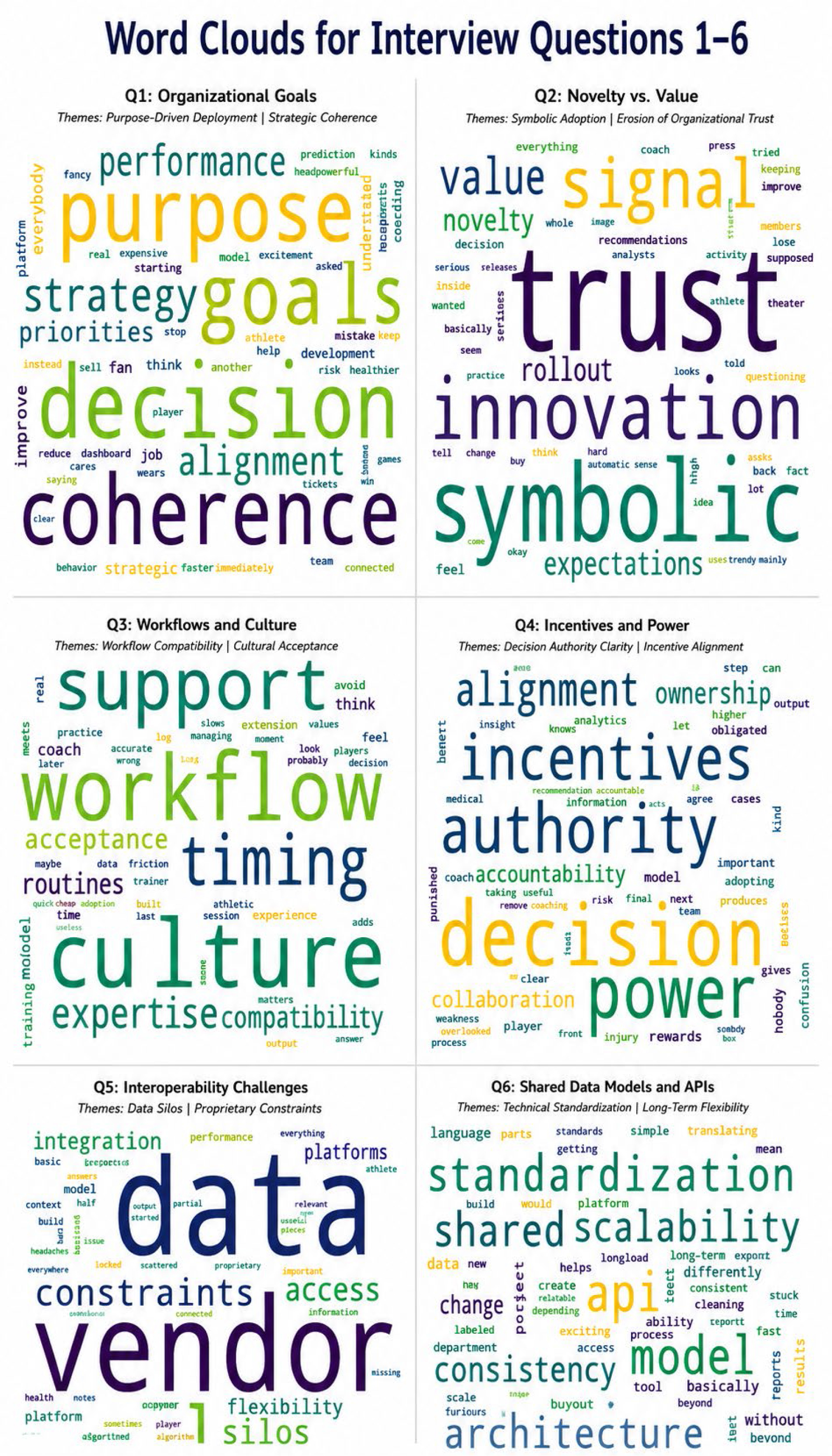
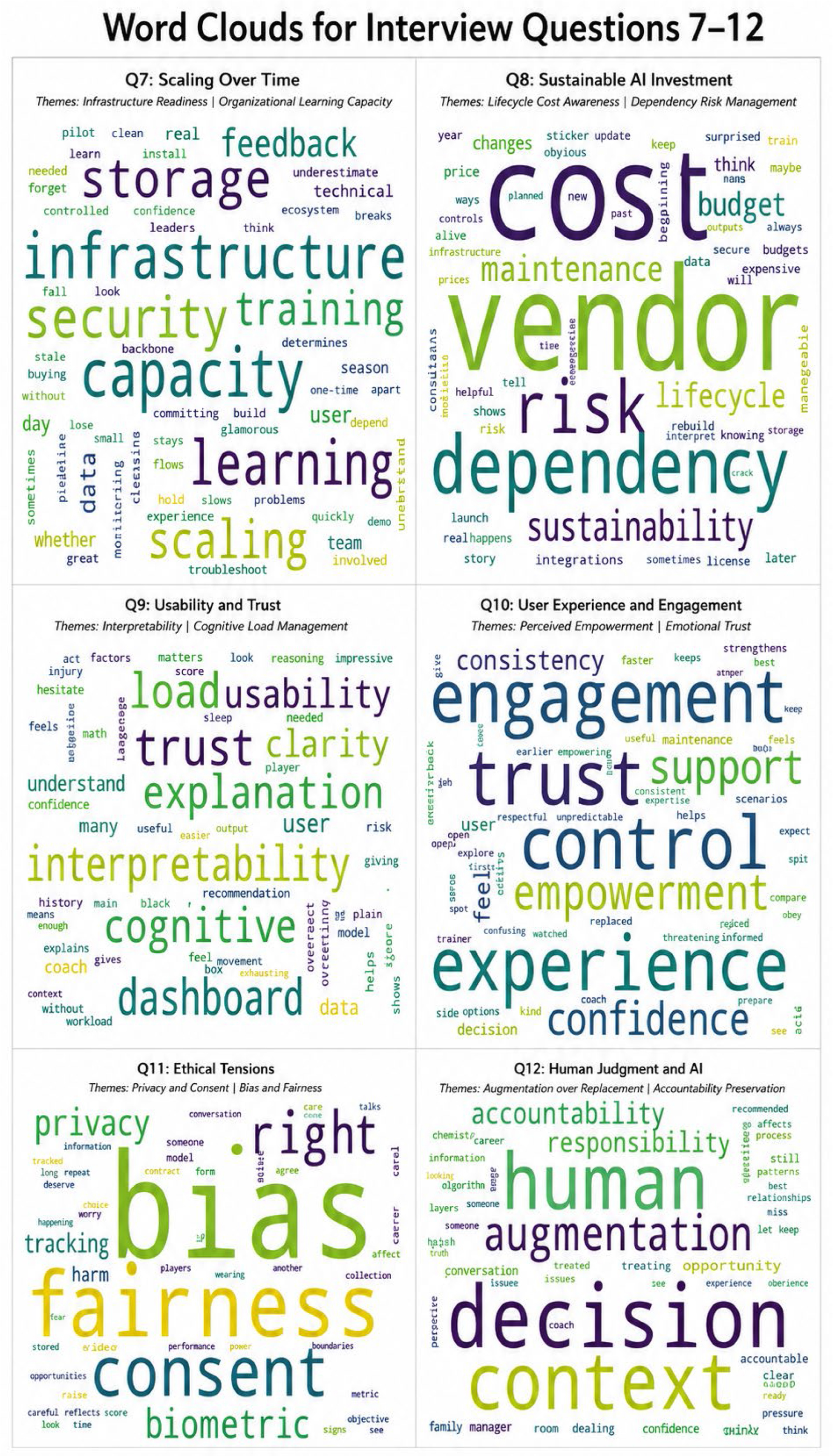
Overall, the findings suggest that AI adoption in sports organizations is most effective when it is purposeful, strategically aligned, technically interoperable, user-centered, ethically governed, and clearly accountable. Participants did not reject AI; rather, they advocated for a disciplined and human-centered approach to its use. They viewed AI as valuable when it improves decision-making, strengthens organizational learning, and supports human expertise. However, they warned that AI can produce harm when adopted for novelty, implemented without workflow integration, governed without transparency, or treated as a substitute for human responsibility.
The results also indicate that sustainable AI adoption requires both technical and organizational readiness. Technical readiness includes infrastructure, data quality, APIs, standardization, and cybersecurity. Organizational readiness includes culture, trust, incentives, training, decision authority, and ethical governance. These dimensions are interdependent. A technically advanced system may fail if users do not trust it, while a culturally supportive organization may still struggle if its data systems are fragmented or inflexible.
Finally, the findings reinforce the importance of treating AI as a sociotechnical system. In sports contexts, AI does not operate in isolation. It interacts with coaches, athletes, executives, analysts, medical personnel, fans, vendors, and institutional norms. Therefore, successful AI implementation depends not only on what the technology can do, but also on how people understand it, use it, question it, and remain accountable for its consequences.
13. Data Analysis and Results
Interview data were analyzed using a reflexive thematic analysis approach, consistent with qualitative research aimed at theory building and applied insight generation. Analysis proceeded in three iterative phases. First, open coding was conducted to capture participants’ language, assumptions, and evaluative judgments regarding AI integration in sports-related contexts. Second, codes were clustered into higher-order themes corresponding to the interview questions, with attention to convergence and divergence across participants. Third, themes were analytically mapped onto the five guiding conceptual domains: alignment with purpose, sociotechnical systems, interoperability and integration, scalability and sustainability, and user-centered design. Throughout the process, analytic memos were used to document interpretive decisions and to examine relationships between themes. The analytic emphasis was not on frequency of responses, but on conceptual consistency, explanatory power, and practical relevance.
13.1. Alignment with Purpose
Participants consistently emphasized that AI technologies deliver value only when they are explicitly anchored to well-defined organizational goals. Across interviews, experts warned against technology-first approaches in which AI is adopted to signal innovation rather than to solve concrete performance, decision-making, or learning problems. Participants noted that misalignment often results in underutilized systems, confusion about success metrics, and erosion of trust among end users. AI systems that were perceived as clearly tied to improving competitive preparation, athlete development, or operational efficiency were described as more likely to be integrated into daily practice.
13.2. Sociotechnical Systems
Findings strongly supported a sociotechnical interpretation of AI integration. Participants emphasized that AI outcomes are shaped as much by human workflows, professional identities, and organizational culture as by algorithmic accuracy. Experts described recurring tensions between data-driven insights and established coaching intuition, noting that resistance often emerged when AI systems disrupted authority structures or imposed additional cognitive burden. Successful integration was consistently associated with collaborative design processes, clear decision authority, and cultural norms that framed AI as an augmentative resource rather than a replacement for human expertise.
13.3. Interoperability and Integration
Interoperability emerged as a persistent barrier to effective AI use. Participants reported that many AI tools operate within isolated data ecosystems, limiting their ability to inform decisions across departments or time horizons. Proprietary platforms and inconsistent data standards were described as major contributors to technical debt and organizational inefficiency. Experts emphasized that shared data models and robust APIs are prerequisites for scalable AI deployment, enabling organizations to integrate insights across scouting, performance, health, and strategy functions.
13.4. Scalability and Sustainability
Participants distinguished sharply between initial AI implementation and long-term sustainability. While pilot projects often generated enthusiasm, experts noted that many systems failed to scale due to underestimated maintenance costs, insufficient internal expertise, and vendor dependency. Sustainability was described as a function of lifecycle planning, governance, and organizational learning rather than technical performance alone. AI systems that lacked clear ownership or upgrade pathways were viewed as liabilities rather than assets over time.
13.5. User-Centered Design
Usability and user experience were identified as decisive factors influencing trust and adoption. Participants consistently noted that non-technical users disengage from AI systems when outputs are opaque, overly complex, or poorly aligned with domain language. Conversely, systems that emphasized interpretability, visual clarity, and actionable recommendations were more likely to be incorporated into decision-making. Emotional responses, such as feeling empowered versus monitored, were described as critical in shaping sustained engagement, particularly in high-pressure sports environments.
14. Actionable Recommendations Alignment with Purpose:
Organizations should define specific decision-making or performance problems before selecting AI technologies.
AI success metrics should be tied to organizational outcomes rather than technical benchmarks.
Leaders should resist adopting AI solely to emulate competitors or signal innovation.
AI initiatives should be explicitly linked to strategic plans and performance frameworks.
Organizational goals should be periodically reassessed to ensure continued alignment with AI outputs.
Sociotechnical Systems:
6. AI systems should be co-designed with coaches, analysts, and other end users.
7. Existing workflows should be mapped prior to AI deployment to identify points of integration.
8. Training programs should address both technical literacy and cultural concerns.
9. Decision authority should be clearly defined when AI recommendations conflict with human judgment.
10. Incentive structures should reward collaborative, data-informed decision-making.
Interoperability and Integration:
11. Organizations should prioritize AI tools that support open standards and data portability.
12. Vendor contracts should include requirements for API access and interoperability.
13. Shared data models should be established across departments to reduce duplication.
14. Proprietary systems that restrict integration should be avoided when possible.
15. AI insights should be embedded directly into existing decision-support platforms.
Scalability and Sustainability:
16. AI investments should be evaluated using full lifecycle cost analyses.
17. Maintenance, retraining, and upgrade requirements should be planned from inception.
18. Internal technical capacity should be developed to reduce long-term vendor reliance.
19. Scalability should be tested across teams, seasons, and organizational levels.
20. Governance structures should be established to oversee AI stewardship and accountability.
User-Centered Design:
21. AI interfaces should use domain-specific language familiar to sports professionals.
22. Interpretability should be prioritized over algorithmic complexity.
23. Systems should minimize cognitive load by highlighting actionable insights.
24. Continuous user feedback should inform iterative design and refinement.
15. Conclusions
This study examined the integration of artificial intelligence (AI) in sports through the perspectives of experienced AI professionals, emphasizing how technological effectiveness is shaped by alignment with organizational purpose, sociotechnical context, interoperability, scalability, and user-centered design. The findings demonstrate that AI does not function as an autonomous driver of improvement; rather, its value emerges through deliberate organizational choices regarding design, governance, and human-technology interaction. Participants consistently rejected technologically deterministic assumptions, instead highlighting that AI systems enhance decision-making and performance only when they are integrated into existing workflows, supported by organizational culture, and trusted by users.
Across the data, a central conclusion is that AI adoption in sports is fundamentally an organizational and cultural challenge, not merely a technical one. Systems introduced without clear purpose, ethical governance, or usability considerations frequently fail to scale or sustain impact. Conversely, AI tools that are purpose-driven, interoperable, and designed to augment human expertise were perceived as capable of strengthening strategic clarity, performance evaluation, and operational efficiency. These conclusions reinforce the importance of approaching AI as a sociotechnical system whose success depends on human judgment, institutional alignment, and long-term stewardship.
15.1. Implications for Sport as a Domain
At the level of sport as a broader domain, the findings suggest that AI is reshaping how competitive advantage is conceptualized and pursued. Rather than privileging access to the most advanced algorithms, future competitive differentiation is likely to depend on how effectively organizations integrate AI into strategic thinking and decision-making cultures. Sports that embrace AI as a tool for learning, adaptation, and reflection, rather than as a mechanism for surveillance or automation, are better positioned to evolve responsibly. Additionally, the emphasis on interoperability and sustainability highlights the need for industry-wide standards and governance frameworks that promote transparency, fairness, and shared learning across leagues and institutions.
15.2. Implications for Athletes
For athletes, the integration of AI presents both significant opportunities and critical risks. On the positive side, AI systems offer unprecedented potential for individualized performance feedback, injury prevention, and skill development through data-driven insights that were previously inaccessible. When designed with user-centered principles, these technologies can empower athletes by increasing self-awareness and supporting informed training decisions. However, the findings also underscore the importance of safeguarding athlete autonomy, privacy, and trust. AI systems that prioritize data extraction over human well-being risk reducing athletes to data points and undermining the relational foundations of coaching and development. Ethical governance and transparent communication are therefore essential to ensure that AI serves athletes’ long-term interests rather than merely organizational efficiency.
15.3. Implications for Sports Organizations
For sports organizations, the study highlights AI integration as a strategic leadership responsibility that extends beyond technology procurement. Effective adoption requires clear articulation of purpose, investment in internal capacity, and governance structures that support accountability and ethical oversight. Organizations that treat AI as a plug-and- play solution are likely to encounter resistance, technical debt, and unsustainable costs. In contrast, those that adopt a sociotechnical approach, co-designing systems with users, aligning incentives, and planning for long-term scalability, are more likely to realize enduring value. Ultimately, the findings suggest that AI can enhance organizational intelligence and cohesion when deployed as a means of augmenting human expertise rather than displacing it, reinforcing the central role of leadership in shaping the future of AI in sport.
Notes
[1] Contributed by Author Contributions:
Conceptualization, D.N.B. and C.N.; data curation, D.N.B.; formal analysis, D.N.B.; investigation, D.N.B. and C.N.; methodology, D.N.B. and C.N.; project administration, D.N.B.; supervision, D.N.B.; validation, D.N.B.; visualization, D.N.B. and C.N.; writing – original draft, D.N.B.; writing – review & editing, D.N.B. and C.N.