

1. Introduction
Entrepreneurship now possesses significant potential owing to its advantageous outcomes. It is the catalyst for holistic growth and advancement for societies (Messikh, 2023). Economic growth is influenced by several variables, with government programs that promote entrepreneurship and business activity being the most significant (Ignatov, 2019). It is thought to be a major source of income, innovation, and job openings.
Only a few years following the initial oil shock, Octave Gélinier made the following observation: “ The nations, occupations, and businesses that innovate and grow are above all those that practice entrepreneurship”. It is costly to operate without an entrepreneur, as evidenced by the figures of economic development, global commerce, licenses, patents, and inventions during the past three decades (Messikh, 2022).
The impact of entrepreneurship has extended to all fields due to its great importance for modern institutions that are interested in developing and advancing projects, including higher education institutions (Messikh, 2021). Universities have departed from their traditional approach to more modern universities that are dominated by an entrepreneurial atmosphere. They are entrepreneurial universities that represent institutions concerned with higher education and scientific research and have a role in the processes of achieving activities related to starting new businesses and organizing and developing various internal projects for academic development, which have their effects on the local and global macro economy, relying on activation and motivational processes for its members, including academics, employees and students, through the element of building a pioneering university system that is concerned with building pioneering characteristics, mindsets and orientations. This entrepreneurial ecosystem is linked to the ability of the educational or university institution to create a mix of interconnected and heterogeneous elements and the supporting infrastructure to create a favorable environment for the creation and development of new innovative projects (Nkusi et al., 2020).
In this regard, many researchers believe that the majority of universities around the world have increasingly begun to shift from the traditional role based on learning and providing scientific knowledge to the model of the complex entrepreneurial university that plays its previous role in addition to effectively participating in the development of private organizations in the local and regional economies in line with the new form of the knowledge-based economy (Wong et al, 2007). By encouraging more entrepreneurship in the area, contemporary universities may contribute significantly to entrepreneurial ecosystems (Gubik & Bartha, 2021).
In this context, recent studies indicate that building an effective university entrepreneurial ecosystem that is interconnected internally and externally (among students, faculty, administration, and the socio-economic sector) can achieve positive economic and institutional impacts for the university and its students (Audretsch et al., 2025).
In light of the transition of the Algerian economy from a command economy to a free market and the global economic liberalization, the establishment of private enterprises accelerated, as entrepreneurship emerged as a viable solution to the unemployment issue (Messikh, 2021).
In this regard, the resolution 12-75 issued by the Ministry of Higher Education and Scientific Research, which includes the establishment of what is called a university degree-startup or university degree-patent, is a valuable new strategy followed by Algeria, represented by the Ministries of Higher Education and Scientific Research and the Ministry of Knowledge Economy and Start-ups, aiming to build a university entrepreneurial ecosystem in line with global trends towards building a sustainable entrepreneurial university model, a model that has always contributed to the comprehensive development of the governments that have adopted it through Creating a generation of university-educated entrepreneurs, who have contributed significantly to building the so-called startup economy (Ayoub, 2017).
The Algerian University has enormous human and material resources and has the expertise and knowledge necessary to support entrepreneurs and innovators. The university works in cooperation with various companies, government institutions, and the local community to provide an environment that encourages innovation and start-ups. These collaborations include the exchange of knowledge and expertise, and the provision of funding and urban spaces to establish innovation centers and start-ups (Ministry of Higher Education and Scientific Research, 2022).
For years, the Algerian University has been offering support and training programs for students and graduates interested in establishing their own projects. These programs include workshops, lectures, and competitions that aim to develop entrepreneurship skills and teach students how to create and manage start-ups. The university also provides technical advice and guidance to entrepreneurs and young innovators to help them transform their ideas into feasible projects and help them face the various challenges they face.
The entrepreneurial government orientation and support in university institutions is considered a turning point in the higher education strategy in Algeria, by seeking to involve the university in the process of driving comprehensive development through entrepreneurship. Some manifestations of these efforts are represented in the establishment of university business incubators (UBI), entrepreneurship development centers (CDE), technology support and innovation centers (CATI) and House of Artificial Intelligence (AIH), in addition to the intensification of conferences, seminars, competitions and entrepreneurial activities, as well as financing programs and academic and logistical support to implement innovative ideas and inventions, and also the Ministerial Resolution 12-75 (Ministry of Higher Education and Scientific Research, 2022).
Where the Resolution 12-75 issued by the Ministry of Higher Education and Scientific Research, which includes the establishment of what is called a university degree-startup or a university degree-patent, is a valuable new strategy followed by Algeria, represented by the Ministries of Higher Education and Scientific Research and the Ministry of Knowledge Economy and Start-ups, aiming to build a university entrepreneurial ecosystem in line with global trends towards building a sustainable entrepreneurial university model, a model that has always contributed to the comprehensive development of the governments that adopted it by creating a generation of university entrepreneurs (those about to graduate), who have contributed significantly to building what is called the start-up economy (Ministry of Higher Education and Scientific Research, 2022).
This paper investigates the influence of the university entrepreneurial ecosystem on the Entrepreneurial attitude of students registered under Ministerial Resolution 12-75 in Algeria.
The added value is that the current study is considered the only one, according to my research surveys, that examined the two variables together with this title in the Algerian research environment. In addition to knowing the impact of the entrepreneurial ecosystem, especially in university institutions and the location of this impact in relation to Ajzen’s theory of planned behavior.
The remainder of the paper is structured as follows. First, a theoretical background and research framework included the literature review for both the university entrepreneurial ecosystem and entrepreneurial attitude. The second is the empirical analysis, which covers the study’s methods and instruments as well as the findings, testing of hypotheses, and discussions, in addition to the conclusion and the reference list at the end of the search.
2. Theoretical Background and Research Framework
2.1. Theoretical Background
The institution’s strategic orientation to acquire certain entrepreneurial features of decision-making attitudes, procedures, and methodologies is known as entrepreneurial orientation (Adebiyi et al., 2019). This orientation has become an urgent necessity for all universities today, considering that it enables them to increase the competitiveness of institutions by encouraging innovation, which strengthens the competitiveness of the countries in which they are located.
Entrepreneurship has also become the main pillar of the roles of contemporary universities, as the entrepreneurial university plays a fundamental role in the economic and social development of most countries, regardless of their systems and economic philosophies. According to researcher Arnaut, the entrepreneurial university is paving the road for the development of a knowledge-based global economy through its innovative endeavors. (Arnaut, 2011). Universities are now the ideal setting for encouraging students to take initiative on their own, through entrepreneurial awareness and consolidating the entrepreneurial culture, which contributes to developing the process of establishing small and medium enterprises and encouraging creativity, which creates job opportunities and wealth, and which achieves a change in the market structure and the transfer of modern technology, all of this to achieve sustainable development.
There is a narrow and sometimes wrong understanding of the use of the term entrepreneurial university by people in general and some researchers, as they define it as a university that creates new businesses by its employees, researchers and students. However, the reality goes beyond that, as it is a university that seeks new sources of funding, such as patents, research under contracts, and entering into partnerships with private and public institutions within the framework of the open innovation strategy. The entrepreneurial university is also considered a natural incubator that provides support structures for professors and students to initiate new projects, both intellectual and commercial (Messikh, 2019).
The entrepreneurial university is considered the modern model of university educational institutions. In addition to its primary mission of training, education and imparting knowledge to students, it plays a role in the process of achieving activities related to starting businesses, planning them, organizing and developing projects within the university to prepare for global academic development, within the framework of the marriage of universities, research institutions and the socio-economic environment on the one hand, and building an entrepreneurial system based on training and accompanying a generation of entrepreneurs on the other hand (Messikh, 2019).
The university is considered one of the active parties in the entrepreneurship system environment, as it is responsible for performing several of qualitative tasks such as providing human capital directed towards self-employment and the desire to take risks and take initiative; training in generating creative and innovative ideas that can be transformed into economic products; in addition to training in establishing and managing entrepreneurial projects; as well as guidance and direction and providing technical and professional support in organization, management and marketing; in addition to conducting scientific research and applied studies and providing consultations and guidance and direction services (Messikh, 2019).
Numerous theories that fall under the categories of psychology, sociology, culture, economics, politics, and history have been established to explain the emergence process, the behaviours of entrepreneurs, and the effects of external factors on the entrepreneurial process (Genty, 2019).
The degree to which an individual has a positive or negative assessment of an action is known as their attitude toward it (Ajzen, 1991). The attitude towards self-employment in the context of entrepreneurship is defined as “the difference between beliefs concerning one’s desire to become self-employed and organizationally employed”. The degree to which an individual has a good or negative personal appraisal of becoming an entrepreneur was referred to as their attitude toward start-ups (Vamvaka et al., 2020).
Entrepreneurial attitude (EA) denotes an individual’s perceptions and inclinations towards entrepreneurship, including their comprehensive assessment of engaging in entrepreneurial activities and the degree of their appeal, encompassing both cognitive and affective elements. The rational choice hypothesis states that people are more inclined to engage in entrepreneurial endeavors if they think the anticipated advantages of entrepreneurship outweigh those of alternative career paths. Furthermore, attitude is more malleable than personality characteristics and is influenced by how an individual interacts with their surroundings. A person’s attitude toward entrepreneurship may be influenced by a variety of characteristics, such as personality, education, and experience (Chen, 2024).
2.2. Framework for Research
Drawing from earlier research that looked at the essential elements of the university entrepreneurship ecosystem (UEE), the model for this study is shown in the following figure:
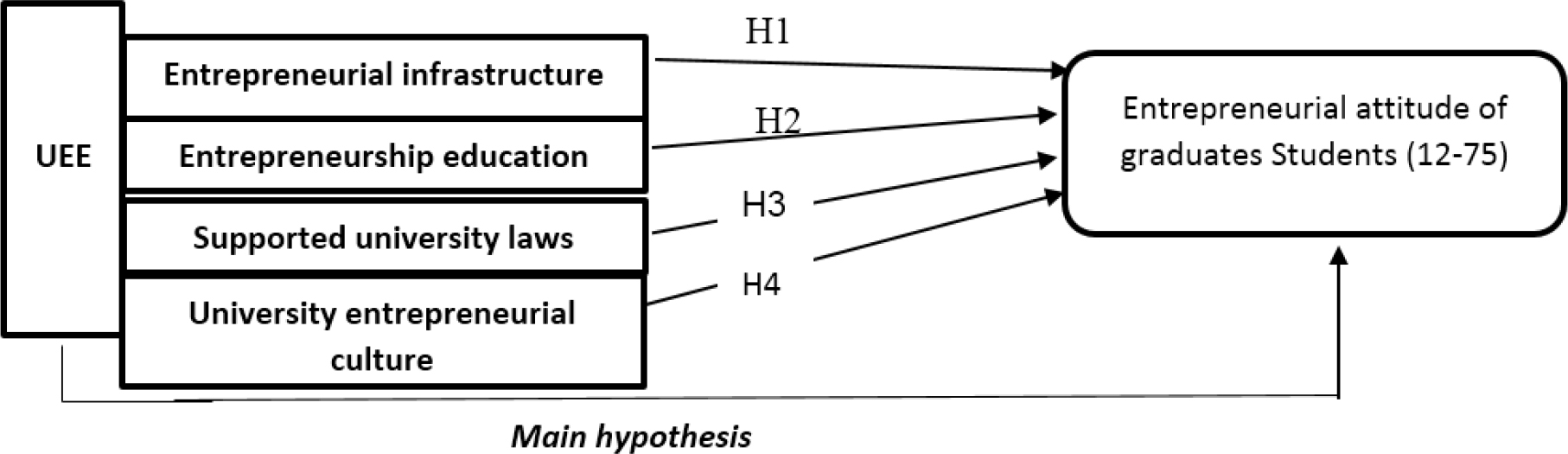
Figure no. 1:
Research framework
(Source: Prepared by the researcher based on previous studies)
3. Methodology
A randomly selected group of students registered under Ministerial Resolution 12-75 from the University of 20 AOUT 1955 in Algeria was investigated in order to solve a study question and achieve the study’s goal.
3.1. Research Questions
The study’s objective is to determine how much Algeria’s university entrepreneurial ecosystem affects entrepreneurial attitudes of graduates Students registered under Ministerial Resolution 12-75 in the University of 20 AOUT 1955 in SKIKDA.
Based on the primary research question, the following specific questions were also investigated to determine the impact of Entrepreneurial infrastructure, Entrepreneurship education, supported university laws, and University entrepreneurial culture as dimensions of the university entrepreneurial ecosystem, researchers in the entrepreneurial field have unanimously agreed upon them. Upon the Entrepreneurial attitude of Students registered under Ministerial Resolution 12-75 at Skikda University:
– How much impact does Entrepreneurial infrastructure have on the Entrepreneurial attitude of students registered under Ministerial Resolution 12-75 in Skikda University?
– How much impact does Entrepreneurship education have on the Entrepreneurial attitude of students registered under Ministerial Resolution 12-75 in Skikda University?
– How much impact does Supported university laws have on the Entrepreneurial attitude of students registered under Ministerial Resolution 12-75 in Skikda University?
– How much impact does the University's entrepreneurial culture have on the Entrepreneurial attitude of students registered under Ministerial Resolution 12-75 in Skikda University?
3.2. Research Population
Based on information from Skikda University’s statistics office and Business Incubator pertaining to 2023/2024, all students registered under Ministerial Resolution 12-75 from the University of 20 AOUT 1955 are included in the research community, totalling 125 students.
The Complete Census method was adopted. A survey was distributed. An analysis of 124 of the survey’s responses was possible, yielding a 99.20% response rate. Multiple regression tests, descriptive statistics, and the Pearson correlation coefficient were used for statistical examination with the support of SPSS version 25.
3.3. Internal Consistency Reliability of the Questionnaire
A reliability analysis was carried out utilizing the Cronbach’s alpha approach described below in order to confirm the measuring apparatus’s long-term viability.
Table no. 1
Coefficient of Cronbach’s alpha
| Variables | Items | The Cronbach’s alpha value |
|---|---|---|
| University entrepreneurial ecosystem | 12 | 0.796 |
| Entrepreneurial attitude | 9 | 0.754 0.754 |
| All variables | 21 | 0.843 |
The total coefficient of Cronbach’s alpha value surpassed 0.6, the coefficient of the independent variable was 0.796, and the coefficient of the dependent variable was 0.754, while the coefficient of the study as a whole was 0.843. This implies that the instrument has a satisfactory degree of stability, allowing the author to be certain that every participant in the investigation can utilize it.
Utilizing the Pearson correlation analysis technique, the tool’s overall mean and variable averages were assessed as another stage to confirm the design’s dependability, as shown in the accompanying table.
Table no. 2
Pearson correlation coefficient
| Variables | Correlation coefficient | Sig |
|---|---|---|
| University entrepreneurial ecosystem | 0.675** | 0.000 |
| Entrepreneurial attitude | 0,662** | 0.000 |
We can observe from the previous table that the correlation coefficients for the variables are sufficient. Furthermore, at the 1% level, the correlation coefficients are strong, positive, and significant, with a significance threshold of p≤0.05. Consequently, the claims are true regarding what they are meant to evaluate.
4. Results and Discussion
4.1. Axes’ Descriptive Statistics
By the outcome of the SPSS, which calculated the questionnaire’s items’ mean and standard deviation to examine the replies from each respondent. The results, which show the opinions of individuals who took part, are shown in the following table according to each research axis.
Table no.3
Descriptive Statistics for Axes
| Dimensions | Average | Std. Dev | Ranking | Arrangement |
|---|---|---|---|---|
| Entrepreneurial infrastructure | 3.700 | 0.562 | 2 | high |
| Entrepreneurship education | 3.610 | 0.644 | 4 | high |
| Supported university laws | 3.460 | 0.600 | 5 | high |
| University entrepreneurial culture | 3.680 | 0.568 | 3 | high |
| Entrepreneurial Attitude | 3.780 | 0.468 | 1 | high |
As can be shown from the above table, where the average value was 3.780 and the standard deviation was 0.468, those who participated in the examined Complete Census demonstrate a high degree of entrepreneurial attitude. With a variance of 0.562 and a mean value of 3.700, the fact that entrepreneurial infrastructure came in second shows how important this component is to students’ entrepreneurial journeys. Taking into account a variation of 0.568 and an average of 3.680, the University's entrepreneurial culture took third place in terms of the degree of approbation. With a mean value of 3.610 and a variance of 0.644, Entrepreneurship education ranked fourth, demonstrating the importance placed on this element in the creation of the entrepreneurial orientation thought of students. Additionally, supported university laws came in last with a mean value of 3.460 and a standard deviation of 0.600, indicating a high level of acceptance by the participants.
4.2. Test of Hypothesis
Regression analyzing was used to examine this study’s hypothesis. The results of the analysis are shown in the subsequent tables.
– Hypothesis 1
H1: There is a statistically significant impact at the 0.05 level of significance for Entrepreneurial infrastructure on the Entrepreneurial attitude of students registered under Ministerial Resolution 12-75 in Skikda University.
As can be seen in the above table, students’ entrepreneurship attitudes are influenced by their level of appreciation for entrepreneurial infrastructure. With a level of statistical significance of 0.000, the B coefficient, which gauges the correlation between the level of entrepreneurial attitude and entrepreneurial infrastructure, was 0.469. The first sub-hypothesis is supported by the data that was previously given.
Skikda University’s possession of entrepreneurial infrastructure, such as a business incubator, entrepreneurship house, meeting rooms, co-working spaces, and laboratories, is essential to support university entrepreneurship endeavors. Where ambitious creative ideas can collaborate and experience a well-equipped infrastructure. In the context of Ajzen’s theory, infrastructure significantly impacts behavioral beliefs regarding feasibility and prospective success, hence improving the assessment of outcomes linked to that success and fostering a more pleasant attitude. By providing an entrepreneurial infrastructure, the entrepreneurial attitude can be developed, and the intention can be created for students to transform concepts and ideas into successful enterprises.
This result comes in the same context, partially or completely, as the following previous studies (Wong et al., 2007; Nkusi et al., 2020; Gubik & Bartha, 2025; Audretsch et al, 2025).
– Hypothesis 2
H2: There is a statistically significant impact at the 0.05 level of significance for Entrepreneurship education on the Entrepreneurial attitude of students registered under Ministerial Resolution 12-75 in Skikda University.
As can be seen from the above table, students’ entrepreneurial attitude is influenced by how much they value entrepreneurship education. With a level of significance of 0.001, the B value, which gauges the correlation with the level of entrepreneurial attitude and entrepreneurial education, was 0.481. The second sub-hypothesis is supported by the data already mentioned.
In this regard, we find that the university under study has made significant strides in including entrepreneurship in all scientific disciplines and colleges, enabling the dissemination of entrepreneurial thought and the formation of an entrepreneurial mindset among students at the University of Skikda. These study programs provide students with the skills and knowledge necessary to start and manage a business. This includes courses, workshops, and seminars that focus on entrepreneurship thinking and practice.
In the context of Ajzen’s theory, identification emphasizes that the entrepreneurial attitude is neither fixed nor just personal, but rather adaptable and situational. Educational institutions may foster and enhance this mentality by emphasizing effective entrepreneurship education.
This result comes in the same context, partially or completely, as the following previous studies (Wong et al., 2007; Nkusi et al., 2020; Gubik & Bartha, 2025; Audretsch et al, 2025).
– Hypothesis 3
H3: There is a statistically significant impact at the 0.05 level of significance for supported university laws on the Entrepreneurial attitude of students registered under Ministerial Resolution 12-75 in Skikda University.
The Entrepreneurial attitude that students have is determined by how well university laws are regarded, as evidenced in the table displayed above. The B value, which evaluates the association between the extent of entrepreneurial attitude and encouraged university laws, was 0.205 with a value of significance of 0.001. The third sub-hypothesis is supported by the data already mentioned.
In terms of the Theory of Planned Behavior, supportive laws and rules diminish negative behavioral beliefs regarding risk and loss while enhancing positive beliefs concerning fairness and support, resulting in a more favorable overall assessment of the entrepreneurial process and a more robust attitude. Here, universities must navigate the regulatory frameworks that affect entrepreneurship. It works to build a legal supportive environment consisting of policies that encourage innovation and reduce bureaucratic obstacles facing student start-ups.
This result comes in the same context, partially or completely, as the following previous studies (Wong et al, 2007; Nkusi et al., 2020; Gubik & Bartha, 2025; Audretsch et al, 2025).
– Hypothesis 4
H4: There is a statistically significant impact at the 0.05 level of significance for University entrepreneurial culture on the Entrepreneurial attitude of students registered under Ministerial Resolution 12-75 in Skikda University.
As can be seen from the above table, students’ entrepreneurial attitude is influenced by the degree to which the university regards its entrepreneurial culture. With a level of statistical significance of 0.000, the B value, which gauges the correlation between the extent of entrepreneurial attitude and university entrepreneurial culture, was 0.362. The fourth sub-hypothesis is supported by the data already mentioned.
Students are encouraged to explore entrepreneurial pursuits by an institutional culture that values creativity, risk-taking, and invention. Moreover, according to TPB, culture has a significant role in determining behavioral attitudes and assessing results. It offers the narratives, conventions, and emotions that help students feel good about entrepreneurship and believe in its significance and viability, which strengthens their entrepreneurial attitude.
This result comes in the same context, partially or completely, as the following previous studies (Wong et al., 2007; Nkusi et al., 2020; Gubik & Bartha, 2025; Audretsch et al., 2025).
– Main Hypothesis
MH: There is a statistically significant impact at the 0.05 level of significance for the University entrepreneurial ecosystem on the Entrepreneurial attitude of students registered under Ministerial Resolution 12-75 in Skikda University.
Table no. 4 shows that the university entrepreneurial ecosystem has a significant and favorable effect on the attitude toward entrepreneurship of students registered under Ministerial Resolution 12-75 in Skikda University.
Table no. 4
A multiple regression analysis to investigate how entrepreneurial attitude is affected by university Entrepreneurial ecosystem
| University entrepreneurial ecosystem | B value | Sig | constant | R | R2 | F value | Sig |
|---|---|---|---|---|---|---|---|
| Entrepreneurial infrastructure | 0.469 | 0.000 | |||||
| Entrepreneurship education | 0.481 | 0.001 | |||||
| Supported university laws | 0.205 | 0.001 | 2.527 | 0.600 | 0.360 | 22.510 | 0.000 |
| University entrepreneurial culture | 0.362 | 0.000 | |||||
The correlation coefficient reached 0.600, which is equivalent to 60.00%. This percentage is a high degree of correlation at a significance level of 0.00, while the coefficient R2 reached 0.360, which means its value (36.0%) of the total variance of the entrepreneurial attitude of students registered under Ministerial Resolution 12-75 in Skikda University can be accounted for by the fluctuation of the entrepreneurial ecosystem at universities. The value of F (22.510), a function at a level below 0.05, is confirmed by the magnitude of this influence. Thus, this validates the primary hypothesis: The entrepreneurial ecosystem at Skikda University has a significant statistical influence on the entrepreneurial attitude of students enrolled under Ministerial Resolution 12-75, with the level of 0.05.
This result comes in the same context, partially or completely, as the following previous studies (Wong et al., 2007; Nkusi et al., 2020; Gubik & Bartha, 2025; Audretsch et al, 2025).
The regression equation may be formulated based on the gathered values, reflecting the components of the university entrepreneurial ecosystem and the development of entrepreneurial attitudes among students enrolled under Ministerial Resolution 12-75 at Skikda University as follows:
Student Entrepreneurial attitude = 2.527 + 0.469 Entrepreneurial infrastructure + 0.481 Entrepreneurship education + 0.205 Supported university laws + 0.362 University entrepreneurial culture.
Finally, we can say that this study’s findings corroborate the Theory of Planned Behavior (Ajzen, 1991) while suggesting a significant contextual adjustment. The results showed that students’ entrepreneurial attitude was significantly impacted by the university’s entrepreneurial ecosystem. This suggests that students’ behavioral attitudes and results assessments of entrepreneurship are formed by the entrepreneurial environment, which acts as an influencing background element and eventually promotes a more positive attitude toward it. As a result, this study not only validates the TPB framework’s applicability to student entrepreneurship but it also expands upon it by emphasizing how important a stimulating university environment is in forming entrepreneurial attitude, which in turn directly influences entrepreneurial intention and, eventually, actual behavior.
The following figure shows the final model with the coefficients.
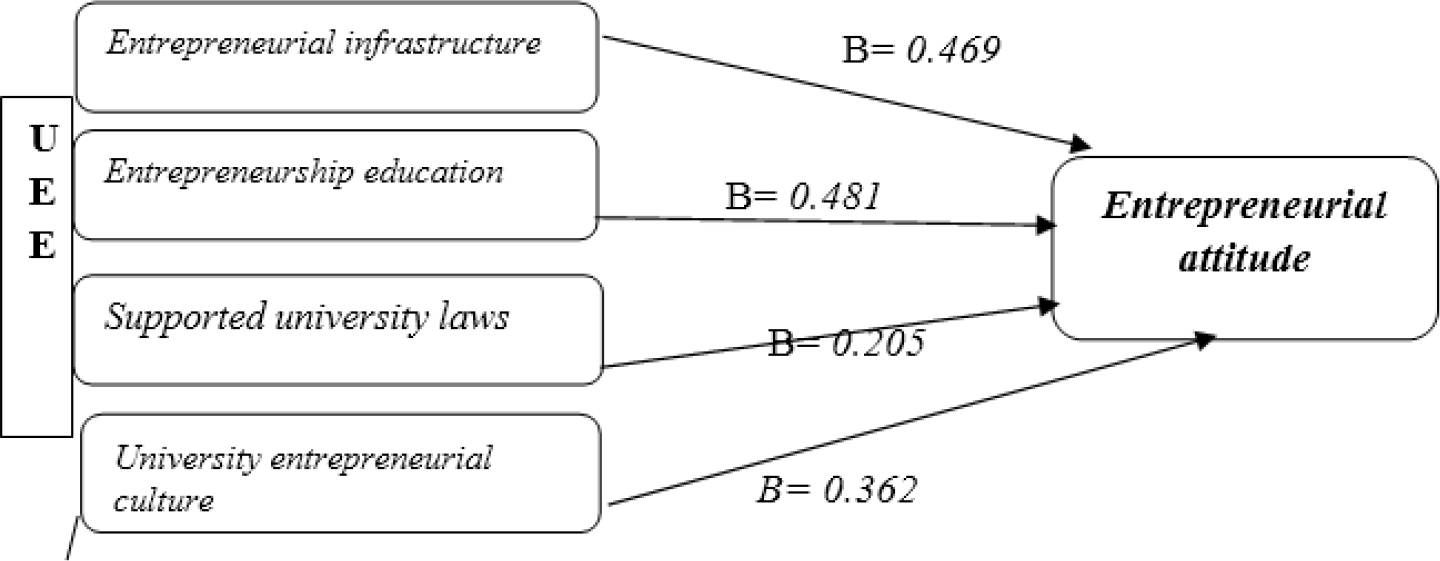
Figure no. 2:
Research final model with the coefficients
(Source: Prepared by the researcher based on SPSS output)
5. Conclusions
The topic of entrepreneurship has recently received a significant share of researchers’ attention, and has thus become comparable to the most important topics that top the front pages of modern research in the field of business, commercially with various changes, especially technological ones, in the economic environment, which includes all the countries’ institutions and establishments, including higher education institutions. Universities have emerged as a result of this transformation from their traditional form to a more modern one that keeps pace with what we are now by adopting the entrepreneurial approach as a new educational method. University institutions currently attach importance to entrepreneurial activity due to its significant impact on the economic return in general, as it supports various economic reforms, through the formation of business incubators that constitute great support for academics, employees and students, which provide the necessary support and guidance for the processes of establishing future projects and transforming innovative ideas into future projects, as well as working to develop current research that is supposed to have a tangible positive impact on comprehensive development in the medium and long term.
The study investigated the impact that the entrepreneurial university ecosystem can add to the entrepreneurial attitude of graduate students (Students involved in resolution 12-75) in the University of 20 AOUT 1955 in Skikda, through investigating how each element of the university entrepreneurial ecosystem influences students’ entrepreneurial attitudes.
The sub-hypothesis indicates that there is a significant statistical relationship between SKIKDA University’s entrepreneurial university ecosystem and entrepreneurial mentality. Whereas the ecosystem cultivates an atmosphere conducive to the development of vital entrepreneurial characteristics, including self-efficacy, inventiveness, and risk-taking. These attributes are essential for fostering a constructive entrepreneurial mindset, as they enable students to initiate action and engage in commercial endeavors.
In conclusion, the empirical results of this study support prior studies, showing that the entrepreneurial ecosystem at the institution has a statistically significant impact on the entrepreneurial mindset of students enrolled at Skikda University under Ministerial Resolution 12-75.
36.0% of the total variance of the entrepreneurial attitude of students enrolled under Ministerial Resolution 12-75 at Skikda University can be explained by the variability of the university’s entrepreneurial ecosystem. The presence of other factors and determinants influencing the entrepreneurial attitude of students, including entrepreneurial background, self-efficacy, entrepreneurial social support, access to resources, and perceived behavioral control, may be used to explain the percentage obtained.
This research offers empirical support for the Theory of Planned Behavior’s operation in a particular educational context and shows how well it explains entrepreneurial behavior.
Higher education institutions have focused on cultivating entrepreneurial students who can enhance business development and generate new employment opportunities, thus serving as catalysts for economic progress. Policies promoting entrepreneurship have been modified, and higher education institutions have intentionally implemented entrepreneurial coursework in response. These institutes provide consulting services, encourage the commercialization of research and technology, and offer courses that include business incubation. Based on the dominant entrepreneurship culture, they establish and preserve university environments that foster their students’ entrepreneurial mindset and aptitude.
Finally, the university encourages the formation of strong networks of relationships and communication between entrepreneurs, start-ups, and various stakeholders. Events and occasions such as conferences, exhibitions, and workshops are organized, where start-ups can exchange ideas and experiences and build strategic partnerships with other parties. All of this serves the national economy and its diversification strategy.
In conclusion, the findings warrant further work, both at the university under study and at other local and international universities, to improve the university entrepreneurship ecosystem. This ecosystem has proven its worth in guiding students toward entrepreneurship, a field of significant importance in the era of the knowledge economy and the start-up economy.
The relationship between the UEE and entrepreneurial attitudes is effectively demonstrated by this study. The ‘black box’ of this link may be unlocked by future studies that concentrate on mediating factors such as psychological traits. Furthermore, investigating the ecosystem’s varying effects on subgroups (such as gender or academic fields) may provide university managers with more complex insights. In addition, analyzing universities and colleges in comparison to other types of institutions (such as teaching-focused versus research-intensive universities) or different cultural contexts could offer more sophisticated insights to universities.
The results of this study must be interpreted in light of some limitations. The study relied on a relatively small sample, which was limited by the small number of students enrolled in this newly implemented program in Algerian universities. Therefore, statistical power may be limited, and the results should be considered exploratory rather than conclusive. In addition, the limited number of participants and reliance on one university mean that it is impossible to generalize the results statistically to a wider population of students in other universities.