
1. Introduction
Lentic ecosystems are inland freshwater environments, including but not limited to lakes, ponds, pools, puddles, and swamps (Reddy et al., 2018). They serve as crucial providers of resources and habitats for both aquatic and terrestrial organisms. These ecosystems come in various forms from permanent bodies of water to temporary ones, and their dynamics are influenced by several abiotic factors. These factors encompass the type of bedrock, basin shape, soil composition, presence of vegetation, nutrient level, availability of light, oxygen concentration, temperature, and pH conditions (Richardson et al., 2020).
Among lentic ecosystems, the “ponds” are natural or artificial small waterbodies (1 m2 to about 5 ha) that hold water temporarily or permanently (Céréghino et al., 2008). They are ubiquitous on the landscape, valuable habitats providing water for domestic, industrial, and agricultural uses (Macintyre et al., 2018); they are also considered of a major ecological importance (Nath et al., 2015). Ponds are tiny, shallow, stagnant bodies of water that are part of an ecosystem (Hawes et al., 2013) and are nowadays recognized as important biodiversity hotspots (Mancinelli et al., 2019).
Moreover, the preservation of a pond relies on both its physicochemical and biological characteristics, and these qualities can vary due to various elements like water source, pollution type, seasonal changes, and human activities in the surrounding areas. All of these factors affect the pond's quality and, consequently, its suitability for aquatic organisms (Saha et al., 2017). However, current research on the significance of ponds is insufficient (Hill et al., 2021). There is a lack of understanding regarding their structure, functioning, environmental vulnerability, connections to the surrounding landscape, and the impact of human activities. Currently, there is a growing interest in pond ecology mainly due to the recent revelation and recognition of their general ecological importance (Świerk and Krzyzaniak, 2019). Given this importance of ponds, various international networks have been established with the aim of protecting, conserving, and promoting the value of these ecosystems, including the European Pond Conservation Network (EPCN), Ramsar convention, Global water partnership, and World Wide Fund for Nature (WWF) (Miracle et al., 2010).
The absence of significant attention in North African countries toward the pond ecosystems is noteworthy. These aquatic environments, with their unique structures and ecological functions, hold great research potential, particularly in understanding the impact of aridity and drought. Despite the arid conditions prevalent in the region, ponds in North Africa demonstrate remarkable resilience and adaptability. They play a significant ecological role, providing valuable ecosystem services and making them ecologically interesting subjects (Arab et al., 2019; Bougoffa et al., 2023; Meradi et al., 2024).
Phytoplanktons are the first link in the food chain in ponds (Yilmaz et al., 2018), and variation of its composition and distribution in the water reflects an environmental change that indicates a trophic state (Reynolds et al., 1993). Phytoplankton dynamics are directly or indirectly influenced by biotic and abiotic factors (Cao et al., 2016). In fact, environmental changes often lead to major irreversible damage on the phytoplankton communities. Aquatic impacted environments lose diversity that at the higher level could affect the well-being of human (Houssou et al., 2016).
Studies on phytoplankton are considered as a very important tool to evaluate water quality and productivity of any type of water body. In addition, it contributes to the understanding of lentic water bodies. Recently, phytoplankton has been used as an indicator to observe and understand changes in the ecosystem as it appears to be sensitive and linked to climatic characteristics (Pandiammal et al., 2017). Many studies have focused on the variability of seasonal and spatial phytoplankton population as a function of changes in species composition and density as well as their dynamics (Chen et al., 2016). Most of these studies are focused on lakes and reserves; data on the water quality and the diversity and dynamics of phytoplankton in natural ponds are largely ignored. Despite the existing studies on phytoplankton in various aquatic environments across North Africa, including lakes, rivers, and lagoons (Daoudi et al., 2012; El Kassas et al., 2016), especially in Algeria (Arab et al., 2019; Draredja et al., 2019), there remains a notable deficiency in data concerning phytoplankton populations in pond ecosystems. This lack of information is a considerable obstacle to fully comprehend the behavior and ecological roles of these microorganisms in such habitats. Compared to their temperate counterparts, Mediterranean ponds are characterized by high hydrological variability (Dimitriou et al., 2009). This is particularly proper of semi-arid and arid environments of North Africa, where freshwater organisms frequently experience severe floods and droughts (Boersma et al., 2014). Morphological and physiological adaptations to these fluctuations (e.g., desiccation tolerance, high population turnover) can confer strong resistance and resilience capabilities to the phytoplankton communities found in these environments (Padisák and Naselli-Flores, 2021). Our study was conducted in the Belezma biosphere reserve (north-eastern Algeria), characterized by a semi-arid climate with low rainfall from year to year. The landscape of the reserve ranges from high-altitude forests to agricultural and urban areas at low elevations (Benzina, 2019).
The main objective of this study is to investigate for the first time the structure, diversity, and seasonal distribution trends of phytoplankton according to the physicochemical characteristics of water in the only natural pond located in the high-altitude mountains of the Belezma biosphere reserve. This study would help to better understand the ecological functioning of “mountain ponds” in natural semi-arid conditions and would represent a tool for the management of such ecosystem in the protected area of Belezma.
2. Materials and methods
2.1. Study area and sampling stations
The studied pond is located in the extreme south east of the Belezma National Park (Northern East of Algeria) (35° 32′ 40″ to 35° 37′ 46″ N; 5° 55′ 10″ to 6° 10′ 45″ E). The Belezma National Park is classified as “Man and Biosphere” reserve since June 2015 because of its rich mosaic of habitats such as forests, thickets, lawns, cliffs, mountains feet, mines, rivers, and important ecosystem services (Benzina et al., 2019). This region is characterized by a semi-arid climate with annual average precipitation over the past 10 years varying between 160.82 and 362.19 mm with an average of 310.24±74.74 mm. In 2017, the precipitation in the studied region was estimated 335.2 mm. This was followed by a slightly lower precipitation level of 313.2 mm in 2018. However, in 2019, the precipitation significantly decreased to 162.82 mm compared to the previous 2 years.
Mean temperature was 17.46±0.27 °C with a maximum of 25.86± .49 °C and a minimum of 8.94±0.38 °C (Benzina et al., 2021). The primary feature within the Belezma National Park area consists of a densely forested expanse covering 23,149.5 hectares (88.18% of the total area). However, in recent years, the reserve has experienced considerable impacts from climate changes. These alterations have led to various adverse effects, notably contributing to the decline of the Atlas Cedar (Cedrus atlantica), an endemic tree species in North Africa (Boukerker and Si Bachir, 2015). There are also small agricultural zones in lower-lying areas, making up only 3.48% of the total reserve area. The human population residing in the reserve is relatively small and thinly distributed, estimated at around 1000 inhabitants.
The studied pond is located at 1434 m of altitude and comprises a naturally occurring circular endorheic pond with a surface area of 400 m2 with 22 m of diameter and a maximum depth of 2 m, and sustenance provided by rainwater (Figure 1).
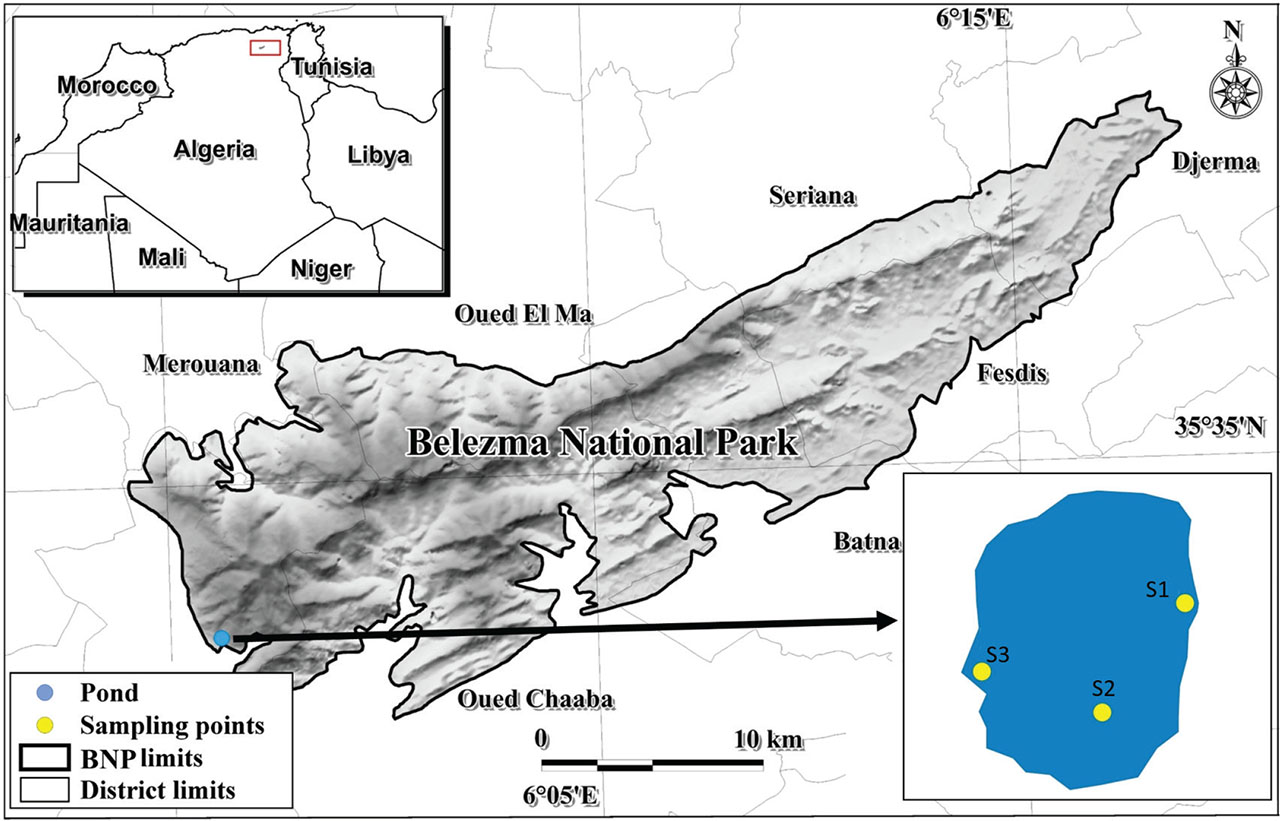
Figure 1.
Location of the three sampling stations in the studied pond of the Belezma biosphere reserve (Northern East of Algeria)
Abbildung 1. Standort der drei Probenahmestationen im untersuchten Teich des Biosphärenreservats Belezma (Nordostalgerien)
2.2. Physicochemical parameters and phytoplankton collection
To measure the physicochemical parameters of water, the structure of phytoplankton communities, and their seasonal and annual variation, we conducted continuous sampling regimen. This involved monthly collections from April 2017 to March 2019 at three sampling stations within the pond, resulting in a comprehensive dataset including 72 samples in total. Stations were chosen according to their accessibility, S1 in the east, S2 in the south, and S3 in the west. Water samples for physicochemical analysis were collected from a depth between 0.2 and 0.4 m in each station, placed in plastic bottles, stored in a cooler, and then transported to the laboratory. Four parameters were measured using a portable multiparameter detector for water quality in the real time: water temperature (WT) (°C), pH, electric conductivity EC (μs cm−1), and turbidity (NTU: Nephrometric Turbidity Unit). In addition, total dissolved solids (TDSs) (mg L−1), water salinity (‰), ammonium (NH4+ mg L−1), nitrates (NO3− mg L−1), nitrites (NO2− mg L−1), and dissolved oxygen (DO, mg L−1) were assessed in the laboratory on the same day of collection, following standardized protocols for water quality monitoring (AFNOR. 2005).
Phytoplankton sampling was carried out in the same three stations used for water sampling and at the same depth (0.2 and 0.4 m) with three samples collected from the pond per month. A volume of 50 L of water (Effendi et al., 2016; Draredja et al., 2019) was filtered through a plankton net (20-μm mesh size) in order to collect all types of algae which inhabit the same environments where water quality sampling was conducted. The collected phytoplankton samples were kept in small plastic containers with 5% formalin, then transported to the laboratory, and kept in the dark for later analysis.
Algae were identified to the lowest taxonomic level (usually genus) using appropriate keys (Prescott, 1954; Compère, 1974–1975; Sournia, 1984–1986; Bourrelly, 1988). Taxonomy was based on AlgaeBase: http://www.algaebase.org and WoRMS: http://www.marinespecies.org.
The counting of the different phytoplankton individuals was carried out in the laboratory using the Utermöhl method (1958) and performed by an inverted microscope. The count was performed on a designated chamber area of 10-ml volume and along horizontal paths across the entire length of the chamber. This procedure was replicated several times (at least three repetitions) to obtain averaged values that closely approximate the actual counts (Chaibi, 2013; Le et al., 2022; Caroppo et al., 2023).
2.3. Data analysis
Abundance frequency of different taxa (F%) was calculated by F% = (ni/N) × 100, where (ni) corresponds to the number of individuals of a given taxa and (N) represents the total number of microalgae individuals. In addition, taxa constancy index (concurrency index: Ci %) was calculated for all recorded phytoplanktons as Ci % = ni / N × 100, representing the number of appearance of a considered taxa (ni) relative to the total sample number (N) (Dajoz 2003). Results are expressed using the percentage with constancy scales of the taxa listed: constant taxa (C: Ci > 50%), accessory taxa (Ac: Ci = 25–49%), accidental taxa (A: Ci = 10–24%), and very accidental taxa (Va: Ci < 10%) (Bigot and Bodot, 1973). Diversity was evaluated by (i) total taxa richness (S) corresponding to the total number of taxa recorded in a sample; (ii) Shannon diversity index : H' = −∑ Pi log2 Pi, where Pi is the proportion by number of the taxa i (ni/N) in the community (Magurran 2004); and (iii) Pielou index (equitability index): E was calculated by the formula: E = H'/ln Smax, where H' = Shannon index, Smax = the maximum possible value of H', and it is equivalent to ln S. Diversity indices of Shannon and equitability were calculated using PAST3 software (Palaeontological Statistics, ver. 1.19).
Canonical correspondence analysis (CCA) was performed to relate the abundance of phytoplankton taxa to physicochemical quality of water and thus to highlight relationships between these variables: seasons and distribution of phytoplankton taxa. With its ability to combine ordination and gradient analysis functions, the CCA is convenient to visualize dimensional ecological data in a readily interpretable manner without prior transformation (Ter Braak, 1986; Palmer, 1993). During CCA computation, five physicochemical parameters of water were considered as quantitative explanatory variables, while seasons were considered as qualitative explanatory inputs: Spring: March, April, and May; summer: June, July, and August; autumn: September, October, and November; and winter: December, January, and February. The permutation test was used to test the significance of CCA with 1000 permutations at a significance level of 5%. As the computed p-value is lower than the significance level alpha = 0.05, we should accept the hypothesis that the sampled seasons/taxa, abundance data are linearly related to the seasons/physicochemical parameters. These analyses were conducted using XLSTAT 2016.
3. Results
3.1. Seasonal fluctuation of physicochemical parameters of water
The majority of water physicochemical parameters exhibit seasonal variation. For instance, water temperature demonstrated seasonal fluctuations, with values ranging from a low of 8.80±2.03 °C during winter 2018 to a high of 27.24±1.54 °C in summer 2017. Water was slightly alkaline, and the pH varied between 7.15 in summer 2018 and 8.79 in spring 2019. The highest value of water conductivity was recorded during winter 2018, reaching 729 μs cm−1; whereas the lowest value was observed in spring 2018 with 407 μs cm−1. The dissolved oxygen values ranged between 3.13 in winter 2019 and 5.11 mg L−1 in winter 2018. Nitrate and ammonium concentrations remained low throughout the sampling period. The highest nitrate concentration was detected in spring 2017, reaching 0.81 mg L−1, and the peak in ammonium level was observed in the same season with 0.03 mg L−1 (Table 1).
Table 1.
Seasonally variation of physicochemical parameters of water summarized with their means (±SD) and ranges for the natural pond of Belezma biosphere reserve
Tabelle 1. Saisonale Variation der physikalisch-chemischen Parameter des Wassers, zusammengefasst mit ihren Mittelwerten (±SD) und Bereichen für den Naturteich des Biosphärenreservats Belezma
| Water parameters | Spring 2017 Mean ± SD Range | Summer 2017 Mean ± SD Range | Autumn 2017 Mean ± SD Range | Winter 2018 Mean ± SD Range | Spring 2018 Mean ± SD Range | Summer 2018 Mean ± SD Range | Autumn 2018 Mean ± SD Range | Winter 2019 Mean ± SD Range | Spring 2019 Mean ± SD Range |
|---|---|---|---|---|---|---|---|---|---|
| Water temperature (°C) | 17.53±4.93 | 27.24±1.54 | 17.74±3.39 | 8.80±2.03 | 15.32±3.51 | 25.08±3.49 | 17.74±4.08 | 08.89±2.16 | 10.37±0.06 |
| 13.00–22.10 | 25.30–29.10 | 14.20–22.00 | 6.00–10.20 | 11.60–19.70 | 22.60–29.80 | 14.20–23.20 | 06.80–11.70 | 10.30–10.4 | |
| pH | 7.67±0.24 | 7.50±0.26 | 8.00±0.47 | 7.96±0.27 | 7.88±0.24 | 7.58±0.26 | 7.37±0.21 | 7.67±0.31 | 8.67±0.13 |
| 7.30–7.96 | 7.23–7.91 | 7.33–8.44 | 7.62–8.48 | 7.56–8.14 | 7.15–8.02 | 7.18–7.67 | 7.37–8.13 | 8.54–8.79 | |
| Conductivity (μs cm−1) | 478.2±52.2 | 512.0±79.4 | 579.9±47.9 | 609.9±81.1 | 479.2±48.0 | 572.1±30.1 | 562.9±59.1 | 533.1±72.2 | 563.3±11.9 |
| 423–533 | 413–616 | 532–652 | 511–729 | 407–537 | 534–621 | 467–613 | 439–622 | 556–577 | |
| Salinity (‰) | 0.15±0.05 | 0.13±0.05 | 0.20±0.00 | 0.26±0.05 | 0.16±0.05 | 0.22±0.04 | 0.20±0.00 | 0.17±0.10 | 0.20±0.00 |
| 0.10–0.20 | 0.10–0.20 | 0.20–0.20 | 0.20–0.30 | 0.10–0.20 | 0.20–0.30 | 0.20–0.20 | 0.10–0.30 | 0.20–0.20 | |
| Turbidity (NTU) | 2.60±0.42 | 5.31±2.07 | 5.39±2.76 | 5.01±2.30 | 4.14±1.75 | 4.96±1.64 | 6.78±3.55 | 7.32±5.56 | 7.15±1.16 |
| 2.11–3.16 | 2.77–8.44 | 1.79–9.32 | 2.20–9.27 | 2.02–7.60 | 2.49–8.02 | 2.09–12.94 | 2.24–17.60 | 6.29–8.47 | |
| TDS (mg L−1) | 201.0±8.9 | 191.4±14.1 | 192.0±12.8 | 188.6±8.8 | 204.9±15.2 | 206.2±12.6 | 212.6±21.9 | 191.4±18.2 | 272.0±20.0 |
| 184–233 | 171–211 | 174–213 | 201–177 | 177–224 | 189–223 | 175–242 | 162–233 | 259–295 | |
| NH4+ (mg L−1) | 0.01±0.08 | 0.01±0.00 | 0.01±0.01 | 0.01±0.01 | 0.01±0.01 | 0.01±0.01 | 0.01±0.01 | 0.01±0.01 | 0.01±0.00 |
| 0.00–0.03 | 0.01–0.02 | 0.00–0.01 | 0.00–0.01 | 0.00–0.01 | 0.01–0.02 | 0.00–0.02 | 0.00–0.02 | 0.01–0.01 | |
| NO3− (mg L−1) | 0.41±0.22 | 0.06±0.07 | 0.15±0.13 | 0.05±0.7 | 0.07±0.11 | 0.09±0.10 | 0.27±0.22 | 0.14±0.17 | 0.01±0.00 |
| 0.16–0.81 | 0.00–0.19 | 0.00–0.39 | 0.00–0.18 | 0.00–0.28 | 0.00–0.31 | 0.00–0.71 | 0.00–0.39 | 0.01–0.01 | |
| NO2−(mg L−1) | 0.01±0.04 | 0.01±0.00 | 0.01±0.00 | 0.01±0.00 | 0.01±0.01 | 0.01±0.00 | 0.01±0.00 | 0.01±0.01 | 0.01±0.00 |
| 0.00–0.01 | 0.01–0.01 | 0.01–0.02 | 0.00–0.01 | 0.00–0.01 | 0.00–0.01 | 0.01–0.02 | 0.00–0.03 | 0.01–0.01 | |
| Dissolved oxygen (mg L−1) | 3.64±0.27 | 3.66 ±0.27 | 3.62±0.20 | 4.35±0.48 | 3.50±0.24 | 3.83±0.36 | 3.85±0.57 | 3.55±0.33 | 3.72±0.015 |
| 3.33–4.12 | 3.29–4.16 | 3.34–4.04 | 3.67–5.11 | 3.16–4.02 | 3.37–4.32 | 3.15–4.64 | 3.13–4.00 | 3.55–3.82 |
3.2. Structure and organization of phytoplankton communities
Overall, 50 taxa of phytoplankton belonging to 6 phyla, 6 classes, 21 orders, and 31 families were recorded in the studied pond. The Chlorophyceae class showed the highest representation with 17 genera, followed by Bacillariophyceae (15 genus), Cyanophyceae (8), Zygnematophyceae (5), Dinophyceae (3), and Euglenophyceae (2) (Table 2).
Table 2.
Taxonomic list, abundance frequency, and accuracy scale of phytoplankton taxa identified in the pond of Belezma biosphere reserve. F%: Abundance frequency. Constant taxa (C), accessory taxa (Ac), accidental taxa (A), very accidental taxa (Va)
Tabelle 2. Taxonomische Liste, Häufigkeit und Genauigkeitsskala der im Teich des Biosphärenreservats Belezma identifizierten Phytoplankton-Taxa. F%: Häufigkeit der Häufigkeit. Konstante Taxa (C), akzessorische Taxa (Ac), zufällige Taxa (A), sehr zufällige Taxa (Va).
| Phylum | Class | Order | Family | Genus/species | F% (accuracy scale) |
|---|---|---|---|---|---|
| Euglenozoa | Euglenophyceae | Euglenales | Euglenaceae | Euglena sp Ehrenberg, 1830 | 0.04 (A) |
| Phacaceae | Phacus sp Dujardin, 1841 | 0.13 (C) | |||
| Mizozoa | Dinophyceae | Gymnodiniales | Gymnodiniaceae | Gymnodinium sp Stein, 1878 | 0.10 (C) |
| Prorocentrales | Prorocentraceae | Prorocentrum sp Ehrenberg, 1834 | 0.01 (Va) | ||
| Thoracosphaerales | Thoracosphaeraceae | Scrippsiella sp Balech, 1965 | 0.06 (Ac) | ||
| Charophyta | Zygnematophyceae | Desmidiales | Closteriaceae | Closterium moniliferum Ehrenberg ex Ralfs, 1848 | 0.01 (Va) |
| Closterium sp Nitzsch ex Ralfs, 1848 | 0.10 (C) | ||||
| Desmidiaceae | Cosmarium sp Corda ex Ralfs, 1848 | 0.15 (C) | |||
| Spirogyrales | Spirogyraceae | Spirogyra sp Link, 1820 | 0.31 (Ac) | ||
| Zygnematales | Zygnemataceae | Zygnema stellinum Müller & Agardh, 1824 | 0.07 (A) | ||
| Cyanobacteria | Cyanophyceae | Nostocales | Aphanizomenonaceae | Anabaena sp Bory de Saint-Vincent ex Bornet & Flahault, 1886 | 12.27 (C) |
| Chroococcales | Chroococcaceae | Chroococcus turgidus Kützing Nägeli, 1849 | 0.13 (A) | ||
| Microcystaceae | Microcystis aeruginosa Kützing, 1846 | 1.29 (C) | |||
| Microcystis sp Lemmermann, 1907 | 0.46 (Ac) | ||||
| Merismopedia sp Meyen, 1839 | 0.96 (Ac) | ||||
| Oscillatoriales | Microcoleaceae | Lyngbya sp Gomont, 1892 | 7.15 (C) | ||
| Oscillatoriaceae | Oscillatoria sp Gomont, 1892 | 27.62 (C) | |||
| Pseudanabaenales | Pseudanabaenaceae | Pseudanabaena sp Lauterborn, 1915 | 2.34 (C) | ||
| Bacillariophyta | Bacillariophyceae | Thalassiophysales | Catenulaceae | Amphora ovalis Kützing, 1844 | 0.22 (C) |
| Amphora sp Kützing, 1844 | 0.88 (C) | ||||
| Achnanthales | Cocconeidaceae | Cocconeis sp Ehrenberg, 1836 | 0.60 (C) | ||
| Cymbellales | Cymbellaceae | Cymbella sp Agardh, 1830 | 0.07 (Ac) | ||
| Fragilariales | Fragilariaceae | Diatoma sp Bory, 1824 | 0.03 (Ac) | ||
| Synedra ulna Ehrenberg, 1832 | 0.86 (C) | ||||
| Synedra sp Ehrenberg, 1830 | 0.62 (C) | ||||
| Naviculales | Pleurosigmataceae | Gyrosigma acuminatum Kützing Rabenhorst, 1853 | 0.15 (C) | ||
| Naviculaceae | Navicula gregaria Donkin, 1861 | 0.76 (C) | |||
| Navicula radiosa Kützing, 1844 | 2.47 (C) | ||||
| Navicula sp Bory de Saint-Vincent, 1822 | 0.43 (C) | ||||
| Melosirales | Melosiraceae | Melosira granulata Ehrenberg, 1861 | 6.52 (C) | ||
| Melosira sp Agardh, 1824 | 2.37 (C) | ||||
| Bacillariales | Bacillariaceae | Nitzschia longissima Brébisson Ralfs, 1861 | 0.57 (C) | ||
| Nitzschia sp Hassall, 1845 | 13.18 (C) | ||||
| Chlorophyta | Chlorophyceae | Chlamydomonadales | Tetrasporaceae | Tetraspora sp Link ex Desvaux,1818 | 1.56 (C) |
| Chlamydomonadaceae | Chlamydomonas sp Ehrenberg, 1833 | 3.71 (C) | |||
| Goniaceae | Gonium sp Muller, 1773 | 0.02 (Va) | |||
| Volvocaceae | Volvox sp Linnaeus, 1758 | 0.57 (Ac) | |||
| Pandorina sp Bory de Saint-Vincent, 1824 | 0.07 (A) | ||||
| Sphaeropleales | Hydrodictyaceae | Hydrodictyon sp Roth, 1797 | 0.44 (Ac) | ||
| Pediastrum boryanum Turpin Meneghini, 1840 | 0.50 (C) | ||||
| Pediastrum simplex Meyen, 1829 | 0.59 (C) | ||||
| Pediastrum duplex Meyen, 1829 | 0.10 (A) | ||||
| Pediastrum sp Meyen, 1829 | 6.22 (C) | ||||
| Tetrahedron sp Kutzing, 1845 | 0.15 (Ac) | ||||
| Radiococcaceae | Palmodictyon sp Kutzing, 1845 | 0.03 (Va) | |||
| Scenedesmaceae | Scenedesmus acuminatus Lagerheim Chodat, 1902 | 0.13 (Ac) | |||
| Scenedesmus quadricauda Turpin Brébisson, 1835 | 0.43 (C) | ||||
| Scenedesmus opoliensis Richter, 1895 | 0.02 (Va) | ||||
| Scenedesmus sp Meyen, 1829 | 0.05 (Ac) | ||||
| Oedogoniales | Oedogoniaceae | Oedogonium sp Link ex Hirn, 1900 | 2.45 (C) |
Oscillatoria sp with the highest abundance frequency (F% = 27.62%) were the most represented in the sample, followed by Nitzschia sp (F% = 13.18%) and Anabaena sp (F = 12.27%). Nevertheless, the other taxa were less frequent with F% < 7.15% (Table 2).
According to the constancy index, most of the taxa were of constant accuracy (58%), and few were accessory (22%), when five taxa were accidental (10%) (Euglena sp, Zygnema stellinum, Chroococcus turgidus, Pandorina sp, Pediastrum duplex) and five taxa were very accidental (10%) (Prorocentrum sp, Closterium moniliferum, Gonium sp, Palmodictyon sp and Scenedesmus opoliensis) (Table 2).
3.3. Seasonal distribution of phytoplankton communities
During all the studied seasons, we observed the proliferation of Bacillariophyceae compared to other classes. The highest abundance was obvious during the winter seasons (50% in 2018 and 52% in 2019). The Chlorophyceae mostly increased in spring 2018 (33%). The peak of total abundance for Cyanophyceae was recorded in winter and spring 2019 (21% for both seasons). The highest abundance of Zygnematophyceae was observed in spring 2017 (9%) and summer 2018 (9%). Euglenophyceae were most represented in spring 2018 (5%), and Dinophyceae in summer 2017 (6%) and 2018 (6%). However, Dinophyceae were totally absent in winter 2018, 2019, and spring 2019 (Figure 2).
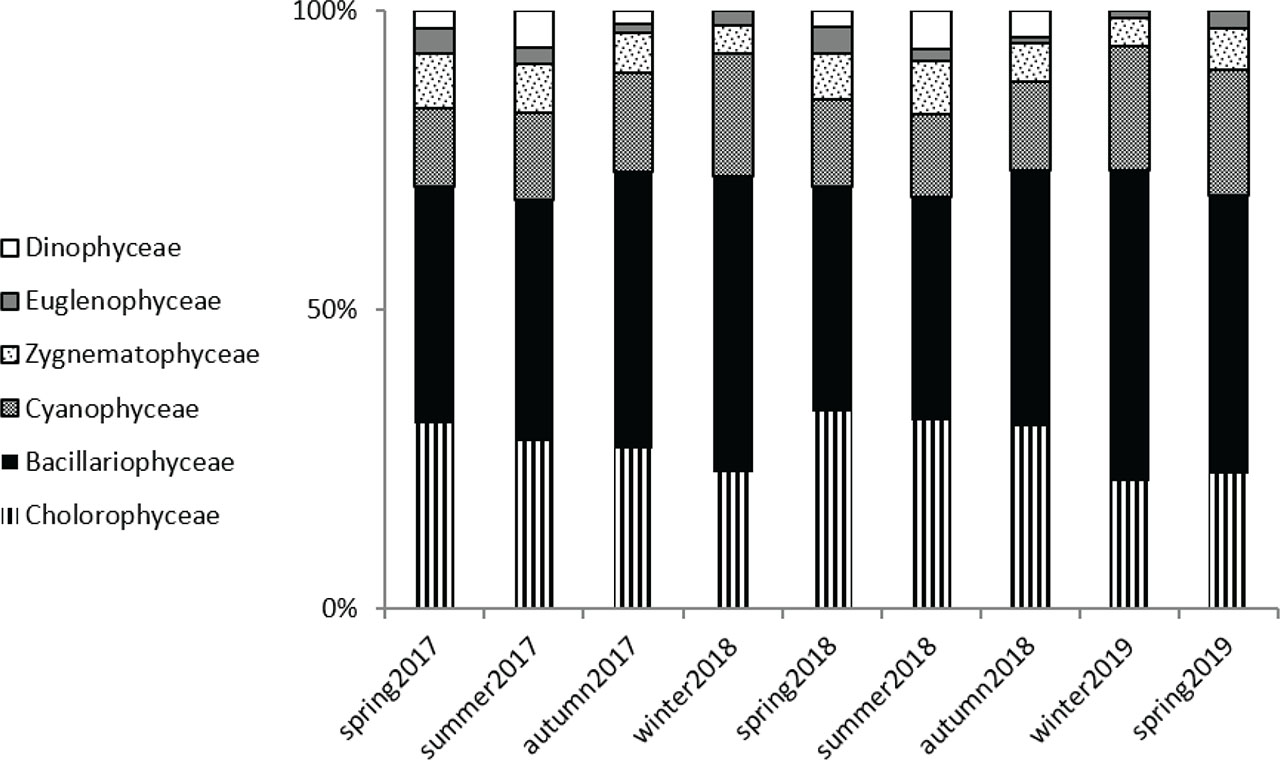
Figure 2.
Seasonal variation of the communities' composition of phytoplankton in a natural mountain pond of Belezma biosphere reserve
Abbildung 2. Saisonale Variation der Phytoplanktonzusammensetzung der Gemeinschaften in einem natürlichen Bergteich des Biosphärenreservats Belezma
The abundance frequency of phytoplankton vary significantly across seasons. The results showed that summer 2018 represented the highest abundance frequency with F% = 21%, followed by summer 2017 and spring 2018 (F% = 17%). Microalgae were less frequent in Spring 2019 with only 2% (Table 3).
Table 2.
Taxonomic list, abundance frequency, and accuracy scale of phytoplankton taxa identified in the pond of Belezma biosphere reserve. F%: Abundance frequency. Constant taxa (C), accessory taxa (Ac), accidental taxa (A), very accidental taxa (Va).
Tabelle 2. Taxonomische Liste, Häufigkeit und Genauigkeitsskala der im Teich des Biosphärenreservats Belezma identifizierten Phytoplankton-Taxa. F%: Häufigkeit der Häufigkeit. Konstante Taxa (C), akzessorische Taxa (Ac), zufällige Taxa (A), sehr zufällige Taxa (Va).
| Abundance and diversity | Spring 2017 | Summer 2017 | Autumn 2017 | Winter 2018 | Spring 2018 | Summer 2018 | Autumn 2018 | Winter 2019 | Spring 2019 |
|---|---|---|---|---|---|---|---|---|---|
| N | 2783 | 4321 | 2562 | 1413 | 4320 | 5371 | 3390 | 1275 | 595 |
| F% | 11 | 17 | 10 | 5 | 17 | 21 | 13 | 5 | 2 |
| S | 44 | 43 | 43 | 38 | 48 | 48 | 45 | 38 | 37 |
| H′ | 2.60 | 2.30 | 2.29 | 2.31 | 2.70 | 2.52 | 2.20 | 2.40 | 2.30 |
| E | 0.69 | 0.61 | 0.61 | 0.64 | 0.70 | 0.65 | 0.58 | 0.66 | 0.64 |
The total taxa richness “S” of phytoplankton varies between seasons and ranged from 37 taxa in spring 2019 to 48 taxa in spring and summer 2018. The highest Shannon diversity index (H' = 2.70) was observed in spring 2018, while the decrease of diversity was pronounced in autumn 2018, where the lowest value was calculated (H' = 2.20). The equitability values were ranged from 0.58 to 0.70 (Table 3).
The canonical correspondence analysis (CCA) was applied to highlight any correlation between physicochemical parameters and their variation during studied seasons and abundance of phytoplankton. Axis 1 explained 73.10% of inertia of the variation in the phytoplankton abundance with eigenvalue of 0.0047183, and Axis 2 explained 19.58% of inertia with eigenvalue of 0.0015583. A permutation test (1000 permutations) confirmed the significance of the first two axes (p = 0.042) (Figure 3).
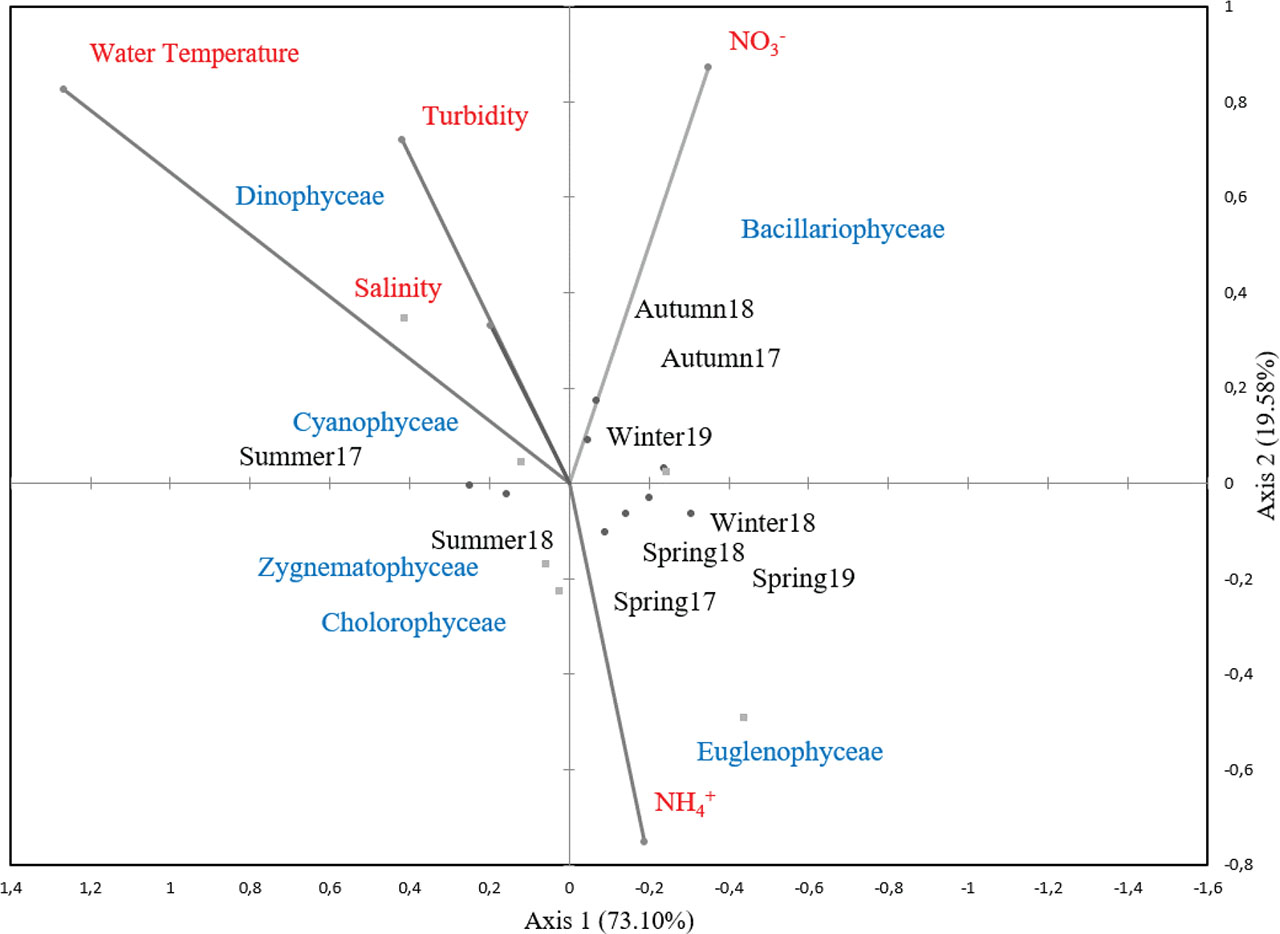
Figure 3.
Canonical correspondence analysis (CCA) plots showing the distribution of phytoplankton according to seasons and physicochemical parameters of water in the pond of the Belezma National Park reserve
Abbildung 3. Diagramme der kanonischen Korrespondenzanalyse (CCA), die die Verteilung des Phytoplanktons nach Jahreszeiten und physikalischchemischen Parametern des Wassers im Teich des Belezma-Nationalparkreservats zeigen
From intra-set regressions of physicochemical parameters with the two axes of the CCA, water temperature (WT), turbidity, salinity, nitrates, and ammonium act as the most important parameters affecting phytoplankton abundance. However, pH, conductivity, total dissolved solids, nitrites, and dissolved oxygen were not taken into consideration due to their low variations depending on the seasons.
According to our analysis, water temperature (WT), turbidity, and salinity are negatively correlated with ammonium, and the highest concentration is relatively recorded in spring 2017, 2018, and 2019 and winter 2018. In addition, high concentration of nitrates was observed during the autumn 2017 and 2018.
Dinophyceae and Cyanophyceae showed a preference for warmer waters with high water temperature, turbidity, and salinity. These taxa appear to be suitable in summer season. Bacillariophyceae positively correlated with nitrates and were abundant during autumn 2017 and 2018. Euglenophyceae tolerated high ammonium levels and were suitable for the three sampled spring seasons. Zygnematophyceae and Chlorophyceae do not seem to be affected by the physicochemical parameters taken into consideration (water temperature (WT), turbidity, salinity, nitrates, and ammonium) in our study; they generally exhibit a preference for the summer season.
4. Discussion
This study provides new information on the physicochemical and biological quality of the studied pond of Belezma biosphere reserve, with new insights into the physicochemical determinants of phytoplankton community composition and seasonal distribution patterns. It is important to point out that the studied pond is located in a semi-arid region that exhibits pronounced seasonal fluctuations in terms of precipitation and water levels, while the anthropogenic impact is practically insignificant.
Our results showed that warmer temperatures of water are observed in spring and summer, which favors the proliferation of phytoplankton. The water temperature is an important factor that influences the annual change in phytoplankton communities (Chen et al., 2016). The high-temperature levels, both air and water, allow an increase in the metabolic rates of these organisms, allowing them to grow and reproduce more quickly (Ferrari, 2020). The pH values of the water were slightly alkaline. The optimal pH for planktonic growth is generally in a neutral to slightly basic range usually between 7.0 and 8.5. This pH range, also recorded in our study site, provides favorable conditions for the growth and reproduction of planktonic organisms by maintaining a chemical environment suitable for metabolic processes (Arab et al., 2019). The low concentrations of nitrates, nitrites, and ammonium recorded throughout the study period globally reflect the good quality of the water in the pond studied despite the significant variations in the seasonal precipitation regime. This can be attributed to the location of the pond within a protected area, with very little exposure to urban sources of pollution or agricultural discharges. These latter are a major cause of the presence of nitrates and nitrites in surface waters and contribute to the appearance of eutrophication phenomena (Zendehbad et al., 2022).
The phytoplankton inventory includes 50 taxa with the dominance of Chlorophyceae, Bacillariophyceae, and Cyanophyceae groups in terms of taxa number, abundance, and accuracy frequencies. Indeed, these groups are the main phytoplankton components in the Mediterranean region (Öterler et al., 2015; Draredja et al., 2019). Among the recorded microalgae in the pond, the genus Nitzschia, Navicula, Oscillatoria, Cymbella, and Microcystis are considered good indicators of pollution as described by Sharma and Tiwari (2018). The presence of Euglena sp and Phacus sp is a direct indication of the beginning of pollution load since both these genera are considered to be dominant and tolerant genera of polluted ponds (Ghosh and Keshri, 2010).
Throughout the seasons studied, the overall abundance frequency and diversity of phytoplankton communities varied considerably. Summer 2018 showed a higher abundance in phytoplankton numbers likely due to relatively higher water temperatures and increased nutrient availability. Conversely, in spring 2019, phytoplankton recorded a low frequency of abundance which would be related to the low spring precipitation (162.82 mm), knowing that the water system of the pond studied is mainly influenced by precipitations. In addition, this season was only represented by one month of sampling (March 2019).
In terms of diversity, the calculated parameters (specific diversity, H' and E) generally indicate that spring allows the establishment of a diverse microalgal community with equally distributed populations. However, autumn showed the lowest values, suggesting that the phytoplankton diversity varied depending on environmental conditions conducive to phytoplankton growth, including temperature, pH, dissolved oxygen, and water levels (Xiaoqian et al., 2017; Basim et al., 2021).
During the seasons studied, Bacillariophyceae, Chlorophyceae, and Cyanophyceae were the most abundant phytoplankton classes, but each of the six inventoried classes showed a different seasonal variation. This pattern of growth aligns with findings from Basim et al. (2021), who observed similar seasonal proliferation in these phytoplankton classes in the semi-arid marshes of Iraq and the Nador lagoon (Morocco) by Daoudi et al. (2012). It also indicates a dynamic balance within aquatic ecosystems in semi-arid areas, where different microalgae groups dominate based on the prevailing environmental conditions, ensuring ecological resilience and stability. For example, the Bacillariophyceae showed a high abundance in winter due to the physiological adaptations that allow them to thrive in cold water temperatures (Rampen et al., 2011). This includes a robust cellular structure and efficient nutrient absorption mechanisms. Bacillariophyceae are considered a euryhaline and eurythermal phytoplankton group, generally adapted to low light levels (Ben Brahim et al., 2015). Furthermore, algae species that thrive in cooler temperatures might be more nutritious or easier to digest for herbivorous species. As these algae decline in warmer seasons, the species that depend on them might face food shortages or have to switch to less optimal food sources, potentially leading to reduced growth and reproduction rates (Rampen et al., 2011).
Chlorophyceae were more abundant in spring and summer, but without showing notable representativeness during a given season. This explains the several adaptive traits that enable them to resist and thrive among environmental changes characteristic of these seasons (Lodang and Kurnia, 2019). Our results indicate a similar decline in Euglenophyceae abundance during spring and summer. Arab et al. (2019) also showed the presence of Euglenophyceae throughout the year with low abundance during the summer in Boukourdane Lake (Algeria). Ultimately, climate change can significantly affect the algae community in a pond by altering key environmental factors such as temperature, light availability, and nutrient levels, especially in such arid environment. Increasing temperatures may favor the growth of certain algae species while suppressing others, potentially leading to shifts in community composition (Celewicz and Gołdyn, 2021). According to CCA analysis, Bacillariophyceae abundance was positively correlated with nitrate concentration, specifically during the autumn season, indicating their association with these colder periods and influence by nitrate levels. These taxa often respond positively to increased nutrient availability, particularly nitrogen compounds (Lepori and Tolotti, 2023). The presence of nitrate even in low concentrations in the studied pond can stimulate phytoplankton growth, leading to increased primary production and potentially fueling higher trophic levels in the food web (Basim et al., 2021). The positive correlation found between Euglenophyceae abundance and ammonium levels, even represented by traces in water, suggests that microalgae growth heavily relies on ammonium. Indeed, these organisms can utilize ammonium as a nitrogen source for the synthesis of essential cellular components, such as proteins and nucleic acids (Gogoi et al., 2019).
Meanwhile, the CCA analysis indicates that salinity directly impacts the distribution of Cyanophyceae and Dinophyceae in the studied pond. These taxa adapted to freshwater thrive within a salinity range of 0.1–0.3 ‰ (Takarina and Wardhana, 2016). Otherwise, the correlation between these two taxa and water temperature strongly suggests their abundance during summer, characterized by the highest temperatures among the other studied seasons. The results of this study are consistent with those from Morton et al. (1992), who observed that these taxa could live and thrive between 21 and 36 °C. Within this range, 27 °C was identified as the most favorable or optimal temperature for their growth. Several studies showed a correlation indicating that the abundance of Cyanophyceae was strongly influenced by temperature variations (Sharma and Tiwari, 2018). Water turbidity is caused by the presence of particles (phytoplankton or other suspended matter) (Domaizon et al., 2012) which suggests the correlation revealed between turbidity and the abundance of Cyanophyceae and Dinophyceae. A similar trend was observed by Nasution et al. (2021) in Jakarta Bay (Indonesia) and in a tropical wetland (Sundarbans, India) by Gogoi et al. (2019).
Our study revealed that phytoplanktons in the Belezma biosphere reserve's natural pond are highly responsive to seasonal changes which have a significant impact on water quality. Warmer seasons (spring and summer) are characterized by higher abundance, species richness, and evenness, which likely reflects optimal growth conditions. In contrast, the colder seasons (autumn and winter) exhibit lower abundance and richness, as harsher conditions limit phytoplankton diversity. This demonstrates a certain vulnerability of algal communities and natural mountain pond ecosystems, requiring management actions for their conservation, in particular, by ensuring a regular water supply during dry periods.
Acknowledgements
The authors are extremely grateful to the Belezma Biosphere reserve office for facilitating the fieldwork within the Belezma National Park territory. Dr. Abdelkrim Arar is also thanked for his invaluable help.