
Table 1
Chemical characteristics of the experimental soil
Tabelle 1. Chemische Eigenschaften des Versuchsbodens
| Site | pH | EC (ds per m) | Organic carbon (%) | Nitrogen (%) | Phosphorus (kg per ha) | Potassium (kg per ha) |
|---|---|---|---|---|---|---|
| Tamia | 6.9 | 0.53 | 0.91 | 0.154 | 14.71 | 190.11 |
[i] Values (except for EC and pH) indicate average values of soils used to collect PGPR; pH and EC values were similar in all the fields.
[ii] PGPR: plant growth-promoting rhizobacteria
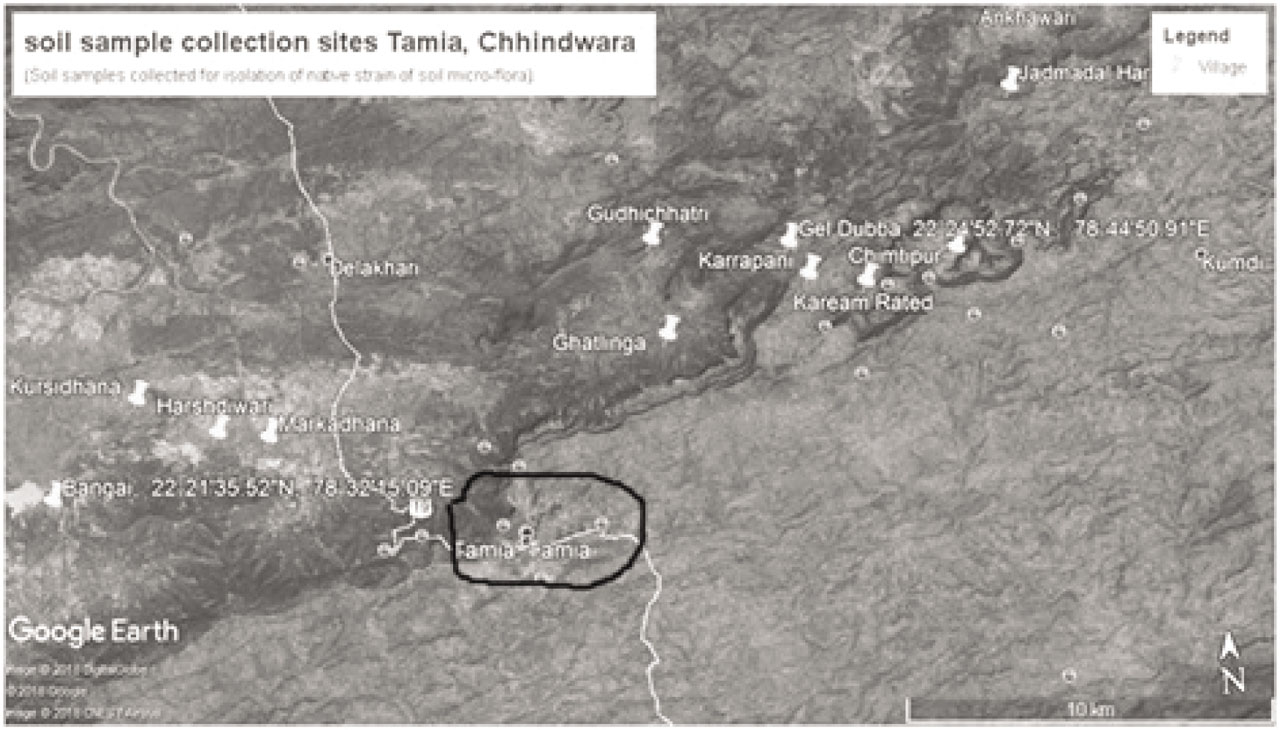
Figure 1
Geographical position of the experimental site
Abbildung 1. Geografische Position des Versuchsstandorts
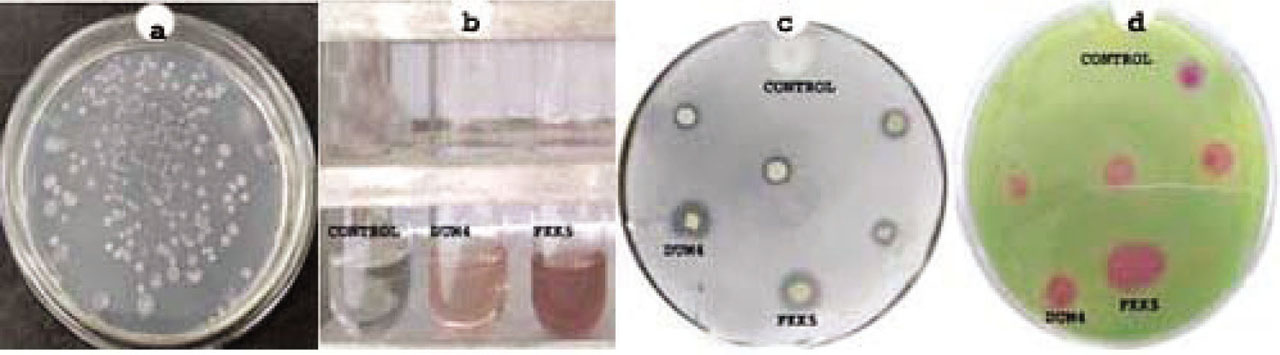
Figure 2
Rhizobacterial isolates on Jensen's nitrogen-free medium (a) and PGPR activities such as IAA production (b), phosphate solubilization on Pikovskaya's medium (c), and siderophore production (d) exhibited by selected rhizobacterial strains, DUM4 and FKK5; IAA: indole acetic acid; PGPR: plant growth-promoting rhizobacteria
Abbildung 2. Rhizobakterielle Isolate auf Jensens stickstofffreiem Medium (a) und PGP-Aktivitäten wie IAA-Produktion (b), Phosphat-Solubilisierung auf Pikovskaya-Medium(c) und Siderophor-Produktion (d) bei ausgewählten Rhizobakterien-Stämmen DUM4 und FKK5
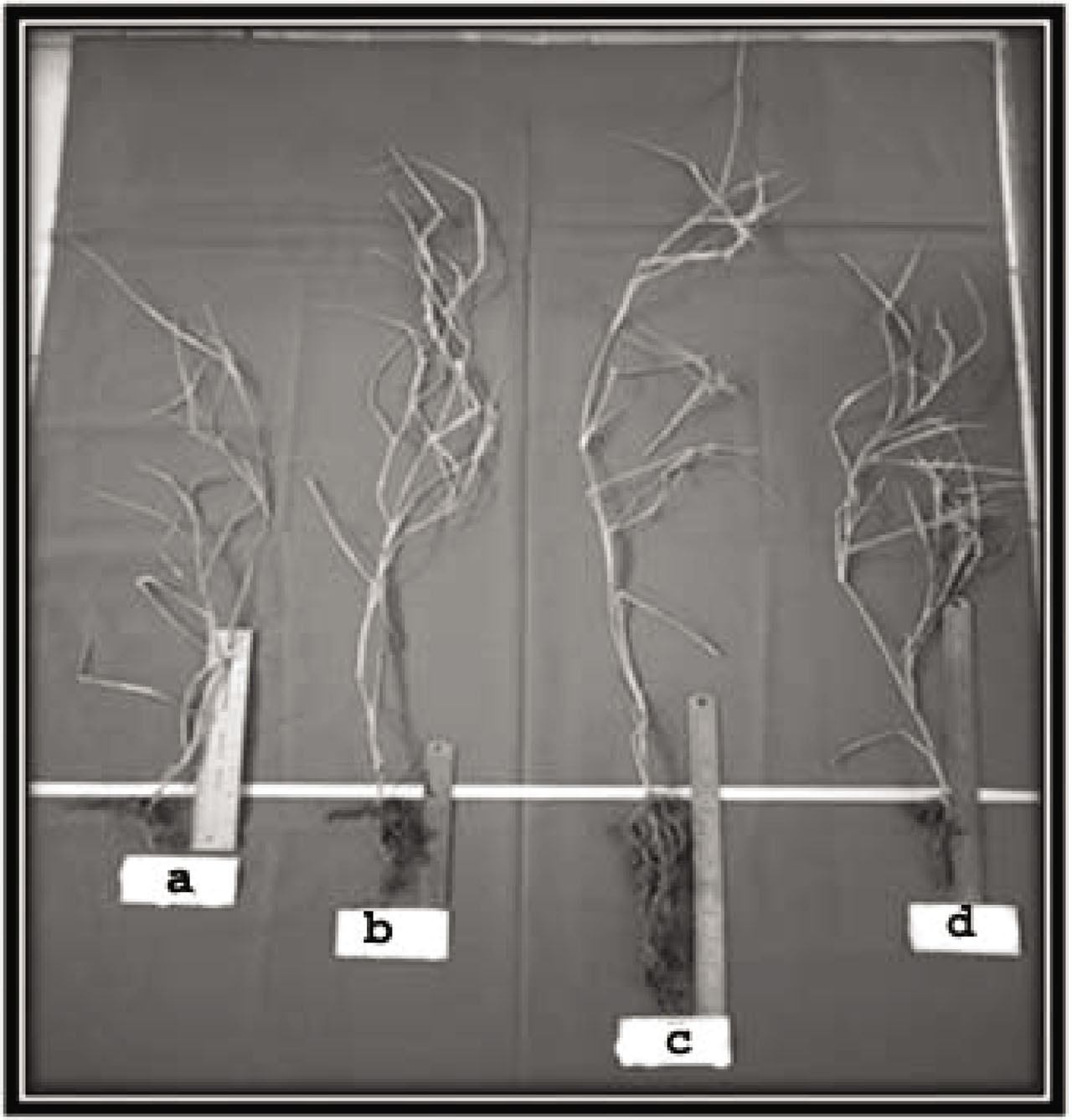
Figure 3
Effect of different bioinocula (a = control, b = FKK5, c = DUM4, and d = Azotobacter chroococcum) priming on the vegetative growth of little millet. The best among three of every treatment is shown
Abbildung 3. Wirkung verschiedener Bioinokula (a = Kontrolle, b = FKK5, c = DUM4 und d = A. chroococcum) Priming auf das vegetative Wachstum kleiner Hirse. Die Beste unter den Dreien jeder Behandlung wird gezeigt.
Table 2
Effect of native and non-native bioinocula priming on important growth characteristics (mean ± SE, n = 3) of little millet after 85 days of sowing before harvest in pot trials
Tabelle 2. Wirkung von Priming nativer und nicht nativer Bioinokula auf wichtige Wachstumsmerkmale (Mittelwert ± SE, n = 3) von Hirse nach 85 Tagen Aussaat vor der Ernte in Topfversuchen
| Treatment Length | Plant height (cm) | Stem diameter (mm) | No. of leaves | No. of tillers (per plant) | Panicle length (cm) |
|---|---|---|---|---|---|
| Non-inoculated | 62.5±2.47b | 1.96 ± 0.13a | 09.66 ± 1.20a | 3.66± 0.33a | 11.33 ± 0.52a |
| Azotobacter chroococcum | 57.6 ± 2.04a | 2.66 ± 0.14b | 14.66 ± 1.45b | 4.33 ± 0.33b | 11.66 ± 0.29b |
| FKK5 | 69.0 ± 2.17c | 2.93 ± 0.17d | 15.40 ± 1.76c | 4.66 ± 0.33d | 13.23 ± 0.52d |
| DUM4 | 72.0 ± 2.62d | 2.76 ± 0.19c | 17.00 ± 1.15d | 4.53 ± 0.33c | 13.10 ± 0.64c |
| LSD (p ≤ 0.05) | 6.16 | 0.44 | 4.04 | 1.38 | 1.54 |
[i] Values within the same column followed by different superscript letters are significantly different at p ≤ 0.05 level. LSD: least significant differences; SE: standard error
Table 3
Effect of native and non-native bioinocula priming on important growth characteristics (mean ± SE, n = 3) of little millet at the harvest
Tabelle 3. Einfluss des Primings von nativen und nicht nativem Bioinokulen auf wichtige Wachstumsmerkmale (Mittelwert ± SE, n = 3) von Hirse bei der Ernte
| Treatment | Root length (cm) | Root dry weight (g) | Total plant biomass (g) | Seed weight per plant (g) |
|---|---|---|---|---|
| Non-inoculated | 10.30 ± 1.27a | 0.163 ± 0.02a | 1.01 ± 0.07a | 0.360 ± 0.01a |
| Azotobacter chroococcum | 12.90 ± 0.47b | 0.197 ± 0.01b | 1.19 ± 0.01b | 0.433 ± 0.03b |
| FKK5 | 13.60 ± 0.55c | 0.206 ± 0.01c | 1.24 ± 0.06d | 0.460 ± 0.02d |
| DUM4 | 17.00 ± 1.82d | 0.279 ± 0.01d | 1.22 ± 0.03c | 0.449 ± 0.01c |
| LSD (p ≤ 0.05) | 3.21 | 0.05 | 0.07 | 0.08 |
[i] Values within the same column followed by different superscript letters are significantly different at p ≤ 0.05 level. LSD: least significant differences; SE: standard error
Table 4
Priming effect of native and non-native bioinocula on grain and biomass yield enhancement (IE) (mean ± SE, n = 3)
Tabelle 4. Priming-Effekt von nativen und nicht nativem Bioinokula auf Getreide- und Biomasseertragssteigerung (IE) (Mittelwert ± SE, n = 3)
| Inoculum | Grain (seed) yield enhancement (%) | Total biomass yield enhancement (%) |
|---|---|---|
| FKK5 | 28.14 ± 8.93c | 23.08 ± 2.23c |
| DUM4 | 24.72 ± 3.62b | 21.87 ± 5.58b |
| Azotobacter chroococcum | 20.43 ± 9.78a | 19.09 ± 9.34a |
[i] Values are the means ± SE. Values within the same column followed by different superscript letters are significantly different at p ≤ 0.05 level. IE: inoculation effectiveness; SE: standard error
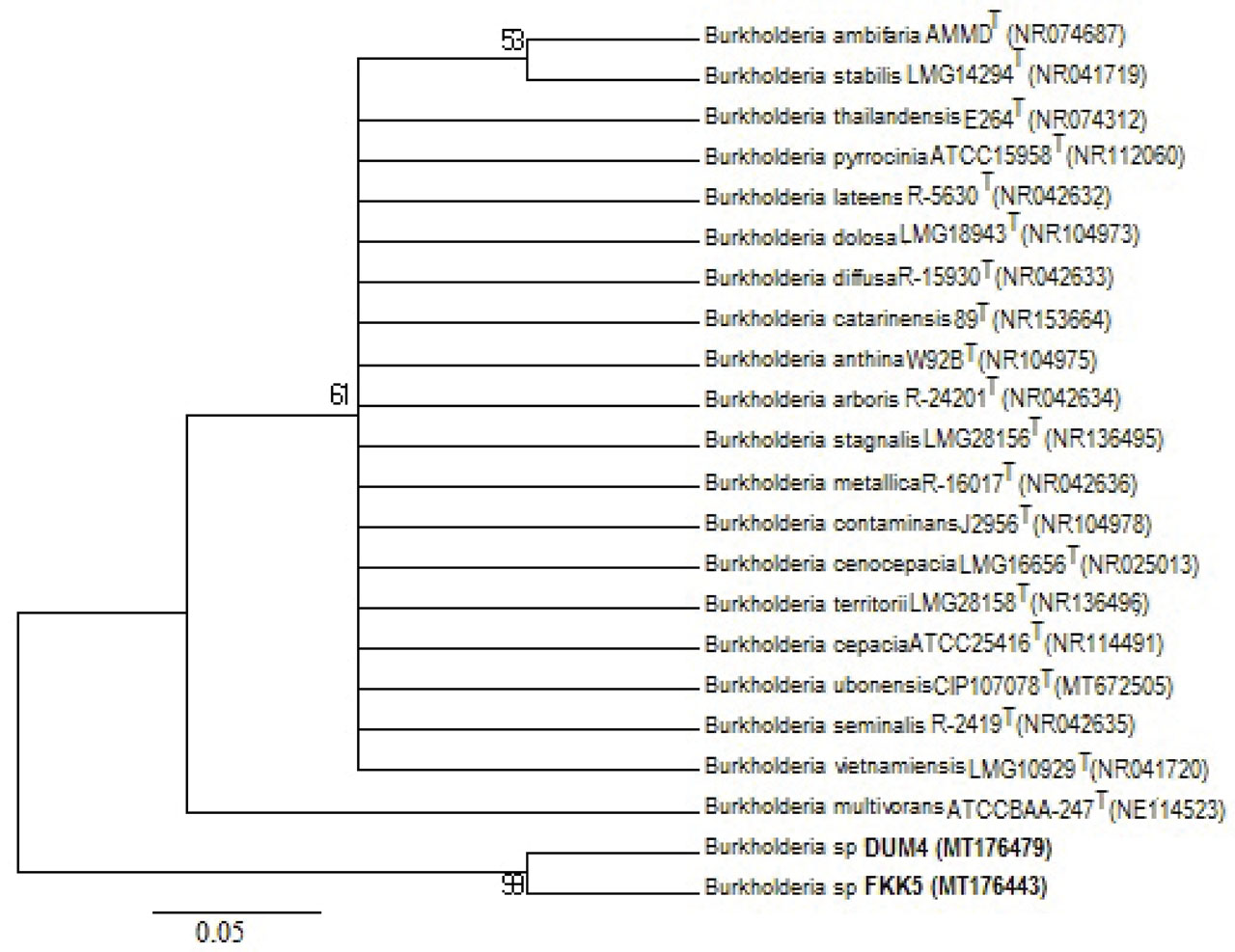
Figure 4
Dendrogram showing the evolutionary relationship of DUM4 and FKK5 with type strains of closely related taxa in the NCBI database, applying neighbor-joining method. The branch length indicates evolutionary distance. Maximum composite likelihood method was used to calculate the evolutionary distance, with units used being the number of base substitutions per site. Sequence accession number is given before the name of taxon. The numbers at the nodes represent bootstrap percent values from 1000 replicates. All positions containing gaps and missing data were eliminated. The analyses were carried out in MEGA6. Dendrogram was condensed with cut-off value 50% for the tree
Abbildung 4. Dendrogramm, das die evolutionäre Beziehung von DUM4 und FKK5 mit Typstämmen eng verwandter Taxa in der NCBI-Datenbank unter Anwendung der Neighbor-Joining-Methode zeigt. Die Astlänge zeigt die evolutionäre Distanz an. Die Maximum-Composite-Likelihood-Methode wurde verwendet, um die evolutionäre Distanz zu berechnen, und die verwendeten Einheiten sind die Anzahl der Basensubstitutionen pro Stelle. Die Sequenzzugangsnummer wird vor dem Namen des Taxons angegeben. Die Zahlen an den Knoten stellen Bootstrap-Prozentwerte von 1000 Replikaten dar. Alle Stellen mit Lücken und fehlenden Daten wurden eliminiert. Die Analysen wurden in MEGA6 durchgeführt. Das Dendrogramm wurde mit einem Cut-Off-Wert von 50% für den Baum verdichtet.
Table 5
Selective morpho-physiological characteristics of the potential isolates
Tabelle 5. Selektive morpho-physiologische Eigenschaften der potentiellen Isolate
| Character | Azotobacter chroococcum 5576 | FKK5 | DUM4 |
|---|---|---|---|
| Gram reaction | − | − | − |
| Cyst formation | + | − | − |
| Pigmentation | Brown | Brown | Brown |
| Motility | + | + | + |
| IAA production | + | + | + |
| NH3 production | + | + | + |
| Starch formation | + | + | + |
| Urease activity | + | + | + |
| Catalase activity | + | + | + |
| Oxidase activity | + | + | + |
| Growth on sucrose | + | + | + |
| Growth on maltose | + | + | + |
| Growth on mannitol | + | + | − |
| Growth on citrate | + | + | + |
| KOH | + | + | + |
[i] + indicates positive reaction, −indicates negative reaction. IAA: indole acetic acid