Have a personal or library account? Click to login
Conversion of agricultural soils in Austria—a case study for a community in Upper Austria Cover

Conversion of agricultural soils in Austria—a case study for a community in Upper Austria

Open Access
|Oct 2020

Figures & Tables

Figure 1

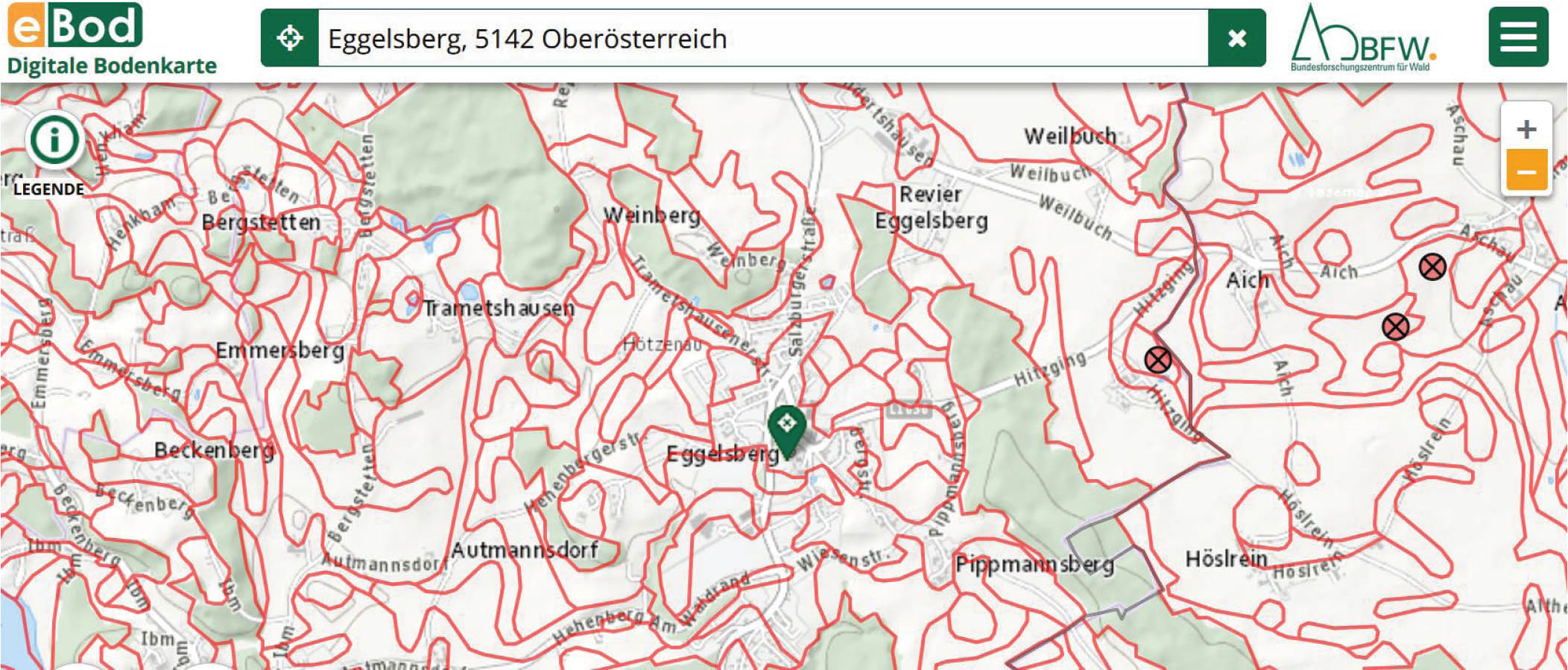
Original map of the Agricultural Soil Survey in the community Eggelsberg. Red lines delineate strata with similar soils (https://bodenkarte.at/).Abbildung 1. Bodenkarte der landwirtschaftlichen Bodenkartierung der Gemeinde Eggelsberg. Die roten Linien bezeichnen Zonen mit gleichen Bodenformen (https://bodenkarte.at/).
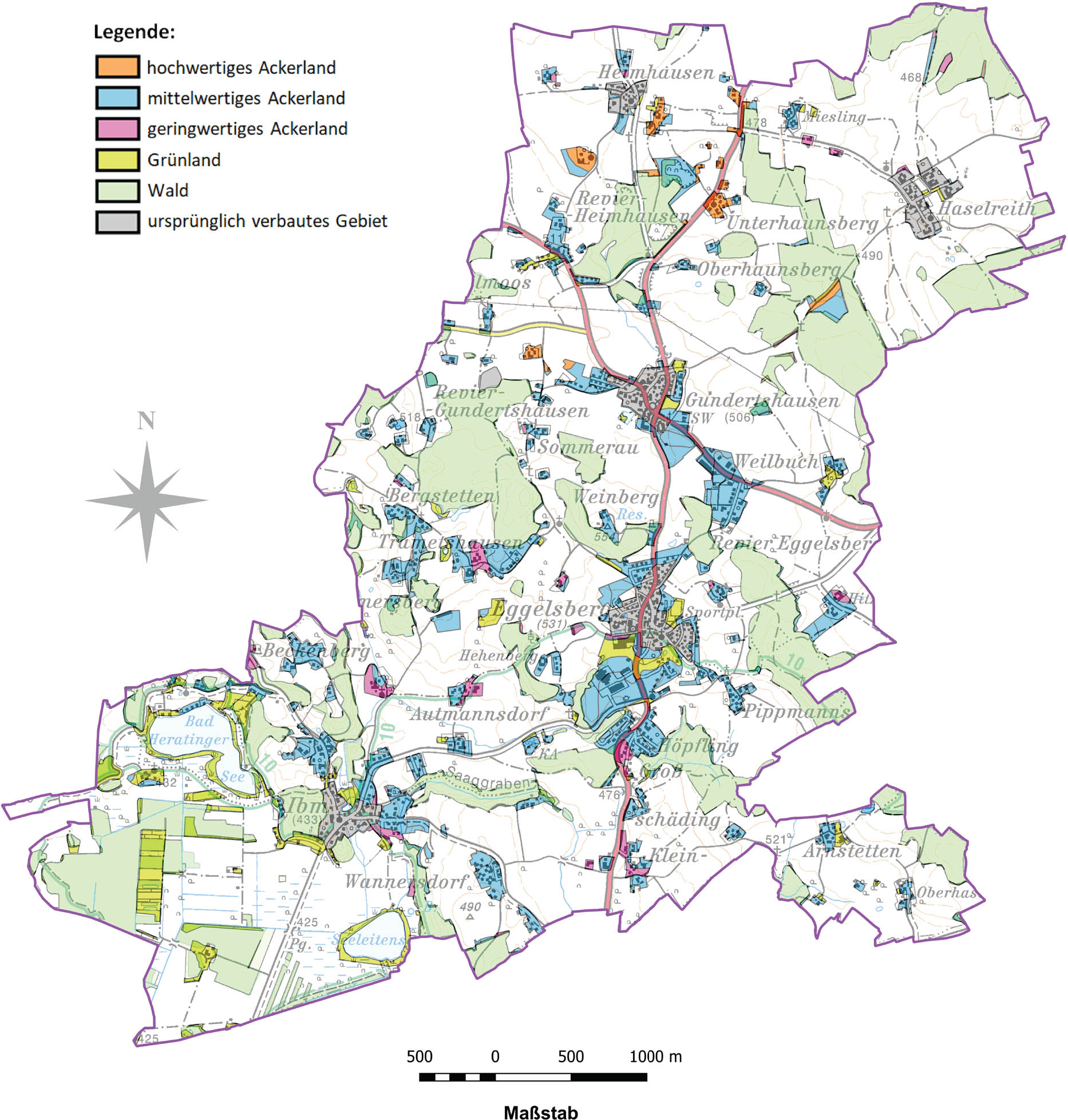

Figure 2

Map of the village Eggelsberg. The grey shades represent the historic area of settlements and light green shades forest. The orange, blue, and magenta shades represent now-sealed areas of high-, medium-, and low-productivity cropland, respectively, and the yellow shades represent now-sealed areas of grassland.Abbildung 2. Karte der Gemeinde Eggelsberg. Die grauen Zonen geben das Siedlungsgebiet von 1970 wieder. Die hellgrünen Flächen sind Wald. Die Farbtöne Orange, Blau und Magenta repräsentieren jetzt verbaute Gebiete mit Ackerland mit hoher, mittlerer und niedriger Produktivität, und die gelben Farbtöne repräsentieren jetzt versiegeltes Grünland.

Figure 3

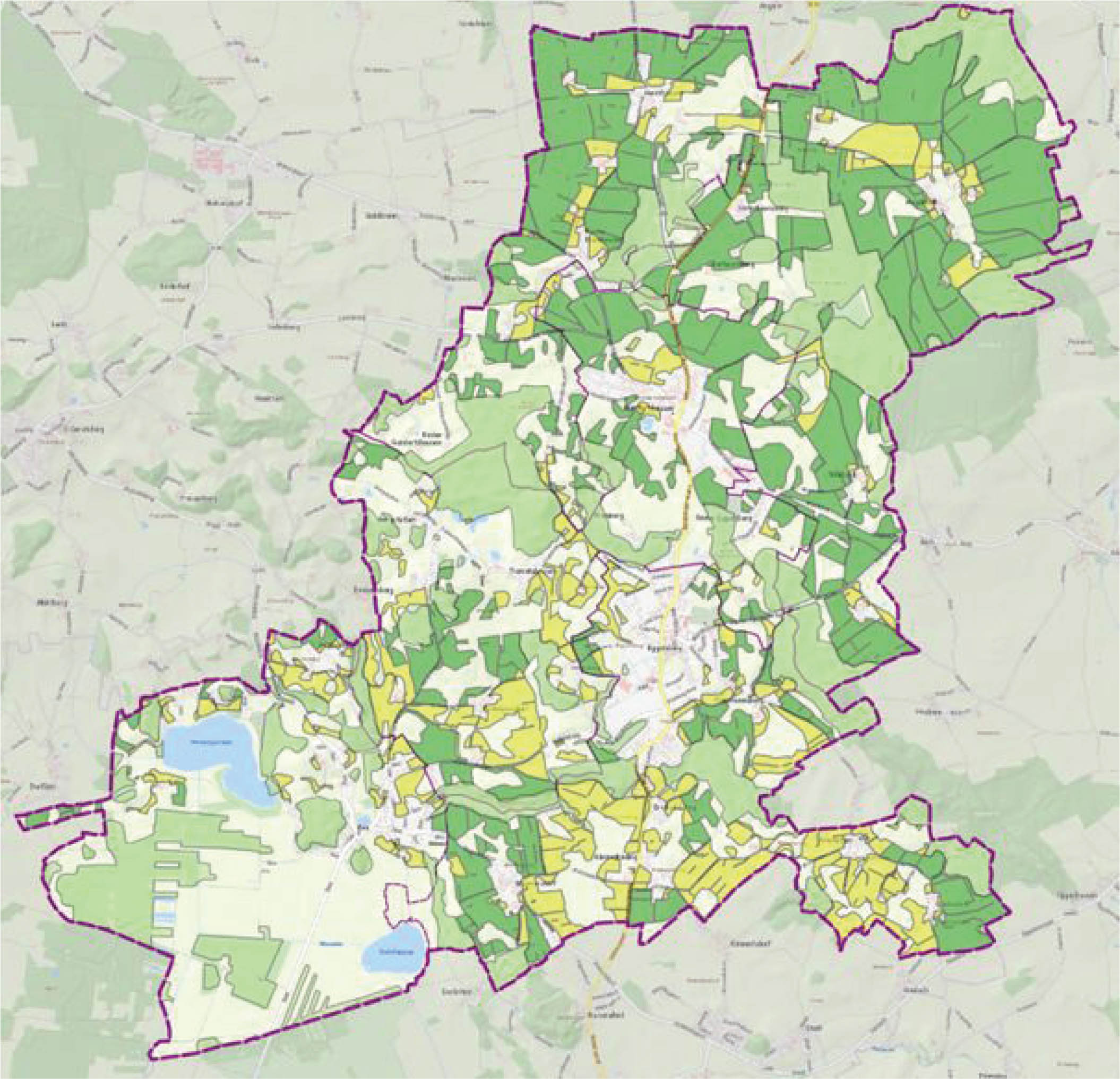
The evaluation of land of the community Eggelsberg according to the recent data. The light-green shades represent forest land, dark-green shades highly productive agricultural land, and the yellow shades highly productive grassland.Abbildung 3. Die Bewertung der Böden in der Gemeinde Eggelsberg auf Grundlage der rezenten Daten der Finanz-Bodenschätzung. Die hellgrünen Flächen zeigen die Waldfläche, die dunkelgrünen Flächen zeigen wertvolles Ackerland und die gelben Flächen zeigen wertvolles Grünland.

Quantity of lost agricultural surface in 50 years in the community EggelsbergTabelle 1_ Bodenverlust in der Gemeinde Eggelsberg in 50 Jahren_

Area in the year 1970 (ha)Soil loss until 2020 (ha)Proportion of soil loss (%)
High-productivity cropland961111.5
Medium-productivity cropland1,22019015.6
Low-productivity cropland1211814.9
Grassland4096315.4
Agricultural land1,84628215.3

Distribution of the area of the community Eggelsberg according to a recent evaluation of soils_Tabelle 2_ Rezente Einschätzung der Bodenqualität in der Gemeinde Eggelsberg_

Area (ha)%
Forest land50021
Valuable cropland86136
Valuable grassland25711
Area of the community2,412
DOI: https://doi.org/10.2478/boku-2020-0007 | Journal eISSN: 2719-5430 | Journal ISSN: 0006-5471
Language: English
Page range: 69 - 76
Submitted on: Feb 29, 2020
Accepted on: Apr 22, 2020
Published on: Oct 23, 2020
Published by: Universität für Bodenkultur Wien
In partnership with: Paradigm Publishing Services
Publication frequency: 4 issues per year

© 2020 Günther Aust, Franz Heinrich, Daniel Horvath, André Musil, Cecilie Foldal, Robert Jandl, published by Universität für Bodenkultur Wien
This work is licensed under the Creative Commons Attribution-NonCommercial-NoDerivatives 3.0 License.