
Table 1.
Performed genetic analyses and obtained results
| Analysis | Methods | Result | Variant and Explanation | Type and Classification | |
|---|---|---|---|---|---|
| 1. | chromosomal microarray | Agilent platform, Human CGH array kit 8x60K | negative | / | / |
| 2. | whole exome sequencing (WES) | Illumina platform, average coverage depth of ≤20x, in-house bioinformatics pipeline, read alignment to the GRCh37/hg19 | negative with secondary findings | carriership findings: heterozygous variant in BTD, FTCD and POLR3A genes | / |
| 3. | whole genome sequencing (WGS) | Illumina platform, average coverage depth of ~30×, in-house bioinformatics pipeline, read alignment to the GRCh37/hg19, SNVs/indels and CNVs called using DRAGEN and Manta | potentially relevant | 6p21.1 deletion, ~4.2 kb (3′UTR of RUNX2), transcript: NM_001015051.3, genomic coordinates: chr6:45518143-45522390 | loss, uncertain significance (class 3) |
| 4. | trio high resolution chromosomal microarray | Agilent platform, Human CGH array kit 4x180K+SNP | inconclusive | only one probe in this region with log2 ratio −1.3 in proband and log2 ratio ~0 in parents | / |
| 5. | trio custom-designed qPCR assay for RUNX2 gene | qPCR assay using four sets of primers for RUNX2 gene: first in exon 2, second in exon 8/3′UTR, third within the 3′UTR itself and fourth downstream of the 3′UTR | positive | deletion of the regions flanked by third and fourth pair of primers, de novo origin | loss, likely pathogenic (class 2) |
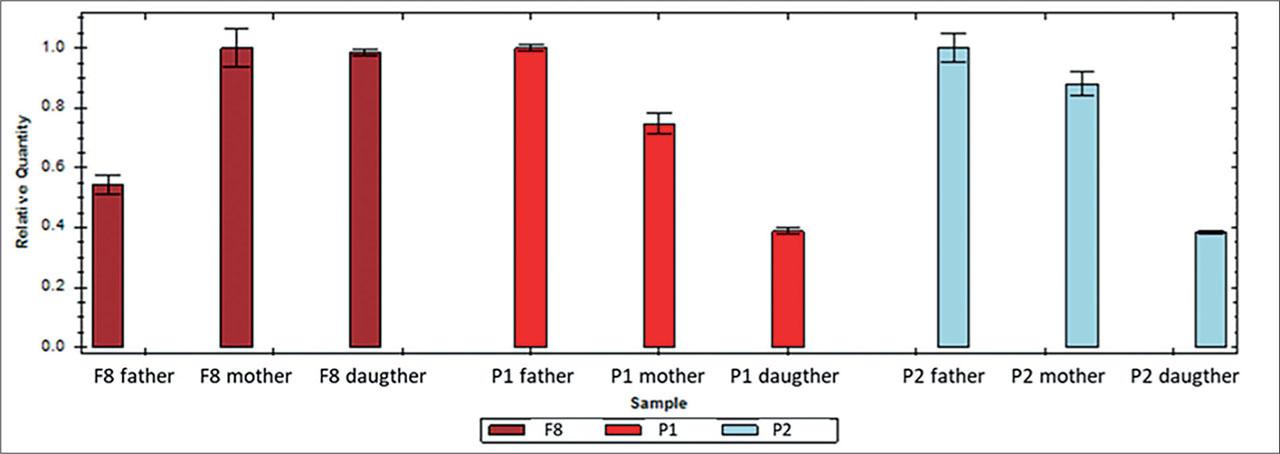
Figure 1.
qPCR results showing the copy number variants in the 3′UTR and the downstream region of RUNX2 gene, compared to the F8 gene in the proband (daughter) and her parents. Legend: To ensure quality control, we conducted a sex determination for the subjects by assessing the copy number of the Factor VIII (F8) gene in relation to the two-copy autosomal reference gene ALB. The father has one copy of the F8 gene, while both the mother and daughter have two copies, as expected. Conversely, the daughter has only one copy of both the 3′UTR (P1 amplicon) and the downstream region of RUNX2 gene (P2 amplicon), whereas parents have two copies. Results for RUNX2 exons 2 and the junction of exon 8/3′UTR, which serve as additional controls, are not included in the figure, as all three samples showed normal two copies. This further demonstrates that the deletion in our patient does not affect the last exon and the junction with 3′UTR region of RUNX2 gene.
Table 2.
Custom-designed primers for the detection of the copy number of RUNX2 3′ UTR and the downstream region
| Gene | Forward primer - sequence (genomic coordinates GRCh37) | Reverse primer - sequence | Amplicon size |
|---|---|---|---|
| RUNX2-3′-UTR | 5′ TCTGAATGCTTGGGCTCACC 3′ (starts at chr6:45519587) | 5′ACTCTCCCTGTGATGTGGGT 3′ | 103 bp |
| RUNX2-3′-UTR+ | 5′CCTGAGCTGTCCAGGTAT TGG 3′ (starts at chr6:45521163) | 5′CGAGAAGGGTTGGGAGCAAT3′ | 93 bp |