INTRODUCTION
Cleidocranial dysplasia (CCD) is an autosomal dominant skeletal dysplasia whose potential causative gene was mapped to the short arm of chromosome 6 in 1995 [1] and later localized to chromosome 6p21 within a region containing CBFA1, a member of the Runt family of transcription factors [2]. The gene is now commonly referred to as RUNX2 (OMIM #600211), with alternative symbols including CBFA1, OSF2, and PEBP2-ALPHA-A. Germline mutations in the RUNX2 gene cause CCD (OMIM #119600), an autosomal dominant disorder that is prototypical representative of its namesake group within the nosology of genetic skeletal disorders [3].
Two decades ago, it was recognized that RUNX2 gene plays a key role in the control of organization, assembly, and activation of the regulatory machinery responsible for skeletal gene expression [4]. RUNX2 was identified as a master transcription factor for osteogenesis [5], functioning as an inducer of osteoblast and chondrocyte differentiation [6]. It also regulates mesenchymal cell proliferation in sutures and their closure by including the signalling pathways such as Fgf, Pthlh, hedgehog, and Wnt [7]. The functional enrichment analysis confirms that RUNX2 gene mutations impact several biological processes involved, including regulation of odontogenesis, cartilage development, cranial skeletal system development, and skeletal system morphogenesis [8], all of which correlate with the phenotypic features of CCD. The RUNX2 gene consists of eight exons and two promoters involved in regulation of its transcriptional levels [5]. Like all members of the same gene family, it contains a highly conserved Runt domain located in exon 2 of this gene, along with several other transcriptionally active domains [5].
The CCD spectrum disorder encompasses a clinical continuum ranging from the classical CCD phenotype, characterized by the triad of delayed closure of cranial sutures, hypoplastic or aplastic clavicles, and dental abnormalities, along with associated skeletal anomalies—to mild CCD, characterized by the isolated dental anomalies without other skeletal features [9]. Genotype–phenotype correlation has been difficult to assess due to the wide phenotypic variability within the CCD spectrum, which is evident even in familial cases [10]. Traditionally, most mutations occurring within the Runt domain are expected to result in the classical CCD phenotype, while short stature and dental anomalies tend to be milder in individuals who had an intact Runt domain and higher residual RUNX2 gene activity [10,11]. However, it is now understood that phenotype–genotype correlation is far more complex, influenced by the distribution of variants across different functional regions of RUNX2 gene and by the type of mutation [12].
Our report presents the first documented case of a deletion in the 3′ Untranslated Region (3′UTR) of RUNX2 gene associated with a CCD phenotype, along with the diagnostic odyssey that preceded this diagnosis.
CASE REPORT
We present the case of a four-and-a-half-year-old female patient. She has been followed by clinical geneticist at the Department of Clinical Genetics the University Children’s Hospital in Belgrade since the neonatal period. She is the first child of healthy, non-consanguineous parents. The family history is unremarkable. The pregnancy was carried to term and delivered by the caesarean section at 41 weeks of gestation. Birth measurements were within normal ranges: weight 3.650 g (P81), length 53 cm (P92), and head circumference 34 cm (P54). Phenotypic features observed in the first days of life suggested a genetic skeletal dysplasia. At the first examination, the following features were noted: facial dysmorphism including hypertelorism, frontal bossing, low and depressed nasal bridge, midface hypoplasia, and a short neck; a widely open anterior fontanelle; a narrow and high-arched palate without a cleft; and skeletal anomalies such as anterolateral bowing of both tibiae, with radiographic evidence of pathological changes in the epiphyses and metaphyses of the long bones of the lower legs. During early infancy, delayed ossification of both hip joints was observed. Cranial, abdominal, and cardiac ultrasound findings showed no associated anomalies. Hearing test was assessed and found to be normal. The initial clinical suspicion pointed toward Robinow syndrome. However, during follow-up, persistent widening of the anterior fontanelle, observation of short/hypoplastic clavicles, postnatal growth restriction (at the age of 3 years and 8 months: height 94 cm [P2], head circumference 51 cm [P77]), and clear brachydactyly led to consideration of possible cleidocranial dysplasia (CCD) in the differential diagnosis. The dental phenotype, which included delayed eruption of deciduous teeth, six supernumerary teeth which had to be removed and enamel hypoplasia supported the suspicion of CCD. A cranial CT scan revealed widened sutures, a persistently open anterior fontanelle, and additional dysmorphisms of the cranial, facial, and vertebral bones. In further follow-up, it was clear that it was a classical CCD phenotype which includes abnormal facial features, remarkable open fontanelles and typical dental abnormalities of CCD. The child’s motor development was mildly delayed. She began walking at 17 months with the aid of physical therapy and rehabilitation. Mild delay in the development of expressive speech and communication was noted, while cognitive development remained intact, requiring speech therapy intervention. The girl has a multidisciplinary follow up which, in addition to a clinical geneticist, includes a children’s orthopaedics, neurosurgeon, physiatrist, otolaryngologist and dentist.
RESULTS
Before the molecular diagnosis of disease was established, the patient underwent a prolonged diagnostic odyssey. The definitive molecular diagnosis was made at the age of three years and eight months. Table 1 summarizes all genetic analyses performed in diagnostic laboratories along with the results obtained. Conventional chromosomal microarray analysis and whole exome sequencing (WES) were negative. Whole genome sequencing (WGS) identified a potentially significant CNV. It is a 4.2 kb large one copy loss within the 6p21.1 chromosomal region, encompassing the 3′UTR of RUNX2 gene (genomic coordinates: chr6:45518143-45522390). This variant was initially classified as uncertain significance (class 3) according to ACMG guidelines [13]. The high-resolution chromosomal microarray was not sensitive enough to confirm this deletion. Trio custom-designed qPCR assay, specifically designed to detect this suspected microdeletion involving the RUNX2 gene, confirmed the deletion of the 3′UTR region and established its de novo origin (Figure 1).
Table 1.
Performed genetic analyses and obtained results
| Analysis | Methods | Result | Variant and Explanation | Type and Classification | |
|---|---|---|---|---|---|
| 1. | chromosomal microarray | Agilent platform, Human CGH array kit 8x60K | negative | / | / |
| 2. | whole exome sequencing (WES) | Illumina platform, average coverage depth of ≤20x, in-house bioinformatics pipeline, read alignment to the GRCh37/hg19 | negative with secondary findings | carriership findings: heterozygous variant in BTD, FTCD and POLR3A genes | / |
| 3. | whole genome sequencing (WGS) | Illumina platform, average coverage depth of ~30×, in-house bioinformatics pipeline, read alignment to the GRCh37/hg19, SNVs/indels and CNVs called using DRAGEN and Manta | potentially relevant | 6p21.1 deletion, ~4.2 kb (3′UTR of RUNX2), transcript: NM_001015051.3, genomic coordinates: chr6:45518143-45522390 | loss, uncertain significance (class 3) |
| 4. | trio high resolution chromosomal microarray | Agilent platform, Human CGH array kit 4x180K+SNP | inconclusive | only one probe in this region with log2 ratio −1.3 in proband and log2 ratio ~0 in parents | / |
| 5. | trio custom-designed qPCR assay for RUNX2 gene | qPCR assay using four sets of primers for RUNX2 gene: first in exon 2, second in exon 8/3′UTR, third within the 3′UTR itself and fourth downstream of the 3′UTR | positive | deletion of the regions flanked by third and fourth pair of primers, de novo origin | loss, likely pathogenic (class 2) |
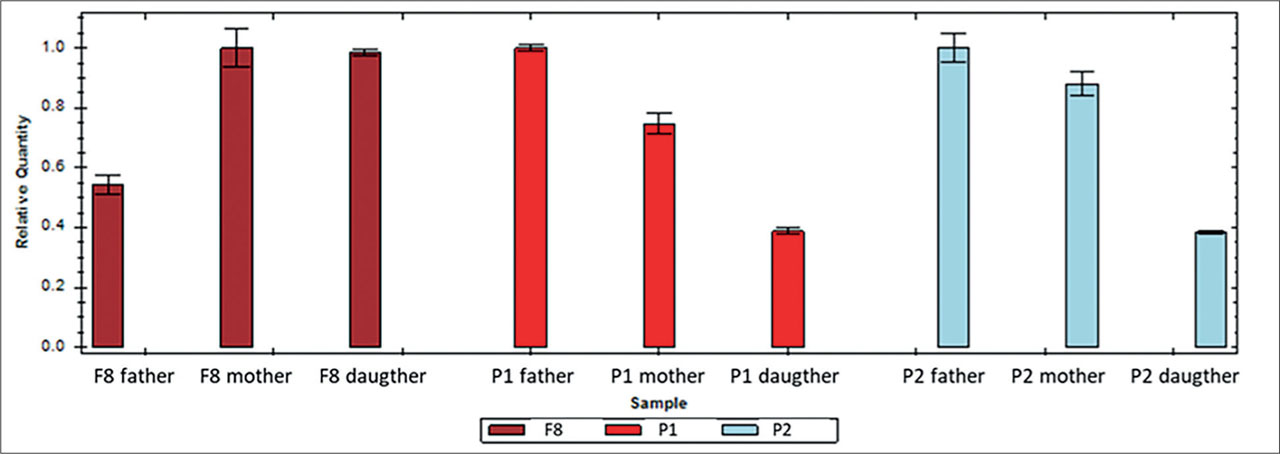
Figure 1.
qPCR results showing the copy number variants in the 3′UTR and the downstream region of RUNX2 gene, compared to the F8 gene in the proband (daughter) and her parents. Legend: To ensure quality control, we conducted a sex determination for the subjects by assessing the copy number of the Factor VIII (F8) gene in relation to the two-copy autosomal reference gene ALB. The father has one copy of the F8 gene, while both the mother and daughter have two copies, as expected. Conversely, the daughter has only one copy of both the 3′UTR (P1 amplicon) and the downstream region of RUNX2 gene (P2 amplicon), whereas parents have two copies. Results for RUNX2 exons 2 and the junction of exon 8/3′UTR, which serve as additional controls, are not included in the figure, as all three samples showed normal two copies. This further demonstrates that the deletion in our patient does not affect the last exon and the junction with 3′UTR region of RUNX2 gene.
Validation and segregation of the RUNX2 3′UTR region deletion by qPCR analysis
To evaluate the RUNX2 copy number in the proband and her parents, their DNA samples were processed in triplicate on the BioRad CFX Opus 96 Real-Time PCR System (Bio-Rad Laboratories, Inc., CA, United States). The qPCR conditions and primer sequences for the RUNX2 exons 2 and 8/3′ UTR, as well as albumin (ALB) and F8 genes, all serving as controls, were as previously described by Zhang et al. [14]. Additionally, we used two custom-designed primers based on the genomic coordinates of a deletion identified through WGS: one within the 3′UTR, and the other downstream of RUNX2 gene. Primer sequences, genomic coordinates and amplicon size are listed in Table 2.
Table 2.
Custom-designed primers for the detection of the copy number of RUNX2 3′ UTR and the downstream region
| Gene | Forward primer - sequence (genomic coordinates GRCh37) | Reverse primer - sequence | Amplicon size |
|---|---|---|---|
| RUNX2-3′-UTR | 5′ TCTGAATGCTTGGGCTCACC 3′ (starts at chr6:45519587) | 5′ACTCTCCCTGTGATGTGGGT 3′ | 103 bp |
| RUNX2-3′-UTR+ | 5′CCTGAGCTGTCCAGGTAT TGG 3′ (starts at chr6:45521163) | 5′CGAGAAGGGTTGGGAGCAAT3′ | 93 bp |
After validation of the deletion by qPCR in proband and establishing its de novo origin, based on the ACMG/ClinGen criteria for copy number variation [15] this variant was reclassified as likely pathogenic (class 2). The reverse genotype–phenotype correlation is clear, as the phenotype of our case corresponds to classical CCD.
DISCUSSION
Approximately 60–80% of RUNX2 gene variants are point mutations detectable by sequencing [7,16,17], while CNVs account for around 10% of all known pathogenic variants in RUNX2 gene [16]. It has therefore been proposed that qPCR or MLPA analyses should be used to screen for intragenic deletions and duplications in RUNX2 gene in patients with a CCD phenotype in whom DNA sequencing fails to identify a causative mutation [16,17]. The 6p21.1–p12.3 microdeletion results in a CCD phenotype [18]. An intragenic microdeletion encompassing exons 2–6, which causes RUNX2 haploinsufficiency, also leads to a CCD phenotype [19]. Other case reports have described patients with deletions involving one individual exon, such as exon 2 [20], exon 3 [21,22], exon 4 [17], and exon 8 [14] of RUNX2 gene, all associated with the CCD phenotype. The comparative review of all previously reported cases with RUNX2 deletions was performed by Zhang et al. [17]. Analysis of phenotypes associated with RUNX2 gene deletions suggests that large deletion mutations do not necessarily have a more severe impact on the RUNX2 gene function than the small deletions or even missense mutations [17]. In cases where a large fragment or even the entire RUNX2 gene is deleted, the pathogenic effects depend on the resulting protein product, which in turn determine the related CCD phenotypes [17].
Variants affecting the 3′UTR of RUNX2 gene represent a recognized mechanism of gene dysfunction. Experimental studies have demonstrated that osteoblastogenesis is regulated by miRNAs that inhibits the expression of osteoblast differentiation-associated markers by targeting the 3′UTR of RUNX2 gene [23,24]. Moreover, 3′UTR variants in RUNX2 gene showed differences in a luciferase reporter assay in a bone cell line model, indicating that these variations in expression may influence bone mineral density [25].
In the literature, there is one reported patient with a deletion in the RUNX2 gene that partially overlaps, at its downstream end, with the variant identified in our case [14]. This 11.38 kb deletion includes exon 8 of RUNX2, and functional RUNX2 gene expression analysis supports its pathogenicity [14]. A deletion involving only the 3′UTR of RUNX2 gene has not been reported in the literature so far. Data on deletions that involve only the 3′UTR of RUNX2 gene are scarce in available databases. In the ClinVar database, there are four reported deletion variants affecting the 3′UTR of RUNX2, all involving a single base pair. These are classified either as variants of uncertain significance (Variation ID: 357101 and 357132) or as benign (Variation ID: 357102 and 357133), and none of them have been supported by functional studies.
Initially, there was no clarity regarding the classification of the variant identified in our reported case. WGS first detected the variant, which was classified as a variant of uncertain significance. However, confirmation by a custom-designed qPCR assay, along with segregation analysis demonstrating a de novo origin, and evidence that variants in this region reduce gene expression [24], led to its reclassification as likely pathogenic. Based on this, the variant can be considered as a disease-causing variant.
This report presents the first documented case of a patient with a deletion affecting only the 3′UTR of RUNX2 gene. Our case provides novel evidence supporting the functional importance of the 3′UTR of the RUNX2 gene, whose haploinsufficiency, due to a very small novel deletion of 4.2 kb, results in a classical CCD phenotype. This case illustrates the clear diagnostic advantage of WGS over WES in detecting CNVs [26], including those located in the 3′UTR of the disease-causing gene. Using this approach, i.e. WGS, a CNV in the RUNX2 gene was identified both in our patient and in one previously reported case [14]. Establishing a molecular diagnosis of disease in some patients may still require multiple steps in genetic testing and various analyses, which can be time-consuming. Careful clinical evaluation to establish an accurate clinical diagnosis remains highly valuable. When there is a strong clinical suspicion of disease whose gene harbours a substantial proportion of CNVs among all variants, such as RUNX2 gene, a targeted deletion/duplication analysis may be warranted. In the future, applying WGS as a first-tier diagnostic test is expected to significantly improve diagnostic yield compared to conventional genetic testing and reduce time to molecular diagnosis in such clinical scenarios.
LIST OF ABBREVIATIONS:
- 3′UTR
3′ Untranslated Region
- RUNX2
Runt-related transcription factor 2
- CCD
Cleidocranial Dysplasia
- CBFA1
Core-Binding Factor, Runt Domain, Alpha Subunit 1
- OSF2
Osteoblast-Specific Transcription Factor 2
- PEBP2-ALPHA-A
Polyomavirus Enhancer-Binding Protein 2 Alpha A Subunit
- CNV(s)
Copy Number Variant(s)
- SNV(s)
Single Nucleotide Variant(s)
- WES
Whole Exome Sequencing
- WGS
Whole Genome Sequencing
- qPCR
quantitative Polymerase Chain Reaction
- CGH
Comparative Genomic Hybridization
- SNP
Single Nucleotide Polymorphism
- ACMG
American College of Medical Genetics
ACKNOWLEGEMENT
We thank the family of presented patient for their consent to participate in this study.