Figure 1.
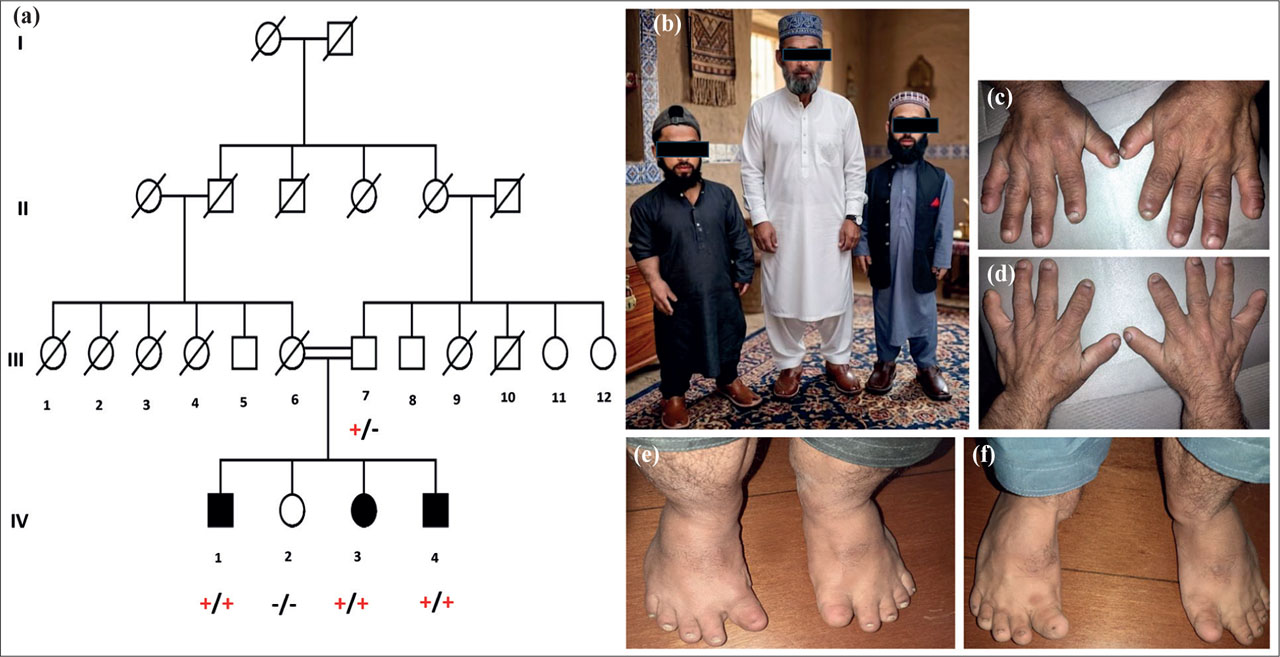
(a) Pedigree of family exhibiting autosomal recessive pattern. (b) The father (III-7), of average height along with the affected males (IV-4, IV-1) who are short statured with normal trunk length and markedly shortened arms and legs. (c, d) Hands of affected males (IV-1 and IV-4) are short and broad. Clinodactyly is seen. Nails are dystrophic, with irregular curvature and thickening. (e, f) Clinical Photographs of feet of IV-1and IV-4 demonstrate broad, flat feet with disproportionately short and stubby toes. Toenails are dystrophic, with bilateral hyponychia of the great toes.
Table 1.
Phenotypic comparison of the patients reported in the present family with AMDM, ACFD, AMD2A, AMD2B and AMD2C
| Characteristics | Current Study | AMD1/Maroteaux | ACFD | AMD2A / Grebe (GDF5) | AMD2B / Du Pan (GDF5) | AMD2C (GDF5) | ||
|---|---|---|---|---|---|---|---|---|
| IV-1 | IV-3 | IV-4 | ||||||
| Phenotypic Features | ||||||||
| Age (years) | 26 | 28 | 22 | NA | NA | NA | NA | NA |
| Height (cm ± SD) | 116.84 cm (−9.6 SD) | 99.06cm (−9.7 SD) | 121.92cm (−10.4 SD) | <125 cm (−6 to −10 SD) | 84, 102 cm (−2.3 to −9.6 SD) | ~100 cm (severe) | Mild–moderate short stature | Severe short stature |
| Weight (kg) | 38.5, | 32.0 | ,38 | Low | 20–30 | Low | Low | Low |
| Head Circumference (cm ± SD) | 54.61 | 50.8 | 53.84 | Macrocephaly | 50.8–54.6 | Normal | Normal | Normal |
| Acromesomelic Limb Shortening | ✓ | ✓ | ✓ | ✓ | ✓ | ✓ (Severe Distal) | ✓ | ✓ |
| Head size | Near normal | Near normal | Near normal | Normal | Large | Normal | Normal | Normal |
| Intelligence | Normal | Normal | Normal | Normal | Normal | Normal | Normal | Normal |
| Brachydactyly | ✓ | ✓ | ✓ | ✓ | ✓ | ✓ (Severe) | ✓ (complex) | ✓ |
| Clinodactyly | ✓ | ✓ | ✓ | ✓ | ✓ | ✓ | ✓ | ✓ |
| Hyponychia | ✓ | ✓ | ✓ | ✕ | ✕ | ✕ | ✓ | ✕ |
| Loose redundant skin | ✕ | ✕ | ✕ | ✓ | ✕ | ✓ | ✓ | ✓ |
| Joint laxity | ✕ | ✕ | ✕ | ✓ | ✕ | ✕ | ✕ | ✓ |
| Feet deformity | Equinus deformity/Metatarsus Adductus | Equinus deformity/Metatarsus Adductus | Equinus deformity/Metatarsus Adductus | Large halluces | Pes planus | Valgus foot deformity | Talipes equinovalgus | Short feet |
| Radiological Features | ||||||||
| Radial bowing & angulation | Severe (Madelung-like) | Severe (Madelung-like) | Severe (Madelung-like) | ✓ | Mild due to coning | ✕ | ✕ | ✕ |
| Dislocated radial head | ✓ | ✓ | ✓ | Rare | Rare | ✓ | Occasional | occasional |
| Subluxation of ulnocarpal joint | ✓ | ✓ | ✓ | ✕ | ✕ | ✓ | ✓ | ✓ |
| Retarded/dislocated Carpal bone age | Marked Delay | Marked Delay | Marked Delay | Marked Delay | Moderate Delay | Extreme Delay/Fused | Mild Delay/Fused (Rudimentary) | Mild Delay/Fused (Rudimentary) |
| Suprapatellar Loose Bodies | ✓ | ✕ | ✕ | ✕ | ✕ | ✕ | ✕ | ✕ |
| Fusion of phalanges | Synostosis | Synostosis | Synostosis | ✕ | Synostosis | Symphalangism | Symphalangism | ✕ |
| Metacarpals | Short | Short | Short | Short | Teardrop | Rudimentary or absent metacarpals | Tear drop | Cuboidal/Extremely short |
| Short phalanges | Proximal phalanges | Proximal phalanges | Proximal phalanges | Middle and proximal phalanges | Middle and Distal | Rudimentary (distal present only) | Middle and proximal | Middle and proximal |
| Thorax | Normal | Normal | Normal | Normal | Narrow | Normal | Normal | Normal |
| Vertebral changes | ✕ | ✕ | ✕ | (kyphosis) | (lumbar lordosis) | ✕ | ✕ | ✕ |
| Chest | Normal | Normal | Normal | Superiorly curved clavicles | Pectus deformities | Normal | Normal | Normal |
| Acetabulum | Normal | Normal | Normal | Dysplastic | Dysplastic | Dysplastic | Dysplastic | Dysplastic |
| Iliac Wings | Normal | Normal | Normal | Squared | Short | Hypoplastic | small | small |
| Coxa valga / vara | Vara | Vara | Vara | Valga | Vara | Dislocated | Valga | Valga |
| Cortical Thickness | Increased | Increased | Increased | Normal | Normal | Normal | Normal | Normal |
| Medullary canals | Narrow | Narrow | Narrow | Normal | Normal | Normal | Normal | Normal |
| Short tibia/fibula | ✓ | ✓ | ✓ | ✓ | ✓ | ✓ (Severely shortened) | ✓ (fibula absent/hypoplastic) | ✓ |
| Metaphyseal Shape | Flared/Irregular | Flared/Irregular | Flared/Irregular | Severely Flared | V shaped | Rudimentary | Normal | Normal |
| Cone Shaped Epiphysis | ✕ | ✕ | ✕ | ✕ | ✓ | ✕ | ✕ | ✕ |
| Short femoral neck/shaft | ✓ | ✓ | ✓ | ✓ | ✓ | ✓ | ✓ | ✓ |
| Distal femur | Hyper Plastic | Hyper Plastic | Hyper Plastic | Broad | Normal | Hypoplastic | Normal to broad | Normal |
| GenuValgum/Varum | Varum | Varum | Varum | ✕ | Varum | Valgum | Valgum | Valgum |
| Autosomal Recessive Inheritance | ✓ | ✓ | ✓ | ✓ | ✓ | ✓ | ✓ | ✓ |
| Gene mutated | IHH | IHH | IHH | NPR2 | IHH | GDF5 | GDF5 | GDF5 |
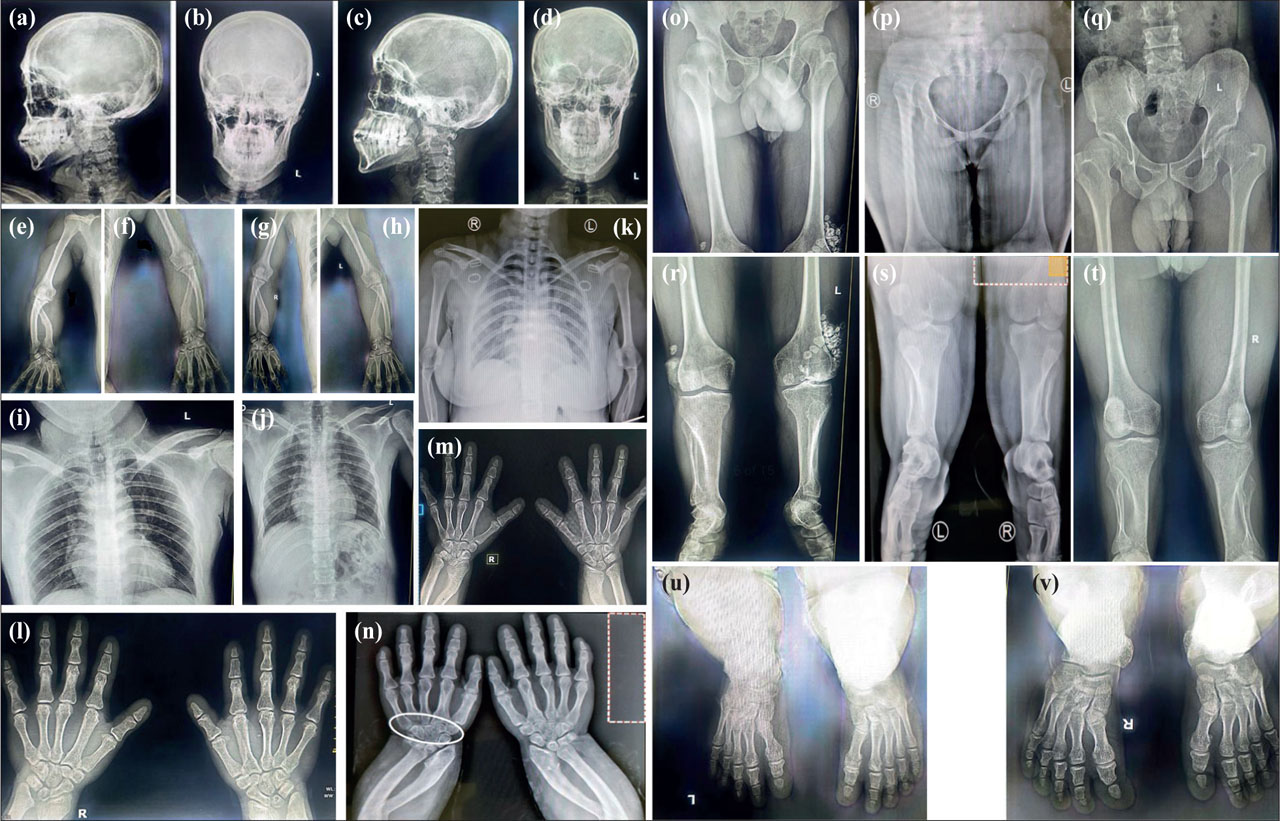
Figure 2.
(a–d) Lateral and anteroposterior (AP) skull radiographs of affected individual IV-1 and IV-4 show generalized calvarial thickening with absence of frontal bossing and no evidence of macrocephaly. (e–h) Left and right upper limb radiograph of affected individuals (IV-1, IV-4) showing bilateral shortening of the radius and ulna, with cortical thickening and narrowed medullary canals, most pronounced in the distal radius. Features of true Madelung deformity, including volar-ulnar bowing of the distal radius, dorsal subluxation of the distal ulna and increased radial inclination are also observed. (i,j,k) Chest radiographs of individuals IV-1, IV-3 and IV-4 reveals normal rib and clavicular structure (l–n) Hand radiographs of all three affected siblings demonstrate severe brachydactyly. A V-shaped configuration of the proximal carpal row is also observed in the individual IV-3. (o–q) AP pelvic radiographs of the affected individuals (IV-1, IV-3 and IV-4) demonstrate bilateral coxa vara, and femoral bowing. (r–t) Lower limb radiographs of the individuals IV-1, IV-3 and IV-4 show shortened and broadened tibia and fibula with genu varum. Flared and irregular metaphyses of the distal femora and proximal tibiae, cortical thickening with narrowed medullary canals is noted. Multiple well-defined calcified loose bodies are seen in the left suprapatellar pouch and juxta-articular region in the affected individual IV-1. (u–v) Foot radiographs of the individuals IV-1, IV-4 depict short and broad tarsals, metatarsal, and phalangeal bones with bilateral fusion of the distal phalanges of the fifth toes. The distal metatarsal and proximal phalangeal epiphyses appear broad and squared. Fixed plantar flexion of the forefeet and equinus deformity at the ankle joints are also evident.
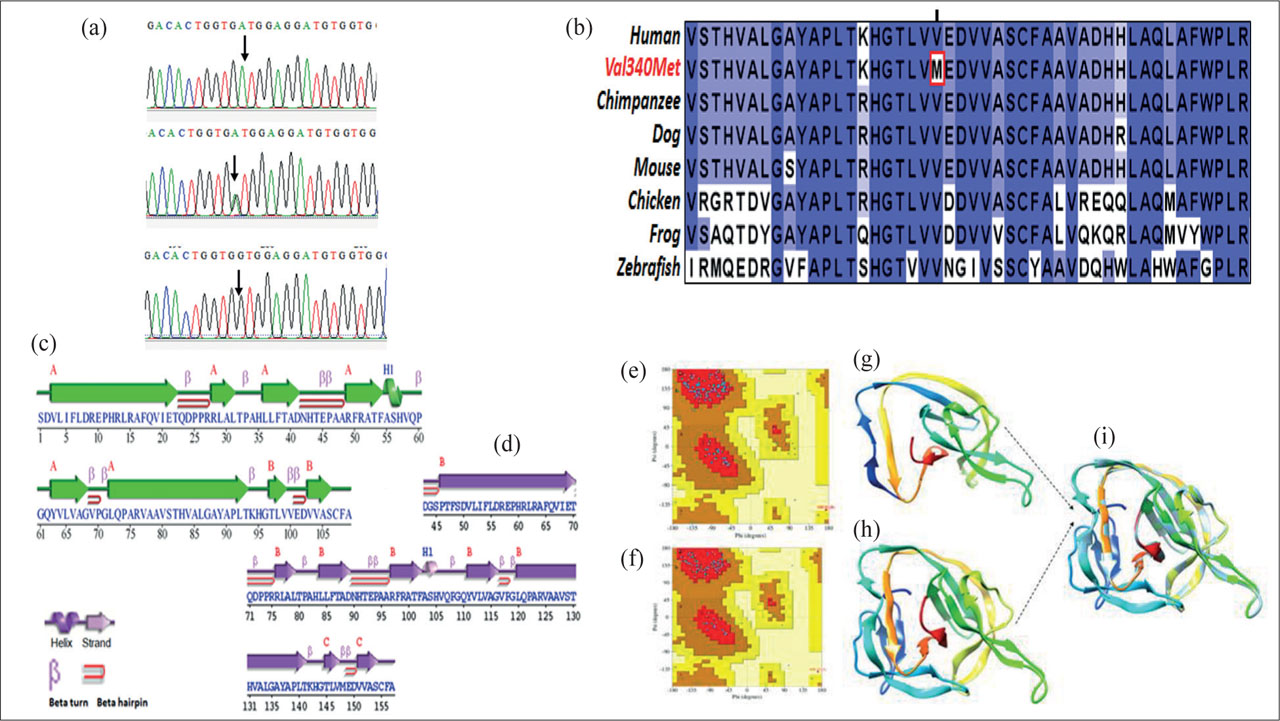
Figure 3.
(a) Sanger electrograms of the variant (c.1018G>A; p. Val340Met) identified in an affected (upper panel), a carrier (middle panel) and a normal (lower panel) (b) Showing conservation of valine amino acid across several species. Secondary structure of (c)IHHWT and (d) IHHVal340Met. Structure validation through Ramachandran plot (e) IHHWT and (f) IHHVal340Met (g) and (h) represents ribbon form of wild type and mutant tertiary structures respectively. (i) Superimposition of mutant and wild type IHH auto processing domain.
Table 2.
Pathogenicity of the identified variant (c.1018G>A; p. Val340Met)
| S. No | Tool used | Prediction |
|---|---|---|
| 1 | Mutation Taster | Disease causing |
| 2 | SIFT | Damaging |
| 3 | Provean | Neutral |
| 4 | PolyPhen-2 | Damaging |
| 5 | DANN | Disease causing (0.9986) |
| 6 | FATHMM-MKL | Damaging (Coding score 0.9894) |
| 7 | FATHMM | Damaging |
Table S1.
The sequence variant was classified as likely pathogenic based on ACMG criteria (Richards et al. 2015) [30]
| Gene | IHH |
| Variant | c.1018G>A, p. Val340Met) |
| ACMG criteria pathogenic variant | |
| Strong | |
| PS1 - same AA as established pathogenic variant | |
| PS2 - denovo | |
| PS3 - invitro assay | |
| PS4 - increase prevalence of the variant | |
| Moderate | |
| PM1 - Mutational hotspot and/or critical and well-established functional domain | |
| PM3 - cis/trans with pathogenic variant | |
| PM4 - Protein length change | |
| PM5 - same aa position, different change | |
| PM6 - assumed denovo | |
| Supporting | |
| PM2 - absent from controls | ✓ |
| PP1 - cosegregation | ✓ |
| PP2 - low rate of benign missense variation | ✓ |
| PP3 - computaional evidence support | ✓ |
| PP4 - patient phenotypes highly specific | ✓ |
| PP5 - reputable resource reports as pathogenic | |
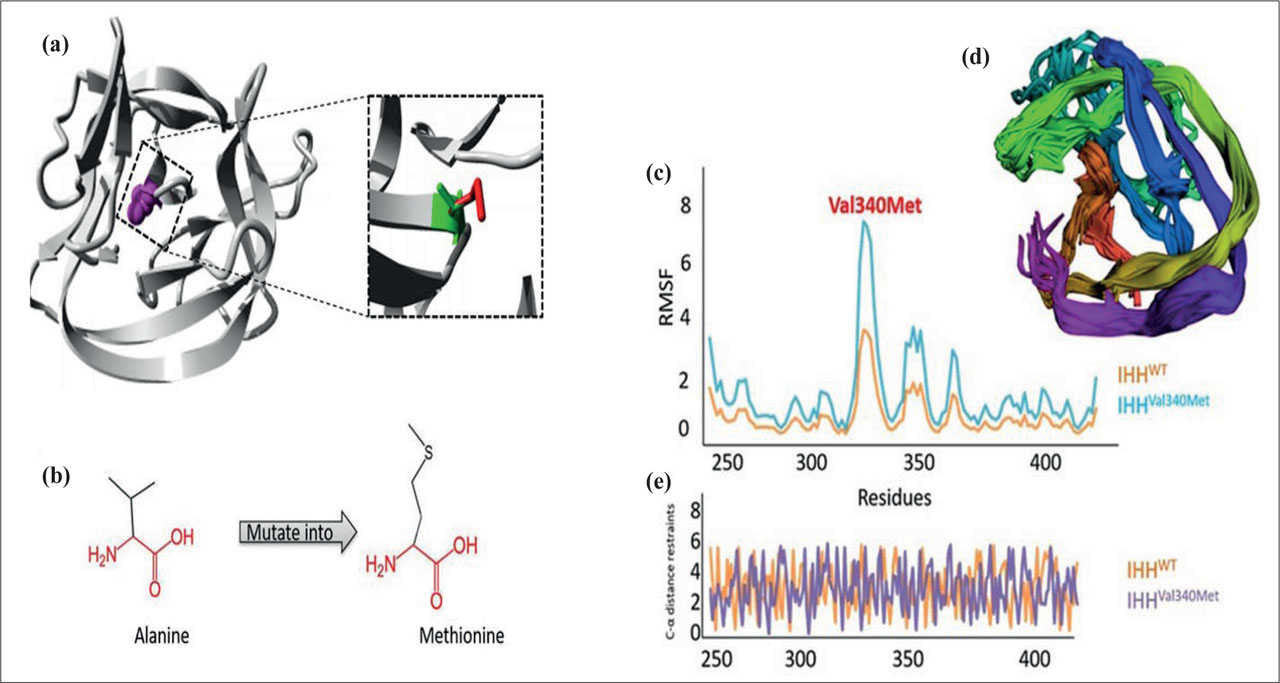
Figure 4.
(a) Ribbon representation of protein in grey colour with mutant residue in magenta colour. In close up view side chain of both wild type and mutant residues are shown in green and red colour respectively. (b) schematic structures of the original (left) and the mutant (right) amino acid. The backbone, which is the same for each amino acid, is coloured red. The side chain, unique for each amino acid, is coloured black. RMSF analysis (c, d) simulation trajectories and (e) C-α distance restraints analysis.