INTRODUCTION
Autism spectrum disorder (ASD) comprises a heterogeneous group of neurodevelopmental conditions characterized by impaired social communication, restricted interests, and repetitive behaviors or activities [1]. Over recent decades, the prevalence of ASD has risen markedly in many countries, affecting approximately 1–2% of the global population. In the United States, the reported male-to-female ratio is approximately 4:1 [2]. The etiology and pathogenesis of ASD are complex and remain incompletely understood. Numerous studies suggest that ASD is a multifactorial disorder involving both genetic predispositions and environmental influences [3]. Immune dysregulation, inflammation, oxidative stress, mitochondrial dysfunction, and exposure to environmental toxicants have all been implicated in ASD-related abnormalities [4]. Currently, there are no approved pharmacological treatments that effectively address the core symptoms of ASD. However, early behavioral interventions have shown promise in improving developmental outcomes in children with ASD [5]. As such, early diagnosis is critical. Presently, ASD diagnosis relies on clinical evaluations of behavioral signs and symptoms according to criteria outlined in the Diagnostic and Statistical Manual of Mental Disorders, Fifth Edition (DSM-5). The absence of objective biological markers makes early detection difficult and highly subjective, with the average age of diagnosis estimated at approximately 4 – 5 years [6]. The identification of reliable, early-detection biomarkers for ASD remains a critical unmet clinical need. While genetic testing has been explored, the genetic heterogeneity of ASD limits the predictive power of current genetic approaches [7]. To address this gap, various biomarker discovery strategies have been employed, including neuroimaging, genomics, transcriptomics, metabolomics, and proteomics. Nevertheless, these methods have yet to yield diagnostic tools with sufficient sensitivity and specificity [8]. Proteomics, which complements genomic research, offers a promising avenue for identifying protein-level alterations that reflect underlying pathophysiological mechanisms. In the present study, we applied an iTRAQ-based quantitative proteomic approach to investigate serum protein expression patterns in children with ASD compared to typically developing controls (TDC). Our objective was to identify candidate protein biomarkers with potential utility for ASD diagnosis.
MATERIALS AND METHODS
Patient Recruitment and Serum Collection
A total of 60 children were included in this study, comprising 30 children diagnosed with autism spectrum disorder (ASD) (24 males and 6 females; aged 3 to 11 years) and 30 age- and sex-matched typically developing children (TDC) serving as controls. All participants were randomly selected from general medical practices in the Plovdiv region, Bulgaria. The diagnosis of ASD was established by certified psychiatrists based on clinical assessments using the Gilliam Autism Rating Scale (GARS), the Childhood Autism Rating Scale (CARS), and the Autism Diagnostic Interview – Revised (ADI-R), in accordance with the Diagnostic and Statistical Manual of Mental Disorders, Fifth Edition (DSM-5) criteria. GARS was used as a norm-referenced tool to evaluate the severity of ASD symptoms. CARS assisted in distinguishing ASD from other developmental delays. ADI-R, a structured interview with the parents, served as the gold standard for comprehensive ASD assessment. The control group (TDC) was matched by age and sex to the ASD group. Clinical evaluations and CARS assessments were performed to confirm the absence of autistic traits in all control participants. None of the participants had received any medication prior to blood collection. Children with a history of infectious, oncological, metabolic, or genetic disorders were excluded from the study. Blood samples were collected in the morning prior to food intake (fasting state). To minimize pre-analytical variability, samples were processed according to standard operating procedures. Briefly, blood was allowed to clot for 1 hour at 37 °C and subsequently centrifuged at 3000 g for 20 minutes at 4 °C. The resulting serum was aliquoted and immediately stored at −80 °C until further analysis. All procedures were reviewed and approved by the Institutional Review Board of the Ethics Committee of the Medical University of Plovdiv. Written informed consent was obtained from the parents or legal guardians of all participants prior to inclusion in the study.
Protein Sample Preparation
Equal volumes of serum from each individual were pooled to generate composite samples for the ASD and TDC groups, respectively. To reduce sample complexity and remove highly abundant proteins, the pooled serum samples were processed using the ProteoMiner™ Protein Enrichment Kit (Bio-Rad, Hercules, CA, USA), following the manufacturer’s instructions. After enrichment, the samples were buffer-exchanged into a denaturing sample buffer containing 7 M urea, 2 M thiourea, 4% (w/v) CHAPS, 40 mM dithiothreitol (DTT), and 40 mM Tris base. Protein concentrations were quantified using the Bradford assay. For each pooled sample, 100 μg of total protein was enzymatically digested using Trypsin Gold (Promega, Madison, WI, USA) at a protein-to-trypsin ratio of 20:1. Digestion was carried out in two steps: the first for 4 hours at 37 °C, followed by a second digestion under the same conditions for an additional 8 hours.
iTRAQ Labeling, SCX Fractionation, and LC-ESI-MS/MS Analysis
Following digestion, peptides were dried by vacuum centrifugation and reconstituted in 0.5 M triethylammonium bicarbonate (TEAB) for isobaric tagging. Peptide labeling was conducted using 8-plex iTRAQ reagents (AB Sciex, Framingham, MA, USA) according to the manufacturer’s protocol. The ASD group peptides were labeled with iTRAQ tag 115, and the TDC group with tag 118. The labeled peptides were then pooled and dried again by vacuum centrifugation. Peptide fractionation was performed using Strong Cation Exchange (SCX) chromatography, following established protocols [9]. The resulting fractions were subjected to liquid chromatography-electrospray ionization-tandem mass spectrometry (LC-ESI-MS/MS) using a Triple TOF 5600 mass spectrometer (AB SCIEX, Concord, ON, Canada).
Data Processing and Functional Analysis
Peptide and protein identification was conducted by searching the acquired MS/MS data against the human protein database (IPI: human_v3.87) using the Mascot search engine (version 2.3.02; Matrix Science, London, UK). Protein identification and quantification procedures were carried out as described by An et al. [9]. For protein quantification, only proteins containing at least two unique peptide spectra were considered. Quantitative protein ratios were normalized and weighted by the median ratio using Mascot’s integrated quantification tools. Proteins with p-values < 0.05 were considered to be significantly differentially expressed. To investigate the biological significance of the differentially expressed proteins (DEPs), functional annotation and enrichment analysis were performed using the Enrichr web-based tool(https://amp.pharm.mssm.edu/Enrichr/) [10]. Gene Ontology (GO) enrichment analysis was performed across three categories: biological process (BP), molecular function (MF), and cellular component (CC). Additionally, Kyoto Encyclopedia of Genes and Genomes (KEGG) pathway analysis was conducted to explore relevant signaling and metabolic pathways. Enrichment results with p-values < 0.05 were considered statistically significant.
RESULTS
iTRAQ-Based Comparative Proteomics Analysis
Using iTRAQ proteomic profiling, a total of 843 proteins were identified with 95% confidence and a 1% false discovery rate (FDR). Of these, 417 proteins were successfully quantified based on 3,699 unique peptides, corresponding to 413,032 MS/MS spectra. Among the quantified proteins, 59 were differentially expressed proteins (DEPs) between the autism spectrum disorder (ASD) group and the typically developing children (TDC) group (Table 1). Of these DEPs, 24 proteins were significantly upregulated, while 35 were downregulated in the ASD group relative to controls (Figure 1).
Table 1.
Differentially expressed proteins identified in blood serum samples from children with АSD and healthy controla
| No | Protein name | Accession number | Gene name | Peptides (95%) | % Cov | Fold change |
|---|---|---|---|---|---|---|
| 1 | A disintegrin and metalloproteinase with thrombospondin motifs 13 (−) | Q76LX8 | ADAMTS13 | 8 | 6.5 | 0.78 |
| 2 | Angiogenin (−) | P03950 | ANG | 3 | 21.8 | 0.81 |
| 3 | Anthrax toxin receptor 2 (+) | P58335 | ANTXR2 | 5 | 16.6 | 1.41 |
| 4 | Apolipoprotein C-II (+) | P02655 | APOC2 | 4 | 49.5 | 1.26 |
| 5 | Apolipoprotein C-IV (+) | P55056 | APOC4 | 6 | 39.4 | 1.72 |
| 6 | Apolipoprotein F (+) | Q13790 | APOF | 2 | 6.7 | 1.30 |
| 7 | Apolipoprotein L1 (+) | O14791 | APOL1 | 15 | 40.6 | 1.40 |
| 8 | Apolipoprotein(a) − precursor (+) | P08519 | LPA/APOA | 13 | 3.7 | 1.75 |
| 9 | Basement membrane-specific heparan sulfate proteoglycan core protein (−) | P98160 | HSPG2 | 5 | 1.3 | 0.73 |
| 10 | Calponin-2 (−) | Q5RFN6 | CNN2 | 3 | 14.2 | 0.72 |
| 11 | Calsyntenin-1 (−) | O94985 | CLSTN1 | 3 | 3.8 | 0.75 |
| 12 | Carboxypeptidase N catalytic chain (−) | P15169 | CPN1 | 7 | 17.5 | 0.77 |
| 13 | Carboxypeptidase N subunit 2 (−) | P22792 | CPN2 | 12 | 28.1 | 0.80 |
| 14 | Chromogranin-A (−) | P10645 | CHGA | 5 | 13.1 | 0.66 |
| 15 | Complement C1q subcomponent subunit A (+) | P02745 | C1QA | 6 | 29 | 1.29 |
| 16 | Complement C4-A (+) | P0C0L4 | C4A | 1 | 62.3 | 7.36 |
| 17 | C-reactive protein (−) | P02741 | CRP | 6 | 23.7 | 0.83 |
| 18 | Extracellular matrix protein 1 (−) | Q16610 | ECM1 | 13 | 31.3 | 0.76 |
| 19 | Fibronectin 1 (−) | Q28275 | FN1 | 2 | 45.5 | 0.76 |
| 20 | Fibulin-5 (−) | Q9UBX5 | FBLN5 | 6 | 15.4 | 0.79 |
| 21 | Flavin reductase (+) | P30043 | BLVRB | 3 | 18.9 | 1.59 |
| 22 | Glia-derived nexin (−) | P07093 | SERPINE2 | 6 | 15.6 | 0.74 |
| 23 | Heparanase (−) | Q9Y251 | HPSE | 5 | 8.8 | 0.80 |
| 24 | Histone H1.3 (+) | P43277 | H1–3 | 2 | 13.6 | 1.39 |
| 25 | Histone H2B 1/2/3/4/6 (+) | P0C1H3 | H2B-I | 3 | 23 | 1.33 |
| 26 | Histone H4 (+) | Q6WV73 | H4 | 6 | 51.5 | 1.52 |
| 27 | Immunoglobulin heavy constant gamma 1 (+) | P01857 | IGHG1 | 1 | 36.5 | 1.40 |
| 28 | Immunoglobulin heavy constant gamma 2 (+) | P01859 | IGHG2 | 1 | 33.6 | 1.35 |
| 29 | Immunoglobulin heavy constant gamma 4 (+) | P01861 | IGHG4 | 3 | 21 | 1.63 |
| 30 | Immunoglobulin heavy variable 3–23 (−) | P01764 | IGHV3–23 | 2 | 26.1 | 0.46 |
| 31 | Immunoglobulin J chain (−) | P01591 | JCHAIN | 4 | 26.4 | 0.82 |
| 32 | Immunoglobulin kappa variable 1–5 (−) | P01602 | IGKV1–5 | 3 | 40.5 | 0.82 |
| 33 | Immunoglobulin kappa variable 3–20 (−) | P01619 | IGKV3–20 | 2 | 31.5 | 0.80 |
| 34 | Immunoglobulin lambda variable 3–1 (−) | P01715 | IGLV3–1 | 1 | 27.4 | 0.78 |
| 35 | Immunoglobulin lambda variable 3–21 (−) | P80748 | IGLV3–21 | 1 | 24.5 | 0.79 |
| 36 | Immunoglobulin lambda variable 3–25 (−) | P01717 | IGLV3–25 | 1 | 36.6 | 0.77 |
| 37 | Insulin-like growth factor-binding protein 5 (−) | P24593 | IGFBP5 | 1 | 3.7 | 0.76 |
| 38 | Intelectin-1 / Omentin (−) | Q8WWA0 | ITLN1 | 5 | 19.8 | 0.73 |
| 39 | Isocitrate dehydrogenase [NAD] subunit alpha, mitochondrial (+) | P50213 | IDH3A | 1 | 2.7 | 1.41 |
| 40 | Kallistatin (+) | P29622 | SERPINA4 | 17 | 44.7 | 1.44 |
| 41 | Keratin, type I cytoskeletal 14 (−) | P02533 | KRT14 | 4 | 15.3 | 0.34 |
| 42 | Keratin, type I cytoskeletal 9 (−) | P35527 | KRT9 | 12 | 26.3 | 0.34 |
| 43 | Latent-transforming growth factor beta-binding protein 1 (−) | Q14766 | LTBP1 | 9 | 7.8 | 0.73 |
| 44 | Lipopolysaccharide-binding protein (+) | P18428 | LBP | 11 | 26.2 | 1.32 |
| 45 | Lipoprotein lipase (−) | P06858 | LPL | 4 | 13.3 | 0.70 |
| 46 | Mimecan (−) | P20774 | OGN | 6 | 13.8 | 0.80 |
| 47 | Myosin-9 (+) | P35579 | MYH9 | 13 | 8.7 | 1.47 |
| 48 | Nidogen-1 (−) | P14543 | NID1 | 11 | 10.1 | 0.69 |
| 49 | Periostin isoform 8 precursor (+) | Q15063 | POSTN | 17 | 28.8 | 1.21 |
| 50 | Plasma serine protease inhibitor (−) | P05154 | SERPINA5 | 12 | 30.3 | 0.77 |
| 51 | Plastin-2 (+) | P13796 | LCP1 | 10 | 19.1 | 1.37 |
| 52 | Platelet basic protein (−) | P02775 | PPBP | 7 | 45.3 | 0.77 |
| 53 | Platelet factor 4 variant (−) | P10720 | PF4V1 | 2 | 48.1 | 0.79 |
| 54 | Profilin-1 (+) | P07737 | PFN1 | 4 | 35.7 | 1.43 |
| 55 | Protein disulfide-isomerase A3 (−) | Q5RDG4 | PDIA3 | 4 | 8.1 | 0.67 |
| 56 | Transforming growth factor beta-1 proprotein (−) | P01137 | TGFB1 | 7 | 19.7 | 0.78 |
| 57 | Tropomyosin alpha-4 chain (−) | P67936 | TPM4 | 5 | 28.2 | 0.80 |
| 58 | Tubulin alpha-1A chain (+) | P68362 | TUBA1A | 4 | 28.6 | 1.35 |
| 59 | Vasodilator-stimulated phosphoprotein (+) | P50552 | VASP | 2 | 6.3 | 1.31 |
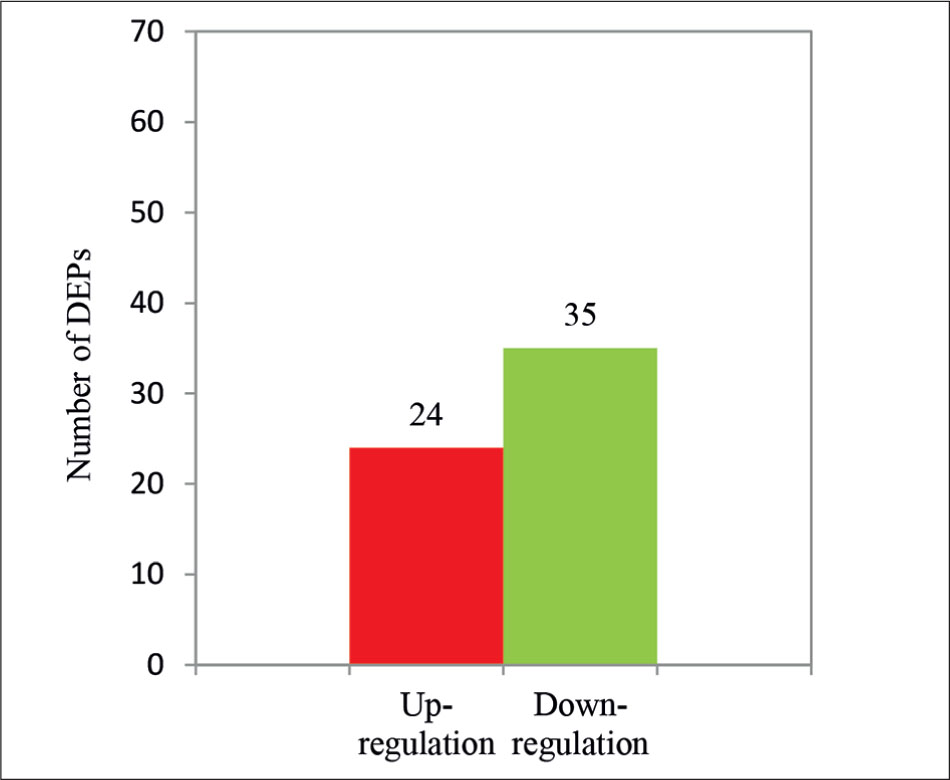
Figure 1.
Differentially Expressed Proteins between ASD and control samples: names of the comparable group; Y-axis: the number of the differentially expressed protein. Red stands for up-regulated proteins, green stands for the number of down-regulated proteins.
Bioinformatics Analysis of Differentially Expressed Proteins
To elucidate the biological roles of the identified DEPs, we performed Gene Ontology (GO) and Kyoto Encyclopedia of Genes and Genomes (KEGG) pathway enrichment analyses using Enrichr (https://amp.pharm.mssm.edu/Enrichr/). Biological Process (BP): The DEPs were significantly associated with processes such as protein processing regulation, activation cascades, complement activation, humoral immune response, immune effector processes, acute inflammatory response, and Fc-gamma receptor signaling pathway (Figure 2A). Cellular Component (CC): Enrichment was observed in structures such as actin filament bundles, stress fibers, platelet alpha granules, focal adhesions, very-low-density lipoprotein (VLDL) particles, actomyosin complexes, and the endoplasmic reticulum lumen (Figure 2B). Molecular Function (MF): Significant enrichment was found for functions including serine-type endopeptidase activity, general endopeptidase activity, immunoglobulin receptor binding, integrin binding, complement component C1q binding, and metal ion binding (Figure 2C).
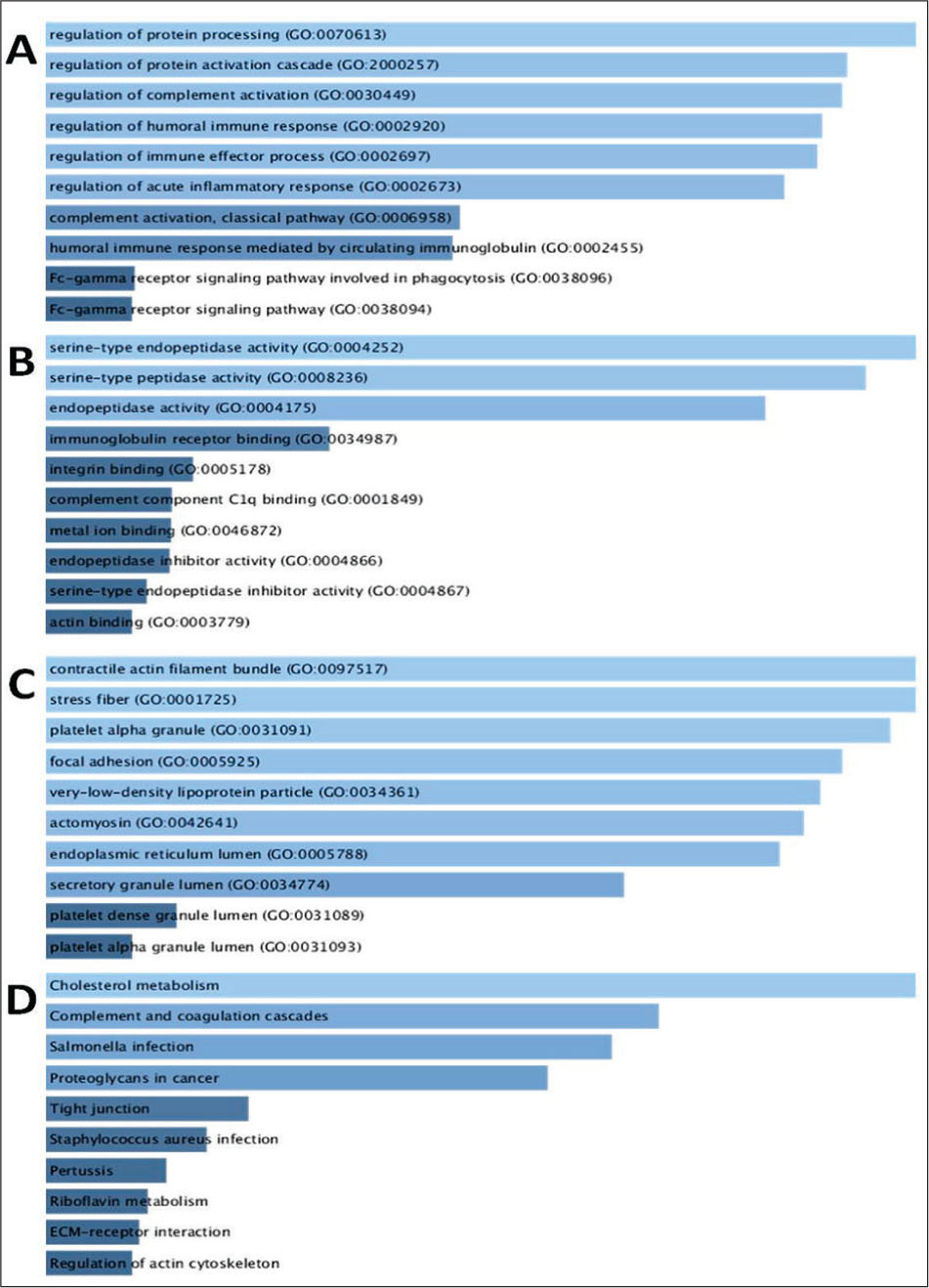
Figure 2.
GO and KEGG pathway enrichment analyses performed using Enrichr on DEPs identified from ASD and TDC.
(A) The top 10 enriched biological processes for DEPs.
(B) The top 10 enriched molecular functions for DEPs.
(C) The top 10 enriched cellular components for DEPs.
(D) The top 10 enriched KEGG pathways for DEPs.
KEGG Pathway Analysis
A total of 80 KEGG pathways were enriched among the DEPs. The top 10 significantly enriched pathways included: Cholesterol metabolism, Complement and coagulation cascades, Salmonella infection, Proteoglycans in cancer, Tight junction, Staphylococcus aureus infection, Pertussis, Riboflavin metabolism, ECM-receptor interaction, Regulation of actin cytoskeleton (Figure 2D).
COG Functional Classification
Clusters of Orthologous Groups (COG) classification revealed the functional distribution of DEPs: Class O (Posttranslational modification, protein turnover, chaperones): 98 proteins, Class R (General function prediction only): 73 proteins, Class Z (Cytoskeleton): 28 proteins, Class T (Signal transduction mechanisms): 21 proteins, Additional COG classes included smaller numbers of proteins across various functional categories (Figure 3).
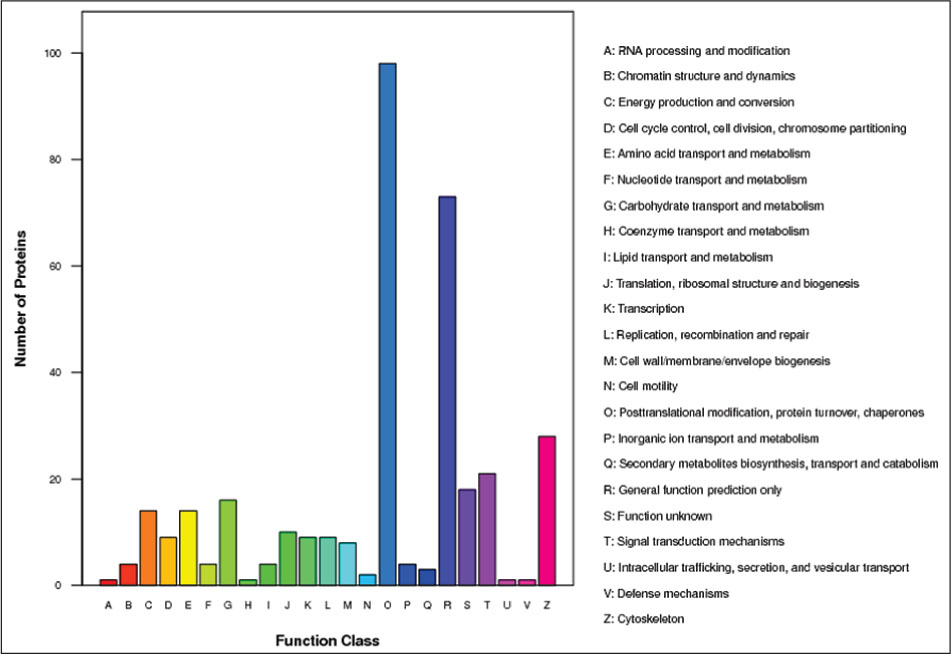
Figure 3.
Histogram of the GOG Analysis. The X-axis displays the COG term; Y-axis displays the corresponding protein count illustrating the protein number of different functions.
DISCUSSION
In this study, iTRAQ-based LC-MS/MS proteomic profiling revealed 59 differentially expressed proteins (DEPs) in the serum of children with autism spectrum disorder (ASD) compared to typically developing children (TDC). These DEPs provide insights into the molecular mechanisms underlying ASD and suggest potential candidate biomarkers for diagnosis or subtyping. Among the identified DEPs, five apolipoproteins (APOC2, APOC4, APOF, APOL1, and LPA) were upregulated in the ASD group. Apolipoproteins (Apos) are essential for the transport of lipids, cholesterol, and fat-soluble vitamins in the bloodstream and play critical roles in maintaining lipid homeostasis [11]. Notably, APOC2, LPL, and LPA were enriched in the cholesterol metabolism pathway, which is consistent with previous reports indicating lipid metabolism disturbances in individuals with ASD. Dysregulated cholesterol and lipid pathways have been proposed to contribute to neurological development and function, and such disruptions may play a role in ASD pathogenesis. Furthermore, we observed elevated levels of complement-related proteins, including C4A, C1QA, and SERPINA5, suggesting immune system dysregulation in ASD. Both C4A and C1QA participate in the classical complement activation pathway, and their upregulation has also been documented in prior ASD studies [ 12]. This reinforces the hypothesis that innate immune responses, particularly those involving the complement system, are implicated in the pathophysiology of ASD. SERPINA5, a multifunctional serine protease inhibitor, regulates hemostasis, fibrinolysis, and extracellular matrix (ECM) remodeling, as well as embryonic development. While elevated SERPINA5 levels have been previously reported in ASD [13], our findings confirm its increased expression, supporting its potential involvement in disease-specific physiological processes. An interesting observation in our study was the downregulation of C-reactive protein (CRP). CRP is a key inflammatory marker that can bind to C1Q and trigger complement activation. Elevated CRP levels have been reported in children with ASD in several studies [14]. However, our results contradict these findings, highlighting a possible heterogeneity in inflammatory profiles among ASD patients. This discrepancy may stem from differences in sample size, methodology, disease subtypes, or environmental influences, and warrants further investigation. Overall, our data support previous findings while providing novel insights into lipid metabolism and immune dysregulation in ASD. These differentially expressed serum proteins—particularly apolipoproteins and complement components—could serve as valuable candidate biomarkers for ASD. However, further validation studies in larger, independent cohorts and functional studies are necessary to elucidate their precise roles in ASD pathophysiology. Another set of five proteins - VASP, TUBA1A, MYH9, FN1, and PFN1—were found to be involved in tight junction formation and the regulation of the actin cytoskeleton, key processes in neurodevelopment and synaptic plasticity. Vasodilator-stimulated phosphoprotein (VASP), a member of the Ena/VASP family, regulates actin filament elongation and dynamics, and is critical in cytoskeletal organization, platelet aggregation, and cellular motility [15]. Profilin-1 (PFN1), an actin-binding protein, facilitates actin polymerization by binding to G-actin and enhancing filament elongation. PFN1 works in concert with VASP, forming a Profilin-Actin-VASP complex that promotes dynamic cytoskeletal remodeling [16]. Notably, this study is the first to report elevated PFN1 levels in ASD patient serum, although increased PFN1 expression has previously been observed in mouse models of Fragile X syndrome, a condition with overlapping symptoms and molecular pathways with ASD [ 17]. TUBA1A, a tubulin alpha-1A chain, is a key component of the microtubule cytoskeleton, highly expressed during brain development and involved in neuronal migration and axonal outgrowth. Mutations in TUBA1A have been associated with human brain malformations and neurodevelopmental syndromes [18]. Together, Profilins and Ena/VASP proteins, such as VASP, play essential roles in neuritogenesis by coordinating the cross-talk between actin filaments and microtubules, critical for the formation and maintenance of neuronal connections [19]. Fibronectin 1 (FN1) is an extracellular matrix glycoprotein involved in cell adhesion, migration, and tissue repair, and is known to interact with the complement system. Previous studies reported increased FN1 levels in ASD patients [12, 20]; however, in our study, FN1 was down-regulated, indicating possible heterogeneity in ECM remodeling or inflammation in ASD, or differences in cohort characteristics and analytical platforms. This discrepancy warrants further investigation. MYH9 (myosin-9), also known as non-muscle myosin heavy chain IIA, plays a critical role in cell migration, signal transduction, and cytokinesis. MYH9 was previously reported as down-regulated in the BTBR mouse model of autism, supporting its potential involvement in the cytoskeletal abnormalities seen in ASD [21]. Interestingly, MYH10, a closely related paralog and MYH9 antagonist, has been classified as a high-confidence ASD candidate gene (score 2) in the SFARI Gene database (https://gene.sfari.org/). Collectively, these findings emphasize the potential involvement of cytoskeletal regulatory proteins and ECM-interacting components in the molecular pathology of ASD, particularly in processes underlying neuronal structure, plasticity, and synaptic function. Moreover, two differentially expressed proteins—TGFB1 and LTBP1—were found to be involved in the TGF-β signaling pathway, a pathway known to regulate development, immune modulation, and neuronal plasticity. Transforming growth factor beta-1 (TGFB1) is a multifunctional cytokine implicated in various neurodevelopmental and neurodegenerative conditions. In agreement with previous studies, we observed decreased levels of TGFB1 in ASD patients, which has been correlated with reduced adaptive behavior and more severe behavioral symptoms [22]. Latent-transforming growth factor beta-binding protein 1 (LTBP1) functions as a structural component of the extracellular matrix (ECM) and plays a role in regulating TGFB1 bioavailability. Accumulating biological, genetic, and clinical evidence suggests that heparan sulfate (HS) metabolism abnormalities may play a key role in the pathogenesis of ASD and other neurodevelopmental disorders. In our study, heparan sulfate proteoglycan 2 (HSPG2), a major component of the basement membrane, was significantly decreased in ASD individuals. HSPG2 contributes to basal lamina integrity, and acts as a reservoir for growth factors and cytokines, influencing key signaling pathways [23]. Heparanase (HPSE), an enzyme that regulates HS degradation and remodeling, was also found to be reduced in ASD patients, suggesting dysregulation in ECM turnover and signaling homeostasis. In addition, Nidogen-1 (NID1), another basement membrane protein known to bind HSPG2 and stabilize the ECM, was significantly down-regulated in ASD serum samples. Together, these three ECM-associated proteins—HSPG2, HPSE, and NID1—participate in cell-ECM interactions, growth factor signaling, and maintenance of ECM structure. Their concurrent down-regulation suggests a disruption in ECM integrity and signaling, which may contribute to abnormal neurodevelopment in ASD. Proteomic biomarkers not only offer promise for early and objective ASD diagnosis, but also hold potential for monitoring treatment responses and furthering our understanding of the molecular mechanisms underlying ASD. In summary, the iTRAQ-based proteomic analysis conducted in this study identified multiple differentially expressed proteins involved in pathways such as the complement cascade, tight junction and actin cytoskeleton regulation, TGF-β signaling, ECM interactions, and cholesterol metabolism. These findings demonstrate the utility of quantitative proteomics in ASD research and provide a valuable foundation for future biomarker validation and mechanistic studies, especially using accessible biospecimens such as peripheral blood.
ACKNOWLEDGMENTS
The authors are most grateful to the families of the participants for their collaboration. Additionally, we would like to acknowledge Prof. V. Stoyanova, Asst. Prof. H. Ivanov and Prof. I. Ivanov (Department of Pediatrics and Medical Genetics Medical University Plovdiv, Bulgaria) for their technical insights and support of this work.
Notes
[2] Financial disclosure Funding
This work was supported by the European Unions Horizon 2020 research and innovation program under grant agreement No 739582 (Project PlantaSYST)