INTRODUCTION
Gastric cancer is a prevalent malignancy with a multifactorial etiology worldwide. It ranks as the fifth most commonly diagnosed cancer globally and represents the fourth leading cause of cancer-related mortality [1,2]. The majority of cases are incidentally diagnosed, often during investigations for unrelated conditions [2]. This malignancy arises from a complex interplay between genetic susceptibility and environmental factors [3, 4, 5, 6].
In addition to hereditary predisposition, several risk factors have been implicated in the development of gastric cancer. These include Helicobacter pylori (H. pylori) infection, intestinal metaplasia, smoking, alcohol use, excessive intake of N-nitroso compounds, diets high in smoked or processed foods, deficiencies in vitamins A and C, viral infections such as Epstein–Barr virus, and a history of gastric or bariatric surgery [2,7,8].
Cholecystectomy, the surgical removal of the gall-bladder, has been hypothesized to influence gastric carcinogenesis, although a direct causal link has not been definitively established [9,10]. Some studies suggest that shared risk factors or indirect mechanisms, such as bile reflux, may play a role.
Following cholecystectomy, bile is no longer stored in the gallbladder and may flow continuously into the duodenum, increasing the likelihood of duodenogastric reflux. This exposes the gastric mucosa to bile and pancreatic enzymes, potentially leading to mucosal injury, chronic inflammation, and subsequent pathological changes [ 11, 12, 13].
Bile acids, particularly under acidic gastric conditions, demonstrate increased membrane permeability, enhancing their cytotoxic potential [ 3, 4, 5]. This may contribute to mucosal damage and inflammation, which can progress to atrophic gastritis and intestinal metaplasia—key precursors to gastric cancer. Previous studies have reported a correlation between elevated bile acid concentrations in gastric fluid and the severity of intestinal metaplasia [14,15].
Epidemiological studies have noted an increased risk of gastric cancer in patients experiencing duodenogastric reflux, particularly among males within 10 years post-cholecystectomy [16]. Other studies have highlighted a possible role of bile reflux in carcinogenesis among patients with gallstones or those who have undergone cholecystectomy, emphasizing the need for clinical awareness [17].
The hTERT (human telomerase reverse transcriptase) gene, located on chromosome 5p15.33, encodes the catalytic subunit of telomerase, an enzyme essential for telomere maintenance and cellular longevity. hTERT consists of 16 exons and 15 introns and plays a pivotal role in cellular proliferation and tumorigenesis [18]. Elevated hTERT expression is a hallmark of cancer cells, contributing to their ability to divide indefinitely, a phenomenon often referred to as “cellular immortality” [7,19].
Overexpression of hTERT has been documented in 85–90% of human malignancies, including glioblastoma, thyroid carcinoma, gastric cancer, melanoma, hepatocellular carcinoma, bladder cancer, liposarcomas, and urothelial tumors [ 20, 21, 22]. This dysregulation promotes unrestrained cellular proliferation and tumor progression.
However, hTERT expression is not universally elevated across all cancer types. In certain malignancies, such as colorectal, lung, esophageal, renal, pancreatic, breast, and prostat cancers, hTERT promoter mutations are relatively infrequent [22].
The c-MYC oncogene regulates numerous pathways related to cell cycle control, apoptosis, and differentiation. Aberrant c-MYC activation has been implicated in various cancers, including gastric carcinoma. It enhances hTERT promoter activity via interaction with the Myc/Max binding site in the core promoter region. c-MYC is a well-established transcriptional activator of hTERT, and studies have shown that bile acids under acidic conditions can stimulate c-MYC activity, further promoting telomerase expression and tumor progression in gastric tissue [5,6,23].
Although current epidemiological data do not conclusively indicate a significant increase in gastric cancer risk following cholecystectomy, the evidence is conflicting. Some studies support a potential link, while others do not, possibly due to variations in study design, population characteristics, and confounding factors such as diet and genetic predisposition [10,24,25].
Given this background, the present study aims to investigate whether increased gastric exposure to bile acids following cholecystectomy contributes to gastric carcinogenesis. Additionally, we seek to examine the roles of hTERT expression and c-MYC activation in the gastric mucosa as potential mechanisms and biomarkers associated with this process.
MATERIALS AND METHODS
Study Design and Participants
This study included 100 individuals who presented to the Department of Gastroenterology at Manisa Celal Bayar University School of Medicine between September 2021 and May 2023. Written informed consent was obtained from all participants. Fresh tissue samples from each case were evaluated both macroscopically and histopathologically.
Participants were categorized into three groups: patients diagnosed with gastric cancer via endoscopy (n = 32), individuals with a history of cholecystectomy (n = 34), and a control group consisting of patients with normal endoscopic and histopathological findings (n = 34). All subjects were assessed at the Department of Gastroenterology and underwent endoscopic procedures based on clinical indications.
Inclusion criteria were: patients aged 18 years or older, a histopathological diagnosis of gastric cancer from endoscopic biopsies, a documented history of cholecystectomy, or dyspeptic patients with normal findings upon endoscopy and histology.
Exclusion criteria were: individuals under the age of 18, refusal to participate, a history of chemotherapy or radiotherapy for gastric or any other malignancy, or current diagnosis of any type of cancer.
The study adhered to the ethical principles outlined in the Declaration of Helsinki. A sociodemographic data form was completed for each participant by the attending clinician.
In all three groups, variables such as disease duration, activity severity, routine laboratory results, pathological evaluation findings, and the presence of Helicobacter pylori (HP) and/or intestinal metaplasia (IM) were recorded for comparative analysis. Cancer staging was conducted by the attending physician using computed tomography (CT) and/or positron emission tomography (PET-CT).
Endoscopic Procedure
All endoscopic examinations were carried out in the Department of Gastroenterology using a standardized protocol. The equipment used included video endoscopes (GIF-H260; Olympus), a video processor (Evis Lucera CV 260 SL; Olympus), and a light source (Evis Lucerna CLV 260 SL; Olympus). Biopsies were obtained from the antrum and corpus using Olympus biopsy forceps, with at least two specimens taken per patient. As all gastric cancer cases involved distal tumors, antral biopsy samples were collected from both the cholecystectomy and control groups for histopathological analysis.
Ethical Approval
The study protocol was approved by the Institutional Review Board of Manisa Celal Bayar University (Approval No. 20.478.486/508, Date: 15 August 2020) and supported by the Scientific Research Project Unit of the university (Project No. 2021-048). Informed consent was obtained from all participants.
Quantitative Real-Time PCR (qRT-PCR)
Total RNA was extracted from tissue samples using TRIzol reagent (Invitrogen) according to the manufacturer’s instructions. Complementary DNA (cDNA) was synthesized using the iScript cDNA Synthesis Kit (Bio-Rad, USA), and stored at −20°C until further analysis.
qRT-PCR was conducted on a Bio-Rad CFX96-DX platform using Advanced Universal SYBR Green Supermix (Bio-Rad). The expression levels of the target genes c-MYC and hTERT, and the reference gene β-actin, were quantified. Primers specific to each gene are listed in Table 1. The thermal cycling protocol included an initial denaturation at 95°C for 10 minutes, followed by 45 cycles of amplification (denaturation at 95°C for 10 seconds, annealing at 60°C for 30 seconds, and extension at 72°C for 1 second), and a final cooling step at 40°C for 30 seconds.
Table 1.
Specific Primer Sequences Used for mRNA Expression Analysis of c-MYC, hTERT, and β-Actin (5′→3′)
| ACTB | |
| Primer sets | ACCAGGGCGTGATGGT (Forward) CGTCCCAGTTGGTGACG (Reverse) |
| c-MYC | |
| Primer sets | CCTGGTGCTCCATGAGG (Forward) CCAGACTCTGACCTTTTGCC (Reverse) |
| hTERT | |
| Primer sets | GCCGATTGTGAACATGGAC (Forward) CGTAGTTGAGCACGCTGAA (Reverse) |
Each PCR run included a no-template control using DNase- and RNase-free water. All reactions were performed under optimized conditions, and gene expression levels were normalized to β-actin. Data analysis was conducted using the Bio-Rad software suite.
Data Analysis
The normality of the distribution of continuous variables was assessed using the Shapiro–Wilk test. Categorical variables were presented as frequencies and percentages. The mean and standard error (SE) values for c-MYC and hTERT expression levels were reported according to gender, Helicobacter pylori status, and the presence of intestinal metaplasia.
Differences in c-MYC and hTERT levels among the groups were analyzed using Two-Way Analysis of Variance (ANOVA). Categorical variables were evaluated using Pearson’s chi-square test or Fisher’s exact test, as appropriate.
In the subgroup of patients with gastric cancer, comparisons of c-MYC and hTERT expression levels based on the presence or absence of metastasis were performed using the Independent Samples t-test. These results were presented as mean ± standard deviation (SD). A p-value of <0.05 was considered statistically significant for all analyses.
Demographic Data Analysis
Demographic characteristics of the study population were analyzed using SPSS version 21.0 (IBM Corp., Armonk, NY, USA). Statistical analyses included chi-square tests, independent samples t-tests, and one-way ANOVA to evaluate differences between groups.
RESULTS
A total of 100 participants were included in the study and were divided into three groups: patients diagnosed with gastric cancer (n = 32), individuals with a history of cholecystectomy (n = 34), and a control group (n = 34).
The mean age of gastric cancer patients was 65.2 ± 10.1 years, while that of the cholecystectomy and control groups was 60.5 ± 9.2 and 59.9 ± 13.5 years, respectively (Table 2). Although gastric cancer patients were slightly older, no statistically significant difference in mean age was observed among the groups (p > 0.05).
Table 2.
Demographic Characteristics of Participants by Group
| Gastric Cancer | Cholecystectomy | Control | ||
|---|---|---|---|---|
| Mean Age | 65,2 ± 10,1 | 60,5 ± 9,2 | 59,9 ± 13,5 | |
| Gender | Female n (%) | 16 (%50) | 22 (%64) | 23 (%67) |
| Male n (%) | 16 (%50) | 12 (%36) | 11 (%33) | |
In terms of gender distribution, 61% (n = 61) of the participants were female and 39% (n = 39) were male. A statistically significant difference was identified between the groups, with a higher proportion of females in the cholecystectomy group (p = 0.021).
Among the gastric cancer group, 14 patients presented with distant metastasis. When comparing c-MYC and hTERTexpression levels between metastatic and non-metastatic gastric cancer patients, no statistically significant differences were observed (c-MYC, p = 0.753; hTERT, p = 0.866).
Comparison of H. pylori Infection and Intestinal Metaplasia Across Study Groups
The distribution of H. pylori positivity did not significantly differ among the study groups (p = 0.740). H. pylori was detected in 55.9% of the control group, 50.0% of the cholecystectomy group, and 59.4% of the gastric cancer group (Table 3).
Table 3.
Comparison of H. pylori Infection and Intestinal Metaplasia Across Study Groups
| Groups | p-value | |||
|---|---|---|---|---|
| Control (n=34) | Cholecystectomy (CK) (n=34) | Gastric Cancer (CA) (CA) (n=32) | ||
| H.pylori | ||||
| Negative | 15 (%44,1) | 17 (%50,0) | 13 (%40,6) | 0,740 |
| Positive | 19 (%55,9) | 17 (%50,0) | 19 (%59,4) | |
| Intestinal Metaplasia | ||||
| Negative | 20 (%58,8) | 26 (%76,5) | - | 0,120 |
| Positive | 14 (%41,2) | 8 (%23,5) | ||
There was also no statistically significant difference in the presence of intestinal metaplasia between the control and cholecystectomy groups (p = 0.120). Intestinal metaplasia was present in 41.2% of the control group and 23.5% of the cholecystectomy group.
Gene Expression Analyses of c-MYC and hTERT
When gender was not considered, group classification had a statistically significant effect on c-MYC levels (p < 0.001). The cholecystectomy group exhibited significantly lower c-MYC expression than both the control and gastric cancer groups (Figure 1). Similarly, when group classification was disregarded, gender had a statistically significant impact on c-MYC levels (p = 0.044), with lower levels in female patients. However, intra-group gender-based differences were not statistically significant (p = 0.057), indicating a uniform trend across groups.
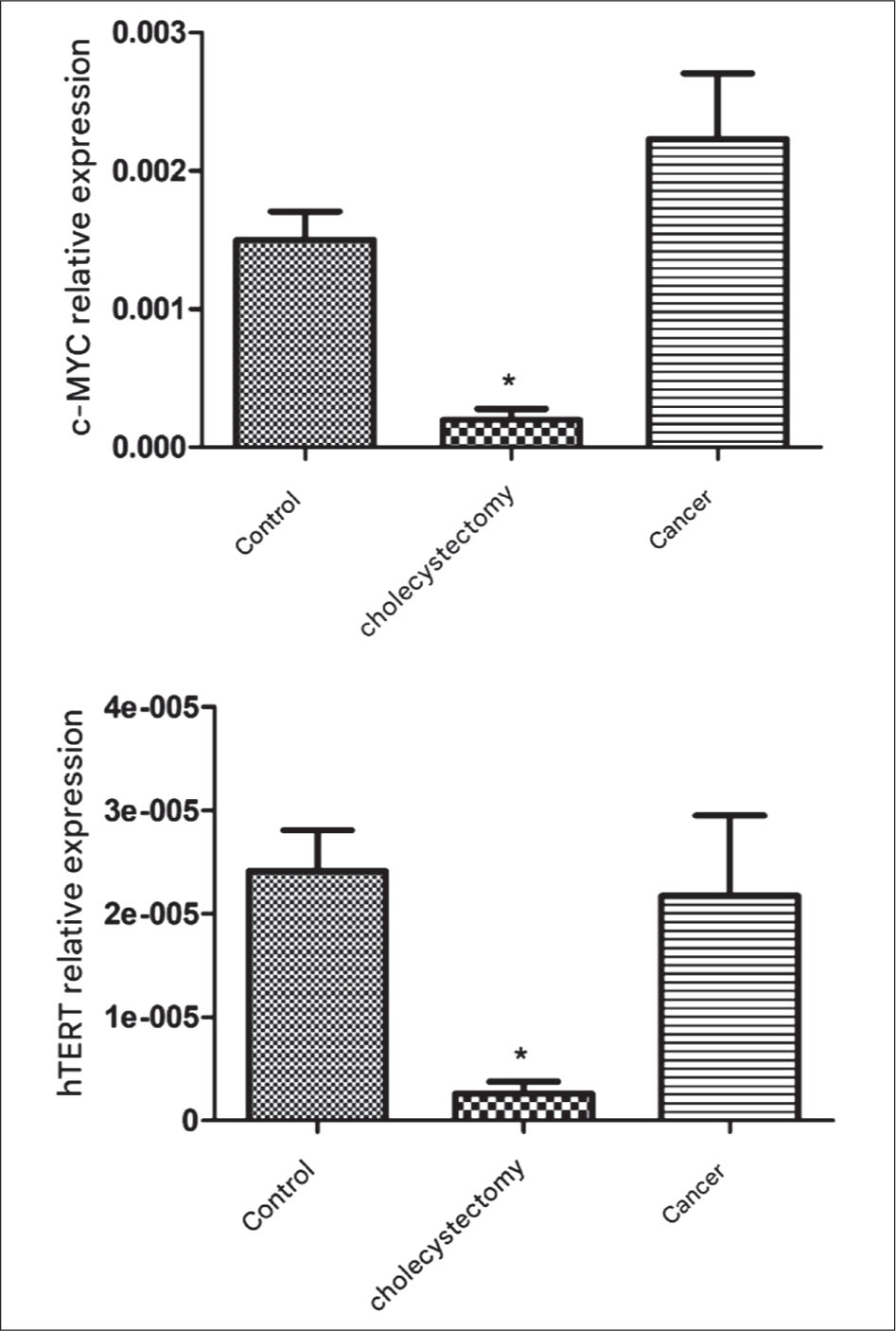
Figure 1.
Relative expressions of c-MYC and hTERT mRNA
When H. pylori status was not considered, group classification remained significantly associated with c-MYC expression (p < 0.001), with the cholecystectomy group displaying lower expression levels than the other groups. However, H. pylori presence did not significantly affect c-MYC levels (p = 0.234), and no significant differences were observed within individual groups based on H. pylori status (p = 0.377).
Regarding intestinal metaplasia, when its presence was not considered, group classification still showed a significant influence on c-MYC levels (p < 0.001), particularly between the cholecystectomy and control groups. In contrast, when group classification was ignored, the presence of intestinal metaplasia had no statistically significant effect on c-MYC levels (p = 0.958), nor did it yield significant differences within the control and cholecystectomy groups (p = 0.505).
Similarly, hTERT expression levels were significantly influenced by group classification when gender was not taken into account (p = 0.003), with the cholecystectomy group showing reduced expression compared to the other two groups (Figure 1). Gender also significantly affected hTERT levels when group classification was ignored (p = 0.043), with lower levels observed in women. However, no significant intra-group gender differences were identified (p = 0.382).
Group classification continued to significantly affect hTERT levels regardless of H. pylori status (p = 0.005), while the presence of H. pylori itself had no significant influence (p = 0.694). There were also no significant within-group differences in hTERT expression related to H. pylori (p = 0.743).
Finally, group classification had a statistically significant effect on hTERT expression independent of intestinal metaplasia (p < 0.001), again showing lower expression in the cholecystectomy group. However, intestinal metaplasia did not significantly affect hTERT levels when group classification was ignored (p = 1.000), nor within the control and cholecystectomy groups (p = 0.637).
DISCUSSION
Telomerase is a ribonucleoprotein complex consisting of an RNA component and human telomerase reverse transcriptase (hTERT). It catalyzes the de novo synthesis of telomeric DNA during cell division, thereby maintaining chromosomal stability and contributing to cellular immortality. hTERT serves as a central regulator in various oncogenic processes. Its activity is closely associated with uncontrolled cellular proliferation and is essential for cancer cells to maintain their replicative potential [6,26]. Approximately 80–90% of human malignancies exhibit elevated hTERT expression, as confirmed by numerous studies [22]. Beyond telomere maintenance, hTERT has been implicated in additional telomere-independent roles in carcinogenesis, including cellular proliferation, malignant transformation, and escape from senescence [6,22].
The c-MYC gene, located on chromosome 8q23–24, encodes a key transcription factor involved in cell cycle regulation, apoptosis, and cellular metabolism. Elevated c-MYC expression has been reported in gastric cancer and is associated with poor prognosis [27,28]. In the present study, c-MYC expression was significantly higher in gastric cancer patients compared to the control group. However, expression levels did not differ significantly between meta-static and non-metastatic cancer cases.
Although c-MYC is a potent activator of hTERT transcription, our findings indicated a paradoxical pattern—c-MYC expression was elevated while hTERT expression was decreased in gastric cancer cases relative to controls. These results suggest a possible regulatory imbalance or the involvement of additional suppressive mechanisms in hTERT expression despite c-MYC activation. As comprehensively reviewed by Gladych et al. [29], hTERT expression is governed by a sophisticated multi-layered network where transcriptional induction by c-MYC can be effectively overridden by antagonistic factors. For instance, the inhibitory effect of MAD1—which competes with c-MYC for the same E-box binding sites—may prevent telomerase activation even in the presence of oncogenic stimuli like c-MYC [30]. Furthermore, Gladych et al. [29] highlight that post-transcriptional regulations, such as alternative splicing or the presence of non-functional mRNA variants, can lead to a discrepancy between transcription factor levels and functional hTERT expression. This ‘molecular disconnect’ observed in our gastric cancer cases may also be attributed to site-specific epigenetic modifications, such as promoter hypermethylation, which acts as a dominant silencing signal that overrides oncogenic drive [31].
The initial steps of gastric carcinogenesis involve dysregulation of cellular processes such as proliferation, apoptosis, and anchorage-independent growth [27,32]. These processes are tightly controlled under normal conditions, and their deregulation, particularly through c-MYC overexpression, has been implicated in tumor development [33,34]. Our finding of elevated c-MYC levels in gastric cancer is consistent with previous reports and supports its proposed role as a key oncogenic factor in gastric carcinogenesis.
Wang et al. demonstrated that inhibition of c-MYC suppressed the acidified bile acid–induced upregulation of hTERT in gastric adenocarcinoma cells, suggesting a direct regulatory role [35]. They further observed that both c-MYC and hTERT expression increased in response to acidified bile acids, supporting a mechanistic link between bile reflux and telomerase activation [6,35]. In our study, patients who had undergone cholecystectomy exhibited reduced expression of both c-MYC and hTERT in gastric tissues compared to cancer cases, suggesting that while chronic exposure to bile reflux may influence gastric mucosal gene expression, it may not immediately trigger the same oncogenic pathways observed in established malignancies.
Another study by Tang et al. reported that acidified bile acids increased the expression of hTERT, c-MYC, and heparanase, which were inversely associated with survival in gastric adenocarcinoma patients [26]. While our findings in the gastric cancer group show a divergence in hTERT levels, the overall high expression of c-MYC aligns with the oncogenic patterns described in their study.
The role of bile reflux in gastric carcinogenesis remains debated. While its contribution to Barrett’s esophagus is well established, its impact on gastric adenocarcinoma is less clear [36,37]. In our analysis, neither c-MYC nor hTERT expression showed significant differences in cases with intestinal metaplasia in the control and cholecystectomy groups. Silva et al. proposed that increased hTERTexpression marks the transition from intestinal metaplasia to gastric cancer, serving as a potential biomarker for early transformation [38]. However, they also reported limited hTERT immunoreactivity in both tumor and non-neoplastic tissues in a Brazilian cohort, suggesting population-specific variability and complexity in telomerase regulation.
CONCLUSION
In this study, we evaluated the impact of cholecystectomy on the expression of c-MYC and hTERT in the gastric mucosa. Our results indicate that cholecystectomy alone does not appear to significantly elevate the expression of these markers to the levels seen in gastric cancer. The observed ‘molecular disconnect’ between c-MYC and hTERT in cancer cases underscores the presence of complex, non-canonical regulatory pathways in gastric carcinogenesis. Further investigation is warranted to elucidate the precise mechanisms of hTERT regulation following chronic bile exposure and to assess whether these markers could eventually serve as indicators for early mucosal transformation.