INTRODUCTION
Periodontitis is an inflammatory disease that manifests itself with the destruction of tooth-supporting tissues as a result of a dysregulated immune response to dental biofilm. Despite the microbial origin of the disease, a number of factors related to the organism - such as immune regulation, systemic health status and genetic predisposition - determine the degree of its progression [1,2]. An increasing number of studies prove that biological sex could be a key factor in the immune regulation of periodontitis, influencing the inflammatory pathways that drive the disease and the response to treatment [ 3, 4, 5].
Sexual dimorphism in the functioning of the immune system is well proven in a number of inflammatory and autoimmune diseases. The activity of the innate and acquired immune response, susceptibility to infections and the way of regulating inflammation differ in men and women [6,7]. These differences are due to the interaction between sex hormones, chromosomal composition (XX/XY) and epigenetic mechanisms that regulate the expression of immune genes and signaling pathways [8]. These biological differences may influence the extent and nature of the immune response against the bacterial biofilm, determining individual differences in the clinical presentation of periodontal inflammation and tissue destruction.
Various studies have demonstrated sex-specific gene expression patterns in gingival and immune cells. Transcriptome analyses have shown that even in clinically healthy gingiva, there are distinct differences between males and females – in men, increased expression of structural and inflammatory genes is observed, while in women, genes related to immune regulation and tissue repair predominate [3,4]. During the development of the disease, these differences are deepened: experimental murine studies have shown that in vitro lipopolysaccharide (LPS) stimulation of male neutrophils yields higher chemokine expression and greater osteoclast formation than female neutrophils, linking chemokine bias to bone resorption [9], while in aged female mice, the number of IL-17-producing γδ and Th17 T cells increases [10].
Beyond cellular mechanisms, sex hormones – including estrogen, progesterone, and androgens – play an important role in shaping immune activity, affecting the production of cytokines and chemokines both in circulating immune cells and within gingival fibroblasts [11, 12, 13]. For instance, progesterone has been shown to downregulate IL-6 expression in gingival fibroblasts, indicating that it may exert a local anti-inflammatory action [11]. Evidence from both clinical and animal studies further suggests that hormone replacement therapy and progesterone-based treatments can help attenuate inflammatory responses and limit alveolar bone loss in selected groups of patients [12,13].
Despite these observations, direct molecular links between sex hormones, local gingival immune gene regulation, and clinical periodontal outcomes are only partially described. Many of the existing studies rely on small or non-representative cohorts, apply bulk-tissue analyses, and often lack simultaneous assessment of hormone concentrations or receptor expression [14,15]. Genetic studies rarely stratify by sex, and integration of data on hormonal regulation and gene expression in periodontitis remains limited [16]. As a result, the molecular mechanisms underlying sex differences in the immune response in periodontal diseases are not fully understood.
Therefore, the primary aim of this exploratory study was to investigate sex-dependent differences in the expression of immune-related genes among patients with severe periodontitis (Stage III/IV). Although saliva is a heterogeneous biofluid, its continuous interaction with the gingival tissues allows it to pool exfoliated cells and inflammatory mediators from the oral environment. Profiling salivary RNA transcripts represents a valuable and non-invasive approach to explore the local immune dysregulation driving severe periodontitis.
By utilizing the NanoString nCounter® Human Inflammation Panel, we hypothesized that males and females would exhibit distinct transcriptomic profiles reflecting variations in the activity of the innate and adaptive immune responses. Overall, this research seeks to provide initial molecular data that lays the foundation for future multiomic and hormonally integrated studies in this area.
MATERIALS AND METHODS
Study design and participants
This exploratory study involved ten systemically healthy, non-smoking patients (five women and five men) diagnosed with severe periodontitis (Stage III/IV), according to the 2018 classification system of the AAP and EFP.
Eligible participants were adults aged 18–65 years, with at least 20 remaining teeth and generalized periodontitis stage III/IV defined by the presence of clinical attachment loss (CAL) ≥ 5 mm in more than 30 % of the teeth.
Exclusion criteria included any systemic disease; use of hormonal contraception, menopausal hormone therapy, testosterone, antiandrogen, or anabolic agents within the past 6 months; endocrine disorders affecting sex hormones (e.g., untreated thyroid, or adrenal disease); antibiotic or anti-inflammatory treatment within 6 months before sampling; smoking; and pregnancy or lactation.
All participants were informed about the study and signed written consent prior to enrollment. The study protocol complied with the principles of the Declaration of Helsinki and was approved by the Ethics Committee of the Medical University – Sofia (Protocol No. 07/23.04.2024).
Clinical examination
A full-mouth periodontal examination was performed by a periodontist using a UNC-15 probe (Hu-Friedy, Chicago, IL, USA). The following clinical parameters were recorded: full-mouth plaque score (FMPS), full-mouth bleeding score (FMBS), probing pocket depth (PPD), clinical attachment loss (CAL), and bleeding on probing (BoP).
Saliva collection and RNA isolation
Unstimulated whole saliva was collected from all participants in the morning (9:00–12:00 a.m.) after at least one hour of fasting. Samples were collected in sterile tubes prefilled with RNA/DNA Shield™ preservation buffer (Zymo Research, CA, USA) to ensure RNA stability during storage. The samples were kept at 4 °C and processed for RNA isolation within two weeks of collection.
Total RNA was extracted using the Quick-RNA™ Miniprep Plus Kit (Zymo Research, CA, USA; cat. no. R1057), following the manufacturer’s protocol. RNA concentration and purity were determined spectrophotometrically (NanoDrop™, Thermo Fisher Scientific, USA) by measuring absorbance at 260 nm and 280 nm, and purity was further evaluated through A260/A280 and A260/A230 ratios. Samples showing adequate concentration and minimal protein or chemical contamination were selected for NanoString analysis.
Gene expression profiling
Gene expression analysis was performed using the nCounter® Human Inflammation Panel (NanoString, Bruker Spatial Biology, WA, USA; cat. no. XT-CSO-HIN2-12) on the nCounter® Pro System. This panel includes 249 genes associated with key inflammatory and immune pathways, along with six internal reference genes.
Hybridization and digital counting followed the manufacturer’s instructions. Raw counts were normalized to internal positive controls and housekeeping genes using the nSolver™ Analysis Software (NanoString Technologies). Genes with low expression (mean count < 20) were excluded from subsequent analyses.
Statistical analysis
Primary data processing and normalization were performed using the nSolver™ Analysis Software (NanoString Technologies Inc., Bruker Spatial Biology, WA, USA). Normalized expression data were exported from nSolver™ and further analyzed in R (version 4.5.0).
Given the small sample size (n = 5 per group), which limits the reliability of normality testing, differences between males and females were evaluated conservatively using the non-parametric Mann–Whitney U test. p-values < 0.05 were considered statistically significant. To correct for multiple testing, the false discovery rate (FDR) was adjusted using the Benjamini–Hochberg method.
Effect sizes were calculated to complement the significance testing and provide more interpretable measures of group differences. For each gene, the log2 fold change (log2FC) and Cohen’s d were calculated in the Females– Males direction to assess sex-associated differences in expression. The log2FC reflects the proportional (biological) change between groups, while Cohen’s d represents the standardized effect size adjusted for variability. Reporting both measures provides complementary information on the magnitude and consistency of sex-related expression differences.
RESULTS
Clinical characteristics of the study population
Ten non-smoking patients diagnosed with severe periodontitis (Stage III/IV) participated in the study, including five women and five men. Their demographic and clinical periodontal characteristics are summarized in Table 1.
Table 1.
Clinical periodontal parameters of the study participants by sex
| Females (n = 5) mean ± SD | Males (n = 5) mean ± SD | p-value | |
|---|---|---|---|
| Age | 48.4 ± 4.2 | 51.2 ± 9.9 | 1.000 |
| FMPS (%) | 53.2 ± 22.6 | 76.2 ± 18.8 | 0.095 |
| FMBS (%) | 50.2 ± 14.0 | 51.6 ± 18.0 | 0.917 |
| PPD ≤ 3 mm (%) | 33.2 ± 4.4 | 33.4 ± 8.9 | 1.000 |
| PPD 4–5 mm (%) | 52.0 ± 3.5 | 55.0 ± 7.0 | 0.599 |
| PPD > 5 mm (%) | 14.8 ± 5.9 | 11.6 ± 4.8 | 0.463 |
| CAL 1–2 mm (%) | 26.2 ± 8.3 | 22.8 ± 7.7 | 0.402 |
| CAL 3–4 mm (%) | 36.6 ± 3.3 | 40.4 ± 12.0 | 0.674 |
| CAL ≥ 5 mm (%) | 37.2 ± 10.8 | 36.8 ± 13.4 | 1.000 |
| BoP (%) | 50.4 ± 15.4 | 40.6 ± 17.0 | 0.463 |
| BL/Age | 1.0 ± 0.2 | 0.9 ± 0.2 | 0.222 |
| Teeth lost (n) | 2.0 ± 3.4 | 3.0 ± 1.0 | 0.139 |
No statistically significant differences were detected between males and females for any of the measured variables, confirming that the two groups were clinically comparable.
Mean full mouth plaque score (FMPS) and full mouth bleeding score (FMBS) were 53.2 ± 22.6% and 50.2 ± 14.0% in females, and 76.2 ± 18.8% and 51.6 ± 18.0% in males, respectively (p > 0.05). Probing pocket depth (PPD) and clinical attachment loss (CAL) were also similar between sexes, indicating comparable periodontal destruction. The average bone loss to age ratio (BL/Age), bleeding on probing (BoP), and number of missing teeth did not differ significantly between groups (p > 0.05).
These results confirm that both male and female patients exhibited a similar degree of periodontal disease severity, providing a sound basis for the subsequent comparison of immune-related gene expression profiles.
Sex-biased differences in immune-related gene expression
The transcriptomic analysis of saliva samples revealed several genes with preliminary sex-associated trends in expression. Table 2 summarizes the top ten genes showing the most pronounced differences between females and males, ranked by their FDR-adjusted p-values.
Table 2.
Differential gene expression between male and female patients with severe periodontitis
| Gene | Females (mean ± SD) | Males (mean ± SD) | log2FC (F/M) | Cohen’s d (F−M) | p-value | FDR |
|---|---|---|---|---|---|---|
| AREG | 30.77 ± 10.04 | 48.90 ± 10.94 | –0.67 | –1.73 | 0.030 | 0.150 |
| NOD2 | 65.24 ± 25.36 | 32.63 ± 22.35 | 1.00 | 1.36 | 0.030 | 0.150 |
| MEF2A | 92.79 ± 48.83 | 47.40 ± 15.99 | 0.97 | 1.25 | 0.050 | 0.150 |
| IL8 | 6774.52 ± 3034.30 | 12004.66 ± 7485.36 | –0.83 | –0.92 | 0.060 | 0.150 |
| MX1 | 294.04 ± 813.10 | 67.84 ± 25.54 | 2.12 | 0.39 | 0.080 | 0.157 |
| STAT1 | 93.86 ± 84.76 | 52.33 ± 12.30 | 0.84 | 0.69 | 0.100 | 0.157 |
| TNFSF14 | 19.79 ± 13.16 | 31.79 ± 8.72 | –0.68 | –1.07 | 0.110 | 0.157 |
| FLT1 | 16.46 ± 12.13 | 31.20 ± 18.48 | –0.92 | –0.94 | 0.150 | 0.160 |
| IFI44 | 23.26 ± 202.93 | 6.14 ± 3.47 | 1.92 | 0.12 | 0.160 | 0.160 |
| IFIT1 | 86.51 ± 478.37 | 25.99 ± 19.12 | 1.73 | 0.18 | 0.160 | 0.160 |
[i] Data are presented as mean ± standard deviation of normalized NanoString gene-expression counts.
Among all analyzed immune-related genes, two showed the most pronounced variation between men and women: AREG (amphiregulin) and NOD2 (nucleotide-binding oligomerization domain-containing protein 2).
AREG expression was significantly higher in men (48.90 ± 10.94) than in women (30.77 ± 10.04), corresponding to a log2 fold change of −0.65 and a large effect size (Cohen’s d = −1.73, unadjusted p = 0.03). In contrast, NOD2 was more strongly expressed in women (65.24 ± 25.36) than in men (32.63 ± 22.35), with log2FC = 1.00, Cohen’s d = 1.36, and unadjusted p = 0.03. These findings are illustrated in Figure 1, which displays boxplots of the normalized log2-transformed expression values.
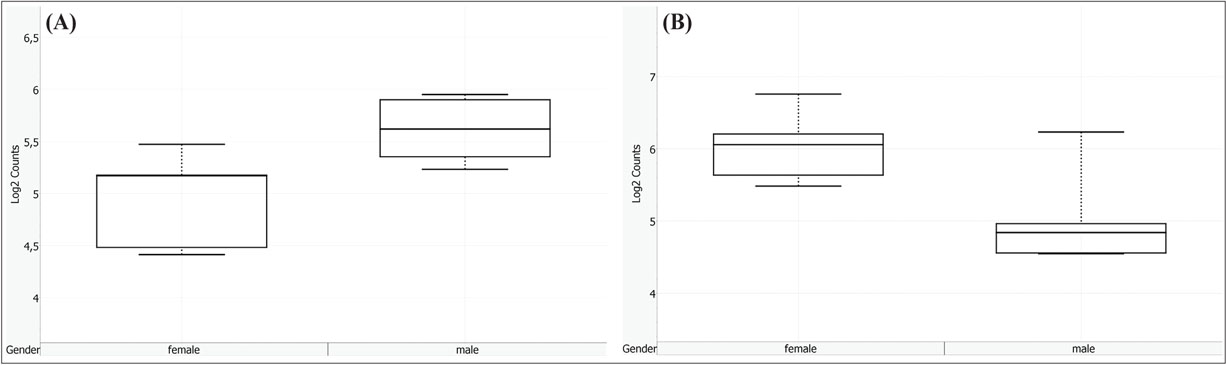
Figure 1.
Sex-related differences in gene expression: (A) Boxplot of AREG expression showing higher transcript levels in males; (B) Boxplot of NOD2 expression showing higher transcript levels in females.
When adjusting for multiple testing using the Benjamini–Hochberg correction, none of the transcripts reached the FDR < 0.05 threshold (both FDR = 0.15). This lack of FDR significance is an anticipated consequence of the limited statistical power inherent to our small sample size. However, the magnitude of the observed effect sizes suggests that these differences are biologically meaningful despite this limitation.
Additional genes such as MEF2A, IL8, MX1, and STAT1 also showed trends toward sex-related variation, although none remained significant after FDR adjustment (Table 2).
DISCUSSION
This pilot investigation offers evidence that sex might influence the way immune-related genes are expressed in individuals affected by severe periodontitis. Our results highlight preliminary trends of sex-associated differences in salivary transcriptomic profiles. However, it must be noted that none of these trends remained statistically significant after correcting for multiple testing (FDR), underscoring the hypothesis-generating nature of these findings. Nevertheless, they support the idea that sex-related biological factors might influence the immune response to periodontal disease. Similar observations have been reported in previous clinical and experimental studies, where men often have a more destructive disease course, while women have a more robust inflammatory response [ 17, 18, 19]. Overall, our results fit into the growing body of evidence that sex hormones, chromosomes, and immunoregulatory mechanisms act together to shape different types of inflammatory responses that influence susceptibility, progression, and recovery in periodontal disease [5,7,20,21].
The two top candidate transcripts reported in our exploratory study (AREG and NOD2) may relate to different but complementary aspects of immune regulation. AREG (amphiregulin) functions as a ligand for the epidermal growth factor receptor (EGFR), which is known to participate in epithelial repair and immune modulation [22, 23, 24]. NOD2 (nucleotide-binding oligomerization domain–containing protein 2), on the other hand, acts as a cytosolic receptor that recognizes bacterial peptidogly-cans and triggers NF-κB–dependent signaling cascades [ 25, 26, 27, 28]. The trend towards increased AREG expression in men might suggest a more active EGFR-dependent repair response, although functional validation is required to confirm this hypothesis. Amphiregulin is produced by epithelial cells, macrophages and regulatory T cells in areas of inflammation, where it stimulates proliferation and influences cytokine secretion [23,24,29]. Its short-term expression promotes healing, whereas prolonged expression may lead to fibrosis or dysregulated tissue remodeling. In the periodontal environment, the AREG–EGFR pathway likely functions as a compensatory mechanism for chronic inflammation and injury. The higher AREG levels in male saliva might hypothetically be linked to sex-specific activation of repair transcriptional programs influenced by hormonal or cellular differences [20,22]. From the other side, NOD2, which is more highly expressed in women, plays a leading role in the innate immune response. Its activation stimulates the production of cytokines such as IL-1β, IL-6, TNF-α and also promotes bacterial clearance via the NF-κB and MAPK pathways [25]. Several studies have demonstrated the association of NOD2 with inflammatory bone loss and aggressive periodontitis, as well as with alterations in microbial recognition and bone metabolism [27,30, 31, 32, 33]. Data from experimental models suggest that NOD2 activation can suppress osteoclastogenesis and maintain mucosal homeostasis, whereas its deficiency enhances inflammatory bone resorption [26,27,34]. Increased NOD2 expression in women could potentially serve as a marker of a more active innate immune defense, consistent with other observations that women demonstrate a stronger inflammatory and antimicrobial response [29,31,32]. These findings suggest that underlying molecular mechanisms driving periodontal tissue destruction may differ between the sexes, even when clinical severity is comparable [17, 18, 19].
The distinct trends in AREG and NOD2 expression between males and females could theoretically point to two different immunoregulatory mechanisms within the same disease. The trend toward higher AREG in men may be hypothesized as an activation of reparative processes aimed at tissue repair through the EGFR-dependent axis. In women, the trend of increased NOD2 expression could potentially imply a tendency for a more intense innate immune response and more efficient microbial recognition. These parallel but different patterns of response are consistent with general immunobiological trends – in men, inflammation is more prone to neutrophil-mediated destruction, while in women it is more regulated and cytokine-mediated [4,10,19].
The immune system appears to react quite sensitively to changes in sex hormone levels. Estrogens, progesterone, and androgens influence immune activity in several ways, affecting both innate and adaptive responses [6,35]. Within the periodontium, cells like gingival fibroblasts, epithelial cells, and leukocytes carry receptors for estrogen and progesterone, which makes them responsive to hormonal shifts throughout the body [11,35]. For instance, progesterone can reduce the production of IL-6 in gingival fibroblasts, a process thought to help temper inflammation and limit tissue damage [35]. Evidence from both clinical and laboratory studies further suggests that hormone replacement therapy, or direct administration of progesterone, can lower IL-1β, TNF-α, and IL-6 concentrations while also reducing alveolar bone loss [12,13,21]. In men, reduced androgen levels and altered concentrations of sex hormone–binding globulin (SHBG) have been associated with a higher risk of periodontitis [20]. All this suggests that systemic hormonal influences and local immune regulation are closely linked. The distinct trends in AREG and NOD2 expression found in our study might hypothetically relate to similar endocrine interactions. Estrogens regulate genes related to innate immunity (including NOD-like receptors), whereas androgens and progesterone modulate epithelial repair and EGFR-dependent transcription [6,12,13,21,35]. The observed trends in our study generate the hypothesis that biological sex may influence immune and repair mechanisms in periodontitis, potentially through hormone-related modulation, although this remains speculative without direct hormonal assessment.
Limitations and future perspectives
The study has several limitations. The relatively small number of participants imposes limitations regarding the statistical power. Even if there were a statistical significance detected in the examined groups (p-values <0.05), the calculated FDR-corrected values reflect a limited power. Importantly, the potential influence of cellular composition on gene expression profiles should also be considered a limitation of the study. Therefore, the observed sex-related differences should be interpreted with caution, as they may also reflect differences in cell-type proportions. The large effect sizes for AREG and NOD2 support targeted validation in a larger, sex-stratified cohort. Nevertheless, the results suggest that transcriptomic analysis in saliva could be used as a method to detect sex-specific immune profiles in severe periodontitis. Future studies should incorporate qPCR validation to confirm these exploratory findings prior to larger-scale implementation. Similar approaches have already been successfully used to study inflammatory mechanisms in other tissues [18,19]. These initial data may serve as a basis for future, larger-scale and multicenter studies with a sex-stratified design that combine transcriptomic, hormonal and epigenetic data. Such studies would be of key importance for a better understanding of the interaction between genetic predisposition, immune signals and endocrine regulation in periodontal diseases.
CONCLUSION
The exploratory results of the present study contribute to the growing evidence that biological sex is an important factor in immune regulation in periodontal diseases. The observed trends in AREG and NOD2 expression between men and women suggest potential molecular mechanisms that may explain sex differences in inflammation, microbial recognition, and tissue repair. Furthermore, the application of NanoString-based salivary transcriptomics demonstrates the potential of noninvasive molecular technologies to reveal subtle biological features related to the pathogenesis of periodontitis. While it is premature to draw direct implications for personalized therapeutic strategies, these initial findings highlight the importance of sex as a biological variable. They provide a foundational framework for future large-scale studies necessary to fully elucidate these pathways in periodontal medicine.
Acknowledgments
This study was conducted as part of project D-125/29.05.2024, funded by the Council of Medical Science at the Medical University – Sofia, Bulgaria.