
Introduction
Obesity is becoming a major global challenge for humanity. It is expected that in one decade, 38.0% of adults around the world will be overweight, if the current growth rate continues [1]. Obesity occurs because of an unbalanced intake of energy. This imbalance contributes to the occurrence of many chronic diseases such as cardiovascular, diabetes, musculoskeletal disorders, and several types of malignant diseases [2, 3, 4].
Obesity is multifactorial. In addition to the non genetic factors, such as nutritional habits and physical inactivity, genetic factors and genetic predisposition play a significant role [2, 5, 6]. So far, 127 genetic loci have been studied that have a potential link to overweight and obesity [1, 4].
Despite many attempts to find a solution to this phenomenon and to reduce the number of people suffering from these diseases, the long-term solution is still being investigated. The development of obesity as a phenomenon is complex [7] and has not been fully understood.
Prevention, as a promising strategy for dealing with this disease, can be achieved by better understanding and controlling of the factors that lead to its manifestation. The analysis and characterization of genetic factors associated with obesity is therefore particularly important.
In the last two decades, various tools have been developed to research, collect data, analyze, and better understand genetic factors. One way of gene analysis is through bioinformatic tools. Bioinformatics is a modern scientific discipline that combines computer science and molecular biology. Bioinformatic tools analyze proteins and nucleic acids, i.e., genes and gene products using computer algorithms and appropriate databases [8].
Due to the ability to quickly analyze biological data, bioinformatics has become an immensely popular and useful field. Specifically, it enables the analysis of biological data such as DNA, RNA, amino acid sequence of proteins, identification of various characteristics and molecular interactions, prediction of 3D structures, etc. All this can be done with tools that are widely available to potential users [9].
Osman et al. [4] has recently performed a bioinformatic analysis of the single nucleotide polymorphisms (SNP) of the human FTO gene (fat and obesity gene) and suggested that the use of in silico analysis may be a good approach to targeting SNPs in other genes associated with the appearance of overweight and obesity. Appa Rao et al. [7] has also used bioinformatic tools to analyze the genes involved in diabetes-related obesity. A similar study was conducted by Abdella [10], which concluded that this method of analysis was useful for further studies related to therapeutic and preventive findings for certain diseases.
In this study, using online bioinformatic tools, data related to the FTO, PPARG (peroxisome proliferator activated receptor γ), ADRB3 (adrenergic receptor β 3) and FABP2 (fatty acid binding protein 2) genes, which have been associated with obesity in humans, were collected and analyzed.
Materials and methods
The data for the sequences of the four genes (and corresponding proteins) have been extracted from the National Center for Biotechnology Information (NCBI) [11]. Using these data, we have summarized the general information about the genes in humans and based on the homology information, we have compared the location of the genes in three species.
Next, a phylogenetic tree was contracted using basic local alignment search tool (BLAST) and multiple sequence alignment (MEGA X) software. The BLAST is an online tool that enables study of the evolutionary history of a gene or protein by comparing the homologous [10]; MEGA X is a package for performing fast and accurate multiple sequence alignment of potentially multiple large sequences of large number of proteins or DNA/ RNA sequences [12]. The method of phylogenetic inference that is used for constructing the phylogenetic trees is distance-matrix methods neighbor joining (NJ) [13]. We have chosen this method because it provides the best trade-off between accuracy and complexity (computation time) [10]. The evolutionary distances were computed using the Maximum Composite Likelihood method [13, 14].
Results
Using the data obtained through NCBI, the FTO, PPARG, ADRB3 and FABP2 genes are characterized and an ontological table is created (Table 1). This table summarizes the key information about these genes including name, location, function, etc.
Table 1
Data on genetic ontology of the genes (proteins) investigated in this study.
| Symbol | Name | Location | Tissue/Expression | Homologs | Function | Pathology of Diseases |
|---|---|---|---|---|---|---|
| FTO | FTO α-ketoglutarate- dependent dioxygenase | 16q12.2 | brain, adrenal glands and 25 other tissues | chimpanzee; rhesus monkey; dog; cow; mouse; rat; chicken; zebrafish; frog | (exact function of this gene is not known); reversing alkylated DNA and RNA damage by oxidative demethylation | strong association with BMI, obesity risk and T2DM |
| PPARG | peroxisome proliferator activated receptor γ | 3p25.2 | biased expression in fat, urinary bladder, colon, stomach and nine other tissues | chimpanzee; rhesus monkey; dog; cow; mouse; rat; chicken; zebrafish | helps in regulating transcription of various genes; regulator of adipocyte differentiation | obsesity, DM, ather oscelrosis, cancer |
| ADRB3 | adrenergic receptor β 3 | 8p11.23 | ovary, urinary bladder, placenta and two other tissues | chimpanzee; rhesus monkey; dog; cow; mouse; rat; chicken; zebrafish; frog | mediate catecholamine-induced activations of adenylate cyclase through the action of G proteins; involved in the regulation of lipolysis and thermogenesis | obesity and body weight-related disorders |
| FABP2 | fatty acid-binding protein 2 | 4q26 | small intestine, duodenum, colon | chimpanzee; rhesus monkey; dog; cow; mouse; rat; chicken; zebrafish; frog | fatty acid-binding protein, uptake, intracellar metabolism, transport of long-chain fatty acids; may act as a lipid sensor to maintain energy homeostasis | obesity, kidney diseases, metabolic disorder |
As seen in Table 1, the four genes are in different loci. Homology is evident among similar species, with minor differences. These genes have various functions, however what they have in common is their contribution to the increase in energy intake, i.e., their contribution to overweight and obesity. We also see a link in the last column where all genes, in addition to other diseases, play a role in obesity-related disorders, such as metabolic disorders, weight-related disorders, and others.
In the second part of this research, all genes are analyzed by comparing three species of organisms, Homo sapiens (human), Mus musculus (mouse) and Gallus (chicken). As a result, an ontological table has been created and is shown in Table 2. The same four genes are found in the three types of organisms. The location of these genes differs in all except for the ADRB3 gene, where we see the same location (chromosome 8) in both Homo sapiens and Mus musculus.
Table 2
Ontology: comparative data on the four genes/proteins in three species.
| Gene | Homo Sapiens (humans) | Mus Musculus (mouse) | Gallus (chicken) | |||
|---|---|---|---|---|---|---|
| Description | Location | Description | Location | Description | Location | |
| FTO | FTO α-ketoglutarate- ependent dioxygenase | chromosome 16; NC_000016.10 (53703963...54121941) | fat mass and obesity associated | chromosome 8; NC_00004.6 (91313367...91668433) | FTO α-ketoglutarate- dependent dioxygenase | chromosome 11; NC_006098.5 |
| PPARG | peroxisome proliferator activated receptor γ | chromosome 3; NC_000003.12 (12287485...12434344) | perixome proliferator activated receptor γ | chromosome 6; NC_000072.6 (115360879...115490404) | perixome proliferator activated receptor γ | chromosome 12; NC_006099.5 |
| ADRB3 | adrenergic receptor β 3 | chromosome 8; NC_000008.11 (37962990...37966599, complement) | adrenergic receptor β 3 | chromosome 8; NC_00074.6 (27225776...27230845, complement) | adrenergic receptor β 3 | chromosome 22; NC_006109.5 (2551442...2554479, complement) |
| FABP2 | fatty acid-binding protein 2 | chromosome 4; NC_000004.12 (119317250...119322138, complement) | fatty acid-binding protein 2, intestinal | chromosome 3; NC_000069.6 (122895072...122899506) | fatty acid-binding protein 2 | chromosome 4; NC_006091.5 |
The evolutionary relationship of organisms and genetic linkage for each gene is done separately by constructing a phylogenetic tree using MEGA X. The style of the trees we have used is the traditional and rectangular type.
Figure 1 shows the analysis of the FTO gene. The evolutionary history was inferred using the NJ method [13]. The evolutionary distances were computed using Maximum Composite Likelihood method [14] and are in units of the number of base substitutions per site. This analysis involved six nucleotide sequences. All ambiguous positions were removed for each sequence pair. There was a total of 1625 positions in the final dataset.
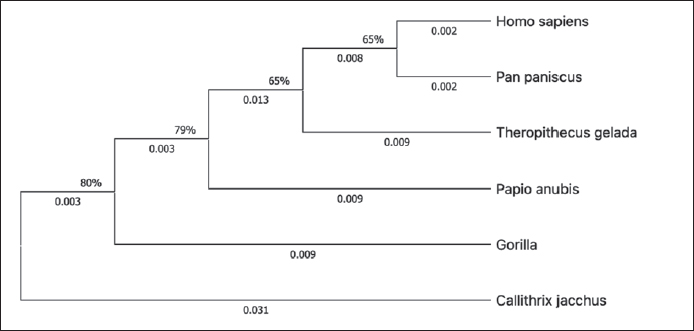
Figure 1
Phylogenetic tree constructed based on the alignment scores of FTO sequences.
The six selected homologs are human (Homo sapiens), bonobo (Pan paniscus), gelada (Theropithecus gelada), olive baboon (Papio anubis), black snub-nosed monkey, gorilla (Gorilla), and the marmoset (Callithrix jacchus). We used BLAST analysis to select five homologs of homo sapiens. The six alignments were made using MEGA X.
From the constructed tree (Figure 1), we see that the more distantly related to human FTO gene is the marmoset FTO gene (Callithrix jacchus). Less distantly related (closer relative) to the human FTO gene is the bonobo FTO gene (Pan paniscus).
Figure 2 shows the phylogenetic tree of the PPARG gene. There was a total of 1199 positions in the final dataset. Six homologs were selected using BLAST, human (Homo sapiens), gorilla (Gorilla), orangutan (Pongo abeii), the sooty mangabey (Cerocebus atys), marmoset (Callithrix jacchus) and Nancy Ma’s night monkey (Aotus nancymaae), which is a night monkey species from South America. From the results of the constructed tree (Figure 2), we see that the more distantly related to the human PPARG gene sequence are the marmoset (Callithrix jacchus) and Nancy Ma’s night monkey PPARG genes (Aotus nancymaae). Less distantly related to the human PPARG gene is the PPARG gene of the gorilla.
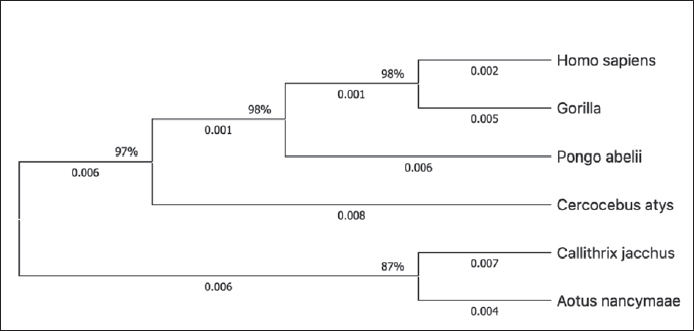
Figure 2
Phylogenetic tree constructed based on the alignment scores of PPARG sequences.
Figure 3 shows the phylogenetic tree of the ADRB3 gene. From the BLAST results, this gene was also present in more different species from which six homologs were selected. All ambiguous positions were removed for each sequence pair. There was a total of 1234 positions in the final dataset. The six selected homologs are the chimpanzee (Pan troglodytes), gorilla (Gorilla), human (Homo sapiens), cattle (Bos taurus), the water buffalo (Bubalus bubalis), and the cat (Felis catus). From the evolutionary analyses (Figure 3), we see that the more distantly related to the human ADRB3 gene is the cat ADRB3 gene (Felis catus). Less distantly related are the chimpanzee (Pan troglodytes) and gorilla (Gorilla).
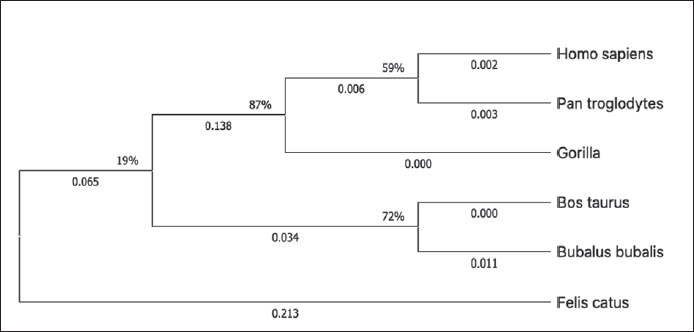
Figure 3
Phylogenetic tree constructed based on the alignment scores of ADRB3 sequences.
Figure 4 shows the phylogenetic tree of the FABP2 gene. Six homologs were selected, the wild Bactrian camel (Camelus ferus), dog (Canis lupus familiaris), the leopard (Panthera pardus), human (Homo sapiens), gorilla (Gorilla) and the sheep (Ovis aries). This analysis involved six nucleotide sequences. All ambiguous positions were removed for each sequence pair. There was a total of 351 positions in the final dataset. From the results of the constructed tree, we see that the less distantly related to the human is the gorilla. More distantly related are the sheep (Ovis aeirs) and camel (Camelus ferus) species.
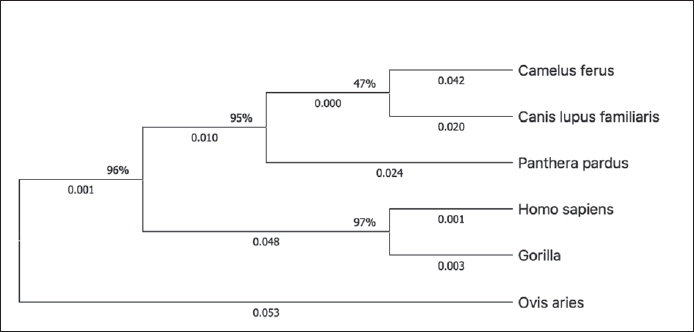
Figure 4
Phylogenetic tree constructed based on the alignment scores of FABP2 sequences.
Discussion
Bioinformatics is a relatively new discipline that has enormous potential for development. The use of bioinformatic tools allows testing and eventual validation of scientific hypotheses, which is of immense importance before starting with experimental work. Bioinformatics combined with other disciplines contribute to the diagnosis and prevention of various diseases with a proven genetic basis.
From the analysis of these genes, we can see that greater similarities exist between human and some species of monkeys such as gorilla, chimpanzee and bonobo, also historically called the pygmy chimpanzee. We can note that the gorilla is more closely related in respect to the FTO and ADRB3 genes, whereas for the other two genes, the chimpanzee species are the closest to humans.
Based on the Table 1 with data on genetic ontology of the genes (and corresponding proteins) investigated in this study, homology is evident. These genes have various functions, and what they have in common is their contribution to the increase in energy intake, i.e., their contribution to overweight and obesity. They all play a role in obesity-related disorders, such as metabolic disorders, weight-related disorders, and others.
Furthermore, from the Table 2 ontological data, we see that the same four genes are found in the three types of organisms. The location of these genes differs in all except for the ADRB3 gene in Homo sapiens and Mus musculus (chromosome 8).
Based on the analysis of the evolution of these genes, we can conclude that the closest homologs to humans are chimpanzees and gorillas. Less homology is observed between humans and other species included in the investigation such as the camel, cat, leopard, dog, the marmoset, etc.
Using bioinformatic tools to identify and characterize obesity-associated genes, we obtain valuable information about the underlying factors and causes of obesity and can contribute toward identifying solutions to this problem. The development of obesity is multifactorial and complex, and genetic predisposition itself depends on other factors such as gene expression. The possession of different variants of these genes is not always manifested with overweight or obesity. Few studies have found that the interaction between transcription factors and epigenetic modifications play a critical role in the expression of the obesity genes [15]. The pathogenesis in the metabolism and the regulation of the expression of these genes is still unclear. Systematic research and more data will be needed to understand the interactions and the effect of all these factors and eventually to identify treatments.