Table 1
American College of Medical Genetics and Genomics (ACMG) classification of variants [17].
| Class 1 | Pathogenic |
| Class 2 | Likely pathogenic |
| Class 3 | Variant of uncertain significance (VUS) |
| Class 4 | Likely benign |
| Class 5 | Benign |
Table 2
Cohort demographics: WES positive and negative.
| Positive n (%) | Negative n (%) | |
|---|---|---|
| Males | 14 | 5 |
| Females | 6 | 1 |
| Total | 20 (77.0)a | 6 (23.0) |
| Age (mean) | 4.9 years | 4.5 years |
| Consanguinity | 14 (53.0) | 4 (15.0) |
[i] a One of the 20 patients had positive WES results but does not explain the phenotype (patient 15 in Table 3).
Table 3
Homozyogous, heterozygous and variants of uncertain significance VUS groups.
| Homozygous Mutations | ||||||||
|---|---|---|---|---|---|---|---|---|
| # | Sex-Age | Family History | Consanguinity | Clinical Characteristics | Onset | Genes | Variant | Diagnoses |
| 1 | F-6 | yes | yes | motor delay; hypotonia; scoliosis; respiratory difficulties in neonatal period; normal congnitions, areflexia | 1 year | P1EZO2 | pathogenic: c.273_279del, p.(Pro92Thrfs*18) | piezo-type mechanosensitive ion channel component; OMIM: 613629 |
| 2 | M-1 | no | yes | severe hypotonia; reduced tendon reflexes; motor/speech delay; cerebellar atrophy; cerebellar cyst; elevated serum CPK | birth | FKRP | likely pathogenic: c.204del, p.(Ser69Profs*60) | MDDGA5 (congenital with brain/eye anomalies), type A5 (MDDGA5); OMIM: 613153 |
| 3 | M-2 | no | yes | vision loss; nystagmus; severe retinal dysfunction | 2 months | RPGRIP1 | pathogenic: c.1107del, p.(Glu370Asnfs*5) | Leber congenital amaurosis type 6, OMIM: 613826 |
| 4 | M-7 | no | yes | intractable epilepsy; global developmental delay; poor vision | 3 years | TPP1 | pathogenic: c.616C>T, p.(Arg206Cys) | neuronal ceroid lipofuscinosis type 2, OMIM: 204500 |
| 5 | M-8 | no | yes | poor hearing; encephalopathy; MRI: white matter changes | 4 years | BTD | pathogenic: c.1618C>T, p.(Arg540Cys) | biotinidase deficiency |
| 6 | M-6 | yes | yes | ataxia; delayed motor milestones; mild intellectual delay; MRI: cerebellar atrophy | 1 year | SPTBN2 | likely pathogenic: c.6258_6261delGAGA, p.(Lys2088Glyfs*228) | infantile-onset spinocerebellar ataxia type 5 |
| 7 | F-8 | yes | yes | ataxia; delayed motor milestones; mild intellectual delay; MRI: cerebellar atrophy | 1 year | SPTBN2 | likely pathogenic: c.6258_6261delGAGA, p.(Lys2088Glyfs*228) | infantile-onset spinocerebellar ataxia type 5 |
| 8 | M-9 | yes | yes | ataxia; oculomotor apraxia; telangiectasia; MRI: cerebellar atrophy | 3 years | ATM | likely pathogenic: c.9066del, p.(Gly3023Alafs*10) | ataxia telangiectasis |
| Heterozygous Mutations | ||||||||
| 9 | F-7 | no | no | delayed language/motor development; intellectual disability; hypotonia; generalized seizures; infantile spasms; visual impairment; normal MRI; normal metabolic profile | 1 year | NTRK2 | pathogenic: c.1301A>G, p.(Tyr434Cys) | early infantile epilectic encephalopathy type 58, OMIM: 617830 |
| 10 | M-3 | yes | no | acute necrotizing encephalopathy; generalized seizures; spasticity; coma and death; brain MRI: symmetric thalamic hyperintense lesions | 3 years | RANBP2 | pathogenic: c.1754C>T, p.(Thr585Met) | acute infection-induced encephalopathy-type 3, OMIM: 608033 |
| 11 | M-4 | no | no | developmental delay; neonatal hypotonia; autistic-like behavior; epilepsy | 1 year | SHANK3 | likely pathogenic: c.2313+1G>A | Phelan-McDermid syndrome, OMIM: 606232 |
| 12 | M-9 | no | no | ataxia; ADHD; delayed speech/ language development; motor delay; hypotonia; normal EEG and brain MRI | 2 years | KAT6A | likely pathogenic: c.1483-1G>A | mental retardation type 32, OMIM: 616268 |
| 13 | M-1 | no | no | intractable neonatal seizures; normal brain MRI | 1 month | PACS2 | pathogenic: c.625G>A, p.(Glu209Lys) | early infantile epileptic encephalopathy type 66, OMIM: 618067 |
| 14 | F-4 | no | yes | intractable focal seizures; normal brain MRI | 3 months | SCN1A | likely pathogenic: c.1377G>C, p.(Gln459His) | early infantile epileptic encephalopathy type 6 (Dravet syndrom), OMIM: 607208 |
| Variant(s) of Uncertain Significance | ||||||||
| 15 | M-6 | no | yes | MCA stroke; dystonia; spasticity; regression of milestones; delayed language/ motor development; focal seizures and abnormal brain myelination on MRI | 4 years | ITGA7 AR | c.1601C>T, p.(Ala534Val) | congenital muscular dystrophy/hypotonia, OMIM: 613204 |
| 16 | F-5 | no | yes | ataxia; frequent falls; macrocephaly, epilepsy and ADHD; MRI: megalencephalic leukoencephalopathy with subcortical cysts | 2 years | MLC1 AR | c.275C>A, p.(Pro92His) | megalencephalic leukoencephalopathy with subcortical cysts type 1, OMIM: 604004 |
| 17 | M-3 | no | yes | delayed speech/language development; dyskinesia; dystonia; infantile onset of the disease; paroxysmal dystonia; MRI: brain atrophy | 2 years | SLC6A3 AR | c.851G>A, p.(Gly284Glu) | infantile Parkinsonism dystonia type 1, DTDS, PMID: 21777827 |
| 18 | M-1 | yes | yes | intractable infantile spasms | 3 months | PNPO AR | c.256T>C, p.(Cys86Arg) | PNPO, OMIM: 603287 |
| 19 | F-6 | yes | yes | ataxia and oculomotor apraxia; brain MRI: molar tooth sign | 2 years | CC2D2A AR | c.916_927del, p.(Pro306_Leu309del) | Joubert syndrome type 9, OMIM: 612285 |
| 20 | M-2 | no | yes | fair hair; global developmental delay; hearing impairment; infantile onset of the disease; motor delay; muscular hypotonia; visual impairment; focal epilepsy; MRI: brain atrophy | 3 months | SPATA5 AR and TIMMDC1a | c.1058A>T, p.(Asp353Val) and c.230T>C, p.Ile77Thr) | EHLMRS, OMIM: 616577 mitochondrial complex I deficiency, OMIM: 618251 |
[i] #: patient number; F: female; M: male; OMIM: Online Mendelian Inheritance in Man; CPK: creatine phosphokinase; MDDGA5: muscular dystrophydystroglycanopathy type A5; MRI: magnetic resonance imaging; ADHD: attention deficit hyperactivity disorder; EEG: electroencephalogram; MCA: middle cerebral artery; DTDS: dopamine transporter deficiency syndrome (DTDS); PMID: PubMed reference number; AR: autosomal recessive; PNPO: pyridoxamine 5’-phosphate oxidase; EHLMRS: epilepsy, hearing loss and mental retardation syndrome.
a Autosomal mitochondrial.
Table 4
Whole exome sequencing negative group.
| # | Sex-Age | Family History | Consanguinity | Clinical Characteristics | Onset |
|---|---|---|---|---|---|
| 1 | F-1 | no | yes | epilepsy and developmental delay; brain MRI: normal | 4 months |
| 2 | M-7 | no | yes | epilepsy and developmental delay; brain MRI: normal | 2 years |
| 3 | M-2 | no | no | intractable epilepsy; poor vision and global developmental delay; brain MRI: normal | 1 year |
| 4 | M-12 | no | yes | global developmental delay; brain MRI: basal ganglia enhancement; metabolic work-up: negative | 6 years |
| 5 | M-4 | yes | yes | intractable focal epilepsy and ADHD | 1 year |
| 6 | M-2 | no | yes | microcephaly; motor delay; brain MRI: white matter changes | 6 months |
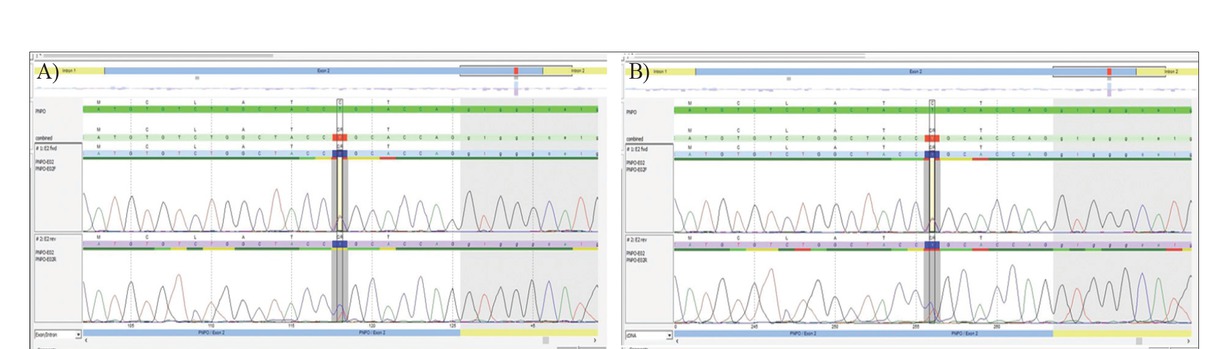
Figure 1
Parents of a child with an inherited PNPO gene mutation. They are cousins and both are heterozygous. A) Mother; B) father.
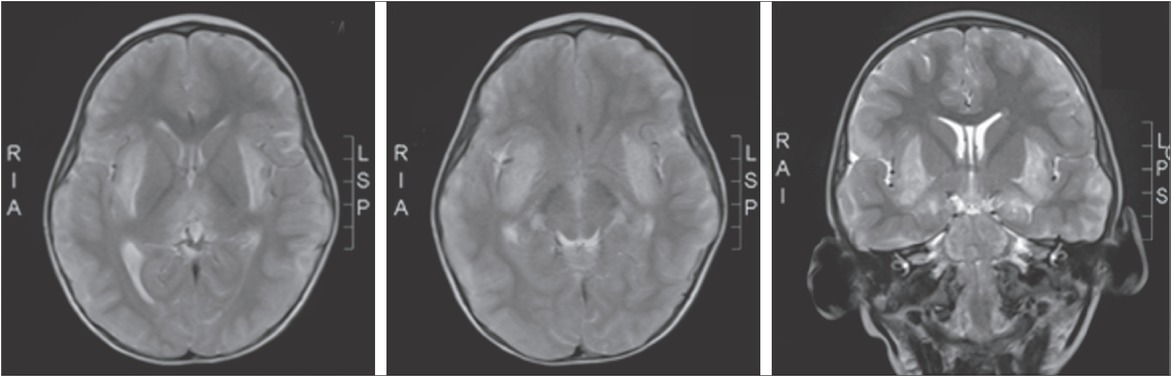
Figure 2
Brain MRI in a child with acute necrotizing encephalopathy and a positive RANBP2 gene mutation. Brain MRI showing increased T2 hyperintensity of basal ganglia (A, B, and C).