Introduction
Childhood neurological disorders are a vast group of heterogenous conditions with a myriad of clinical presentations. Reaching a diagnosis can be challenging, time-consuming and costly. Sometimes, multiple imaging, laboratory investigations and ancillary procedures are exhausted trying to reach a final diagnosis [1]. Families also suffer from the dilemma of multiple investigations. Many neurological conditions in children present with variable degrees of presentations as well as different stages of progression, thus, multiple metabolic and genetic investigations are requested. Recently, whole exome sequencing (WES) has become an important diagnostic tool for many presumed genetic or idiopathic neurological conditions [2]. Whole exome sequencing is becoming rapidly available, cost-effective and can be a shortcut to the diagnosis. Reaching a diagnosis in a child with a neurological disorder, counseling parents and preventing recurrences of similar conditions in his/her family is the essence of pediatric neurology practice. Nowadays, phenotype-based genetic testing and panels are slowly being substituted by WES [3]. The depth of screening using WES and variant coverage as well as identification of novel and pathogenic variants is rapidly improving. The increasing rate of WES sensitivity, expanding genetic databases, shorter turn-around time and decreasing prices of WES are appealing and promising [4].
In the Middle East region and Africa, consanguinity is common. In Saudi Arabia, 52.0-67.0% of marriages are from the same family and tribe [5,6]. This cultural practice can be associated with a higher percentage of neurogenetic and metabolic conditions [7]. The diagnostic yield of WES can range from 20.0 to 70.0% with a higher yield in consanguineous populations [8, 9, 10, 11]. Few studies in the Middle East reviewed the outcomes of WES in children with neurological disorders in a population with high consanguinity rate such as Saudi Arabia [13, 14, 15, 16]. Such characteristics could increase the yield of WES. In this cohort, the clinical characteristics and WES results of children with variable neurological disorders in Saudi Arabia are reviewed.
Material and methods
A retrospective chart review for 26 children with undiagnosed neurological conditions was performed from January 2018 to November 2019. These neurological disorders ranged between developmental delay, hypotonia, epilepsy, loss of vision, ataxia, white matter changes, intellectual delay, encephalopathy and metabolic abnormalities. This review was conducted for children attending the pediatric neurology clinic at King Abdulaziz University, Jeddah, Saudi Arabia. Medical history, patients’ demographics, history of consanguinity (second cousin or closer), clinical examination and neuroimaging were reviewed and documented. All patients underwent proband-only WES. Further segregation analyses were performed for parents planning future pregnancies. Whole exome sequencing was performed in an accredited laboratories, Centogene in Rostock, Germany and Blueprint laboratories in Helsinki, Finland. Variant classifications into five classes were based on American College of Medical Genetics and Genomics (ACMG) guidelines [17] (Table 1). All patients signed a consent form for WES. The study was approved by the King Abdulaziz University Research Ethics Committee.
Table 1
American College of Medical Genetics and Genomics (ACMG) classification of variants [17].
| Class 1 | Pathogenic |
| Class 2 | Likely pathogenic |
| Class 3 | Variant of uncertain significance (VUS) |
| Class 4 | Likely benign |
| Class 5 | Benign |
Results
There were 19 males and seven females included in the study. Age of presentation ranged from 1 to 12 years (mean 4.8 years). Nineteen patients had positive WES results (73.0%), five patients with variants of unknown significance (VUS) that matches the clinical picture, one patient with VUS that does not explain the observed clinical characteristics. The remaining six patients were negative. The average age in the WES-positive group was 4.9 years and the average age in the WES-negative group was 4.5 years. Consanguinity was positive in 69.0% of the cohort, most of them were in the WES-positive group (Table 2).
Table 2
Cohort demographics: WES positive and negative.
| Positive n (%) | Negative n (%) | |
|---|---|---|
| Males | 14 | 5 |
| Females | 6 | 1 |
| Total | 20 (77.0)a | 6 (23.0) |
| Age (mean) | 4.9 years | 4.5 years |
| Consanguinity | 14 (53.0) | 4 (15.0) |
[i] a One of the 20 patients had positive WES results but does not explain the phenotype (patient 15 in Table 3).
The WES-positive cohort results were classified into pathogenic, likely pathogenic variants and VUS. In the homozygous and heterozygous groups, pathogenic and likely pathogenic mutations were found. These mutations, when paired with the phenotype, confirms the clinical picture (Tables 3 and 4). The VUS group was mainly clinically upgraded to clinically significant variants as those patients have matched genotype and phenotype. No benign or likely benign variants were detected in this cohort.
Table 3
Homozyogous, heterozygous and variants of uncertain significance VUS groups.
| Homozygous Mutations | ||||||||
|---|---|---|---|---|---|---|---|---|
| # | Sex-Age | Family History | Consanguinity | Clinical Characteristics | Onset | Genes | Variant | Diagnoses |
| 1 | F-6 | yes | yes | motor delay; hypotonia; scoliosis; respiratory difficulties in neonatal period; normal congnitions, areflexia | 1 year | P1EZO2 | pathogenic: c.273_279del, p.(Pro92Thrfs*18) | piezo-type mechanosensitive ion channel component; OMIM: 613629 |
| 2 | M-1 | no | yes | severe hypotonia; reduced tendon reflexes; motor/speech delay; cerebellar atrophy; cerebellar cyst; elevated serum CPK | birth | FKRP | likely pathogenic: c.204del, p.(Ser69Profs*60) | MDDGA5 (congenital with brain/eye anomalies), type A5 (MDDGA5); OMIM: 613153 |
| 3 | M-2 | no | yes | vision loss; nystagmus; severe retinal dysfunction | 2 months | RPGRIP1 | pathogenic: c.1107del, p.(Glu370Asnfs*5) | Leber congenital amaurosis type 6, OMIM: 613826 |
| 4 | M-7 | no | yes | intractable epilepsy; global developmental delay; poor vision | 3 years | TPP1 | pathogenic: c.616C>T, p.(Arg206Cys) | neuronal ceroid lipofuscinosis type 2, OMIM: 204500 |
| 5 | M-8 | no | yes | poor hearing; encephalopathy; MRI: white matter changes | 4 years | BTD | pathogenic: c.1618C>T, p.(Arg540Cys) | biotinidase deficiency |
| 6 | M-6 | yes | yes | ataxia; delayed motor milestones; mild intellectual delay; MRI: cerebellar atrophy | 1 year | SPTBN2 | likely pathogenic: c.6258_6261delGAGA, p.(Lys2088Glyfs*228) | infantile-onset spinocerebellar ataxia type 5 |
| 7 | F-8 | yes | yes | ataxia; delayed motor milestones; mild intellectual delay; MRI: cerebellar atrophy | 1 year | SPTBN2 | likely pathogenic: c.6258_6261delGAGA, p.(Lys2088Glyfs*228) | infantile-onset spinocerebellar ataxia type 5 |
| 8 | M-9 | yes | yes | ataxia; oculomotor apraxia; telangiectasia; MRI: cerebellar atrophy | 3 years | ATM | likely pathogenic: c.9066del, p.(Gly3023Alafs*10) | ataxia telangiectasis |
| Heterozygous Mutations | ||||||||
| 9 | F-7 | no | no | delayed language/motor development; intellectual disability; hypotonia; generalized seizures; infantile spasms; visual impairment; normal MRI; normal metabolic profile | 1 year | NTRK2 | pathogenic: c.1301A>G, p.(Tyr434Cys) | early infantile epilectic encephalopathy type 58, OMIM: 617830 |
| 10 | M-3 | yes | no | acute necrotizing encephalopathy; generalized seizures; spasticity; coma and death; brain MRI: symmetric thalamic hyperintense lesions | 3 years | RANBP2 | pathogenic: c.1754C>T, p.(Thr585Met) | acute infection-induced encephalopathy-type 3, OMIM: 608033 |
| 11 | M-4 | no | no | developmental delay; neonatal hypotonia; autistic-like behavior; epilepsy | 1 year | SHANK3 | likely pathogenic: c.2313+1G>A | Phelan-McDermid syndrome, OMIM: 606232 |
| 12 | M-9 | no | no | ataxia; ADHD; delayed speech/ language development; motor delay; hypotonia; normal EEG and brain MRI | 2 years | KAT6A | likely pathogenic: c.1483-1G>A | mental retardation type 32, OMIM: 616268 |
| 13 | M-1 | no | no | intractable neonatal seizures; normal brain MRI | 1 month | PACS2 | pathogenic: c.625G>A, p.(Glu209Lys) | early infantile epileptic encephalopathy type 66, OMIM: 618067 |
| 14 | F-4 | no | yes | intractable focal seizures; normal brain MRI | 3 months | SCN1A | likely pathogenic: c.1377G>C, p.(Gln459His) | early infantile epileptic encephalopathy type 6 (Dravet syndrom), OMIM: 607208 |
| Variant(s) of Uncertain Significance | ||||||||
| 15 | M-6 | no | yes | MCA stroke; dystonia; spasticity; regression of milestones; delayed language/ motor development; focal seizures and abnormal brain myelination on MRI | 4 years | ITGA7 AR | c.1601C>T, p.(Ala534Val) | congenital muscular dystrophy/hypotonia, OMIM: 613204 |
| 16 | F-5 | no | yes | ataxia; frequent falls; macrocephaly, epilepsy and ADHD; MRI: megalencephalic leukoencephalopathy with subcortical cysts | 2 years | MLC1 AR | c.275C>A, p.(Pro92His) | megalencephalic leukoencephalopathy with subcortical cysts type 1, OMIM: 604004 |
| 17 | M-3 | no | yes | delayed speech/language development; dyskinesia; dystonia; infantile onset of the disease; paroxysmal dystonia; MRI: brain atrophy | 2 years | SLC6A3 AR | c.851G>A, p.(Gly284Glu) | infantile Parkinsonism dystonia type 1, DTDS, PMID: 21777827 |
| 18 | M-1 | yes | yes | intractable infantile spasms | 3 months | PNPO AR | c.256T>C, p.(Cys86Arg) | PNPO, OMIM: 603287 |
| 19 | F-6 | yes | yes | ataxia and oculomotor apraxia; brain MRI: molar tooth sign | 2 years | CC2D2A AR | c.916_927del, p.(Pro306_Leu309del) | Joubert syndrome type 9, OMIM: 612285 |
| 20 | M-2 | no | yes | fair hair; global developmental delay; hearing impairment; infantile onset of the disease; motor delay; muscular hypotonia; visual impairment; focal epilepsy; MRI: brain atrophy | 3 months | SPATA5 AR and TIMMDC1a | c.1058A>T, p.(Asp353Val) and c.230T>C, p.Ile77Thr) | EHLMRS, OMIM: 616577 mitochondrial complex I deficiency, OMIM: 618251 |
[i] #: patient number; F: female; M: male; OMIM: Online Mendelian Inheritance in Man; CPK: creatine phosphokinase; MDDGA5: muscular dystrophydystroglycanopathy type A5; MRI: magnetic resonance imaging; ADHD: attention deficit hyperactivity disorder; EEG: electroencephalogram; MCA: middle cerebral artery; DTDS: dopamine transporter deficiency syndrome (DTDS); PMID: PubMed reference number; AR: autosomal recessive; PNPO: pyridoxamine 5’-phosphate oxidase; EHLMRS: epilepsy, hearing loss and mental retardation syndrome.
a Autosomal mitochondrial.
Table 4
Whole exome sequencing negative group.
| # | Sex-Age | Family History | Consanguinity | Clinical Characteristics | Onset |
|---|---|---|---|---|---|
| 1 | F-1 | no | yes | epilepsy and developmental delay; brain MRI: normal | 4 months |
| 2 | M-7 | no | yes | epilepsy and developmental delay; brain MRI: normal | 2 years |
| 3 | M-2 | no | no | intractable epilepsy; poor vision and global developmental delay; brain MRI: normal | 1 year |
| 4 | M-12 | no | yes | global developmental delay; brain MRI: basal ganglia enhancement; metabolic work-up: negative | 6 years |
| 5 | M-4 | yes | yes | intractable focal epilepsy and ADHD | 1 year |
| 6 | M-2 | no | yes | microcephaly; motor delay; brain MRI: white matter changes | 6 months |
Eight patients had homozygous mutations, six patients had heterozygous mutations and six patients were carrying VUS. All patients had variable neurological presentations such as: epilepsy, intellectual delay, motor delay, regression of milestones, hypotonia, visual abnormalities, ataxia and MRI brain changes. Similar family history in another sibling or relative was reported in seven patients with positive WES result.
One patient had ITGA7 classified as VUS that does not explain the phenotype. He was developmentally normal then developed regression of milestones and a middle cerebral artery stroke after meningoencephalitis. An ITGA7 mutation was reported to be associated with congenital muscular dystrophy, neonatal hypotonia, proximal atrophy and scoliosis ,which were not apparent in this patient before his regression.
Variants of unknown significance with consistent phenotypes were seen in five patients (Table 3). The MLC1 mutation in patient #16 was consistent with megalencephalic leukoencephalopathy with subcortical cysts type 1. The patient developed ataxia and convulsions. Brain MRI also showed expected white matter changes and temporal cysts. Patient #17 had a SLC6A3 mutation compatible with infantile Parkinsonism-dystonia type 1. He presented with orolingual, upper and lower limbs dystonia and was initially diagnosed as cerebral palsy. Patient #18 was diagnosed with intractable infantile spasms and failed to respond to multiple antiseizure medications for several months. He also developed regression of milestones. A PNPO mutation was reported once. He was put on pyridoxal 5 phosphate cofactor therapy. No more seizures were reported by the parents and he is now developmentally up to age after 1 year of follow-up. Targeted analysis of both parents showed heterozygous mutations in both (Figure 1). Patient #19 was found to have ataxia and oculomotor apraxia. Brain MRI showed classic molar tooth sign. The CC2D2A mutation is associated with Joubert syndrome. Patient #20 had infantile onset of developmental delay, hearing impairment, hypotonia, visual impairment, focal epilepsy, high serum lactic acid and brain MRI showed brain atrophy. Mutations in SPATA5 and TIMMDC1 were reported to cause epilepsy, hearing loss, and mental retardation syndrome and mitochondrial complex I deficiency, respectively.
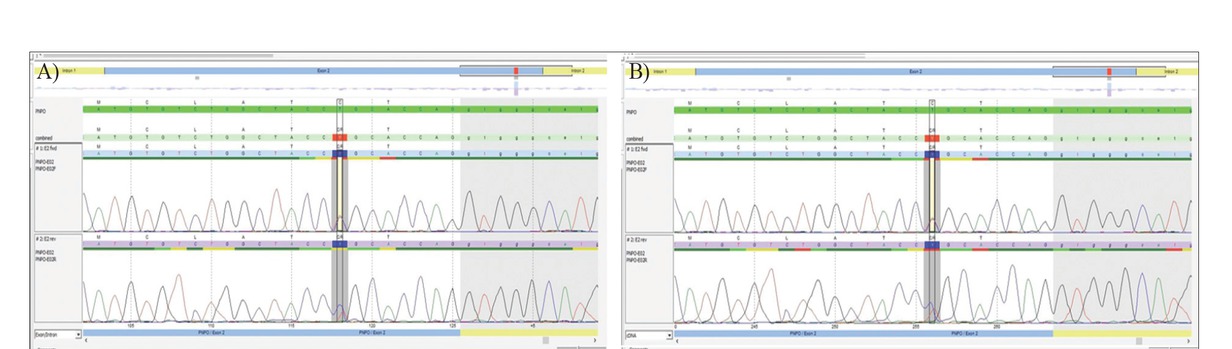
Figure 1
Parents of a child with an inherited PNPO gene mutation. They are cousins and both are heterozygous. A) Mother; B) father.
Discussion
The introduction of WES in medicine has changed the way of physician’s approach to patients. The number of newly diagnosed neurogenetic conditions and mutations are increasing.
Multiple studies worldwide reviewed WES findings, however, few in the Middle East region. In Saudi Arabia, the Arabic ethnic background is the main population structure. Consanguinity is common in marriages. Thus, more metabolic and neurogenetic conditions are prevalent in our region.
In this study, 19 patients (73.0%) out of 26 patients had genetically and phenotypically consistent findings. In the WES-positive group, consanguinity was present in 53.0% of the families whereas in the WES-negative it was 15.0%. Compared to other studies in the region [18,19] 43.0-49.0% of WES results showed clinically significant results in Saudi Arabia. Other studies from the United Arab Emirates and Qatar, reached 54.0-68.0% genetically confirmed diagnoses [14,15]. Larger studies including 2000-3000 WES samples from different ethnic regions, showed a lower diagnostic rate, around 25.0% from the USA [11], Care4Rare Canada [20] and Finding of Rare Disease Genes (FORGE) [21]. Consanguinity was positive in 18 families of the cohort (69.0%). In other studies, a similar rate of 66.0-75.0% of consanguinity was reported [12,14]. The most common features of WES results in the Middle East are a high percentage of consanguinity and a higher positivity rate of WES results [22,23].
Whole exome sequencing has a direct impact on management [24]. For example, patient number #5 (Table 3) had a positive BTD mutation classified as pathogenic. He was 7 years old when diagnosed with biotinidase deficiency. His symptoms were noticed by his parents since he was 3 years old. He had hearing problems, ataxia, convulsions and intermittent encephalopathy. He was in coma and ventilatory-dependent when WES was requested. Once started on biotin supplements, he gradually started to improve. Currently, he is off the ventilator. He is redeveloping motor gains with physical therapy. He has not experienced any more convulsions and his hearing has improved.
Another patient in the cohort has a pathogenic RAN-BP2 gene mutation. He presented with acute necrotizing encephalopathy (ANE) (Figure 2). A few months after being diagnosed, his sister was also diagnosed with clinical ANE. Unfortunately, both siblings died despite aggressive immunotherapy.
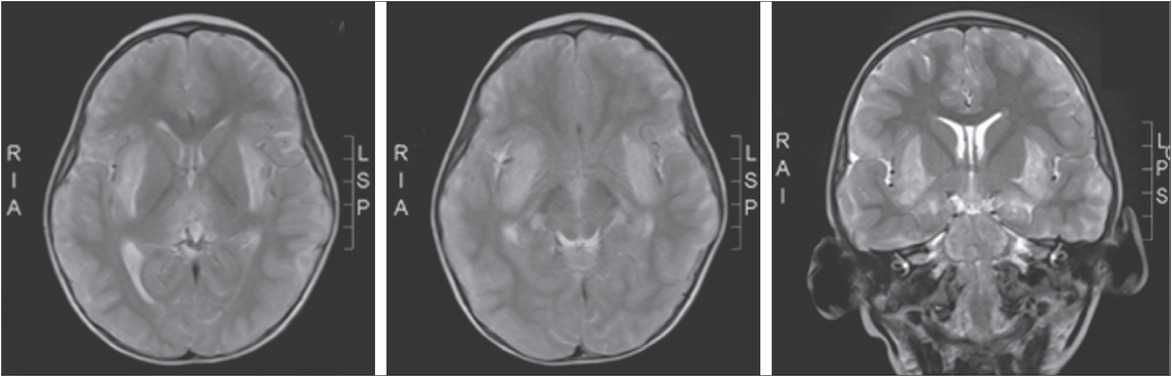
Figure 2
Brain MRI in a child with acute necrotizing encephalopathy and a positive RANBP2 gene mutation. Brain MRI showing increased T2 hyperintensity of basal ganglia (A, B, and C).
In conclusion, WES is an integral diagnostic tool in a pediatric neurology clinic. It is of great importance to unravel the diagnostic odyssey of many neurological and neurogenetic conditions. Family counseling, prevention of recurrence and treatment depends on proper genetic diagnoses. Pricing of WES is still a challenge at many centers and countries [25,26]. Sometimes, WES results can also take more than 2-3 months that can delay WES-focused medical care.
The high yield of WES results in this study, though a small number of patients, is compatible with similar studies. This study promotes performing WES in childhood neurological disorders, especially when these is a similar family history and positive consanguinity.