
Introduction
In April 2017, with its supply of lethal injection drugs about to expire and with 32 inmates still on its death row, 2 the state of Arkansas announced that it would perform eight executions over 11 days. Though legal problems halted half of them, the other half were carried out as planned. At the time, Arkansas's last execution had taken place in 2005. In that execution, the state used the well-established, “traditional” three-drug lethal injection cocktail: sodium thiopental, pancuronium bromide, and potassium chloride.
Eight years later, in 2013, after failing to obtain new supplies of those drugs, Arkansas adopted a new execution protocol which called for the use of lorazepam and phenobarbital. 3 Critics noted that those drugs had never before been used in an execution and that they were unlikely to cause death quickly, if at all. 4 In 2015, the state retreated and once again changed its drug protocol. This time, it adopted a three-drug cocktail that was being used by some other states. It began with midazolam, a sedative, and followed it with vecuronium bromide and potassium chloride. 5
The first of Arkansas's 2017 executions, and its first using midazolam, was that of Ledell Lee, who had been sentenced to death in 1995 for the rape and murder of his 26-year-old neighbor, Debra Reese. Lee had two trials. Several alibi witnesses testified during his first trial, which ended in a hung jury. At his second trial, the defense inexplicably called no alibi witnesses, and the jury found Lee guilty. 6 On the eve of his execution, The Innocence Project and the ACLU appealed to the Arkansas Supreme Court on the grounds that DNA evidence from the crime scene had never been tested with modern technology. The court refused to stay Lee's execution, arguing that this last minute appeal came too close to the scheduled execution date. The execution proceeded on April 20th, ten days before Arkansas's batch of new lethal injection drugs would expire.
After placing intravenous lines (IVs) in Lee's arms, Arkansas's execution team started the flow of midazolam at 11:44 p.m. 7 Slowly, Lee's eyes shut as he swallowed repeatedly. The coroner pronounced him dead 12 minutes after the execution began. Unlike some of the midazolam executions 8 in other states, Lee's appeared to go off without a hitch. Emboldened by its apparent success, Arkansas went ahead with its plan to kill Jack Jones four days later.
As a young child, Jack Jones's father abused him, and he suffered “sexual abuse at the hands of three strangers who abducted and raped him.” 9 By 1994, Jones was a suicidal 30-year-old with bipolar disorder, depression, and ADHD. On a June night in 1995, Jones broke into an accountant's office in Bald Knob, Arkansas. There, he found a book-keeper named Mary Phillips and her 11-year old daughter, Lacy. After attempting to rob Mary, Jones bound her to a chair, raped her, and strangled her with a cord. Jones then assaulted Lacy, strangling her and crushing her skull. 10
When they arrived, investigators found Lacy in a closet tied to an office chair. 11 Miraculously, she survived and was able to testify at her assailant's trial. There was, however, little doubt about Jones's guilt. When first questioned by police, he waived his Miranda rights and confessed to the crime. 12 During his sentencing, the jury found that aggravating factors, including the cruelty of his crime and his previous criminal record, outweighed his troubling childhood. They sentenced him to death.
More than two decades after the sentencing, guards steered the wheelchair-bound Jack Jones 13 into Arkansas's death chamber. When the witnesses arrived at 7:00 p.m., Jones was already strapped to a gurney, intravenous lines sticking out of his arms. At 7:06 p.m., the warden wiped a hand over his face, signaling the start of the execution. 14
Throughout the fourteen-minute execution, correctional staff checked Jones's consciousness by sticking a tongue depressor in his mouth, “lifting his eyelids and rubbing his sternum.” 15 According to Jones's lawyer, Jack began to gasp and gulp for air four minutes into the execution—a sign that he was experiencing physical pain. Witnesses said that his mouth moved like a “fish... chomping on bait.” 16 Soon, the movement slowed and the team declared Jones dead at 7:20 p.m..
His legal team and state officials interpreted the movement of the inmate's mouth in different ways. Jones's lawyers contended that he “was moving his lips and gulping for air [which is] evidence that the [midazolam] did not properly sedate him.” 17 They called Jones's death “torturous.” A Department of Corrections spokesperson disagreed, stating that, “the inmate was apologizing to the department director, Wendy Kelley, and thanking her for the way she treated him.” 18 During Jones's execution, the prison staff shut off the death chamber microphone before the lethal injection began, which was standard procedure in Arkansas. 19 Had the microphone been on, we might have a better understanding of Jack Jones's final moments.
Witnesses also could not see the problems that ensued an hour earlier when the state made several attempts to place an adequate IV. For 45 minutes, they could not find a suitable vein. 20 In a detailed timeline of the execution, Arkansas officials claimed that it only took eight minutes to place Jones's IV. Yet the autopsy report notes that medical examiners “found five needle marks on Jones's neck and clavicle... area” that were covered up with makeup. 21
The same day it executed Jones, Arkansas also put Marcel Williams to death. Williams had been convicted and sentenced to death for the 1997 kidnapping, rape, and murder of a 22-year-old mother, Stacy Errickson. 22 The Williams execution lasted 17 minutes. Witnesses reported that he moved “up until three minutes before he was declared dead.” 23 According to Jacob Rosenberg, one of the media witnesses at the execution, “His eyes began to droop and eventually close... His breaths became deep and heavy. His back arched off the gurney [countless times] as he sucked in air.” 24 Throughout the execution, state officials conducted consciousness checks by feeling his pulse and touching his eyes. After one check, a member of the execution team could be seen whispering “I’m not sure.” 25 In a statement to the press, Williams's lawyer said that he was “gravely concerned” about the execution and feared that Williams was conscious and in pain during the procedure. 26
The executions of Jack Jones and Marcel Williams were followed by an even more troubling execution three days later—the fourth and final killing of the week. This time, it was Kenneth Williams whom Arkansas put to death. Williams grew up in an abusive household. 27 By the time he was 9 years old, “Williams joined a street gang called the Gangster Disciples. Two years later he was molested by another boy.” 28 According to testimony at his clemency hearing, he decided to become “the predator, not the prey” at a young age. 29 In 1998, he kidnapped and killed a college cheerleader, Dominique Hurd. After spending less than a year in prison, Williams “escaped by hiding in a hog slop-filled tank of a garbage truck.” 30 Once outside the prison, he shot a former prison warden, stole his truck, and led police on a high-speech chase during which he hit and killed another man. For his new slew of crimes, he was sentenced to death in August 2000. 31
On April 27, 2017, Williams became the 200th person, and the 140th black man, executed in Arkansas since 1913. 32 It was the first time since 1999 that Arkansas executed two people in a single day. 33 About three minutes after receiving a dose of midazolam, Williams began to thrash about and convulse on the gurney. One reporter said that he “lurched forward 15 times, then another five times, more slowly” before gasping and taking labored breaths. 34 Witnesses could hear the inmate moaning and groaning.
Despite those widely-reported details, state officials insisted that everything went as planned, calling the execution “flawless.” A Department of Corrections spokesperson insisted that “Williams [only] coughed without sound—in direct contradiction of media witness testimony.” 35 Governor Asa Hutchinson refused to heed calls for an investigation and reportedly “remained confident in the state's protocol.” 36
Yet an independent autopsy confirmed that Williams's execution was anything but flawless. Joseph Cohen, the California-based pathologist who conducted it, concluded that Williams “experienced pain” and likely felt “a sensation of air hunger, fear, shortness of breath, respiratory distress, and dizziness.” 37 The press and Williams's legal team described his execution as a “horrifying” botch. 38
This single week in Arkansas provides a window into the fate of lethal injection and the consequences of the decomposition of the standard three-drug-protocol. For every lethal injection during the more than thirty years between 1977 and 2009, states used only a single lethal injection protocol. However, drug shortages beginning in 2009 forced death penalty states to make a lethal choice. They could halt capital punishment, revive defunct methods of execution, or try new ways of carrying out lethal injection. Most made the third choice, turning to untested drugs and drug combinations.
As a result, over the course of the last decade, the lethal injection paradigm decomposed. For many years, lethal injection involved the use of a single drug combination. Now it signifies an execution method that uses a wide variety of drugs and procedures.
Even as it encountered mishaps in its rapid-paced executions, Arkansas did not slow down. Instead, it hid behind various provisions in its execution procedure—such as inserting the IV behind a curtain and switching off the microphone after an inmate's final words—that obscured key parts of the execution process from view. The state insisted, against considerable evidence to the contrary, that all went according to plan. More than three years later, a federal court cleared Arkansas to continue using midazolam in its executions as long as it tweaked its procedures slightly. 39 This pattern of mishaps and responses is paradigmatic of the practice of lethal injection across the United States.
This article shows that as lethal injection protocols and drugs proliferated and as the paradigm decomposed, executions became more error-prone and unpredictable. At the same time, states revised their protocols in ways that made it harder to say when executions did not conform to those protocols’ requirements. In Part 1, we recount the origins of the once-standard three-drug protocol. In Part 2, we discuss that protocol's collapse and the rise of new lethal injection techniques. In Part 3, we discuss what happened in the execution chamber during lethal injections carried out between 2010 and 2020 and show that as states switched to new drug protocols, lethal injection became more mishap-prone. In Part 4, we examine state responses to the threat mishaps pose to lethal injection. In the face of criticism, they adopted secrecy statutes and adjusted their procedural documents to both prevent and obscure mishaps. In our conclusion, we take up what lethal injection's decomposition means for the practice itself and for America's continuing use of capital punishment.
I. Lethal Injection's Early Years
A. Lethal Injection Is Born in Oklahoma
In July 1976, the Supreme Court ended a four-year de facto moratorium on the death penalty when it announced its decision in the landmark case Gregg v. Georgia. 40 After Gregg, every death penalty state reinstated capital punishment, and Oklahoma was no exception. The same month the Gregg decision was announced, Oklahoma Governor David Boren convened a special legislative session to swiftly restore capital punishment. 41 At the time, Oklahoma law designated the electric chair as its method of execution. However, the state's only electric chair was no longer in working condition. 42
Responding to this situation, State Senator Bill Dawson and State Representative Bill Wiseman proposed that the state adopt a new method of execution: lethal injection. Though New York State first considered adopting lethal injection in 1888, the method had never been used to execute an inmate in the United States or elsewhere. 43 Dawson and Wiseman argued that lethal injection had two clear advantages over other methods. First, it was much cheaper than other methods of execution, including electrocution, lethal gas, hanging, or shooting. 44 They also claimed, without any evidence, that it would be more humane. Death could be accomplished with “no struggle, no stench, no pain.” 45
For advice about which drugs might be used, they reached out to the Oklahoma Medical Association which refused to help for fear of possibly violating medical ethics. They had trouble enlisting help from other medical practitioners until they consulted A. Jay Chapman, Oklahoma's chief medical examiner. Later, Chapman described himself as “an expert in dead bodies but not an expert in getting them that way.” 46
Believing that lethal injection would be less violent and gruesome than the electric chair, Chapman offered a blueprint for Oklahoma's lethal injection law: “an intravenous saline drip shall be started in the prisoner's arm, into which shall be introduced a lethal injection consisting of an ultrashort-acting barbiturate in combination with a chemical paralytic.” 47 This language would quickly become the model for many states’ lethal injection laws.
The proposal to adopt lethal injection was very controversial among death penalty supporters. Some argued that making executions less gruesome and painful would weaken the death penalty's deterrent effect. Others said that it would prompt suicidal people to commit murders in hopes of dying painlessly via lethal injection. 48 Few disputed the premise that this new execution method was indeed more humane than other methods.
During Oklahoma's legislative debate, State Senator Gene Stipe offered an amendment to limit the duration of lethal injections. 49 He argued that if there was no such limit, the condemned might languish between life and death for hours or even days. Stipe proposed a five-minute limit, contending that the longest recorded hanging in American history lasted four minutes and fifty-eight seconds and no electrocution exceeded five minutes. The amendment failed, but not before the bill's sponsors remarked that they expected most executions to take less than five minutes.
After extensive debate, the Oklahoma State Senate passed the lethal injection bill by a 26-20 vote. The House soon followed suit, 74-18. On May 11, 1977, the governor signed legislation making Oklahoma the first state to adopt lethal injection as its method of execution.
Initially, the state's new execution protocol called for the use of only two drugs: sodium thiopental, the “ultrashort-acting barbiturate” that would anesthetize the inmate, and pancuronium bromide, the “chemical paralytic” that would asphyxiate the inmate. Potassium chloride, the final piece of the traditional three-drug protocol that stops the heart, was added to the protocol four years later, before anyone was put to death by lethal injection. Oklahoma's lethal injection statute made no mention of a third drug. 50
B. The Diffusion of Lethal Injection
As Senator Dawson hoped, the new lethal injection law “put Oklahoma in one of those rare instances of being a pioneer.” 51 However, at the same time that Oklahoma's bill was up for debate, Texas's legislature considered a bill that would change the state's method of execution from electrocution to lethal injection. In Texas, lethal injection's proponents stressed that it would be a less violent alternative to electrocution. Texas Representative George Robert Close described electrocution as “a very scary thing to see. Blood squirts out of the nose. The eyeballs pop out. The body almost virtually catches fire. I voted for a more humane treatment because death is pretty final. That's enough of a penalty.” 52 W. J. Estelle, the director of Texas's Department of Corrections, argued that “the lethal injection method suits our state of civilization more than electrocution.” 53
In Texas, other death penalty supporters worried that lethal injection provided an easy way out for criminals. They claimed that its supposed lack of pain and violence defeated the primary purpose of the death penalty—to deter future crimes. Underlying their objection to lethal injection was a belief that vicious murderers do not deserve to die painlessly or more humanely than their victims.
Death penalty opponents also objected to Texas's lethal injection bill, arguing that the death penalty is inhumane and cruel, regardless of the method used. 54 Abolitionists were concerned that switching to lethal injection, which better masks signs of violence and pain, would “salve the public conscience” and open an execution floodgate. 55 Pointing to the fact that black inmates were much more likely to get the death penalty for similar crimes than their white counterparts, critics added that the apparent humanity of lethal injection would not benefit the condemned. Instead it would benefit “the affluent white majority which kills blacks, browns and poor ‘white n-’ in the name of Texas.” 56 Abolitionist groups packed House committee hearings hoping to pressure lawmakers to halt all state executions. 57
Despite these efforts, Texas became the second state to adopt lethal injection on May 12, 1977, one day after Oklahoma. Texas's statute was almost identical to Oklahoma's and did not name specific drugs. 58 After spending several months considering various drugs and drug combinations, the Texas Department of Corrections decided to use “sodium thiopental in lethal doses.” 59 And, like Oklahoma, Texas added pancuronium bromide and potassium chloride before carrying out the nation's first lethal injection in 1982.
Death penalty states across the United States quickly followed Oklahoma and Texas in adopting lethal injection. Between 1977 and 1982, Idaho, New Mexico, Washington, and Massachusetts switched to lethal injection. 60 Unlike Oklahoma and Texas, which executed a combined total of 681 inmates between 1976 and 2020, these four states have executed only nine inmates among them over the same time period. 61 Three of these early-adopters—New Mexico, Washington, and Massachusetts—have since abolished the death penalty.
In December 1982, Texas used its three drug lethal injection protocol for the first time in the execution of Charles Brooks Jr. 62 This first lethal injection eerily mirrored America's first electrocution. In August 1890, New York prison guards strapped William Kemmler to an electric chair, covered his face, and shot 1,000 volts of electric current through his body for 17 seconds. 63 Kemmler's body writhed and caught fire, but he continued to breathe heavily, his chest expanding and contracting as drool fell down his chin. 64 The warden quickly ordered a second wave of currents. This time, 2,000 volts of electricity went through Kemmler for seventy-three seconds, causing his blood vessels to rupture. In stark contrast to the quick and humane death that the new technology promised, Kemmler's electrocution was tortuously long and filled the chamber with the odor of burning flesh.
Brooks's execution also did not live up to lethal injection's promise of a quick and humane death. 65 Before the drugs began to flow, three technicians repeatedly failed in their efforts to insert an IV into a vein in Brooks's arm, spattering the sheet covering him with blood. 66 During the several minutes it took for the drugs to take effect, Brooks's eyes looked forward in terror. He wagged his head, his fingers trembled, he mouthed words, and he let out a harsh rasp. 67 It took seven minutes for Brooks to die.
Despite these problems, states continued to adopt lethal injection, as shown in Figure 1. By the end of 1983, seven additional states—Arkansas, Illinois, Montana, Nevada, New Jersey, North Carolina, and Utah—had switched their execution method to lethal injection. 68 By 1988, a total of 21 states had passed lethal injection statutes. Strikingly, every one of them chose the traditional three-drug protocol. This was still true when Nebraska became the 39th state to adopt the method in 2009. From 1982 until the end of 2009, every execution by lethal injection was done in one way: sodium thiopental to anesthetize the inmate, pancuronium bromide to paralyze them, and potassium chloride to stop their heart.
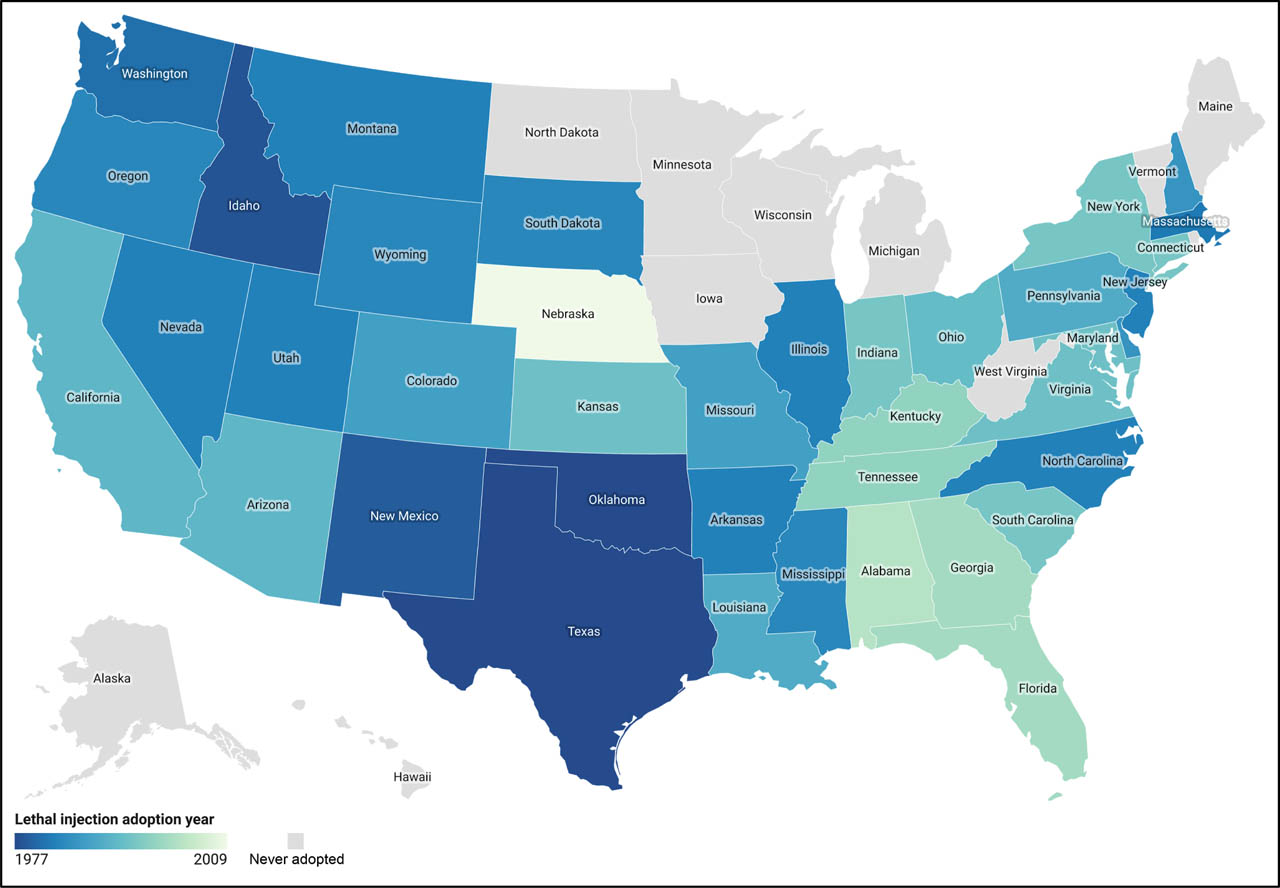
Figure 1
Lethal Injection Adoption by State.
II. The Collapse of the Original Lethal Injection Paradigm
The post-2009 period has witnessed the unravelling of the original lethal injection paradigm with its three-drug protocol. By 2016, no states were employing it. Instead, they were executing people with a variety of novel drug combinations. The shift from one dominant drug protocol to many was made possible by the advent of a new legal doctrine that granted states wide latitude to experiment with their drugs. This doctrine had its beginnings in the Supreme Court's Baze v. Rees 69 decision, its first on the constitutionality of lethal injection. 70
In 2004, Ralph Baze, who had been sentenced to death in Kentucky for the murder of a sheriff and deputy sheriff, and another inmate on death row, Thomas Bowling, filed lawsuits challenging the constitutionality of their upcoming executions. They contended that lethal injection violated the Eighth Amendment because an improper administration of the traditional three-drug protocol could cause “excruciating pain.” They argued that because other execution methods posed a “lower risk of causing pain or suffering,” the lethal injection protocol could inflict “unnecessary and wanton... pain.” Baze and Bowling proposed two alternative protocols in their suit. The first used only sodium thiopental to cause an overdose, eschewing the second and third drugs. The second alternative omitted the paralytic agent while retaining the first and third drugs.
After the Kentucky Supreme Court upheld the state's execution protocol, Baze and Bowling appealed to the Supreme Court. The Court ruled 7-2 against Baze and Bowling. The plurality opinion, written by Chief Justice Roberts and joined by Justices Samuel Alito and Anthony Kennedy, found lethal injection to be constitutional. Furthermore, it introduced the requirement that any plaintiff mounting an Eighth Amendment challenge to a method of execution had to present a “feasible, readily implemented” alternative that would “significantly reduce a substantial risk of severe pain.” 71 The Court also held that pancuronium bromide, the paralytic in the three drug combination, served the valid purposes of “hastening death” and “preserving the dignity of the procedure, especially where convulsions or seizures could be misperceived as signs of consciousness or distress.” 72
Baze indicated that the Court would defer to the choices states made concerning their execution protocols. It assigned to plaintiffs the burden of proving that protocols created an unconstitutional risk, rather than requiring states to prove that they did not do so. 73 As a result, states were left with considerable latitude to experiment with new protocols or to stick with the traditional three-drug protocol.
Just after Baze, an Ohio court decided that the state could no longer use a three-drug execution protocol because it contravened state law. 74 To continue executing people, Ohio abandoned the traditional three-drug protocol in 2009. In its place, it implemented a new protocol: a single large dose of sodium thiopental. 75
Ohio's break from tradition was the first step in lethal injection's decomposition. Though its switch was the result of litigation in state court, other states quickly followed suit, adopting the one-drug protocol because of its relative simplicity. 76 By the end of 2013, 13 states had switched to such a protocol.
Just as Ohio's one-drug execution method began to spread, states started to encounter difficulties in obtaining execution drugs. Bowing to pressure from abolitionist groups, many American drug manufacturers decided to limit the distribution of drugs used for lethal injections. One producer, the American pharmaceutical company Hospira, stopped producing sodium thiopental entirely. 77 Following this decision, in December 2010, Oklahoma executed John Duty with pentobarbital, another short-acting barbiturate that had never before been used in an execution, rather than sodium thiopental. 78 For its second drug, Oklahoma used vecuronium bromide, a common substitute for the original pancuronium bromide. 79 For its third drug, Oklahoma continued to use potassium chloride.
With American supply chains cut off, some states turned to European drug companies. 80 In response, the British anti-death penalty group Reprieve launched its Stop the Lethal Injection Project. Manufacturers that had been selling drugs for executions found themselves on the receiving end of a shaming campaign. 81 Later, both the United Kingdom and the European Union banned the export of drugs for executions. As Gibson and Barrett Lain note, European governments, not the drug companies themselves, were the “true change agents.” 82 Those governments insisted that pharmaceutical companies conform to the abolitionist norms of what Gibson and Barrett Lain label the international “moral marketplace.” 83
In response to these decisions, states soon followed Oklahoma's lead and started to use drugs like pentobarbital. Thirteen states held pentobarbital executions in 2011 alone. 84 Some used a three-drug pentobarbital protocol; others used a one-drug pentobarbital protocol. By 2013, the concurrent shifts from three drugs to one drug and from sodium thiopental to pentobarbital combined to produce four distinct lethal injection protocols. 85 (See Table 1).
Table 1
Drug protocols used between 2010 and 2013.
| One-drug | Three-drug | |
|---|---|---|
| Sodium thiopental | Ohio, Washington | Texas, Louisiana, Oklahoma, Florida, Mississippi, Virginia, Alabama, Georgia, Arizona |
| Pentobarbital | Ohio, Arizona, Idaho, Texas, South Dakota, Georgia, Missouri | Oklahoma, Texas, South Carolina, Mississippi, Alabama, Arizona, Georgia, Delaware, Virginia, Florida, Idaho |
[i] Drug protocols used in executions from January 2010 through September 2013, by state. In September 2013, states began to adopt even newer drug protocols that eschewed barbiturates, the class of drugs that contains both sodium thiopental and pentobarbital. States that held executions with multiple protocols are listed twice.
However, the switch to pentobarbital did not alleviate supply pressures. 86 Soon, the drug's only major producer began to restrict its sale to death penalty states. 87 As a result, states had to find other drugs to use in executions.
In 2013, Florida geared up to conduct the nation's first execution using midazolam hydrochloride as the first drug in its three-drug protocol. 88 Richard Dieter, executive director of the Death Penalty Information Center, called it, “an experiment on a living human being.” 89 A lethal injection drug expert at the Death Penalty Clinic at the University of California, Berkeley told NPR in 2013, “If [midazolam] does not in fact deeply anesthetize the prisoner, then he or she could be conscious and aware of being both paralyzed and able to experience pain and the experience of cardiac arrest.” 90 Nevertheless, Florida's execution proceeded as planned. In 2014, Oklahoma, Arizona, and Ohio also conducted executions with midazolam.
Two of those states, Ohio and Arizona, did not just replace the first drug in the traditional three-drug protocol with midazolam, they also dropped the second and third drugs for hydromorphone, an opiate made from morphine. 91 In both states, the first executions using the new drug combination were botched, and no executions with that protocol have happened since.
However, states have continued to experiment with other drugs and drug combinations. Their forays beyond the well-trodden ground of barbiturates, the class of drugs to which sodium thiopental and pentobarbital belong, did not end with midazolam. In 2017, when drug manufacturers refused to provide Florida with that drug, the state chose to use a different sedative, etomidate, in its place. Etomidate is an ultrashort-acting sedative and anesthetic that has no analgesic (pain-blocking) abilities, and it had never before been used in an execution. 92
Florida conducted seven executions with etomidate in combination with rocuronium bromide and potassium acetate between 2017 and 2019. In fact, that protocol's third drug was also a novel choice: Oklahoma inadvertently used potassium acetate instead of potassium chloride in a 2015 execution, but no state had used it intentionally until Florida adopted it in 2017.
Like Florida, Nebraska had trouble acquiring its lethal injection drugs in the latter part of the 2010–2020 decade. After it failed for years to find drugs, the state allowed its corrections director to choose a new protocol. In 2018, Nebraska held the only American execution conducted with a four-drug combination when it used diazepam, fentanyl, cisatracurium besylate, and potassium chloride. 93 The first three drugs, which tranquilized, knocked out, and paralyzed the inmate respectively, were all new to executions.
By the end of 2020, states had used at least ten distinct drug protocols in their executions. 94 Some protocols were used multiple times, and some were used just once. Even so, the traditional three-drug protocol was all but forgotten: its last use was in 2012. To better understand states’ changing protocols over time, we sort them into three different categories: barbiturate combinations, barbiturate overdoses, and sedative combinations. (See Table 2). Figure 2 also displays states’ dramatic shift in drug use. After years of experimentation, all that remains of the original paradigm is a needle in the inmate's arm and a declaration of death. 95
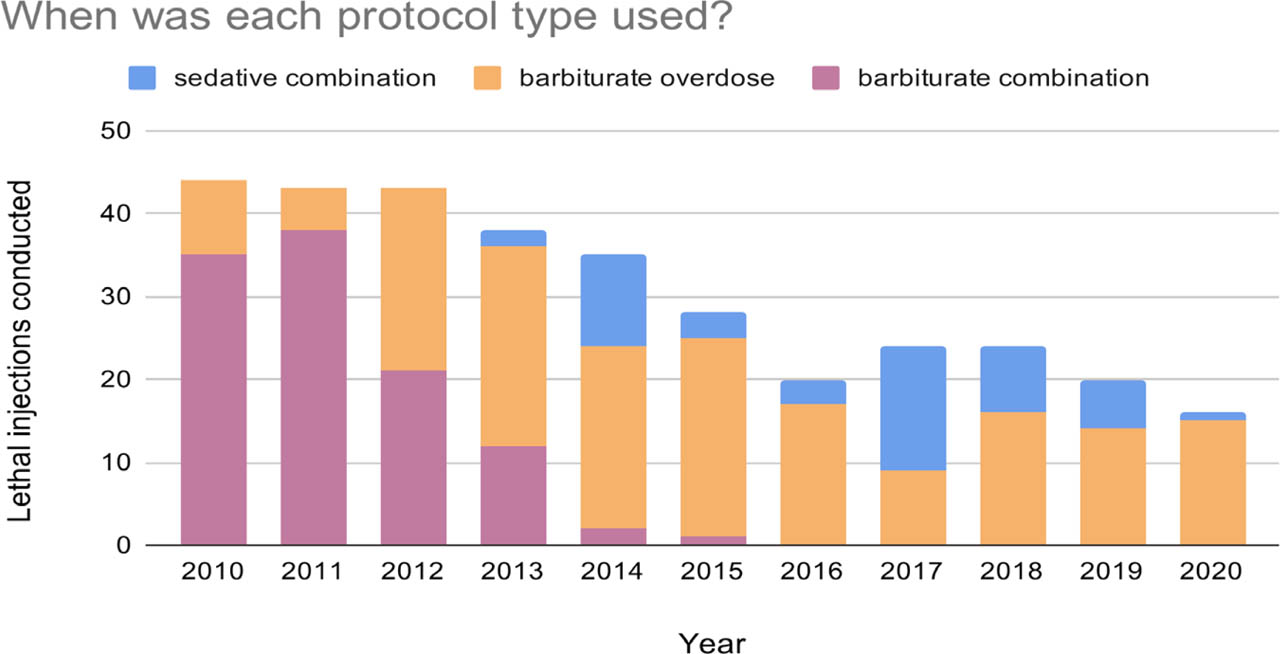
Figure 2
Protocol type by year of use.
Table 2
Classification of lethal injection drug protocols.
| Classification | Characteristics | Examples |
|---|---|---|
| Barbiturate combination | Sodium thiopental or pentobarbital in combination with a paralytic and a heart-stopper | Sodium thiopental, pancuronium bromide, and potassium chloride (traditional three-drug protocol) Pentobarbital, rocuronium bromide, and potassium chloride |
| Barbiturate overdose | Sodium thiopental or pentobarbital on their own | Sodium thiopental alone Pentobarbital alone |
| Sedative combination | Midazolam, etomidate, or diazepam in combination with other drugs | Midazolam and hydromorphone Etomidate, vecuronium bromide, and potassium acetate |
III. Lethal Injection Mishaps, 2010–2020
From 2010 to the end of 2020, states and the federal government carried out 335 lethal injections, making up the overwhelming majority of executions in that decade. 96 As the executions of Jack Jones and Marcel Williams, among others, show us, some of those executions went wrong. In what follows, we describe the ways in which the decade's mishaps occurred, the reasons they did, and how states, inmates, and others reacted when mishaps occurred.
Problems in American executions are, of course, nothing new. For as long as America has used capital punishment, states have encountered such problems. Sarat reports that 3 percent of the executions carried out from 1890 to 2010 were botched in some way. 97 Hangings sometimes resulted in gruesome beheadings and slow asphyxiations. During electrocutions, inmates convulsed and occasionally burst into flames. Lethal gas, billed as yet another humane execution technology, caused its victims to cough, jerk, and writhe for several minutes before death. Lethal injection, as we have already noted, is no exception.
To analyze lethal injection's problems over the last decade, we examined every execution for evidence of mishaps: discrete, identifiable moments in an execution when lethal injection faltered. Mishaps include identifiable procedural errors committed by the execution team. For example, officials sometimes start the injection early, before the inmate can finish their last words. In other cases, executioners are unable to set intravenous lines or set them incorrectly. Mishaps also include unforeseen bodily reactions to lethal drugs, such as inmates crying out, claiming that the injections burn, coughing, gasping, or heaving their chests. These reactions signal that an inmate underwent unnecessary emotional or physical suffering, or otherwise responded to the execution in an unexpected way.
Such mishaps occurred in many lethal injections during the last decade. 98 For example, in 27 of the lethal injections carried out during that period, or 8.1 percent, executioners struggled to set adequate IVs, as in the 2014 execution of Clayton Lockett. 99
In 1999, when he was 23, Lockett beat and raped a group of young women before shooting and killing one of them. 100 At his trial, Lockett's counsel offered no defense. After three hours of deliberation, the jury found him guilty of “conspiracy, first-degree burglary, three counts of assault with a dangerous weapon, three counts of forcible oral sodomy, four counts of first-degree rape, four counts of kidnapping and two counts of robbery by force and fear.” 101 He “was sentenced to death for first-degree murder, and more than 2,285 years in prison for his other convictions.” 102
Fifteen years later, after attempting suicide on the morning of his execution, guards dragged Lockett into Oklahoma's death chamber. 103 Once there, and after having been strapped to a gurney, a paramedic tried to place an intravenous line in his arms and feet, but failed to find an adequate vein. After three placement attempts, the paramedic asked a doctor on hand—who was ostensibly there only to check for consciousness and pronounce the time of death—to assist her. Fifty-one minutes after starting to place the IV, the two successfully placed it in Lockett's groin using a painful and invasive procedure. They covered the IV with a sheet to hide Lockett's groin from the witnesses.
At 6:23 p.m., the executioners started the flow of midazolam. Lockett looked confused for several minutes as he waited for the drugs to take effect, then closed his eyes. During the first consciousness check, the doctor found that Lockett was still conscious, prompting a two-minute pause before a second check. The second time, the doctor determined that Lockett was unconscious. At this point, the executioners injected the paralytic, vecuronium bromide.
After the injection, Lockett moved his feet and head while mumbling, “Oh, man.” He began to writhe and struggle against the restraints holding him down. On the electric heart monitor, his heart rate fell by two thirds. The doctor again entered the execution chamber and lifted the sheet, revealing a “protrusion the size of a tennis ball” where the IV had failed. 104 Instead of sending the drugs into his bloodstream, they had gone into the flesh of his groin. The warden closed the curtain between the witness room and the execution chamber as the doctor and paramedic scrambled to finish the execution. At 6:56 p.m., the director of the Oklahoma Department of Corrections, who had watched from the witness room, stopped the execution. Ten minutes later, and more than 40 minutes after the lethal injection drugs began to flow, Clayton Lockett died. Many reports say he died from a heart attack, but an independent autopsy attributed his death to the lethal injection drugs themselves. 105
Lockett's botched lethal injection was one of the most infamous in the death penalty's recent history. However, even when the execution team sets effective lines, or realizes that they cannot set an effective IV and stops the execution, the process is often painful. As executioners poke and prod inmates with needles, they fall back on a variety of techniques that inflict substantially more pain than simply placing an IV into an arm. 106
Even if the IV is set correctly, the rest of the lethal injection process is not pain free. In 4.8 percent of the last decade's lethal injections, inmates said they were in pain at some point during the execution. One such inmate was Anthony Shore who was executed for a series of murders that led him to be known as the “Tourniquet Killer.” 107
On January 18, 2018, with IVs already set, Shore apologized to his victims, saying that “no amount of words or apology could ever undo what I’ve done... I wish I could undo the past, but it is what it is.” 108 Soon after the injection of compounded pentobarbital began, Shore cried, “Oh wee, I can feel that it does burn. Burning!” He then shook on the gurney and struggled to breathe before dying 13 minutes later, according to a witness's sworn affidavit.
The burning sensation that Shore reported occurs with surprising frequency in lethal injections. 109 In fact, this particular mishap may result from specific changes that states have made to their lethal injection protocols. Over time, they have generally increased the amount of each drug that they inject into inmates. For example, Virginia's 1995 drug protocol called for 120 mEq of potassium chloride as its final drug. By 2011, it had doubled the dose to 240 mEq. Similarly, Oklahoma's execution protocol used 100 mg of midazolam when it executed Clayton Lockett. Soon after, it increased the amount five-fold. These massive doses push lethal injection far outside of the realm of standard pharmaceutical practice. 110
In 83 lethal injections, the inmate spoke or made noise after the injection began, utterances that ranged from screams, to sobs, to slurred sentences. 111 Commonly, inmates exhibit unusual breathing patterns, body movement, and dramatic changes in skin color. 112 Seventy-three included coughing, snorting, and other sudden respirations. In 183 lethal injections, the inmate moved after the injection began. Many twitched or jerked, some heaved their chests, and others fluttered their eyes as the drugs took effect. 113
Some of these reactions may be inevitable consequences of death by lethal injection. Lethal injection works on a microscopic level inside of the inmate, concealing its operation from view. 114 In fact, medical professionals disagree about how each of the drugs used in lethal injection actually kills. 115 Further complicating the effort to understand what happens during a lethal injection is the paralytic used in many protocols. If administered correctly, it prevents inmates from indicating any pain, even involuntarily, making it difficult for witnesses to determine if the condemned suffer. 116
Though it is often impossible for inmates to display what is happening during a lethal injection, certain mishaps show that lethal injection is far removed from the original promise that it would allow the condemned to die by peacefully falling asleep. In September 2020, a NPR investigation found signs of pulmonary edema—fluid filling the lungs—in 84 percent of the 216 post-lethal injection autopsies it reviewed. 117 Some autopsies reveal that inmates’ lungs filled while they continued to breathe, which would cause them to feel as if they were drowning and suffocating. 118
As states switched drug protocols, the frequency of mishaps shifted dramatically. Most striking among these shifts is the increased frequency with which witnesses or newspapers said that executions were “botched.” Between 2010 and 2020, newspapers and independent witnesses used this term to describe 28 of the lethal injections, or 8.4 percent. 119 This label was used to describe only 3.7 percent of barbiturate combination executions. However, newspapers or witnesses labelled 7.3 percent of barbiturate overdose executions as botched, about twice the rate as barbiturate combinations. In sedative combination executions, the rate skyrocketed to 22.4 percent.
Another striking difference between barbiturate combination protocols and the bevy of novel cocktails is how long they take to work. We found that, between 2010 and 2020, barbiturate overdose executions lasted 62 percent longer than barbiturate combination executions, including the traditional three-drug protocol. 120 Sedative combinations resulted in executions that lasted twice as long as their barbiturate combination counterparts. 121
As shown in Figure 3 below, the average execution time in 2010 was just over nine minutes. In 2020, the average time was over 20 minutes. More than 74 of the executions we analyzed took longer than 20 minutes—four times longer than lethal injection's creators expected the method to take. 122 In fact, almost none of the lethal injections over the last 11 years lasted less than five minutes. In a few jarring cases, lethal injections took longer than an hour.
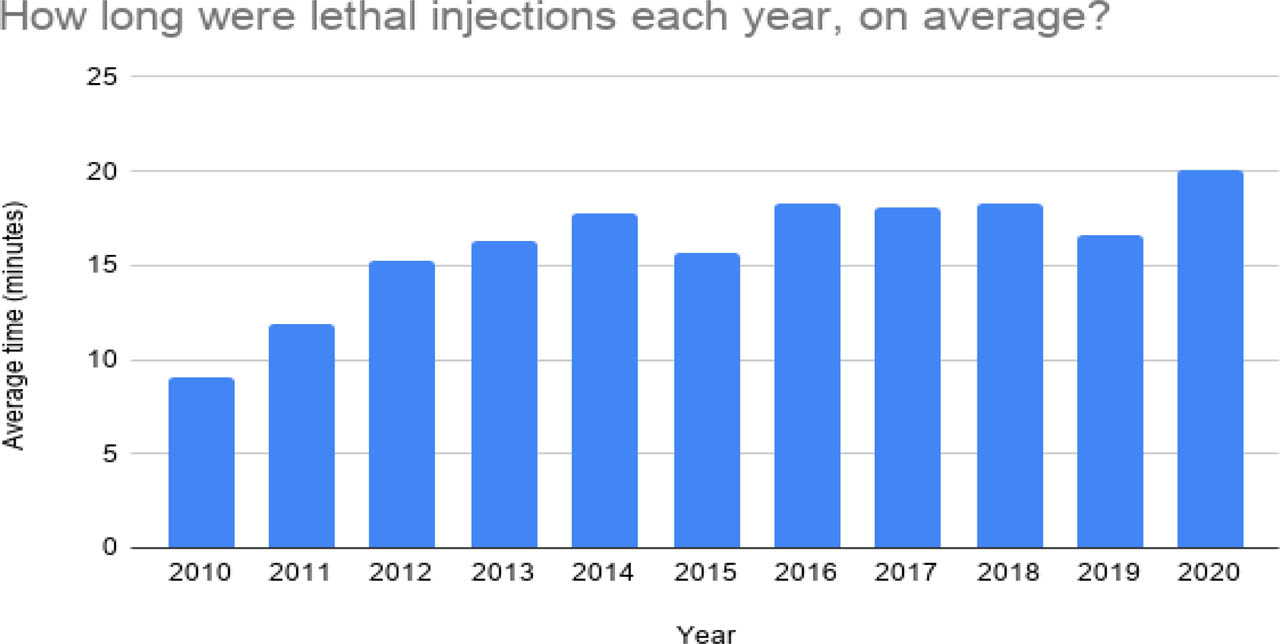
Figure 3
Average duration of lethal injections by year.
Figure 4 helps explain why. Sedative combination protocols, which were commonly used in the latter half of the last decade, take over twice as long to kill as barbiturate combination protocols, which were predominately used in the first half.
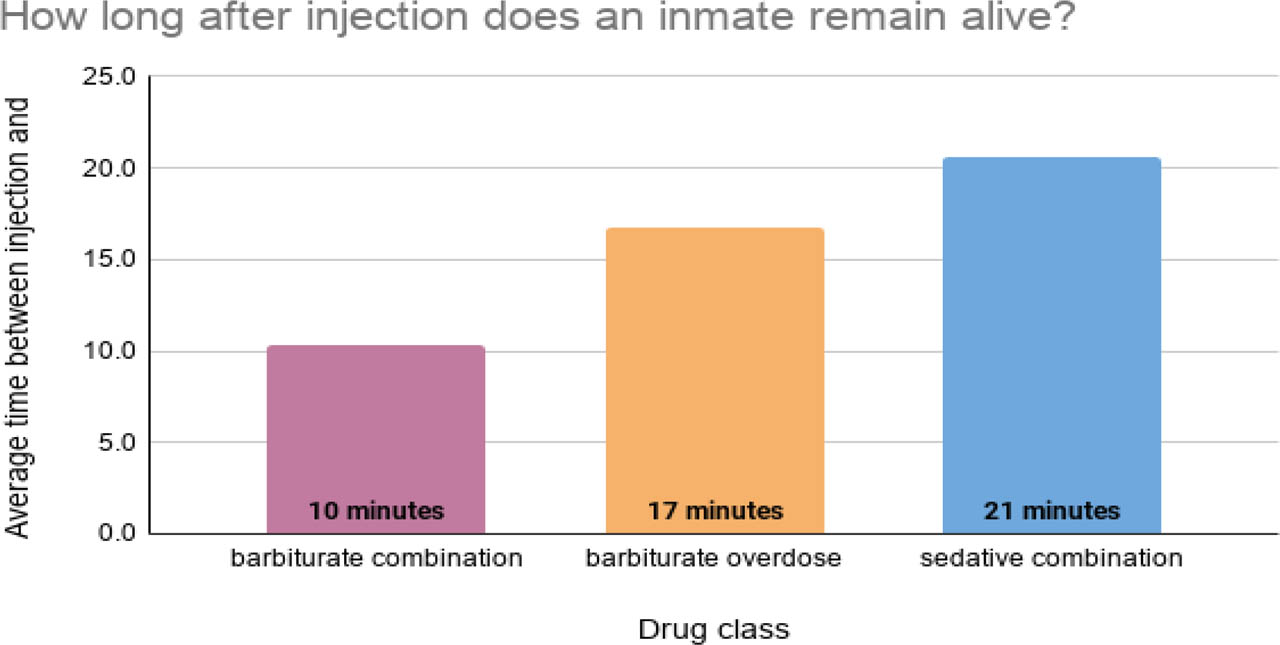
Figure 4
How long after injection does an inmate remain alive?
IV. The Choreography: States Change and Hide Procedures
States responded to the kind of mishaps we have described in two ways. 123 First, they modified their execution procedures to make mishaps less likely. Such changes included adding consciousness checks, mandating that the IV be clearly visible, and inserting backup lines in case the primary line fails. Other states chose to make it harder to identify or label any irregularity in the execution chamber as a departure from their protocols and procedures. They introduced greater ambiguity and discretion into their procedures. Doing so afforded executioners greater flexibility when something goes wrong. States also have attempted to keep their procedures and drug suppliers secret from inmates and the public. The two responses, specificity and obfuscation, are not mutually exclusive. In fact, as states added some steps to prevent mishaps, they often made other procedures less specific. 124
A. Avoiding Mishaps: Procedural Specificity
As the lethal injection paradigm decomposed, some death penalty states attempted to avoid preventable errors with procedural adjustments. For example, they added steps to parts of the lethal injection process where preventable mishaps commonly occur, such as in the injection of the sedative or anesthetic. If the executioners inject the second or third drugs before the first drug anesthetizes the inmate, the condemned will suffer excruciating pain. Similarly, paralytics must have time to immobilize the inmate lest pain be apparent to witnesses as they jerk and squirm on the table. In the late 2000s and early 2010s, at least nine states 125 began to specify waiting periods between the injection of each drug in the lethal cocktail. One particularly instructive case is Virginia, which made no mention of waiting periods in its October 2010 protocol. However, the state's July 2012 protocol called for a 30 second waiting period after the first drug's injection. By February 2014, Virginia's procedure called for a two-minute waiting period at the same juncture. 126
After 2010, at least seven 127 state procedures required that officials conduct “consciousness checks” on the condemned inmate. Executioners must evaluate an inmate's consciousness with auditory and physical stimuli between injecting the first and second drugs. For example, in its December 2010 protocol, Pennsylvania instructed officials to close the curtain and call the inmate's name in a loud voice before “assess[ing] consciousness of the inmate by tactical stimulation... touching the inmate's shoulder and brushing the inmate's eyelashes.” 128
A few states also added specificity when it comes to the placement of IVs, especially after the botched execution of Clayton Lockett. For example, Oklahoma added a number of mishap-preventing and mishap-detecting provisions to its lethal injection protocol. It required officials to record the number of IV insertion attempts, read the drug name out loud before its administration, leave the IV in the inmate after death for a medical examiner to see, and ensure the IV insertion remained visible.
Ohio's 2004 protocol only briefly mentions IV access. It records a preference for setting IVs into the inmate's arms, but does not require the execution team to ensure the IVs are working. In 2009, before Lockett's ill-fated execution, Ohio began to specify that executioners use a saline drip to test the IVs, perform vein assessments ahead of time, and ensure that the IV insertion points are visible throughout the execution.
Procedural specificity also occurs in protocols that identify decisional contingencies (if, then) in the lethal injection process. We call this “branching.” From 2010 to 2020, many lethal injection protocols came to resemble decision trees with many branches, rather than a simple set of instructions. Figure 5 displays Ohio's protocol as a decision tree.
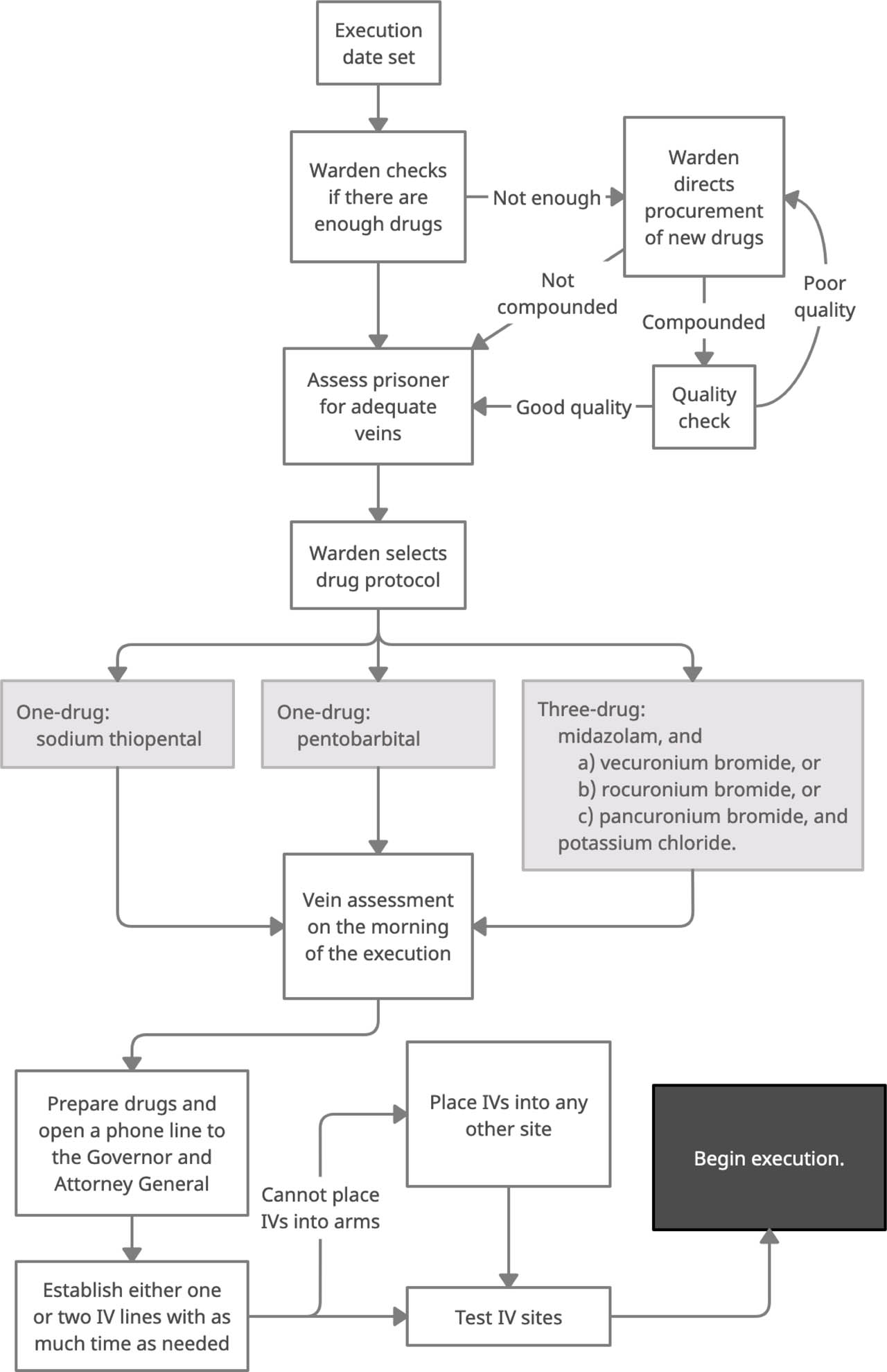
Figure 5
Branching in Ohio's lethal injection procedure.
At least 14 states 129 adopted one or more elements of branching, providing additional instructions in case IV lines cannot be established, drugs do not cause unconsciousness or death, or an IV line fails. Three of these states—Arizona, Idaho, and Oklahoma—include a contingency procedure to revive the inmate in case they go into cardiac arrest. In this way, protocols provide executioners with specific methods to address various issues as they arise. Further, by acknowledging many possibilities, states ensure that fewer events fall outside the purview of lethal injection protocols. Problematic lethal injections are more difficult to critique.
Increases in specificity may help imbue lethal injection with legitimacy after problematic executions. In this way, states implicitly signal that lethal injection can be improved by better procedures and that they are committed to such improvement. Legal scholar Jody Madeira notes that mistakes have been normalized in the lethal injection paradigm: “Corrections has long explored execution methods through a ‘learning-by-doing’ process, and may interpret each botched execution as a unique event instead of a patterned consequence of haphazard lethal injection reform.” 130 By amending their procedures, states treat lethal injection mishaps as anomalies—wrongs that can be righted with procedural tweaks.
B. Obscuring Mishaps in Lethal Injection: Secrecy, Ambiguity, Discretion
At the same time as they dealt with mishaps by adding specific checks to their procedures, death penalty states have attempted to obscure the perception of mishaps by hiding executions, and information related to executions, from public view. According to the Death Penalty Information Center, of the 17 states that carried out executions between 2011 and 2018, 14 prevented witnesses from seeing at least one part of the execution, 15 prevented witnesses from hearing the sounds of the execution, and 16 concealed the source of the drugs used. 131 All 17 prevented witnesses from finding out when lethal drugs were administered. 132 As states hide more of their procedures and executions, it becomes increasingly difficult to say that, or when, an execution went wrong. 133
Another way states have adapted to mishaps is to make their protocols less specific at certain points during their executions. They have introduced greater ambiguity in the language governing crucial parts of their protocols. For example, even as states have added more checks to ensure that IVs are working, they have allowed executioners to attempt to set lines for longer periods of time and in more places.
States also have added ambiguity in execution length. No state procedures now specify a maximum time that should pass between injection and death. As a result, lethal injection's critics cannot point to a specific regulation in order to hold states accountable for long and painful executions.
In fact, the refusal of courts or legislatures to impose time constraints on executions has been integral to lethal injection's survival. 134 One exemplary case is the Tennessee Supreme Court's 2017 case West v. Schofield. 135 Several inmates challenged the constitutionality of the state's one-drug pentobarbital protocol, partially on the grounds that it creates a substantial risk of a lingering death. One of the their expert witnesses reviewed thirty pentobarbital executions conducted in Georgia, Ohio, and Texas and found that all of these executions resulted in death within 30 minutes of the first pentobarbital injection. Because no procedural, legal, or judicial standard of “lingering death” had ever been established, the Tennessee court had to decide whether a half-hour death constituted cruel and unusual punishment. Without explicitly affirming a 30-minute standard for lethal injections, it ruled in favor of the protocol's constitutionality.
States have made it hard to say when mishaps occur by explicitly or implicitly authorizing officials to exercise discretion. Thus states have set extremely broad expectations about how long the IV insertion is supposed to take. In 2017, Kentucky provided a one-hour window for the process before an execution must be stopped. 136 It revised its protocol in 2018 and expanded that window to three hours. Similarly, in 2016 Ohio made its lack of a standard explicit, writing in its protocol that the IV insertion team should take “as much time as necessary.” 137
While protocols previously limited IV insertion site options to minimize pain, they have come to allow for a wider array of sites. After 2010 eight states 138 provided lists of ordered preferences for a large number of insertion sites. Protocols from least 13 states 139 indicated no preference for an IV site at some point in the last decade, leaving that decision for the IV team to make. Additionally, four states 140 have, sometime after 2010, explicitly called for a “cut down” procedure 141 in order to place a central venous line (in the chest) when necessary. Three states currently allow cut downs. Protocols in four additional states 142 allow a central venous line placement without proscribing a cut down.
Discretion is also frequently granted when the dosage prescribed by a protocol is insufficient to kill. At least 19 states’ protocols 143 have allowed officials overseeing the execution to inject additional doses as they see fit. Thirteen of those states 144 have left the length of the waiting period between rounds of injection completely up to prison officials’ discretion. Among states that do specify a waiting period length, the periods are inconsistent. 145 Occasionally, permission for a second injection is accompanied by permission for a range of other actions; Oklahoma's 2015 protocol allows the execution team to close the curtain, remove all of the witnesses, inject additional doses, and “determine how to proceed,” a generous grant of discretion that gives officials room to change the procedure on the fly.
Moreover, states have increasingly left the choice of drugs for any particular execution to the warden overseeing an execution. At least 14 death penalty states 146 no longer specify a particular drug protocol, as they had before 2009. Instead, they allow officials to choose from a menu of drugs and drug combinations if needed. 147 Idaho's 2012 protocol reads, “which option is used is dependent on the availability of chemicals,” making it explicit that these menus serve to enable executions to proceed in the face of drug shortages.
Ambiguity and discretion provide executioners with a kind of blank check that brings lingering, fraught deaths into the fold of acceptable executions. Ambiguous language allows officials to elide details and avoid the specific provisions that once protected inmates from painful procedures or long executions. The discretion that protocols now allow means that executioners have wide latitude to modify execution procedures. Executioners can do what they deem necessary to kill an inmate--while acting within the authority grated by the state.
V. Conclusion: Failure, Reform, Failure in America's Death Penalty System
The recent history of lethal injection echoes the longer history of the death penalty. When states encountered problems with their previous methods of execution, they first attempted to address these problems by tinkering with their existing methods. When tinkering failed, they adopted allegedly more humane execution methods. When they ran into difficulty with the new methods, state actors scrambled to hide the death penalty from public view. 148 They have followed this same playbook during the era of lethal injection.
Our glimpse into the death chamber—aided by newspaper articles, independent investigations, and court documents—reveals that procedural changes have done little to make lethal injection more humane. 149 According to Deborah Denno, “it is questionable whether any of the [changes to lethal injection procedures]... can fix [them] with a sufficient degree of reliability.” 150 In fact, lethal injection became more error-prone as states switched from barbiturate combinations to other types of drug protocols. 151 As the original lethal injection paradigm has decomposed, its problems have grown.
Some states have responded to lethal injection's problems by resurrecting older methods of execution as backups in case lethal injection becomes “unavailable” in the future. Between 2014 and 2015, six states made the firing squad, electrocution, or lethal gas backup methods of execution, and the federal government joined them in 2020. 152 If lethal injection becomes “unavailable,” Missouri, Utah, and Wyoming allow execution by firing squad; Tennessee and Virginia will execute by electric chair; and Oklahoma will execute with nitrogen gas. 153
Yet, perhaps the recent actions of Ohio Governor Mike Dewine shed particular light on the fate of lethal injection. On December 8, 2020 Dewine announced an “unofficial moratorium” on his state's death penalty. 154 The moratorium came almost three years after a federal judge compared Ohio's lethal injection procedure to “waterboarding, suffocation, and exposure to chemical fire.” The judge found that lethal injection “will almost certainly subject prisoners to severe pain and needless suffering.” 155 Dewine responded that “Ohio is not going to execute someone under my watch when a federal judge has found it to be cruel and unusual punishment.” Ohio's efforts to keep lethal injection alive—such as switching drug cocktails, adding checks to its procedure, and obscuring mishaps in its death chamber—have not solved its problems.
Some scholars argue that the evolution of America's methods of execution is a story of progress. 156 To them, the adoption of each new execution method marked the abandonment of more barbaric and gruesome methods. 157 In contrast, the period from 2010 to 2020 was less a period of progress than of deterioration and decline. New drugs and drug combinations may have allowed the machinery of death to keep running. New procedures may have given the increasingly jerry-rigged lethal injection process a veneer of legitimacy. But none of these recent changes have resolved its fate or repaired its vexing problems. As Arkansas found out in its 2017 execution spree, there is little that can be done to save lethal injection from its status as America's least reliable and most problematic death penalty method.
We would like to thank the lawyers, librarians, and archivists who provided us with invaluable research assistance. Among them are Jennifer Moreno, Judy Gallant, Missy Roser, Dawn Cadogan, Joel Rudnick, Matthew Storey, Maureen Della-Barba, Kevin Spangenberg, Yvette Toledo, LaTavius D. Jackson, Barndon Vasquez, Mike Blackwell, Holly Hasenfratz, and Dena Hunt. We are grateful for the helpful comments of Daniel LaChance and Timothy Kaufman-Osborne on an earlier draft of this paper.