
Introduction
Protocell models of the origin of life propose that the first living entities were simple, self-assembled compartments that encapsulated catalytic and genetic material (1, 2). These compartments are typically suggested to be formed by single-chain amphiphiles such as aliphatic fatty acids (3,4,5), since these molecules can be synthesized abiotically (6,7,8), spontaneously self-assemble to yield vesicles in solution (9,10,11,12,13,14), and form membranes which are sufficiently permeable to allow metabolites to passively diffuse into the compartment (15, 16). Fatty acids between 10 and 20 carbon atoms in length are deemed more likely to be involved, owing to their ability to form stable bilayers without transitioning into gel phases (17,18,19).
An important requirement for prebiotic compartments is that they allow concentration of metabolically-relevant molecules within protocells and display selectively higher permeability towards specific molecules required for the emergence of early genetic material or metabolic reactions (20). One key metabolite for protocellular life is d-ribose, not least because of its central role in the synthesis of nucleic acid polymers (21,22,23). Ribose has been shown to inhibit flocculation of decanoic acid, stabilizing vesicles (11, 24). Ribose also binds strongly to fatty acid membranes, (25) and can be synthesized prebiotically (26). However, prebiotic synthesis of ribose via the formose reaction produces all eight aldopentose stereoisomers, among a broad range of sugar species (Figure 1). (27) How was d-ribose selectively incorporated into the genetic polymers of life? Multiple prebiotic processes have been suggested to select for d-ribose over the other aldopentoses, (28) including enantioselective phosphorylation, (29) enantioselective catalysis by chiral minerals (30, 31) or peptides, (32) and enantioselective adsorption to crystal surfaces (33). Of interest to the current study are experimental findings that d-ribose permeates through fatty acid bilayers faster than other aldopentoses.
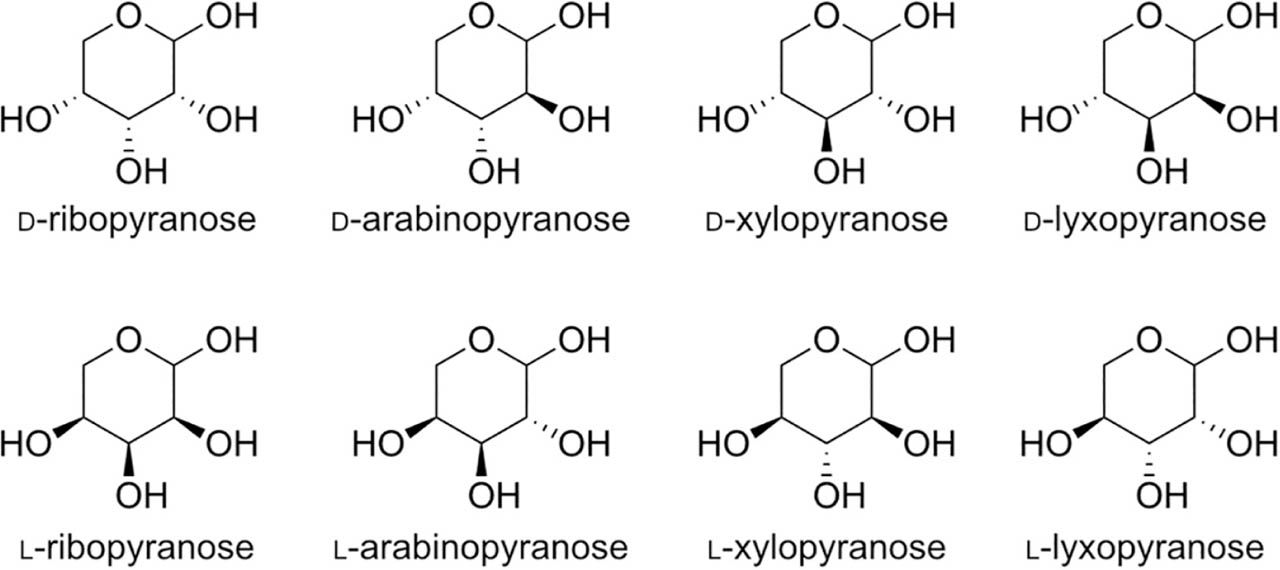
Figure 1.
Aldopentose stereoisomers.
Experiments performed by Sacerdote and Szostak have explored the permeability of multiple saccharides, including aldopentoses, across fatty acid bilayers, with 5- and 10-fold faster permeation of d-ribose observed across myristoleate (14:1 Δ(9)), palmitoleate (16:1 Δ (9)), and oleate (18:1 Δ(9)) bilayers compared to d-arabinose, d-lyxose, d-xylose and l-xylose (34). Faster permeation of d-ribose compared to its diastereomers was also observed in bilayers containing mixtures of short-chain fatty acids (36). Based on these findings, the authors suggested that the enhanced permeability of d-ribose may favor its selection over the other aldopentoses for incorporation into prebiotic nucleic acid polymers.
Computational studies have attempted to understand the cause of the faster permeation of d-ribose through fatty acid bilayers. Computational simulations offer an advantage over direct measurement in that they also provide access to atomic-scale structural details, albeit at the cost of lengthy simulation times. Using adaptive biasing force molecular dynamics (MD), the simulated permeability coefficients for β-d-ribopyranose, β-d-arabinopyranose, and β-d-xylopyranose (35) were in good agreement with experimentally measured values. Intramolecular hydrogen bonds between neighboring hydroxyl moieties formed more frequently in β-d-ribopyranose than the other aldopentoses, suggesting that β-d-ribopyranose is more stable in non-polar environments than β-arabinopyranose and β-xylopyranose. The authors present the more stable hydrogen bonding behavior as causing faster permeation through the membrane hydrophobic core. Interestingly, a later simulation demonstrated that the faster permeation for β-d-ribopyranose relative to β-d-arabinopyranose did not extend to ribo-adenosine relative to arabino-adenosine (37). The implication of this finding is that preferential permeation into protocells occurs for free sugars, not conjugated sugars. This means that if protocellular membranes were equally permeable to multiple diastereomers of ribose, multiple non-ribose aldopentoses would be incorporated into nucleotides and nucleic acid polymers. The consequences of including non-ribonucleotides in prebiotic nucleic acid polymers are not known, but various studies suggest that prebiotic nucleic acid polymers are likely tolerant of non-canonical nucleotides with variations in the base or linkages (38,39,40,41,42,43,44). The study of selective bilayer permeation, then, is not motivated by the known implications of non-ribonucleotides being incorporated into prebiotic genetic material. Rather, selective permeation of d-ribose in prebiotic bilayers has been proposed as a potential mechanism that could explain why modern nucleic acid polymers exclusively use d-ribose (34).
Previous experimental and computational studies did not examine the permeation of l-ribose, the enantiomer of d-ribose. Additionally, these studies examined permeation through bilayers containing fatty acids of chain length 14 and higher, whereas prebiotic compartments are often described as likely to contain fatty acids as short as 10 carbon atoms (18, 19). In the present study, we simulate the permeation of β-d-ribopyranose, β-d-arabinopyranose, β-l-xylopyranose, and β-l-ribopyranose through multiple bilayer compositions, some of which include the short chain lauric acid (12:0). We observed faster permeation of β-d-ribopyranose through the longer-chain bilayer compositions (oleic acid, myristoleic acid, and POPC) compared to other aldopentoses. However, for bilayers containing lauric acid, β-l-ribopyranose permeated between 2-fold and 3-fold faster than β-d-ribopyranose. These results suggest that origin-of-life scenarios should explicitly consider the presence of β-l-ribopyranose as a competing substrate for the formation of the first nucleic acid polymers and attempt to include mechanisms to exclude its inclusion in the first forms of life. Experimental validation of our predicted permeability coefficients in bilayers containing short chain fatty acids would shed further light on the true stereoselective capabilities of protocellular membranes.
Methods
Description of the simulated systems
The study simulated the permeation of four stereoisomers of ribose (β-d-ribopyranose, β-d-arabinopyranose, β-l-xylopyranose, and β-l-ribopyranose) through six different bilayer compositions. Four of the bilayers contain a single lipid species: oleic acid (18:1 Δ (9)), myristoleic acid (14:1 Δ (9)), lauric acid (12:0), or POPC. The remaining two bilayers were composed of mixtures of short chain fatty acids: an equimolar mixture of myristoleic acid, lauric acid, and myristic acid (14:0), and a mixture containing excess lauric acid (8:1:1 lauric: myristoleic: myristic acids). Each bilayer contained a total of 240 lipid molecules. Bilayers were positioned in the x, y plane in a box of dimensions 6.0 nm × 6.0 nm × 12.0 nm, with a water height of 4.0 nm above and below the bilayer. All fatty acids were represented as a mixture of protonated and deprotonated fatty acid molecules in a 1: 1 ratio. Sodium and chloride ions were added as counter ions to neutralize the electric charge of the system, to a final concentration of 200 mM. The stereoisomers of ribose were all simulated as β-anomeric forms, owing to the greater abundance of the β-pyranose anomer in solution for ribose and xylose (45). Additionally, previous work has shown that the pyranose form is the most relevant for membrane permeation (35). While α-arabinopyranose is more abundant in solution than β-arabinopyranose, we have simulated the permeation of β-d-arabinopyranose for consistency with previous computational work on aldopentose permeation (35). Additionally, in agreement with previous spectroscopic and computational experiments determining saccharide conformations in solvent, β-d-ribopyranose was simulated in the 4C1 conformation, (46) β-l-ribopyranose and β-l-xylopyranose in the 1C4 conformation, (47) and β-d-arabinopyranose in the 1C4 conformation (35).
Preparation of simulated bilayers and solute systems
Bilayers were prepared for simulation using CHARMM-GUI (48, 49). Oleic acid bilayers contained 60 deprotonated (OLE) and 60 protonated (OLEP) fatty acid molecules in both the upper and lower leaflets. Myristoleic acid bilayers contained 60 deprotonated (MYRO) and 60 protonated (MYROP) fatty acid molecules in both the upper and lower leaflets. Lauric acid bilayers contained 60 deprotonated (LAU) and 60 protonated (LAUP) fatty acid molecules in both leaflets. The equimolar mixture of short chain fatty acids contained 20 molecules of MYRO, MYROP, LAU, LAUP, deprotonated myristic acid (MYR) and protonated myristic acid (MYRP) in both leaflets. The mixture of short chain fatty acids with excess lauric acid contained 48 molecules of LAU and 48 molecules of LAUP in both leaflets, with an additional six molecules each of MYRO, MYROP, MYR, and MYRP in both leaflets. Bilayer systems were equilibrated prior to the addition of solutes.
Ribose stereoisomers were parameterized using the CHARMM36 July 2022 force field version. Initial coordinates were sourced from CHARMM-GUI, using the following residue identifiers: β-d-ribopyranose, BRIBP; β-d-arabinopyranose, BDARBP; β-l-xylopyranose, BLXYL; β-l-ribopyranose, BLRBIP. Solute coordinates were minimized in vacuum, and minimized coordinates inserted into equilibrated bilayer systems using the GROMACS 2022.1 (50) utility gmx insert-molecules. For each combination of bilayer composition and solute, four replicate simulations were prepared, each containing the bilayer with a single molecule of solute. Replicate bilayer-solute systems were minimized and equilibrated independently and subsequently simulated together as four communicating walker simulations.
Molecular dynamics simulation methodology
All MD simulations in this study were performed using GROMACS 2022.1 (50). The accelerated weight histogram (AWH) method was used to bias sampling of the solute-bilayer systems to calculate bilayer permeability for each solute-bilayer pair. In all simulations, van der Waals interactions were evaluated pairwise within a cutoff of 1.2 nm, with a force-switch between 1.0 nm and 1.2 nm. Coulomb interactions were calculated within a cutoff of 1.2 nm using particle mesh ewald (PME) (51). Bonds to hydrogen atoms were constrained using the parallel linear constraint solver (P-LINCS) algorithm (52). Water molecules were parameterized as transferable intermolecular potential 3P (TIP3P) (53). Lipid and solute molecules were parameterized using the CHARMM36 July 2022 force field (54, 55). Simulation was performed using a 2 fs integration time step, except where noted otherwise.
Bilayer equilibration simulations
Bilayer systems were minimized using the steepest descent integrator for 5000 steps to within a force tolerance of 1000 kJ · mol−1 · nm−1. Equilibration was performed in the NVT ensemble at a temperature of 296.15 K (i.e., 23°C, the temperature used to experimentally characterize permeation of monosaccharides into fatty acid vesicles (34)) with a coupling time constant of 1.0 ps in two stages with progressively weaker position and dihedral restraints on all lipid molecules. Both stages used a 1 fs time step for a total duration of 125 ps, with the temperature maintained by the Berendsen thermostat (56). The first stage used restraints with force constants of 1000 kJ · mol−1 · nm−2, the second stage used 400 kJ · mol−1 · nm−2. Following this, bilayer systems were equilibrated in the NPT ensemble at a pressure of 1 atm (coupling time constant 5.0 ps) using the Berendsen barostat applied in a semi-isotropic fashion (isotropic coupling in the x and y direction, separate coupling in the z direction) with a compressibility of 4.5e−5 bar−1 in both directions. Equilibration proceeded in multiple stages with decreasing force constants: 125 ps with 1 fs time step using 400 kJ · mol−1 · nm−2 position restraints and 200 kJ · mol−1 · nm−2 dihedral restraints, followed by 500 ps with 2 fs time step using 200 kJ · mol−1 · nm−2 for all restraints, 500 ps using 40 kJ · mol−1 · nm−2 position restraints and 100 kJ · mol−1 · nm−2 dihedral restraints, 500 ps with no restraints. Finally, the system was equilibrated using the Nose–Hoover thermostat and Parrinello–Rahman barostat for 10,000 ps.
Solute minimization in solvent
Solutes coordinates were placed in the center of a box of dimensions 2.5 nm × 2.5 nm × 2.5 nm and minimized in vacuum using the steepest descent integrator for 5000 steps to within a force tolerance of 1000 kJ · mol−1 · nm−1.
Bilayer-solute system equilibration simulations
A single molecule of minimized solute was inserted into pre-equilibrated bilayer systems using gmx insert-molecules with a van der Waals scale factor of 0.4. A total of four independent insertions were performed to yield four independent replicate bilayer-solute systems. Each bilayer-solute system was minimized using the steepest descent integrator for 5000 steps to within a force tolerance of 1000 kJ · mol−1 · nm−1. Equilibration was performed in the NPT ensemble for 1000 ps. Temperature was equilibrated to 310 K using the Nose–Hoover thermostat (coupling time constant 1.0 ps), with separate coupling groups for the bilayer and for the solvent with solute. This temperature was selected for consistency with previously-published simulations of ribose membrane permeability (35). Pressure was equilibrated to 1 atm using the C-rescale barostat (57) (coupling time constant 5.0 ps), with no compressibility in the z direction to ensure each independent replicate system maintained the same z-axis length for subsequent AWH multi-walker simulations.
AWH sampling simulations
AWH simulations were used to sample the position of the solute along the z-axis to calculate the potential of mean force for the permeation of the solute through the bilayer. Simulation was performed using a convolved biasing potential with shared biases across the four walker simulations. A single bias coordinate was applied, with an estimated initial average error of 40 kJ · mol−1. The bias histogram was equilibrated before entering the initial stage. The target distribution was defined as a uniform coordinate distribution across the entire z-axis of the bilayer-solute system. The estimated diffusion constant for the z-axis coordinate dimension was set to 5e−4 nm2 ps−1, with a cover diameter of 8 nm. The reaction coordinate was provided by the pull module, which was configured to use the external potential from the AWH module. The pull was applied in the positive z-axis direction, with a force constant of 25,000 kJ · mol−1 · nm−2. AWH simulations were continued until the walkers had exited the initial stage, and at least one walker simulation had sampled a complete transition of the solute across the entire bilayer, leading to total simulation times between 400 ns and 2800 ns depending on the solute-bilayer combination.
Permeability coefficient calculation
The free energy of solute permeation was extracted from the AWH simulation energy files using the gmx awh tool. The permeability coefficient was calculated from the free energy of permeation according to the relation from Marrink and Berendsen (58):
Where:
Pm is the permeability coefficient
z1 and z2 are the limits of the solute's position in bulk water on either side of the bilayer
A(z) is the change in the free energy of the solutes as a function of their position along the z-axis perpendicular to the plane of the bilayer
kB is the Boltzmann constant (here used as the molar thermal energy value 8.314463 J · K−1)
T is temperature in K
D(z) is the diffusion coefficient in the direction perpendicular to the bilayer surface.
The diffusion coefficient D(z) value is that determined for the β-d-ribopyranose 4C1 chair form, (35) shown graphically in Figure 2A. To correct the baseline of the free energy profile for each permeation free energy profile, the average of the force reported in the bulk water region (the 0.5 nm region furthest from the bilayer) was subtracted from all force measurements to shift the reported force profile to 0 in the bulk water regions.
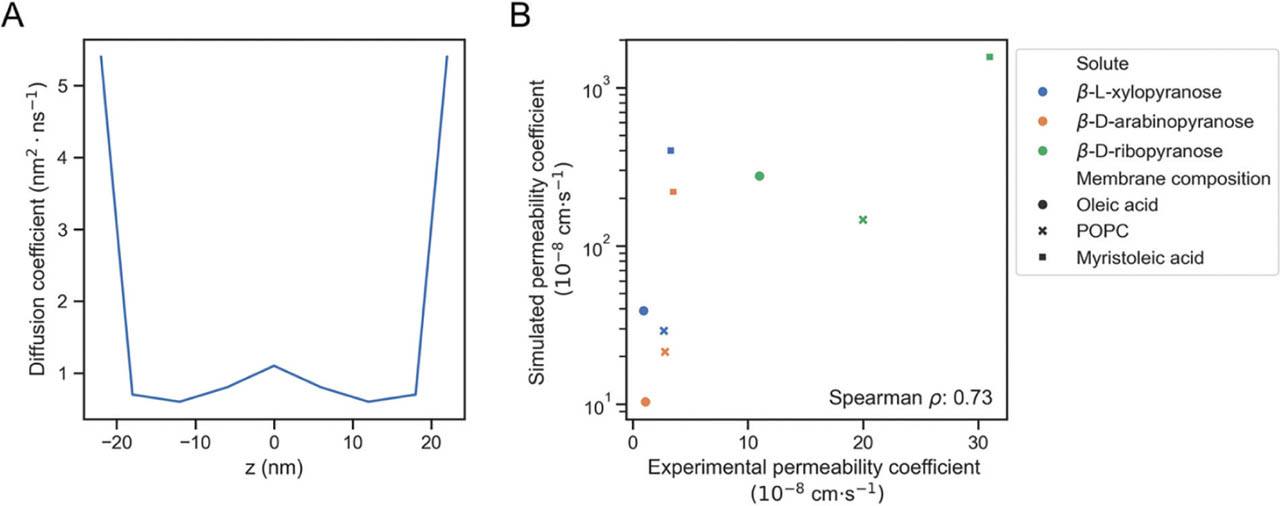
Figure 2.
Simulated permeability coefficients show a strong rank correlation to published permeability coefficients. (34) (A) Ribose diffusion coefficient profile used to calculate permeability coefficients for all solutes and membrane compositions. (35) (B) Correlation of experimental and simulated permeability coefficients, with Spearman ρ rank correlation value shown at the bottom right. Solutes are shown by color (blue, β-l-xylopyranose; orange, β-d-arabinopyranose; green, β-d-ribopyranose). Membrane composition shown by shape (circles, oleic acid; crosses, POPC; squares, myristoleic acid).
Spearman ρ rank correlation was measured using the scipy library (59). Intramolecular hydrogen bond interactions were measured using MDAnalysis (60, 61). All MD simulation data and code used to perform analyses and graphing in the present study are available in the Zenodo repository accessible by DOI (10.5281/zenodo.18740630). The methods are also available at protocols.io, accessible by DOI (10.17504/protocols.io.kxygx8qy4v8j/v1).
Results
To determine the suitability of the AWH simulation approach for evaluating membrane permeability of ribose stereoisomers, we compared the simulated permeability coefficients for β-l-xylopyranose, β-d-arabinopyranose, and β-d-ribopyranose with experimentally determined permeability coefficients (34) in oleic acid, myristoleic acid, and POPC bilayers. The correlation between experimental and simulated permeability coefficients is shown in Figure 2B, with permeability coefficients shown in Table 1. The permeability coefficients measured here are point estimates without measures of statistical uncertainty; we therefore interpreted the differences between permeability coefficients qualitatively using a rank correlation test. The Spearman ρ rank correlation measure of 0.73 reflects a moderately strong positive correlation between simulation and experiment. For each membrane composition, β-d-ribopyranose is correctly identified as the most permeable substrate, in agreement with experimental data.
Table 1.
Simulated solute permeability coefficients for ribose and selected stereoisomers across fatty acid and phospholipid membranes.
| Oleic acid | Myristoleic acid | Lauric acid | Short chain (equimolar) | Short chain (excess lauric) | POPC | |
|---|---|---|---|---|---|---|
| β-d-ribopyranose | 276.5 | 1566 | 13.2 | 349.3 | 267.3 | 146.5 |
| β-d-arabinopyranose | 10.3 | 219.8 | 2.4 | 33.2 | 58.8 | 21.4 |
| β-l-xylopyranose | 39.0 | 400.4 | 14.2 | 172.1 | 99.3 | 29.1 |
| β-l-ribopyranose | 172.7 | 1552 | 40.9 | 1001 | 498.7 | n.d. |
The simulation method somewhat over-estimates permeation through myristoleic acid bilayers, with approximately order-of-magnitude increases in the simulated permeability for β-l-xylopyranose and β-d-arabinopyranose between oleic acid and myristoleic acid bilayers. Additionally, the simulated permeability values for poorly-permeable β-l-xylopyranose and β-d-arabinopyranose through oleic acid and POPC show large variation between 10 cm · s−1 and 40 cm · s−1 despite a relatively narrow range of variation in the experimental values between 0.98 cm · s−1 and 3.5 cm · s−1. This demonstrates the simulation method is less able to discriminate between poorly-permeant substrates, and better at representing the enhanced permeability of highly-permeant substrates (in the current case, β-d-ribopyranose).
After confirming the usefulness of the simulation approach, we explored the permeability of a hitherto un-tested ribose stereoisomer, β-l-ribopyranose, through oleic acid and myristoleic acid bilayers (Table 1). β-l-ribopyranose permeates similarly to β-d-ribopyranose through the myristoleic acid bilayer (1552.3 cm · s−1 compared to 1566.4 cm · s−1). Permeability through the oleic acid bilayer was slightly reduced compared to β-d-ribopyranose (172.7 cm · s−1 compared to 276.5 cm · s−1), while still permeating faster than β-d-arabinopyranose and β-l-xylopyranose (10.3 cm · s−1 and 39.0 cm · s−1 respectively). In the oleic acid and myristoleic acid bilayers, β-l-ribopyranose diffused across the membrane at a similar rate to β-d-ribopyranose.
Next we considered membrane compositions more relevant to an origin-of-life scenario, composed of shorter chain fatty acids. In simulations of pure lauric acid bilayers, all solutes were poorly-permeant with permeability coefficients <50 cm · s−1. However, in simulations of bilayers containing mixtures of short chain fatty acids, β-l-ribopyranose was more permeable than the other solutes. In simulations of the equimolar mixture of short chain fatty acids, β-l-ribopyranose permeated 3-fold faster than β-d-ribopyranose (1000.9 cm · s−1 compared to 349.3 cm · s−1 respectively), β-l-xylopyranose (172.1 cm · s−1) and β-d-arabinopyranose (33.2 cm · s−1). Increasing the proportion of lauric acid in the bilayer composition reduced the permeation rates of both β-l-ribopyranose and β-d-ribopyranose, while maintaining a 1.9-fold difference in permeability coefficient (498.7 cm · s−1 compared to 267.3 cm · s−1). In summary, short-chain fatty acid bilayers, similar to the proposed amphiphile repertoire of origin-of-life environments, were more permeable to β-l-ribopyranose than to β-d-ribopyranose in simulations.
To evaluate a possible mechanism for the increased permeability of β-l-ribopyranose in short chain fatty acid bilayers, we measured the rate of intramolecular hydrogen-bonding interactions formed by each solute during permeation along the bilayer system (Figure 3). In oleic acid, mytistoleic acid, and lauric acid bilayers, both β-l-ribopyranose and β-d-ribopyranose formed more intramolecular hydrogen bonds than β-l-xylopyranose and β-d-arabinopyranose. Hydrogen-bonding rates for all solutes increased in the bilayer hydrophobic core, with similar maximum rates displayed by β-l-ribopyranose and β-d-ribopyranose (2.76 vs 2.79, 2.60 vs 2.67, and 2.81 vs 2.80 hydrogen bonds per ns for oleic, myristoleic, and lauric acid bilayers). The maximum hydrogen-bonding rate is similar between β-l-ribopyranose and β-d-ribopyranose in both short chain fatty acid bilayers. In the equimolar mixture of short chain fatty acids, β-l-ribopyranose and β-d-ribopyranose formed 2.66 and 2.73 hydrogen bonds per ns respectively in the bilayer center, with similar rates in the lauric-enriched short chain fatty acid bilayer (2.68 and 2.74, respectively). These results indicate that the faster permeation rate of β-l-ribopyranose compared to β-d-ribopyranose was not due to an increased rate of hydrogen bond formation during permeation.
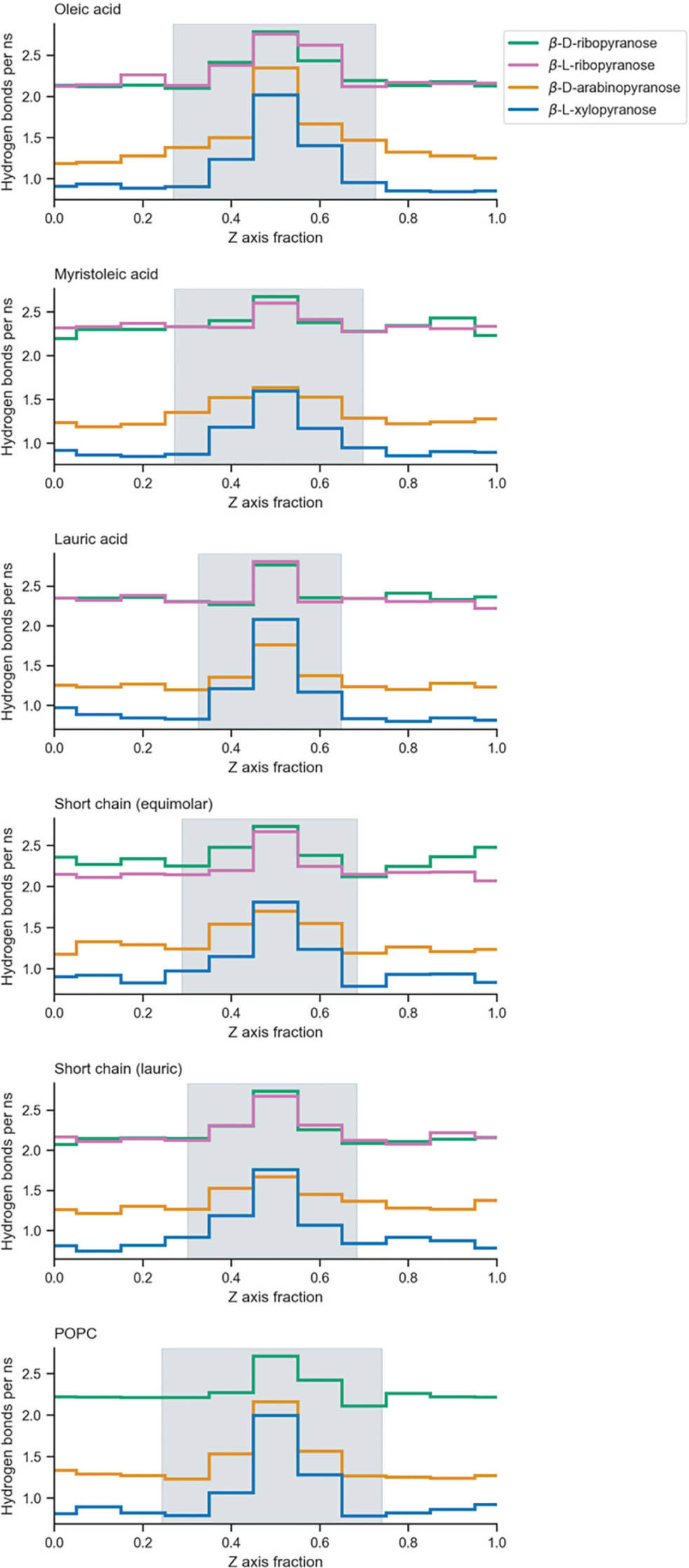
Figure 3.
Intramolecular hydrogen bonds formed per ns in different regions of the simulated system. The horizontal axis corresponds to the z-axis, that is, the axis along which solute permeation was sampled. The region of the permeation axis occupied by each bilayer is indicated by a grey rectangle. Bulk water is located at z-axis fractions of 0.0 and 1.0, and the bilayer core is located at a z-axis fraction of 0.5. Histograms are coloured by solute according to the legend.
Discussion
Our simulations predict higher computed permeability for β-l-ribopyranose than for β-d-ribopyranose in short-chain fatty acid bilayers. This finding is a simulation-based prediction; corresponding permeability measurements in matched vesicles have not yet been reported. By contrast, our longer-chain bilayer simulations showed similar permeation for both enantiomers of ribose. The most pertinent question raised by our results is mechanistic: why does β-l-ribopyranose permeate faster than β-d-ribopyranose? In all but one of the bilayer simulations, the solutes are the only chiral molecules present inasmuch as water, ions, and the single-chain fatty acid species used all possess internal planes of symmetry (POPC contains a chiral center). Hence, the fatty acid bilayer simulations for β-l-ribopyranose and β-d-ribopyranose should, in principle, be mirror images of each other, with similar intermolecular interactions and permeation behaviour, such as observed for d-xylose and l-xylose (34), where both sugars diffused through multiple fatty acid bilayers with near-identical permeability coefficients. In the present work, we confirmed the similar rates of intramolecular hydrogen-bonding activity between β-l-ribopyranose and β-d-ribopyranose during permeation through fatty acid bilayers, suggesting that the faster permeation of β-l-ribopyranose is not caused by more effective shielding of its polar moieties from the hydrophobic core of the bilayer.
A recent experimental study has shown differential diffusion for d-ribose and l-ribose. Goode and co-workers (62) examined the stereoselective permeability of membranes containing archaea-like diether isoprenoid phospholipids. They considered two membrane compositions, one containing glycerol-1-phosphate lipids, and the other containing glycerol-3-phosphate lipids. Both membranes showed no difference in permeation for d/l-xylose or for d/l-arabinose, in keeping with previous experimental results with fatty acid membranes (34). However, both membrane types were more permeable to d-ribose than l-ribose. No mechanism is suggested for this stereoselection, other than the general chiral properties of the membrane composition allowing the bilayer to act as a ‘substrate recognition structure'. Nevertheless, the observed stereoselection of membranes containing archaea-like lipids suggests that certain membrane compositions could achieve the biased permeation required to assemble a protocell with the ability to select for d-ribose. Tellingly, the chiral membrane species used in this study are not proposed to be abiotically available, rendering questionable their relevance to origin-of-life scenarios. Indeed, the evolutionary history of the ‘lipid divide' between archaeal and bacterial lipids is an active field of research in its own right (63,64,65,66), with the origins of stereoselective archael-like lipids completely unclear.
One potential limitation of the present work is that we used a single diffusion profile for the calculation of permeability coefficients, namely that of the β-d-ribopyranose 4C1 chair conformer (Figure 2A). This diffusion profile (35) was used to calculate permeability coefficients for all solutes. We applied the same diffusion profile in the present work, an assumption that could be tested by calculating the diffusion profile for each solute individually. In the work presented herein, we employed single, well-sampled diffusion simulations (67) to maximize the breadth of the bilayer-solute combinations. This methodology allowed for comparative analysis of aldopentose permeation through multiple bilayer compositions. While multi-replicate simulation ensembles is a recognized strategy to quantify stochastic uncertainty (67), the significant computational investment required for such an approach was balanced against the need to consider multiple solutes and multiple bilayer compositions. The rank correlation observed between our simulations and aldopentose permeation experiments demonstrates that this approach serves as a robust method to assess aldopentose permeability. Future high-throughput computational efforts may build upon this method by employing ensemble averages to further refine the precision of the permeability coefficient values.
Further work is also warranted to characterise the permeability of mixtures of short chain fatty acid amphiphiles with demonstrated abiotic availability, towards a broad range of saccharide solutes with plausible prebiotic synthetic routes. While the origin of life field has often featured a degree of ‘cherry-picking' for the most promising results (68, 69), a comprehensive comparison should give a clearer picture of the true stereoselective capabilities of protocellular membranes. The present study presents a computational method for conducting such experiments in silico. Additionally, the influence of specific methodological aspects, such as the use of a single diffusion profile for all solutes and the chosen size of the bilayer patch size, could be explored by varying these while expanding the repertoire of simulated bilayers and solutes to the range of substrates and bilayer compositions which have already been experimentally evaluated (34, 36). Additional avenues for future application of the simulation framework used in this study include the consideration of fluctuating prebiotic temperatures on sugar permeability, and the role of chiral membrane components in the permeability of protocellular compartments.
Finally, we discuss the noteworthy prebiotic implications of the present work. The main finding is that prebiotic fatty acid bilayers are just as permeable to both l-ribose as to d-ribose. This suggests that protocells would readily incorporate both ribose enantiomers into nucleic acid polymers, creating heterochiral RNA. How well would prebiotic RNA tolerate this heterochirality? RNA composed completely of l-ribonucleotides (L-RNA) maintains the same physical properties as natural D-ribonucleic acid (D-RNA) (70). L-RNA duplexes form a left-handed A-form helix, the exact mirror image of the D-RNA right-handed A-form double helix, and show the same thermodynamic stability. Circular dichroism spectroscopy shows that L-RNA produces an exact inverse of the D-RNA spectrum. Heterochiral duplexes containing paired strands of D-RNA and L-RNA are less stable than their homochiral counterparts: 12-mer heterochiral duplexes have their melting temperature lowered by ~30°C (70). Incorporating l-ribose and d-ribose in a single strand further lowers the duplex thermal stability: 10-mers of DNA with a single l-deoxyribonucleotide in the center of the strand show between 3.4°C and 4.3°C lower melting temperatures than homochiral D-deoxyribonucleic acid (D-DNA) duplexes (71). Depending on the local sequence neighborhood, l-deoxyribonucleotides have been shown to reduce the melting temperature of 12-mers by between 7.3°C and 12.5°C (72). RNA duplexes are similarly sensitive to the destabilizing effects of l-ribonucleotides, with a 7-mer containing a single l-ribonucleotide exhibiting a 10.8°C decrease in melting temperature relative to homochiral D-RNA (73).
RNA duplex stability is related to a key challenge in prebiotic nucleic acid replication, namely the strand separation problem, wherein duplex stability is something of a two-edged sword. On the one hand, high duplex stability protects RNA from hydrolytic cleavage: duplex RNA is orders-of-magnitude more resistant to hydrolytic cleavage under alkaline conditions than single-stranded RNA, with hydrolytic degradation half-lives at pH 12.0 of 2.7 days and 277 minutes, respectively (74). On the other hand, high duplex stability precludes replication, as the nucleobases of both duplex strands are not available to act as a template for a newly-assembled strand (75). The melting temperature of RNA duplexes increases with the length of the sequence, such that duplexes longer than 30 bp are not separable by thermal denaturation in prebiotic conditions, and thus not replicable (76). Large fluctuations in prebiotic temperatures have been proposed as one mechanism to allow prebiotic denaturation of long RNA duplexes; however, these higher temperatures also enhance the rate of hydrolytic degradation for the dissociated single strands. Should the rate of degradation outpace the rate of copying, the RNA strand is destroyed before it can be replicated, effectively a ‘dead-end' genetic sequence which cannot be thermally dissociated without being completely hydrolyzed (75).
Thus, RNA duplex stability increases the lifetime over which RNA molecules may persist, while limiting the maximum length of replicable sequences and decreasing the speed of replication. Viable prebiotic RNA replication cycles, then, are proposed to involve synergistic combinations of various mechanisms which can separate RNA strands at prebiotically-relevant temperatures (77). These include pH-driven strand separation (78), salt gradient fluctuations (79), and non-canonical 2′-5′ backbone linkages in place of the regular 3′-5′ linkages (75, 76). l-ribonucleotide incorporation could function similarly to these mechanisms, reducing the RNA duplex melting temperature and facilitating strand copying of longer sequences at prebiotically-relevant temperatures.
In parallel to this prebiotic boon, however, the inclusion of both l-ribose and d-ribose within the protocell could impose a heavy metabolic overhead cost on RNA replication. In a recent modeling study, Laurent and co-workers demonstrated that a system containing both ribose enantiomers can reach homochirality by ‘chiral stalling', whereby ligation to a growing RNA strand is slower where the chirality of the terminal nucleotide does not match that of the template (80). Chiroselective ligation has been observed between d-ribopyranose and l-ribopyranose, slowing the speed of ligation by at least two orders of magnitude in cases of chiral mismatch between the template and elongated strands (81). Thus, we expect the inclusion of l-ribose in protocellular nucleic acid polymers to cause the protocell to accumulate slow-replicating, less stable heterochiral RNA duplexes along with the faster-replicating, but more thermally stable, homochiral duplexes.
The presence of a prebiotic mixture of heterochiral and homochiral RNAs poses a number of unresolved questions. To what extent do heterochiral RNA duplexes interfere with the emergence of functional D-RNA ribozymes? Hydrolytic degradation would be expected to eventually dismantle the less stable, less replicative heterochiral strands, but without removal, the l-ribonucleotides will remain available inside the protocell environment to be re-integrated and stall the growth of newly-ligated heterochiral duplexes. What kind of nucleotide concentration within the protocell is required to counterbalance this global reduction to replication speed? Our results suggest that protocell interiors are equally exposed to both enantiomers of ribose, and so we encourage the field to direct more attention to the challenges posed by heterochiral RNA in the prebiotic scenario.
Conclusion
In this study, we examined the permeability of β-d-ribopyranose and selected aldopentose stereoisomers through fatty acid bilayers of varying chain length and composition. Our approach calculates permeability coefficients consistent with available experimental measurements, albeit with systematic over-estimation for myristoleic acid bilayers. While β-d-ribopyranose permeated faster than other aldopentoses through oleic acid, myristoleic acid, and lauric acid bilayers, β-l-ribopyranose was more permeant through short chain fatty acid bilayers such as those proposed to constitute protocellular membranes. These simulations indicate that passive membrane permeation alone may be insufficient to select for the d-enantiomer of ribose, however experimental verification is needed. Taken together, our data implies that protocell interior environments contained both enantiomers of ribose, leading to a mixture of heterochiral and homochiral nucleic acid polymers. The implications for protocellular replication are slower replication of genetic material, and greater consumption of nucleotides to produce off-target RNA sequences. Whether these challenges are surmountable remains to be seen.
Acknowledgements
A. H. F. is the Joseph Meyerhoff Profession of Biochemistry at the Weizmann Institute of Science. This work was supported by the Walt and Rowena Foundation.