
Introduction
The RNA world hypothesis (RWH) remains the leading evolutionary framework for life's origin (1). Some claim that it has been established beyond reasonable doubt (2). Others opine that extant cells provide little if any evidence for this view (3). Proponents argue that rRNAs found in extant ribosomes are indisputable historical remnants of this period. Critics counter that all RNA- and deoxyribonucleotide hydrolysis (DNA)-templated polymerases—indispensable for RNA and DNA replication—are protein-based and contain no RNA components (4). The RWH makes no predictions about which classes of RNA should be found in extant organisms, nor is it invalidated by patterns of their absence. For example, miRNA (5) and snRNA (6, 7) are only found in eukaryotes whereas CRISPR RNA (8) and tmRNA (9) are absent in eukaryotes. Any pattern of RNA genes could be explained through judicious assumptions about ancestral additions, losses, or independent origins.
The RWH's appeal stems from the possibility that a single biomolecule could both catalyze reactions and carry genetic information. An initial state with mandatory collaboration between DNA, RNA and proteins seems implausible. Consequently, the putative RWH period is assumed to have begun with the prebiotic accumulation of nucleotide precursors and to have persisted until DNA assumed the role of genetic information storage (2). An analysis published in 2017 dated the RNA World to approximately 4.2 Ga (10). Conditions during this era were likely inimical to RNA, owing to impact-generated heat and powerful oceanic tides driven by a nearby Moon and Earth's rapid rotation (11,12,13,14).
Paradoxically, others have dated the DNA-genomic LUCA to approximately 4.2 Ga, leaving little time for an RNA-only phase, a subsequent RNA:DNA hybrid stage, and the emergence of DNA-only genomic ancestors of LUCA.
Absent fossil evidence, a rich variety of evolutionary reconstructions can be envisioned, producing a range of potential timelines. Complicating the conceptual landscape, competing proposals involve a single long RNA genome (2) versus systems of shorter collaborating RNAs (15).
At some point all RWH scenarios would require one or more embedded polymerase ribozymes. These must use the entire genome or individual RNAs as a template to produce the complementary sequence and then the complementary strand must be used as the template to replicate the original genome or RNA network (16).
A classical experiments by Sol Spiegelman on the Qβ bacteriophage demonstrated that natural selection strongly favors RNA genome truncation. The original strand with ~4500 nucleotide bases was shortened to a population having only 550 bases in 74 generations (17). Another dilemma is that internal base pairing is required to form three-dimensional catalytic structures, but such pairing interferes with replication by ribozymes, which lack helicase-like functions (15). Significant loss of replicative fidelity each cycle would lead to error catastrophe of the population (15).
The minority hypothesis of shorter collaborating RNAs able to form autocatalytic cycles (15) seems to ameliorate some problems while creating new ones. A distinct (hypothetical) ensemble of RNAs would need to be replicated with the correct stoichiometry at the correct time and location. Furthermore, a new evolutionary transition would be required: combining the individual RNAs into a larger genome (whether RNA or DNA) while remaining viable during the entire process.
A key challenge is the source of a constant supply of suitable nucleotides to form RNA. Equally fundamental, RNA is known to be labile, prone to hydrolysis (18). This prompts the central question addressed in this paper: what maximum length could abiotic RNA have achieved and at what concentration? This question is important because modern organisms are claimed to trace back to a LUCA with genomes exceeding 2.5 million nucleotides (19, 20).
Length and concentration of RNA
RNA chains are produced by condensing nucleotides, as shown in Figure 1.
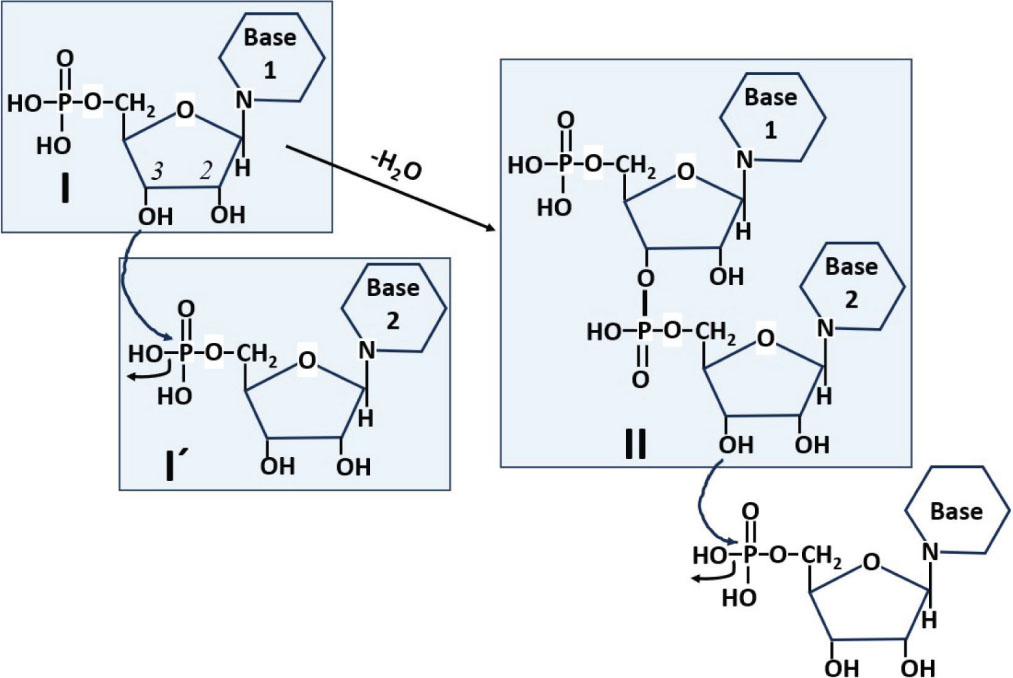
Figure 1.
Condensation of nucleotides to form RNA polymers.
An upper bound can be calculated for the concentration of any RNA oligomer in aqueous equilibrium using simplifying chemical assumptions, such as neglecting side reactions. Let N represent a nucleotide such as molecule I in Figure 1, having one phosphate group attached.
Ignoring side-reactions for simplicity, the polymerization equilibria would be:
By induction,
It is reasonable to assume that K ≈ K1 ≈ K2 ≈ … ≈ Kn−1 if the oligomers remain soluble and don't fold in a way that isolates the ends that must react. Whenever these assumptions do not hold, the effective concentrations of N or Nn will be lower, decreasing the concentration of the next-larger oligomer. Side-reactions will also decrease the effective concentrations, such as when the C2′ instead of C3′ hydroxyl reacts, or when N-glycosidic bonds to the nucleobases are hydrolyzed. Interfering reactions with other chemicals would also decrease the effective concentrations of N and Nn. Consequently, a very conservative upper bound for the steady-state concentration of an RNA oligomer can be expressed as,
Eq. (5) indicates that only K and [N] need to be known to establish the highest concentration possible of abiotically produced RNA of any length in aqueous equilibrium.
Conceivably RNA strands could have arisen abiotically through exceptional localized processes instead of a steady incremental build-up. However, RWH scenarios require mobile RNA in water, where they would be diluted and quickly hydrolyzed.
RNA hydrolyzes rapidly
RNA hydrolyzes easily due to the 2′ OH group, which enables a two step cleavage via a 2′,3′ cyclic phosphate intermediate, as shown in Figure 2.
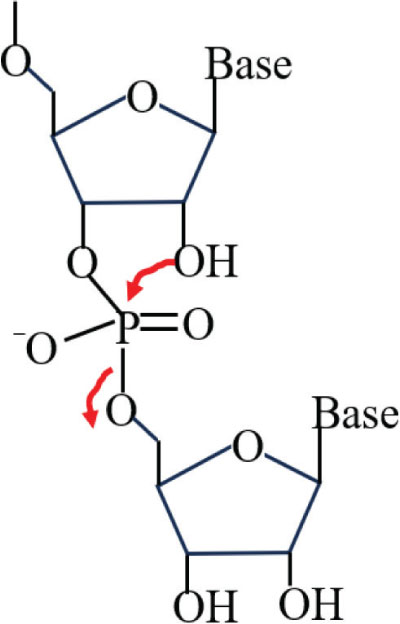
Figure 2.
Low activation energy 2′, 3′ cyclic phosphate pathway to hydrolyze phosphodiester bond in RNA.
At pH 6–7 and 25°C, individual RNA phosphodiester bonds have t½ ≈ 4 years (uncatalyzed) and 9 days at 100°C (21,22,23). All results in this paper assume ~25°C. (However, the rapid degradation at much higher temperatures is a serious concern for wet-dry cycle and hydrothermal vent simulation experiments). Hydrolysis is significantly accelerated under alkaline conditions, by divalent metals, and on mineral surfaces (23).
The half-life of RNA with length L nucleotides remaining intact can be estimated by
as derived in Appendix 1. For example, at 25°C, if L = 10Free energy of hydrolysis to calculate K
The equilibrium constant K in Eq. (5) can be calculated from the free energy of hydrolysis, which is the reverse of the condensation reaction. A widely cited study determined ΔG°hyd = −22.2 kJ/mol for DNA at 25°C and pH 7 (see Figure 3) (24). RNA condensation yields approximately the same ΔG° value, indicating that hydrolysis is strongly favored for both DNA and RNA. (25)
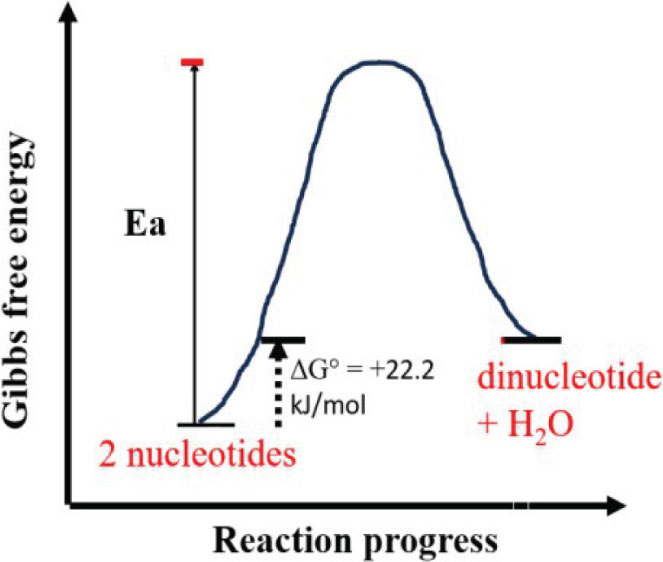
Figure 3.
Condensation of nucleotides is endergonic (thermodynamically unfavorable) and hydrolysis of oligomers is exergonic (thermodynamically favorable). Not drawn to exact scale.
According to the Gibbs free energy equation,
where:ΔG° is the standard Gibbs free energy change.
R is the ideal gas constant (8.314 J/mol·K).
T is the absolute temperature 298.15 K (i.e. 25°C) for standard conditions.
Keq is the equilibrium constant for the reaction N + N ⇄ X N2.
K1 for the condensation reaction in Eq. (1) can be calculated.
Since ΔG° = +22.2 kJ/mol= +22,200 J/mol,
and RT = 8.314 × 298.15 ≈ 2478.82 J/mol
Concentration of nucleotides (nucleoside monophosphates, NMPs)
A fundamental question for the RWH becomes: what values of [N] should be assumed? The total mass balance must hold, with total nucleotide distributed across oligomers plus unreacted monomer:
Since at equilibrium
it follows thatSince from Eq. (9) Kn−1 ≈ 10−4, and under abiotic conditions [N] << 1, Eq. (12) confirms that [Nn] << [Nn−1] in aqueous equilibrium for all values of n. This means that very little of the initial nucleotide pool is consumed to form the oligomers. At equilibrium, when maximum oligomer concentration has been achieved,
Eq. (13) expresses that production and degradation of nucleotides would initially equilibrate to a steady-state concentration, [Ninitial]. Upon oligomerization, only a negligible proportion of Ninitial would be consumed when the system reaches equilibration.
The RWH is only feasible if [Ninitial] was very high. The likelihood of this requires reverse engineering the nucleotides, as shown in Figure 4. This reveals that three kinds of molecules are needed (ribose, four nucleobases, and phosphate) joined through N-glycosidic and phosphoester bonds. These five requirements will be evaluated next. The phosphodiester bond to link nucleotides was already mentioned above and activating groups will be discussed later.
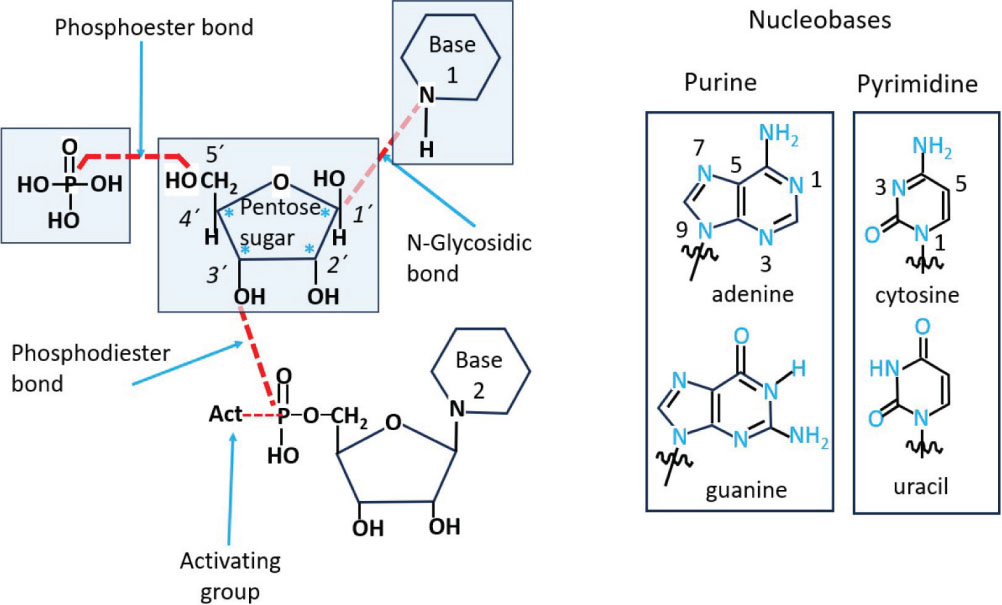
Figure 4.
Deconstruction of nucleotides into their chemical building blocks to facilitate a retro-synthetic analysis.
Abiotic synthesis of the ribose sugar
The formose reaction is considered the most promising route to synthesize ribose, although at prebiotically realistic concentrations of formaldehyde (<10−3 M), sugar products are not obtained even after adding minerals and salts (26,27,28,29). High pH (~10–12), higher temperatures (ca. 60°C–80°C) and a catalyst like Ca2+ or Mg2+ are necessary for the formose reaction, yielding a vast variety of sugars, polyols, and other chemicals (‘sugar tar’) (30, 31). Using very concentrated formaldehyde under optimal temperatures can produce single digit percentages of a mixture of sugars (30) if the reaction is stopped quickly (29, 36). The ribose for RNA represents a small fraction of this mixture, being a small proportion of just the aldo-pentose (5-carbon) sugars. Continued exposure to formaldehyde, especially at elevated temperatures, converts sugars into amorphous ‘tar’. The prebiotic concentration of ribose stereoisomers would likely have been <10−5 M.
Should more concentrated ribose have accumulated in some environment, it is unstable in water, with half-lives ~73 min at 100°C (pH 7.0); 300 days at 25°C (pH 7.4); and ~44 years at 0°C (pH 7.0) (32). The half-lives would have been significantly lower at pH ≥ 10. This instability has led some researchers to conclude that ribose and other sugars were not used by the first genetic substances (32).
Abiotic synthesis of nucleobases
The tar-like polymer from concentrated HCN, extensively explored by Juan Oró, is considered the most promising source of prebiotic nucleobases. (33) When [HCN] ≤0.01 M, hydrolysis to form formamide (HCONH2) and formic acid (HCOOH) predominate over polymerization (28). But concentrations >0.01 M would have been unlikely on early Earth (28).
Miyakawa et al. (34) estimated equilibrium concentrations of HCN at pH 8 as 6 × 10⁻¹⁶ M at 200°C; 7 × 10⁻¹³ M at 100°C; and 2 × 10⁻⁶ M at 0°C. This is several orders of magnitude lower than needed to produce nucleobases at detectable levels. Nevertheless, most origin-of-life (OoL) experiments to produce nucleobases use high HCN concentrations (1.0–11.0 M) leading to a polymeric material called azulmin. The very exergonic (favorable) reaction produces highly cross-linked polymers that must be hydrolyzed in strong acid at around 100°C for a few days. Consequently, the usefulness of HCN, to produce nucleobases has been viewed critically (33).
Uracil was obtained in about 0.005% yield (based on moles HCN) using 0.1 M HCN solutions at room temperature. However, only upon acid hydrolysis (5 M HCl at 110°C) of the oligomer was nucleobase formed (35).
In other experiments, Schwartz et al. (36) used 0.01 M HCN solutions with ammonium hydroxide at pH 9.2 at 25°C and obtained 0.004% of adenine.
An alternative strategy involves creating NH4CN from gaseous HCN and NH3. In an extreme example of experimental persistence, 0.1 M NH4CN solutions were maintained for 25 years(!) at −20°C then hydrolyzed with 6.0 N HCl at 100°C and then 0.01 M phosphate (at pH 8.0) at 140°C for 3 days. Yields based on HCN were 0.038% adenine and 0.0035% guanine (33). Uracil and cytosine were not identified.
Cytosine is not obtained in HCN or NH4CN solutions, or at best in trace concentrations. It is consumed by deamination (having activation energy ~23.4 kcal/mol) (37) to form uracil with a half-life of ~340 years at 25°C (pH 7) and much shorter half-life in the presence of mineral catalysts (38). Furthermore, solar UV light converts cytosine to its photohydrate and to cyclobutane photodimers (38). Cytosine is notably absent in analysis of meteorite compositions, and at best would be in parts-per-trillion concentrations (39). Cytosine is also not reported in electric spark discharge experiments.
Shapiro (37, 39) has vigorously critiqued the variety of inconsistent conditions used to synthesize the individual biological nucleobases. Low temperature (~−20°C) is required to prevent HCN hydrolysis and allow polymerization, while high temperature (~100°C) and low pH are subsequently needed to hydrolyze the azulmin polymer to release nucleobases—conditions that are mutually incompatible.
Instead of working with HCl, sophisticated processes have been devised to form nucleobases. To illustrate, Lagoja and Herdewijn formed hypoxanthine (which resembles adenine chemically) by reacting glycinamide and diformylurea at 175°C (41). The prebiotically implausible drying agent P2O5 was then used at 100°C followed by some additional reactions at 100°C. It seems unlikely that such studies shed much light on the origin of nucleobases.
The experiments mentioned above, together with the fact that nucleotides readily hydrolyze (especially at high temperature) lead to the expectation that prebiotic nucleobase concentration would have been very low. Concentration estimates are not available for the various environmental conditions, and the formose reaction conditions are incompatible with those required to form sugars from HCN. Specifically, the necessary concentration for HCN implies temperatures <0°C and pH < 7, but no sugars would form via the formose reaction under these conditions. It seems reasonable to assume nucleobase concentrations were <10−5 M, consisting of mostly adenine and trace amounts of cytosine.
Prebiotic availability of phosphate
It is estimated that Earth's primordial oceans contained on average 0.04–0.13 × 10⁻⁶ M dissolved phosphate (30). Most of the phosphorus would have been inaccessible as water-insoluble minerals such as apatites (42). Also, orthophosphate is precipitated by divalent metals such as Zn2+, Mg2+ and Ca2+ and thus not available for reaction in solution (43).
Costanzo et al. [42] tested 12 phosphate minerals to determine which could phosphorylate nucleosides.
Crystal minerals were ground to fine powder and suspended in pure formamide (HCONH2). However, formamide hydrolyzes readily in water to form formic acid and ammonia, making it an implausible prebiotic solvent. Suspensions were heated to 130°C for 72 hr and centrifuged then the temperature was lowered to 90°C before adding 0.025 M adenosine to the formamide solution.
It seems likely that the concentration of dissolved phosphate would have been <10−7 M preceding and during a putative RNA World.
5′-Phosphorylation of the nucleoside
Nucleosides must be phosphorylated at the ribose 5′-OH position. The reaction Adenosine + Pi → AMP is endergonic (i.e. unfavorable), with ΔG′ ≈ + 14 kJ·mol−1 at 25°C and pH 7 (44, 45).
Costanzo et al. (42) reported that no adenosine phosphorylation occurred in water at 90°C since the glycosidic bond degraded. Therefore, they used formamide as the solvent in these experiments. Reactions were terminated after a few days when degradation products became dominant (Figure 5). The highest 5′-AMP yield (~6% of input adenosine) resulted from the mineral libethenite, Cu2 (PO4)(OH). Five minerals produced no phosphorylation products, two produced trace amounts, and the remainder yielded far less than 1%.
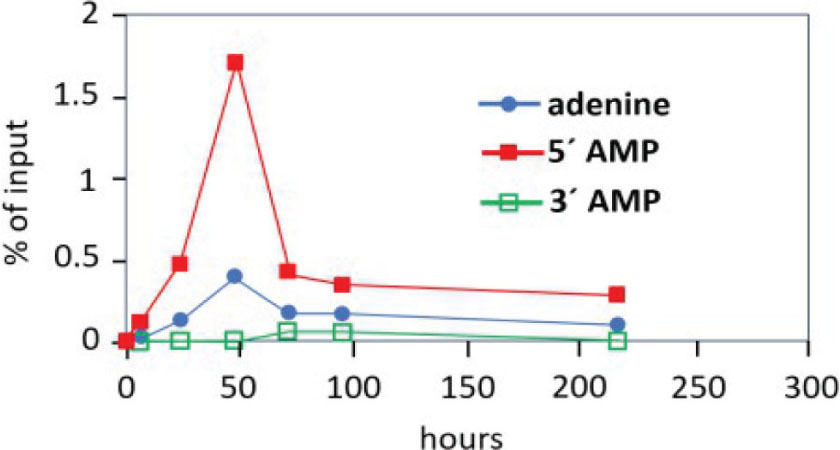
Figure 5.
Adenosine phosphorylation in formamide at 90°C in Reichenbachite, Cu2+ (PO) (OH). Mineral pretreated for 72 hr at 130°C. From Costanzo et al. (42) slightly modified.
2′:3′-cyclic AMP instead of phosphorylated AMP
Since thermodynamics favors hydrolysis instead of condensation of nucleotides (see Figure 1), researchers often synthesize 2′:3′-cyclic AMP instead. The strained cyclic phosphate is in a high-energy state that can polymerize readily to form RNA-like chains (i.e. with mixed 2′–5′ and 3′–5′ linkages) (46,47,48).
The prebiotic relevance of these studies is questionable. To illustrate, when adenosine was reacted with dissolved KH2PO4 (0.05 M at 90°C), 2′:3′-cyclic AMP was only obtained in water-free formamide (42). In addition, the concentration of a reactant such as KH2PO4 would have been prebiotically very low since the dominant natural phosphorus reservoir would have been apatite-group minerals such as fluorapatite and hydroxylapatite that are highly insoluble in water (42).
5. Formation of the N-glycosidic bond
An N-glycosidic bond must be formed at the C1′-OH position to link ribose with a nucleobase. The half-life of this bond is about 6000 years at 25°C (pH 7) but decreases rapidly with temperature and under both acidic and basic conditions. (18) Half-lives over a range of temperatures were calculated using parameters from Stockbridge et al. (18) in Table 1 of Appendix 2.
A productive and abiotically realistic pathway for the N-glycosylation step has not been found (25). The high activation energy to displace the C1′-OH requires high-temperature and other destructive conditions that destroy the reactants and leads to undesired side products.
This is known as the nucleosidation problem (25). After considerable experimentation and optimization, Orgel succeeded in obtaining up to 3% yields of the β-adenosine (49, 50) but N-glycosylation of the pyrimidine nucleosides (cytidine and uridine) under the same conditions did not occur (49,50,51).
Baseline concentration of prebiotic nucleotide
Figure 4 shows that the four nucleotides require pre-assembly of four nucleobases; ribose; and phosphate. All were present in very low concentrations and needed to have been present concurrently. The phosphate must then be attached to the ribose at the C5′–OH position (an endergonic reaction) and the nucleobases attached to the ribose at the C1′–OH position.
The latter reaction has a high energy of activation overcome through high temperatures that destroy both reactants and product. Additionally, once formed, the successful bonds are easily hydrolyzed.
Noteworthy in the above analysis are the inconsistent conditions necessary. The boiling point of HCN at atmospheric pressure is approximately 25.6°C, but liberation of nucleobases from HCN cross-linked polymers requires hydrolysis in strong acid at around 100°C for several days. No HCN would have been present in solution under those conditions, and would have hydrolyzed in any event. The formose reaction also requires elevated temperatures, typically 60°C–80°C. At such temperatures, the necessary high HCN concentration could not have accumulated, and any ribose formed would have been rapidly destroyed.
Comparison with other prebiotic concentration estimates might provide some intuition for a reasonable estimate for nucleotides, [N].
Bada calculated that the concentration of all amino acids in primordial oceans would have been about 10−10 M (52). Since amino acids are much simpler molecules than nucleotides and not as readily hydrolyzed, it is reasonable to assume that at equilibrium in prebiotic water the average concentration of nucleotide (including the missing cytosine monophosphate) would have been [N] < 10−10 M.
Using this value to calculate the concentration of tetranucleotide (n = 4) and K ≈ 1.3 × 10⁻⁴ from Eq. (9) in Eq. (5) leads to
To put this into perspective, we can calculate the molarity of one molecule in all current terrestrial water, ca. 1.26 × 10²¹ L. Using Avogadro's number for the number of molecules in 1 mole:
Since 10−52 M < < 10−45 M, it would seem that not one RNA molecule four nucleotides or longer would have existed in terrestrial water prebiotically at equilibrium.
This baseline expectation can be modified using two strategies. I. Increase the equilibrium constant K; and II. Increase the local concentration of nucleotide, N.
I. Strategies to increase the equilibrium constant K
Use non-aqueous polar solvents
Examples of this approach were mentioned above, but terrestrial prebiotic environments dominated by such solvents do not seem feasible on early Earth.
Activate the phosphate group
Researchers use a series of chemical principles such as compartmentalization, removal of water, and activating groups to increase the equilibrium constant K of oligomerization.
The phosphate attached to the ribose 5′-OH can be activated in various ways.
Phosphorimidazolides, shown in Figure 6, are especially effective in facilitating oligomerization (53,54,55). Gibard et al. developed a protocol using 0.1 M uridine, reacted with 5 equiv. diamidophosphate (DAP) and 1 equiv. imidazole in the presence of 0.5–3 equiv. of zinc chloride or magnesium chloride (38, 56).
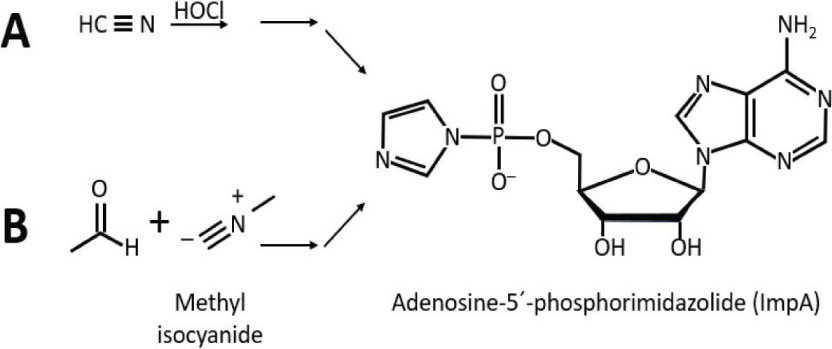
Figure 6.
Proposed abiotic synthetic routes to nucleoside-5′-phosphorimidazolides by (A) Yi et al. (55) and (B) Mariani et al. (54, 60).
Unfortunately, the favored products are 5′,5′-pyrophosphates and linkages using 2,5′-phosphodiester bonds, with only very short linear 3′,5′-oligomers (57). Some metal ions including Pb2+, Zn2+, and Lu3+ were found to improve the imidazole-activated polymerization, leading to 5-mer, 4-mer, and 3-mer, respectively (19, 58, 59). However, as mentioned above orthophosphate is precipitated by divalent metals (43).
High concentrations of other external activating agents such as cyanamide (61) and carbodiimides (62) facilitate polymerization in aqueous solution but could not form oligomers longer than dinucleotides in sustainable yields. (25) These reagents hydrolyze rapidly in water.
II. Strategies to increase local concentration of nucleotide, [N]
Wet-dry cycles
Higher equilibrium constants can be obtained by removing water. A well-known chemical methodology is wet-dry cycles (also called concentration-evaporation, dehydration–rehydration, or drying–wetting cycles). This also concentrates nucleotides locally. Pioneering studies had established the feasibility of synthesizing RNA oligomers at 70°C–90°C in this manner (63).
Two recent studies applied this technique, optimizing the conditions. Hassenkam and Deamer placed drops of 10 mM AMP + UMP and 10 mM GMP + UMP aqueous mixtures (pH 3) on freshly cleaved mica surfaces and evaporated the water on a hot plate at 80°C (64). Initial drying took several minutes, then dried samples were maintained at 80°C for 30 min before rehydration with minimal ultra-pure deionized water. After three wet-dry cycles, large polymeric cyclic and linear substances were produced. Room-temperature experiments produced no polymeric material.
Song et al. (65) prepared 10 mM aqueous AMP solutions (pH 2.5) at room temperature, transferred small volumes into wells on glass slides, and dried them on a thermostat-controlled hot plate at 85°C. After drying (several minutes), slides were maintained at 85°C for ~30 min to provide activation energy for condensation, producing a thin film. Water was then added at room temperature and stirred for ~5 s with a spatula. This process was repeated for 3 wet-dry cycles. The authors identified a broad oligomer distribution: for UMPn, the average was n = 16.3 ± 10.5 with maximum n = 53; for AMPn, average n = 14.7 ± 9.3 with longest oligomer n = 44 (their Figure 2) (65). Yields of larger oligomer increased from 1 to 2 wet-dry cycles but decreased significantly with the third cycle, especially for the largest oligomers (their Figure 2) (59).
These wet-dry experiments produced favorable equilibrium constants (by driving off water), but more importantly, concentrated pure nucleotides on two-dimensional surfaces.
Hassenkam and Deamer estimated that evaporating a 20–40 μL drop of 10 mM nucleotide solution over 1 cm2 produced 10–30 nm thick films composed of 30–60 stacked pure nucleotides (64).
In bulk water, H+ and OH− ions are randomly distributed, but at hydrophobic interfaces such as air or solid surfaces, high H+ concentrations can form (65). These protons accelerate condensation via acid-catalyzed mechanisms by activating phosphate groups for nucleophilic attack by free ribose −OH groups. (19). Additionally, electric fields at interfaces help align nucleotides and further facilitate reactions (19).
Importantly, tightly packed nucleotides attached to glass surfaces are protected from moisture. Furthermore, proper alignment during evaporation can occur, analogous to crystallization. However, once solid thin films form, dried nucleotides become immobilized and cannot polymerize further. This is solved by adding the minimal amount of water after the condensation step to provide mobility, after which the water is quickly removed.
Song et al. (65) recognized that under their experimental conditions the RNA polymers would be completely degraded to the component nucleotides within a few days. Therefore, only three very short cycles were employed. The lability of RNA polymers under these conditions was already established by the work of Mungi et al. (66) who reported that about half of AMP solutions are depurinated (i.e. the N glycosidic bond is broken) within ~6 hr at 90°C and pH 2. Glycosidic bonds are known to be very labile, especially in purines (67) and the rate of depurination accelerates rapidly at >85°C (68).
Concentrate activated nucleotides on Montmorillonite
Montmorillonite ((Na, Ca)0.33(Al, Mg)2(Si4O10)(OH)2 · nH2O) is common in deep-sea sediments and acts as an efficient adsorbent. Catalysts like montmorillonite can generate high local reactant concentrations at catalytic sites within interlayers that facilitate polymerization (62).
Amino groups on nucleobases bind to its surface. When densely packed on Montmorillonite, 3′,5′-dimers and other products formed (62). Insights resulting from extensive optimization reported in the seminal paper (62) were used in decades of subsequent experiments. These include:
Detailed protocols to remove interfering organic material.
Pretreatment to ensure the exchangeable cation in the mineral is a suitable alkali or an alkaline earth metal ion. (69) For example, Na+-montmorillonite is an effective catalyst but Cu2+-montmorillonite is not.
Thorough mixing of the Na+-montmorillonite and activating agent by centrifuging.
Thorough mixing of 5′-AMP, Na+-montmorillonite and activating agent in a vortex mixer.
Optimal temperatures, such as 4°C to obtain highest 5′,3′-dinucleotide yield.
Very high concentration of chemically pre-modified (i.e. activated) 5'-AMP ca. 14.5 mM.
Subsequent experiments identified the most effective activating agents, replacing the originally used EDAC with imidazolides. The prebiotically more plausible activating diiminosuccinonitrile (DISN) displayed no catalytic effect. A recurring observation has been the unfortunate production of 5′,2′-dimers along with the RNA 5′,3′-dimers, in addition to other products.
Optimizing the experimental conditions improved oligomer yields. Ferris and Ertem began with 14.5 mM solutions of 5′-phosphorimidazolide adenosine (ImpA, i.e. already activated nucleotide) mixed with high concentrations of Na+-Volclay for 3 days at room temperature (70).
Oligomer chains ≥8-mers were obtained in trace amounts up to 10 nucleotides. Exclusively 3′,5′-linked polymers comprised only 9% of trimers and 3% of tetramers, but interestingly 27% of pentamers.
Jheeta and Joshi reported that oligomerization of 15 mM ImpA without Na+-montmorillonite produced only cyclic dimers and trace amounts of linear dimers (71). With montmorillonite present, 15 mM D,L-ImpA with D,L-ImpU produced oligomers up to 11-mers (in trace amounts), but when lowered to 1.5 mM no oligomers longer than trimers were reported, and further lowering to 0.15 mM seems to have only produced dimers (68).
Ferris developed another method for obtaining longer oligomers (62). Using a ‘feeding reaction’ strategy—adding fresh activated monomer daily to a 10-mer primer already attached to montmorillonite—produced approximately 30–40-mers attached to the primer. Changing the phosphate-activating group from imidazole to 1-methyladenine produced 40–50-mers of A or U without primers (62).
III. New values for K and [N]
Higher values for K
Oligomerization can be improved significantly using various strategies. We will not elaborate here on prebiotically unrealistic terrestrial studies such as those using non-aqueous polar solvents, as mentioned above. We will also exclude recent scenarios whose creativity are inversely proportional to prebiotic plausibility. This includes ice eutectic phase conditions (72, 73), as well as lipid- or vesicle-assisted compartmentalization (74) that use implausible mixtures that require high concentrations of chemically activated reactants. We will reflect on the much - discussed scenarios where water is evaporated or nucleotides have been pre-activated.
Unfortunately, although the equilibrium constant, K, can be increased with these methods, the conditions inevitably also decrease the concentration of the nucleotide or activated nucleotide under prebiotic conditions, for several reasons. The chemicals used to activate the nucleotide's phosphate hydrolyze in water (43); low concentrations of nucleotide and reactants must now be co-located; the reactants must be in a suitable stoichiometry; creating the activated group is endergonic, leading to an unfavorable equilibrium constant; and the activated nucleotide would hydrolyze rapidly. Therefore, the tradeoffs between increased K and decreased [N] and decreased [N]activated must now be evaluated.
Lower values for [N] and [N]act
Doubts have been expressed about the prebiotic relevance of the carefully planned laboratory experiments designed to channel chemical reactions towards a predetermined outcome (33).
Concentration of nucleotides in prebiotic wet-dry cycles
Shapiro critiqued models based on the dry-lagoon concept for many reasons, including that decomposition and side reactions caused by the drying process cannot be ignored and would have interfered (38). Our analysis has a more limited focus, namely the question of what concentration of prebiotic nucleotide might have realistically accumulated in a relevant environment. We acknowledge the significant difficulties created by interfering chemicals, but will treat these reactions as merely diluting the reactants, to simplify.
Successful wet-dry cycle experiments require ideal and very narrow ranges of temperature, pH, and timing to minimize the destruction of the starting nucleotides and oligomer products. A wide range of hot spring conditions would have been present, having pH ≈ 1–7 and fluctuating temperature ≈ 25°C–100°C, so somewhere a suitable one would have existed. However, the effect of fluctuating temperatures has not been reported in the literature. During long geological periods at temperatures ~50°C nucleotide oligomerization would have been negligible whereas nucleotides and their precursors would have steadily hydrolyzed under these conditions. Alternatively, during short periods of aqueous temperatures ~95°C, the nucleotides, their precursors, and oligomers would have hydrolyzed virtually instantly.
There are other concerns about the relevance of the various studies. The crystal-like films mentioned above required unrealistically high initial concentration of nucleotides and the absence of impurities. For example, a single contact with saline water would have permanently introduced NaCl in a proportion many orders of magnitude higher than nucleotides would have been present, which would have interfered with forming pure nucleotide films.
Of the nucleotides that happened to accumulate under suitable prebiotic conditions, virtually all would have been rapidly degraded upon re-exposure to the hot water from which they had evaporated.
Alternatively, if they remained permanently isolated from water, they would not have been available for the RNA World processes. Removed from water they would have been exposed to intense early Earth UV radiation and eventually destroyed.
It is unlikely that prebiotic wet-dry cycles under realistic conditions could have satisfied all these requirements to have increased the concentration of [N] locally to above our proposed nucleotide concentration of 10−10 M.
Concentration of activated nucleotides in prebiotic environments
Attachment of activating groups to the nucleotide phosphate is a very unfavorable endergonic reaction. Furthermore, the concentration of the activating reagents in water would have been very low. Low concentration of reactants (~10−5 M) undergoing one or more bimolecular reactions with very unfavorable equilibrium constants would have required significant time and led to trace concentrations of product. The putative activated nucleotides would need to be used quickly before they hydrolyze.
Purified powdered montmorillonite with the right cations and no contaminants would have been rare. Suitable montmorillonite becomes even less probable when effective stirring is also required with very high concentrations of the chemicals used to produce activating agents. Requiring judiciously timed repeated grinding of a highly concentrated montmorillonite paste (56, 75) further stretches credibility. Realistically, only an insignificant proportion of the available nucleotides would have enjoyed this exalted status.
Unsurprisingly, the relevance of prebiotic activated ribonucleosides has met with considerable skepticism (25).
IV. Re-evaluation concentration of RNA oligomers [Nn]
The considerations above will be used to re-estimate the concentration of RNA oligomers, [Nn].
Clearly,
where Nact is the chemically modified nucleotide optimized to undergo oligomerization. Note that many commonly used activating or coupling agents used, such as 1-ethyl-3-(3-dimethylaminopropyl) carbodiimide (EDAC), would not have been present prebiotically at all.Rearranging Eq. (5) leads to:
Replacing the parameters with activated nucleotides, the relationship becomes:
The equilibrium constant Kact is now greater than K, but the now significantly lower concentration of Nact would lead to less oligomer if as anticipated
To illustrate, suppose activation increases K by a factor of 104, but only 10−3 of N would be present as Nact. For the reaction,
these assumptions lead to which equals in this example 10−2K1[N]2. Less dinucleotide would have formed.Variety of mononucleotide isomers
Special environments might be envisioned where [N] > 10−10 M could have arisen. However, [N] < 10−10 M still seems to be a robust proposal since other factors are also involved. It is well-known that polymerization of formaldehyde and HCN to produce nucleotide precursors generate many interfering chemicals. These chemicals, plus the amines, aldehydes, alcohols, carboxylic acids, etc. also present from other sources would have decreased the effective [N] available to form RNA.
Another issue we are neglecting is that only D-sugars are acceptable to form RNA. Suppose this problem had been resolved and only D-ribose was concentrated in some environment, together with only the four correct nucleobases adenine, cytosine, guanine, and uracil; and phosphate. The thermodynamic problems of forming phosphoester and N-glycosidic bonds were mentioned, but not the need to join all the molecules correctly.
What fraction would have had the requisite β-D-ribofuranose, N9-glycosidic bond for purines/N1 for pyrimidines, and 3′,5′-phosphodiester linkages to form RNA?
D-ribose exists as five interconverting isomers, shown in Figure 7 (76).
Each of these have four hydroxyl (−OH) groups where a glycosidic (C–N) bond could link to a nucleobase.
Adenine and cytosine have three −NH groups able to form glycosidic (C–N) bonds (adenine and cytosine exist in two equilibrating forms in water).
Guanine has five NH groups and uracil has two −NH groups where glycosidic bonds could form.
After glycosidic bonds formed, three −OH positions would remain where a phosphate could attach.
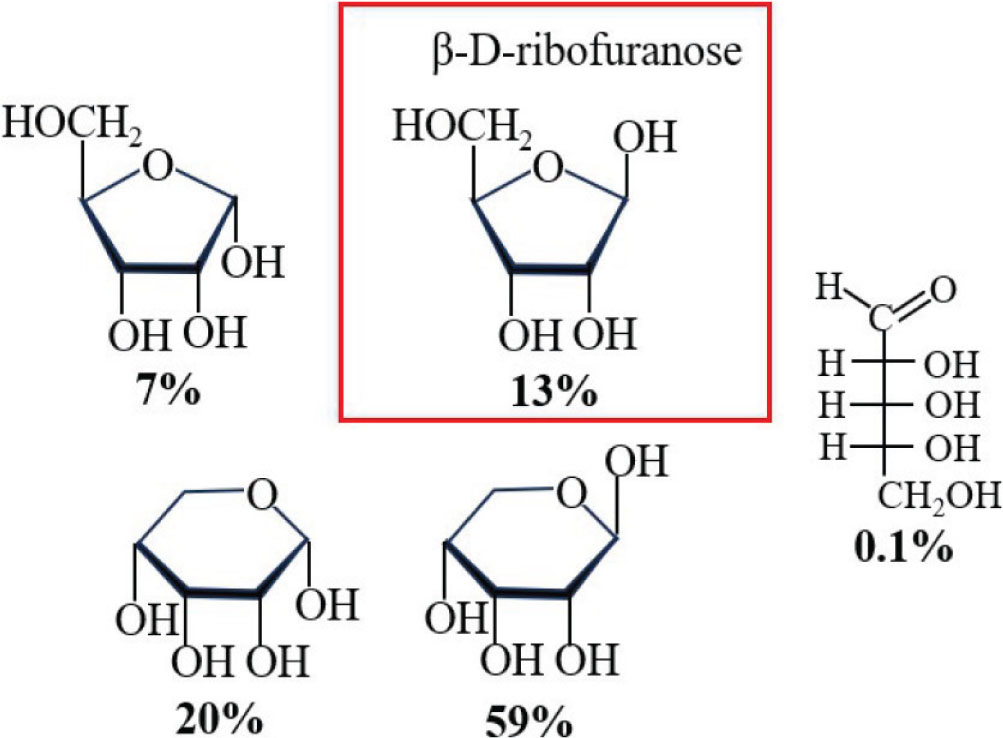
Figure 7.
Proportion of equilibrating soluble isomers of D-ribose (76). Exact proportions are modified by temperature. Framed in red is β-D-ribofuranose, used in RNA.
The minimum number of isomers based on only D-ribose would be:
This assumes ideal stoichiometries, and neglects the additional products having zero to multiple phosphates or bases attached to the same D-ribose. Also, all the cyclic products, including polyphosphates, were also not taken into account. The [N] = 10−10 M proposed and used in Eq. (14) refers to the concentration of only the correct β-D-ribofuranose nucleotide isomer whereas the formose reaction and HCN polymerization would have also produced the competing variants, and of course the L-ribose mirror images. These considerations alone indicate that the effective [N] would be diluted by a factor of at least 100–1000.
The reality is far worse. Every correct nucleotide, activated or not, could react with a β-D-ribofuranose nucleotide whose N-glycosidic bond was hydrolyzed (losing the nucleobase) or with one that has been modified by an environmental contaminant. Therefore, it seems very unlikely that a plausible scenario having [N] > 10−10 M would have existed.
Discussion
Figures 1 and 3 show how nucleotides are assembled and the chemical analysis above suggests that nucleotides could not have accumulated in high concentrations prebiotically.
Ribose decomposes rapidly in water, (32) free reactive phosphate would not have been available, attachment of phosphate to the C5′–OH is endergonic, and the N-glycosidic bond has a high energy of activation and is easily hydrolyzed (66).
Also, the best synthetic routes to ribose require unrealistic concentrations of formaldehyde and produces minuscule yields (26,27,28) (plus a myriad of side-products) and the best routes to nucleobases require unrealistically high concentrations of HCN leading to minuscule yields embedded in polymeric tar (34, 36, 77, 78). Very low temperatures would be required to form nucleobases from HCN, whereas very high temperatures in wet-dry cycles, contradictory conditions that would have prevented accumulation of nucleotides in a single location.
Another inconsistent trade-off is using suitable pH values, such as pH ~2.5 for wet-dry cycles or hydrolysis from polymers, but pH ≥ 10 for the formose reaction.
Realistically, no nucleotide would have been present in prebiotic environments analogous to those used in wet-dry cycle studies (65). The conditions would have required virtually no contaminants, an ideal depositional flat surface, and temperatures raised from around 25°C to ca. 85°C and back down very rapidly. These conditions are incompatible with pure ~10−2 M β-D-ribofuranose nucleotide concentrations used in the experiments. Concentrations of ~10−2 M activated β-D-ribofuranose nucleotides, such as those used in montmorillonite studies, are so implausible that no conclusions from the experiments can be drawn relevant to the RWH.
Evaporation of warm ponds or freshwater environments in the vicinity of volcanoes would have produced a muddy or cement-like mass of chemicals, with nucleotides widely dispersed and immobile at different levels. These would have remained entombed in dry solid material and served no role in the origin of life. Alternatively, subsequent incursion of water would have hydrolyzed the nucleotides.
The elaborate metabolic pathways used in cells to produce nucleotides rely on specific enzymes and have not inspired credible abiotic counterparts. As Yadav et al. (33) diplomatically summarized these attempts,
So far, all attempts to recapitulate the biological pathways for nucleotide synthesis (or other chemistries) have at best produced dubious results.
Doubts about the credibility of synthetic routes to produce RNA precursors is widespread.
Yadav, Kumar, and Krishnamurthy (33) wrote in a recent Chemical Reviews article that,
while many of the chemistries of abiotic nucleotide synthesis are successful inproducing high amounts of the products, the experimental set up is not widelyaccepted as prebiotically realistic in terms of its concentrations, spatial-sequenceseparation and the availability of pure starting materials.
Having concluded that a single RNA tetranucleotide probably had not formed prebiotically before an RNA World would have existed, the claim that the RWH has been established beyond any reasonable doubt seems unjustified (79).
We believe the research community would benefit if experiments would be performed that permit extrapolation to prebiotic conditions. This is discussed in Appendix 3.
RNA as an information carrier
Surprisingly, little attention has been focused on the continual provision of pure β-D-ribofuranose 5′-monophosphate or more frequently, activated 5′-monophosphate in RWH experiments. In solution, (D)-ribose will be present as five equilibrating isomers (Figure 7).
After one nucleobase and one phosphate have attached to a (D)-ribose, two of the four −OH groups remain for each of the ribose isomers. This leads to four possible isomeric dinucleotides.
The lowest number of possible dinucleotide isomers results from two UMP to produce 120 × 120 × 4 = 57,600 isomers, and the highest when linking two GMP to form 300 × 300 × 4 = 360,000 isomers. Converting the monomer into a dimer increases the variety of isomers by about three orders of magnitude. The hyperexponential increase in isomers with RNA chain length will rapidly ‘dilute’ the proportion of correctly linked β-D-ribofuranose oligomers to irrelevant levels. This is why the oligomerization experiments use pure β-D-ribofuranose nucleotides. The multitude of isomeric RNA-like oligomers would prevent useful copies from being replicated.
This reality can be combined with the estimate by Robertson and Joyce that if a replication of A, C, G, and U could be achieved with a fidelity of about 99%, an RNA genome length of about 100 nucleotides would be conceivable (57). However, faithful replication of any of hundreds of potential isomers at each nucleotide position could not have been achieved with 99% fidelity.
One could speculate on the minimal size of an ancestral RNA genome. Large-scale genome surveys show that in ~95%–96% of bacterial genomes the 16S, 23S and 5S rRNA genes are transcribed from a single rrn operon, with only a small fraction showing exclusively unlinked rRNA genes (~3.7%) or mixed arrangements (~0.6%). (80, 81) The primary ribosomal RNA transcript generally has a similar structure (82, 83): leader sequences (~115 nt), 16S rRNA (~1540 nt), (84) internal spacer with tRNA genes, 23 S rRNA (~2900 nt), (82) internal spacer 5S rRNA (~120 nt), (85) trailer sequence (82). The single, long primary transcript is then enzymatically cleaved by RNase III (86,87,88). In model bacteria such as Escherichia coli the full-length primary transcript precursor contains about 5200 nucleotides (80, 82, 88).
Conclusions
The key role played by ribosomal RNAs (rRNAs) in extant cells has been offered as the strongest evidence for the RWH. (1, 50, 57, 89, 90) The use of tRNAs in the genetic code is also claimed to be evidence that supports this hypothesis (1, 2).
Additional RNA would have been required for the full complement of tRNAs, RNA gene regulation; a variety of ribozymes; and an RNA-dependent RNA polymerase (RdRp) to replicate the entire genome (2).
A minimal RNA genome would have required at least 10,000 nucleotides, or less likely, a co-located network of multiple-copy collaborating RNA each having the correct sequences.
Taken together, these considerations suggest that the RWH raises more problems than it resolves.
Appendices
Appendix
Appendix 1. Time RNA and DNA survive fully intact based on half-life of individual nucleotides
Assuming independent first-order (exponential) hydrolysis with constant rate κ, the survival probability of a single bond for time interval t is
A chain of L nucleotides contains L−1 independent internucleotide bonds, so the probability that all bonds remain intact is
The whole-molecule half-life satisfies
Therefore,
leading toSince
Appendix 2. Half-lives of glycosidic bond connecting pentose sugar and nucleobase
In the Arrhenius equation, k = Aexp–(Ea/RT), but the pre-exponential factor (frequency factor) A is generally not known. However, if a reference value for k is known at a different temperature a linear form can be used to calculate k at a different temperature.
andTaking the ratio and rearranging leads to
Useful parameters are available from Stockbridge et al. (18)
The rate constants calculated using Eq. (34) were used to estimate half-lives at pH 7, using the relationship t½ = ln(2)/k, with the results shown in Table 1. The N-glycosidic bond is also catalyzed by both acid and base (18).
Table 1.
Calculated half-lives of the glycosidic bond connecting RNA ribose and nucleobase, at pH 7. Parameters taken from Stockbridge et al. (18).
| Days | Years | ||
|---|---|---|---|
| 25°C | 3.7 × 10⁻¹² s−1 | 2,168,253 | 5,936 |
| 80°C | 5.82 × 10⁻⁹ s−1 | 1379.3 | 3.78 |
| 85°C | 1.02 × 10⁻⁸ s−1 | 790.2 | 2.16 |
| 90°C | 1.75 × 10⁻⁸ s−1 | 459.7 | 1.26 |
| 95°C | 2.96 × 10⁻⁸ s−1 | 271.4 | 0.74 |
| 100°C | 1.40 × 10⁻⁷ s−1 | 162.5 | 0.44 |
In addition, the ribose ring can degrade by opening and then closing to form the anomers α-furanoside, and the α- and β-pyranosides (18).
Appendix 3. Sensitivity analysis of the reported outcomes
Extensive optimization is performed in OoL experiments for practical reasons. Results can be collected faster and products can be obtained in high enough amounts to be characterized.
Also, experiments that produced the target chemicals in only trace amounts are unlikely to be published. However, the published optimizations often rely on prebiotically impossible solvents, reactant purities, concentrations, precise timing, multiple inconsistent conditions, and so on. This leads to non-quantitative disagreements as to the relevance of the studies.
In an extensive review of studies to form nucleotides prebiotically, Yadav et al. emphasized that,
The concentration of reactants, the formation of products in discrete steps, and the need for a specific sequence has been raised as issues that need to be addressed within the context of the early Earth environment, an effort that is ongoing. It must be pointed out that such criticisms are not unique to this work but common to almost all of the synthetic work covered in this review
(33).
Paradoxically, the authors of many of the cited papers explicitly claim their experiments were prebiotically plausible.
Chemists and chemical engineers routinely perform sensitivity analysis to define in-specification product qualities and to design safe manufacturing processes. Now, OoL researchers inevitably test key parameters to optimize yields hoping to increase the likelihood a manuscript will be accepted. It would not be difficult to vary key parameters such as temperature, concentration, duration, purity, proportion of activated nucleotides, etc. to permit extrapolation towards prebiotically credible settings. That would eliminate criticism of having reported absurd conditions.
Prohibitively long experiments to mimic plausible prebiotic conditions are not necessary, only enough data to establish a trend. Some examples are shown in Figure 8 to illustrate how interesting results might actually not be relevant under plausible prebiotic conditions. This would be a valuable service to the reader.
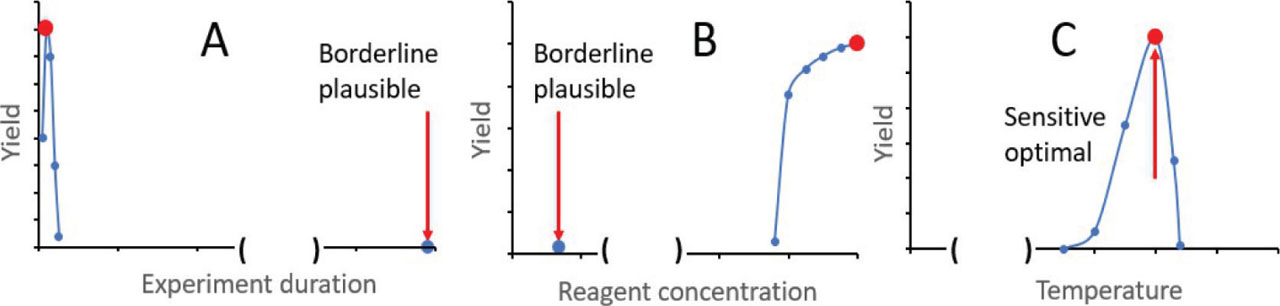
Figure 8.
Possible outcomes of extending a key reaction parameter. (A) Yields rapidly approach zero when continuing the experiment. (B) Yields rapidly approach zero when lowering the concentrations slightly (C) Raising the temperature slightly beyond the optimal value decreases the yield.
Evaluation of the trendlines would be valuable for ‘proof-of-prebiotic-relevance’ purposes.
Here are some experiments which should be carried out in the context of RWH studies.
Repeat the wet-dry cycles 10, 20, and 30 more cycles.
Repeat condensation experiments on Montmorillonite over a range of 0%–100% activated nucleotide.
In oligomerization reactions, mix the nucleotides with different proportions of competing isomers.
In oligomerization reactions vary the pH and temperature. (These will fluctuate naturally in nature. An ideal temperature of 85°C would be accompanied by periods of higher, destructive temperatures).
Vary the reactant concentrations over a range of values.
Place the nucleotides or activated nucleotides at optimal concentrations (e.g. 15 mM) and temperature (e.g. 85°C) in a sealed flask for 1, 2, 5, 10 weeks before performing 3 wet-dry cycles.
Yadav et al. (33) use the expression 'to channel' to describe how chemical outcomes were deliberately guided in all the published experiments they reviewed. For example, they wrote,
Considering all these problems, intensive efforts have been expended in simplifying and ‘cleaning-up’ the classical formose reaction and to channel it toward ribose production.
(Emphasis added)
However, a detailed 2025 13C NMR study provided deep insights into the key equilibrium reactions occurring in the formose reaction. The analysis demonstrated that at best only trace amounts of ribose can form. (92)
Reporting outcomes over a range of parameters would help identify chemical outcomes plausibly resulting naturally vs. only feasible with expert guidance. Yadav, Kumar, and Krishnamurthy have drawn attention to this issue, pointing out that, (33)
To date there has been no single prebiotically plausible experiment that has moved beyond the generation of a mixture of chemical products, infamously called ‘the prebiotic clutter’. And this is particularly evident in the ‘three pillars’ of prebiotic chemistry, the Butlerow's formose reaction, the Miller − Urey spark discharge experiment, and the Oró's HCN polymerization reaction − even though all of them have been (and are being) studied intensively.
The proposed sensitivity analysis would identify which initiatives merit further exploration. Series of experiments could be expertly planned using design of experiments (DOE) methodologies to identify the optimal parameter values to jointly provide maximum information. Datasets based on DOE methodologies are by design ideal to develop predictive equations that can take into account interactive influences between variables.