
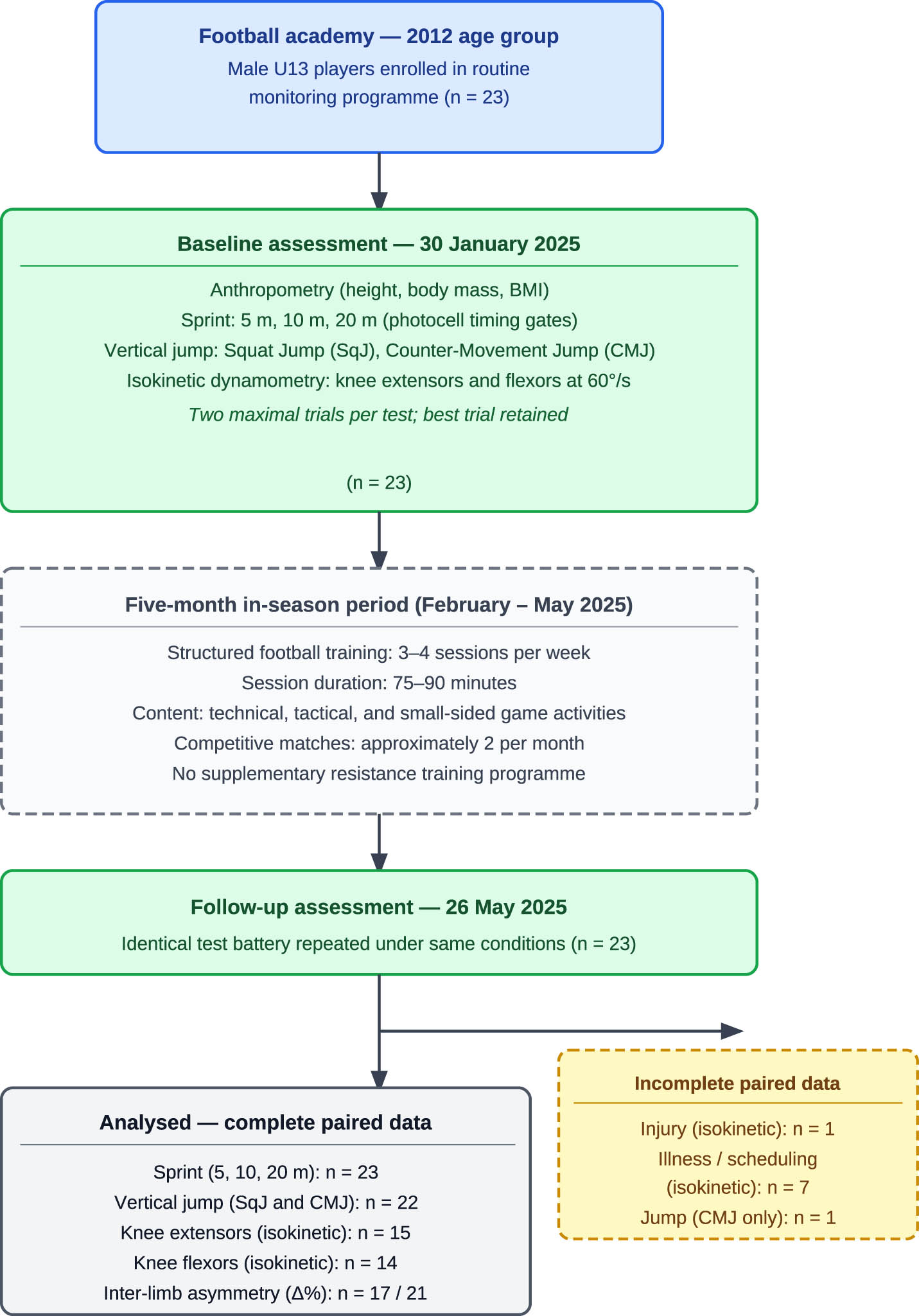
Figure 1
Flow of participants through the study. SqJ, squat jump
Source: Author’s contribution.
Table 1
Sprint times at baseline and follow-up (n = 23)
| Distance (m) | January | May | Δ (s) | t(22) | p | d |
|---|---|---|---|---|---|---|
| 5 | 1.23 ± 0.09 | 1.27 ± 0.09 | +0.033 | 2.27 | 0.034 | 0.47 |
| 10 | 2.06 ± 0.13 | 2.11 ± 0.10 | +0.053 | 2.64 | 0.015 | 0.55 |
| 20 | 3.57 ± 0.12 | 3.56 ± 0.13 | −0.008 | −0.39 | 0.697 | −0.08 |
Notes: Values are means ± standard deviations of two trials. Δ, mean change (positive values indicate slower times); d, Cohen’s d. Significance was set at p < 0.05.
Source: Author’s contribution.
Table 2
Vertical jump performance at baseline and follow-up (n = 22)
| Variable (cm) | January | May | Δ (cm) | t(21) | p | d |
|---|---|---|---|---|---|---|
| SqJ | 26.9 ± 4.4 | 27.9 ± 4.6 | +1.02 | 2.11 | 0.047 | 0.45 |
| CMJ | 27.6 ± 4.1 | 28.5 ± 4.0 | +0.92 | 2.24 | 0.036 | 0.48 |
Notes: Values are the best of two trials. d, Cohen’s d; SqJ, squat jump. One player was unable to perform jump testing at either timepoint owing to injury (Figure 1). Significance was set at p < 0.05.
Source: Author’s contribution.
Table 3
Isokinetic peak force and inter-limb asymmetry at 60°/s
| Knee extension (n = 15) | January | May |
|---|---|---|
| Peak force, stronger limb (kg) | 26.3 ± 6.0 | 23.9 ± 5.2 |
| Asymmetry, M ± SD (%) | 14.7 ± 13.1 | 9.4 ± 6.4 |
| Asymmetry, median (range) (%) | 11.0 (0.4–49.4) | 7.8 (1.4–26.3) |
| Players >10% | 9 (60%) | 5 (33%) |
| Players >15% | 5 (33%) | 2 (13%) |
| Players >20% | 4 (27%) | 1 (7%) |
| Knee flexion (n = 14) | January | May |
|---|---|---|
| Peak force, stronger limb (kg) | 13.5 ± 2.6 | 18.2 ± 8.1 |
| Asymmetry, M ± SD (%) | 7.1 ± 5.6 | 13.5 ± 13.3 |
| Asymmetry, median (range) (%) | 6.8 (0.0–16.7) | 11.4 (2.0–54.4) |
| Players >10% | 4 (29%) | 8 (57%) |
| Players >15% | 2 (14%) | 5 (36%) |
| Players >20% | 0 (0%) | 1 (7%) |
Notes: M, mean; SD, standard deviation. Asymmetry = (stronger limb − weaker limb)/stronger limb × 100. Sample sizes differ between exercises owing to incomplete paired data (Figure 1). Absolute peak force values from the two exercises are not directly comparable owing to differences in machine set-up and effective lever arm; between-exercise comparisons were therefore not performed.
Source: Author’s contribution.