
1. Introduction
Metabolic syndrome (MS) refers to the cluster of various metabolic risk factors, and it is an increasing health issue worldwide (Batista & Soares, 2013; Kassi et al., 2011). For example, available literature emphasized that the prevalence of MS was 19.5% among individuals aged between 19 and 40 years old, as well as approximately 50% in persons aged at least 60 years in the United States (Hirode & Wong, 2020). Insulin resistance (IR) represents an impaired function of insulin hormone that elicits a decrease in glucose absorption by the skeletal muscles, greater hepatic production of glucose, and increased lipolysis in the adipose tissue (Gastaldelli, 2022). A robust body of scientific evidence indicates that the presence of MS was associated with a higher incidence of different cardiovascular diseases, including coronary heart diseases, stroke (Galassi et al., 2006), and atherosclerosis (Bonora, 2006). Analogously, the link between IR and the risk of occurrence of cardiovascular diseases (Gonzalez-Chávez et al., 2018) and diabetes type 2 (Reaven, 2011) has also been demonstrated.
The phenomenon of rapid weight loss (RWL) among combat sports athletes (CSA) refers to losing approximately 5% of body weight less than 1 week before competition (Khodaee et al., 2015). The prevalence and methodology referring to the RWL have been extensively examined (Artioli et al., 2010; Drid et al., 2021; Roklicer et al., 2022; Štangar et al., 2022; Zhong et al., 2024). Namely, the existing body of evidence unequivocally indicated that an indeed high percentage of CSA practiced weight reduction procedures. For instance, the relevant literature revealed that 87% of elite sambo athletes (Drid et al., 2021) and even 96% of high-level judokas (Štangar et al., 2022) underwent the RWL procedure before competitions. Moreover, the Olympic-style wrestlers reported that the most commonly employed methods with respect to the RWL were increased exercise, gradual dieting, training in a heated room, and sauna (Roklicer et al., 2022). Additionally, the acute body weight loss was also related to the various health outcomes of CSA. More specifically, robust scientific evidence demonstrated that RWL induced significant muscle damage in judokas (Roklicer et al., 2020) and wrestlers (Lukic-Sarkanovic et al., 2024).
Numerous investigations comprehensively addressed the parameters referred to the metabolic health among retired athletes (Batty et al., 2024; Chang et al., 2009; Laine et al., 2016; Panayiotoglou et al., 2017; Sisk et al., 2024; Street et al., 2023; Thornton et al., 2023; Unt et al., 2008). Collectively, the obtained results emphasized that former athletes had more favorable overall metabolic health compared with the control group (CG). For example, substantially lower levels of systolic blood pressure and total cholesterol were observed among former elite rowers and rugby athletes compared with the general population (Thornton et al., 2023). Most importantly, although the retired athletes had more favorable metabolic health relative to the matched controls, it is crucial to highlight that the prevalence of MS and overweight and obesity were indeed pronounced among the mentioned population. More precisely, the relevant body of knowledge indicated that 33.3 and 58.3% of former soccer players aged 46.7 years had MS as well as overweight and obesity, respectively (Panayiotoglou et al., 2017). However, taking into account the index pertaining to the values of triglycerides and glucose, the former soccer players had lower levels of IR relative to the matched sedentary controls (Panayiotoglou et al., 2017).
The available scientific evidence referring to the MS and IR among former elite middle-aged CSA is fairly limited. Moreover, the role of RWL with respect to the overall metabolic health, particularly including the IR, of the middle-aged retired CSA has not yet been comprehensively determined. In addition, exploring the relevant metabolic outcomes in the population of former CSA should provide novel and valuable health, as well as practical insights. Therefore, the objective of the current study is to determine the MS and IR among the population of former CSA who practiced RWL during their careers compared with the CG. It was hypothesized that the MS variables and IR would be more pronounced among retired CSA compared to the controls without a history of acute body weight reduction.
2. Materials and methods
2.1. Study design and participant’s recruitment
The current retrospective case–control study was conducted in December 2024 at the Provincial Institute for Sports and Sports Medicine, Novi Sad, Serbia. The following inclusion criteria have been applied: (1) participants were former CSA; (2) males aged between 40 and 65 years old (middle-aged adults) were taken into account; (3) RWL was implemented during the competitive careers of athletes. Regarding the mentioned phenomenon, only athletes who practiced weight loss procedures at least three times per year, losing approximately 5% of their body weight during their careers, were considered suitable for inclusion. RWL patterns of CSA were estimated using a questionnaire referring to the history of acute body weight reduction, and (4) elite competitive level was observed among retired CSA. Age and level of play matched male former athletes in a CG did not compete in combat sports and were without a history of RWL. A written informed consent for participation in the current study was obtained from the retired athletes in both groups. Ethical approval was provided by the Faculty of Sport and Physical Education, University of Novi Sad, Serbia (Ref. No. 49–10-02–2023-1), and the investigation was carried out consistently with all aspects of the Declaration of Helsinki.
Sample size calculation was performed with the software G*Power version 3.9.1.4. The effect size of 0.60, alpha level of 0.05, and power of 0.80 indicated that a minimum of 104 respondents was necessary to reveal the differences between involved groups with respect to the overall metabolic health outcomes.
2.2. Measurements
2.2.1. Anthropometric characteristics and blood pressure
Body height and body weight were measured without the shoes and to the nearest 0.1 cm, implementing a 202 stadiometer (Seca, Germany) and a Seca 761 scale (Seca, Germany), respectively. Body mass index was calculated as a ratio of body weight and squared values of body height (kg/m²). The evaluation of waist circumference was conducted to the nearest 0.1 cm in a standing relaxed position midway between the lower edge of the rib cage and spine iliac anterior superior, using the nonstretching anthropometric tape. Blood pressure was recorded following at least 5 min of rest in a seating position with a sphygmomanometer (Riester Diplomat, Jungingen, Germany) from the participant’s right arm, taking into account a cuff size of 14.5 cm × 54.5 cm. The mentioned parameter was measured two times, with a period of rest of 1 min, and the average score for each respondent was presented in the study.
2.2.2. Blood parameters analysis
All blood parameters were addressed in the morning after an overnight fasting of 12 h. Blood samples were gathered in a special tube without anticoagulant to provide a serum. Each assessed blood sample was centrifuged at 1,300 × g for 15 min. Serum samples were stored at −80°C for all subsequent analyses. The blood variables included fasting glucose, fasting insulin, and outcomes related to the lipids. Lipid parameters refer to total cholesterol, high-density lipoprotein (HDL) cholesterol, low-density lipoprotein (LDL) cholesterol, and triglycerides. Fasting glucose and lipid outcomes were analyzed with the Architect c8000 Clinical Chemistry AutoAnalyzer device (Abbott Laboratories, USA) by enzymatic colorimetric methodology, as suggested by the manufacturers. The DANA device (model: DA3200) with the Monobind sandwich ELISA test kit (Monobind Inc., USA) was employed regarding the evaluation of fasting insulin. The precision of the assays was analyzed with the intra- and interassay coefficients of variation. In addition, homeostatic model assessment of insulin resistance (HOMA-IR) was also calculated using the following formula: fasting insulin (μIU/mL) × fasting glucose (mg/dL)/405.
2.2.3. Lifestyle variables
The physical activity levels of the examined population were estimated using the long form of the International Physical Activity Questionnaire (IPAQ). The validity and reliability of the XX of the highlighted measuring tool have already been demonstrated (Milanović et al., 2014). The outcomes of physical exercise pertained to walking, time spent in moderate and vigorous physical activity, as well as sedentary behavior. The overall level of physical engagement was assessed, taking into account only the aspects of the mentioned questionnaire pertaining to the “recreation, sport, and leisure time physical activity” as well as the “time spent in a sitting position.” Regarding the evaluation of the other relevant lifestyle parameters, including smoking and alcohol, the analyzed population answered the two available questions (Do you smoke cigarettes? and Do you occasionally drink alcohol?) with “Yes” or “No.”
2.2.4. Oral glucose tolerance test
An oral administration of 75 g of glucose with 300 ml of pure water was carried out following 12 h of overnight fasting. In addition, athletes were required to maintain their common level of physical activity for at least 3 days before the implementation of the oral glucose tolerance test (OGTT) (Bartoli et al., 2011). Two relevant outcomes were estimated before and after the test, including fasting insulin and fasting glucose. All respondents were completely relaxed, without smoking and eating, during the period of 2 h before the final measurement of the mentioned parameters. The greater values of fasting insulin after OGTT indicated higher levels of IR. The range of fasting plasma glucose between 140 and 199 mg/dL following the applied test indicated impaired glucose tolerance, while the values between 100 and 125 mg/dL were defined as impaired fasting glycemia. All relevant assessments, such as anthropometric characteristics, blood pressure, blood analysis, lifestyle parameters, and OGTT, were carried out by experienced researchers and medical practitioners.
2.2.5. Definitions of MS and overweight and obesity
The MS was defined in line with the statement of the International Diabetes Federation and the American Heart Association/National Heart, Lung, and Blood Institute (Grundy et al., 2005). More precisely, the presence of MS was recorded if cut-off values in three of five parameters were exceeded. The thresholds for the mentioned variables were as follows: abdominal obesity (waist circumference > 102 cm in males); hyperglycemia (fasting blood glucose ≥ 100 mg/dL or current use of insulin or oral hypoglycemic drugs); hypertriglyceridemia (triglycerides ≥ 150 mg/dL); low HDL cholesterol (HDL < 40 mg/dL in males); and high blood pressure (systolic/diastolic blood pressure ≥ 130/85 mmHg) or regular use of antihypertensive drugs. Obesity was determined according to the recorded values of body mass index (kg/m²). The body mass index between 25 and 29.9 kg/m² indicated overweight, while the values ≥30 kg/m² represented obesity (WHO, 2000).
2.2.6. Statistical analysis
Data processing was performed using statistical software SPSS version 30.0 (Statistical Package for Social Sciences, IBM Statistics, Armonk, NY, USA). Taking into account the overall number of involved respondents, the normality of distribution was verified with the Kolmogorov–Smirnov test. The nonparametric Mann–Whitney U test examined differences between groups with respect to demographic characteristics, physical activity variables, metabolic health parameters, and IR. Differences between baseline and final measurements for both independent groups regarding the fasting insulin and fasting glucose were determined with the Wilcoxon Signed–Rank test. The rank-biserial correlation (r) was computed as an effect size measure with respect to the mentioned nonparametric tests and interpreted as small, medium, and large for values 0.10, 0.30, and 0.50, respectively (Cohen, 1992). Differences between groups concerning the presence of the MS, as well as overweight and obesity, were examined using adjusted binary logistic regression analysis, with age as a covariate variable. Odds ratio (OR) with the corresponding 95% confidence interval (CI) was applied as a parameter of the effect estimate, and considered small (1.68), medium (3.47), and large (6.71), as suggested by the literature (Chen et al., 2010). Smoking and alcohol use among the included groups were explored with the Chi-squared test. Demographic parameters, physical activity, MS outcomes, and IR were expressed as mean and standard deviation. Frequencies and percentages (%) were reported for the type of sports, smoking, and alcohol, as well as for the prevalence of MS, and overweight and obesity. Differences concerning all assessed variables between former CSA and CG without a history of RWL were considered statistically significant if the P value was <0.05.
3. Results
A total of 108 respondents fulfilled all previously highlighted eligibility criteria and were included in the present study. There were 56 former elite CSA and 52 age- and competitive-level-matched male controls. Athletes with a history of implementation of RWL most commonly competed in judo (25%), sambo (22%), karate (21%), and box (14%), while more than half of respondents in a CG participated in soccer (63%) (Table 1). CSA were shorter (p = 0.005) and had higher values of body mass index (p = 0.001) relative to the respondents who have not practiced weight loss reduction during their careers. No between-group differences were revealed with respect to the other demographic parameters and all lifestyle outcomes (Table 2).
Table 1
All included sports in both groups of former elite athletes
| Groups and types of sports | Frequencies (%) of athletes |
|---|---|
| RWL group | 56 (52) |
| Box | 8 (14) |
| Jiu-Jitsu | 4 (7) |
| Judo | 14 (25) |
| Karate | 12 (21) |
| Kickboxing | 5 (9) |
| Sambo | 12 (22) |
| Taekwondo | 1 (2) |
| Control group | 52 (48) |
| Athletics | 8 (15) |
| Mountain climbing | 5 (10) |
| Rowing | 4 (8) |
| Soccer | 33 (63) |
| Swimming | 2 (4) |
Note: RWL = rapid weight loss.
Source: Authors’ contribution.
Table 2
Demographic and lifestyle parameters of the analyzed groups
| Variables | RWL group | Control group | P value |
|---|---|---|---|
| Age (years) | 51.93 ± 7.80 | 51.12 ± 7.36 | 0.504 |
| Body height (cm) | 176.77 ± 6.31 | 180.37 ± 7.14 | 0.005 |
| Body weight (kg) | 92.11 ± 15.68 | 88.66 ± 13.43 | 0.290 |
| Body mass index (kg/m²) | 29.39 ± 4.23 | 27.11 ± 3.67 | 0.001 |
| Walking (min) | 239.57 ± 315.43 | 288.92 ± 456.92 | 0.816 |
| Moderate physical activity (min) | 179.25 ± 385.83 | 215.31 ± 558.00 | 0.411 |
| Vigorous physical activity (min) | 110.25 ± 164.88 | 123.92 ± 246.29 | 0.728 |
| Sedentary behavior (min) | 1476.43 ± 950.30 | 1832.31 ± 1414.20 | 0.279 |
| Alcohol, n (%) | 23 (41%) | 31 (60%) | 0.054 |
| Smoking, n (%) | 5 (9%) | 5 (10%) | 0.902 |
Note: RWL = rapid weight loss. Bolded P value indicates statistically significant differences between groups.
Source: Authors’ contribution.
Statistically significant differences between included groups were observed for several MS outcomes, indicating that CSA who were subjected to the RWL during their careers had greater levels of systolic blood pressure (r = −0.42, p < 0.001), diastolic blood pressure (r = −0.42, p < 0.001), and triglycerides (r = −0.28, p = 0.004) relative to the CG. A tendency toward statistically significant differences was observed regarding the glucose variable (r = −0.19, p = 0.053) and HOMA-IR (r = −0.17, p = 0.081) in favor of the former CSA. Higher values of total cholesterol (r = −0.25, p = 0.011) were recorded among the respondents with a history of acute body weight reduction compared with the matched controls. There were no differences between groups concerning the other parameters related to the MS as well as LDL cholesterol. No between-group differences were also noted with respect to the levels of fasting insulin (Table 3).
Table 3
Differences between groups regarding metabolic health outcomes
| Outcome measures | RWL group | Control group | Mean differences (95% CI) | Z values | r | P value |
|---|---|---|---|---|---|---|
| Waist circumference (cm) | 104.84± 7.96 | 103.62± 7.04 | 1.22 (−1.65, 4.10) | −0.86 | −0.08 | 0.391 |
| Fasting glucose (mg/dL) | 103.87 ± 25.19 | 95.33 ± 15.21 | 8.55 (0.67, 16.44) | −1.94 | −0.19 | 0.053 |
| Systolic blood pressure (mm/Hg) | 130.20 ± 9.98 | 124.96 ± 12.89 | 5.24 (0.81, 9.67) | −4.37 | −0.42 | <0.001 |
| Diastolic blood pressure (mm/Hg) | 84.73 ± 10.42 | 76.79 ± 7.94 | 7.94 (4.42, 11.46) | −4.38 | −0.42 | <0.001 |
| HDL cholesterol (mg/dL) | 23.12 ± 5.36 | 22.54 ± 4.31 | 0.58 (−1.28, 2.45) | −0.54 | −0.05 | 0.588 |
| Triglycerides (mg/dL) | 34.15 ± 18.77 | 25.16 ± 13.25 | 8.99 (2.75, 15.23) | −2.88 | −0.28 | 0.004 |
| LDL cholesterol (mg/dL) | 61.70 ± 16.29 | 59.34 ± 15.27 | 2.36 (−3.67, 8.40) | −1.51 | −0.15 | 0.132 |
| Total cholesterol (mg/dL) | 100.41 ± 15.67 | 93.92 ± 17.75 | 6.49 (0.11, 12.87) | −2.55 | −0.25 | 0.011 |
| Fasting insulin (μIU/mL) | 12.58 ± 10.27 | 9.43 ± 6.03 | 3.14 (−0.05, 6.34) | −1.46 | −0.14 | 0.144 |
| HOMA-IR | 3.54 ± 3.83 | 2.28 ± 1.58 | 1.26 (0.15, 2.37) | −1.75 | −0.17 | 0.081 |
Note: HDL = high-density lipoprotein; HOMA-IR = homeostatic model assessment of insulin resistance; LDL = low-density lipoprotein; RWL = rapid weight loss. Bolded P value indicates statistically significant differences between groups.
Source: Authors’ contribution.
Evaluation of IR and glucose tolerance following OGTT is emphasized in Table 4. Regarding the fasting insulin, significantly higher values in the mentioned variable were observed in both groups at the final relative to the baseline assessment; however, a greater increase was revealed for the group that consists of former CSA (mean differences (MD) = −54.76 [95% CI −71.20, 38.33] vs. MD = −33.81 [95% CI −42.12, −25.50], respectively). Athletes with a history of body weight reduction had superior values of fasting insulin after OGTT compared with the CG (p = 0.026). The level of blood glucose significantly increased following an implemented intervention compared with the baseline measurement in the former CSA (r = 0.30, p = 0.002). However, there were no differences between initial and final testing for the mentioned parameters in the CG. Statistically significant differences between groups were observed at the final measurement in favor of the athletes with a history of RWL (p = 0.023).
Table 4
The levels of fasting insulin and fasting glucose before and after OGTT for both groups
| Groups | Outcome measures | |
|---|---|---|
| RWL group | Fasting insulin | Fasting glucose |
| Baseline | 12.58 ± 10.27 | 103.89 ± 25.19 |
| Final | 67.34 ± 65.58 | 120.92 ± 52.10 |
| Mean differences (95% CI) | −54.76 (−71.20, 38.33)*** | 36.54 (−26.82, −7.25)** |
| Z values | −6.49 | −3.06 |
| r | −0.61 | 0.30 |
| Control group | ||
| Baseline | 9.43 ± 6.03 | 95.33 ± 15.21 |
| Final | 43.25 ± 30.86 | 96.96 ± 30.73 |
| Mean differences (95% CI) | −33.81 (−42.12, −25.50)*** | −1.63 (−9.05, 5.79) |
| Z values | −6.19 | −0.22 |
| r | −0.61 | 0.02 |
| Between-group differences | ||
| P value | 0.026 # | 0.023 # |
Note: OGTT = oral glucose tolerance test; RWL = rapid weight loss. ***Statistically significant differences between baseline and final measurement, p < 0.001 (Wilcoxon test). **Statistically significant differences between baseline and final measurement, p < 0.01 (Wilcoxon test). #Statistically significant differences between included groups at the final measurement (Mann–Whiteny U test). Bolded P value indicates statistically significant differences between groups.
Source: Authors’ contribution.
A substantially higher odds of having a MS were observed among former CSA compared with the participants without a history of acute weight reduction (68 vs. 19%, respectively, OR = 9.49 [95% CI 3.76, 23.95], p < 0.001). Likewise, the former CSA had substantially greater odds of the presence of overweight and obesity compared with the athletes in a CG (95 vs. 73%, respectively, OR = 6.45 [95% CI 1.72, 24.02], p = 0.006). Differences between the analyzed groups referring to the prevalence of emphasized outcomes are demonstrated in Figure 1.
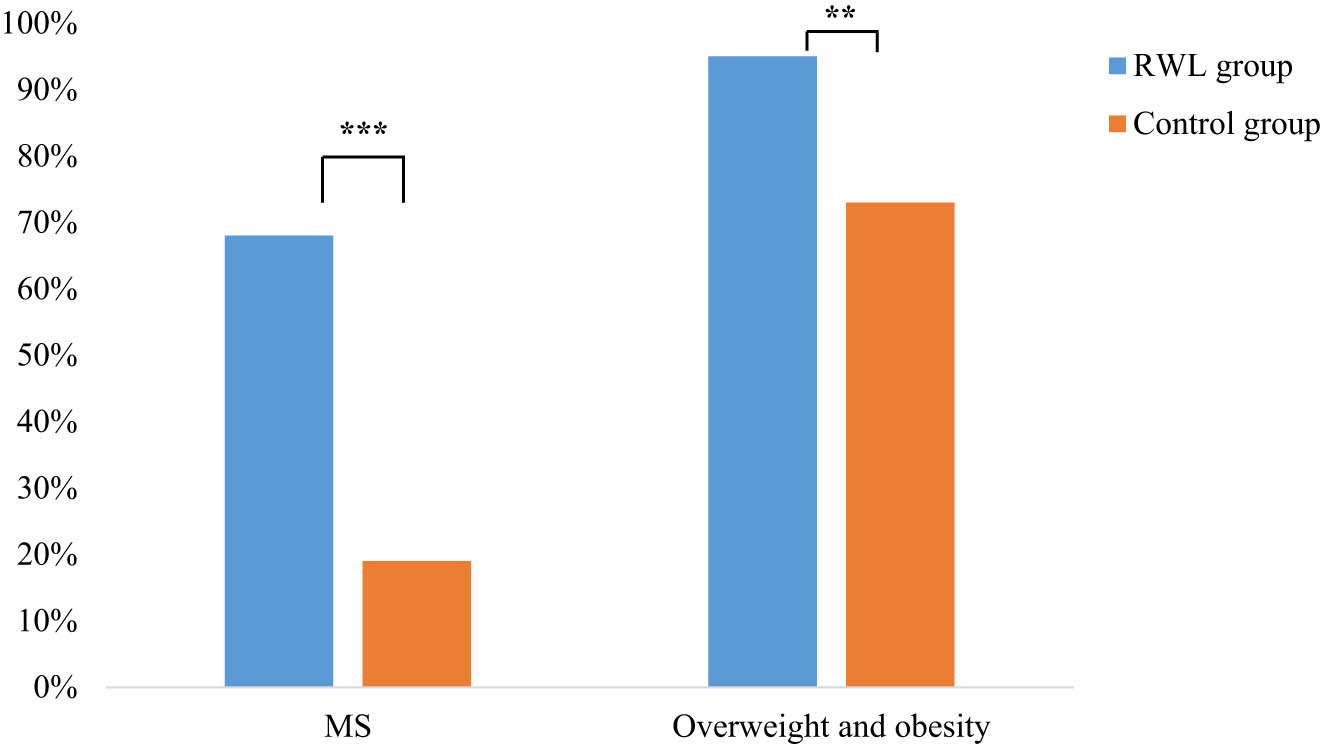
Figure 1
Prevalence of MS and overweight and obesity among athletes with a history of RWL and matched male controls. MS = metabolic syndrome; RWL = rapid weight loss. ***Statistically significant differences between groups, p < 0.001. **Statistically significant differences between groups, p < 0.01. Adjusted binary logistic regression analysis has been applied, using a variable age as a covariate
Source: Authors’ contribution.
4. Discussion
4.1. Principal findings
The goal of the present study was to determine the differences in metabolic health outcomes and IR between former elite CSA who practiced RWL and the matched CG. Consistent with the hypothesis, the most relevant findings emphasized that parameters of MS and the fasting insulin levels were significantly higher among former CSA compared to the group without a history of body weight reduction during their careers. More specifically, greater values of systolic blood pressure, diastolic blood pressure, triglycerides, and total cholesterol were revealed among athletes who competed in various combat sports relative to the CG. Moreover, the obtained results of the OGTT unambiguously indicated that athletes who implemented acute weight reduction during their careers had more pronounced levels of IR and impaired glucose tolerance than the former elite athletes who did not compete in combat sports. Finally, the current study provided quite compelling evidence that the odds of having MS and being overweight and obese were substantially higher among CSA compared to the controls.
4.2. Comparison with the existing evidence and interpretation of the obtained results
To date, to the best of the author’s knowledge, there is only one relevant investigation that evaluated the parameters referring to the MS among former middle-aged and older CSA (Maksimovic et al., 2024). More precisely, the findings of the existing literature are consistent with the evidence emphasized in the present study, indicating that higher levels of MS variables were recorded among former elite CSA compared to the matched male controls. Most importantly, this case–control study took into account exclusively middle-aged respondents and revealed that IR was also more pronounced among athletes with a history of RWL relative to the CG, substantially extending and deepening the available body of knowledge and the overall evidence pertaining to the addressed topic. Additionally, the metabolic health outcomes and IR were also examined in the context of de-training among young taekwondo athletes (Sung et al., 2017). The obtained results revealed that the absence of physical activity was negatively associated with the lipid profile and increased the IR of the analyzed population, supporting the findings of the present study. Further, the outcomes pertaining to metabolic health have also been comprehensively explored among former power athletes (Emami et al., 2018). The authors emphasized that retirement from the sport was responsible for detrimental changes regarding obesity and systolic blood pressure. Moreover, the findings with respect to the IR are also in agreement with the current study, highlighting an apparent presence of the increased values of the mentioned outcome measured with the HOMA-IR. On the other hand, it is also crucial to emphasize that the available body of evidence concerning RWL and overall metabolic health among current CSA is quite scarce. However, a narrative review provided preliminary evidence regarding the potential negative aspects of the implementation of weight cycling, which consists of weight reduction and weight regain, in the context of the MS parameters and IR in active CSA (Lebron et al., 2024). In addition, RWL was also inversely associated with numerous relevant health outcomes of current CSA, such as cardiac biomarkers (Milovančev et al., 2024) and kidney function (Lakicevic et al., 2021; Trivic et al., 2023). Overall, this investigation provided convincing evidence that RWL negatively correlated with the overall metabolic health of the former CSA, including MS and IR, as assessed based on the levels of fasting insulin and glucose following OGTT. In addition, although a tendency toward the differences between groups was observed for the HOMA-IR variable, only average results of former CSA were higher than the established cut-off values of 2.5 (Minh et al., 2021), indicating an apparent presence of the IR, and consequently, a need for preventive strategies during their careers, as well as lifestyle modifications following retirement.
Indeed, there is ample body of scientific evidence with respect to the prevalence of MS and overweight and obesity among former athletes (Altowerqi & Zainuddin, 2021; Altowerqi et al., 2020; Batista & Soares, 2013; Miller et al., 2008). Still, the findings of the existing literature are contradictory with the revealed percentage of MS among retired CSA with a history of body weight reduction. Specifically, the available body of knowledge highlighted that the prevalence of the emphasized outcome in retired athletes was between 13% (Batista & Soares, 2013) and 39% (Altowerqi & Zainuddin, 2021), which is substantially lower compared with the recorded 68% among former CSA of the current study. Analogously, the presence of overweight and obesity was significantly higher in retired CSA relative to the obtained results of the relevant studies referring to former athletes without a history of RWL during their careers. Namely, a total of 94% of the retired CSA included in this study were overweight and obese, while available literature indicated 58% (Altowerqi & Zainuddin, 2021) and even 70% (Altowerqi et al., 2020) of the incidence of the mentioned parameter among former athletes. In summary, the findings referring to the prevalence of MS as well as overweight and obesity also highlighted explicit and long-term consequences associated with the RWL procedure among the examined population. Therefore, the CSA and their coaches should comprehensively consider the implementation of various preventive strategies with respect to acute body weight reduction. For instance, the current CSA can potentially apply RWL less frequently during the competitive years and particularly to reduce the percentage of their body weight lost to avoid an emphasized impairment of their health status. Additionally, the alternative solution should be a complete elimination of RWL practice among CSA. The education of combat sports coaches and athletes in terms of the mentioned considerations and the overall inverse association between RWL and metabolic health outcomes and IR after careers is highly recommended in the future.
4.3. Health implications of the study
As already highlighted, there is convincing evidence that the presence of MS and IR correlated with several health outcomes, such as the risk of cardiovascular diseases. Hence, it is apparent that various lifestyle interventions are highly warranted for the population of former elite CSA. Namely, numerous studies indicated that physical activity engagement positively correlated with overall health, especially metabolic outcomes, among retired athletes (Batista & Soares, 2013; Majerczak et al., 2019; Pihl et al., 2003). More specifically, fulfilling the guidelines referring to the engagement in 150 min of moderate-to-vigorous physical activity per week reduced the likelihood of the occurrence of MS among former elite athletes who competed in various sports, such as gymnastics, volleyball, soccer, basketball, swimming, etc. (Batista & Soares, 2013). Most importantly, several investigations indicated that aerobic exercise was effective regarding the improvements in MS and IR among former athletes (Chen et al., 2009; Majerczak et al., 2019). Therefore, exercise specialists should try to stimulate engagement in the mentioned type of physical activity of the examined population to potentially improve overall metabolic health. Additionally, adequate nutrition as well as a reduction of consumption of alcohol and smoking should also be taken into account. In other words, a combination of appropriate lifestyles, including the implementation of recommended types and levels of physical activity and desirable nutritional habits with the absence of alcohol and smoking, is indispensable, particularly for the former CSA in which the MS and IR were recorded. Overall, the cooperation between medical workers and exercise specialists appears necessary with respect to the recommended lifestyle patterns to modify and enhance the evaluated MS outcomes and IR, consequently avoiding the potential occurrence of cardiovascular diseases among the population of former CSA.
4.4. Strengths, limitations, and future directions
This investigation has numerous strengths that are indispensable to be highlighted and extensively analyzed. The examined population consisted exclusively of former athletes who competed at the highest level during their careers. Additionally, various types of combat sports were observed, potentially enhancing the generalization of the most relevant findings. However, future studies should take into account additional former elite CSA who were subjected to the RWL during their careers, such as wrestlers and mixed martial arts fighters. Most importantly, this is the first-ever investigation that addressed metabolic health outcomes among former middle-aged CSA, particularly including the phenomenon of IR. Consequently, the practical relevance is comprehensively emphasized, especially for the exercise specialists and medical workers, as well as crucial health implications with respect to the high-risk population, such as former athletes with the presence of MS and IR.
There are several apparent limitations referring to the present study that should be taken into account regarding the interpretation of the overall findings. Namely, the retrospective analysis of differences in the analyzed outcomes between former CSA and participants without a history of weight loss reduction was conducted. Therefore, more prospective studies are highly recommended in the future. The current investigations included exclusively males; hence, studies evaluating former female CSA are indispensable in the future. Moreover, examining sex differences in the addressed metabolic outcomes among former CSA with a history of RWL represents a valuable future direction. It should also be noted that a group of nonathletic population was not observed. Further, certain restrictions referring to the implemented measuring tools should be highlighted. The fact is that the phenomenon of obesity was determined by the body mass index. Consequently, the obtained results for the mentioned parameter should be carefully interpreted and more thoroughly examined in the future. In other words, more valid measuring instruments, such as dual-energy X-ray absorptiometry, with respect to the analysis of the overall body composition of the examined population, should be employed in the future. Moreover, the modality of the evaluation of the exposure variable can be considered controversial, due to the lack of clear validation of the applied self-reported questionnaire. Thus, the emphasized methodological constraint, as well as the more detailed analysis of the history of RWL of the population of the former CSA, should be addressed in the future. In addition, the physical activity engagement was assessed subjectively, with IPAQ. Most importantly, objective quantification of the mentioned parameters using accelerometers should be carried out, potentially providing a more robust and comprehensive understanding of the relationship between the level of physical activity, MS, and IR of the analyzed population.
5. Conclusion
The most relevant findings of the current study suggest that RWL was associated with the presence of MS and IR among former elite middle-aged CSA. Moreover, the substantially greater odds regarding the presence of MS and overweight and obesity were revealed among athletes who practiced RWL during their careers relative to the CG. Due to the highlighted relationship between impaired overall metabolic parameters and numerous health outcomes, particularly the risk of the occurrence of cardiovascular diseases, lifestyle modifications, including engagement in aerobic exercise, are highly recommended for the analyzed population. At least, examining the variables related to the MS and IR among former elite female CSA with a history of acute body weight reduction is a valuable future direction.
Acknowledgments
The authors are grateful to all subjects for their participation in the study.
Funding information
This investigation was funded by the Provincial Secretariat for Higher Education and Scientific Research, grant number 142-451-3098.
Author contributions
Nemanja Maksimovic and Patrik Drid were responsible for the conceptualization and writing of the manuscript. Marko Manojlovic and Nemanja Lakicevic contributed to the methodological aspects, including the data processing. Tatjana Trivic, Yerlan Seisenbekov, and Antonino Bianco were included in the interpretation of the results, drawing conclusions, and revision of the study. All authors read and approved the final version of the manuscript.
Conflict of interest statement
The authors state no conflict of interest
Data availability statement
The datasets used and/or analyzed during the current study are available from the corresponding author upon reasonable request.