
1. Introduction
Volleyball spiking and serving impose high, phase-specific activation demands on the shoulder musculature, evidencing substantial repetitive loading of the glenohumeral complex (Rokito et al., 1998). Across volleyball, shoulder overuse comprises a substantial fraction of all overuse problems, with estimates ranging from ∼16 to 32% depending on cohort and methodology (Wolfe et al., 2019). Contemporary epidemiology also indicates that overuse accounts for more than one-third of all injuries in volleyball, with the shoulder among the most affected regions (Young et al., 2023).
Modifiable risk factors include external rotator (ER) weakness and an unfavorable external/internal rotation (ER/IR) strength balance, with an ER/IR ratio below ∼0.75 frequently implicated in overuse pathology (Intelangelo et al., 2025). Sport-specific adaptations such as glenohumeral internal rotation deficit (GIRD) are prevalent in volleyball and may differ between athletes with and without shoulder pain, underscoring the need to differentiate physiological from pathological patterns (Alqarni et al., 2024). Adolescent volleyball players likewise demonstrate sex-specific asymmetries and a notable prevalence of GIRD, highlighting that these adaptations emerge early in the athletic pathway (Mizoguchi et al., 2022).
Meta-analysis suggests athletes with scapular dyskinesis face a higher risk of future shoulder pain compared with those without dyskinesis, linking scapular control to symptom development (Hickey et al., 2018). Kinematic determinants such as ball-impact position during the spike alter shoulder girdle activation patterns and may therefore modify mechanical load exposure and injury risk (Miura et al., 2020).
Within in-season mesocycles, professional teams exhibit clear relationships between daily training loads, neuromuscular fatigue, decrements in explosive output, and changes in well-being (Clemente et al., 2019, 2020; Lima et al., 2021; Lima et al., 2019, 2020; Rebelo et al., 2023). In overhead sports, however, mechanical demand is shaped not only by workload magnitude but also by how the task is coordinatively organized. Recent muscle-synergy analysis (Tajik et al., 2025) of the badminton forehand overhead smash showed that high-velocity overhead actions can be described by a limited number of coordinated synergies, providing a motor-control framework in which scapular stabilizers, power-producing muscles, and deceleration-related posterior muscles contribute sequentially to task execution. Although volleyball spiking and badminton smashing are sport-specific skills, both are ballistic overhead actions that require rapid force transfer through the kinetic chain and tightly timed shoulder-girdle coordination. This broader biomechanical perspective supports the relevance of monitoring scapular and posterior-shoulder muscles during repeated volleyball training exposures.
At a broader level, recent biomechanics frameworks have emphasized that integrating movement analysis with field-applicable neuromuscular monitoring may help bridge performance optimization, injury-risk mitigation, and athlete rehabilitation, particularly when assessments can be deployed repeatedly in ecologically valid sporting environments (Dhahbi, 2025). Preventive interventions such as structured warm-up routines can improve neuromuscular control and shoulder stability in overhead athletes (Al Attar et al., 2021; Zarei et al., 2021), yet they do not directly quantify the short-term mechanical state of the musculature during the training process itself. Thus, while established risk constructs such as ER/IR imbalance, scapular dyskinesis, and rotational range deficits remain clinically important, there is still a need for practical methods capable of characterizing localized session-related muscle responses in real training settings.
Most volleyball research continues to evaluate shoulder function through strength testing, range-of-motion assessment, or performance outcomes (Parmar et al., 2020). These approaches remain valuable, but they do not directly quantify resting muscle mechanical properties such as tone, stiffness, and elasticity. Other tools, including tensiomyography and shear wave elastography, also provide important information on muscle contractile or stiffness-related characteristics and have been applied in volleyball or other overhead contexts (Parmar et al., 2020; Tsurukami et al., 2024). However, for repeated pre- to post-session monitoring in a team-training environment, handheld myotonometry offers distinct practical advantages: it is portable, rapid, non-invasive, and supported by promising reliability across muscle groups, while providing frequency, stiffness, and logarithmic decrement from the same brief mechanical impulse (Lettner et al., 2024). In the present context, myotonometry was therefore selected not as a replacement for other biomechanical methods, but as a field-feasible tool for tracking session-related changes in resting muscle mechanical properties.
Whether such resting mechanical changes co-occur with changes in explosive upper-body performance is less certain. The seated medicine-ball throw test is an open-kinetic-chain field test commonly used in overhead athletes and has shown moderate-to-strong associations with isokinetic shoulder and elbow strength, making it a practical proxy for upper-body power rather than a direct measure of local shoulder tissue status (Borms et al., 2016; Linkovski et al., 2024). Biomechanically, if session load alters the mechanical state of scapular stabilizers and posterior-shoulder muscles sufficiently to influence proximal stability or force transmission, concurrent changes in seated medicine-ball throw performance may emerge. At the same time, this task also depends on neural drive, intersegmental coordination, and technique, so any association with resting muscle mechanical properties should be considered exploratory rather than deterministic. To address existing gaps in volleyball research, the present pilot study aimed to quantify acute and short-term changes in shoulder girdle muscle mechanical properties (tone, stiffness, and elasticity) in competitive volleyball players during a 3-week in-season preparatory mesocycle immediately preceding the Polish Academic Volleyball Championships, using validated non-invasive assessment techniques.
2. Material and methods
2.1. Study design and setting
The primary objective was to investigate acute and short-term changes in the mechanical properties of shoulder girdle muscles in response to structured training sessions. All procedures were performed in the controlled environment of a university volleyball facility. Each monitored training session lasted 120 min and followed a standardized structure consisting of dynamic warm-up, technical volleyball drills (passing, setting, serving, and spiking), tactical exercises, game-like scrimmage play, and conditioning-related components. To minimize the influence of environmental variability, all measurements were carried out in a quiet, temperature-controlled room within the training complex, maintained at a stable temperature of 23 ± 1°C and relative humidity of 55 ± 3%. Sessions were consistently performed on Tuesdays between 5:00 and 7:00 p.m., thereby controlling for circadian influences (Afonso et al., 2026).
The study protocol was reviewed and approved by the Independent Bioethics Committee for Scientific Research at the Medical University of Gdańsk on April 10, 2025 (Resolution No. KB/95-242/2025). All procedures were conducted in accordance with the principles of the Declaration of Helsinki. Prior to participation, athletes were informed about the study aims, procedures, and potential risks, and each provided written informed consent. Participation was voluntary, and confidentiality of individual data was maintained at all times.
2.2. Participants
The study population consisted of eight experienced male volleyball players. Inclusion criteria required active team membership, consistent participation in training leading to the national championship, age of at least 18 years, and good general health without musculoskeletal or systemic conditions. Athletes were excluded if they sustained an acute injury or illness during the study, reported persistent upper limb pain at baseline, presented with glenohumeral instability or hypermobility, or had any neurological or connective tissue disorder. Recruitment was conducted by direct invitation from the coaching staff, and all athletes received detailed oral and written information before providing written informed consent.
The sub-elite competitive level participants had a mean age of 21.9 years (range: 18–23), a mean height of 189.5 cm (range: 174–199 cm), and a mean body mass of 87.5 kg (range: 76–105 kg). Limb length, measured from the acromion to the tip of the middle finger, averaged 95.6 cm (range: 91–101 cm). Five athletes were right-handed, while three were left-handed, ensuring that shoulder dominance was considered in analyses. All players were free from acute injury and had no history of upper-limb surgery or musculoskeletal disorders within the previous 6 months. At the time of the study, none reported shoulder pain, instability, or neurologic symptoms. Participation was voluntary, and all athletes provided written informed consent.
All athletes reported a structured volleyball training background of 6–9 years (mean: 7.4 years). The players engaged in four to five structured training sessions per week, each lasting approximately 2 h, supplemented by one to two weekly competitive matches during the season. The training program consisted of standardized warm-up routines, technical skill drills (passing, setting, serving, and spiking), tactical play scenarios, and game-like scrimmage play. Strength and conditioning sessions were incorporated twice weekly, with emphasis on resistance training, plyometrics, and shoulder-specific preventive exercises. In total, the weekly training load averaged 10 to 12 h of structured volleyball-specific activity.
2.3. Variables and outcomes
The primary outcomes of interest were the mechanical properties of shoulder girdle muscles, assessed with non-invasive myotonometry (MyotonPRO, Myoton AS, Estonia). The device provided measurements of muscle frequency in Hertz, reflecting neuromuscular tone; stiffness in Newtons per meter, indicating resistance to deformation; and logarithmic decrement, representing the ability of the muscle to return to its initial shape after deformation. Secondary outcomes included explosive upper body force, evaluated using a seated medicine ball throw test, and indirect indicators of fatigue derived from pre- to post-training changes in the mechanical parameters and performance measures.
2.4. Data sources and measurement procedures
All measurements were performed during a 3-week in-season preparatory mesocycle immediately preceding the Polish Academic Volleyball Championships, characterized by relatively high training demands and an emphasis on technical-tactical refinement and conditioning. Assessments were carried out once per week, always on Tuesdays between 17:00 and 19:00, coinciding with the first high-intensity training session of the week. This timing ensured standardized recovery status, as Mondays were typically reserved for rest or light conditioning after weekend matches. Each assessment session lasted approximately 15–20 min per participant and was performed under consistent environmental conditions to minimize diurnal and external variability.
On each assessment day, data were collected at two fixed time points: immediately before training (pre-session baseline) and within 5–10 min after the 120-min session (post-session). The monitored sessions followed a standardized team format that included (i) a dynamic warm-up with mobility drills, dynamic stretching, and low-intensity ball work; (ii) technical volleyball drills focused on passing, setting, serving, and spiking; (iii) tactical game-based exercises and structured play scenarios; and (iv) game-like scrimmage play and conditioning components. These sessions corresponded to the team’s first high-intensity practice of the week during the 3-week in-season preparatory mesocycle immediately preceding the Polish Academic Volleyball Championships. At the broader weekly level, athletes typically completed four to five volleyball sessions of approximately 2 h each, supplemented by one to two competitive matches, resulting in an overall volleyball-specific exposure of approximately 10–12 h per week. However, the number of individual exercises performed within each monitored session, as well as objective external-load variables such as jump count, spike count, serve count, accelerometry-derived load, or session rating of perceived exertion, were not recorded. Therefore, the monitored stimulus should be interpreted as a standardized volleyball training session of relatively high practical demand rather than as a fully quantified mechanical dose. Pre-training assessments reflected neuromuscular status after at least 24 h without strenuous activity, while post-training assessments captured short-term changes in muscle mechanical properties following the session.
No formal warm-up was performed prior to pre-training assessments to ensure that baseline measures represented the athletes’ resting neuromuscular state. To reduce startle effects and ensure proper execution, participants completed a short familiarization procedure consisting of three MyotonPRO impulses on a non-target shoulder muscle and one submaximal practice medicine ball throw at ∼70% effort. During training sessions, a dynamic warm-up including mobility drills, dynamic stretches, and low-intensity ball work preceded technical and tactical drills. Post-training assessments were conducted without additional warm-up to capture immediate fatigue-related changes.
2.4.1. Myotonometry assessments
Muscle mechanical properties were measured using the MyotonPRO device (Myoton AS, Tallinn, Estonia), a handheld, non-invasive digital palpation instrument validated for reliability in skeletal muscle assessment (Davidson et al., 2017; Peipsi et al., 2012). The device uses a 3-mm-diameter probe that applies a brief, low-force mechanical impulse to the muscle surface, inducing natural damped oscillations. These oscillations are captured by an integrated accelerometer, and the device software calculates muscle frequency (Hz), stiffness (N/m), and logarithmic decrement (dimensionless). Prior to each measurement session, calibration of the MyotonPRO was verified according to manufacturer instructions, using the included calibration block.
Assessments were performed on the dominant upper limb at eight anatomical sites: proximal and distal points on the upper trapezius, lower trapezius, infraspinatus, and serratus anterior. Sites were identified relative to bony landmarks, measured with an anthropometric tape, and marked with a dermatological pencil at the first session for replication in subsequent weeks. Participants sat upright with arms relaxed at their sides. For each site, three impulses were delivered, separated by 5–10 s, and the mean value was used. The order of testing was standardized as follows: upper trapezius, infraspinatus, lower trapezius, and serratus anterior, with proximal sites assessed before distal sites. A rest interval of 30–45 s was provided between muscles.
All measurements were performed in a temperature-controlled room (23 ± 1°C; 55 ± 3% humidity). A certified MyotonPRO operator performed the assessments, and anatomical localization was supervised by a physiotherapist with over 25 years of clinical experience. To minimize inter-rater variability, the same assessors performed all sessions.
2.4.2. Seated medicine-ball throw test
Explosive upper-body performance was assessed using the seated medicine-ball throw test, a validated test of shoulder and arm power. A standardized 2 kg medicine ball (Trial brand, diameter 19 cm) was used for all participants. Players sat on the floor with their backs against a wall, legs extended, and feet shoulder-width apart. Holding the ball at chest level and slightly behind the midline, they were instructed to throw it forward as far as possible while maintaining full back contact with the wall.
Each athlete performed three maximal attempts separated by 1-min passive recovery intervals. Distances were measured with a steel tape from the wall to the first ground contact point of the ball, recorded to the nearest centimeter. The best of three attempts was used for analysis. To avoid potentiation or fatigue effects on muscle properties, the seated medicine-ball throw test was always performed after myotonometry. A standardized 3-min rest interval separated the two assessments.
2.4.3. Measures obtained
The MyotonPRO provided three biomechanical parameters: frequency (Hz), reflecting resting muscle tone; stiffness (N/m), quantifying resistance to deformation; and logarithmic decrement, reflecting elasticity and recovery after deformation. The seated medicine-ball throw test yielded maximal throwing distance in meters, representing explosive upper-body performance.
2.5. Study size
A priori sample size estimation was conducted using G*Power 3.1 software. The calculation was based on a paired-samples design, with a two-tailed significance level set at α = 0.05, statistical power (1 − β) of 0.80, and an expected medium effect size (dz = 0.50) for acute pre–post changes in shoulder muscle mechanical properties. The analysis indicated that 34 participants would be required to detect an effect of this magnitude, 24 for a moderate-to-large effect (dz = 0.60), 19 for a large effect (dz = 0.70), and 15 for a very large effect (dz = 0.80). However, due to the limited availability of eligible athletes from the sub-elite university team during the study period, only eight participants were recruited. Accordingly, the present investigation should be considered a pilot, exploratory repeated-measures study rather than a confirmatory, adequately powered experiment. This sample size allowed detection primarily of very large within-subject effects (minimal detectable effect size = 1.16). Therefore, non-significant findings, interaction effects, and correlation estimates should be interpreted with caution.
2.6. Statistical procedures
All statistical analyses were conducted using Python (v3.11) with the pandas, scipy, statsmodels, and pingouin libraries. Descriptive statistics are presented as mean ± standard deviation (SD). Statistical significance was set at p < 0.05. To address the within-subject design, the study employed both week-specific paired comparisons and two-way repeated-measures ANOVA. First, for each week, paired-samples t-tests were used to evaluate pre- to post-training differences in muscle tone, elasticity, stiffness, and seated medicine-ball throw test performance. For each test, Cohen’s dz was calculated as an index of effect size, with 95% confidence intervals (95% CI) derived from non-central t distribution methods.
Second, to assess overall patterns across the 3-week mesocycle, 2 (Time: pre vs post) × 3 (Week: 1–3) repeated-measures ANOVAs were conducted separately for each dependent variable and muscle. Main effects of Time and Week, as well as their interaction (Time × Week), were evaluated. Partial eta squared () was reported as a measure of effect size. Where significant week effects were identified, post-hoc pairwise comparisons between weeks were performed using paired t-tests with Bonferroni correction. To complement these inferential analyses, estimated marginal means (EMMs) with 95% CI were calculated for Time and Week factors, providing interpretable reference values.
3. Results
3.1. Seated medicine-ball throw test
Descriptive values, paired comparisons, and effect sizes for seated medicine-ball throw test performance are presented in Table 1. Across the three monitored weeks, pre- to post-session changes were small and non-significant in Week 1 and Week 2. In Week 3, throw distance decreased, representing the only significant within-week pre- to post-session change.
Table 1
Seated medicine ball throw performance (mean ± SD, meters), paired t-tests, and effect sizes (Cohen’s dz, 95% CI)
| Week | Pre-training (m) | Post-training (m) | p-value | Cohen’s dz (95% CI) |
|---|---|---|---|---|
| 1 | 6.04 ± 0.82 | 5.83 ± 0.83 | 0.49 | –0.26 (–1.09 to 0.58) |
| 2 | 5.45 ± 0.38 | 5.36 ± 0.45 | 0.66 | –0.16 (–1.00 to 0.67) |
| 3 | 5.42 ± 0.58 | 4.92 ± 0.54 | 0.036 | –0.91 (–1.75 to –0.08) |
Source: Author’s contribution.
Exploratory repeated-measures ANOVA showed no significant main effect of Time (F(1,7) = 3.87, p = 0.090, = 0.356) and no Time × Week interaction (F(2,14) = 0.92, p = 0.422, = 0.116). The main effect of Week did not reach the prespecified threshold for statistical significance (F(2,14) = 3.57, p = 0.056, = 0.338).
3.2. Shoulder muscle mechanical properties
The graphical presentation of MyotonPRO results for the individual weeks is shown in Figures 1–3. Overall, the clearest repeated pre- to post-session pattern was observed for upper trapezius tone, while the most consistent decrement changes were observed for the lower trapezius. Stiffness responses were more variable and limited to isolated findings.
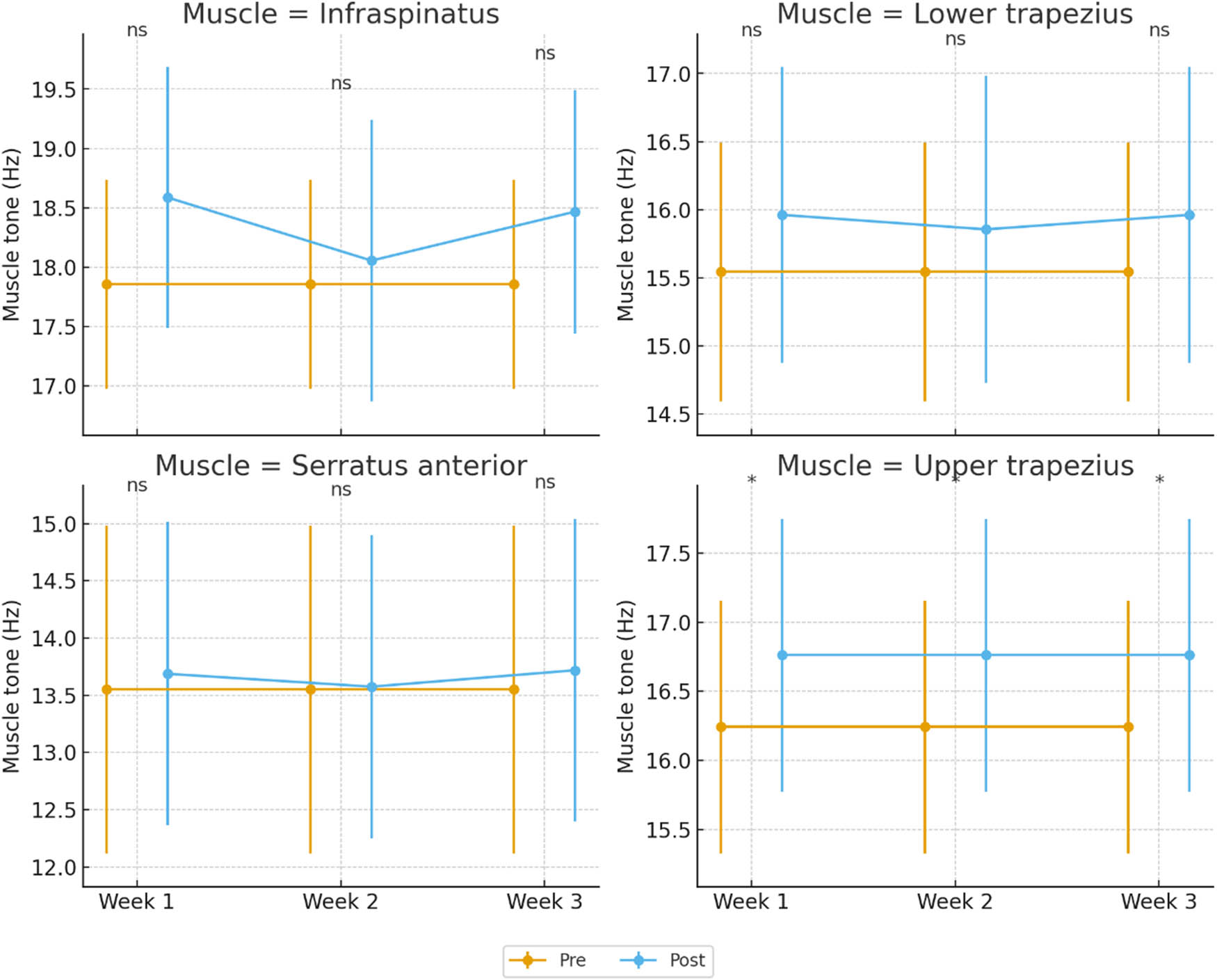
Figure 1
Muscle tone in the different muscle sites. *Significantly different (p < 0.05); ns: no significant
Source: Author’s contribution.
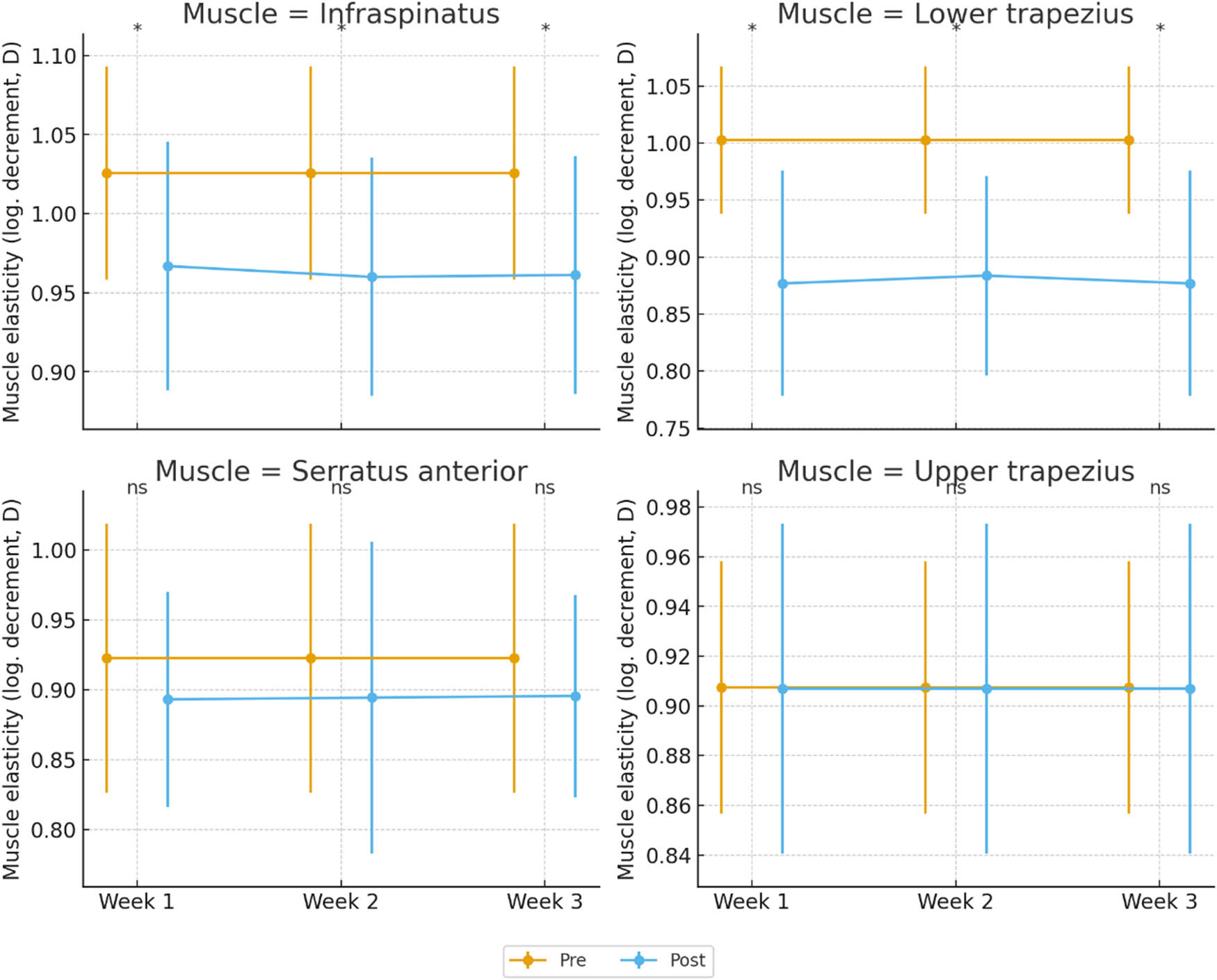
Figure 2
Muscle elasticity in the different muscle sites. *Significantly different (p < 0.05); ns: no significant
Source: Author’s contribution.
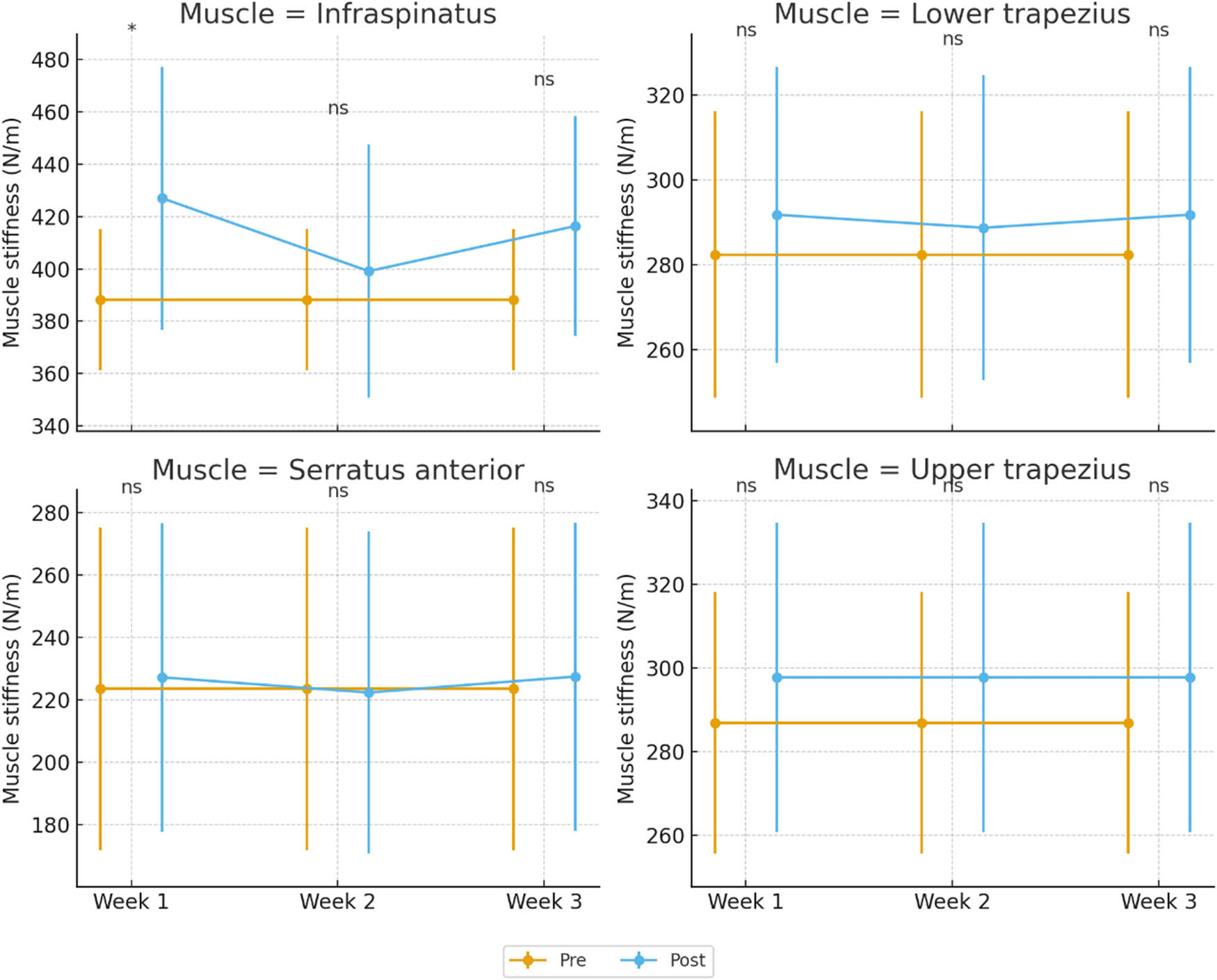
Figure 3
Muscle stiffness in the different muscle sites. *Significantly different (p < 0.05); ns: no significant
Source: Author’s contribution.
3.2.1. Muscle tone
Upper trapezius tone increased significantly after training in all three weeks. No significant week-specific pre- to post-session changes in tone were observed for the infraspinatus, lower trapezius, or serratus anterior.
Exploratory repeated-measures ANOVA supported this pattern, showing a main effect of Time for upper trapezius tone (F(1,7) = 12.12, p = 0.010, = 0.634). A main effect of Week was also observed for upper trapezius tone (F(2,14) = 4.28, p = 0.035, = 0.379), but Bonferroni-adjusted post-hoc comparisons between weeks were not significant.
3.2.2. Muscle elasticity (logarithmic decrement)
Lower trapezius decrement decreased significantly after training in all three weeks, indicating a consistent change in this parameter across the mesocycle.
Infraspinatus decrement decreased significantly only in Week 3. Weeks 1 and 2 showed non-significant reductions. No significant week-specific decrement changes were observed for the upper trapezius or serratus anterior.
At the exploratory repeated-measures level, infraspinatus decrement showed a Time effect at the significance threshold (F(1,7) = 5.61, p = 0.050, = 0.445). Given the pilot sample and the prespecified criterion of p < 0.05, this result should be interpreted cautiously and not as strong confirmatory evidence. No other clear Time, Week, or interaction effects were observed for the decrement.
3.2.3. Muscle stiffness
Week-specific stiffness changes were largely non-significant. The only significant paired comparison was observed for the infraspinatus in Week 1. In Weeks 2 and 3, infraspinatus stiffness increases were smaller and non-significant. No significant week-specific stiffness changes were observed for the upper trapezius, lower trapezius, or serratus anterior.
Exploratory repeated-measures ANOVA did not identify significant Time, Week, or Time × Week effects for stiffness in any muscle (all p ≥ 0.13).
4. Discussion
Across the 3-week in-season preparatory mesocycle immediately preceding the Polish Academic Volleyball Championships, we observed consistent post-training increases in upper-trapezius muscle tone, accompanied by reductions in logarithmic decrement (greater elasticity) in lower trapezius and a week-3 reduction in infraspinatus decrement; stiffness changes were muscle-specific and generally inconsistent.
The upper trapezius (UT) showed a consistent and significant increase in muscle tone after training across all weeks, whereas infraspinatus, lower trapezius (LT), and serratus anterior (AS) displayed minimal or no changes. Elevated resting tone after exercise aligns with evidence that overhead/shoulder tasks load the UT substantially during arm elevation and rotation (often occurring in volleyball), with high EMG amplitudes and altered timing in overhead athletes and after fatiguing external-rotation tasks (scapular muscles examined: UT, LT, SA, and infraspinatus). Volleyball- and overhead-task studies consistently show strong UT recruitment and load-responsive activation in posterior shoulder and scapular stabilizers, supporting the possibility of a selective UT tone increase (Kara et al., 2021). Short-term increases may be driven by residual neural excitation and heightened spindle sensitivity after repeated overhead actions (e.g., spikes, overhead pass, and block). A complementary explanation is that transient postural factors may also have contributed to the isolated UT response. Recent work has emphasized that sustained static head-neck-shoulder positioning, rather than a single “poor posture,” can acutely increase cervical and shoulder-girdle loading, supporting a “posture change” rather than simple “posture correction” Framework (Dhahbi & Ben Saad, 2024). Although posture was not measured in the present study, time spent in static seated positions before or after training, video analysis, or smartphone use during downtime may plausibly have influenced cervical-shoulder muscle tone. Therefore, the observed UT increase is more appropriately interpreted as a localized response likely reflecting a combination of overhead loading and transient postural exposure, rather than neural excitation alone.
Elasticity improved consistently in LT across all weeks and in infraspinatus in week 3; UT and SA showed no meaningful change. Sport-specific drill sequences typically reduce musculotendinous viscosity and damping and increase ROM, with a previous study reporting acute decreases in passive stiffness after dynamic work; these changes are often larger in stabilizers and postural muscles under submaximal, repetitive session loads (Opplert & Babault, 2018). Likely temperature-driven viscosity declines, improved fascial gliding, and short-term collagen extensibility increases, which enhance elastic recoil in frequently cycled stabilizers (e.g., LT during scapular upward rotation and posterior tilt control) (Warneke et al., 2024). In contrast, higher-intensity loading of UT may favor tone elevation more than viscoelastic recovery within the same session (Paine & Voight, 2013).
A stiffness rise appeared only in infraspinatus in week 1 (large effect) and did not recur thereafter; other muscles showed trivial stiffness shifts. After unaccustomed or eccentric-biased work, passive stiffness commonly rises acutely and over subsequent days (part of the exercise-induced muscle damage/delayed onset muscle soreness profile), whereas repeated exposure blunts responses. Our week-1 only increase may fit the early-bout response seen in eccentric and stretch-shortening; by weeks 2–3, accommodation likely attenuated the response (Hody et al., 2019). However, the specific mechanism underlying this transient response cannot be determined from the present data. Because no biomarkers, elastography, or fluid-sensitive measures were collected, explanations based on titin- or extracellular-matrix-mediated stiffness modulation remain speculative. Simpler mechanisms, including transient hyperemia, fluid redistribution/edema, or short-lived increases in passive tension after an unaccustomed session, are equally plausible. The absence of recurrence across weeks, therefore, suggests a short-term, session-specific response rather than evidence for a defined structural mechanism.
In the present pilot dataset, changes in seated medicine-ball throw performance did not show a clear co-occurrence with the observed resting muscle mechanical responses. Explosive performance depends primarily on active neural drive, rate of torque development, intersegmental coordination, and task-specific technique, which need not covary with resting/passive mechanical properties measured at a single post-session time point. This interpretation is consistent with intervention-based evidence showing that ballistic throwing-related performance is more directly improved through gains in active shoulder strength capacity. For example, a study (Agrebi et al., 2024) reported that a specific ballistic-strength training program improved isokinetic shoulder peak torque and corrected shoulder muscle-ratio imbalances in high-level handball players, supporting the view that active torque-producing qualities are more proximal determinants of explosive overhead performance than passive tone or stiffness assessed at rest. Accordingly, MyotonPRO-derived variables may be better interpreted as complementary descriptors of localized tissue status than as direct surrogates of short-term ballistic throwing output.
Several limitations should be acknowledged. First, the study included only eight athletes, whereas the a priori power analysis indicated that 34 participants would be required to detect a medium within-subject effect. Accordingly, the present work should be interpreted as a pilot, exploratory study, and the findings should not be considered confirmatory. The small sample limits statistical precision, reduces power for interaction and correlation analyses, and restricts generalizability to other competitive levels, female athletes, and other age groups. Second, the study did not include a control group or control condition. Therefore, the observed pre- to post-session changes cannot be attributed specifically to the training stimulus, as natural day-to-day variation, measurement variability, and other contextual influences may also have contributed. Third, although the training sessions were standardized in structure, the external load was described only in general terms and was not quantified using variables such as spike count, serve count, jump count, accelerometry, or other workload metrics. Consequently, the mechanical dose imposed on the shoulder complex could not be established, and any interpretation linking the observed Myoton-derived changes to specific loading exposure or fatigue mechanisms remains tentative. Fourth, no formal warm-up was performed before the seated medicine-ball throw test. Although this decision was made to preserve the resting baseline condition for the pre-training myotonometry assessment, it may have influenced absolute throwing performance and the magnitude of the pre- to post-session comparison. Finally, the monitoring period was limited to 3 weeks, and no data were collected on shoulder strength balance (ER/IR), rotational range of motion, or internal load/well-being indices. Longer and more comprehensive longitudinal studies are needed to determine whether the short-term mechanical changes observed here have meaningful implications for performance, recovery, or shoulder health.
From a practical perspective, upper-trapezius tone and lower-trapezius elasticity appeared responsive to the monitored sessions in this cohort. Practitioners may consider these measures as adjunct indicators of session-related muscle mechanical responses in scapular stabilizers, but they should be interpreted alongside other performance, recovery, and workload measures rather than as stand-alone indicators of load or injury risk.
5. Conclusions
Consistent pre- to post-session increases in upper trapezius tone, together with reductions in logarithmic decrement in the lower trapezius and infraspinatus, indicate that selected shoulder stabilizers exhibited measurable short-term mechanical changes across the monitored volleyball sessions. These findings support the feasibility of handheld myotonometry for detecting localized muscle mechanical responses in an ecologically valid training context. Given the pilot sample, lack of a control group, and absence of quantified external load, these findings should be interpreted cautiously. At present, myotonometry should be viewed as a complementary monitoring method for describing session-related muscle responses rather than as a stand-alone tool for guiding load management, optimizing performance, or inferring injury risk. Future studies with larger cohorts, longer follow-up, and integrated load, functional, and clinical measures are needed to determine its practical value in volleyball settings.
Funding information
Authors state no funding involved.
Author contributions
RS and MG conceived and designed the study; RS and MG conducted the study and collected the data; KD performed the formal data analysis and participated in data interpretation; MG conducted the literature review; RS and MG prepared the first draft of the manuscript; RS and KD contributed to the development of the methodology and supervised the research. All authors participated in the interpretation of the results; KD critically revised the manuscript for important intellectual content.
Conflict of interest statement
No potential conflict of interest was reported by the author(s).