
Table 1
Inclusion and exclusion criteria for systematic review
| Inclusion criteria | Exclusion criteria |
|---|---|
| Articles published after year 2000 | Articles published before year 2000 |
| Articles written in English | Duplicates |
| Human studies | Animal studies |
| Original articles | Reviews and meta-analyses |
| Research includes SNPs analysis | Studies not concerning SNPs analyses |
| Studies include genes VEGFA and VEGFR (KDR) | Clinical trails |
| Genetic association studies | Case studies |
| Case-control studies | Cancer research |
| Studies including analyses of the correlation between genetic variants and predisposition to a specific type of physical performance | Studies not concerning athletes |
| Studies including analyses of the correlation between genetic variants and susceptibility to tendon and ligament injuries | |
| Studies concerning athletes |
Source: Author’s contribution.
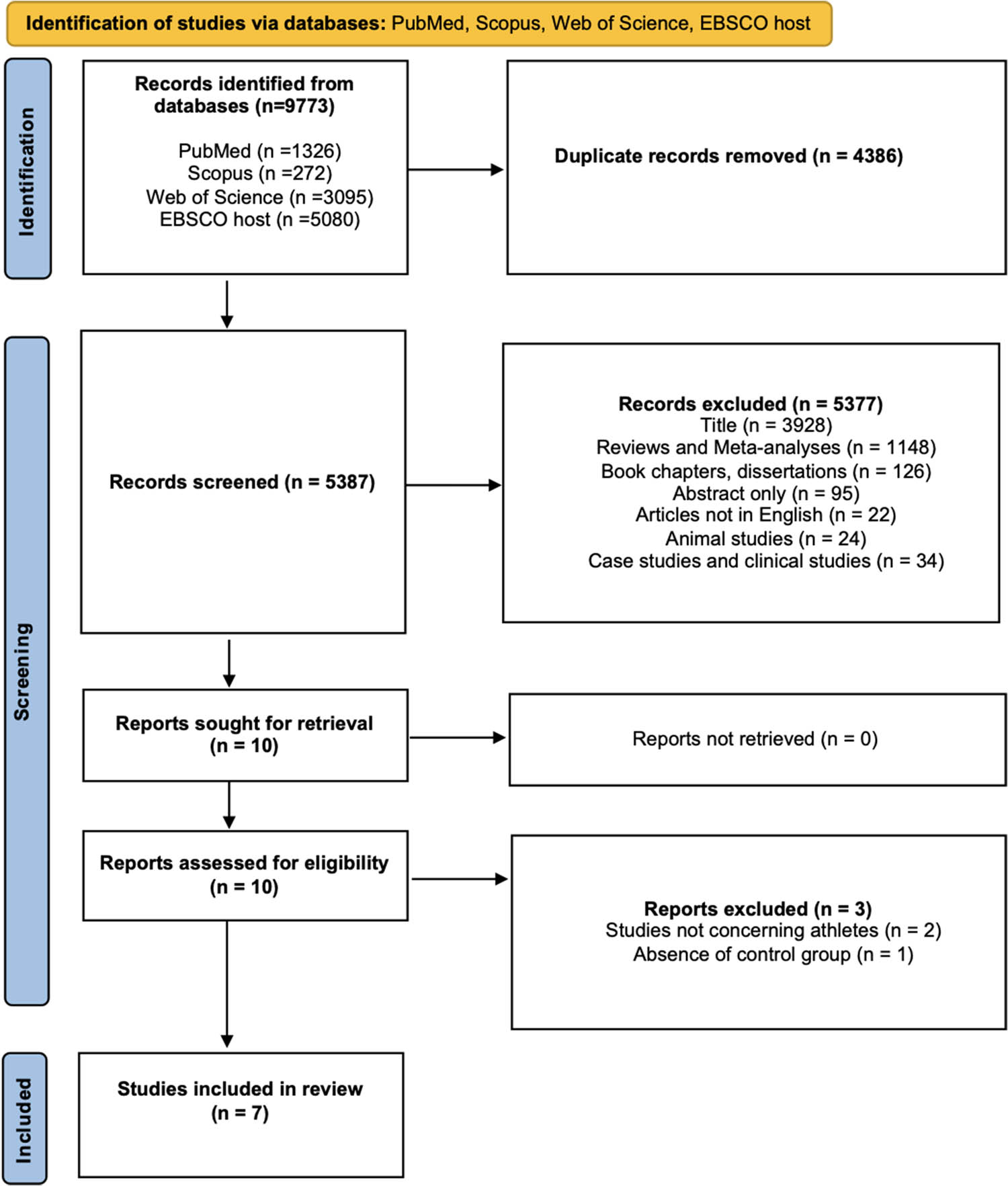
Figure 1
Studies selection flow diagram (PRISMA flow diagram for systematic reviews)
Source: The CC BY 4.0 licensed template provided on the official PRISMA website, Author’s contribution.
Table 2
Characteristics of the studies included in systematic review
| No. | First author, year | Gene | SNP variant | Participants | Country; population | Research focus | Main outcome |
|---|---|---|---|---|---|---|---|
| 1 | Ahmetov 2008 | VEGFA | rs2010963 [G/C] | Athletes | Russian; Caucasian | Physical performance | The C allele of VEGFA rs2010963 variant is associated with elite athlete status and a predisposition for enhanced aerobic performance. |
| 2 | Ahmetov 2009 | KDR (VEGFR2) | rs1870377 [T/A] | Athletes | Russian; Caucasian | Physical performance | The A allele and the AA genotype in the VEGFR2 rs1870377 variant is associated with elite athlete status in endurance sports as well as higher aerobic capacity. |
| 3 | Eider 2013 | KDR (VEGFR2) | rs1870377 [T/A] | Athletes | Poland; Caucasian | Physical performance | The A allele in the VEGFR2 rs1870377 variant is associated with predisposition to endurance sports. |
| 4 | Cięszczyk 2017 | VEGFA | rs699947 [A/C] | Athletes and physically active individuals | Poland; Caucasian | ACL injury risk (non-contact) | No significant differences between allele and genotype frequency and susceptibility to non-contact ACL ruptures in VEGFA rs699947. |
| 5 | Lulińska-Kuklik 2018 | VEGFA | rs699947 [A/C] | Physically active individuals. | Poland; Caucasian | ACL injury risk (non-contact) | The CC genotype in the VEGFA rs2010963 variant is associated with an increased susceptibility to a non-contact ACL rupture. |
| rs1570360 [G/A] | |||||||
| rs2010963 [G/C] | |||||||
| 6 | Shukla 2020 | VEGFA | rs699947 [A/C] | Athletes | India; South Asian | ACL injury risk (non-contact) | The A allele in VEGFA rs699947 and the I allele in VEGFA rs35569394 is associated with an increased risk of ACL. The C–D haplotype (rs699947, rs35569394) may present a protective effect against ACL injury. |
| rs35569394 [I/D] | |||||||
| 7 | Feldmann 2022 | VEGFA | rs699947 [A/C] | Physically active individuals. | Sweden, Poland, Australia | ACL injury risk (non-contact) | The CC genotype and C allele in VEGFA rs2010963 are associated with an increased risk of ACL injury. The A–A–G haplotype (rs699947, rs1570360, rs2010963) in VEGFA may have a protective role against ACL rupture. Additionally, gene–gene interactions between VEGFA and KDR, particularly the A–G–A–A combination, are correlated with a reduced risk of ACL injury. |
| rs1570360 [G/A] | |||||||
| rs2010963 [G/C] | |||||||
| KDR (VEGFR2) | rs1870377 [T/A] | ||||||
| rs2071559 [A/G] |
Source: Ahmetov et al., 2008, Ahmetov et al., 2009, Eider et al., 2013, Cięszczyk et al., 2017, Lulińska-Kuklik et al. 2018, Shukla et al. 2020, Feldmann et al., 2022.
Table 3
Genomic location and potential functional relevance of analyzed VEGFA and KDR polymorphisms
| Gene | Reference SNP number | Polymorphism type | Nucleotide change | Genomic location | Potential functional effect | Reference |
|---|---|---|---|---|---|---|
| VEGFA | rs699947 | SNP | A/C | Promoter | May alter transcription factor binding sites (TFBS) and modulate VEGFA transcription | Buroker (2014) |
| VEGFA | rs1570360 | SNP | G/A | Promoter | Regulatory SNP that may modify transcription factor binding and promoter activity | Buroker (2014) |
| VEGFA | rs2010963 | SNP | G/C | 5′ untranslated region (UTR) | May influence mRNA stability and translational efficiency, affecting VEGF-A protein levels | Buroker (2014) |
| VEGFA | rs35569394 | Indel (18 bp) | Insertion/Deletion | Promoter | May create or disrupt TFBS and influence VEGFA gene transcription | Buroker (2015) |
| KDR | rs1870377 | SNP (missense) | T/A | Coding sequence (exon 11) | Missense substitution (His472Gln); in silico analyses suggest minimal impact on protein structure, splicing regulation, or microRNA binding. | Berardi et al., (2015) |
| KDR | rs2071559 | SNP | G/A | Promoter | May alter TFBS, leading to reduced transcription | Rahim et al., (2018) |
Source: Buroker 2014, Buroker 2015, Berardi et al., 2015, Rahim et al., 2018.