
1. Introduction
Hypertension (HT) represents a significant public health challenge globally, contributing to cardiovascular diseases, strokes, and premature mortality. In 2019, the prevalence of HT among adults in the World Health Organization (WHO) European region declined compared to 1990. In contrast, the prevalence has increased in Asian regions, with the WHO Southeast Asia region experiencing a rise from 29 to 32% in countries such as India, Nepal, Indonesia, and Thailand. To alleviate the global burden of cardiovascular diseases, it is essential to prioritize the management of HT, particularly in the WHO Southeast Asia region (Kario et al., 2024).
Uncontrolled high blood pressure (BP) can lead to several serious consequences. Research has established a clear connection between anxiety, stress, and elevated BP, which can contribute to the development of various heart-related conditions (Lee et al., 2021). A recent study by Sun et al. (2021) revealed a U-shaped relationship between resting heart rate (HR) and cardiovascular outcomes in hypertensive patients, indicating that both excessively low and high HRs are linked to an increased risk of adverse events. These findings suggest that strategies aimed at promoting autonomic balance, particularly those that reduce sympathetic activity and enhance parasympathetic tone, could offer cardiovascular benefits, especially for patients with elevated HR (>80 bpm). This modulation of autonomic function presents a promising non-pharmacological approach that aligns with the physiological mechanisms proposed for aromatherapy.
Research indicated that over half of patients undergoing treatment for HT struggled to adhere to their medication regimens due to intolerable side effects, even though most HT medications typically have mild side effects (Lee et al., 2021; van der Laan et al., 2017). In addition to pharmacological treatments, non-pharmacological approaches are crucial for managing HT and preventing its complications (Kodela et al., 2023). Various strategies, including stress management, dietary changes, and physical activity, have effectively reduced HT risk and improved treatment outcomes (Verma et al., 2021).
HT is characterized by an overactive sympathetic nervous system and diminished parasympathetic modulation, resulting in a persistent autonomic imbalance. This imbalance leads to elevated HR, increased peripheral vascular resistance, and promotes vascular remodeling. The dynamic equilibrium between the sympathetic and parasympathetic nervous systems is crucial for maintaining cardiovascular homeostasis, and any disturbances in this balance can contribute to the onset and progression of elevated BP. Classic studies have established that autonomic dysregulation is a fundamental underlying factor in both early and sustained HT, with excessive sympathetic drive associated with structural and functional changes in the vasculature (Amerena & Julius, 1995). Further research has confirmed that an increased sympathetic tone coupled with reduced vagal activity are central characteristics of human HT (Grassi et al., 2015; Zamojski et al., 2016). Therefore, non-pharmacological interventions aimed at restoring autonomic balance, such as exercise, relaxation techniques, and lifestyle modifications, have been shown to enhance parasympathetic activity, reduce sympathetic hyperreactivity, and ultimately contribute to more effective BP management (Grassi et al., 2015).
Massage therapy, along with various other non-pharmacological interventions, is recognized for its ability to effectively modulate autonomic balance by diminishing sympathetic activation and enhancing parasympathetic tone. These physiological modifications yield significant measurable outcomes, including reductions in HR, BP, and the levels of stress-related hormones such as cortisol (Moyer et al., 2004). Furthermore, a subsequent meta-analysis of randomized controlled trials (RCTs) has corroborated that massage therapy considerably lowers both systolic blood pressure (SBP) and diastolic blood pressure (DBP), as well as resting HR, specifically in individuals diagnosed with HT and prehypertension (Liao et al., 2016).
Inhalation of lavender essential oil (Lavandula angustifolia) influences cardiovascular function through olfactory-limbic pathways that affect autonomic regulation. Key aromatic compounds, such as linalool and linalyl acetate, appear to decrease sympathetic activity while enhancing vagal (parasympathetic) tone by acting on limbic structures and hypothalamic centers. This interaction results in measurable reductions in HR and BP, as well as promoting a sense of relaxation (Sayorwan et al., 2012). Numerous systematic reviews and meta-analyses of randomized trials indicate that aroma inhalation, especially with lavender, can reduce anxiety and related physiological measures, including SBP and DBP as well as HR, when compared to control conditions (Hur et al., 2014; Tan et al., 2023; Yoo et al., 2023). Nevertheless, effect sizes (ESs) are generally small to moderate, and significant between-study heterogeneity is frequently observed. Additionally, not all meta-analyses arrive at the same conclusions, and methodological limitations in the primary trials, such as small sample sizes, variability in aromas, doses, and delivery methods, short follow-up durations, and unclear blinding, reduce confidence in the long-term efficacy of inhaled lavender for HT management. Therefore, although inhaled lavender shows potential as an adjunctive, non-pharmacological intervention for reducing sympathetic arousal and transient elevations in BP, larger and well-designed RCTs with standardized aroma preparations and clinically relevant hypertensive populations are essential to confirm its effectiveness and safety for routine use in patients with HT.
Research on hypertensive patients suggested that inhaling lavender essential oil may help reduce BP in individuals with HT (Eguchi et al., 2016; Gultom et al., 2016; Koulivand et al., 2013; Rahmadhani, 2022). Furthermore, studies indicated that foot massage and reflexology can effectively lower both BP and HR (Calisanie & Preannisa, 2022; Fitriani et al., 2019; Kotruchin et al., 2021; Lestari et al., 2023). Notably, one study that investigated the impact of aroma massage on the BP and sleep quality of hypertensive patients yielded positive results. However, it is important to note that this study only included female participants and involved full-body massages (Ju et al., 2013).
An increasing body of research suggested that patient engagement in self-care, particularly in managing chronic illnesses, can result in improved health outcomes. Prioritizing autonomy and self-management is essential for individuals with HT. Emphasizing these aspects is critical for preventing adverse effects and enhancing the quality of life for those living with chronic conditions (Audthiya et al., 2021; Sarasohn-Kahn, 2013). Several previous studies primarily focused on reflexology and foot massage as passive interventions for hypertensive patients. The recent preliminary research aimed to investigate an integrative therapy that combines foot massage, reflexology, and aromatherapy as self-care strategies for individuals with high BP. The findings indicated that patients with HT may experience a reduction in HR after a single self-administered session of aromatherapy foot massage and reflexology. However, it may be challenging to observe a significant change in BP after just one session of these self-care techniques. Consequently, detecting statistically significant results can be difficult, particularly when working with a small sample size (Hanphitakphong et al., 2025).
To date, there remained a notable gap in research addressing the impact of aroma massage on the quality of life (QOL) for hypertensive patients. In light of epidemiological findings and the focus on improving patient care to alleviate symptoms and prevent mortality, evaluations of QOL offered critical insights into the psychological, social, and physical effects of illness. Assessing health-related QOL was particularly important in the context of chronic diseases, as it provided a patient-centered perspective on the effects of illness and its treatments (Megari et al., 2013). Furthermore, studies indicated that a significant proportion of individuals with HT experience poor sleep quality (Audthiya et al., 2021), which can, in turn, exacerbate the condition (Yang et al., 2021). Consequently, healthcare professionals should consider integrating sleep interventions into their management strategies for hypertensive patients. To address the gap in research, this study aimed to investigate the effects of self-foot massage and reflexology combined with aromatherapy on physiological parameters, sleep quality, and QOL in individuals with HT.
2. Material and methods
This study was a 4 week, parallel-group, single-blinded, three-arm RCT. It was prospectively registered with the Thai Clinical Trial Registry (TCTR identification number TCTR20240801002). The research received approval from the Human Ethics Committee at the University of Phayao (HREC-UP-HSST 1.3/021/67) and adhered to the Declaration of Helsinki. All participants gave written informed consent before participating in the trial.
The sample size was determined using G*Power software version 3.1.9.7, with an alpha coefficient of 0.05, a statistical power of 0.80, and an ES of 0.7. This calculation indicated that a minimum of 42 participants would be required. Considering the possibility of participant dropout, the sample size was increased by 2 participants per group, bringing the total to 48 participants.
A total of 48 hypertensive patients were randomly assigned to one of three groups, each consisting of 16 participants: the self-foot massage and reflexology combined with aromatherapy group (SFM), the foot massage group (FM), and the control group (CON). Each intervention session lasted 15 min, with a frequency of three sessions per week (Figure 1).
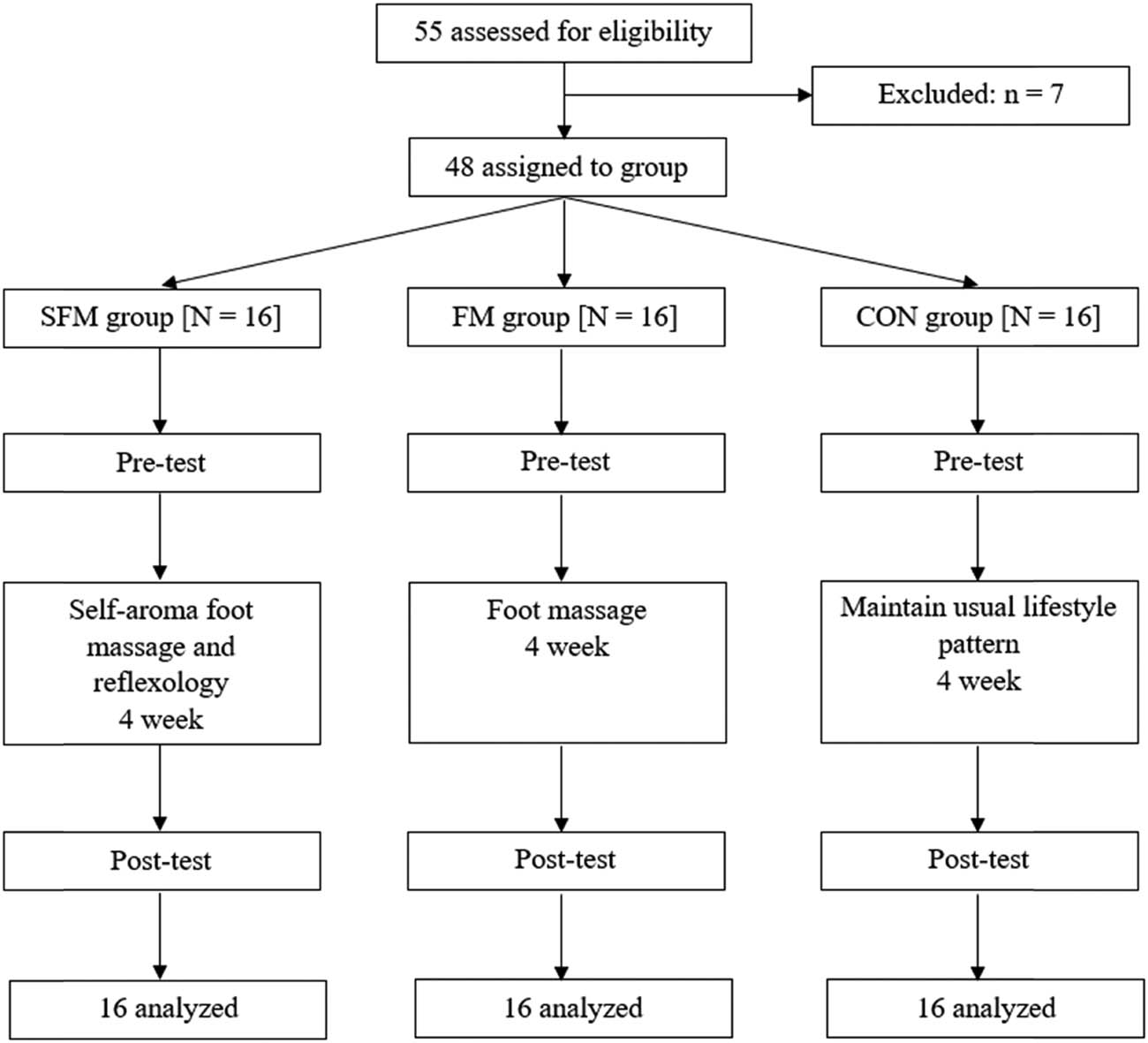
Figure 1
Flowchart of participants’ progress through the phases of the trial
Source: Author’s contribution.
Participants aged between 30 and 60 years were evaluated based on specific inclusion and exclusion criteria. To qualify for inclusion, individuals must: (1) have been diagnosed with HT at least 6 months prior, (2) consistently use antihypertensive medication, (3) possess a normal sense of smell, (4) not have used any essential oils within the past 6 months, (5) not have received foot massage or reflexology in the previous 6 months, (6) provide informed consent to participate in the study, and (7) demonstrate normal perception and cognitive function.
Participants with extremely high BP (SBP ≥ 180 mmHg and/or DBP ≥ 110 mmHg) were excluded from the study. Additionally, individuals with a history of fragrance allergy, sinusitis, respiratory disease, cancer, kidney disease, diabetes mellitus, and lower extremities problems were excluded. The study also excluded participants who used sedative drugs, were pregnant, experienced a menstrual period, or had blurred vision (Hanphitakphong et al., 2025).
The primary outcomes were HR and BP. A digital BP monitor (HOF BP, HK-803 Robot, Pharmahof Co., Ltd) was utilized to measure these outcomes. The secondary outcomes included sleep quality and QOL. Sleep quality was evaluated using the Thai-Pittsburgh Sleep Quality Index (Thai-PSQI), a valid and reliable tool for screening and identifying significant sleep disturbances, which aligns closely with the original English version. This measure consists of 19 items organized into 7 components: subjective sleep quality, sleep latency, sleep duration, sleep efficiency, sleep disturbances, the use of sleep medication, and daytime dysfunction. These components are combined to produce a global score, with values ranging from 0 to 21; higher scores indicate poorer sleep quality. A cut-off score of greater than 5 suggests poor sleep quality. Individuals with a global PSQI score of 5 or less are classified as good sleepers, while those with a score exceeding 5 are classified as poor sleepers (Sitasuwan et al., 2014).
QOL was determined using the Thai version of the World Health Organization Quality of Life-BREF (WHOQOL-BREF). This measure consisted of 26 items, including 24 items for 4 domains (physical, psychological, social, and environmental). Responses were recorded on a 5-point Likert scale, ranging from “none” to “very much,” across four distinct domains. The scoring of the WHOQOL-BREF-THAI was standardized, yielding a total score range of 26–130 points and divided into categories of low (26–60 scores), average (61–95 scores), and good (96–130 scores) for overall QOL (Mahatnirunkul et al., 1998). These encompassed seven questionnaires for physical health (7–16 scores = low, 17–26 scores = average, 27–35 scores = good), six focusing on mental health (6–14 scores = low, 15–22 scores = average, 23–30 scores = good), three examining social relationships (3–7 scores = low, 8–11 scores = average, 12–15 scores = good), and eight addressing environmental domains (8–18 scores = low, 19–29 scores = average, 30–40 scores = good) (Khanthong et al., 2024).
Outcomes were evaluated at baseline and after a 4 week experimental period. The researcher conducting the assessment was unaware of the group assignments. The SFM group participated in a 15 min self-administered foot massage and reflexology session utilizing specialized hemisphere-shaped equipment). The present study applied stimulation to the reflex point situated at the first metatarsal bone, in accordance with the methodology described by Kotruchin et al. (2021). Additionally, they inhaled lavender essential oil (pure lavender essential oil, Chanaka Dhibesra Damri, Royal Project Agricultural Research and Development Center, Thailand) through an ultrasonic aroma diffuser, which combined three drops of essential oil with 120 mL of water for aromatherapy. The FM group engaged in a 15 min session of foot massage by a massage therapist. Almond moisturizing oil (Phutawan Shop, Thailand) was used as massage oil. In this study, almond oil was used only one drop per foot to reduce friction during foot massage, not for any aromatherapy purpose. The CON group was asked to keep their activities of daily living.
The data were analyzed using SPSS statistical software version 26 (SPSS Inc., Chicago, IL). All baseline data are presented as mean value ± standard deviation (SD). The Shapiro-Wilk test was performed to assess the normality of all variables. Statistical significance was established at p < 0.05.
Paired t-tests were used for within-group comparisons and a within-group ES of 0.20 was considered small, 0.50 medium, and 0.80 large (Cohen, 1988). Between-group comparisons were performed using analysis of covariance (ANCOVA), with baseline values as covariates. When necessary, multiple comparisons with confidence interval adjustment using the Bonferroni procedure were used for post-hoc comparisons. The between-group ES was calculated using partial eta squared (pη 2) and 0.10 was considered small, 0.25 medium, and 0.40 large (Cohen, 1988).
The Kruskal–Wallis test was also used for WHO QOL as data were not normally distributed.
3. Results
Of the 48 volunteers, all participants completed the study. The study population is shown in Table 1. As illustrated in Table 2, the SFM group experienced a significant reduction in SBP of 13.44 ± 5.63 mmHg (p < 0.001), DBP of 5.25 ± 3.59 mmHg (p < 0.001), and HR of 11.19 ± 5.89 bpm (p < 0.001). Additionally, there was a noteworthy improvement in the PQSI score with a change of 1.38 ± 1.50 (p < 0.01). In the FM group, SBP also showed a significant decrease of 8.81 ± 8.93 mmHg (p < 0.01) and HR decreased by 7.5 ± 3.92 bpm (p < 0.001). However, no significant changes were observed in DBP, PQSI score, or QOL for this group. In the CON group, no significant differences were noted across any of the variables measured.
Table 1
General characteristics of the participants
| Variables | Total (N = 48) mean value ± SD | SFM group (n = 16) mean value ± SD | FM (n = 16) mean value ± SD | CON (n = 16) mean value ± SD |
|---|---|---|---|---|
| Gender: Male/Female | 25/23 | 7/9 | 8/8 | 10/6 |
| Age (year) | 48.69 ± 7.09 | 48.81 ± 7.86 | 50.31 ± 6.64 | 46.94 ± 6.73 |
| Weight (kg) | 69.31 ± 9.69 | 67.06 ± 10.12 | 69.50 ± 9.32 | 71.38 ± 9.74 |
| Height (cm) | 164.04 ± 5.50 | 163.94 ± 6.04 | 163.63 ± 5.52 | 164.56 ± 5.23 |
| Body mass index (kg/m2) | 25.66 ± 2.49 | 24.85 ± 2.56 | 25.8700 ± 2.31 | 26.26 ± 2.54 |
| Duration of HT (year) | 6.52 ± 2.00 | 7.13 ± 1.86 | 6.50 ± 1.75 | 5.94 ± 2.29 |
HT: Hypertension.
Source: Author’s contribution
Table 2
Pre-test and post-test comparison of SBP, DBP, HR, and PQSI between the groups
| Variables | Groups | Pre-test mean value ± SD | Post-test mean value ± SD | Paired sample t-test | ANCOVA | ||||
|---|---|---|---|---|---|---|---|---|---|
| t | p-value | Cohen’s d | F | p-value | η 2 | ||||
| SBP (mmHg) | SFM | 156.88 ± 5.50 | 143.44 ± 6.18 | 9.54 | <0.001 | 2.30 | 7.165 | 0.002 | 0.246 |
| FM | 153.94 ± 4.74 | 145.13 ± 7.82 | 3.95 | 0.001 | 1.36 | ||||
| CON | 154.31 ± 3.55 | 151.25 ± 5.94 | 1.90 | 0.077 | 0.63 | ||||
| DBP (mmHg) | SFM | 86.81 ± 3.17 | 81.56 ± 3.90 | 5.85 | <0.001 | 1.48 | 5.641 | 0.007 | 0.204 |
| FM | 84.88 ± 3.96 | 82.88 ± 2.73 | 1.94 | 0.156 | 0.59 | ||||
| CON | 83.81 ± 3.04 | 85.31 ± 3.59 | −1.48 | 0.161 | 0.45 | ||||
| HR (bpm) | SFM | 83.94 ± 2.79 | 72.75 ± 4.49 | 7.60 | <0.001 | 2.99 | 21.392 | 0.000 | 0.493 |
| FM | 81.69 ± 3.95 | 74.19 ± 4.54 | 7.66 | <0.001 | 1.76 | ||||
| CON | 82.31 ± 4.85 | 81.31 ± 3.65 | 0.897 | 0.384 | 0.23 | ||||
| PQSI total score | SFM | 8.25 ± 1.24 | 6.88 ± 1.09 | 3.67 | 0.002 | 1.17 | 6.112 | 0.005 | 0.217 |
| FM | 7.88 ± 1.26 | 7.44 ± 1.37 | 1.07 | 0.300 | 0.33 | ||||
| CON | 7.75 ± 1.00 | 8.19 ± 1.28 | −1.815 | 0.089 | 0.38 | ||||
Source: Author’s contribution
ANCOVA confirmed significant differences in SBP, DBP, HR, and PSQI between the three groups (p = 0.000–0.007, η 2 = 0.204–0.493) except for the quality of life.
Post-hoc tests confirmed that the SFM significantly improved SBP (p = 0.001, 95% CI = −13.527 to −3.932), DBP (p = 0.002, 95% CI = −6.887 to −1.681), HR (p = 0.003, 95% CI = −12.054 to −6.148), and PSQI (p = 0.001, 95% CI = −2.35 to −0.63) more than CON.
FM significantly improved SBP (p = 0.013, 95% CI = −10.667 to −1.314), and HR (p < 0.001, 95% CI = −9.834 to −4.002) when compared to CON, but there was no difference for DBP (p = 0.037, 95% CI = −5.089 to −0.164) and PSQI (p = 0.066, 95% CI = −1.64 to 0.05).
For the quality of life, the Kruskal–Wallis test demonstrated no difference for WHOQOL-BREF between the three groups (Table 3).
Table 3
Pre-test and post-test comparison of WHOQOL-BREF between the groups
| Variables | Groups | Pre-test median (IQR) | Post-test median (IQR) |
|---|---|---|---|
| Physical health | SFM | 26.50 (25.00–29.00) | 27.50 (25.00–30.00) |
| FM | 27.00 (25.25–28.75) | 27.50 (26.00–30.00) | |
| CON | 28.50 (26.25–30.75) | 30.00 (26.25–31.00) | |
| p-value | 0.216 | 0.057 | |
| Psychological | SFM | 26.00 (24.25–28.00) | 25.50 (24.25–27.00) |
| FM | 26.00 (25.00–27.00) | 26.00 (25.00–27.00) | |
| CON | 27.00 (25.25–28.00) | 27.00 (25.25–28.00) | |
| p-value | 0.548 | 0.362 | |
| Social relationships | SFM | 10.00 (9.00–11.00) | 10.50 (9.00–11.75) |
| FM | 10.00 (9.00–12.75) | 10.50 (9.00–12.00) | |
| CON | 11.00 (10.00–11.00) | 11.50 (10.25–12.00) | |
| p-value | 0.312 | 0.337 | |
| Environment | SFM | 32.00 (30.00–34.75) | 32.00 (30.00–34.50) |
| FM | 31.00 (29.25–34.75) | 30.00 (29.00–35.00) | |
| CON | 31.00 (30.00–31.75) | 30.50 (30.00–32.00) | |
| p-value | 0.622 | 0.562 | |
| Overall | SFM | 99.50 (94.00–105.00) | 105.00 (97.50–112.50) |
| FM | 103.50 (97.25–109.00) | 103.50 (97.75–105.75) | |
| CON | 104.50 (99.00–111.75) | 102.00 (95.25–109.50) | |
| p-value | 0.153 | 0.545 |
Source: Author’s contribution
4. Discussion
The aim of this study was to evaluate the effects of combining foot massage, reflexology, and aromatherapy on physiological parameters, sleep quality, and quality of life in individuals with HT. The findings indicated that an intervention featuring self-foot massage, reflexology, and aromatherapy can result in reduced BP and HR, as well as improved sleep quality for patients with HT. Notably, no adverse effects were reported during this short-term study. The FM group showed improvements in SBP and HR following the intervention, although there were no changes observed in DBP or sleep quality. In contrast, the CON group exhibited no significant variations in any measured outcomes. Furthermore, there were no notable differences in QOL among the three groups.
To the researchers’ knowledge, this study represents the first investigation into the effects of foot massage, reflexology, and aromatherapy on BP, HR, sleep quality, and overall quality of life in hypertensive patients. Comparing results across different studies can be challenging due to variations in activities, experimental durations, and measurement tools. In this research, participants in the SFM group engaged in self-administered foot massages and reflexology using dome-shaped devices equipped with ultrasonic aroma diffusers. This was conducted over 12 sessions, each lasting 15 min, across a 4 week experimental period. In contrast, participants in the FM group received professional foot massages from a qualified massage therapist, also over 12 sessions, with each session lasting 15 min.
To elucidate the changes in outcomes related to BP and HR, it appeared that the combined effects of lavender essential oil, foot massage, and reflexology may trigger a parasympathetic response, resulting in reductions in both BP and HR following the intervention. These findings were consistent with the study by Ju et al. (2013), which demonstrated that aroma massage can positively impact BP and sleep quality in hypertensive patients. However, it is important to note that the research exclusively included female participants, and the intervention involved a full-body massage. Regarding HR, these results aligned with our previous pilot study, which observed a decrease of approximately 6.5 beats per minute (bpm) following a single intervention session (Hanphitakphong et al., 2025). In the current study, a decrease of about 11 bpm in HR was found, which may be attributed to the longer duration of the intervention.
Following the intervention, this current study demonstrated a significant improvement in both SBP and DBP. These findings aligned with those of Calisanie et al. (2022), which showed that foot massage can effectively reduce BP and alleviate anxiety in individuals with HT. Moreover, the current results were consistent with previous research by Rahmadhani et al. (2022), which indicated that aromatherapy could help lower BP in hypertensive individuals. In that study, participants inhaled lavender scent from a steam diffuser for 15 min daily for 6 days. Additionally, the present findings echoed those of Kotruchin et al. (2021), who reported that a single session of 2 min foot reflexology significantly decreased HR (by 2.6 bpm and 4.1 bpm after 15 and 30 min of intervention, respectively) in hypertensive patients, despite no statistically significant change observed in DBP. In contrast, the results from the 12th session of the intervention in the present study may lead to substantial changes in both BP and HR.
The crucial role of foot health in promoting the overall wellness is well understood. The feet contain unique reflex zones associated with different organ systems, which can significantly impact vital physiological functions, such as BP (Cai et al., 2023). Foot reflexology highlights specific points on the body believed to regulate vital energy, or qi, in line with ancient Chinese practices (Wang et al., 2013). During foot reflexology sessions, the modulation of vagal tone is enhanced by activating a neural baroreflex, resulting in physiological changes in autonomic nerve function, particularly a reduction in HR (Stanley et al., 2013). In this study, the specific reflex point targeted was located at the first metatarsal bone, consistent with similar research conducted by Kotruchin et al. (2021). Notably, the present findings indicated an average decrease in HR of approximately 11 bpm in the SFM group, with an ES of 2.99, signifying a considerable impact. Furthermore, the current study also showed a reduction in BP, reporting decreases of around 13 mmHg SBP and 5 mmHg for DBP in the SFM group. The observed ESs of 2.30 and 1.48 further indicated a significant difference in BP outcomes.
In our study, participants who received foot massages exhibited a mean reduction in resting HR to approximately 72.8 bpm. Notably, this figure falls within the 70–74 bpm range identified by Sun et al. (2021) as the reference group linked to a lower incidence of major adverse cardiovascular events among hypertensive patients, indicating lower risks compared to the groups with HRs below 65 bpm or above 80 bpm. In their extensive multicenter retrospective cohort study, Sun et al. (2021) identified a U-shaped (nonlinear) relationship between baseline HR and cardiovascular risk, with the lowest risk occurring around a mid-range HR of approximately 72 bpm. Consequently, our intervention may guide participants toward a more advantageous HR zone (moving from higher baseline values) that has been linked to lower long-term cardiovascular risk in other populations. However, it is important to note that although foot massage resulted in an acute reduction in HR among our subjects, we did not measure definitive cardiovascular outcomes; thus, any inferred benefits regarding decreased events remain speculative and necessitate prospective validation. Future longitudinal trials should evaluate whether repeated massage or sustained autonomic modulation can lead to reductions in adverse cardiac outcomes within at-risk populations.
Foot massage, incorporated into the intervention, serves as a form of cutaneous stimulation that aids the body in achieving homeostasis through both extrinsic and intrinsic mechanisms that impact peripheral blood flow. In extrinsic contexts, the manipulations involved in foot massage stimulate vasomotor activity, resulting in the relaxation of smooth muscles and vasodilation within arterioles. Moreover, foot massage has a soothing psychological effect, influencing the activity of the autonomic nervous system. Specifically, parasympathetic nerve fibers stimulated during a foot massage release acetylcholine, which affects nodal cells and reduces depolarization frequency, leading to a decrease in HR (Chen et al., 2019).
Moreover, when examining lavender aromatherapy, which was part of the intervention, there is evidence indicating that linalool, a terpene found in lavender, effectively diminishes sympathetic nervous system activity while promoting parasympathetic activity (Koulivand et al., 2013). The enduring effects of parasympathetic activation may lead to enhanced sleep quality. Additionally, research conducted by Xu et al. (2021) found that applying linalool to specific acupoints increased sleep duration in rodents that had received pentobarbital. This suggests that linalool may have sedative properties that contribute to the relaxation effects commonly associated with aromatherapy. However, the implications of these findings for human sleep quality remain uncertain.
The QOL outcomes in the present study could not be modified. The current study likely employed a home program intervention. QOL was evaluated using the Thai version of the WHOQOL-BREF, consisting of 26 items – 24 of which are categorized into 4 domains: physical, psychological, social, and environmental. According to the protocol of the SFM group, patients were required to carry out the intervention independently at home, which may have limited their interactions with others and their environment. Moreover, the brief duration of the study sessions might have been insufficient to enhance the quality of life. Participants took part in 12 self-administered foot massage and reflexology sessions, which may account for the lack of significant changes observed in the multidimensional quality of life. This may be due to inadequate intervention dosage.
Unsurprisingly, no changes in the studied variables were observed in the control group. Although no significant differences were found between the SFM and FM groups, it was evident that the changes in the SFM group were more pronounced, particularly regarding SBP and HR. One possible explanation for the lack of distinction between the FM and SFM groups could be that the FM group did not receive aromatherapy. The different intervention techniques may play a crucial role in these outcomes; participants in the SFM group were required to perform the intervention independently, while those in the FM group received treatment from a massage therapist. This distinction allowed patients to choose their preferred mode of therapy. Moreover, no differences in sleep quality or DBP were noted between the CON and FM groups. This situation might suggest that the SFM group performed better than the FM group. Importantly, recent evidence indicated that effective HT self-care interventions should incorporate individual perspectives to enhance knowledge and improve home-based management of HT (Konlan et al., 2023). Therefore, promoting foot self-massage and reflexology, combined with aromatherapy, was advisable for hypertensive patients.
This study exhibited several noteworthy strengths, particularly its implementation of a RCT design, which facilitated a comprehensive examination of the primary outcomes. Another significant advantage was the application of a single-blind methodology.
However, the primary limitation of this study lies in its asymmetrical design and the presence of potential confounding variables between groups, which may weaken the validity of the conclusions. For instance, the SFM group received aromatherapy, while the FM group did not. Additionally, foot massage was administered by trained professionals, whereas self-massage was performed by the participants themselves. As a result, differences between the groups cannot be definitively attributed to self-massage or aromatherapy alone. Future research is necessary to clarify the effects of self-administered vs professionally delivered massage, as well as the impact of massage with or without aromatherapy. Other important limitations must be acknowledged before making broad generalizations. First, the research design did not allow for the assessment of long-term effects, highlighting the necessity for validation of the findings in future studies. Second, the study lacked subjective clinical outcome assessments related to stress or anxiety, which was a considerable concern given the well-documented connection between these factors, elevated BP, and various cardiovascular health issues. Additionally, the absence of a double-blind design may introduce bias, potentially resulting in an overestimation of the observed effects. Ultimately, incorporating a crossover study design in subsequent research, along with subjective evaluations and satisfaction measures, would enhance the depiction of relaxation associated with the parasympathetic nervous system.
5. Conclusion
The practice of self-administered lavender foot massage and reflexology presented a positive impact on BP, HR, and sleep quality in patients with HT. This approach can be considered a complementary therapy alongside pharmacological treatments designed to enhance BP and HR control in individuals with high BP. Furthermore, achieving improved sleep quality may contribute to the prevention of adverse cardiovascular outcomes. Additional research is required to assess the long-term effects of these interventions on hypertensive patients who rely on lifelong antihypertensive medication. It may also be beneficial to include individuals experiencing high levels of stress in future studies. Moreover, incorporating evaluations of relaxation levels, stress levels, satisfaction scores, and brain activity could provide a more comprehensive understanding of these treatments’ effects.
Acknowledgements
We would like to express our gratitude to all the participants who contributed to the data collection process.
Funding information
This research was supported by University of Phayao and Thailand Science Research and Innovation Fund (Fundamental Fund 2024).
Conflict of interest statement
The authors have no conflicts of interest to declare.