
1. Introduction
Urinary incontinence (UI) is a disorder that has been increasingly gaining attention in recent years from both the medical community and the public (Li et al., 2023; Milsom & Gyhagen, 2019). The most common type of UI in females is stress UI (SUI) (Nygaard & Heit, 2004), which is characterized by urine leakage occurring during or shortly after an increase in intra-abdominal pressure. Such situations are typical when coughing, sneezing, laughing, or during physical activity. SUI is a particularly noticeable problem in females. It causes a range of physical and psychological discomforts, negatively impacting quality of life and limiting social and athletic activity.
Although the topic of SUI has remained in the shadows for years, current epidemiological data confirm that SUI is an emerging health problem among females worldwide, and according to forecasts, its prevalence will continue to increase (Harland et al., 2023). Special attention should be paid to females who regularly engage in physical activity (Mahoney et al., 2023; Nygaard & Shaw, 2016). High-intensity exercise can adversely affect pelvic floor muscles. Therefore, it is important to increase awareness and knowledge about SUI (Mahoney et al., 2023; Nygaard & Shaw, 2016).
Regular physical activity is crucial for the proper functioning of the body and general health (Kannel, 1979). Both a lack of physical activity and intense sports requiring rapid movements are independent risk factors for SUI (Bo & Nygaard, 2020; Townsend et al., 2008).
CrossFit® is a type of training that combines strength training with elements of gymnastics and high-intensity activities such as jumping and running (Meyer et al., 2017). Its main goals are to develop key motor skills such as cardiorespiratory fitness, muscular endurance, strength, flexibility, power, speed, coordination, agility, balance, and precision (Wagener et al., 2020). Swimming is one of the most popular sports worldwide (Troup, 1999) and offers numerous benefits for the circulatory, respiratory, and musculoskeletal systems. Regular swimming training increases cardiac output, improves lung capacity, and strengthens respiratory muscles (Lavoie & Montpetit, 1986).
However, females training in CrossFit® have reported problems with SUI (Bo & Nygaard, 2020; Nygaard et al., 2015). Moreover, to strength-based sports, strenuous endurance sports (such as swimming) may also increase the risk of SUI (Kopyra et al., 2024). Some females discontinue or modify sports due to SUI and the following discomfort (Nygaard & Heit, 2004; Nygaard et al., 2015).
The primary aim of this study is to determine the characteristics of SUI in females who train in CrossFit®, swimming, and are physically inactive, with the following analysis of differences between those subgroups. Second, we aimed to examine the impact of training and demographic factors on the risk of developing SUI. We hypothesize that SUI is more common among females engaged in CrossFit® than in swimming or untrained subjects.
2. Material and methods
2.1. Study population
Of 151 individuals who fulfilled the survey, a total of 125 females met the inclusion criteria. Their body height and body mass amounted to 167.65 ± 5.83 cm and 63.90 ± 8.95 kg., respectively; 43 (34.4%) declared regular swimming, 41 (32.8%) regularly trained in CrossFit®, while the remaining 41 participants (32.8%) did not engage in any regular physical activity. In the group of females training in CrossFit®, the largest percentage was those with over 3 years of training experience (56.1%), followed by those training for 1–2 years (24.4%). Among female swimmers, the vast majority (90.7%) had over 3 years of training experience. Table 1 presents detailed demographic and training characteristics of the study population.
Table 1
Characteristics of the study population
| Sport discipline | Age | BMI | Training experience | Training volume | Duration of single training session | Training exertion | ||||||||
|---|---|---|---|---|---|---|---|---|---|---|---|---|---|---|
| In (years) | n | % | In (kg m−2) | In (years) | n | % | In (trainings/week) | n | % | In (min) | n | % | (On a 0–10 scale) 0 = not at all, 10 = a great deal | |
| CrossFit® (n = 41, 32.8%) | 18–24 | 14 | 34.2 | 22.8 ± 2.12 | ≤1 | 4 | 9.8 | 1 | 2 | 4.9 | ≤30 | 1 | 2.4 | 6.9 ± 1.1 |
| 25–30 | 12 | 29.3 | 1–2 | 10 | 24.4 | 2 | 3 | 7.3 | 30–45 | 4 | 9.8 | |||
| 31–35 | 7 | 17.1 | 2–3 | 4 | 9.8 | 3 | 18 | 43.9 | 46–60 | 19 | 46.3 | |||
| >35 | 8 | 19.5 | ≥3 | 23 | 56.1 | 4 | 7 | 17.1 | 61–90 | 14 | 34.2 | |||
| >4 | 11 | 26.8 | >90 | 3 | 7.3 | |||||||||
| Swimming (n = 43, 34.4%) | 18–24 | 39 | 90.7 | 21.7 ± 1.8 | ≤1 | 1 | 2.3 | 1 | 5 | 11.6 | ≤30 | 0 | 0.0 | 6.2 ± 1.3 |
| 25–30 | 4 | 9.3 | 1–2 | 2 | 4.7 | 2 | 12 | 27.9 | 30–45 | 4 | 9.3 | |||
| 31–35 | 0 | 0.0 | 2–3 | 1 | 2.3 | 3 | 13 | 30.2 | 46–60 | 18 | 41.9 | |||
| >35 | 0 | 0.0 | ≥3 | 39 | 90.7 | 4 | 0 | 0.0 | 61–90 | 14 | 32.6 | |||
| >4 | 13 | 30.2 | >90 | 7 | 16.3 | |||||||||
| Physically inactive (n = 41, 32.8%) | 18–24 | 31 | 75.6 | 23.8 ± 4.1 | — | — | — | — | — | — | — | — | — | — |
| 25–30 | 8 | 19.5 | — | — | — | — | — | — | — | — | — | |||
| 31–35 | 1 | 2.4 | — | — | — | — | — | — | — | — | — | |||
| >35 | 1 | 2.4 | — | — | — | — | — | — | — | — | — | |||
Abbreviations: BMI, body mass index.
Note: “–” for physically inactive women means that no respondent chose those answers.
Source: Author’s contribution.
The study met the regulations of the Ethical Committee of the Medical University of Warsaw (no. KC #83007) and was conducted following the guidelines of the Declaration of Helsinki. The participants were informed about the purposes and methodology of this study and gave informed consent.
2.2. General procedures of investigation
We conducted this study via an online-based survey between February and April 2025 among Polish childless females. The form was shared online on social media groups focused on physical activity and targeted at female populations. Exclusion criteria included: (a) females with a history of childbirth, (b) females declaring they engaged in physical activity other than CrossFit® or swimming, (c) females under the age of 18 years old, and (d) males. To reduce the specific nature of particular sports, we investigated only the two disciplines (one strength and one endurance). Data was screened for potential duplicates, and repeated replies were excluded. We did not analyze different types of strength and endurance sports together. We defined the regular swimming and CrossFit® training as any amount of weekly volume of training accumulated into at least 1 session per week for at least 3 continuous months. Participants could train with or without competitive goals, but it must be the participant’s preferred sports discipline. To be classified as an inactive participant, the females must decline any kind of regular sports activity, both recreational and professional, fulfilling the minimal requirements described above. Participants could practice other sports, but cannot practice both types of sport simultaneously (swimming and CrossFit®). We conducted and reported this study according to the STROBE Guidelines by the EQUATOR Network for cross-sectional studies (von Elm et al., 2007).
The survey consisted of two or three parts, depending on the responses provided. The first part was mandatory for all participants and consisted only of the author’s questions and included general and sociodemographic data such as gender, previous childbirth, age, height, and weight. The second part was related to training practices, and a question was about CrossFit® (part 2a) or swimming (part 2b). The respondent could fulfill only one part. It included questions about training experience, the frequency and duration of training, and a Borg fatigue scale. In both parts, there were questions about SUI: whether this problem had ever occurred, when it occurred, and whether SUI affected their reported physical activity. The final third part was also mandatory for all respondents and included the International Consultation on Incontinence Questionnaire – Urinary Incontinence Short Form (ICIQ-SF). The final part of the survey included the ICIQ-SF, which can be scored from 0 to 21. Higher scores indicate greater urinary incontinence severity. The interpretation scale is as follows: 0 indicates lack of SUI, 1–5 indicates mild, 6–12 moderate, 13–18 severe, and 19–21 very severe UI. The questionnaire underwent validation studies that supported its credibility (Avery et al., 2004; Gron Jensen et al., 2022). Parts 2a and 2b about the training practices were not necessary for inactive females. A full English transcript of the survey tool is attached in Supplementary Material 1.
2.3. Statistical methods
We performed the statistical analysis using JASP (Version 0.17.3, JASP Team). Distribution of continuous data was evaluated using the Shapiro–Wilk test and presented as mean ± standard deviation. Categorical data were presented as numbers (percentages). There were no missing variables and no necessity to impute data.
We used the χ 2 test to compare differences in SUI prevalence among physically inactive females, females training in swimming, and females training in CrossFit®. Results of χ 2 were supported by the odds ratio (OR) and Cramér’s V as effect size measurements.
We used multivariate logistic regression to determine predictors of developing SUI in females training in swimming and CrossFit® (coded as a binary factor: Yes = 1 and No = 0). Before analysis, the assumptions for logistic regression were checked. Demographic variables (categorical [age] and continuous [BMI]) and training variables (categorical [sports discipline, training experience, training volume, training duration] and continuous [training exertion]) were included in the model. If a variable had more than two levels, one level was coded as the reference group or decoded into two levels. Results were presented using β estimates, standard error, Wald statistic, and OR supported with 95% confidence intervals (CI). Model fit was assessed using Nagelkerke’s R 2.
We tested the power of the sample post-hoc in the G*Power Software (version 3.1.9.6) (Kang, 2021). The sample of 125 participants met the criteria of statistical power: a large effect size and power >80% for all applied tests. We set the statistical significance level at P < 0.05.
3. Results
3.1. Prevalence of SUI and comparative analysis between physical activity levels
We presented the incidence of SUI in Table 2. Females practicing CrossFit® (n = 20 [48.8%]) reported SUI episodes more frequently compared to females practicing swimming (n = 14 [32.6%]) or inactive females (n = 10 [24.4%]). There were significant differences between the number of females suffering from SUI who trained in CrossFit® compared to those training in swimming (χ 2(1) = 5.26, P = 0.02, OR = 2.95), and Cramér’s V was φ = 0.25, considered a small-to-medium effect size. Significant differences were observed between the number of females suffering from SUI who trained in CrossFit® and those who were physically inactive (χ 2(1) = 5.19, P = 0.02, OR = 2.95), with Cramér’s V at φ = 0.25, indicating a small-to-medium effect size. However, there were no significant differences between the number of females suffering from SUI who trained in swimming and those who were physically inactive (χ 2(1) = 0.69, P = 0.41, OR = 1.50), while the Cramér’s V was φ = 0.09, presenting a negligible effect size. Those relationships are visualized in Figure 1.
Table 2
Results of the ICIQ-SF questionnaire
| Sport discipline | How often do you leak urine? | When does urine leak? | How much urine do you usually leak? | How much does leaking urine interfere with your everyday life? 0 = not at all; 10 = a great deal | Presence – Severity of SUI | ||||||||||
|---|---|---|---|---|---|---|---|---|---|---|---|---|---|---|---|
| Type of answer | n | % | Type of answer | n | % | Type of answer | n | % | Type of answer | n | % | Level | n | % | |
| CrossFit® (n = 41, 32.8%) | Never | 24 | 58.5 | Never – urine does not leak | 21 | 51.2 | None | 21 | 51.2 | 0 | 27 | 65.9 | No – Lack | 21 | 51.2 |
| About once a week or less often | 16 | 39.0 | Leaks when you are physically active/exercising | 20 | 48.8 | A small amount | 19 | 46.3 | 1 | 7 | 17.1 | Yes – Mild | 15 | 36.6 | |
| Two or three times a week | 1 | 2.4 | Leaks when you cough or sneeze | 4 | 9.8 | A moderate amount | 1 | 2.4 | 2 | 2 | 4.9 | Yes – Moderate | 5 | 12.2 | |
| About once a day | 0 | 0.0 | Leaks for no obvious reason | 2 | 4.9 | 3 | 4 | 9.8 | Yes – Severe | 0 | 0.0 | ||||
| Several times a day | 0 | 0.0 | Leaks before you can get to the toilet | 1 | 2.4 | A large amount | 0 | 0.0 | 7 | 1 | 2.4 | Yes – Very severe | 0 | 0.0 | |
| All the time | 0 | 0.0 | |||||||||||||
| Physically inactive (n = 41, 32.8%) | Never | 31 | 75.6 | Never – urine does not leak | 33 | 80.5 | None | 31 | 75.6 | 0 | 33 | 80.5 | No – Lack | 31 | 75.6 |
| About once a week or less often | 8 | 19.5 | Leaks when you are physically active/exercising | 4 | 9.8 | A small amount | 10 | 24.4 | 1 | 1 | 2.4 | Yes – Mild | 6 | 14.6 | |
| Two or three times a week | 0 | 0.0 | Leaks when you cough or sneeze | 6 | 14.6 | A moderate amount | 0 | 0.0 | 2 | 3 | 7.3 | Yes – Moderate | 2 | 4.9 | |
| About once a day | 0 | 0.0 | Leaks for no obvious reason | 2 | 4.9 | 3 | 1 | 2.4 | Yes – Severe | 2 | 4.9 | ||||
| Several times a day | 2 | 4.9 | Leaks before you can get to the toilet | 3 | 7.3 | A large amount | 0 | 0.0 | 4 | 1 | 2.4 | Yes – Very severe | 0 | 0.0 | |
| All the time | 0 | 0.0 | 7 | 2 | 4.9 | ||||||||||
| Swimming (n = 43, 34.4%) | Never | 31 | 72.1 | Never – urine does not leak | 30 | 69.8 | None | 30 | 69.8 | 0 | 30 | 69.8 | No – Lack | 29 | 67.4 |
| About once a week or less often | 10 | 23.3 | Leaks when you are physically active/exercising | 8 | 18.6 | A small amount | 11 | 25.6 | 1 | 6 | 14.6 | Yes – Mild | 11 | 25.6 | |
| Two or three times a week | 1 | 2.3 | Leaks when you cough or sneeze | 7 | 16.3 | A moderate amount | 2 | 4,.7 | 2 | 4 | 9.3 | Yes – Moderate | 3 | 7.0 | |
| About once a day | 1 | 2.3 | Leaks for no obvious reason | 3 | 7.0 | 3 | 1 | 2.3 | Yes – Severe | 0 | 0.0 | ||||
| Several times a day | 0 | 0.0 | Leaks before you can get to the toilet | 2 | 4.7 | A large amount | 0 | 0.0 | 4 | 1 | 2.3 | Yes – Very severe | 0 | 0.0 | |
| All the time | 0 | 0.0 | 7 | 1 | 2.3 | ||||||||||
Abbreviations: SUI, stress urinary incontinence.
Source: Author’s contribution.
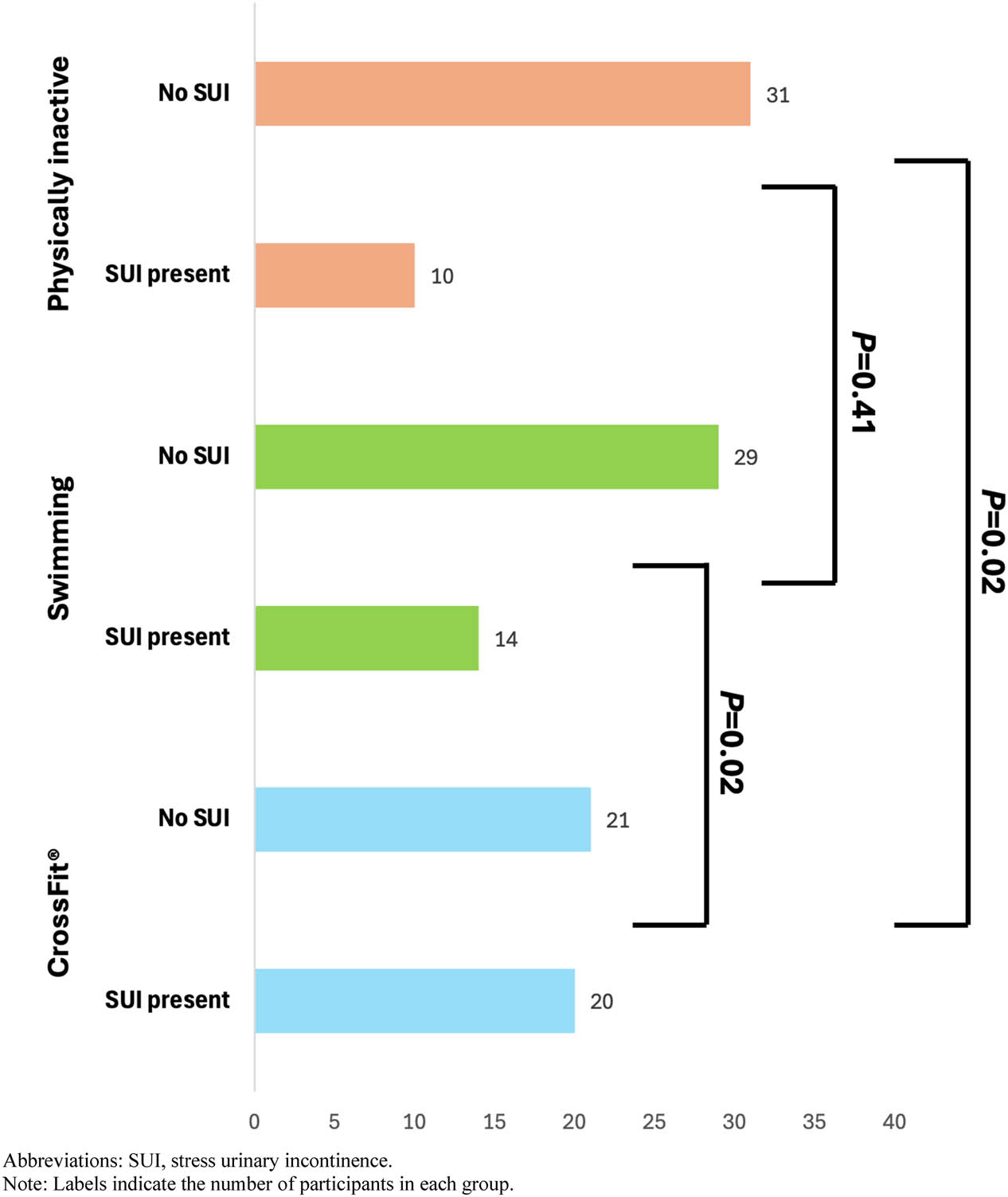
Figure 1
Differences in the number of participants suffering from stress urinary incontinence. Labels indicate the number of participants in each group. Abbreviations: SUI, stress urinary incontinence
Source: Author’s contribution.
In the open questions, females most often suffered from SUI during jumping rope exercises, but in the group of female swimmers, 67.4% (n = 29) had never experienced SUI, and of those who had experienced SUI, 32.6% (n = 14) declared that the severity of SUI was the highest after several years of regular training (20.9%; n = 9). However, no swimmer stated that the problem impacted her activity, while the majority of participants training CrossFit® (29.3%; n = 12) declared that SUI did not affect their physical activity.
3.2. Results of the ICIQ-SF questionnaire
In the 0–10 scale on the impact of SUI on the interference with everyday life, the majority of females indicated a value of “0” both for CrossFit® (n = 27 [65.9%]) and swimming (n = 30 [69.8%]). In the physically inactive subgroup, “0” was selected by 80.5% of females (n = 33). Higher scores on the scale (indicating greater interference with everyday life) were found primarily in the CrossFit® group. 34.1% (n = 14) of participants rated the impact of the problem at ≥1. In the swimmers group, there were also a few cases indicating values ≥1 up to 7, but their percentage was relatively lower (n = 13 [30.2%]). A similar distribution is observed among physically inactive females; a certain percentage (n = 8 [19.5%]) admitted that the problem of SUI affected their everyday life to some extent ( ≥1 on the scale). There were only 2 (4.9%) females with a severe degree of SUI, both in the physically inactive group. Based on the scores in ISIQ-SF, all the remaining females with SUI had mild or moderate degrees. Detailed scores of the questionnaire are presented in Table 2.
3.3. Factors contributing to the risk of SUI in females training in Crossfit® and swimming
Despite the final multivariable logistic regression model not being statistically significant, it was on the verge of significance (χ²(74) = 16.84, p = 0.051). Negelkerke’s R 2 was 0.25, which indicated that the analyzed predictors explained one-fourth of the variance in risk of developing SUI among physically active females (detailed analysis is presented in Table 3). Only BMI was a significant predictor (β = 0.30, p = 0.04). Each increase of 1 kg m−2 was related to an increased chance of developing SUI for 34% (OR = 1.34, 95%CI: 1.02, 1.78). No other covariate was a significant predictor of developing SUI.
Table 3
Predictors of stress urinary incontinence in physically active females
| Coefficients | β | SE | Wald | P | OR | OR 95% CI |
|---|---|---|---|---|---|---|
| Intercept | −7.50 | 3.84 | 3.83 | 0.05 | 5.516 × 10⁻⁴ | (−15.02, 0.02) |
| Age | ||||||
| 18–24 Years | — | — | — | — | 1.00 (ref.) | — |
| 25–30 years | 0.91 | 0.73 | 1.56 | 0.21 | 2.49 | (−0.59, 10.40) |
| 31–35 Years | 1.56 | 1.09 | 2.05 | 0.15 | 4.76 | (−0.56, 40.32) |
| >35 Years | −1.60 | 1.21 | 1.73 | 0.19 | 0.20 | (−0.02, 2.19) |
| BMI (in kg m−2) | 0.30 | 0.14 | 4.29 | 0.04 | 1.34 | (1.02, 1.78) |
| Sports discipline | ||||||
| CrossFit® | — | — | — | — | 1.00 (ref.) | — |
| Swimming | 0.01 | 0.72 | 7.553 × 10⁻⁵ | 0.99 | 1.01 | (0.25, 4.10) |
| Training experience | ||||||
| >2 Years | — | — | — | — | 1.00 (ref.) | — |
| ≤2 Years | 1.40 | 0.76 | 3.42 | 0.06 | 4.06 | (0.92, 17.96) |
| Training volume | ||||||
| 1–2 Sessions per week | — | — | — | — | 1.00 (ref.) | — |
| ≥3 Sessions per week | 0.13 | 0.64 | 0.04 | 0.83 | 1.14 | (0.33, 3.99) |
| Training duration | ||||||
| ≤1 h | — | — | — | — | 1.00 (ref.) | — |
| >1 h | −0.34 | 0.56 | 0.36 | 0.55 | 0.72 | (0.24, 2.13) |
| Training exertion (on a 0–10 scale) 0 = not at all, 10 = a great deal | 0.02 | 0.21 | 0.01 | 0.92 | 1.02 | (0.68, 1.54) |
Abbreviations: SE, standard error; OR, odds ratio; CI, confidence interval; BMI, body mass index.
Note: Presence of stress urinary incontinence coded as 1. Training experience of <1 year and 1–2 years coded as ≤2 years, while training experience of 2–3 years and >3 years coded as >2 years. Training volume of 1 and 2 sessions per week coded as 1–2 sessions per week, while 3, 4, and >4 sessions per week coded as ≥3 sessions per week. Training duration of <30 min, 30–45 min, and 46–60 min coded as ≤1 h, while 61–90 and >90 min coded as >1 h.
Source: Author’s contribution.
4. Discussion
In this study, we evaluated the prevalence of SUI among females practicing strength training (CrossFit®), endurance sports (swimming), and complete inactivity. We noticed that: (a) SUI is more frequent among females who train in CrossFit® than in swimming or avoid physical activity, (b) being physically inactive did not solve the problem of SUI, and SUI also occurs among inactive participants, and (c) the age and training-related factors are not the significant predictors of SUI, apart from the BMI.
4.1. The role of pelvic floor muscles in preventing SUI
The pelvic floor muscles support the structures of the pelvic floor, tighten the urethra, and stabilize the pelvis and spine (Eickmeyer, 2017). These are the key mechanisms by which the pelvic floor muscles prevent urine leakage during sudden increases in intra-abdominal pressure (Nygaard & Heit, 2004). Typically, intra-abdominal pressure increases during sneezing or coughing, but particularly during exercise. Intra-abdominal pressure increases primarily during strength or high-impact sports, but the increase also occurs to a lesser degree during other disciplines (Milsom & Gyhagen, 2019). Weakening the pelvic floor muscles leads to SUI, and their training is one of the main advices to prevent and treat SUI. Ultimately, strengthening the pelvic floor muscles allows for better control of urination (Harland et al., 2023).
4.2. CrossFit® and SUI
CrossFit® is one of the sports in which SUI is very common in females. Previous reports suggested that even 36% of females training in CrossFit® report leaking urine (Pisani et al., 2022). Leakage during physical activity is primarily associated with repeated episodes of increased intra-abdominal pressure, especially when abdominal muscle contractions are not accompanied by conscious activation of pelvic floor muscles (Nygaard et al., 2015). The even higher frequency of SUI during CrossFit® is confirmed by the results of our study. Moreover, females regularly training in CrossFit® had the highest rate of SUI. In this group, nearly half of the participants (48.8%) reported SUI, which was significantly higher than in the remaining. The differences between groups were significant, suggesting that the type of physical activity may influence the incidence of SUI. Although in our study the frequency of SUI was the highest for CrossFit®, other studies on SUI also show similar rates in athletes participating in high-intensity sports involving a lot of jumping, such as running, basketball, and martial arts (Dominguez-Antuna et al., 2023; Elks et al., 2020; Forner et al., 2021). This leaves the other disciplines to other studies.
4.3. Swimming and SUI
Swimming is a low-taxing sport that lacks jumps or sudden changes of direction, making SUI less common than in high-intensity sports such as CrossFit®, as described earlier (Lavoie & Montpetit, 1986; Nygaard et al., 2015). Most studies indicate lower rates of SUI among females practicing swimming than other high-impact sports (Rebullido et al., 2021). Although swimming generates significantly less mechanical stress on the pelvic floor, it is postulated that the intense work of the abdominal, lower limb, and trunk muscles during swimming may contribute to a higher incidence of SUI in females (Almeida et al., 2016; Rubin et al., 2024). Moreover, intensive swimming training may lead to significant changes in the electrical activity of the pelvic floor muscle, which contributes to its overload and weakening (Dornowski et al., 2019). However, the majority of studies indicate that swimming contributes little to SUI among females, and our results are consistent with this statement. In the group of female swimmers, 67.4% of the participants had never experienced a SUI incidence, and the percentage of females reporting SUI incidents was lower than in the CrossFit® group (32.6% vs 48.8%).
4.4. Comparative analysis and SUI among inactive females
A comparative analysis of the results of this study revealed significant differences in the incidence of SUI between the CrossFit® and swimming or inactive groups, but not between the swimming and inactive groups. The highest incidence of SUI was observed among females participating in CrossFit® (48.8%), which was significantly higher than among swimmers (32.6%) and physically inactive females (24.4%). Regular swimming, although not completely free from SUI, had only slightly elevated frequency of SUI compared to inactive subjects. However, due to its specific high-intensity nature, CrossFit® training may be associated with a higher likelihood of SUI. Furthermore, our study demonstrated that even in the physically inactive group, about ¼ of females reported symptoms, confirming that physical exercise is not the only responsible factor and that the etiology of SUI is multifactorial. Therefore, we underscore that SUI is a problem not only among older females or those who have previously been pregnant, but also among young, physically active females (Kopyra et al., 2024; Szczepańska et al., 2021).
We noticed that only the BMI was a significant predictor of SUI in the multivariable analysis. Collective analysis of different training and demographic (age, BMI) factors better mirrors real-world settings. In our analysis, higher BMI was associated with a higher possibility of developing SUI. It is well known that higher weight, especially when overweight or obesity occurs, is linked to the development of several diseases (Jin et al., 2023). Higher body mass places a greater challenge on the pelvic floor muscle to stabilize and control surrounding structures (Nygaard & Heit, 2004). However, the clinical relevance of the BMI-related impact should be interpreted cautiously due to the limited sample size and self-reported data.
It should be underscored that the majority of our participants were 18–24 years old. Risk of SUI typically grows with age (Harland et al., 2023). The lack of a significant contribution in the multivariable analysis could be explained by the narrow age distribution of our sample. None of the training factors (intensity, volume, experience, etc.) was associated with the risk of developing SUI. However, significant differences occurred between disciplines, suggesting that the risk of developing SUI is inherent in the particular discipline itself, not in the character of training. Finally, only 34.2% of the CrossFit® athletes were 18–24 compared to more than ¾ in the swimming and inactive groups. This could have skewed the results, as the higher prevalence of SUI was observed in CrossFit®. Perhaps, it was to some degree mitigated by the older age of the subjects in CrossFit®, rather than due to the nature of this sport.
4.5. Limitations
Despite yielding interesting and important results, the study had certain limitations that are worth considering. Only young, nulliparous females from three groups were included in the study: those practicing CrossFit®, swimming, and those who were physically inactive. This means that the results cannot be directly applied to females practicing other sports. Another limitation was the online survey format. This format influenced the subjective nature of responses and could have led to underestimation or overestimation of SUI symptoms. We screened the data for duplicate replies, but only those that were the same were clearly detectable. We cannot ensure that the same participant did not fill out the form twice, giving different replies. We recommend cautious interpretation of the results, taking these limitations into account, and future replication studies are recommended.
5. Conclusions
Females training in CrossFit® had the highest incidence of SUI. Female swimmers experienced SUI to a lesser extent than female CrossFit® participants. Inactivity alone does not eliminate the risk of SUI, and its frequency is comparable to that of females who train in swimming. Only BMI was a significant predictor of SUI, with its increase linked with a higher possibility of developing SUI among physically active females. There were no other significant training or demographic predictors of SUI. However, SUI was found to have no significant impact on training practices in either the CrossFit® or swimming groups. The presence of SUI even among young, apparently healthy nulliparous females highlights the need for early education and targeting preventive strategies on the factors with the strongest contribution.
Acknowledgments
Przemysław Kasiak, M.D., has been supported by the START Scholarship from the Foundation for Polish Science for outstanding young researchers under 30 years old. Grammarly was used for linguistic correctness and clarity. This research was conducted as part of master’s thesis of Kaja Czupryńska. Grammarly was used for linguistic correctness and clarity.
Funding information
No funding was received for conducting this study.
Author contributions
Conceptualization, T.C., P.K. and K.C.; methodology, T.C., P.K. and K.C.; validation, T.C., P.K. and K.C.; formal analysis, T.C., P.K. and K.C.; investigation, T.C., P.K. and K.C.; resources, T.C., P.K. and K.C.; data curation, T.C., P.K. and K.C.; writing – original draft preparation, T.C., P.K. and K.C.; writing – review and editing, T.C., P.K., K.C., A.M. and D.Ś.; visualization, T.C., P.K. and K.C.; supervision, T.C.; project administration, T.C., P.K. and K.C.; funding acquisition, T.C., P.K., K.C. and D.Ś. All authors have read and agreed to the published version of the manuscript.
Conflict of interest statement
The authors declare no conflict of interest.
Data availability statement
Data supporting conclusions will be made available on an individual basis upon reasonable request to the corresponding author.