
1. INTRODUCTION
China is one of the earliest countries in the world to develop astronomy, with credible astronomical records dating back over 3000 years. These ancient astronomical records not only have a significant value for historical research and ancient astronomy studies but also play an important role in modern astronomical research (Liu, 1990; Han, 2001; Feng, 2017). Ancient local chronicles in China refer to comprehensive, systematic documents that record history and status of natural, political, economic, cultural, and social aspects at that time within a certain administrative region. Many ancient local chronicles have specialized textual descriptions of astronomical phenomena (including solar eclipses, lunar eclipses, occultations, transits, conjunctions), which provide important observational data for astronomical research. In general, texts in ancient local chronicles objectively describe astronomical observations of the time. However, considering that local chronicles are recorded by humans, many astronomical phenomena are qualitatively described using words, inevitably containing subjective elements. Additionally, during the transmission process of these ancient local chronicles, there may be omissions in individual information; neighboring regions may also recopy each other, and some astronomical phenomena were recorded with recalling. All these factors can lead to inaccuracies or even errors in the contents recorded in some local chronicles. Therefore, caution is needed when utilizing ancient local chronicle materials for related research.
It is well known that there is a secular trend of slowing down of the Earth’s rotation. Studies have shown that astronomical observation records in ancient literature can be used to study secular change of the Earth’s variable rotation (Stephenson, 1997, 2003; Morrison & Stephenson, 2004; Morrison et al., 2021; Han et al., 1984, 1995; Wu & Liu, 1987; Pang et al., 1988; Zhang & Han, 1995; Han, 1996; Han & Qiao, 2003; Tanikawa & Sôma, 2004; Stephenson et al., 2016). According to astronomical observation records in ancient China, a total solar eclipse occurred on A.D. 1641 November 3. There were 32 records containing this eclipse observation in ancient historical literature (Liu et al., 1998; Ma & Liu, 2019). Up to now, no scholars used this observation record to study the Earth’s variable rotation. Recently, the authors find textual records about the eclipse from the Local Chronicle of Jingzhou Prefecture in the Qing Dynasty and verify detailed textual records about this observation from the local records of Zhijiang County and Yidu County that were governed under Jingzhou Prefecture. With modern astronomical planetary ephemeris DE422 released from the Jet Propulsion Laboratory (JPL) of the National Aeronautics and Space Administration (NASA) (Konopliv et al., 2011), this paper calculates a visible region of the eclipse on the surface of the Earth and combines observation records about the total solar eclipse in Zhijiang County and Yidu County to study the secular change in the Earth’s variable rotation.
2. TOTAL SOLAR ECLIPSE OBSERVATION RECORDS IN LOCAL CHRONICLES AND OBSERVATION SITE
In Volume 76 of the Local Chronicle of Jingzhou Prefecture written in the sixth year of Emperor Guangxu in the Qing Dynasty, observation records about the solar eclipse are presented in Figure 1a. The corresponding English description is as follows.
In October (the 14th year of the Emperor Chongzhen’s reign in the Ming Dynasty), on the first day of the month, daytime was as dark as night in Zhijiang County and Yidu County.
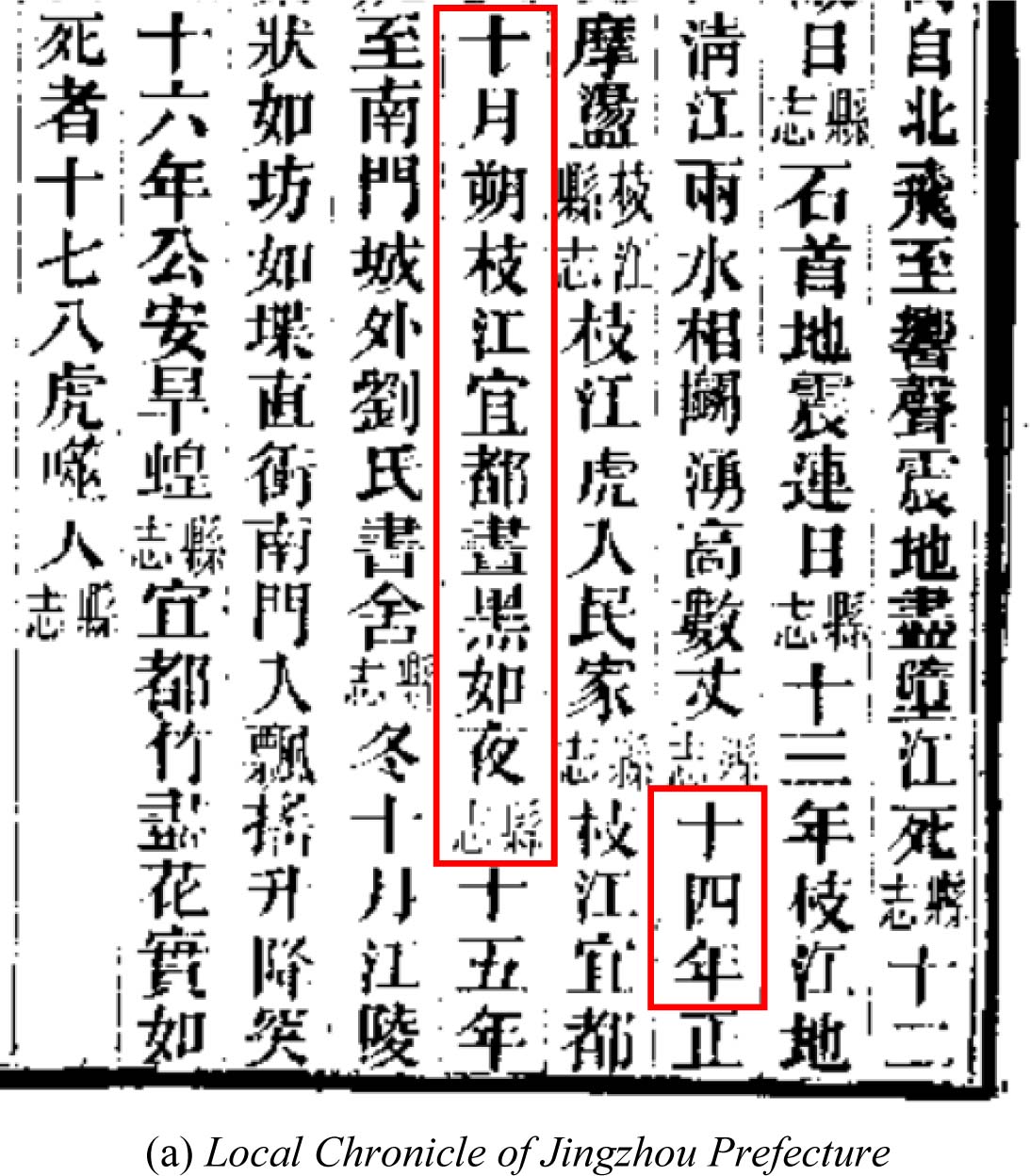
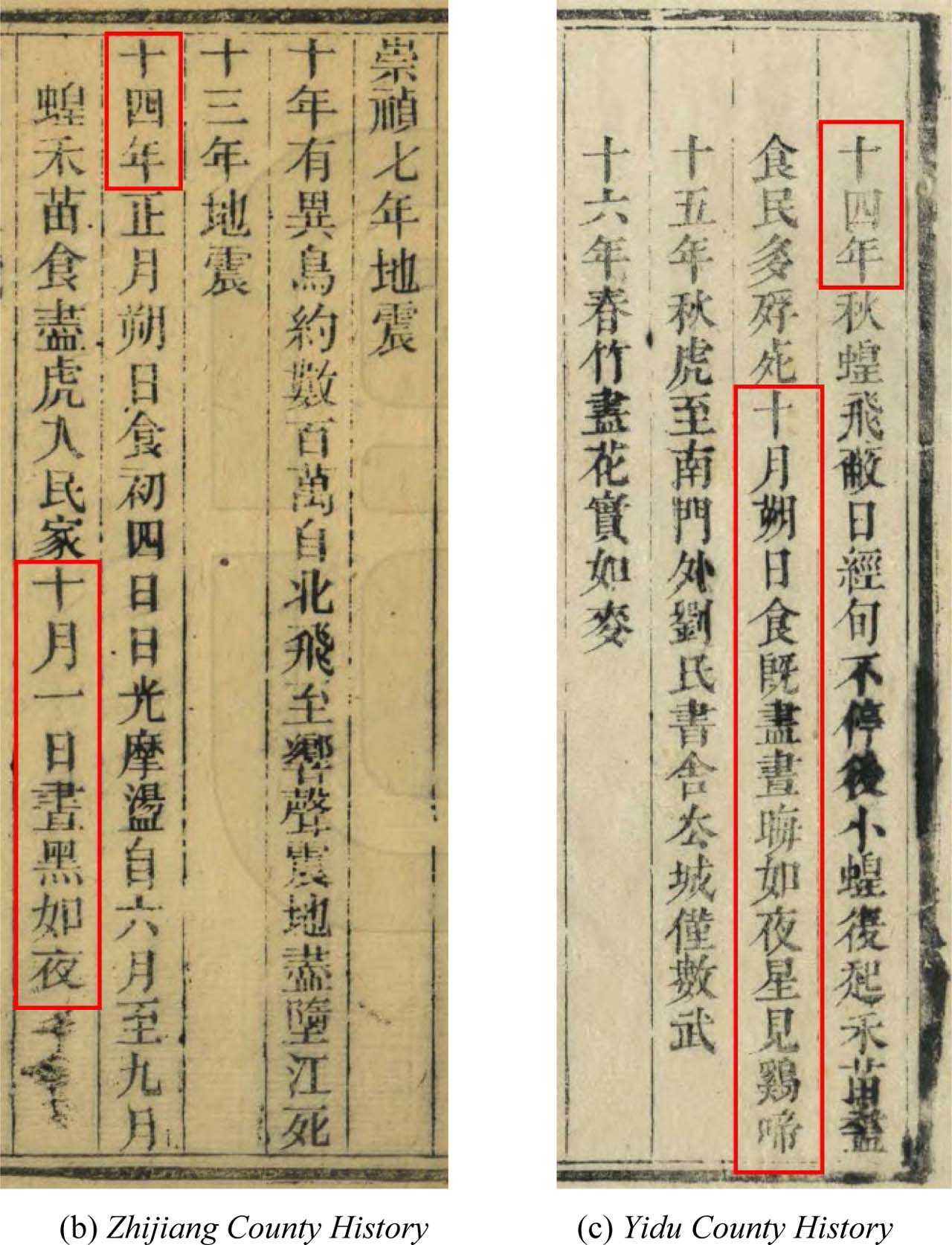
Figure 1.
Astronomical observation records of solar eclipse on A.D. 1461 November 3 in (a) Local Chronicles of Jingzhou Prefecture, (b) Zhijiang County, and (c) Yidu County, and the relevant Chinese text is marked with a red border
In the Chinese ancient chronic time system, the first day of October of the 14th year of the Emperor Chongzhen’s reign in the Ming Dynasty corresponds to A.D. 1641 November 3 in the present time with Gregorian calendar. It can be preliminarily speculated that what happened was possibly a total solar eclipse. Further verification is needed. Considering that the “prefecture” in the Qing Dynasty was a higher administrative unit, the geographical area controlled by the “prefecture” was also large. The office location of Jingzhou Prefecture was in Jiangling County, which governs Jiangling County, Gongan County, Shishou County, Jianli County, Songzi County, and Zhijiang County, as well as Yiling Prefecture (leading its own jurisdiction and Changyang County, Yidu County, Yuanan County) and Gui Prefecture (leading its own jurisdiction and Xingshan County, Badong County), making a total of two scattered prefecture and eleven counties.
This record in the Local Chronicle of Jingzhou Prefecture is identified as having been compiled from the local chronicles. Meanwhile, it also mentions Zhijiang County and Yidu County. Therefore, it can be inferred that this record may have been derived from the local chronicles of Zhijiang County and Yidu County.
The authors consult Zhijiang County History written in the fifth year of Emperor Tongzhi in the Qing Dynasty. On Volume 20 of the local chronicle, there was a record of solar eclipse in A.D. 1641 (see it in Figure 1b). “On October 1st, daytime was as dark as night.” The textual description is almost identical to the text in the Local Chronicle of Jingzhou Prefecture.
The authors further consult Yidu County History written in the 36th year of Emperor Kangxi in the Qing Dynasty. In Volume 11, the records of the solar eclipse on A.D. 1641 November 3 are as follows:
In October, on the first day of the month, a solar eclipse occurred. ji, Day was dark as night, stars appeared, roosters crowed.
Its Chinese description is given in Figure 1c. The term ji, a key word in ancient texts describing celestial phenomena, specially indicates that a total solar eclipse takes place. The following text displays a scene at the time: The sky darkened, resembling nightfall, stars appeared, and chickens crowed. These descriptions vividly and meticulously capture the sky’s appearance during the total solar eclipse and the abnormal behavior of animals.
Combined with the records of Zhijiang County History and Yidu County History, it can be confirmed that a total solar eclipse occurred on A.D. 1641 November 3, and the eclipse was observed in Zhijiang County and Yidu County. The Zhijiang County and Yidu County are observation sites of the total solar eclipse.
3. THE ΔT VALUE STUDY WITH TOTAL SOLAR ECLIPSE OBSERVATIONS OF A.D. 1641 NOVEMBER 3
Astronomical planetary ephemeris holds an important practical value for astronomy and Earth science, as well as other related fields. The DE series planetary ephemeris, released by NASA JPL, has been widely used in astrometry, geodesy, deep space exploration, and aircraft measurement and control. In September 2009, JPL released DE422 planetary ephemeris (Konopliv et al., 2011), with data spanning from B.C. 3001 to A.D. 3000. This DE422 planetary ephemeris can meet basic need of researchers studying ancient astronomical phenomena.
An eclipse is a special astronomical phenomenon when the Moon moves to the middle between the Sun and the Earth, and the black shadow behind the Moon falls exactly on the surface of the Earth. In the DE422 astronomical planetary ephemeris, the Terrestrial Dynamical Time (TDT) system, a uniform time, is adopted. Using the DE422 ephemeris, spatial positions with high precision of the Sun and the Moon under the TDT time system can be calculated. According to geometric relationship of the Sun, the Moon, and the Earth, visibility of solar eclipse on the surface of the Earth, called solar eclipse path, can be obtained.
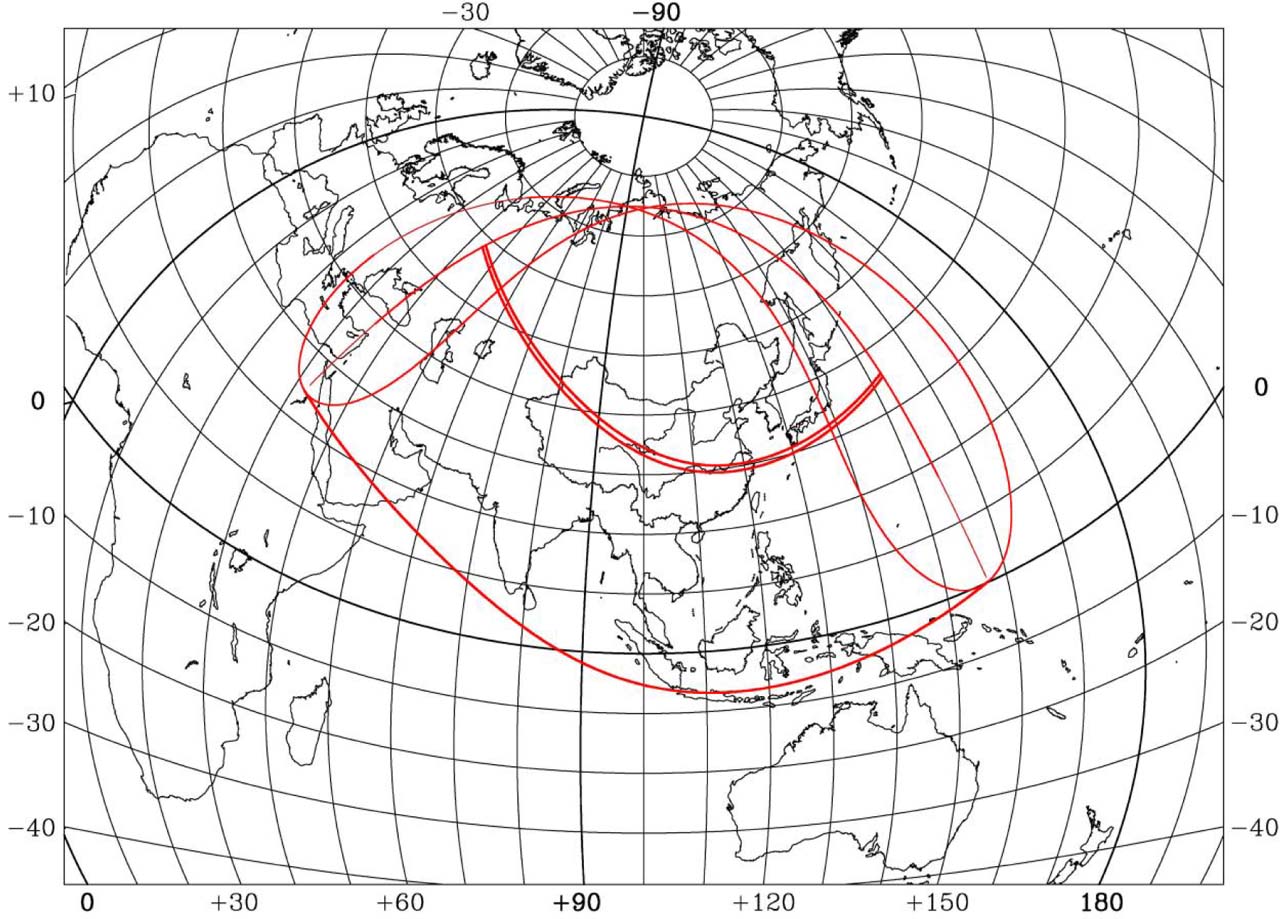
Figure 2.
The solar eclipse path on A.D. 1461 November 3 (with the TDT time system)
In this work, we utilize the DE422 ephemeris to calculate the solar eclipse on November 3 and plot solar eclipse path in Figure 2. The narrow strip in the figure shows that if someone located in this area, a total solar eclipse could be observed. The below red line approximately parallel to this strip denotes the southern boundary of the area where a partial solar eclipse can be observed. The two ends marked by the red line show the areas on the ground where the eclipse begin and the eclipse end can be observed at sunrise and sunset.
Actually, the Earth’s rotation is not uniform. Secular change is significant in the Earth’s variable rotation. The ΔT, a correction number for Universal Time (UT), describes a cumulative effect of the difference between TDT and UT. Astronomical planetary ephemeris gives the region where a solar eclipse can theoretically be observed. The region differs from the region where the solar eclipse was observed at ancient time. Here, Δλ is used to denote the longitude difference between theoretical region and actual observation region. We divide Δλ by 15 to get the ΔT value. Using solar eclipse observation records of ancient documents, we can calculate the value of ΔT at that time, corresponding to secular change of the Earth’s variable rotation.
Considering the textual records about the total solar eclipse that occurred on A.D. 1641 November 3 in Zhijiang County, the county should locate within the narrow strip where the total solar eclipse can be observed. The upper and lower limits of the ΔT value can be calculated and listed in Table 1. Similarly, Yidu County is also located within the narrow strip, where the total solar eclipse can be observed. We calculate the upper and lower limits of the ΔT value and list it in Table 1. That is to say, only when the value of ΔT takes a value within this range, people in Zhijiang County and Yidu County can observe the total solar eclipse.
Table 1.
The upper and lower limits of ΔT in Zhijiang County and Yiduo County
| Observation site | Latitude | Longitude | Lower limit of ΔT(sec) | Upper limit of ΔT(sec) |
|---|---|---|---|---|
| Zhijiang County | 30°.43N | 111°.77E | −1467 | 664 |
| Yidu County | 30°.40N | 111°.45E | −263 | 1991 |
With the content of Table 1, to ensure that the total solar eclipse on A.D. 1641 November 3 can be observed at both Zhijiang County and Yidu County, the range of the ΔT value should be in [−263 sec, 664 sec].
4. DISCUSSION
Using astronomical observation records of some ancient countries, Stephenson and Morrison (2004) provide a formula for estimating the ΔT value. Due to the limitations of observation accuracy and error at different times, they presented it in the form of a piecewise function. With this formula, we calculated the ΔT value for A.D. 1641 November 3, applied necessary corrections (Espenak & Meeus, 2006), and obtained a ΔT value of 61 sec with an uncertainty of 5 sec. It can be seen that this value is within the ΔT range obtained in the above section. It can be seen that the results of this work mutually corroborate Morrison and Stephenson’s formula. Therefore, this indirectly demonstrates the reliability of this work.
For the observation record of the total solar eclipse on A.D. 1641 November 3, there is a following textual description in Ershen Yelu compiled by Sun Zhilu in the Qing Dynasty:
The day was eclipsed, and both day and night were lit up with stars. The sky was filled with stars, white birds were flying and singing, and cattle, sheep, chickens, and dogs were all frightened and ran away.
However, it is not possible to verify where this observation took place. So we cannot make an in-depth study with the descriptions.
Additionally, Volume 13 of the Local Chronicle of Shaoxing Prefecture written during the Emperor Kangxi in the Qing Dynasty also contained records about this solar eclipse (Figure 3), with specific textual descriptions identical to those in Ershen Yelu.
Term ji indicated that a total solar eclipse was observed in Shaoxing Prefecture (Liu & Ma, 2017). However, Shaoxing Prefecture at that time governed eight counties including Shanyin County, Huiji County, Shangyu County, Xiaoshan County, Sheng County, Xinchang County, Zhuji County, and Yuyao County. The records in the Local Chronicle of Shaoxing Prefecture might come from observations in one of these counties. We cannot verify a detailed observation site of the solar eclipse in the Local Chronicle of Shaoxing Prefecture.
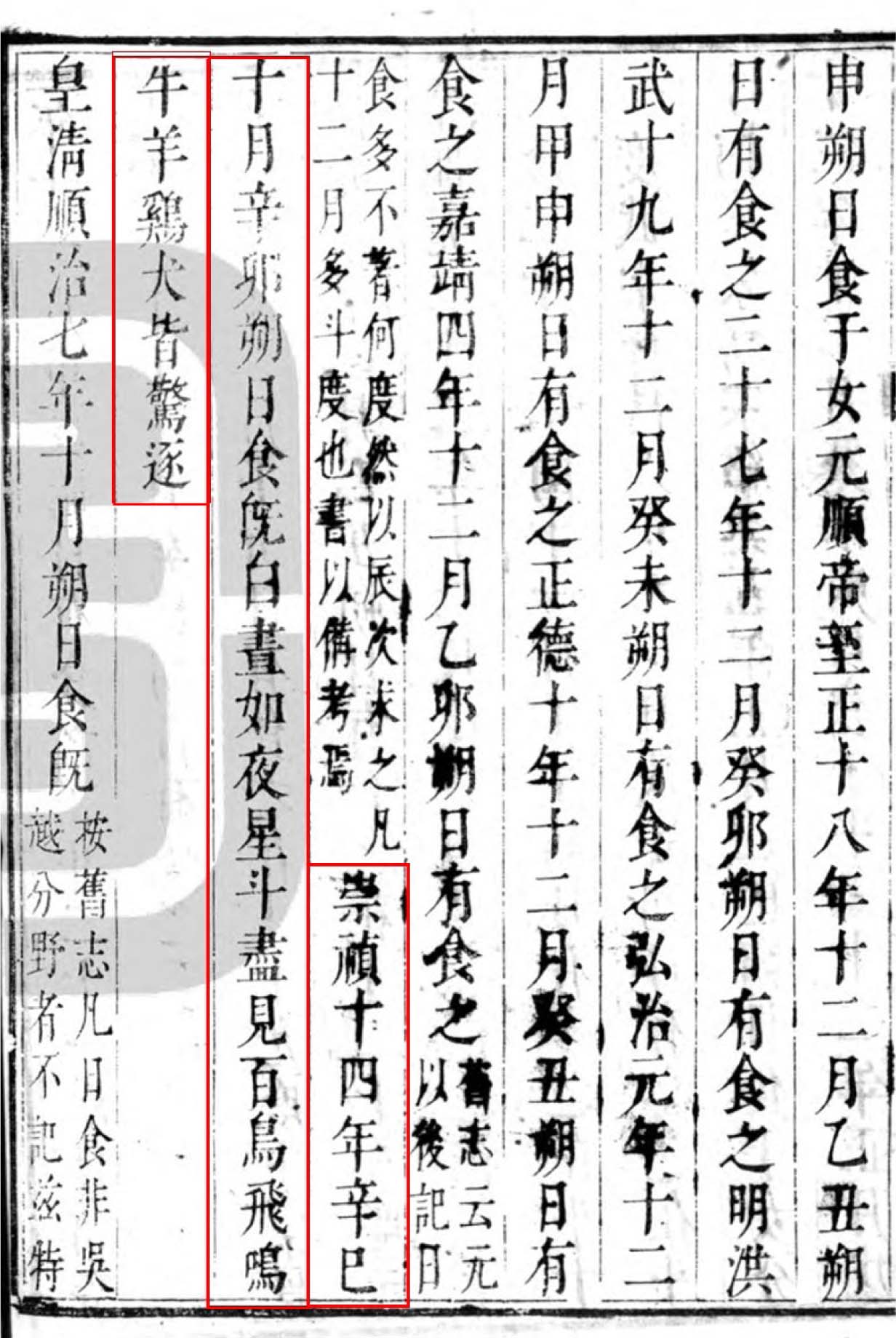
Figure 3.
Astronomical observation records of the solar eclipse on A.D. 1461 November 3 in the Local Chronicle of Shaoxing Prefecture, and the relevant Chinese text is marked with a red border.
Combining the ΔT value obtained from observation in Zhijiang County and Yidu County, we suppose the location of Shaoxing Prefecture (30°.01N, 120°.58E) as the observation site of the solar eclipse on A.D. 1641 November 3 and calculate the visible time of the eclipse phase in Shaoxing Prefecture. The results are listed in Table 2. The local time is also provided in the table.
Table 2.
Visible time of solar eclipse on A.D. 1641 November 3 in Shaoxing Prefecture
| ΔT (sec) | Eclipse phase | TDT (hh:mm:ss) | Local time (hh:mm:ss) | Solar elevation (deg) | Magnitude |
|---|---|---|---|---|---|
| −263 sec | Partial eclipse begins | 4:58:27 | 13:05:09 | 40.7 | 1.0 |
| Maximum eclipse | 6:24:53 | 14:31:35 | 29.4 | ||
| Partial eclipse ends | 7:41:42 | 15:48:25 | 15.8 | ||
| 664 sec | Partial eclipse begins | 4:49:08 | 12:40:23 | 42.8 | 1.0 |
| Maximum eclipse | 6:17:43 | 14:08:58 | 32.9 | ||
| Partial eclipse ends | 7:37:17 | 15:28:32 | 19.5 |
From Table 2, the solar eclipse had a magnitude of 1.00 in Shaoxing Prefecture, indicating that the observable phenomenon at this location was very close to a total solar eclipse. Therefore, it is understandable why ancient people recorded the phenomenon in local records as a total solar eclipse.
5. SUMMARY
Combining with the local chronicles of Zhijiang County and Yidu County from the Qing Dynasty, we confirm that the total solar eclipse on A.D. 1641 November 3 should be observed in the two places. In this work, we study the secular change of the Earth’s variable rotation and obtain the range [−263sec, 664sec] of the ΔT value. Furthermore, we study time of the eclipse in Shaoxing Prefecture. The results are consistent with the actual observation records in the local chronicle. The results of this paper have reference value for related studies about the Earth’s variable rotation.
Acknowledgments
The authors are grateful to JPL for providing the DE astronomical planetary ephemeris and thank Profs. Qiyuan QIAO and Yanben HAN for providing some program codes for solar eclipse calculation. This work was carried out under the support of the Special Research Program on Obscure and Rare Disciplines of the National Social Science Foundation of China (Grant No. 24VJXG010).