
1. INTRODUCTION
Accurate and dense measurements of Earth’s gravity at sea are an essential input to geoscientific products and applications, for example, exploration of natural resources in geophysics and geology or height reference for ship navigation and offshore construction in geodesy and hydrography. In the past, detailed knowledge of the gravity field was crucial for ballistics. Therefore, gravity data were usually confidential. Also, gravity data for exploration purpose may be subject to restrictions due to their commercial value. Thus, gravity data are still often classified and cannot be easily exchanged or distributed. Moreover, new marine gravity surveys are very costly and time-consuming. Due to mathematical requirements of gravity field modeling, gravity data are needed over regions larger than the subject of analysis, including both land and sea areas.
In the 1960s to 1980s, many campaigns of Earth’s gravity measurements were carried out in the coastal zones of Germany, Poland, Lithuania, Latvia, and Estonia, mainly with the support of the research infrastructure of the Soviet Union. During the period of independence from the Soviet Union and the transformation of the political system, much of these older data remain forgotten or not fully used. Now, it is scientifically and economically justified to reactivate these data, especially since the southern and eastern Baltic Sea regions are still not covered by dense gravimetric measurements (see, e.g., Ågren et al., 2016), in contrast to the coasts of Denmark, Germany, and Sweden (see, e.g., Lu et al., 2019; Olsson et al., 2022). Improving the insufficient mapping of the gravity field in the southern and eastern Baltic Sea regions is very important due to the decision of the Baltic Sea Hydrographic Commission (BSHC) to implement a common height reference frame called Baltic Sea Chart Datum 2000 (Liebsch et al., 2023). This datum will be based on a geoid model determined from measurements of the Earth’s gravity. The main challenge is ensuring consistency between the national and Baltic Sea height reference systems, which requires consistent geoid models. Consistency among geoid models can only be achieved by making reliable gravity data available to all interested parties.
The BalMarGrav project (https://interreg-baltic.eu/project/balmargrav/), co-funded by the EU Interreg Baltic Sea Region 2021–2027 Programme, gathered a transnational network of experts in the region to save and reprocess the historical marine gravity data from the southern and eastern parts of the Baltic Sea. During the project, guidelines and methods were developed to recalculate historical marine gravity data to modern geodetic and gravimetric reference systems. As part of the work carried out in the project, two major historical gravity datasets were identified in the maritime area of Poland, each with individual status regarding available original data sources, reprocessing and ownership. The Institute of Geodesy and Cartography (IGiK) in the cooperation with the Academy of Sciences of Union of Soviet Socialist Republics (USSR) conducted the marine gravity measurements during four surveying campaigns: three on the Zaria vessel in 1970–1972 and one on the Jan Turlejski vessel in 1972. The second dataset is supervised by the Polish Geological Institute – National Research Institute (PGI-NRI) and consists of measurements of the Ustka-Rozewie (1976–1979) survey commissioned by the Geological Institute (currently PGI-NRI) and measurements of a sea-bottom campaign in 1978–1979 commissioned by Petrobaltic co. (currently ORLEN Petrobaltic).
Present-day marine gravity surveys along the Polish coast consist of four large campaigns using the Deneb vessel in 2018 (Johann et al., 2023), the Nawigator XXI vessel in 2019 (Pająk and Pyrchla, 2024) and in 2023 (Wilde-Piórko et al., 2023b; Zusevics, 2025), and the ORP Heweliusz in 2021 (Pyrchla et al., 2024). Additionally, seven small campaigns were performed from 2018 to 2024 in the Gulf of Gdańsk, the Gulf of Puck, the Odra River, and along the Polish coast (Pyrchla et al., 2020a; Pyrchla et al., 2020b; Pająk and Pyrchla, 2024).
In this paper, the historical marine gravity data from the Polish Exclusive Economic Zone are reprocessed into gridded datasets to be used for geoid modeling in the future. The historical gravity data are transformed to modern reference frames. Moreover, free-air and Bouguer anomaly grids are obtained. Analyses of their consistency and compatibility with global geopotential and bathymetric models are conducted to validate the gridded historical data.
2. HISTORICAL MARINE GRAVITY CAMPAIGNS ALONG THE POLISH COAST
In 1970–1972, IGiK in cooperation with the Institute of Earth Physics (IPE) of the Academy of Sciences of the USSR conducted the sea surface marine gravity measurements in Polish Baltic waters within four surveying campaigns: on the Zaria vessel in 1970, 1971, and 1972 and on the vessel Jan Turlejski in 1972 (Chowańska-Otyś, 1974; Chowańska-Otyś, 1977; Wilde-Piórko et al., 2023a). Catalogs and descriptive documentation from the Zaria 1970 and 1971 campaigns, as well as from the Jan Turlejski campaign, all in hard copy, were found in the archives of the Geodesy and Geodynamics Center of IGiK. The catalogs and reports exist in Russian as duplicates (original and copy). The documents were scanned, and OCR (Optical character recognition) versions were created. Subsequently, the reports were translated into Polish and English, and ASCII files containing catalog values were prepared. The available documentation does not contain raw data, which makes it impossible to fully reprocess the data. Unfortunately, measurements from the campaign conducted in 1970 were found unsuitable because of problems with determination of the ship’s position. They have never been published and therefore cannot be discussed in this article.
The database of Central Geological Archives (CAG) managed by the PGI-NRI contains two records of historical marine gravity data from the Baltic Sea. They were intended for use in issues related to geophysical exploration and were taken as a supplement to the gravimetric semi-detailed surveys taken simultaneously in the land area of Poland. The largest dataset, in terms of area, taken by Petrobaltic in 1978–1979, was part of the maritime research program of the Warsaw Pact countries carried out in the Baltic Sea region and was carried out by Russian crews. The detailed report of the Petrobaltic campaign (in Russian) was digitized. It contains, among others, a technical description, gravity values, and maps of the gravity anomalies. The Ustka-Rozewie survey (1976–1981) was taken as a complement to Petrobaltic measurements in the coastal area, at smaller depths, and was carried out by Polish teams. The documentation of the Ustka-Rozewie campaign (in Polish), besides the reports, contains also observation logs of the control network measurements. All documents were digitized.
Gravity measurements on the Zaria vessel, 1971
The expedition on the Zaria vessel in 1971 provided gravimetric measurements in the Baltic Sea along the Polish coast between the mouths of the Oder and Vistula rivers, in a strip about 65 km (35 NM) wide (Figure 1; Chowańska-Otyś, 1977; Wilde-Piórko et al., 2023a).
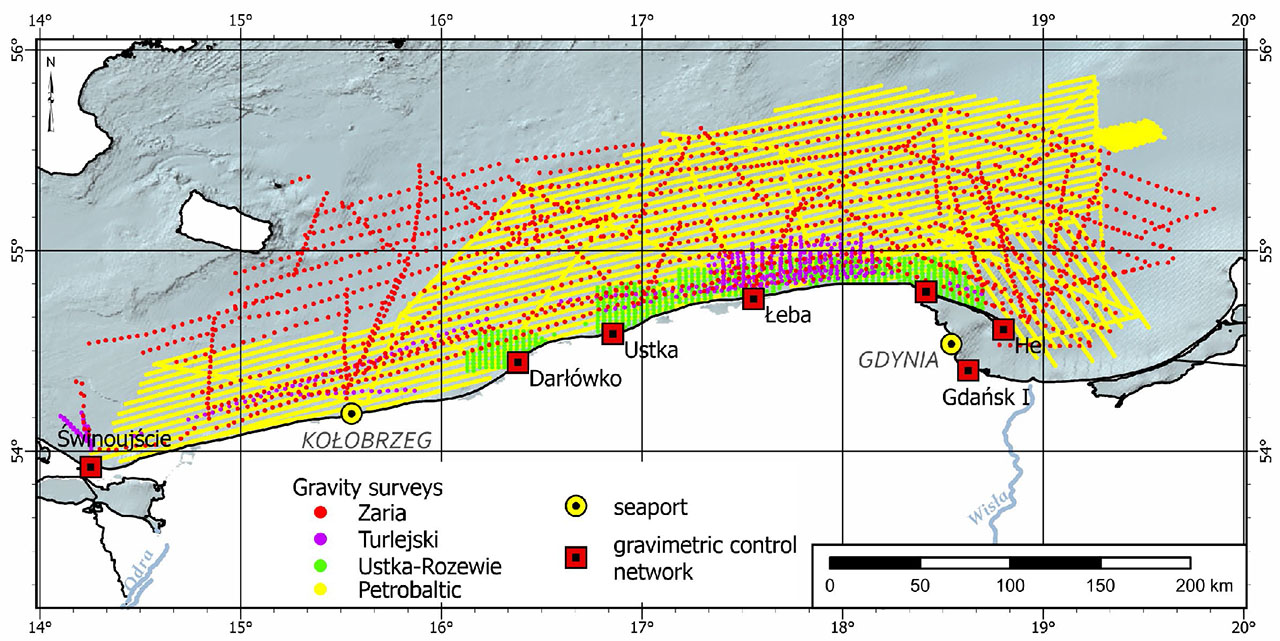
Figure 1.
Historical marine gravity data along the Polish coast collected in 1971–1981
Navigational measurements were conducted by the Gdynia Maritime University. The location of the ship was determined using the Decca radionavigation system, which measured the phase difference of two electromagnetic oscillations sent by two transmitters and recorded by a receiver. The average error of the ships position was estimated at ±224 m, with the maximum value equal to ±960 m. Unfortunately, the coordinate reference frame is not specified. However, it is stated that the data are given in the current reference frame. Thus, the positions of gravity points most probably refer to the Pulkovo “1942” geodetic reference frame (Kryński, 2007).
No information about the method of measuring sea depth and its accuracy, as well as about the reference height system used, was found in the original documentation. It can be assumed that the sea depth was referenced to the Kronstadt-60 vertical datum.
Two reference gravity measurements were conducted in ports of Gdynia and Kołobrzeg (Figure 1) at sites connected with the gravimetric points of the Polish gravimetric control network. The values of gravity were determined in the IGiK-1968 gravity reference frame. A set of three strongly damped, gyroscopically stabilized, gravimeters GAL-M was utilized. Their operating principle was based on elastic properties of twisted fibers. The final gravity value was calculated as the average of the gravity values from three gravimeters. During processing, continuous marine gravimetric measurements on profiles were averaged over each 15-min interval. As a result of averaging, gravity measurements along the routes were reduced to discrete points, spaced by approximately 3.1 km (1.7 NM). The density of gravimetric point coverage at the measured area, excluding rejected measurements, was 1 point per ∼9.3 km2 (5 NM2). The mean square error of a single gravity value, determined from the comparison of the measurements at the intersection points of the profiles, is equal to ±2.2 mGal. Finally, a catalog of gravimetric points and gravimetric maps at a scale of 1:200 000 with a contour interval of 5 mGal were developed, representing the measured values of gravity as well as Faye anomaly and Bouguer anomaly.
Gravity measurements on the Zaria vessel, 1972
Original documentation concerning the campaign conducted in 1972 on the Zaria vessel was not found. However, the file containing the gravity data from this campaign, in the form of point number, latitude [°], longitude [°], gravity [mGal], depth [m], has been preserved in the digital resources of the Centre of Geodesy and Geodynamics of IGiK (Figure 1). It was considered a reliable source of gravity data from the Zaria 1972 campaign. It is also reasonable to assume that these data refer to the same reference frames as data of the Zaria 1971 campaign, that is, gravity refers to the IGiK-68 gravity reference frame (realization of the Potsdam System), positions to the Pulkovo “1942” and sea depths to the Kronstadt-60.
Gravity measurements on the Jan Turlejski vessel, 1972
The aim of the marine gravity campaign conducted on the Jan Turlejski vessel in 1972 was to obtain gravity data of higher accuracy than those from the Zaria campaigns. It was achieved by increasing the accuracy of the ship’s coordinates, reducing the distance between the profiles, and repeating gravity measurements.
The following measurements were conducted (Figure 1): (a) survey in the basin of 1300 km2 near the port of Łeba in order to refine the gravimetric map developed on the basis of observations from the 1971 Zaria campaign; (b) survey along separate routes in the Pomeranian Bay, in the area not covered by the Zaria campaigns; (c) survey during the voyage from Gdynia to Świnoujście and return routes in order to control the measurements conducted during the Zaria campaigns; and (d) measurements during berths in the ports of Gdynia and Świnoujście.
To determine the coordinates of gravity points, Decca and “Sea-fix” (short-range) radio-navigation systems were utilized. The maximum location accuracy with “Sea-fix” system was 2 m (Chowańska-Otyś, 1977). There is no information about the position reference system; however, it is reasonable to assume that it was the Pulkovo “1942,” the same one used for the Zaria campaigns.
No information about the method of measuring sea depth and its accuracy, as well as about the reference height system used, was found in the original documentation. It can be assumed that the sea depth was realized in the Kronstadt-60 vertical datum.
The gravimetric equipment consisted of three gyro-stabilized gravimeters. The gravimetric point on the seaward wharf at the mooring place of the Jan Turlejski vessel in the port of Gdynia was used to link the marine gravity measurements to the national gravimetric control network. There is no information about the gravimetric reference system used, so it was assumed following Kryński (2007) that gravity values refer to the IGiK-68 gravity reference frame.
The 50 × 25 km Łeba polygon was located 10 km north of the port of Łeba in Polish territorial waters. Measurements were conducted along parallel profiles spaced 2 km apart and meridional secant profiles spaced 3 km apart. In the Pomeranian Bay, the measurements were performed on five profiles.
Continuous gravimeter readings were averaged over 10-minute intervals, thereby reducing them to discrete points every 2–3 km. Average gravity values from three gravimeters were calculated. Differences in gravity at nodal points were determined, and then, the gravimetric observations were adjusted. The final results of gravimetric measurements were presented in the form of a catalog of gravimetric points and gravimetric maps (for the Łeba polygon) at a scale of 1:200,000 with a contour interval of 2.5 mGal for observed gravity values as well as Faye and Bouguer anomalies. The accuracy of Jan Turlejski gravity data was assessed as to be at the level of 2.0–2.5 mGal.
Petrobaltic sea bottom campaign, 1978–1979
Observations of gravity values at the bottom of the Baltic Sea were conducted using GAKEMK bottom gravimeters. Relative measurements were referenced to bottom points in Klaipėda and Kaliningrad, implementing the IGSN71 system in the area of USSR. In 1981, some points of detailed marine network, established for surveying, were connected to the existing PGI-NRI detailed gravimetric network, that is, the implementation of the Potsdam gravity system in Poland (two points: Gdańsk and Świnoujście; Olszak et al., 2024). The points in this dataset were located using a radio-navigation system with an accuracy of approximately 80 m, and the depths were determined using a probe with an accuracy of 1.4 m. Available documents do not contain raw data, which makes it impossible to fully reprocess the data. The area covered by the measurements is approximately 27,180 km2, on which 8,878 points were located with an average interval of 1 km along profiles with 4-km interval between profiles. Approximately 4% of points were selected for control measurements, which showed that the accuracy of the gravity measurements on the sea surface at the level of 0.7 mGal (mean square error). The available dataset contains coordinates of points in the Pulkovo “1942”, sea depths in the Kronstadt-60, gravity values in the IGSN71 system implemented by the USSR gravimetric network, and free-air and Bouguer anomalies for several densities. In addition to gravimetric measurements, geomagnetic imaging was also taken as part of this campaign.
Ustka-Rozewie sea bottom campaign, 1976–1981
An additional survey, complementing the one conducted on behalf of Petrobaltic, was carried out in coastal areas in 1976–1981; it is known as the Ustka-Rozewie study. The measurements covered the area up to 10 km from the coastline, excluding the Bay of Gdańsk and military naval training areas. Gravimetric measurements were performed on the sea bottom synchronously using two gravimeters, GAK-7 DT and GD-K, on both sides of the ship. The geolocation was determined using the radio navigation method (RYM-2 probe), with an accuracy of ±20 m, and the depths of the points were determined using the Krupp probe with an accuracy of 0.1 m. In total, the measurements covered 690 points designed in a grid with an average spacing of 2 km. The reference network consisted of several deep-sea control points connected to the PGI-NRI 3rd class gravimetric control network in the Potsdam system (Olszak et al., 2024). In each measurement epoch, approximately 2–3% of the points were repeated, obtaining mean square differences of 0.24 mGal within each year of measurement. Very good consistency of the measurements was achieved as a result of the use of synchronous measurements and a small processing area, which minimized gravimeter scale errors. The surveys were not completed, the area of western coast of Poland was missed due to martial law introduced in Poland. Afterwards, in times of economic crisis from the beginning of the 1980s, there was a lack of financial resources.
The documents, in Polish, include observation logs of underwater base network and survey measurements, making it possible to fully recalculate all measurements thanks to adjustment of base network with a strict least-square method to new gravimetric system, International Terrestrial Gravimetric Reference Frame (ITGRF), and detailed measurement redevelopment. The available dataset contains coordinates of points in the Pulkovo “1942”, sea depths in the Kronstadt-60, and the value of gravity in the Potsdam system implemented by the PGI-NRI archival 3rd class network.
3. CONVERSION OF HISTORICAL MARINE GRAVITY DATA TO MODERN REFERENCE FRAMES
Geodetic reference frame
The positions of historical marine gravity data along the Polish coast were determined in the Pulkovo “1942” geodetic reference frame referred to the Krasovsky ellipsoid. The conversion of geodetic coordinates to ETRF2000 (2011 epoch) was conducted based on the Bursa-Wolf transformation with seven parameters determined for the points of the basic geodetic control network for the area of Poland (Kadaj, 2001; Kadaj 2015). Parameters of this transformation are also defined as a EPSG code no. 1644. The accuracy of such conversion is about 1 cm for the area of Poland, and an extrapolation beyond the land area decreases it up to 10 cm. Neglecting the quasi-geoid undulation with respect to Krasovsky ellipsoid, that is, assuming that the normal height is equal to the ellipsoidal height, leads to a horizontal position error of 0.36 mm. For a quasi-geoid height difference of 15 m with respect to the Krasovsky ellipsoid (typical for southern Baltic Sea), the nonparallelism between the normal vectors of the Krasovsky and GRS80 ellipsoids does not exceed 5 arcsec. The coordinates of each gravity station were recalculated with own developed software.
Height reference frame
Conversion of the depth values from the Kronstadt-60 height datum to the European Vertical Reference Frame (EVRF) was omitted due to the lack of clarity about the height systems in which the measurements were made and the quality of the sensors. The difference between the past height frames and modern one (EVRF2007) could be estimated at +15 cm in the case of the Kronstadt-86 and +7 cm in the case of the older Kronstadt-60 (https://www.crs-geo.eu/crs-description.htm). These values exceed far the accuracy of the depths provided in the catalogs. Additionally, depth values affect the free-air and Bouguer (with density of 2.67 g/cm3) anomalies by 0.040 mGal and 0.010 mGal, respectively, which is also far beyond the reported accuracies of the gravity data. So finally, all original values of heights and depths were used.
Gravimetric reference frame
The historical marine gravity data along the Polish coast were determined in the reference gravity frames depending on their origin: Zaria and Jan Turlejski in IGiK-68 and the Petrobaltic and Ustka-Rozewie in PIG-68. These frames are realizations of the Potsdam System, so conversion of gravity data to the ITGRF is necessary. The transformation procedures differ and depend on the availability of raw documentation.
In the case of Zaria and Jan Turlejski campaigns, a conversion formula was developed based on recalculation of gravity values at the gravimetric control network points in Gdańsk and Kołobrzeg, that is, the nearest ones to these campaign areas:
where:gIGRF – gravity value in the IGRF [mGal];
gIGSN71 – gravity value in the IGSN71 [mGal];
gIGiK–68 – gravity value in the IGiK-68 [mGal].
Details concerning the recalculation procedure are given in Wilde-Piórko et al. (2023a).
The conversion of the Petrobaltic and Ustka-Rozewie gravity data to the ITGRF was done with different approaches, depending on the content and detail of the available documents. For the Petrobaltic campaign, no raw measurement logs are available. Marine gravity values were referred only to two Polish reference coastal points in Świnoujście and Gdańsk. In 2023, these points were remeasured and related to the modern basic gravimetric control network of Poland. These new values determined in the ITGRF were used to re-adjust the Petrobaltic network of sea bottom points by using the least-square method (LSM). Next, a simple mathematical model of gravity correction was developed with linear polynomial formula of geodetic latitude and longitude by using the new gravity values of sea bottom network. This strategy of “distribution” of gravity values allowed to create a model with average accuracy of 0.057 mGal (root mean square error), with a maximum residual value of 0.1 mGal. The transition from the Petrobaltic gravity frame to the ITGRF resulted in a change of gravity values by 0.25–0.5 mGal (Figure 2).
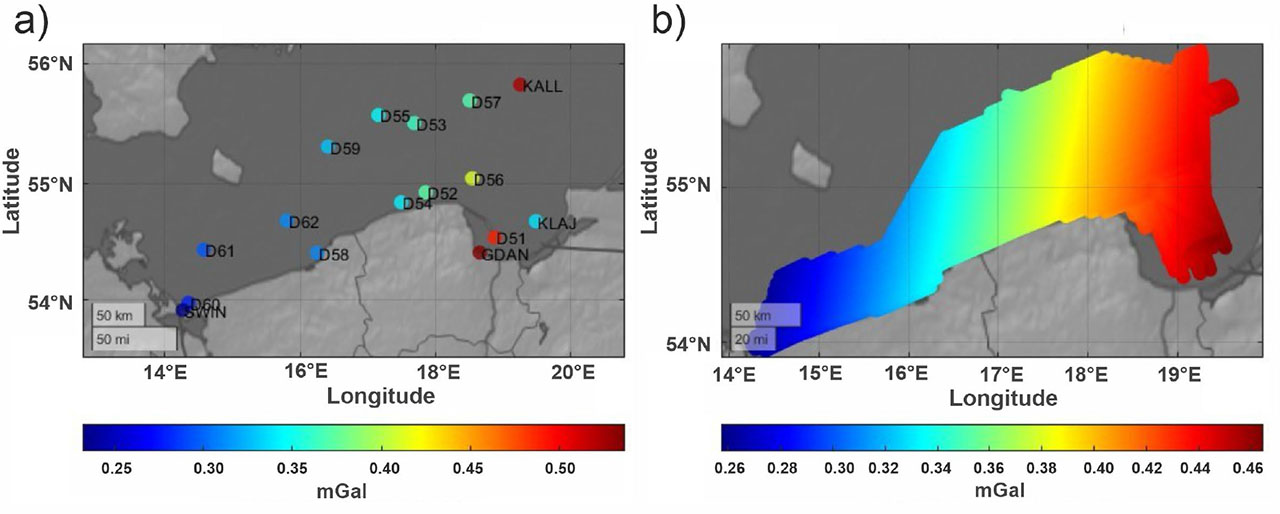
Figure 2.
Gravity difference between the USSR realization of IGSN71 and ITGRF for the Petrobaltic network (a) and a distribution of the gravity corrections applied to the Petrobaltic data (b)
For the Ustka-Rozewie campaign, the observation logs of the control network measurements and detailed reports have been preserved. In 2023, each of the five points of the coastal control network of campaign was remeasured by a relative gravimeter with an error of 10 µGal and referred to the modern basic gravimetric control network of Poland. Next, the bottom gravity control network of the campaign was aligned by LSM, resulting in an average error of gravity values of 0.106 mGal. This adjustment covered the whole bottom control network and is therefore characterized by slightly larger errors in comparisons with original calculations, where network fragments (subnetwork) were aligned separately. However, the proposed approach ensures a single-rank network of reference points and no differences between the epochs of measurement. At the end, the values of gravity at measured points were determined by recalculation of measurement logs in the profile method scheme using the new gravity values developed at the bottom control network.
4. DETERMINATION OF FREE-AIR AND BOUGUER ANOMALY GRIDS
Free-air and Bouguer gravity anomalies at gravity point P were calculated as follows:
where:gP – gravity value at the gravimetric point P at the sea surface (HP = 0);
γQ – normal gravity at the projection of P on the GRS80 ellipsoid;
G – gravitational constant;
ρ – mean density of the Earth’s upper crust 2.67 g/cm3;
ρw – salt water density 1.03 g/cm3;
DP – sea depth below the gravimetric point P.
Additionally, it was necessary to recalculate the gravity values from the sea bottom to the sea surface for the Petrobaltic and Ustka-Rozewie campaigns. The following formula (Poincaré-Prey reduction) was used for this purpose:
where:Hw – height of the water column above the gravimetric point as negative value;
ρwγQ – salt water density 1.03 g/cm3.
Taking into account the observation techniques and the quality of the sensors used at that time, quality of depth measurements was analyzed by comparing them with the bathymetric model ETOPO 2022 of 15″ resolution (NOAA, 2022; accessed 01/2024). The difference between depths of each measured point and the ETOPO 2022 model was calculated (Figure 3). Results indicate a significant difference in the accuracy of bathymetric data for each campaign (Table 1). The Petrobaltic and Ustka-Rozewie surveys are characterized by the standard deviation of differences between measured and modeled values of 1.4 m, slightly worse than the declared accuracy of the sensor used. However, taking into account the uncertainty of the ETOPO 2022 model and the uncertainty of point location at sea, this result should be considered very good. In the case of older missions, that is, Zaria and Jan Turlejski, significantly worse results are obtained, which indicate that the depth data are not very reliable, and they should not be used for the calculation of Bouguer anomalies. Additionally, gravity values of points showing the biggest depth differences in relation to the ETOPO 2022 model may be determined incorrectly, for example, as a result of an incorrectly measured position. Therefore, such points were manually removed from the datasets. Finally, in case of data from Zaria and Jan Turlejski campaigns for further calculations, it was decided to use depth values from the ETOPO 2022 model, as they are very compatible with the latest marine gravity campaigns.
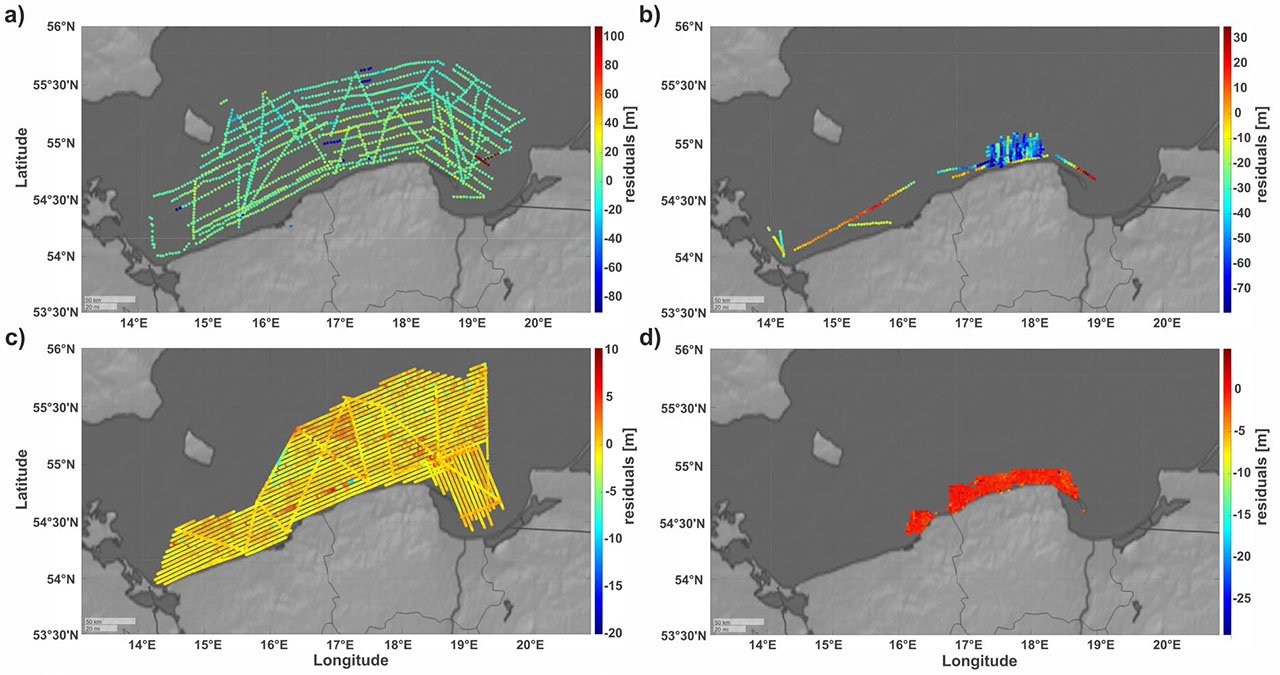
Figure 3.
Differences between the depths measured and depths from the ETOPO 2022 15″ model for the Zaria (a), Jan Turlejski (b), Petrobaltic (c), and Ustka-Rozewie (d) campaigns
Table 1.
Statistics of the differences of depths measured during the Polish historical gravimetric campaigns and the respective ones obtained from the ETOPO 2022 model [m]
| Gravimetric campaign | Number of points | Min | Max | Mean | Std. dev. |
|---|---|---|---|---|---|
| Zaria | 1710 | −90.5 | 107.4 | 2.9 | 14.6 |
| Jan Turlejski | 409 | −79.4 | 34.8 | −34.5 | 26.3 |
| Petrobaltic | 8382 | −20.0 | 10.2 | 0.2 | 1.4 |
| Ustka-Rozewie | 717 | −29.3 | 4.9 | −0.7 | 1.4 |
The calculated Bouguer anomalies were tested externally, that is, the values of Bouguer anomalies at crossovers were compared between campaigns. The calculations were conducted for point data within a 3-km radius using the cubic interpolation (Table 2). The highest standard deviation of differences between the campaigns, that is, above 3 mGal, was observed for the following pairs: Zaria 1971 – Zaria 1972, Zaria 1971 – Petrobaltic and Zaria 1972 – Jan Turlejski. The lowest ones, that is, below 2 mGal, were observed for Zaria 1971 – Jan Turlejski, Jan Turlejski – Petrobaltic and Petrobaltic – Ustka-Rozewie. Generally, the observed differences are not large taking into account inaccuracies in the determination of the position far from the shore during the Zaria 1971 and Zaria 1972 campaigns.
Table 2.
Statistics of the differences between the recalculated Bouguer anomalies for the Polish historical gravimetric campaigns [mGal]
| Gravimetric campaign | Number of crossovers | Min | Max | Mean | Std. dev. |
|---|---|---|---|---|---|
| Zaria 1971 – Zaria 1972 | 42 | −11.2 | 7.0 | −1.1 | 3.8 |
| Zaria 1971 – Jan Turlejski | 57 | −5.8 | 3.7 | −0.7 | 1.7 |
| Zaria 1971 – Petrobaltic | 221 | −7.3 | 9.7 | 0.7 | 3.6 |
| Zaria 1971 – Ustka-Rozewie | 47 | −3.9 | 4.3 | −1.0 | 2.0 |
| Zaria 1972 – Jan Turlejski | 19 | −1.2 | 9.2 | 1.8 | 3.3 |
| Zaria 1972 – Petrobaltic | 223 | −5.0 | 8.6 | 2.4 | 2.5 |
| Zaria 1972 – Ustka-Rozewie | 13 | −5.1 | 5.4 | −0.9 | 2.9 |
| Jan Turlejski – Petrobaltic | 144 | −9.6 | 1.4 | −2.0 | 1.9 |
| Jan Turlejski – Ustka-Rozewie | 95 | −7.1 | 2.2 | −2.1 | 2.2 |
| Petrobaltic – Ustka-Rozewie | 134 | −1.8 | 8.2 | 0.5 | 1.2 |
The choice of the grid resolution was optimized based on interpolation error analysis for free-air and Bouguer anomalies. The cells of 15″, 30″, 45″, 1′, 1.2′, 1.5′ and 2′ size were tested, and the root square mean of difference between the interpolated values at grid points and nearest observed point values (RMS) was calculated (Figure 4). The kriging method was utilized for the interpolation. The RMS values calculated from the free-air and Bouguer anomalies showed very high compliance; thus, later only the RMS for free-air anomalies was discussed. The most appropriate cell sizes are those for which the RMS values are close to the uncertainty of the gravity measurements, that is, 2′ for Zaria and Jan Turlejski, 30″ for Petrobaltic, and 15″ for Ustka-Rozewie. However, to standardize historical data, facilitate its subsequent use, and meet the requirements for regional geoid model calculation, the recalculated datasets were gridded at 1′ × 1′. This resolution offers an optimal compromise between the datasets’ varying quality and the need for grid uniformity.
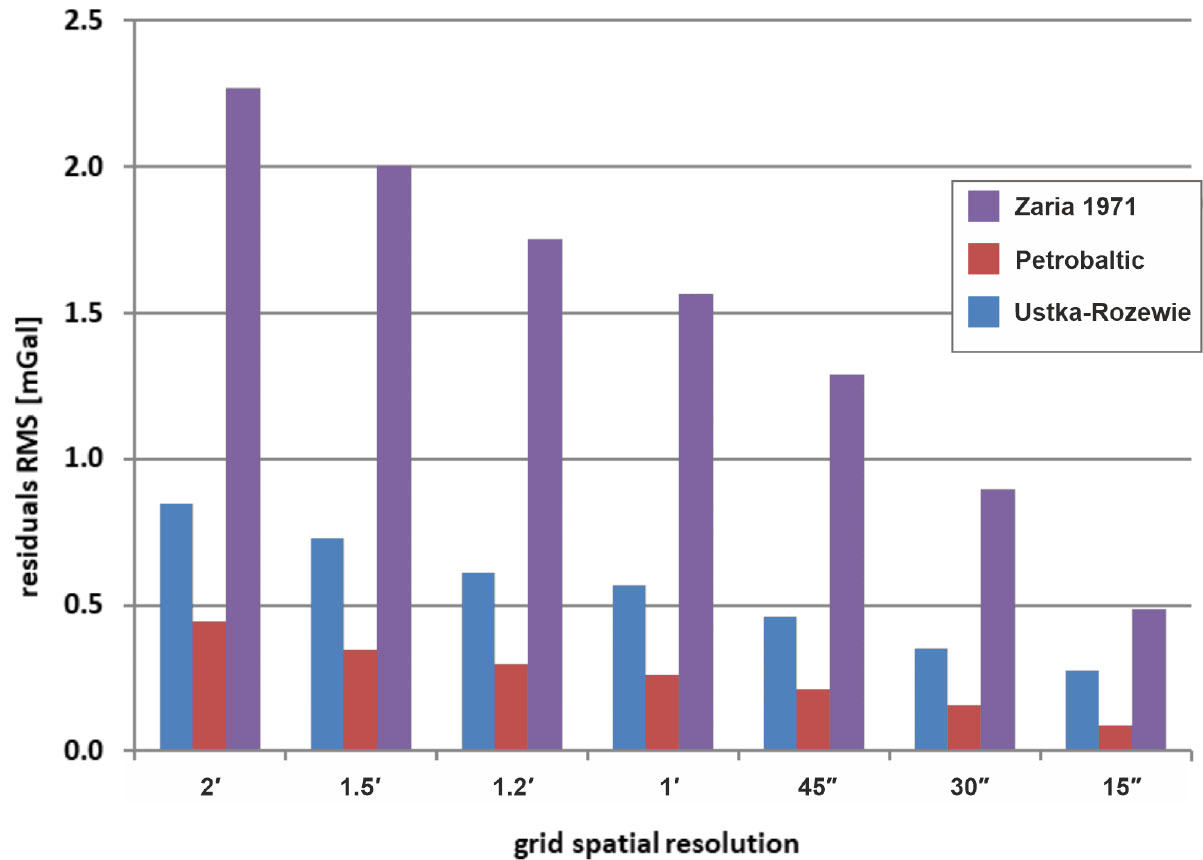
Figure 4.
Interpolation errors of free-air anomalies with respect to the size of grid cells
Finally, free-air (Figure 5) and Bouguer (Figure 6) anomalies of all datasets were interpolated into a grid with a spatial resolution of 1′ × 1′, which corresponds to 1.9 km × 1.1 km, in the area of 54° < φ < 56° and 14° < λ < 20°. The grid for each campaign was truncated using the boundary generated on the base of the coverage of these campaigns.
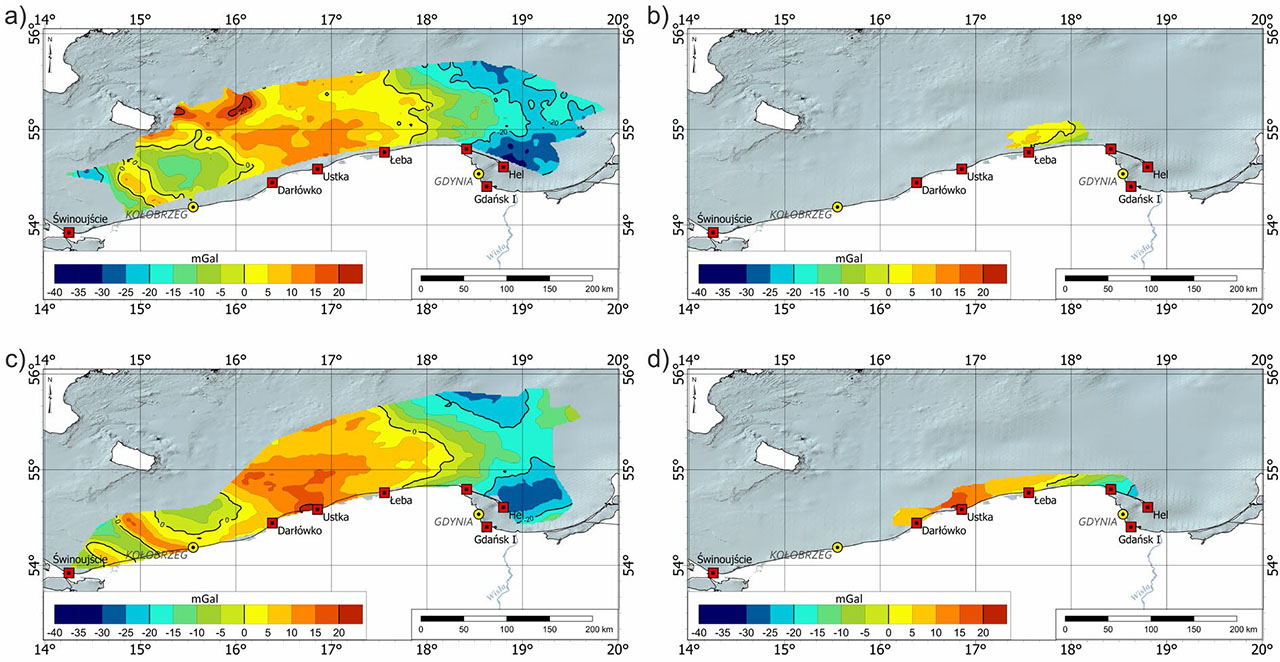
Figure 5.
Gridded free-air anomalies calculated from the measurements of the Zaria (a), Jan Turlejski (b), Petrobaltic (c), and Ustka-Rozewie (d) campaigns
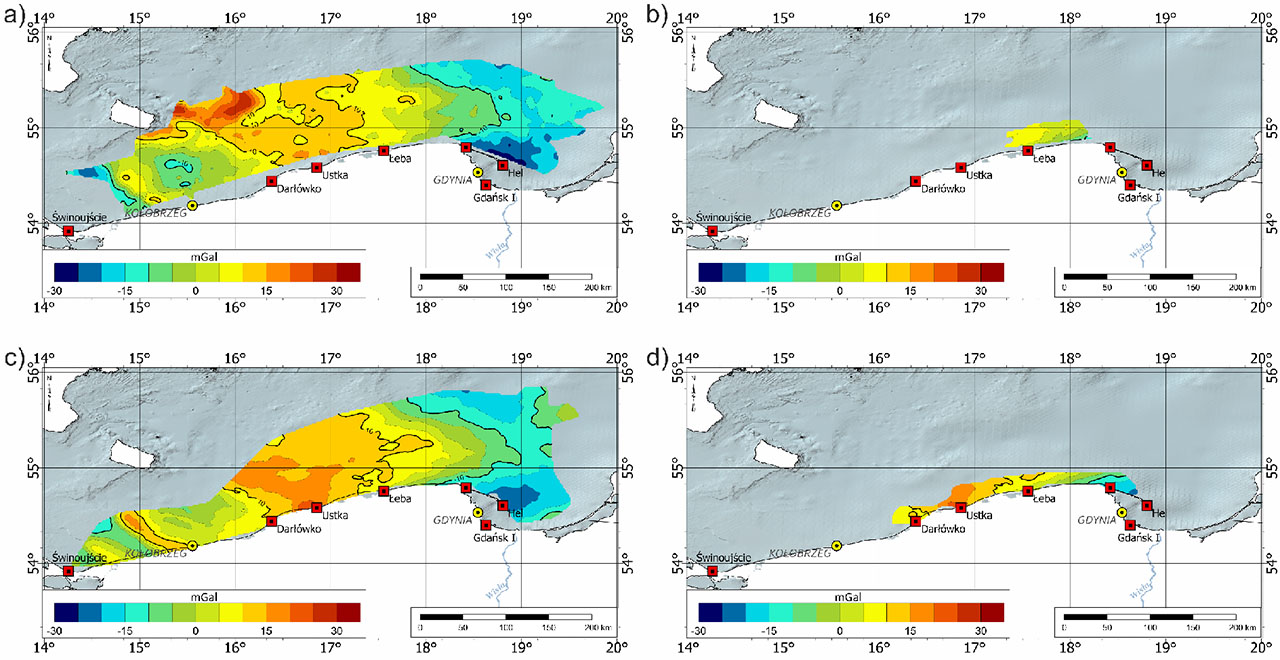
Figure 6.
Gridded Bouguer anomalies calculated from the measurements of the Zaria (a), Jan Turlejski (b), Petrobaltic (c), and Ustka-Rozewie (d) campaigns
5. DISCUSSION
Three global geopotential models: EGM2008 (Pavlis et al., 2012), EIGEN-6c4 (Förste et al., 2014), and GECO (Gilardoni et al., 2016) were used for validation of resulted anomalies grids in the study area. Models were downloaded as gfc files from the International Centre for Global Earth Models (ICGEM) service (Ince et al., 2019; accessed 01/2024). Differences between free-air anomalies of Polish historical marine gravity measurements and free-air anomaly values obtained from the above-mentioned models for grid points for each campaign are shown in Figures 7–10 and their statistics in Table 3.
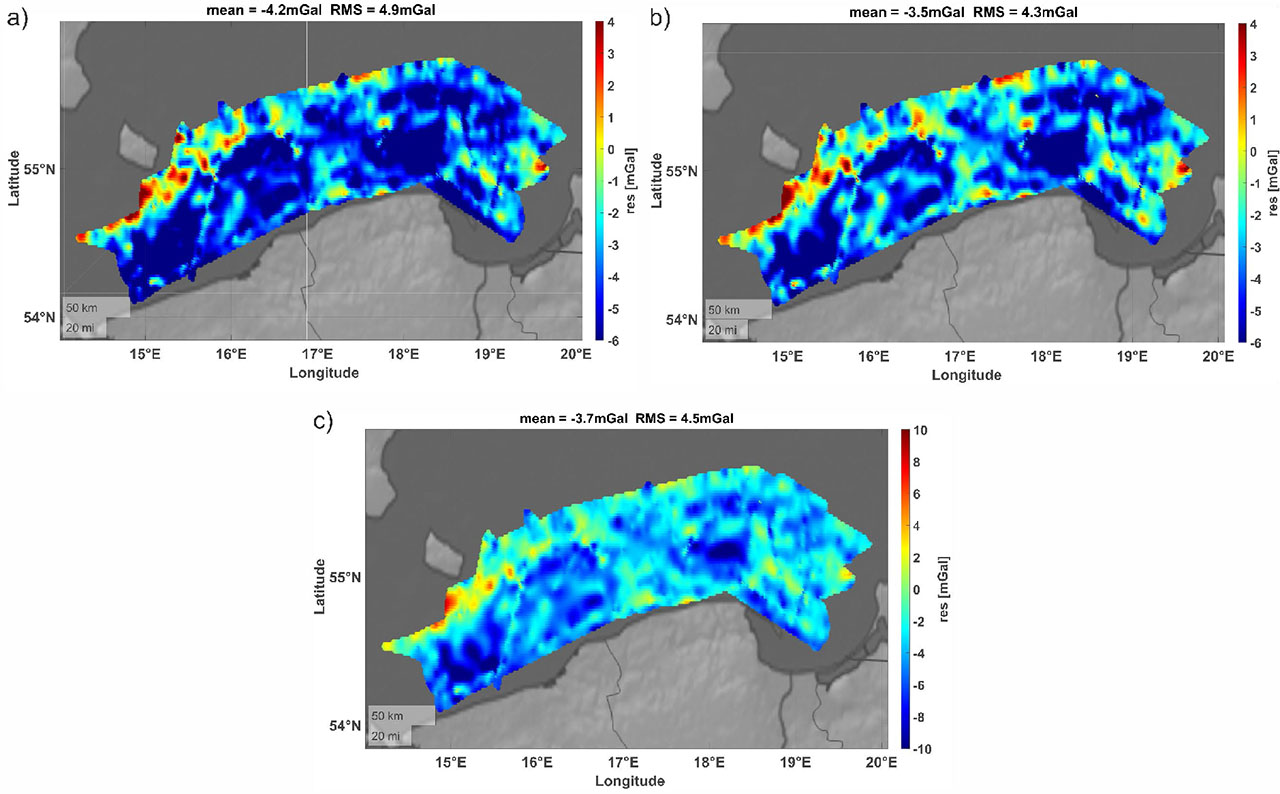
Figure 7.
Differences between the gridded free-air anomalies from the Zaria campaign and EGM2008 (a), EIGEN-6c4 (b), and GECO (c) models, respectively [mGals]
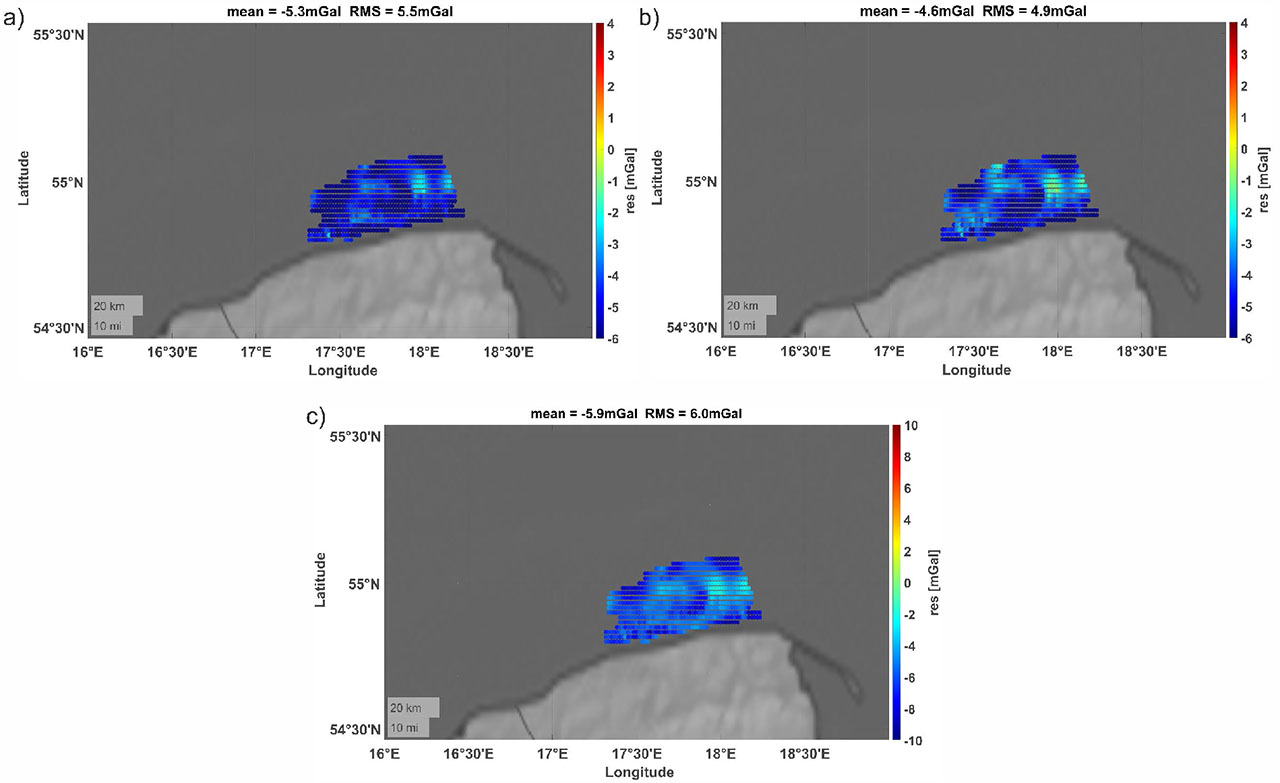
Figure 8.
Differences between the gridded free-air anomalies from the Jan Turlejski campaign and EGM2008 (a), EIGEN-6c4 (b), and GECO (c) models, respectively [mGals]
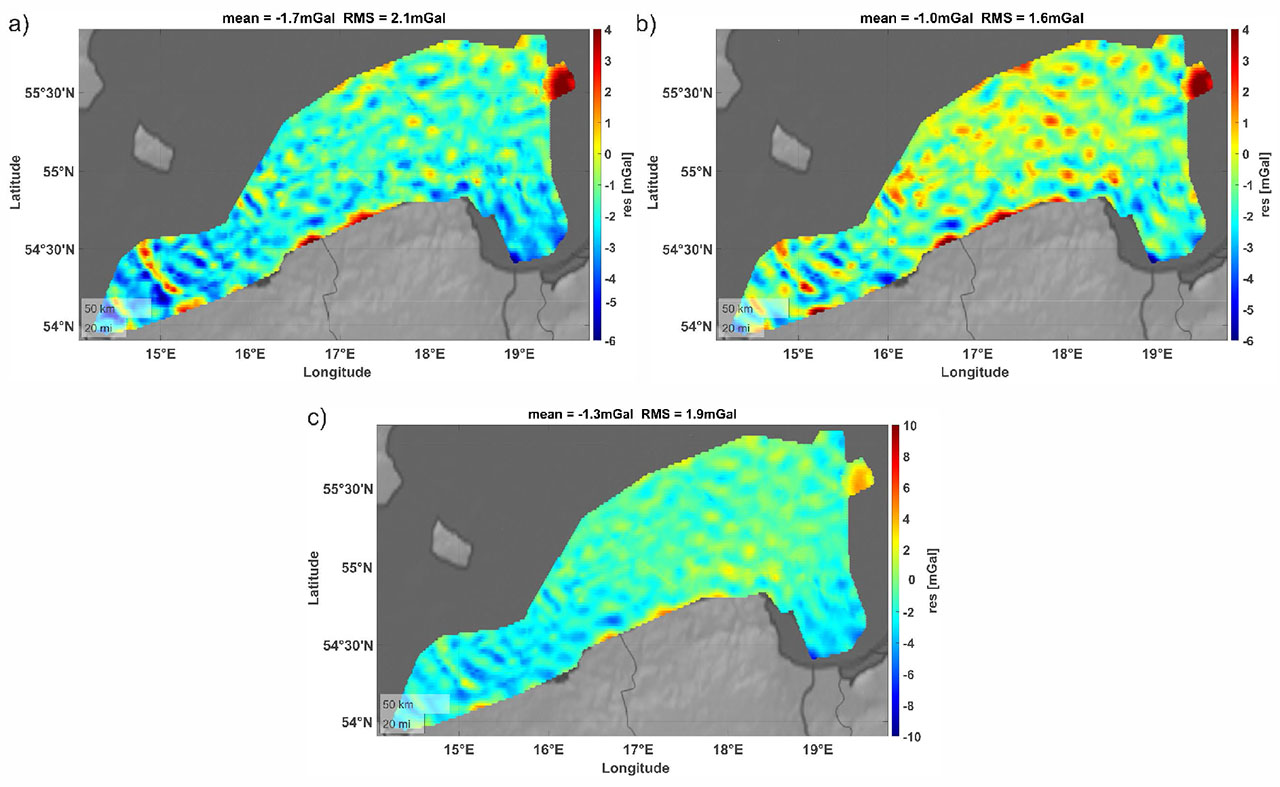
Figure 9.
Differences between the gridded free-air anomalies from the Petrobaltic campaign and EGM2008 (a), EIGEN-6c4 (b), and GECO (c) models, respectively [mGals]
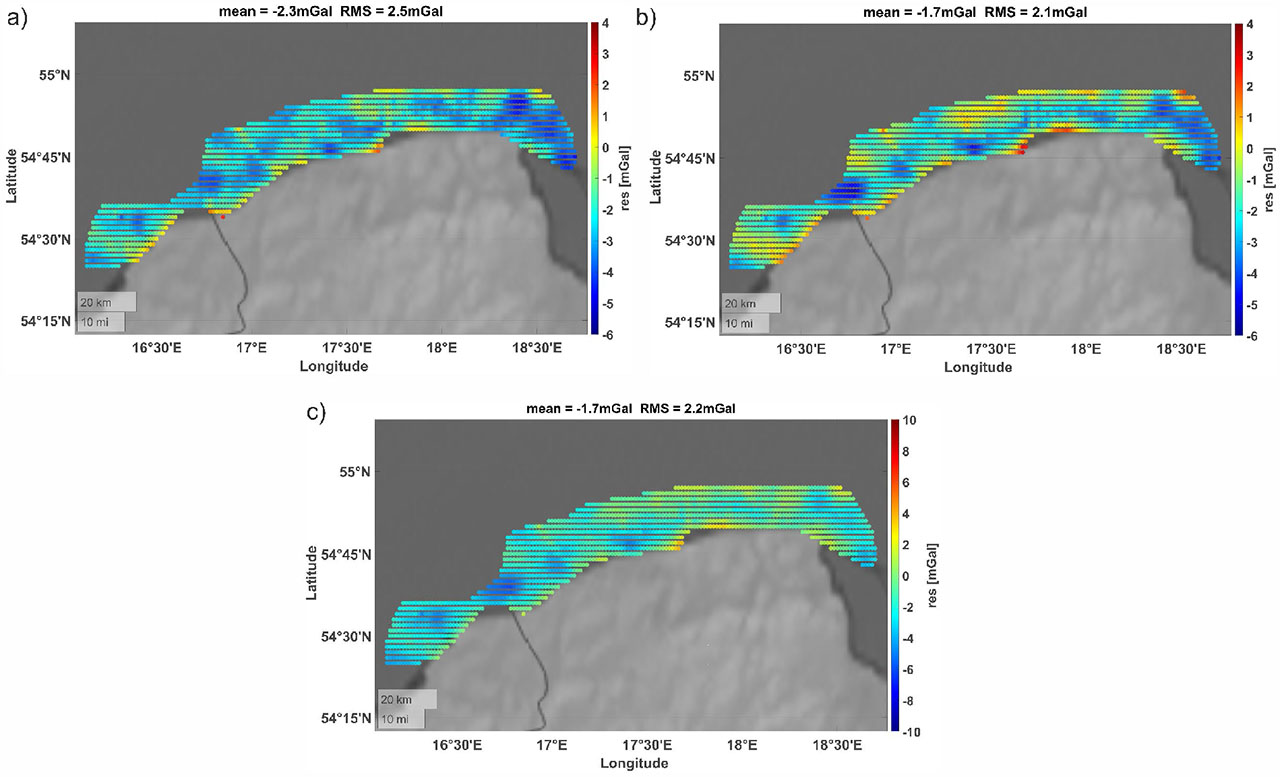
Figure 10.
Differences between the gridded free-air anomalies from the Ustka-Rozewie campaign and EGM2008 (a), EIGEN-6c4 (b), and GECO (c) models, respectively [mGals]
Table 3.
Statistical summary of differences between gridded free-air anomalies calculated from the Polish historical marine gravity measurements and global geopotential models (GGM) [mGal]
| GGM | EGM2008 | EIGEN6c4 | GECO | |||||||||
|---|---|---|---|---|---|---|---|---|---|---|---|---|
| Statistics/Campaign | Min | Max | Mean | Std. dev. | Min | Max | Mean | Std. dev. | Min | Max | Mean | Std. dev. |
| Zaria | −13.9 | 6.9 | −4.2 | 2.5 | −13.0 | 8.1 | −3.5 | 2.4 | −13.9 | 8.8 | −3.7 | 2.5 |
| Jan Turlejski | −9.8 | −2.0 | −5.3 | 1.3 | −9.6 | −0.8 | −4.6 | 1.5 | −9.9 | −1.7 | −5.9 | 1.4 |
| Petrobaltic | −6.2 | 5.8 | −1.7 | 1.2 | −7.6 | 6.3 | −1.0 | 1.2 | −7.4 | 5.4 | −1.3 | 1.4 |
| Ustka-Rozewie | −4.9 | 2.5 | −2.3 | 1.0 | −5.4 | 3.0 | −1.7 | 1.3 | −6.1 | 3.8 | −1.7 | 1.5 |
The EGM2008, EIGEN6c4, and GECO models show very good consistency of resulted gridded anomalies obtained on the basis of the Jan Turlejski, Petrobaltic, and Ustka-Rozewie campaigns, with standard deviations of residuals of 1.0–1.5 mGal. However, gravity values of the Jan Turlejski campaign seem to be shifted by about −5 mGal in comparison to global geopotential models. The lowest compatibility between measured and global geopotential models is observed for northwestern area of the Zaria campaign, close to the Bornholm island, where a range of free-air anomaly differences exceeds 20 mGal. Most probably, it is a result of reported low accuracy, over 1 km, in determination of the positions of survey points.
However, it has to be stated that in spite of the “age” of the presented marine gravity data, they show very good agreement with the modern global geopotential models, especially in the case of bottom measurements conducted within the Petrobaltic and Ustka-Rozewie campaigns.
6. CONCLUSIONS
The presented study allowed the recovery of historical Polish marine gravity data, which were measured in 1971–1981 in the southern Baltic Sea. The coordinates of measured points were transformed to the ETRF2000 (2011 epoch), their heights to the EVRF2007 and gravity values to the ITGRF, taking into account the available documentation. In case of Zaria and Jan Turlejski campaigns, only the simplest transformation of gravity data was possible. In case of the Petrobaltic survey, a mathematical formula for conversion of gravity values based on an empirically determined model was created and utilized. For the Ustka-Rozewie survey, archive data were converted using the control network adjustment and logs calculation. Next, a simple procedure for determination of gridding resolution was proposed, and the gridded 1′×1′ free-air and Bouguer anomalies were calculated for each survey. Finally, the resulted gridded anomalies were validated using three global geopotential models: EGM2008, EIGEN6c4, and GECO, showing very good consistency of resulted gridded anomalies of the Jan Turlejski, Petrobaltic, and Ustka-Rozewie campaigns, with standard deviations of residuals of 1.0–1.5 mGal. Only in the case of the Zaria campaigns was the standard deviation of residuals 2.5 mGal. Additionally, depths measured during the surveys were validated by the bathymetric model ETOPO 2022 of 15" resolution, indicating that for the Zaria and Jan Turlejski campaigns, depths are not very reliable and should be replaced by values derived from modern bathymetric models.
Acknowledgments
The authors would like to thank the anonymous reviewers for their valuable comments and corrections, which greatly contributed to improving the quality of the manuscript. The authors would like to express their gratitude for the valuable substantive discussions that took place during the BalMarGrav project meetings among the members of the BalMarGrav Working Group. The presented work was co-funded by the European Union in the frame of the Interreg Baltic Sea Region Programme 2021–2027 under the #S009 BalMarGrav project. Additionally, the work of the IGiK employees was supported by the Polish Ministry of Education and Science within the framework of the program entitled “Co-financed International Projects” – Contract No. 5271/Interreg VI B BSR 2021-2027/2023/2 for the execution of the co-financed international project No. W 59/Interreg VI B Baltic Sea Region 2021-2027/2022. The realization of the BalMarGrav project in the PGI-NRI was co-financed by a subsidy from the Ministry of Education and Science (currently the Polish Minister of Science and Higher Education) with funding covering the years 2023 and 2024.
The BalMarGrav Working Group: Tobias Bauer, Mirjam Bilker-Koivula, Przemysław Dykowski, Artu Ellmann, Orjan Josefsson, Jānis Kaminskis, Jan Kryński, Tobias Nilsson, Romuald Obuchovski, Per-Anders Olsson, Tomasz Olszak, Eimuntas Kazimieras Paršeliūnas, Jerzy Pyrchla, Krzysztof Pyrchla, Olga Rosowiecka, Joachim Schwabe, Gabriel Strykowski, Małgorzata Szelachowska, Jakub Szulwic, Arkadiusz Tomczak, Sander Varbla, Monika Wilde-Piórko, and Vents Zuševics.