
1. INTRODUCTION
The accomplishments of ancient Chinese astronomy are evident in its astronomical observations, calendars, instruments, and universal theories imbued with oriental characteristics. The astronomical observations are one of the main contents of this field. The continuity, comprehensiveness, and precision found in the historical records of Chinese astronomy are unmatched by any other nation globally. These records serve as crucial historical resources for studying ancient astronomy.
Since the 20th century, the discovery of high-precision quartz clocks has enabled direct observation of the Earth’s variable rotation. This was followed by the invention of various types of atomic clocks and the development of Earth observation technologies such as the Very Long Baseline Interferometry, the Satellite Laser Ranging, and the Global Positioning System. These advancements have allowed for continuous observations of the Earth’s rotational variations over many years. It is widely recognized that the Earth’s rotation is closely related to various components of the global system, including the solid Earth, atmosphere, and oceanosphere. The variation in Earth’s rotation influences these components to a certain extent. Consequently, studies on the Earth’s variable rotation have garnered significant attention from astronomers and geophysicists (Barnes et al., 1983; Dickey, 1995; Chao, 2004; Le Mouël et al., 2019).
Researchers have determined that variations in Earth’s rotation from A.D. 1623 can be ascertained through telescopic observations of lunar occultations and planetary transits. Historical records of solar and lunar eclipses further allow for the identification of earlier secular changes in Earth’s rotation. Since the 1960s, numerous scholars have undertaken studies to project these secular changes using ancient solar and lunar eclipse observations (Pang et al., 1988, 1995; Stephenson & Morrison, 1995; Stephenson, 1997; Zhang & Han, 1995, 2000; Han, 1999; Wu & Liu, 1987; Liu, 1988; Sôma et al., 2002; Tanikawa & Sôma, 2004; Ma, 2023a, 2023b, 2023c). They used solar eclipse observations from different periods in ancient times to study the changes in Earth’s rotation at that time. Notably, Stephenson et al. (2016) compiled historical observations from some historical countries, including China, India, and Babylon, to examine the secular change in Earth’s rotation over the past four millennia.
The secular change of the Earth’s rotation can be examined through observational records of solar eclipses, inclusive of total and annular solar eclipses (collectively referred to as central eclipses), at specific locations. If the stage moment of the solar eclipse is documented at that location, it also provides insight into the secular change of the Earth’s rotation. While numerous observational records concerning eclipse observations exist within Chinese historical documents, relatively few include information on the stage moment of the eclipse.
Historical records of the total solar eclipse on June 25, A.D. 1275 are preserved in ancient Chinese documents. Some documents also provided the moment of the eclipse’s stage. However, these records failed to give the site of observation at the time. In conventional studies, it is often presumed that the dynasty’s capital is the observation site at that time. This assumption is reasonable given that the official responsible for astronomical observations would likely be located in the capital. Morrison et al. (2021) identified Linan (120°15E, 30°28N), the capital during Emperor Deyou’s reign in the Song Dynasty, as the observation site for the solar eclipse on June 25, A.D. 1275 and calculated a ΔT value range. In this present work, by cross-referencing these historical records with other sources, we have been able to verify the location where the eclipse was observed. Furthermore, using modern astronomical ephemeris released by the Jet Propulsion Laboratory (JPL) of the National Aeronautics and Space Administration (NASA), we have calculated ground path and observable locations of the eclipse. This work also examines the secular change in Earth’s rotation, with ephemeris on investigating the ΔT value, the correction number of the Universal Time (UT) that characterizes secular change of the Earth.
2. TOTAL SOLAR ECLIPSE OBSERVATIONS ON JUNE 25, A.D. 1275 IN CHINESE HISTORICAL DOCUMENTS
2.1. Observation records in the History of Song
The 24 Official Histories is a collective term for the 24 official historical texts penned by ancient Chinese dynasties, all of which were compiled in the chronicle style. These texts span from the era of the legendary Yellow Emperor (circa B.C. 2550) to the 17th year of Emperor Chongzhen’s reign in the Ming Dynasty (A.D. 1644). The version of the 24 Official Histories utilized in this study, known as the Baina edition, was published between 1930 and 1936. This edition comprises ancient texts from the Song and Yuan dynasties, as well as gravure woodblock edition from the Ming Dynasty, all of which hold significant historical and cultural heritage value.
The History of Song of the 24 Official Histories underwent revision in April of the third year of Emperor Zhizheng’s reign during the Yuan Dynasty (A.D. 1343) and was completed by October of the fifth year of his reign (A.D. 1345). In relation to the observation of a solar eclipse on June 25, A.D. 1275, two record descriptions within the History of Song are provided as Appendix of this work.
The historical records provide detailed description of the events that transpired during a total solar eclipse in the first year of Emperor Deyou’s reign. Upon the occurrence of the eclipse, there was a marked decrease in light, rendering individuals unable to discern each other at close range. This phenomenon lasted from si (9:00–11:00) to wu (11:00–13:00), after which the brightness returned to normal.
This document serves as an observational record of total solar eclipse phenomena, primarily providing temporal data regarding the stages of the eclipse. However, it lacks information on the specific location of the observation.
2.2. Observation records in several annals of local history
Total solar eclipse phenomena are typically observed only within a narrow geographic belt on the ground. Theoretically, during any given dynasty, if ancient inhabitants of a particular location witnessed an eclipse, their report would be recorded by the dynasty’s historians. Consequently, we have consulted several historical documents from China, particularly local history annals, for records of a solar eclipse observation that occurred on June 25, A.D. 1275.
Annals of local history in China encompass historical documents that offer a comprehensive and systematic depiction of the current state of nature, politics, economy, culture, and society within specific administrative regions. Some annals of local history have documented astronomical phenomena, including solar eclipses, lunar eclipses, lunar occultations, and conjunctions. These records serve as invaluable resources for historical astronomy research.
We identified documents pertaining to the total solar eclipse that occurred on June 25, A.D. 1275, in the annals of local history from both Hangzhou city in Zhejiang Province and Nanjing city (then known as Jinling) in Jiangsu Province. The historical records’ descriptions are provided as Appendix of this work.
The Zhizheng Jinling New Prefecture Annals, authored by Zhang Xuan, was compiled at the conclusion of Zhizheng’s third year of reign (A.D. 1343) and began to be published in his fourth year (A.D. 1344). The annals’ initial section meticulously documents literature cited within certain local history annals.
Upon verification, the tiangan-dizhi day of the first day in June 1275 was indeed Gengzi day, as corroborated by both the History of Song and the Hangzhou Prefecture Annals. However, in the Zhizheng Jinling New Prefecture Annals, this day is recorded as Gengshen day. This discrepancy is preliminarily attributed to a transcription error or an error during the dissemination of the written record.
The Zhizheng Jinling New Prefecture Annals document the observation of a total solar eclipse in Jinling city during the Yuan Dynasty. This historical record offers more detailed information than the History of Song, specifically describing the conditions of the eclipse in certain areas. It states that “it was bright from the northwest of Huai,” indicating that the total solar eclipse could not be observed from this location.
During the Yuan Dynasty, the majority of the Qinhuai river was located within Jinling city, which is recognized as the largest regional river in that city. Historically, during the Han Dynasty, this river was referred to as Huaishui. Following the Tang Dynasty, it adopted its current name, Qinhuai. It is plausible that the name Huaishui continued to be prevalent among ancient populations. The northern region of the Huai corresponds to the northwest area of the Qinhuai river.
Based on the aforementioned Chinese historical documents, it is confirmed that the total solar eclipse in June of A.D. 1275 was accurately observed. The observation site for this event was located in Jinling city during that period. The subsequent section of this study will focus on conducting secular change analysis of Earth’s rotation, incorporating the observations made in Jinling city.
3. THE ΔT VALUE STUDY WITH TOTAL SOLAR ECLIPSE OBSERVATIONS OF JUNE 25, A.D. 1275
3.1. Description of the study method
Astronomical observations, such as solar and lunar eclipses, provide a means to study the changes in Earth’s rotation. These phenomena occur in a predictable pattern due to the specific motion rules of the Sun, Moon, and Earth. By utilizing these rules, we can accurately calculate observable conditions of solar and lunar eclipses both in ancient times and in the future.
The Terrestrial Dynamical Time (TDT) system utilized in theoretical calculations of solar and lunar eclipses and time system in actual observations are not uniform. This discrepancy results in calculation outcomes that do not accurately reflect actual events. The primary manifestation of this difference, identified as a longitude difference Δλ on the surface of the Earth, is attributed to the cumulative effects of the Earth’s variable rotation. The relationship between these time accumulation effects and the longitude difference is delineated below:
whereHere, the ΔT value represents the correction number for UT, which corresponds to the time difference between TDT and UT. Δλ denotes the longitude difference between the theoretical region and the actual observation region. Modern planetary ephemeris gives the region where a solar eclipse can theoretically be observed. The longitude of the region differs from the longitude where the solar eclipse is observed in historical documents. Certainly, the discrepancy between local time (LT) and UT is contingent upon the longitude of the observation site.
During a central solar eclipse, the region on Earth where the central eclipse stage is visible is a narrow geographic belt on the ground swept by the lunar umbral shadow. If a central eclipse event is observed at a specific location, that location lies within the narrow geographic belt. By calculating the difference between the longitude of the observation site and the theoretical calculation belt, we can determine the upper and lower limits of the ΔT value.
3.2. Solar eclipse path on June 25, A.D. 1275
The astronomical planetary ephemeris holds significant practical value in fields such as geodesy, astrometry, deep space exploration, and aircraft measurement and control. The DE series planetary ephemeris, released by JPL, has gained widespread use. In September 2009, JPL introduced the DE422 planetary ephemeris, which covers the period from B.C. 3001 to A.D. 3000. This ephemeris can meet the fundamental research needs of scholars in ancient astronomy (Konopliv et al., 2011).
The Prussian Friedrich Bessel developed a geometric method for solar eclipse prediction in 1824. He devised a system of coordinate transformations that projected the Moon’s shadow onto a reference plane. This allowed precise, scalable calculation of eclipse paths and local circumstances. In 1863, the American William Chauvenet gave the spherical transformation relationship between space geometry and ground visibility for the solar eclipse in his book, A Manual of Spherical and Practical Astronomy. In 1904, the American Roberdeau Buchanan displayed the mathematical theory of eclipses according to Chauvenet’s transformation of Bessel’s method. In this work, the authors develop computer programs to calculate solar eclipse path on the Earth’s surface according to a detailed implementation diagram of this theory provided by the Nautical Almanac Office of Great Britain (1961). In this study, we utilize the DE422 planetary ephemeris to study the solar eclipse that occurred on June 25, A.D. 1275.
The solar eclipse on June 25, A.D. 1275, had a coincidence time of right ascension for the Sun and the Moon at 3:00:20 (TDT). According to positional relationship among the Sun, the Moon, and the Earth, observable situation of the solar eclipse on the Earth’s surface can be obtained, which is called as solar eclipse path. Figure 1 shows the solar eclipse path of June 25, A.D. 1275 under the TDT time system. In the figure, the narrow belt in the middle indicates the area on the ground where a total solar eclipse can be observed. The two lines approximately parallel to this belt denote the northern and southern boundaries of the area on the ground where a partial solar eclipse can be seen. The two ends of the solar eclipse path show boundaries where the 1st contact and the 4th contact of the eclipse can be observed at sunrise and sunset on the ground. In the figure, the center of the hollow circle displays the observation site in historical documents. The central eclipse’s maximum width was approximately 247 km. Table 1 provides the TDT times for each stage of the solar eclipse, including the partial eclipse begins (the first contact), the total eclipse begins (the second contact), the maximum eclipse, the total eclipse ends (the third contact), and the partial eclipse ends (the last contact).
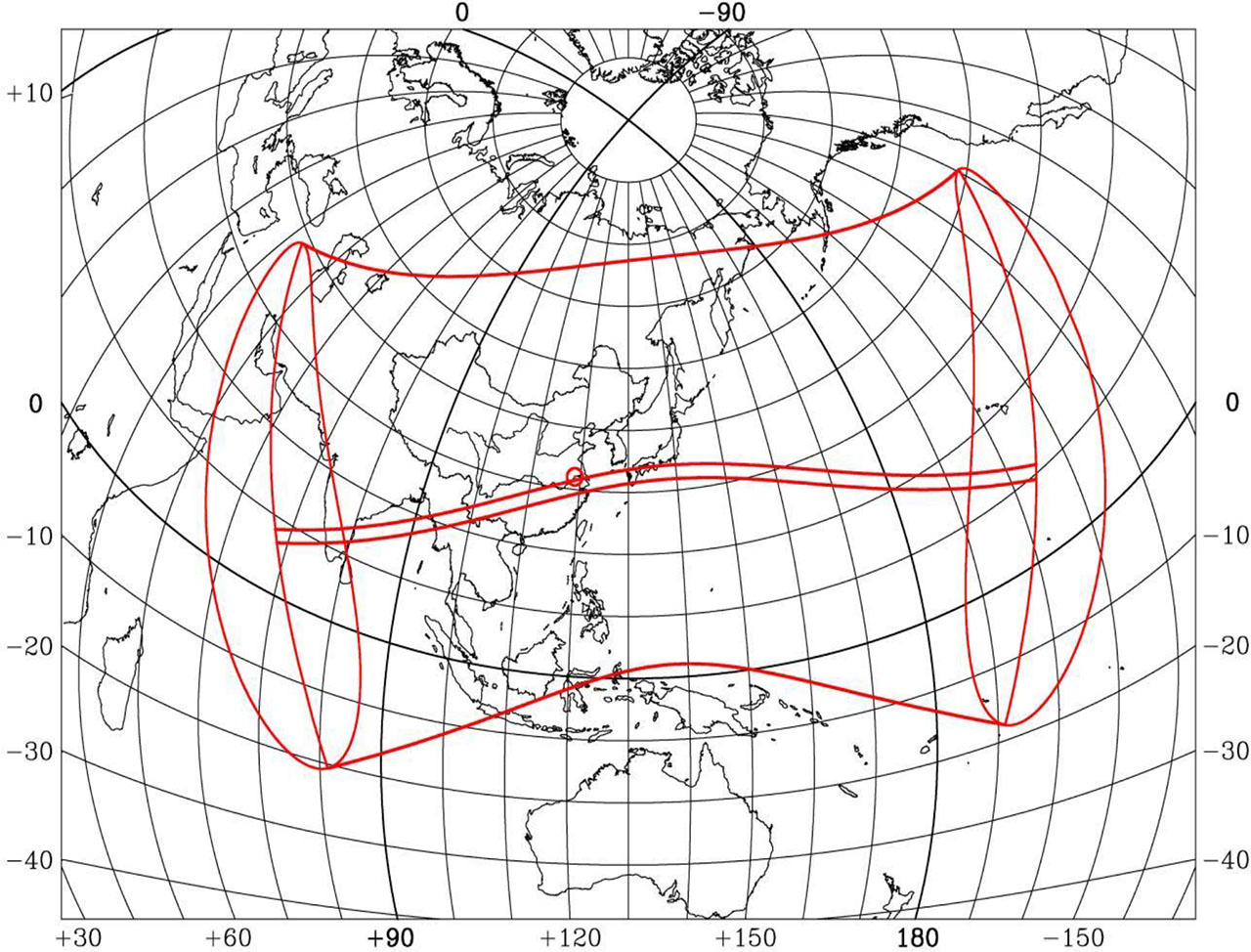
Figure 1.
The solar eclipse path on June 25, A.D. 1275 (with the TDT time system)
3.3. The ΔT value from solar eclipse on June 25, A.D. 1275
In conjunction with the aforementioned historical documents, Jinling, an ancient name for Nanjing city in Jiangsu Province, is situated within the central eclipse belt of the total solar eclipse that occurred on June 25, A.D. 1275.
Archaeological findings suggest that Jinling is currently located in the Qinhuai district of Nanjing (118°49ʹ02ʺE, 32°00ʹ29ʺN). LT under the TDT time system at Jinling for each stage of the solar eclipse is listed in the last column of Table 1.
Total solar eclipse was observed in Jinling, and the city should be within the visible range of the total solar eclipses. Here the observation site is located on the west side of the total solar eclipse zone, where the ΔT value is negative. The latitude of the city was higher than the latitude of the southern boundary of the belt, where the total eclipse can be observed (Figure 2).
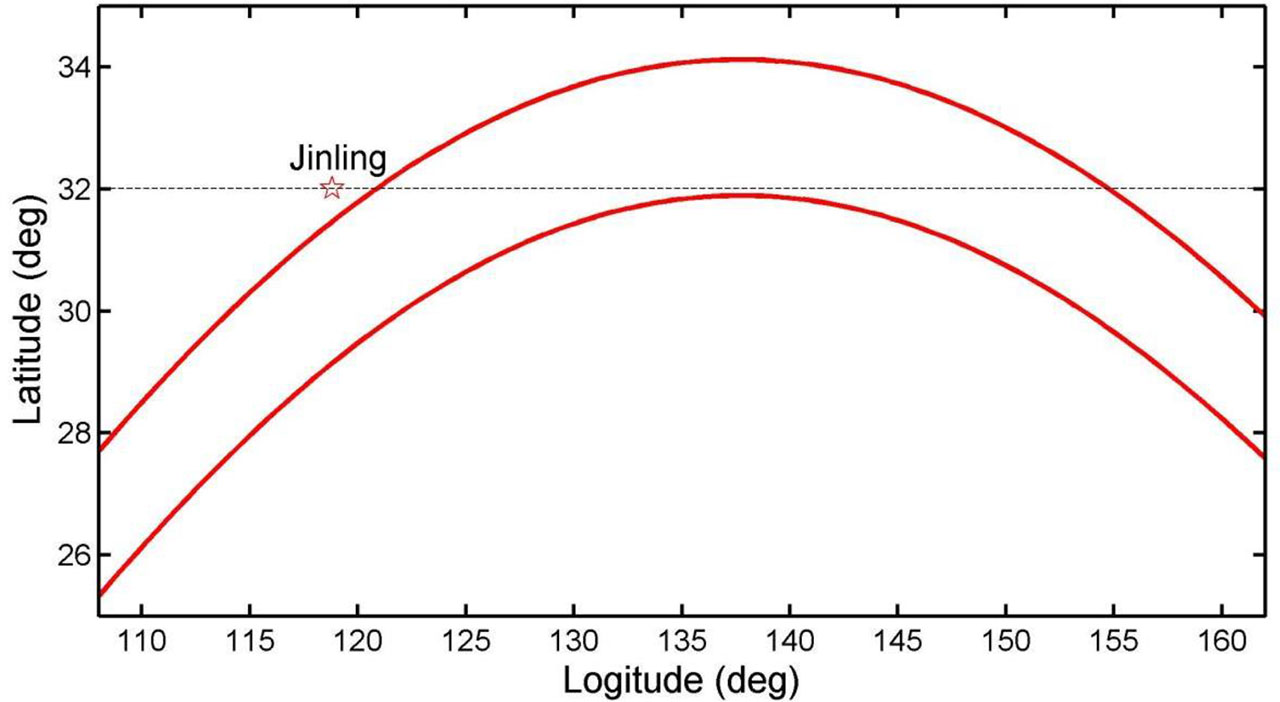
Figure 2.
Diagram of the position of the total eclipse and Jinling position
According to the difference between longitude of Jinling city and longitude of the total solar eclipse belt, the ΔT value can be obtained. The larger the difference, the smaller the ΔT value. Furthermore, considering the approximate scope of the ΔT value, the upper limit of the ΔT value recorded during total solar eclipse observations is −494 sec.
Furthermore, it is evident that the central eclipse area in Jinling aligns with the northeast–southwest direction, a conclusion corroborated by the textual description in Appendix.
The historical record of the eclipse on June 25, A.D. 1275 indicates that the eclipse stage began at ji and ended at wu, with its brightness returning thereafter. In ancient China, ji corresponds to the time period from 9:00 a.m. to 11:00 a.m., while wu signifies the time from 11:00 a.m. to 01:00 p.m. Consequently, the eclipse commenced in the initial stage at 10:00 a.m. LT and transitioned into the restore stage at 12:00 a.m. LT. The observational error can be estimated to be approximately 1 h.
LT of the eclipse’s stage moment at the observation site can be linked to UT. The UT times for the eclipse and restoration stages are 02:04:44 and 04:04:44, respectively. According to time information of the solar eclipse listed in Table 1, the TDT times for the initial eclipse and restoration stages are 00:22:40 and 05:37:07, respectively. The difference between TDT and UT is represented by the ΔT value. The recorded ΔT at the two stages of the eclipse is −291 sec, which is an average value obtained from two stages. This corresponds to two observations, thereby reducing the observation error by half to 0.5 h. Consequently, the range of ΔT based on solar eclipse observation is [−2091, +1509] sec.
4. DISCUSSION AND CONCLUSION
Utilizing observational records from Chinese historical documents, it is posited that the total solar eclipse on June 25, A.D. 1275 was witnessed in Jinling city during that period. This information, when combined with the DE422 ephemeris released by NASA’s JPL, allows for an inference of the observable conditions at that time. In addition, secular change in Earth’s rotation is examined. The ΔT value for this period ranges between −2091 and −494 sec. The findings of this study offer a valuable reference for further research into the Earth’s variable rotation using astronomical observations. Also, this study represents an initial phase of the research. Subsequently, we aim to delve deeper into the relationship between the Huaishui and the Qinhuai river to enhance the reliability of the eclipse data for calculating secular change in Earth’s rotation.
The Complete Library in the Four Branches of Literature, ordered by Emperor Gaozong of the Qing Dynasty, was initiated in the 38th year of Qianlong’s reign (A.D. 1773). The compilation, writing, and revision were finalized in the 52nd year of Qianlong’s reign (A.D. 1787). Notably, the History Ministry’s local chronicle of Jinling city, the Zhida Jinling New Prefecture Annals, also documented this total solar eclipse. Its record closely aligns with that in the Zhizheng Jinling New Prefecture Annals. Interestingly, Zhang Xuan compiled a version of the book during the Yuan Dynasty. The citations in both local chronicles are identical. It is posited that ancient scholars erroneously referred to the Zhizheng Jinling New Prefecture Annals as the Zhida Jinling New Prefecture Annals, leading to two distinct versions (Han, 2020). Therefore, it is appropriate to use the Zhizheng Jinling New Prefecture Annals as one of historical literature references for solar eclipse on June 25, A.D. 1275 in this work.
Acknowledgment
The authors are grateful to the Jet Propulsion Laboratory for providing the DE astronomical planetary ephemeris and thank Profs Qiyuan QIAO and Yanben HAN for providing some program codes for solar eclipse calculation. The authors are grateful for the reviewers whose comments have largely contributed to the improvement of the manuscript. This work was carried out under the support of the Special Research Program on Obscure and Rare Disciplines of the National Social Science Foundation of China (Grant No. 24VJXG010).
Appendices
APPENDIX
1. Historical records of solar eclipse on June 25, A.D. 1275 in the History of Song
(1) In the “Astronomy V” of the History of Song, it is recorded that during the first year of Emperor Deyou’s reign (equivalent to A.D. 1275), a solar eclipse occurred in June, which was Gengzi and the first day of every month in the Chinese calendar. The event was denoted by the special character ji, signifying a total eclipse. Concurrently, the stars were visible, and chickens and ducks returned to their respective nests. The relevant Chinese text in the literature is marked with a red border in Figure A1.
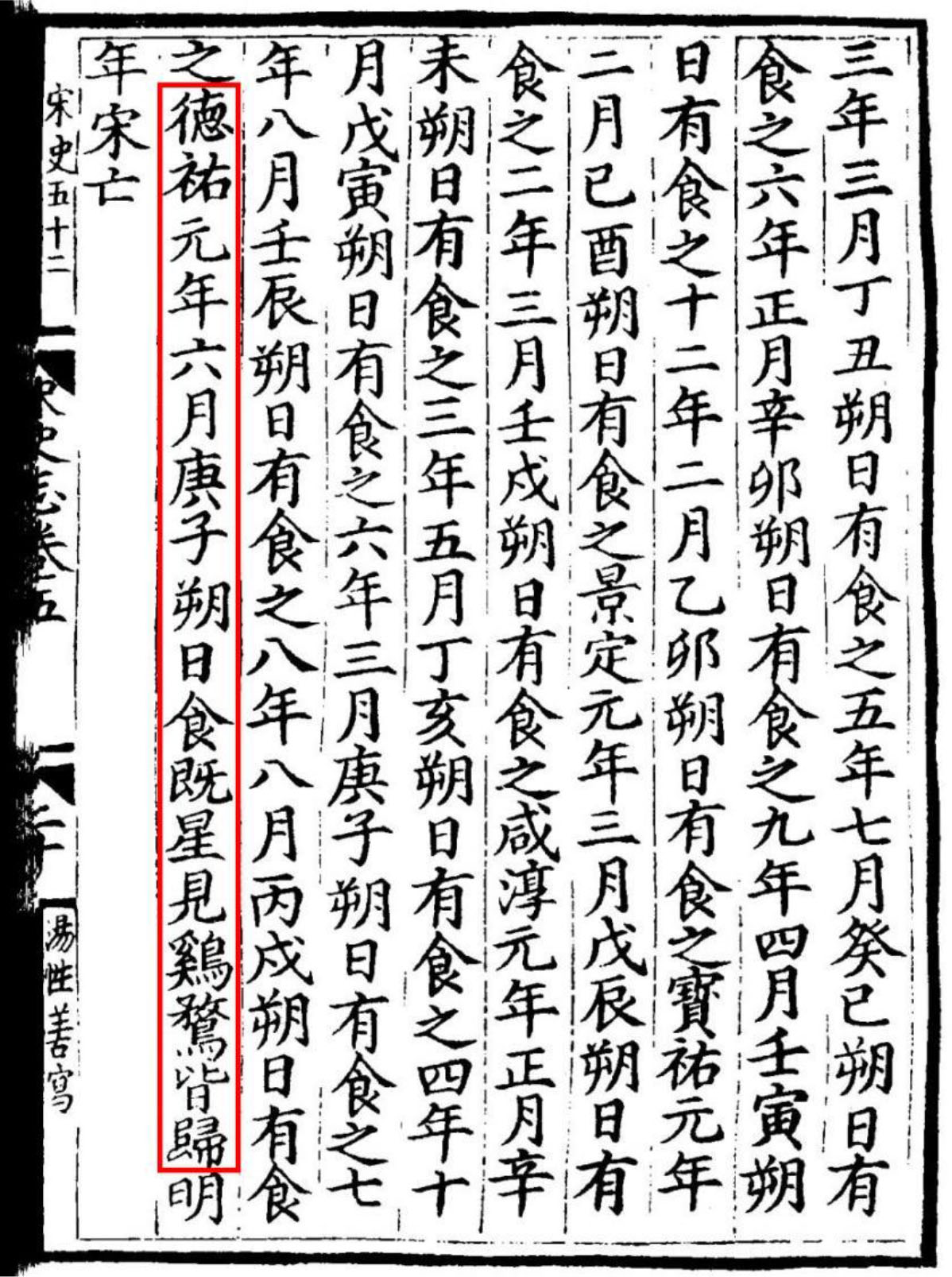
Figure A1.
Total solar eclipse observation records written with Chinese characters from “Astronomy V” of the History of Song
(2) Within the “Wuxing V” section of Zhi volume, it is recorded that during the first year of Emperor Deyou’s reign, on Gengzi date of June, an eclipse occurred. Both the sky and Earth were shrouded in darkness, making it impossible for individuals to distinguish each other at close range. In addition, chickens and ducks retreated to their nests. This phenomenon persisted from si (a specific timing method in ancient China, equivalent to 9:00–11:00) until wu (corresponding to 11:00–13:00), after which it gradually brightened. The relevant Chinese text in the literature is marked with a red border in Figure A2.
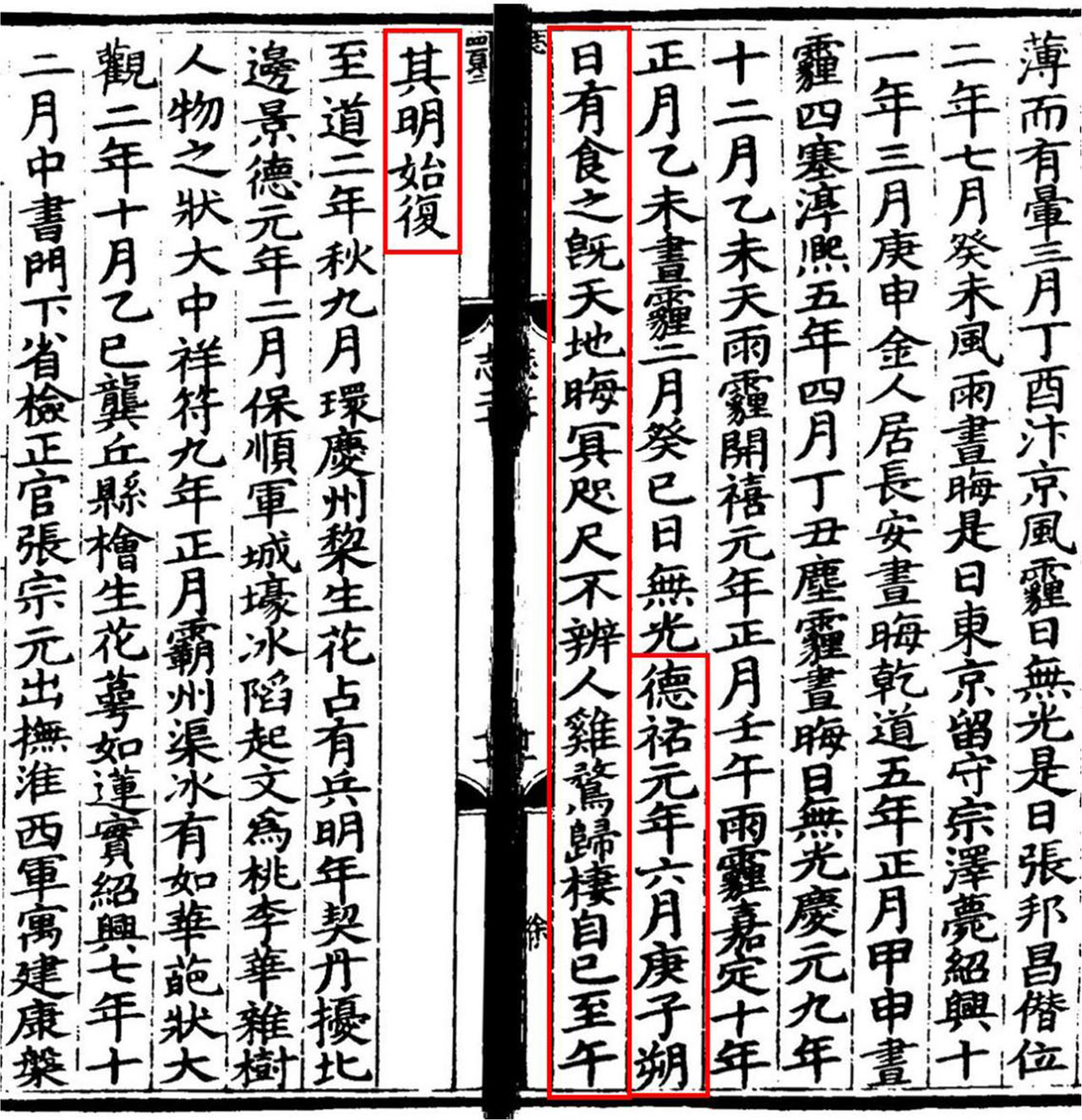
Figure A2.
Total solar eclipse observation records written with Chinese characters from “Wuxing V” of the History of Song
2. Historical records of solar eclipse on June 25, A.D. 1275 in several annals of local history
(1) In Volume 83 of the Hangzhou Prefecture Annals, revised by Gong Jiajun and authored by Li Rong during the Qing Dynasty, the text pertaining to the eclipse aligns perfectly with that in the History of Song. The observational records from the Hangzhou Prefecture Annals are cited in the Wuxing volume of the History of Song. Consequently, Hangzhou city cannot be directly identified as the observation site for the aforementioned eclipse.
(2) Within Volume III of the Zhizheng Jinling New Prefecture Annals, authored by Zhang Xuan during the fourth year of Emperor Zhizheng’s reign in the Yuan Dynasty.
The relevant Chinese text in the literature is marked with a red border in Figure A3.
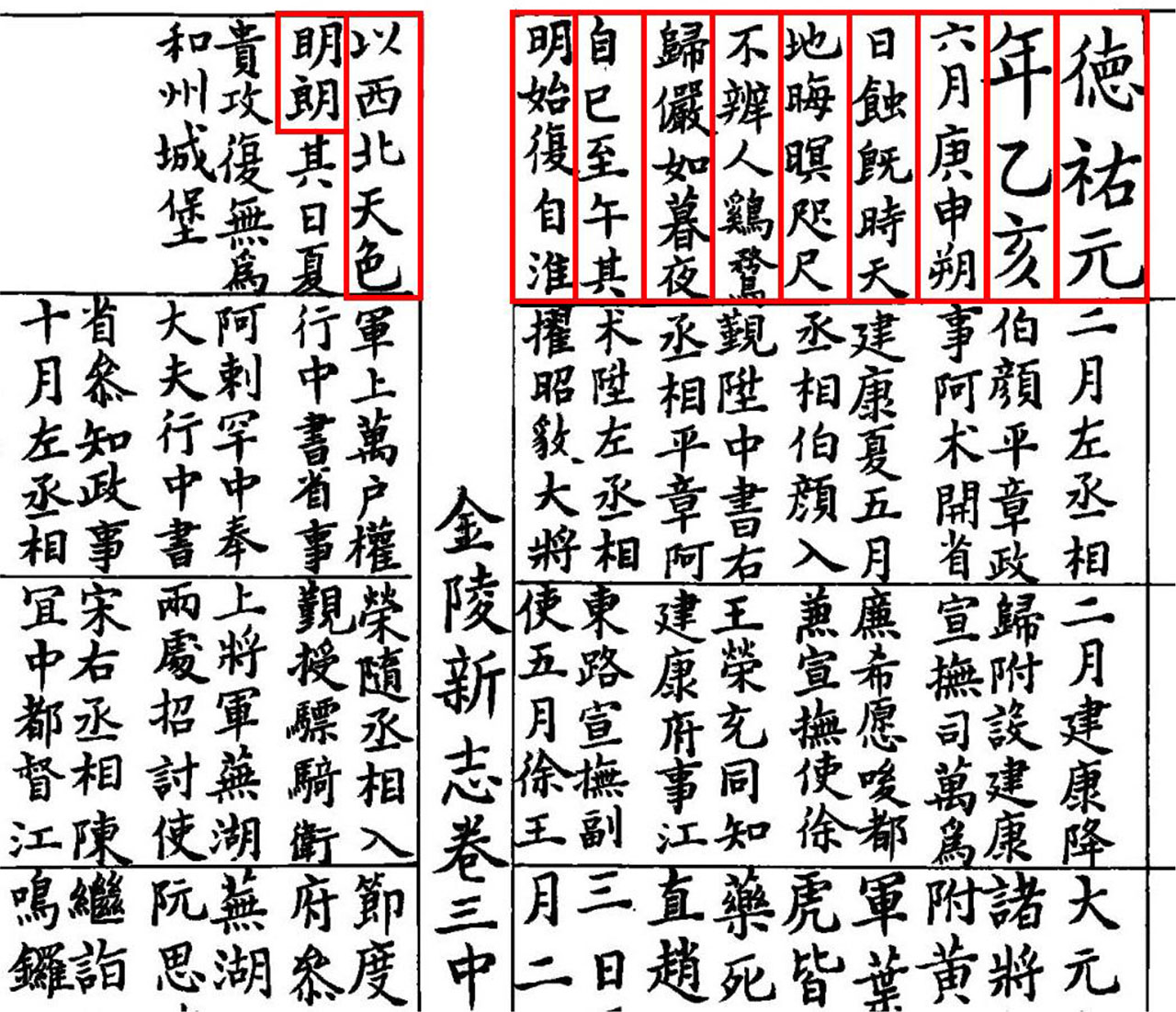
Figure A3.
Total solar eclipse observation records written with Chinese characters from the Zhizheng Jinling New Prefecture Annals
It can be described in the following English text:
“During the first year of Emperor Deyou’s reign, specifically in the Yihai year and Gengshen date in June, a solar eclipse occurred. This event resulted in both the sky and the Earth becoming obscured, to the extent that individuals could not distinguish each other from a short distance away. The chickens and ducks retreated to their nests, creating an atmosphere akin to nightfall. This condition persisted from si to wu before its light began to return. The restoration of light was particularly noticeable from the northwest region of Huai.”