
Table 1.
Configurations of the compared satellite data
| Period | Data set No. 1 | Data set No. 2 |
|---|---|---|
| 01.01.2001–01.01.2021 | Seasonalized SSHA | Seasonalized EWT (JPL) |
| 01.01.2001–01.01.2021 | Deseasonalized SSHA | Deseasonalized EWT (JPL) |
| 01.01.2001–01.01.2021 | Seasonalized SSHA | Seasonalized EWT (CSR) |
| 01.01.2001–01.01.2021 | Deseasonalized SSHA | Deseasonalized EWT (CSR) |
| 01.01.1993–01.01.2018 | Seasonalized SSHA | Seasonalized HRSST |
| 01.01.1993–01.01.2018 | Deseasonalized SSHA | Deseasonalized HRSST |
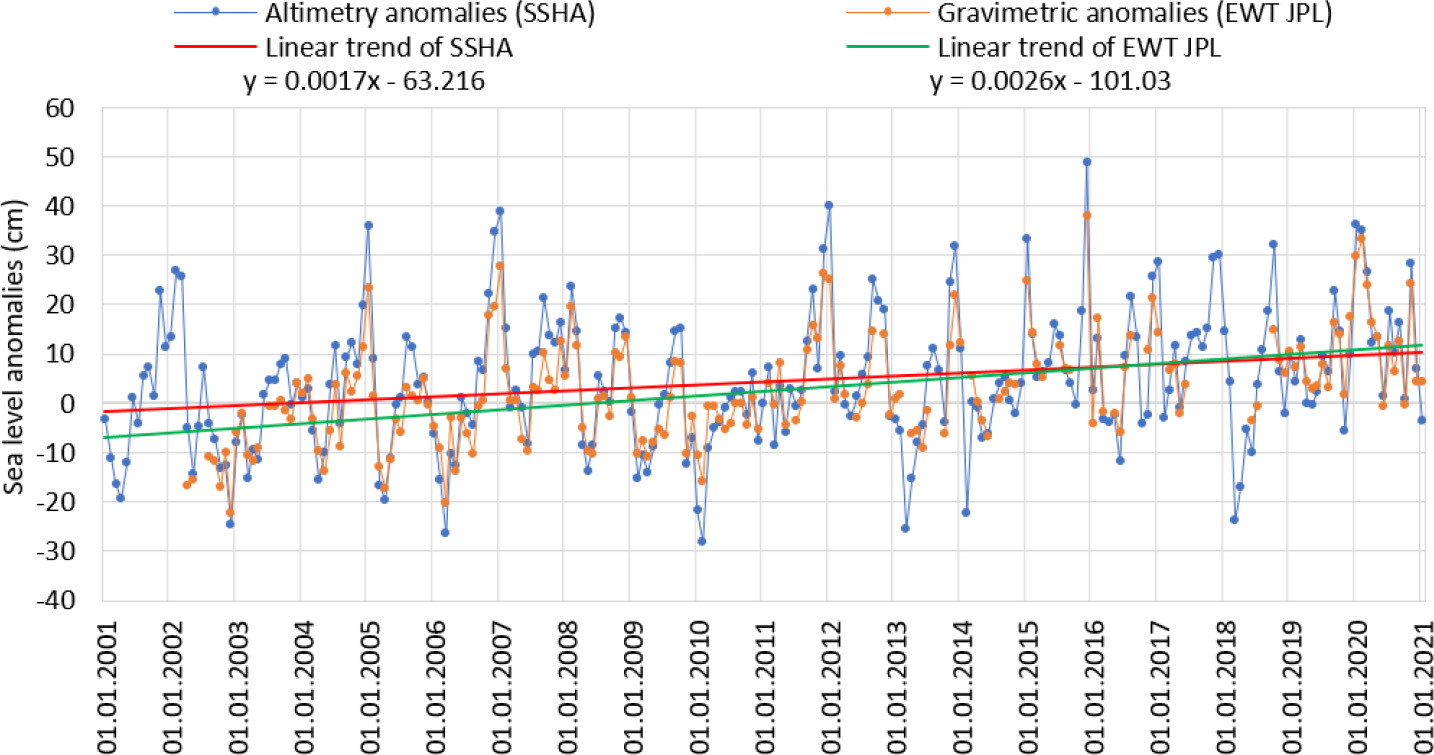
Figure 1.
Sea level anomalies from altimetric (SSHA) and gravimetric (EWT JPL) data from 2001–2021 before the removal of seasonal signals for the Baltic Sea. The trend values are given in cm/day
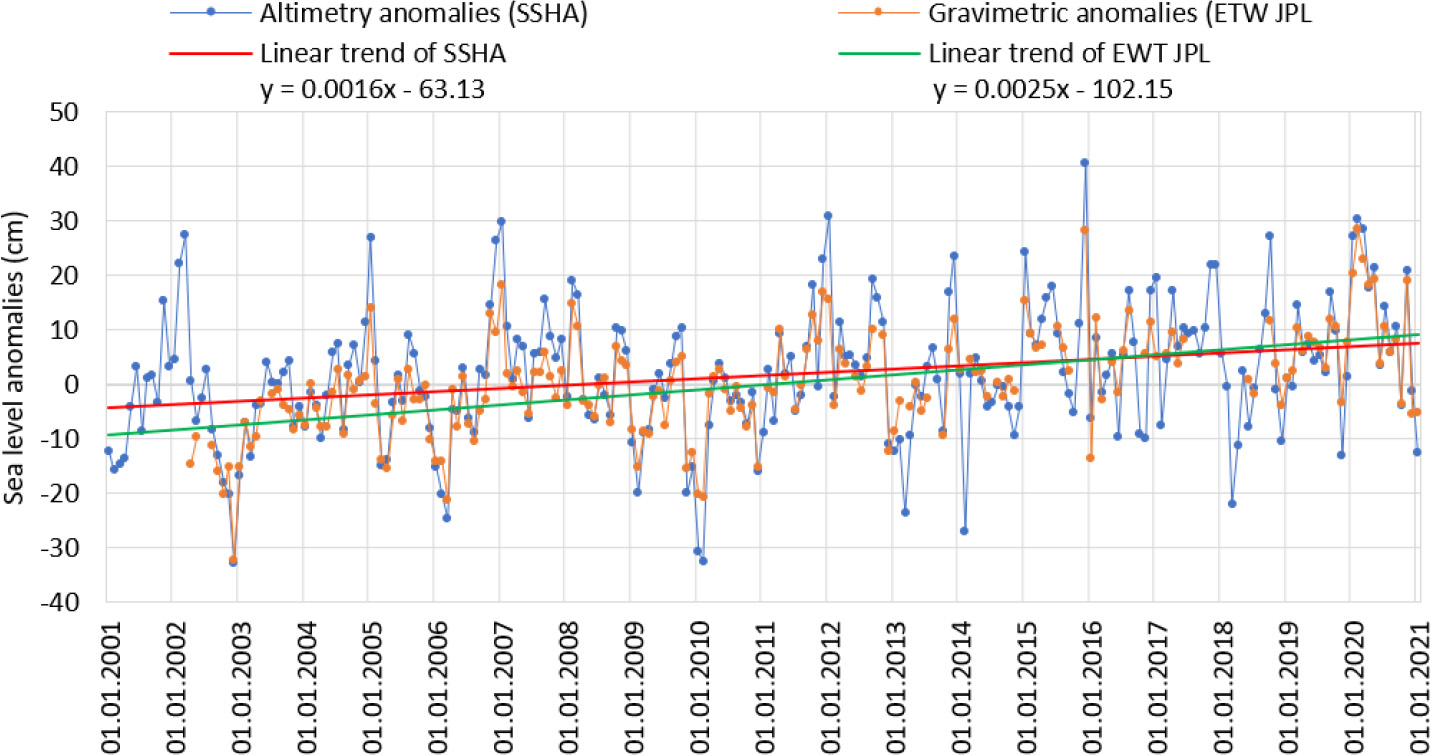
Figure 2.
Sea level anomalies from altimetric (SSHA) and gravimetric (EWT JPL) data from 2001–2021 after the removal of seasonal signals for the Baltic Sea. The trend values are given in cm/day
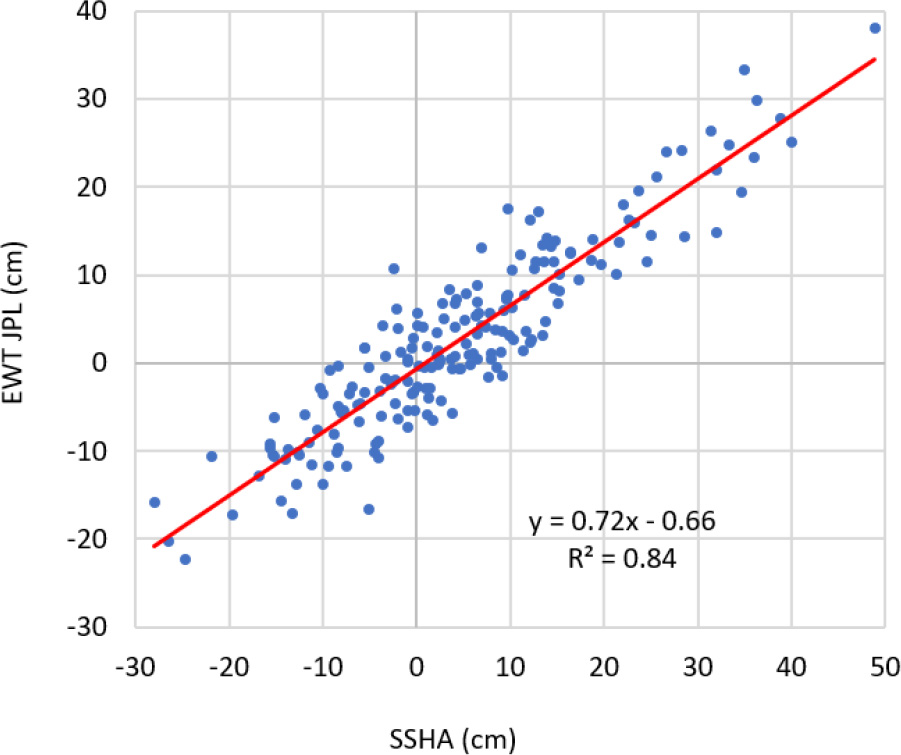
Figure 3.
Correlation between altimetric (SSHA) and gravimetric (EWT JPL) anomalies for 2001–2021 before removal of seasonal signals for the Baltic Sea
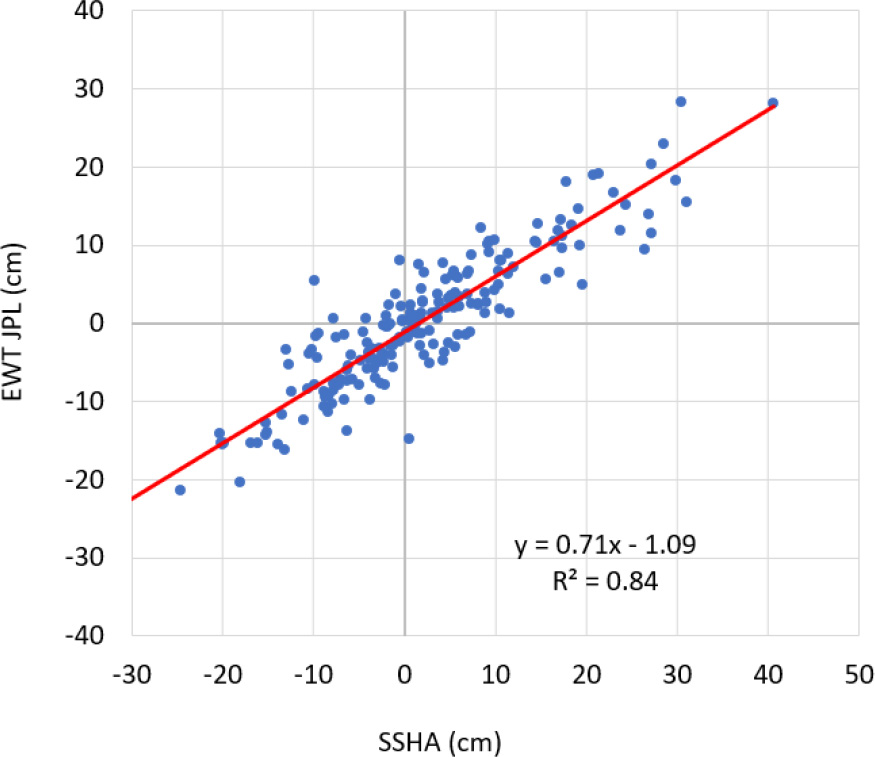
Figure 4.
Correlation between altimetric (SSHA) and gravimetric (EWT JPL) anomalies for 2001–2021 after removal of seasonal signals for the Baltic Sea
Table 2.
Results of statistical analyses of sea level changes from altimetric (SSHA) and gravimetric (EWT) data before removal of seasonal signals
| Region | Period | Sea level rise trend (cm/yr) | Linear regression coefficient | Pearson correlation coefficient | ||||
|---|---|---|---|---|---|---|---|---|
| SSHA | EWT JPL | EWT CSR | SSHA − EWT JPL | SSHA − EWT CSR | SSHA − EWT JPL | SSHA − EWT CSR | ||
| Baltic Sea | 2001–2006 | 1.20 | 3.76 | 3.36 | 0.70 | 0.59 | 0.92 | 0.87 |
| 2006–2011 | −1.50 | −0.69 | −0.47 | 0.65 | 0.56 | 0.94 | 0.90 | |
| 2011–2016 | 0.99 | 1.13 | −0.66 | 0.67 | 0.56 | 0.92 | 0.86 | |
| 2016–2021 | 1.68 | 1.90 | 1.06 | 0.67 | 0.56 | 0.88 | 0.79 | |
| 2001–2021 | 0.62 | 0.95 | 0.33 | 0.72 | 0.55 | 0.92 | 0.86 | |
| The central part of the Baltic Sea | 2001–2006 | 1.20 | 4.49 | 3.39 | 0.76 | 0.62 | 0.89 | 0.83 |
| 2006–2011 | −1.93 | −1.13 | −0.58 | 0.64 | 0.58 | 0.89 | 0.86 | |
| 2011–2016 | 1.64 | 0.62 | −0.58 | 0.73 | 0.58 | 0.89 | 0.82 | |
| 2016–2021 | 1.50 | 1.57 | 0.95 | 0.67 | 0.56 | 0.83 | 0.73 | |
| 2001–2021 | 0.58 | 0.84 | 0.29 | 0.72 | 0.56 | 0.88 | 0.81 | |
| Gulf of Gdańsk | 2001–2006 | 1.02 | 2.48 | 1.57 | 0.54 | 0.35 | 0.85 | 0.73 |
| 2006–2011 | −1.53 | −1.10 | −0.95 | 0.59 | 0.38 | 0.91 | 0.83 | |
| 2011–2016 | 1.10 | 0.33 | −1.10 | 0.55 | 0.38 | 0.87 | 0.73 | |
| 2016–2021 | 1.13 | 0.77 | 0.37 | 0.55 | 0.42 | 0.85 | 0.74 | |
| 2001–2021 | 0.62 | 0.51 | −0.18 | 0.57 | 0.32 | 0.89 | 0.67 | |
| Gulf of Bothnia | 2001–2006 | 1.50 | 3.94 | 4.49 | 0.67 | 0.63 | 0.92 | 0.89 |
| 2006–2011 | −1.53 | −2.92 | −0.37 | 0.65 | 0.60 | 0.94 | 0.89 | |
| 2011–2016 | 0.99 | 1.06 | −0.11 | 0.67 | 0.58 | 0.93 | 0.88 | |
| 2016–2021 | 1.75 | 2.01 | 1.68 | 0.67 | 0.60 | 0.88 | 0.80 | |
| 2001–2021 | 0.62 | 1.13 | 0.58 | 0.73 | 0.61 | 0.90 | 0.88 | |
| Gulf of Finland | 2001–2006 | 1.17 | 5.66 | 7.01 | 0.94 | 1.01 | 0.91 | 0.85 |
| 2006–2011 | −1.57 | −0.58 | 1.06 | 0.76 | 0.68 | 0.92 | 0.81 | |
| 2011–2016 | 1.39 | 0.51 | −0.99 | 0.76 | 0.56 | 0.89 | 0.75 | |
| 2016–2021 | 2.15 | 1.93 | 2.12 | 0.63 | 0.56 | 0.83 | 0.74 | |
| 2001–2021 | 0.62 | 1.02 | 0.91 | 0.81 | 0.72 | 0.90 | 0.81 | |
| Gulf of Riga | 2001–2006 | 1.24 | 4.05 | 2.30 | 0.74 | 0.46 | 0.90 | 0.80 |
| 2006–2011 | −1.50 | −0.29 | −0.62 | 0.65 | 0.46 | 0.91 | 0.87 | |
| 2011–2016 | 1.35 | 0.77 | −0.55 | 0.53 | 0.32 | 0.87 | 0.81 | |
| 2016–2021 | 1.93 | 1.57 | 0.88 | 0.52 | 0.35 | 0.82 | 0.68 | |
| 2001–2021 | 0.62 | 0.95 | −0.03 | 0.64 | 0.35 | 0.87 | 0.74 | |
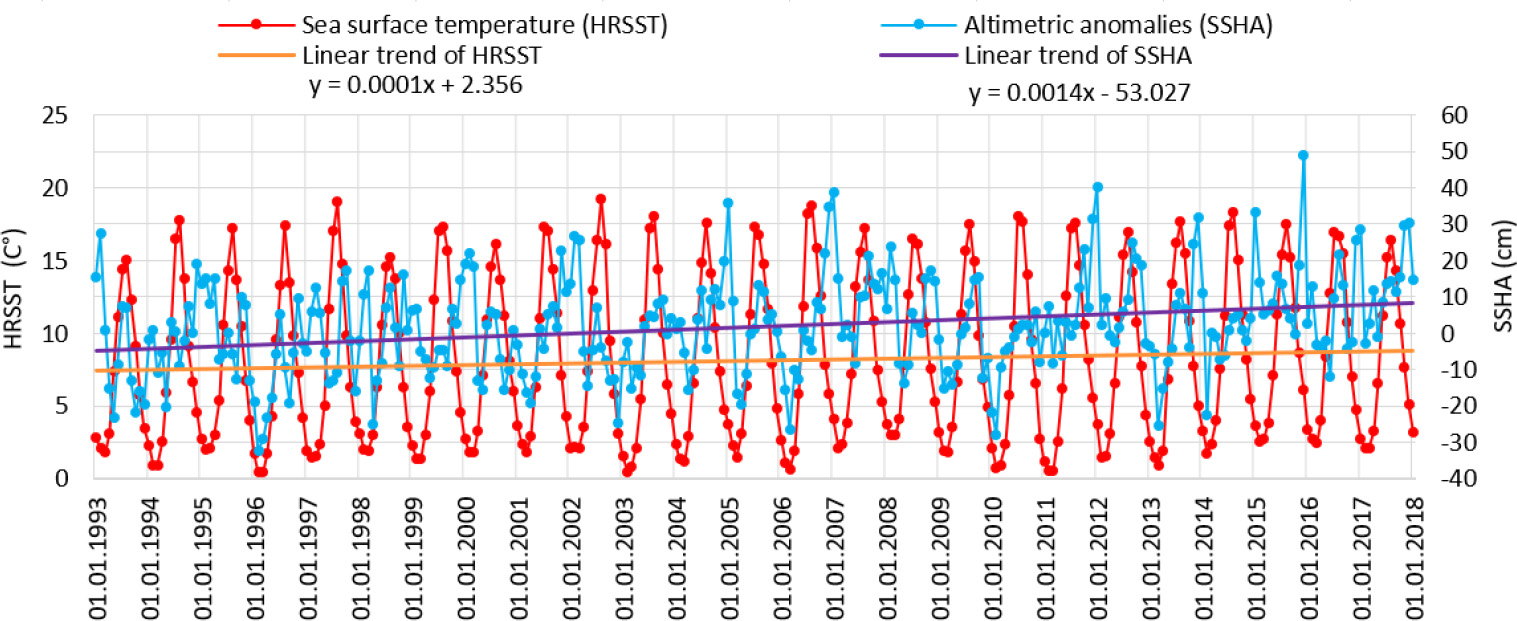
Figure 5.
Altimetric anomalies (SSHA) and sea surface temperature (HRSST) from 1993 to 2018 before the removal of seasonal signals for the Baltic Sea. The trend values are given in cm/day
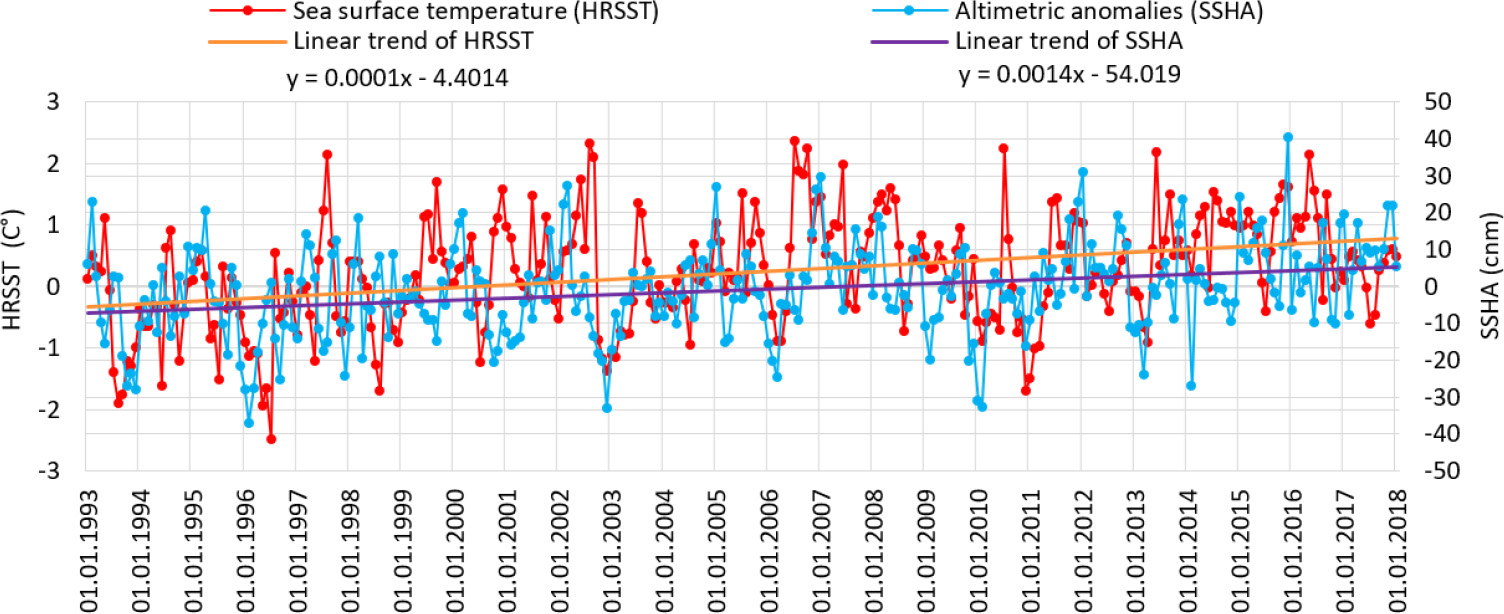
Figure 6.
Altimetric anomalies (SSHA) and sea surface temperature (HRSST) from 1993 to 2018 after the removal of seasonal signals for the Baltic Sea. The trend values are given in cm/day
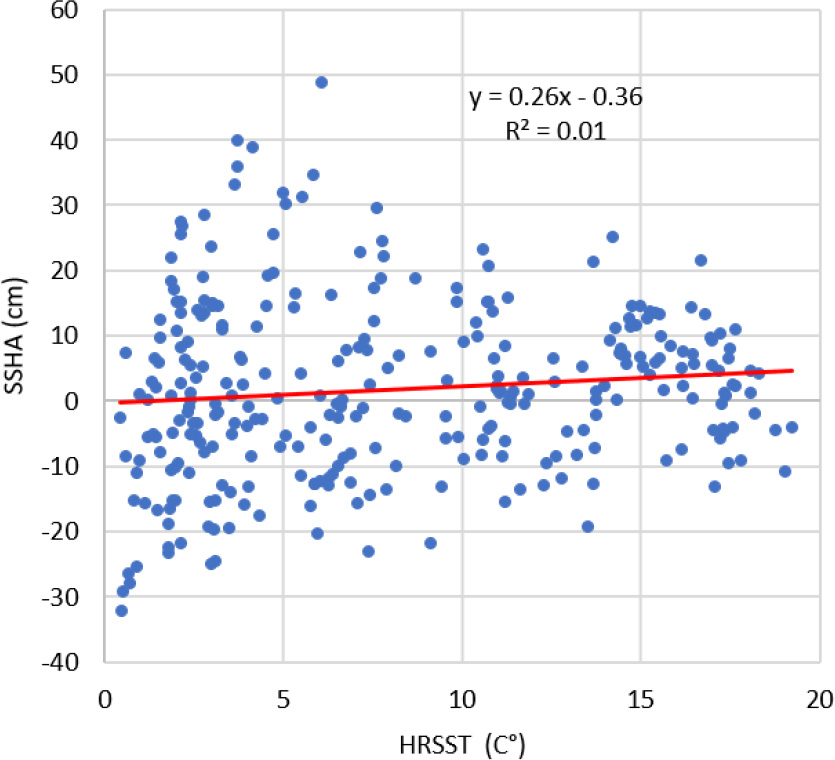
Figure 7.
Correlation between altimetric anomalies (SSHA) and sea surface temperature for 1993–2018 before removal of seasonal signals for the Baltic Sea
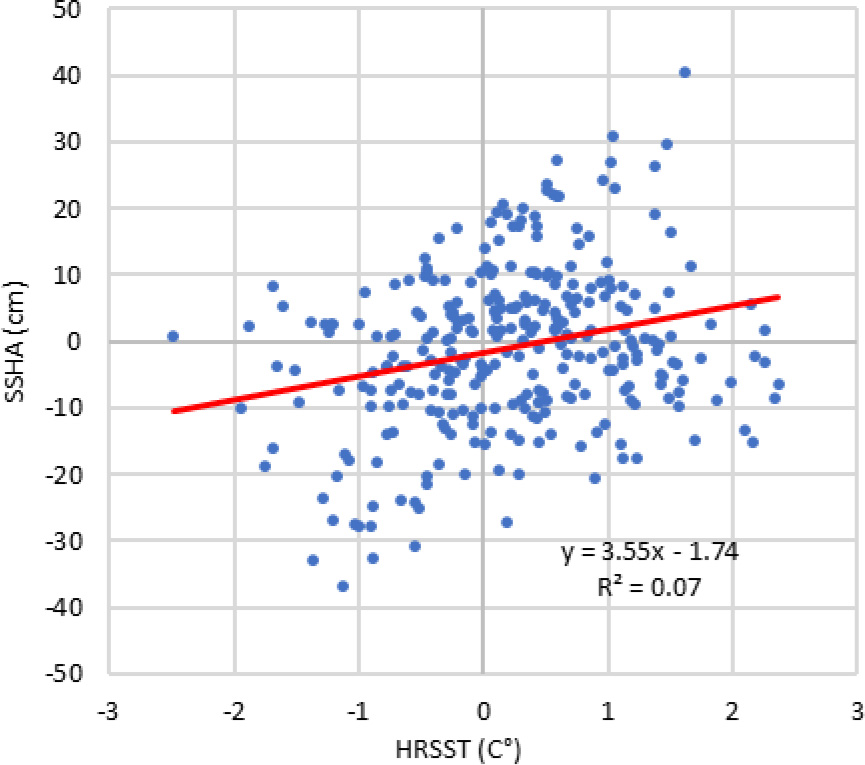
Figure 8.
Correlation between altimetric anomalies (SSHA) and sea surface temperature for 1993–2018 after removal of seasonal signals for the Baltic Sea
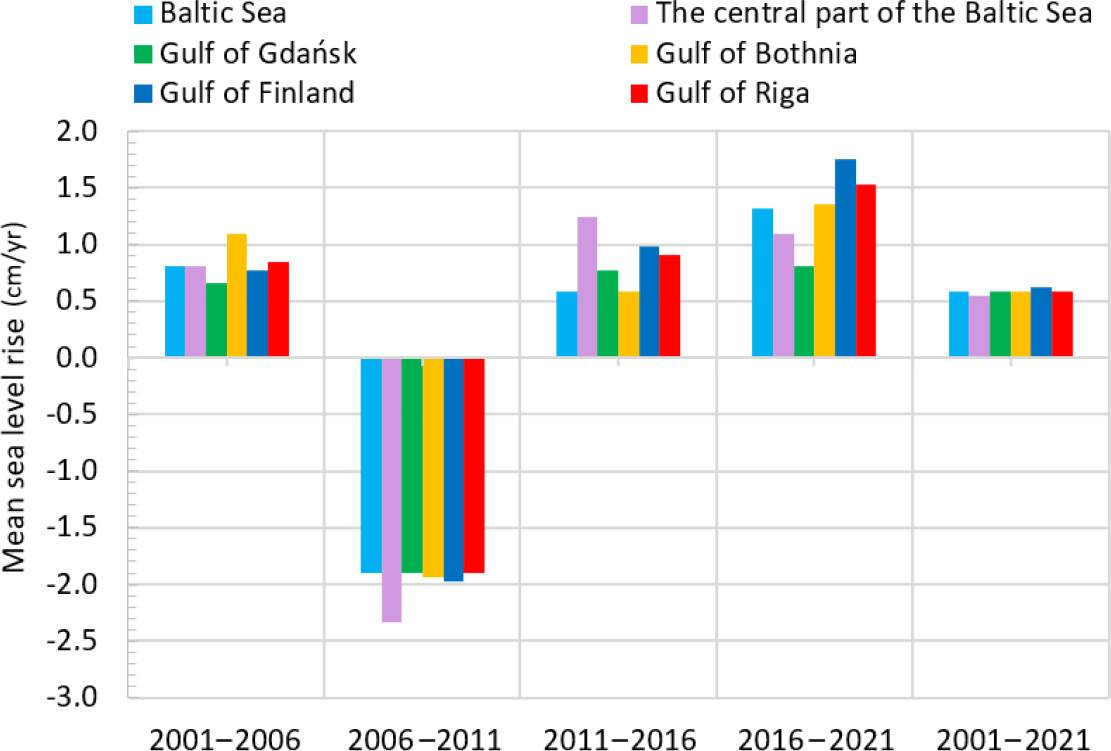
Figure 9.
Mean sea level rise linear trends of Baltic Sea in 2001–2021 from altimetric data (SSHA) after removal of seasonal signals
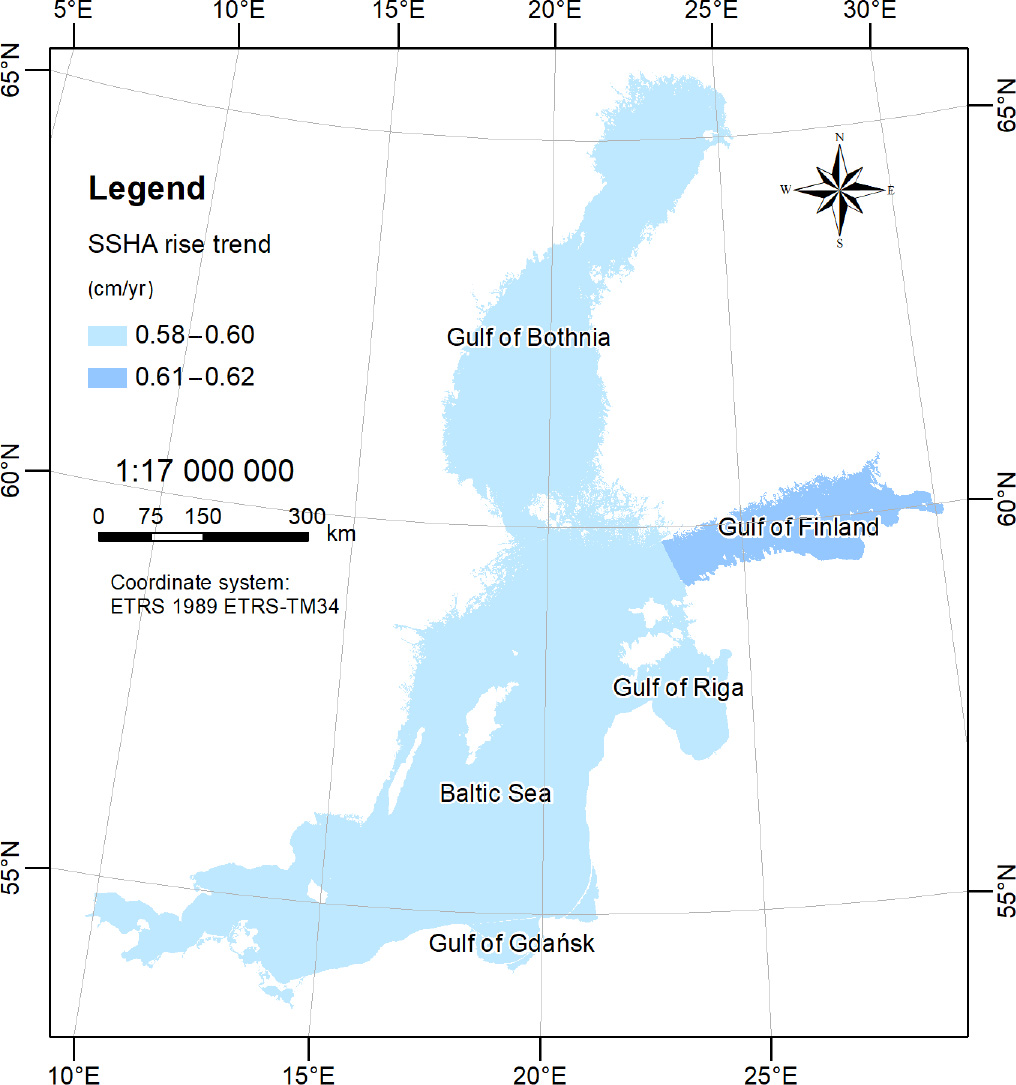
Figure 10.
Choropleth map of linear trends of Baltic Sea level rise in 2001–2021 from altimetric data (SSHA) after removal of seasonal signals
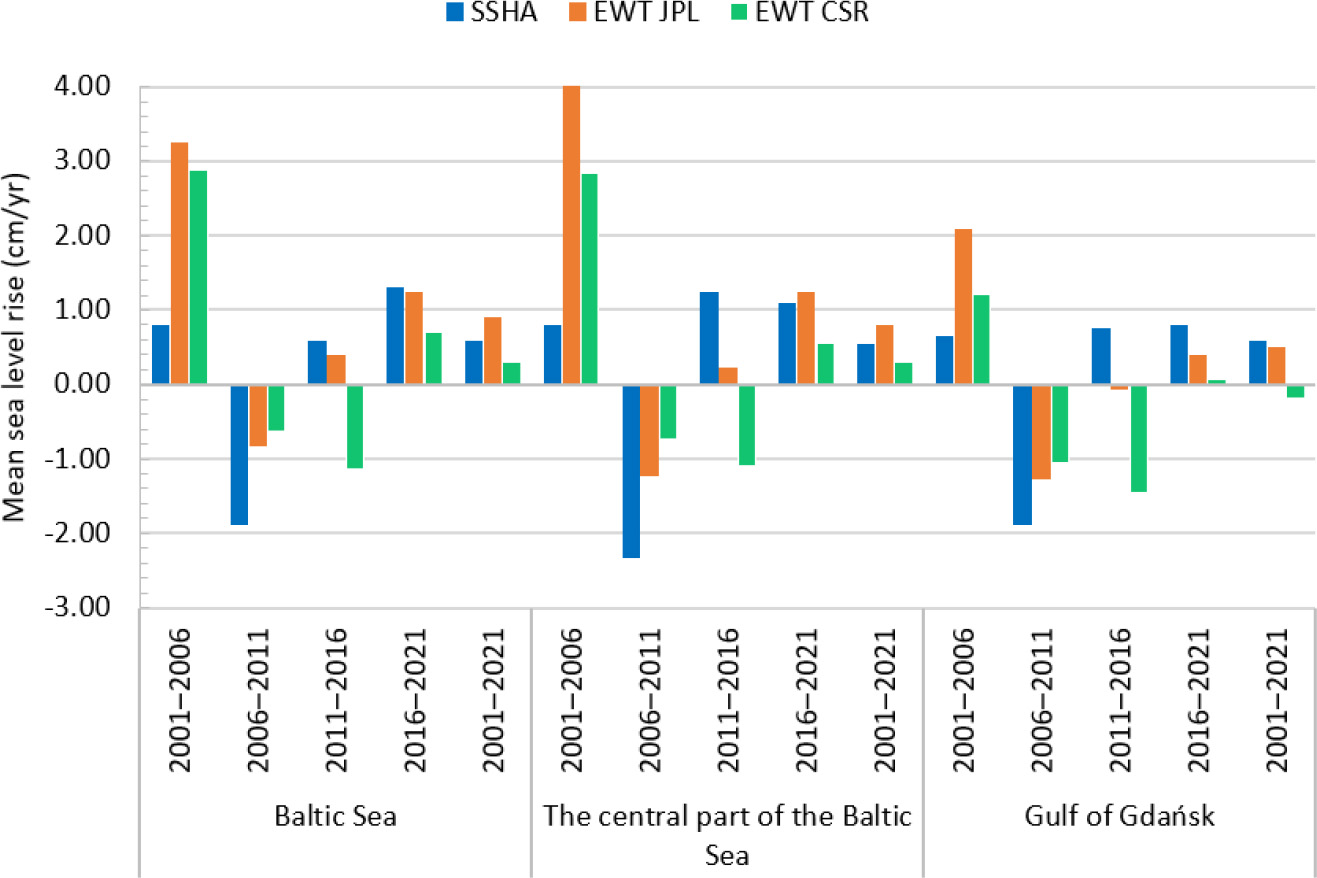
Figure 11.
Sea level rise linear trends of the Baltic Sea, the central part of the Baltic Sea, and the Gulf of Gdańsk in 2001–2021 from altimetric (SSHA) and gravimetric data (EWT) after the removal of seasonal signals
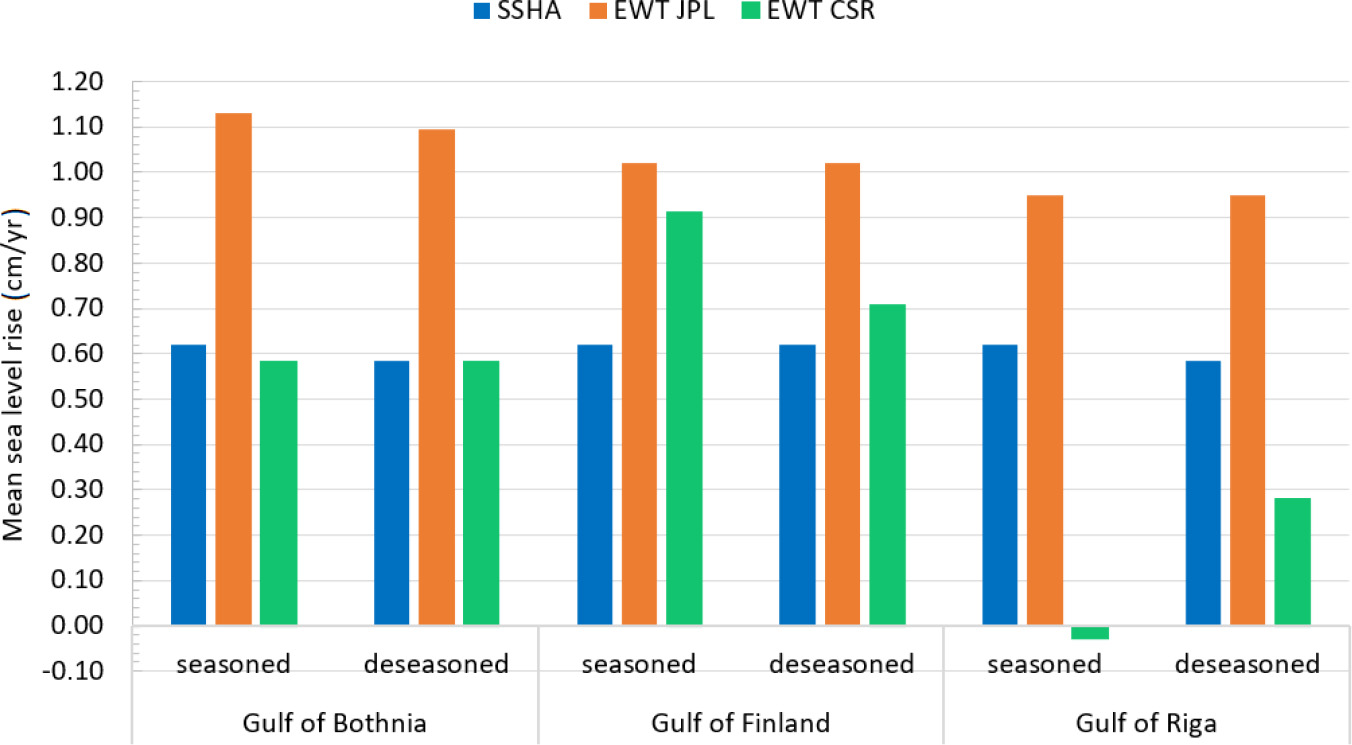
Figure 12.
Sea level rise linear trends for the Gulf of Bothnia, the Gulf of Finland, and the Gulf of Riga in 2001–2021 from altimetric (SSHA) and gravimetric data (EWT) before and after removal of seasonal signals
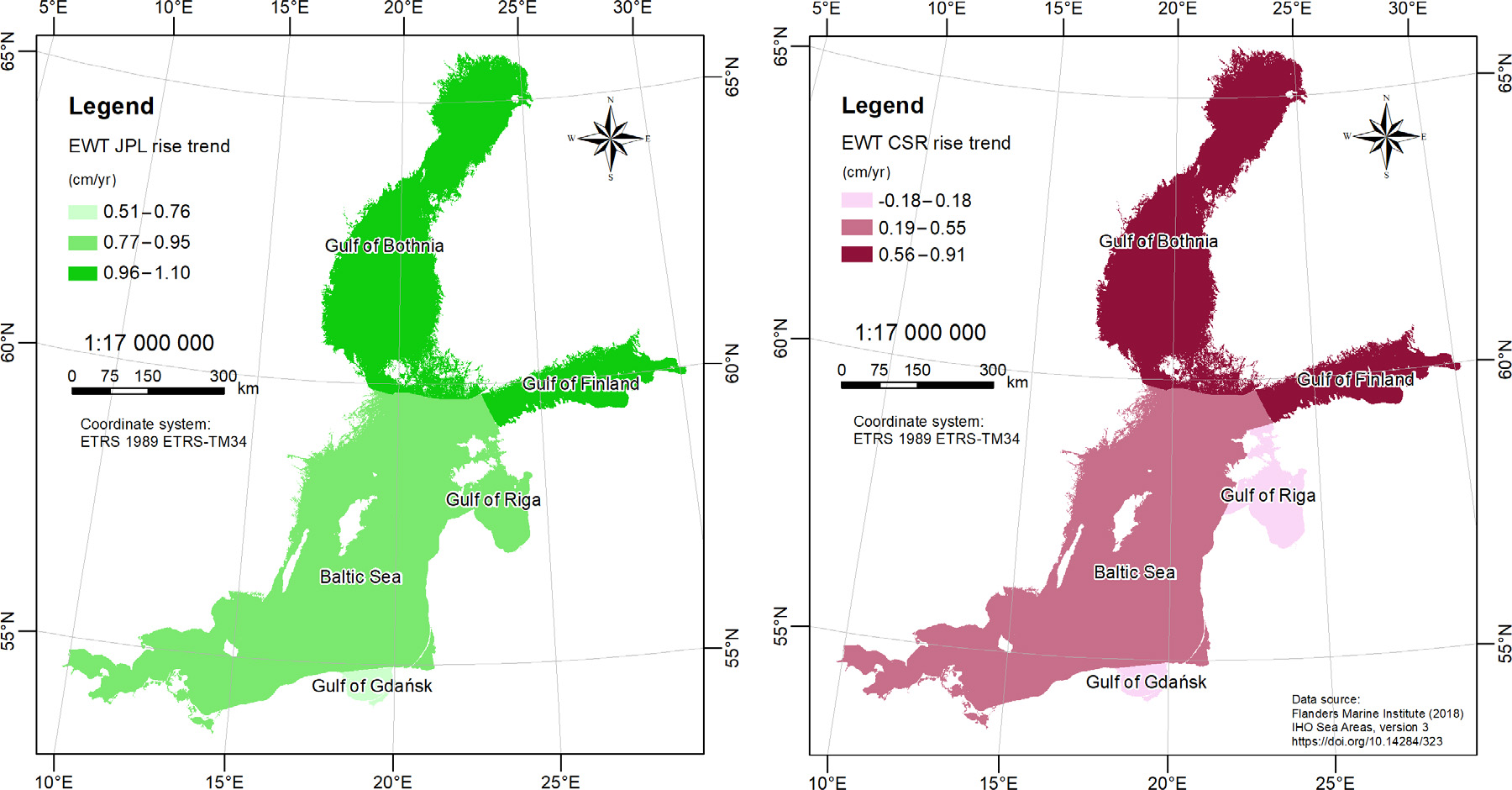
Figure 13.
Choropleth maps of linear trends of Baltic Sea level rise in 2001–2021 from gravimetric data (EWT) after the removal of seasonal signals
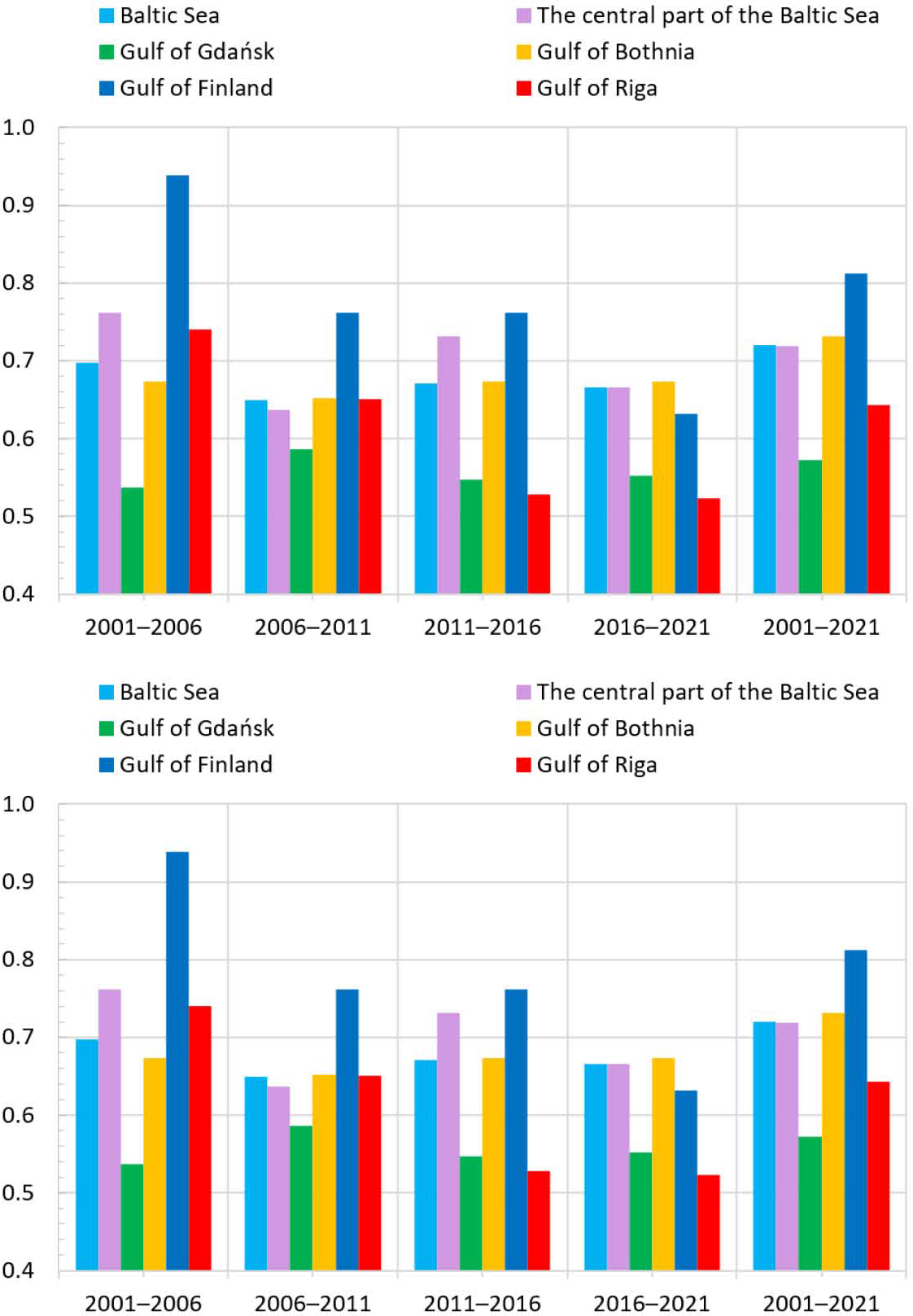
Figure 14.
Linear regression coefficients between altimetric anomalies (SSHA) and gravimetric anomalies (EWT JPL) for the Baltic Sea in 2001–2021 after the removal of the seasonal signal
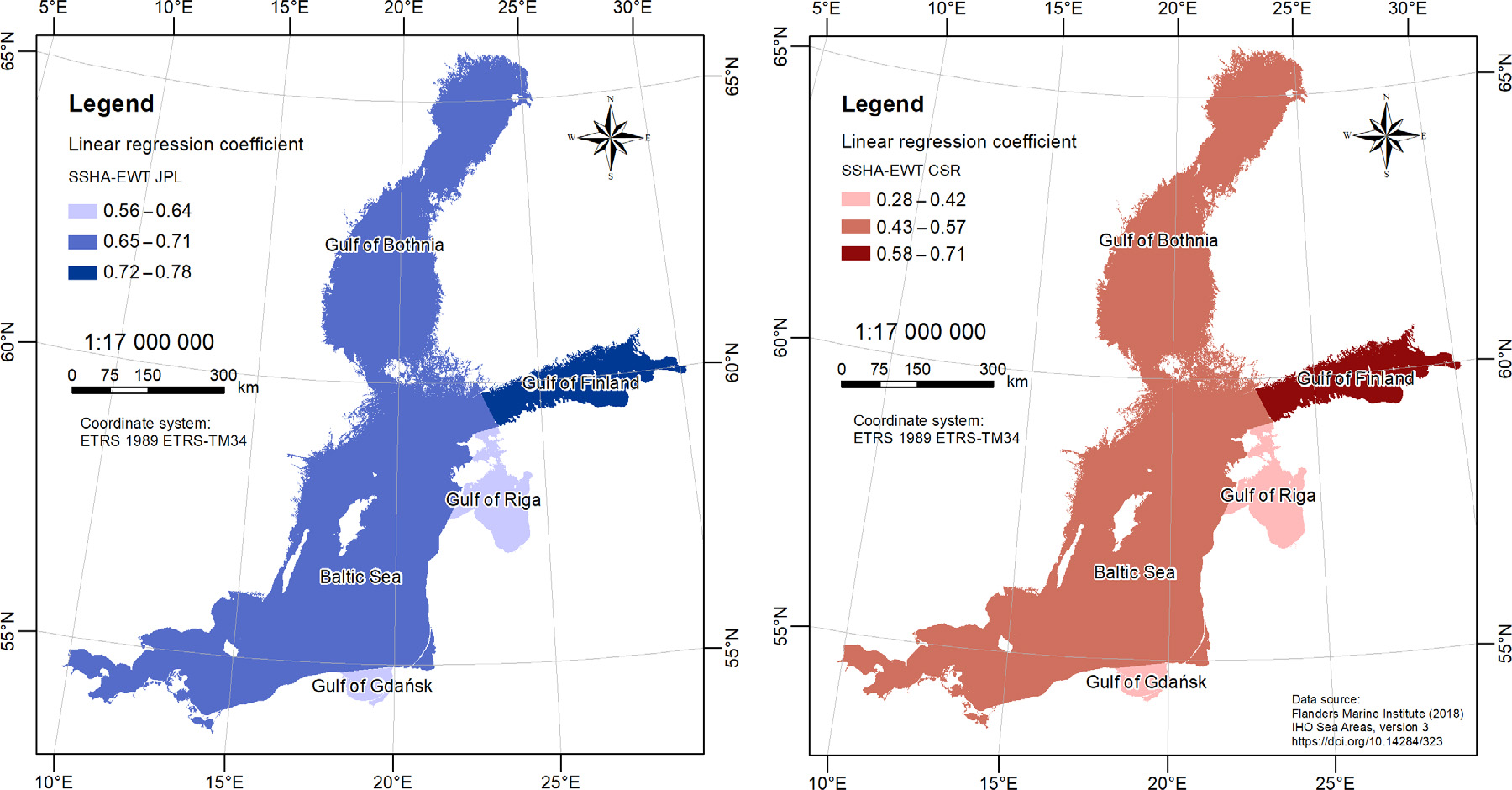
Figure 15.
Choropleth maps of linear regression coefficients between altimetric anomalies (SSHA) and gravity anomalies (EWT JPL/CSR) of the Baltic Sea in 2001–2021 after the removal of seasonal signals
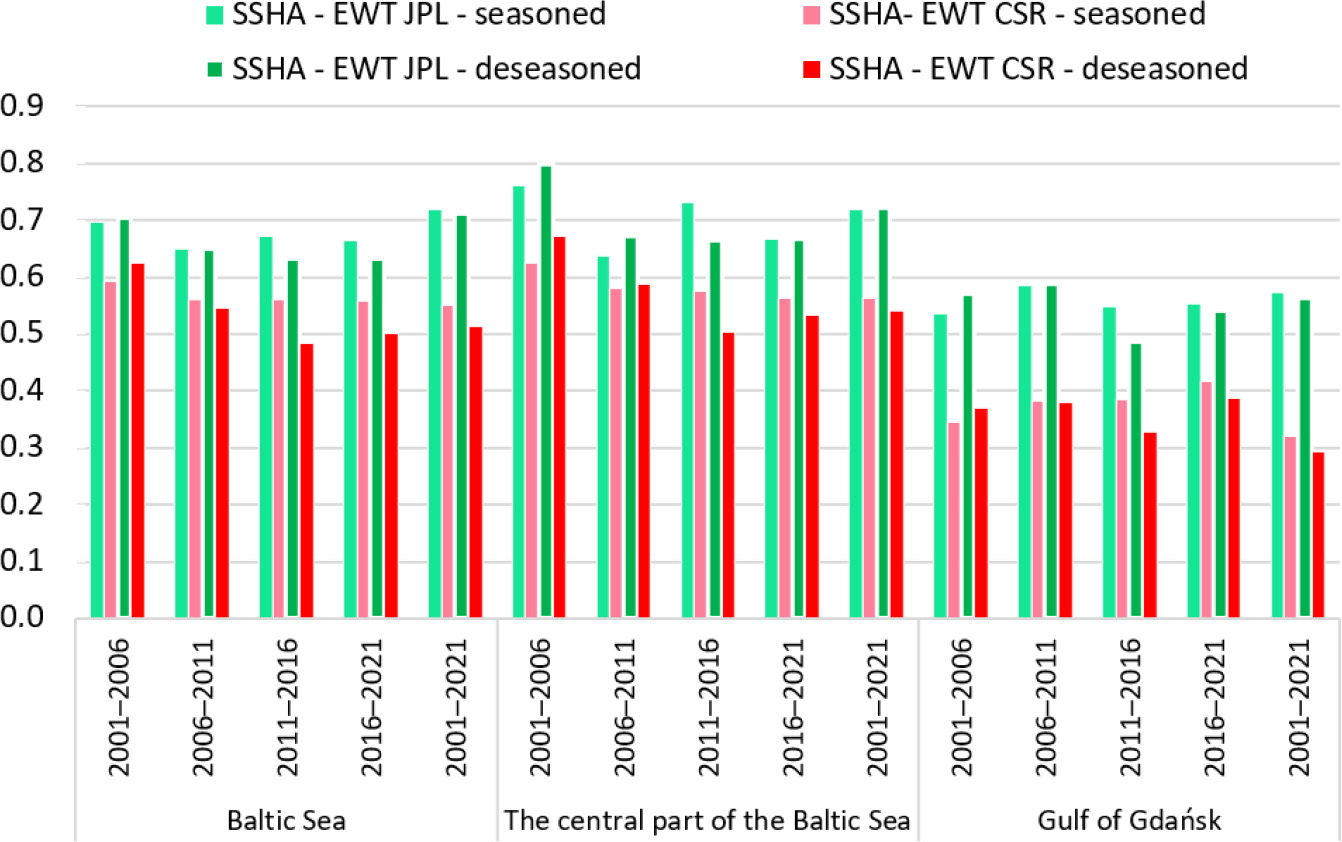
Figure 16.
Linear regression coefficients between altimetric anomalies (SSHA) and gravity anomalies (EWT JPL/CSR) of the entire area of the Baltic Sea, the central part of the Baltic Sea, and the Gulf of Gdańsk in 2001–2021
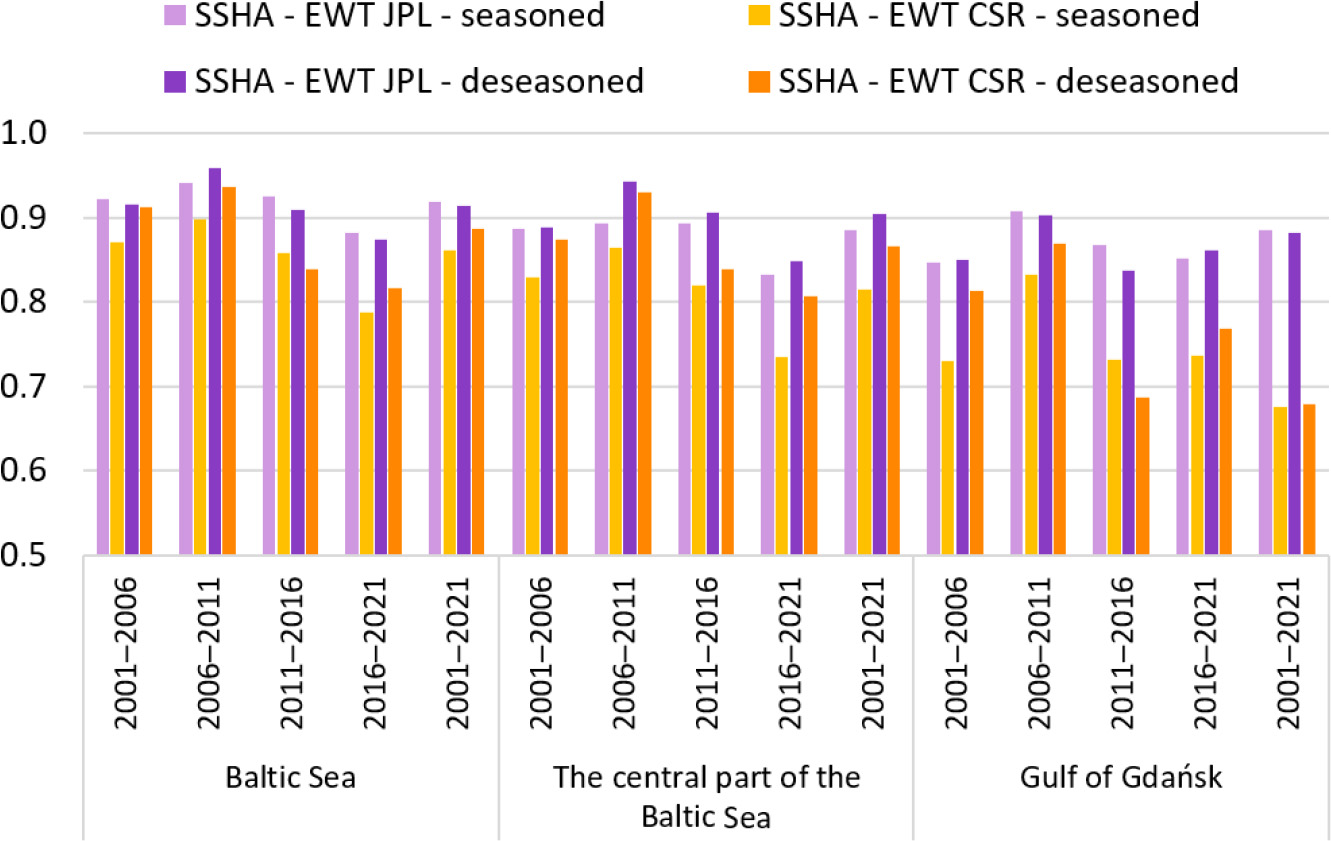
Figure 17.
Pearson correlation coefficients between altimetric anomalies (SSHA) and gravity anomalies (EWT JPL/CSR) of the entire area of the Baltic Sea, the central part of the Baltic Sea, and the Gulf of Gdańsk in 2001–2021
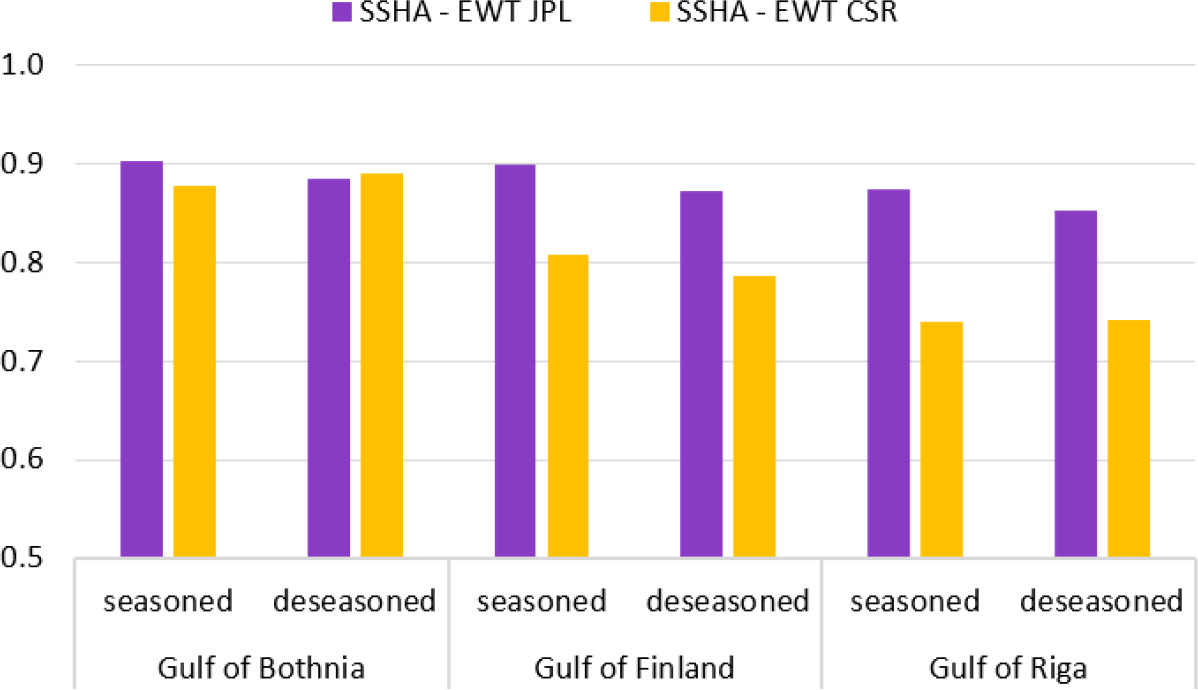
Figure 18.
Pearson correlation coefficients between altimetric anomalies (SSHA) and gravity anomalies (EWT JPL/CSR) of the Gulf of Bothnia, the Gulf of Finland, and the Gulf of Riga in 2001–2021
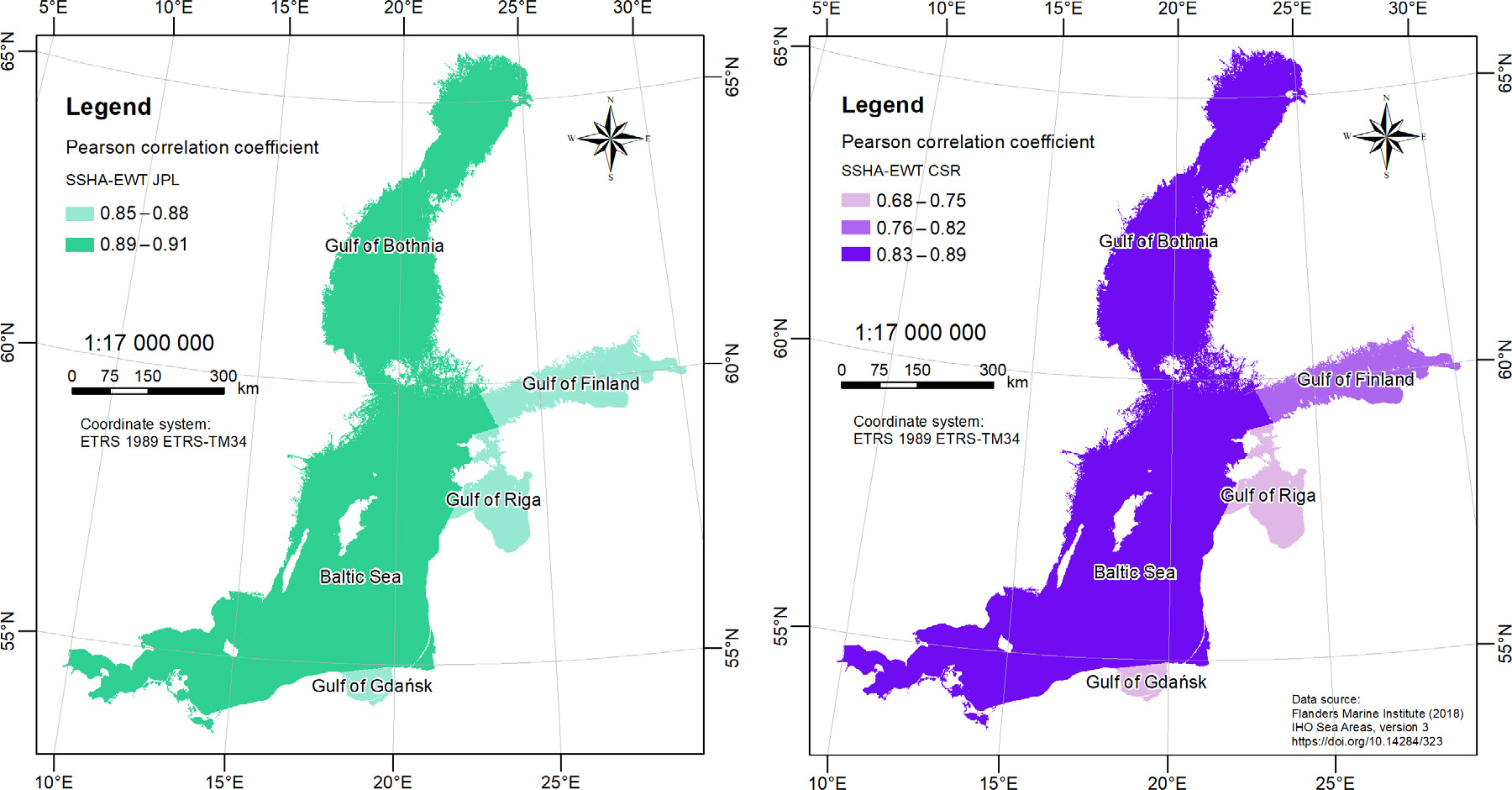
Figure 19.
Choropleth maps of Pearson correlation coefficients between altimetric anomalies (SSHA) and gravity anomalies (EWT JPL/CSR) of the Baltic Sea in 2001–2021 after the removal of seasonal signals
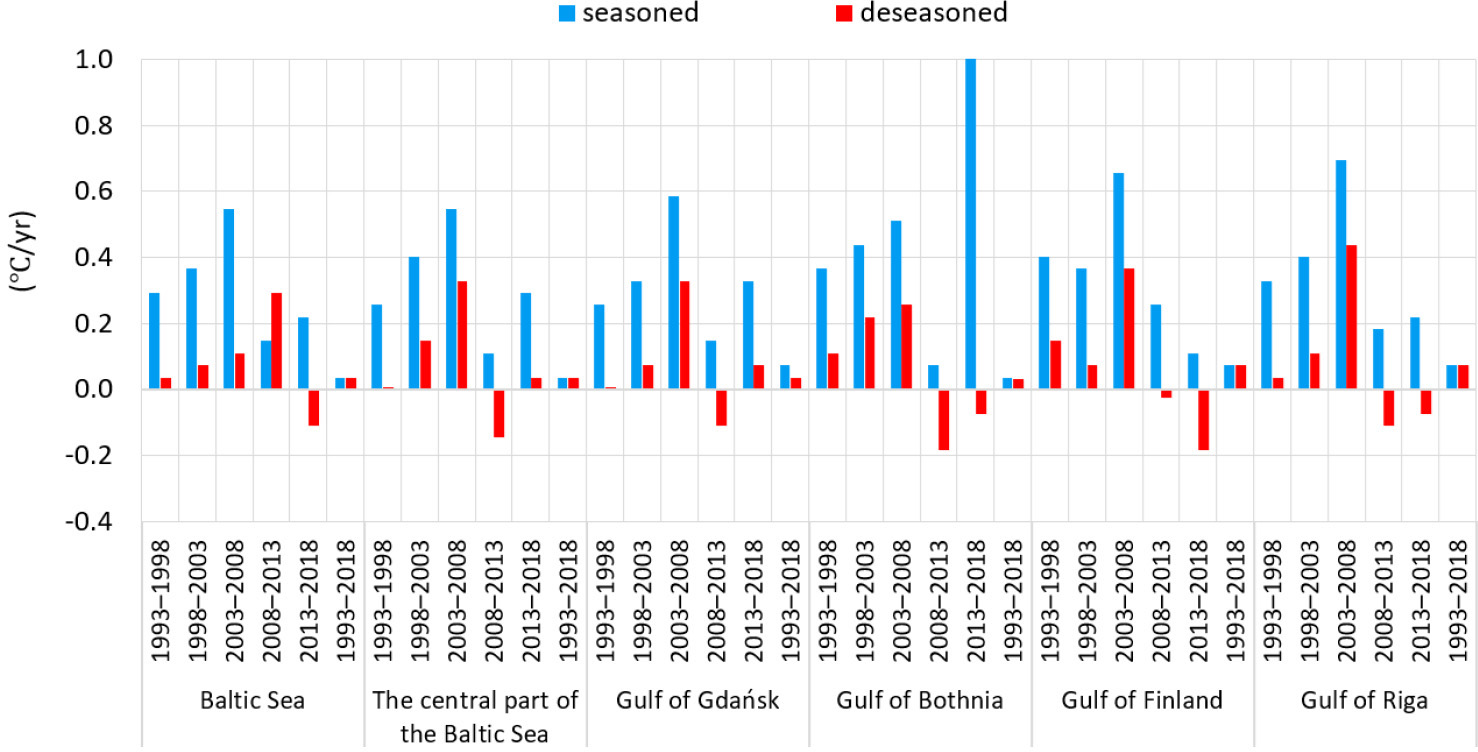
Figure 20.
Sea surface temperatures (HRRST) linear trends of the Baltic Sea in 1993–2018
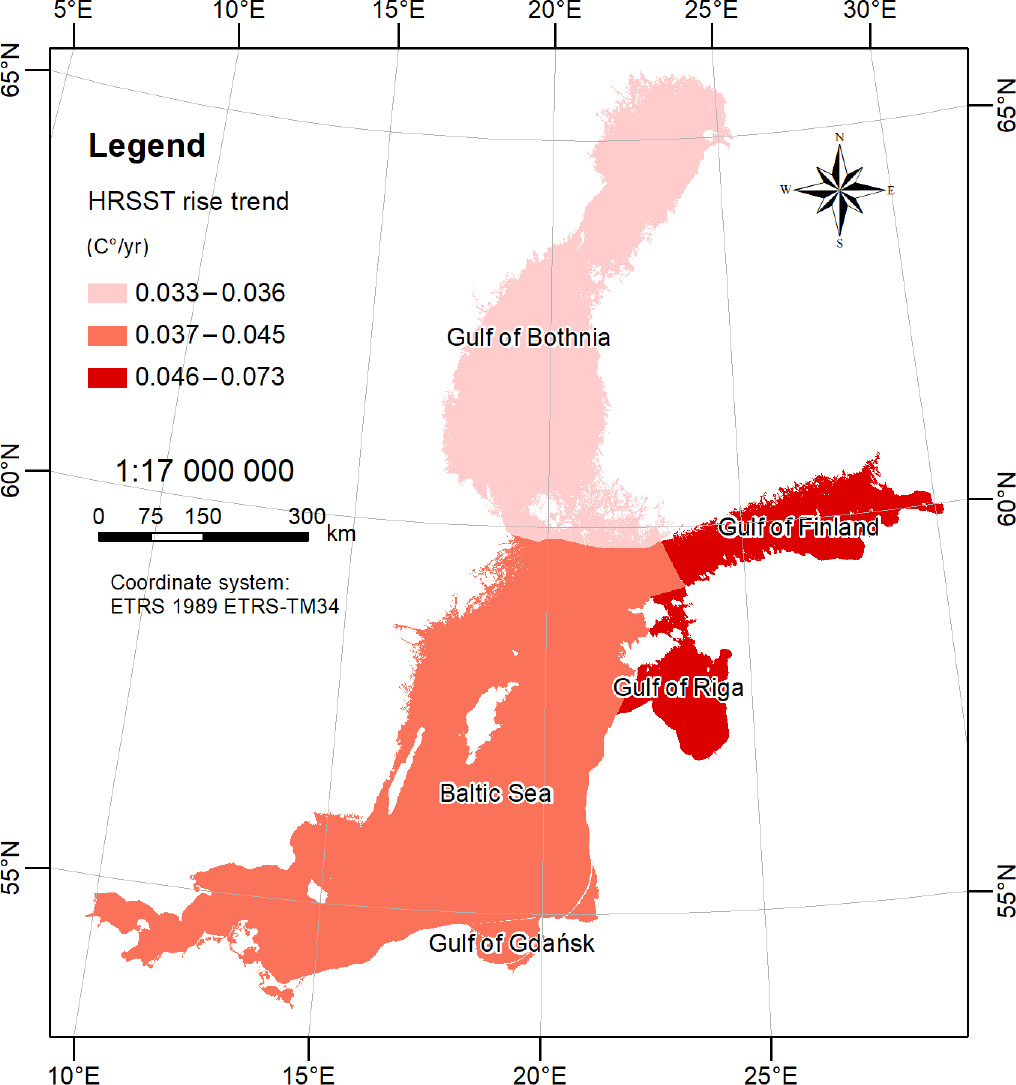
Figure 21.
Choropleth map of sea surface temperatures (HRRST) linear trend of the Baltic Sea in 1993–2018 after the removal of seasonal signals
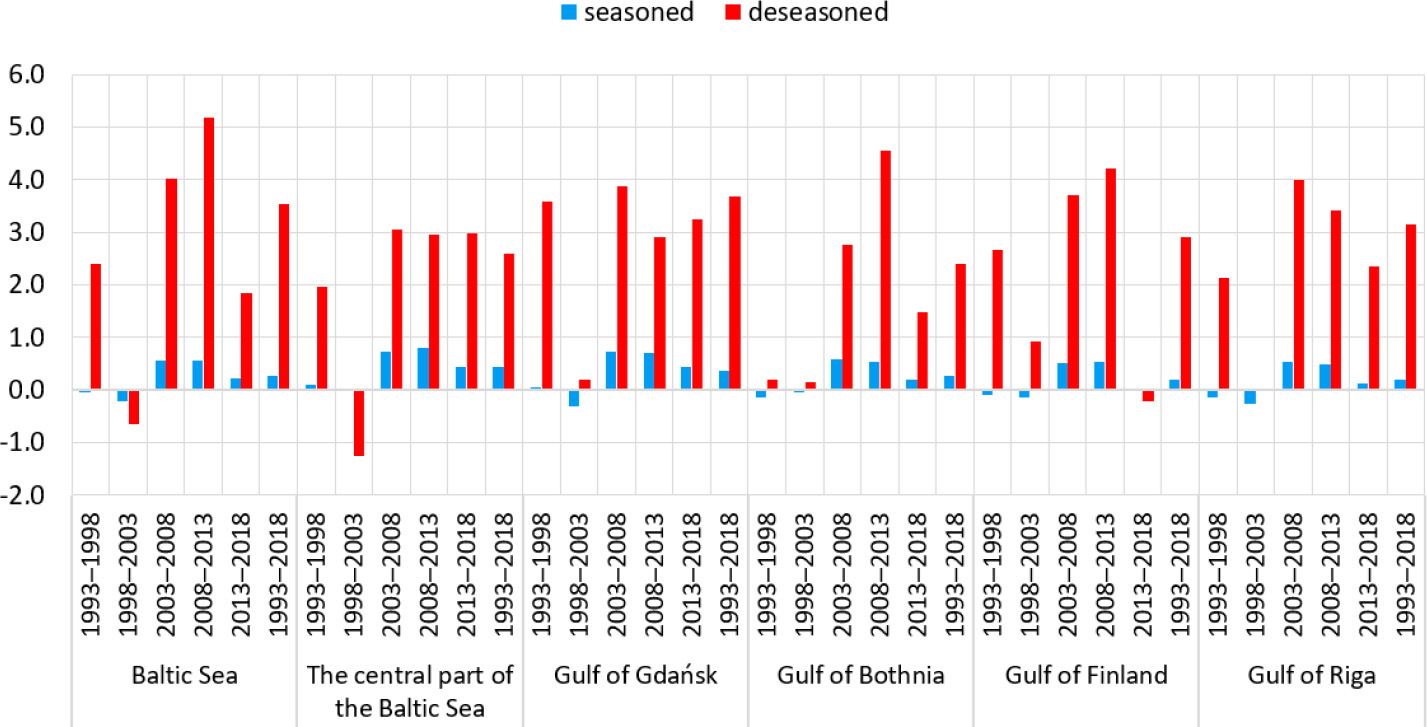
Figure 22.
Linear regression coefficients between altimetric anomalies (SSHA) and sea surface temperatures (HRSST) for the Baltic Sea in 1993–2018
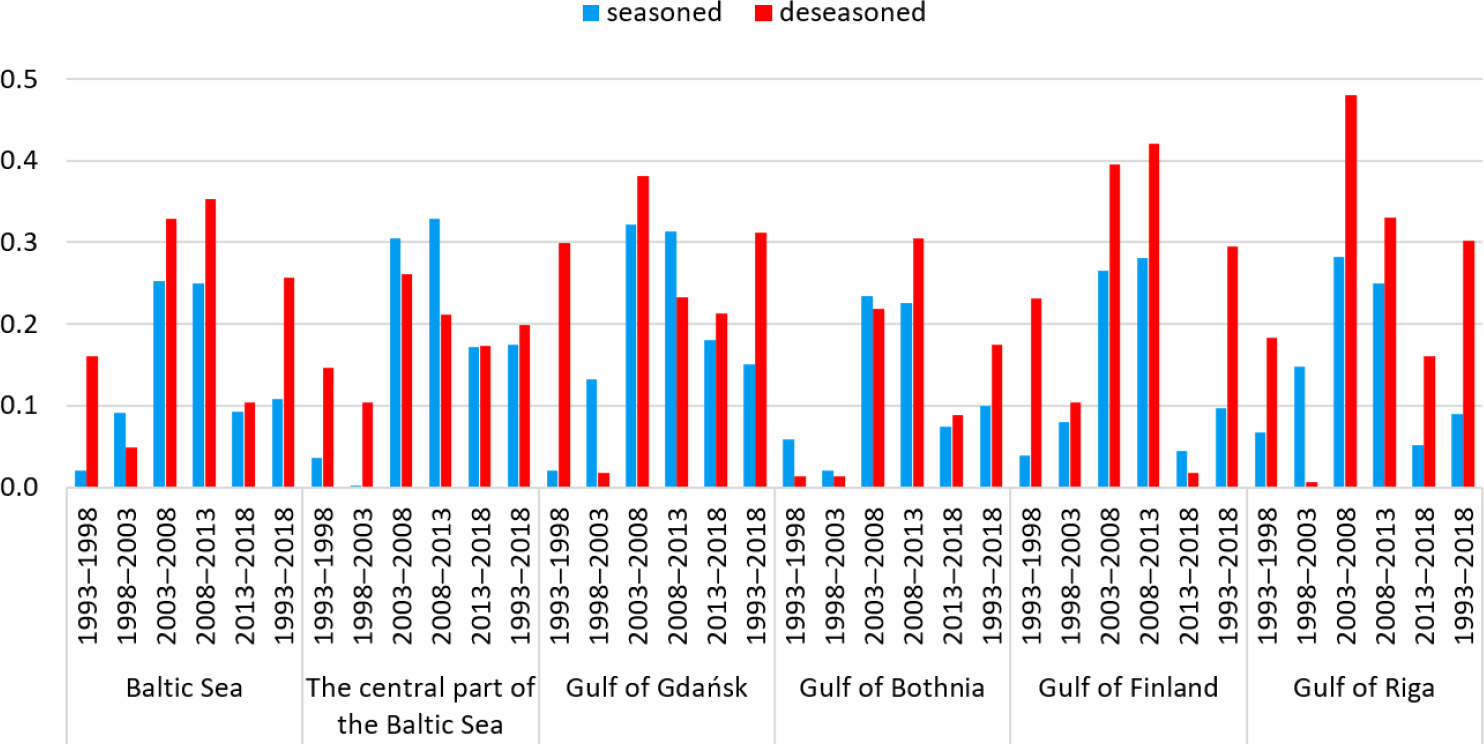
Figure 23.
Pearson correlation coefficients between altimetric anomalies (SSHA) and sea surface temperatures (HRSST) of the Baltic Sea in 1993–2018
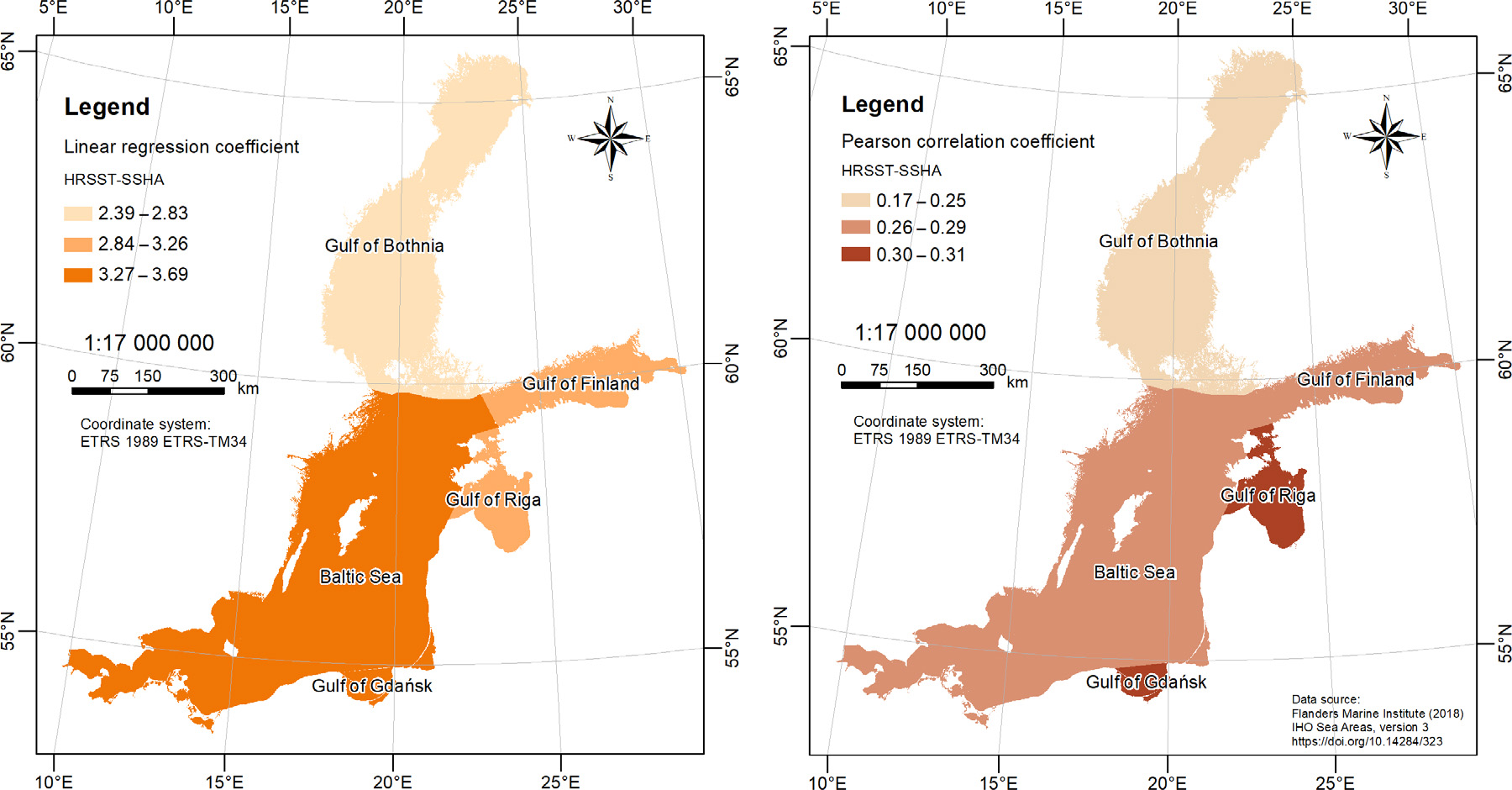
Figure 24.
Choropleth map of linear regression and Pearson correlation coefficients between altimetric anomalies (SSHA) and sea surface temperatures (HRSST) for the Baltic Sea in 1993–2018
Table A1.
Results of statistical analyses of sea level changes from altimetric (SSHA) and gravimetric (EWT) data after removal of seasonal signals
| Region | Period | Sea level rise trend (cm/yr) | Linear regression coefficient | Pearson correlation coefficient | ||||
|---|---|---|---|---|---|---|---|---|
| SSHA | EWT JPL | EWT CSR | SSHA – EWT JPL | SSHA – EWT CSR | SSHA – EWT JPL | SSHA – EWT CSR | ||
| Baltic Sea | 2001–2006 | 0.80 | 3.25 | 2.88 | 0.70 | 0.62 | 0.92 | 0.91 |
| 2006–2011 | −1.90 | −0.84 | −0.62 | 0.65 | 0.55 | 0.96 | 0.94 | |
| 2011–2016 | 0.58 | 0.40 | −1.13 | 0.63 | 0.48 | 0.91 | 0.84 | |
| 2016–2021 | 1.31 | 1.24 | 0.69 | 0.63 | 0.50 | 0.87 | 0.82 | |
| 2001–2021 | 0.58 | 0.91 | 0.29 | 0.71 | 0.51 | 0.91 | 0.89 | |
| The central part of the Baltic Sea | 2001–2006 | 0.80 | 39.06 | 2.85 | 0.80 | 0.67 | 0.89 | 0.87 |
| 2006–2011 | −2.34 | −1.24 | −0.73 | 0.67 | 0.59 | 0.94 | 0.93 | |
| 2011–2016 | 1.24 | 0.22 | −1.10 | 0.67 | 0.50 | 0.91 | 0.84 | |
| 2016–2021 | 1.10 | 1.24 | 0.55 | 0.67 | 0.53 | 0.85 | 0.81 | |
| 2001–2021 | 0.55 | 0.80 | 0.29 | 0.72 | 0.54 | 0.90 | 0.87 | |
| Gulf of Gdańsk | 2001–2006 | 0.66 | 2.08 | 1.20 | 0.57 | 0.37 | 0.85 | 0.81 |
| 2006–2011 | −1.90 | −1.28 | −1.06 | 0.59 | 0.38 | 0.90 | 0.87 | |
| 2011–2016 | 0.77 | −0.07 | −1.46 | 0.49 | 0.33 | 0.84 | 0.69 | |
| 2016–2021 | 0.80 | 0.40 | 0.07 | 0.54 | 0.39 | 0.86 | 0.77 | |
| 2001–2021 | 0.58 | 0.51 | −0.18 | 0.56 | 0.29 | 0.88 | 0.68 | |
| Gulf of Bothnia | 2001–2006 | 1.10 | 3.39 | 3.94 | 0.66 | 0.65 | 0.91 | 0.91 |
| 2006–2011 | −1.93 | −0.44 | −0.58 | 0.64 | 0.56 | 0.95 | 0.92 | |
| 2011–2016 | 0.58 | 0.66 | −0.69 | 0.61 | 0.48 | 0.90 | 0.86 | |
| 2016–2021 | 1.35 | 1.57 | 1.24 | 0.62 | 0.52 | 0.87 | 0.82 | |
| 2001–2021 | 0.58 | 1.10 | 0.58 | 0.71 | 0.56 | 0.89 | 0.89 | |
| Gulf of Finland | 2001–2006 | 0.77 | 4.89 | 6.35 | 0.90 | 1.03 | 0.88 | 0.81 |
| 2006–2011 | −1.97 | −0.80 | 0.84 | 0.74 | 0.66 | 0.92 | 0.81 | |
| 2011–2016 | 0.99 | −0.04 | −1.50 | 0.69 | 0.51 | 0.81 | 0.68 | |
| 2016–2021 | 1.75 | 1.39 | 1.61 | 0.60 | 0.55 | 0.78 | 0.71 | |
| 2001–2021 | 0.62 | 1.02 | 0.91 | 0.78 | 0.71 | 0.87 | 0.79 | |
| Gulf of Riga | 2001–2006 | 0.84 | 3.50 | 1.86 | 0.72 | 0.44 | 0.87 | 0.85 |
| 2006–2011 | −1.90 | −0.47 | −0.84 | 0.64 | 0.41 | 0.91 | 0.91 | |
| 2011–2016 | 0.91 | 0.33 | −0.99 | 0.46 | 0.23 | 0.81 | 0.71 | |
| 2016–2021 | 1.53 | 1.17 | 0.44 | 0.50 | 0.30 | 0.83 | 0.77 | |
| 2001–2021 | 0.58 | 0.95 | −0.04 | 0.62 | 0.28 | 0.85 | 0.74 | |
Table A2.
Results of statistical analyses of sea level changes from altimetric (SSHA) and sea surface temperature (HRSST) data before removal of seasonal signals
| Region | Period | Sea surface temperature rise trend (HRSST) (C°/yr) | Sea level rise trend (SSHA) (cm/yr) | Linear regression coefficient (HRSST – SSHA) | Pearson correlation coefficient (HRSST – SSHA) |
|---|---|---|---|---|---|
| Baltic Sea | 1993–1998 | 0.29 | −0.29 | −0.05 | 0.02 |
| 1998–2003 | 0.37 | −0.66 | −0.20 | 0.09 | |
| 2003–2008 | 0.55 | 2.63 | 0.57 | 0.25 | |
| 2008–2013 | 0.15 | 2.08 | 0.56 | 0.25 | |
| 2013–2018 | 0.22 | 3.58 | 0.23 | 0.09 | |
| 1993–2018 | 0.04 | 0.51 | 0.26 | 0.11 | |
| The central part of the Baltic Sea | 1993–1998 | 0.26 | 0.00 | 0.09 | 0.04 |
| 1998–2003 | 0.40 | −0.69 | 0.00 | 0.00 | |
| 2003–2008 | 0.55 | 2.15 | 0.74 | 0.30 | |
| 2008–2013 | 0.11 | 1.61 | 0.80 | 0.33 | |
| 2013–2018 | 0.29 | 3.07 | 0.44 | 0.17 | |
| 1993–2018 | 0.04 | 0.47 | 0.45 | 0.17 | |
| Gulf of Gdańsk | 1993–1998 | 0.26 | 0.03 | 0.05 | 0.02 |
| 1998–2003 | 0.33 | −0.29 | −0.31 | 0.13 | |
| 2003–2008 | 0.58 | 2.66 | 0.72 | 0.32 | |
| 2008–2013 | 0.15 | 2.41 | 0.70 | 0.31 | |
| 2013–2018 | 0.33 | 3.65 | 0.44 | 0.18 | |
| 1993–2018 | 0.07 | 0.55 | 0.37 | 0.15 | |
| Gulf of Bothnia | 1993–1998 | 0.37 | −0.62 | −0.15 | 0.06 |
| 1998–2003 | 0.44 | −0.66 | −0.05 | 0.02 | |
| 2003–2008 | 0.51 | 2.85 | 0.57 | 0.23 | |
| 2008–2013 | 0.07 | 1.93 | 0.54 | 0.23 | |
| 2013–2018 | 1.83 | 3.80 | 0.21 | 0.07 | |
| 1993–2018 | 0.04 | 0.55 | 0.26 | 0.10 | |
| Gulf of Finland | 1993–1998 | 0.40 | −0.37 | −0.08 | 0.04 |
| 1998–2003 | 0.37 | −0.62 | −0.14 | 0.08 | |
| 2003–2008 | 0.66 | 2.77 | 0.52 | 0.27 | |
| 2008–2013 | 0.26 | 2.08 | 0.54 | 0.28 | |
| 2013–2018 | 0.11 | 3.47 | −0.03 | 0.04 | |
| 1993–2018 | 0.07 | 0.51 | 0.20 | 0.10 | |
| Gulf of Riga | 1993–1998 | 0.33 | −0.26 | −0.14 | 0.07 |
| 1998–2003 | 0.40 | −0.62 | −0.26 | 0.15 | |
| 2003–2008 | 0.69 | 2.74 | 0.54 | 0.28 | |
| 2008–2013 | 0.18 | 2.37 | 0.49 | 0.25 | |
| 2013–2018 | 0.22 | 3.58 | 0.13 | 0.05 | |
| 1993–2018 | 0.07 | 0.58 | 0.19 | 0.09 |
Table A3.
Results of statistical analyses of sea level changes from altimetric (SSHA) and sea surface temperature (HRSST) data after removal of seasonal signals
| Region | Period | Sea surface temperature rise trend (HRSST) (C°/yr) | Sea level rise trend (SSHA) (cm/yr) | Linear regression coefficient (HRSST – SSHA) | Pearson correlation coefficient (HRSST – SSHA) |
|---|---|---|---|---|---|
| Baltic Sea | 1993–1998 | 0.04 | 0.51 | 2.40 | 0.16 |
| 1998–2003 | 0.07 | −0.69 | −0.65 | 0.05 | |
| 2003–2008 | 0.11 | −1.06 | 4.02 | 0.33 | |
| 2008–2013 | 0.29 | 2.26 | 5.18 | 0.35 | |
| 2013–2018 | −0.11 | 1.68 | 1.84 | 0.10 | |
| 1993–2018 | 0.04 | 0.51 | 3.55 | 0.26 | |
| The central part of the Baltic Sea | 1993–1998 | 0.01 | −0.40 | 1.97 | 0.15 |
| 1998–2003 | 0.15 | −1.10 | −1.25 | 0.10 | |
| 2003–2008 | 0.33 | 1.75 | 3.05 | 0.26 | |
| 2008–2013 | −0.15 | 1.20 | 2.95 | 0.21 | |
| 2013–2018 | 0.04 | 2.66 | 2.98 | 0.17 | |
| 1993–2018 | 0.04 | 0.47 | 2.60 | 0.20 | |
| Gulf of Gdańsk | 1993–1998 | 0.01 | −0.33 | 3.59 | 0.30 |
| 1998–2003 | 0.07 | −0.66 | 0.20 | 0.02 | |
| 2003–2008 | 0.33 | 2.30 | 3.87 | 0.38 | |
| 2008–2013 | −0.11 | 2.04 | 2.91 | 0.23 | |
| 2013–2018 | 0.07 | 3.29 | 3.25 | 0.21 | |
| 1993–2018 | 0.04 | 0.55 | 3.69 | 0.31 | |
| Gulf of Bothnia | 1993–1998 | 0.11 | −1.06 | 0.21 | 0.01 |
| 1998–2003 | 0.22 | −1.06 | 0.14 | 0.01 | |
| 2003–2008 | 0.26 | 2.45 | 2.77 | 0.22 | |
| 2008–2013 | −0.18 | 1.53 | 4.56 | 0.30 | |
| 2013–2018 | −0.07 | 3.36 | 1.49 | 0.09 | |
| 1993–2018 | 0.03 | 0.51 | 2.39 | 0.17 | |
| Gulf of Finland | 1993–1998 | 0.15 | −0.77 | 2.66 | 0.23 |
| 1998–2003 | 0.07 | −1.02 | 0.92 | 0.10 | |
| 2003–2008 | 0.37 | 2.37 | 3.69 | 0.40 | |
| 2008–2013 | −0.03 | 1.68 | 4.21 | 0.42 | |
| 2013–2018 | −0.18 | 3.07 | −0.21 | 0.02 | |
| 1993–2018 | 0.07 | 0.51 | 2.90 | 0.29 | |
| Gulf of Riga | 1993–1998 | 0.04 | −0.69 | 2.14 | 0.18 |
| 1998–2003 | 0.11 | −1.02 | −0.01 | 0.01 | |
| 2003–2008 | 0.44 | 2.34 | 4.00 | 0.48 | |
| 2008–2013 | −0.11 | 1.97 | 3.42 | 0.33 | |
| 2013–2018 | −0.07 | 3.18 | 2.35 | 0.16 | |
| 1993–2018 | 0.07 | 0.55 | 3.16 | 0.30 |