
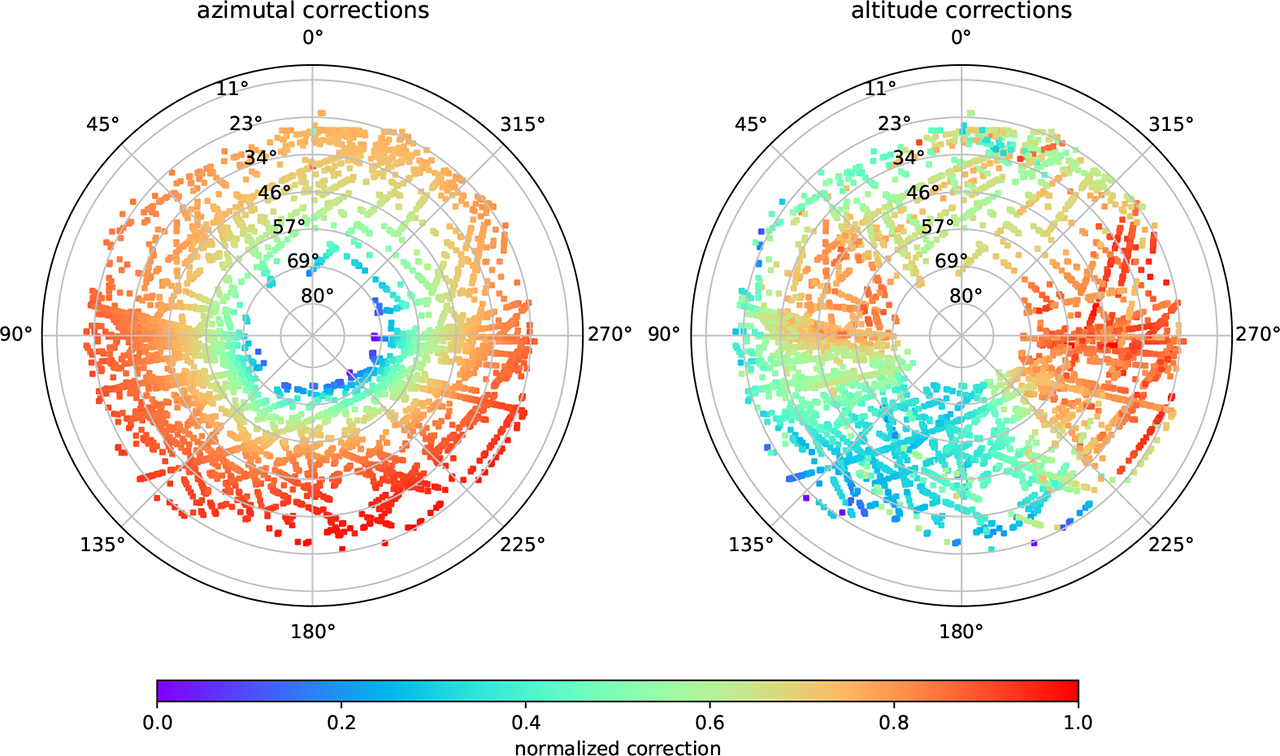
Figure 1.
Raw source data for the model. Approximately 13,000 points are plotted in the horizon coordinate system. Normalized corrections are shown in different colors.
Table 1.
General structure of the TIM network, each row is a layer. Total number of trainable parameters is 19,762.
| Layer type | Number of neurons | Number of parameters | Activation |
|---|---|---|---|
| InputLayer | 4 | 0 | None |
| Dense | 64 | 320 | tanh |
| Dense | 64 | 4160 | relu |
| Dense | 64 | 4160 | relu |
| Dense | 64 | 4160 | relu |
| Dense | 32 | 2080 | relu |
| Dense | 32 | 1056 | relu |
| Dense | 32 | 1056 | relu |
| Dense | 32 | 1056 | relu |
| Dense | 16 | 528 | relu |
| Dense | 16 | 272 | relu |
| Dense | 16 | 272 | relu |
| Dense | 16 | 272 | relu |
| Dense | 8 | 136 | relu |
| Dense | 8 | 72 | relu |
| Dense | 8 | 72 | relu |
| Dense | 8 | 72 | relu |
| Dense | 2 | 18 | sigmoid |
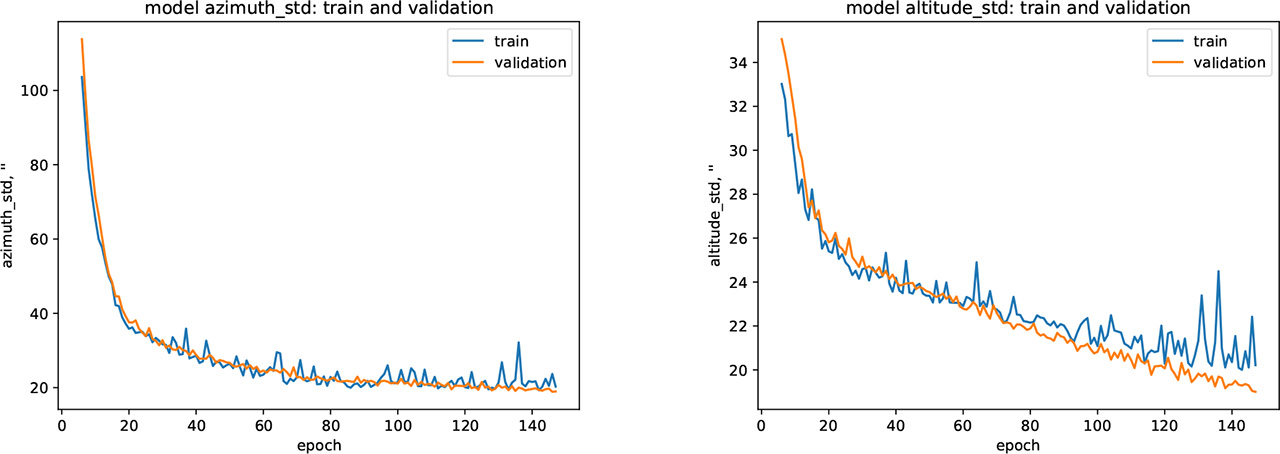
Figure 2.
Cost function (standard deviation) for corrections to azimuth (left) and altitude (right) depending on learning iteration number (epoch)
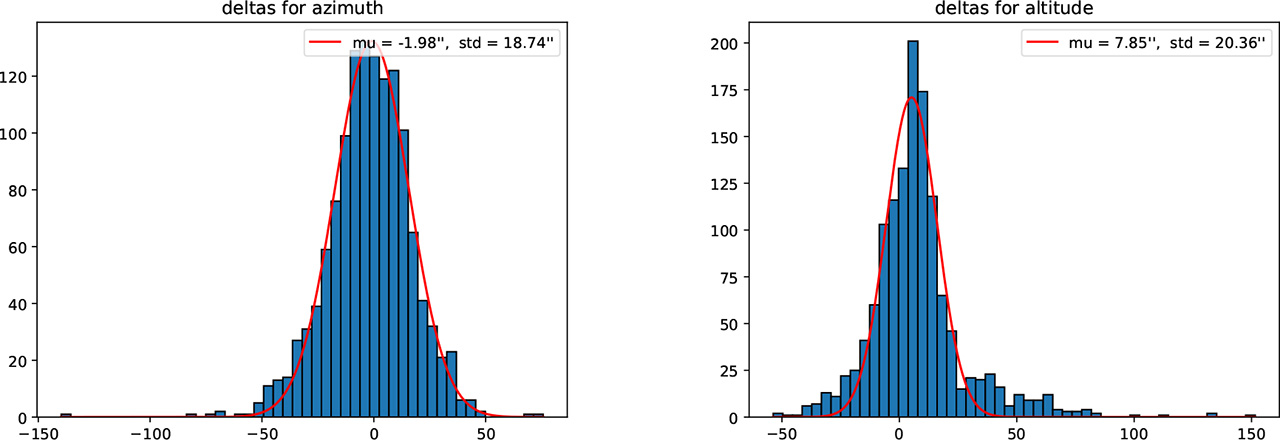
Figure 3.
Residual distribution of modeled and original corrections