
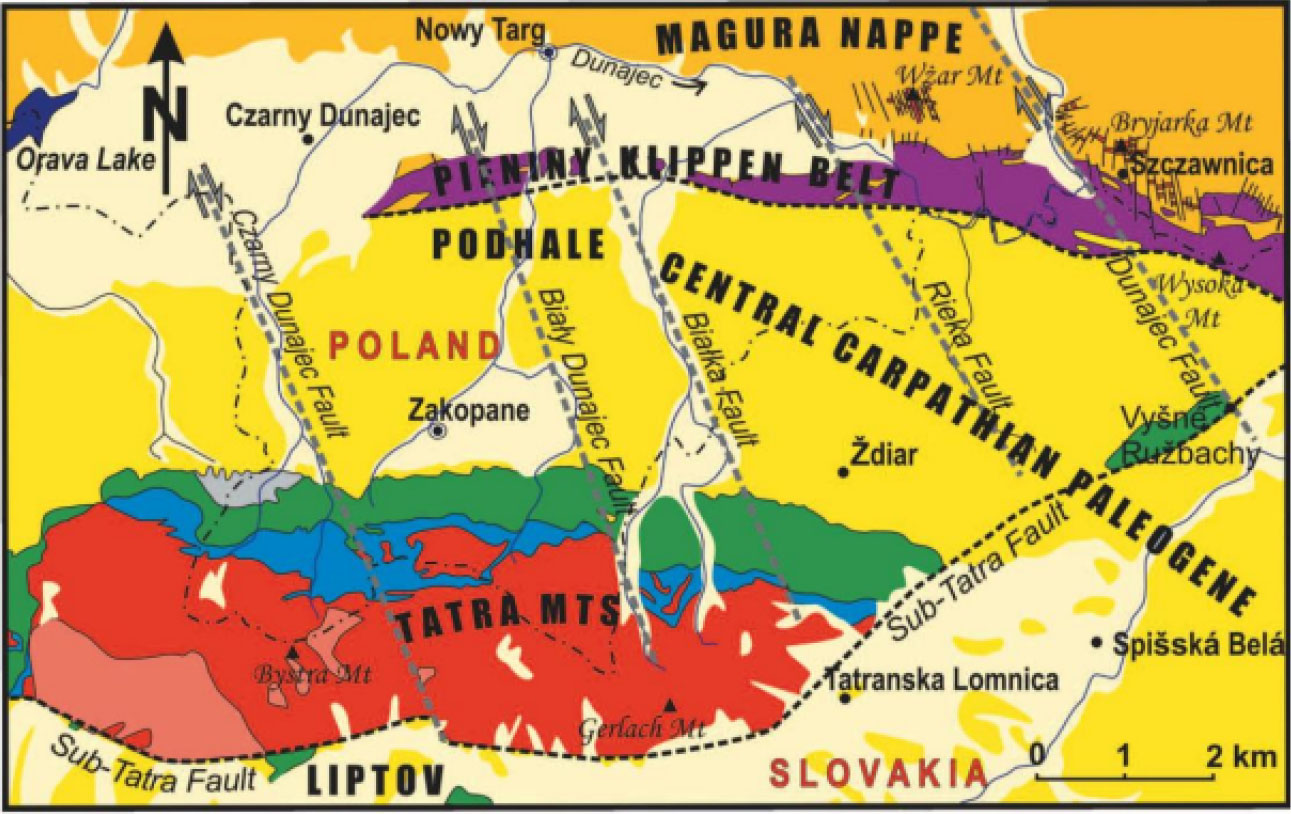
Figure 1.
The geological structure of the Pieniny Klippen Belt (Jurewicz, 2005)
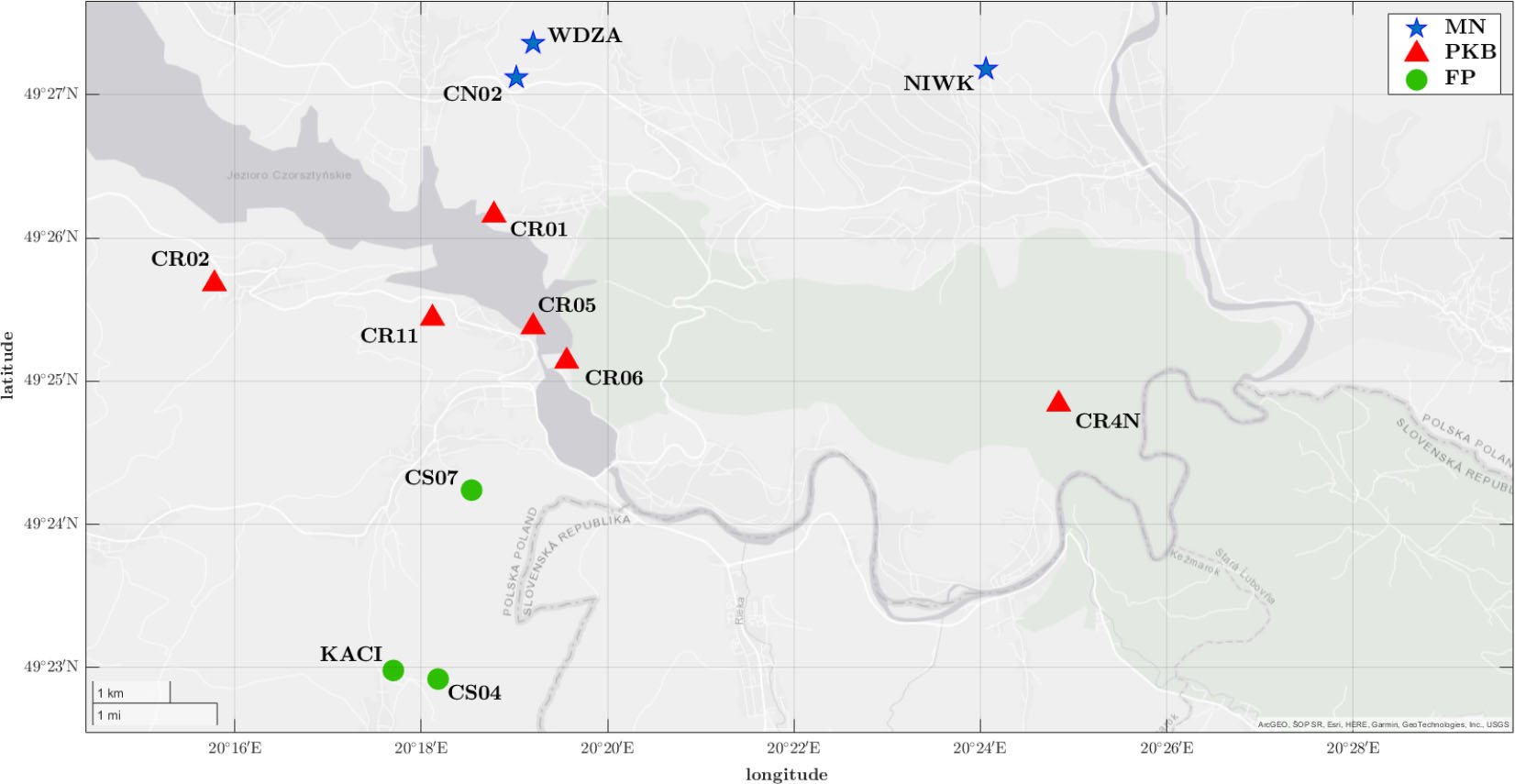
Figure 2.
The map points of the Pieniny Klippen Belt (red triangles), the Magura Nappe (blue stars), and the Podhale Flysh (green circles)
Table 1.
List of measuring epochs for each point in the Pieniny Test Field area
| Station | Unit | Duration of the measurement session [hours] | Measuring epochs | Number of epochs |
|---|---|---|---|---|
| CR01 | PKB | 6.0 | 2004, 2006 – 2020 | 16 |
| CR02 | 6.0 | 2004, 2006 – 2020 | 16 | |
| CR4N | 6.0 | 2006,2008 – 2020 | 16 | |
| CR05 | 6.0 | 2004, 2006 – 2020 | 16 | |
| CR06 | 6.0 | 2004, 2006 – 2020 | 16 | |
| CR11 | 6.0 | 2004, 2006 – 2014 | 10 | |
| NIWK | MN | 6.0 | 2004, 2006 – 2020 | 16 |
| WDZA | 72.0 | 2004, 2006 – 2020 | 16 | |
| CN02 | 6.0 | 2004, 2006 – 2015 | 11 | |
| KACI | FP | 72.0 | 2004, 2006 – 2020 | 16 |
| CS04 | 6.0 | 2004, 2006 – 2015 | 11 | |
| CS07 | 6.0 | 2004, 2006 – 2020 | 16 | |
| GUBA | TM | 72.0 | 2004, 2006 – 2014 | 10 |
| HAGA | 72.0 | 2004, 2006, 2008 – 2020 | 15 | |
| KAWI | 72.0 | 2004, 2006 – 2020 | 16 |
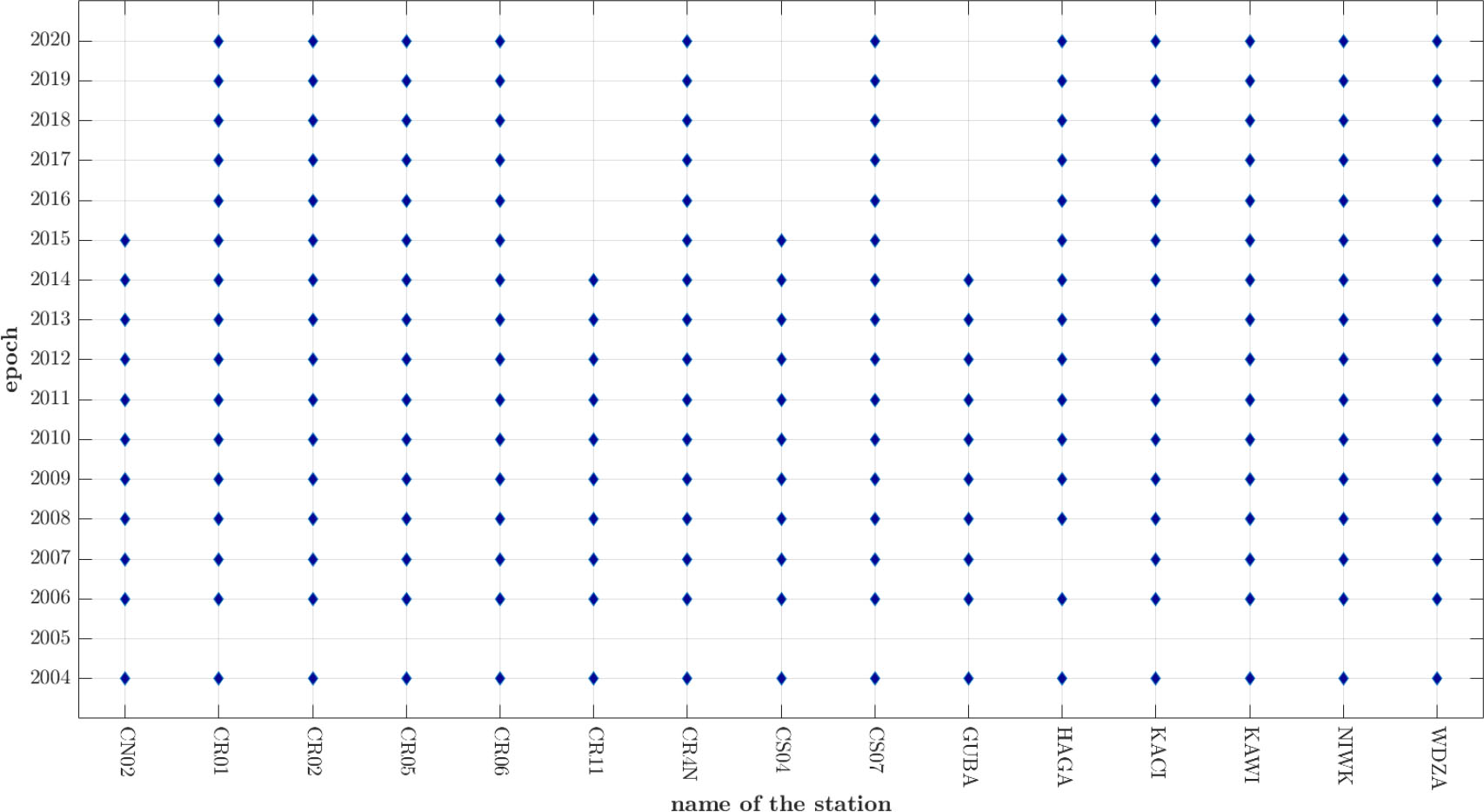
Figure 3.
The plot showing the measuring epochs for each point in the Pieniny Test Field area
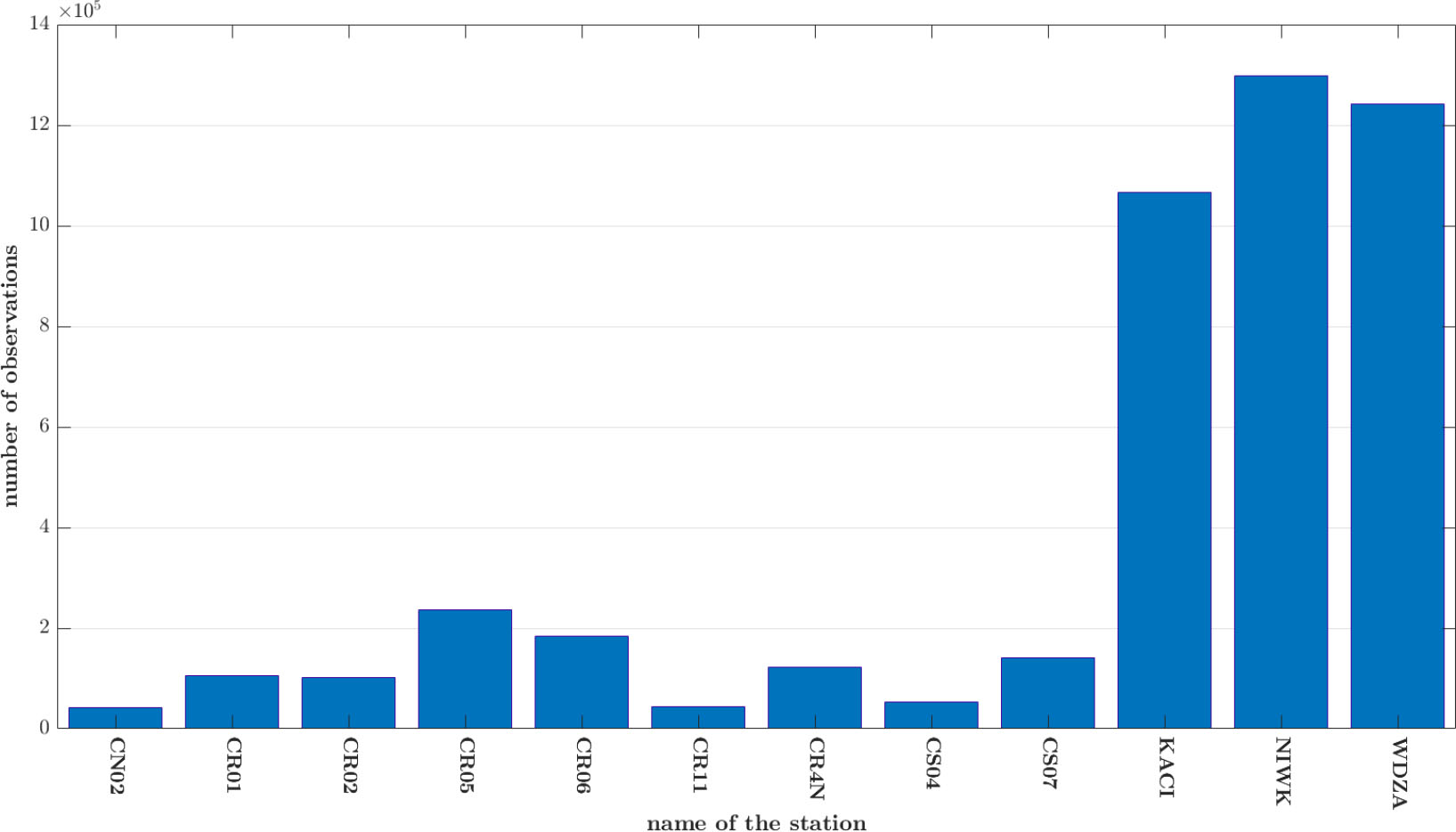
Figure 4.
The histogram of the number of observations at each point of the Pieniny Geodynamic Test Field
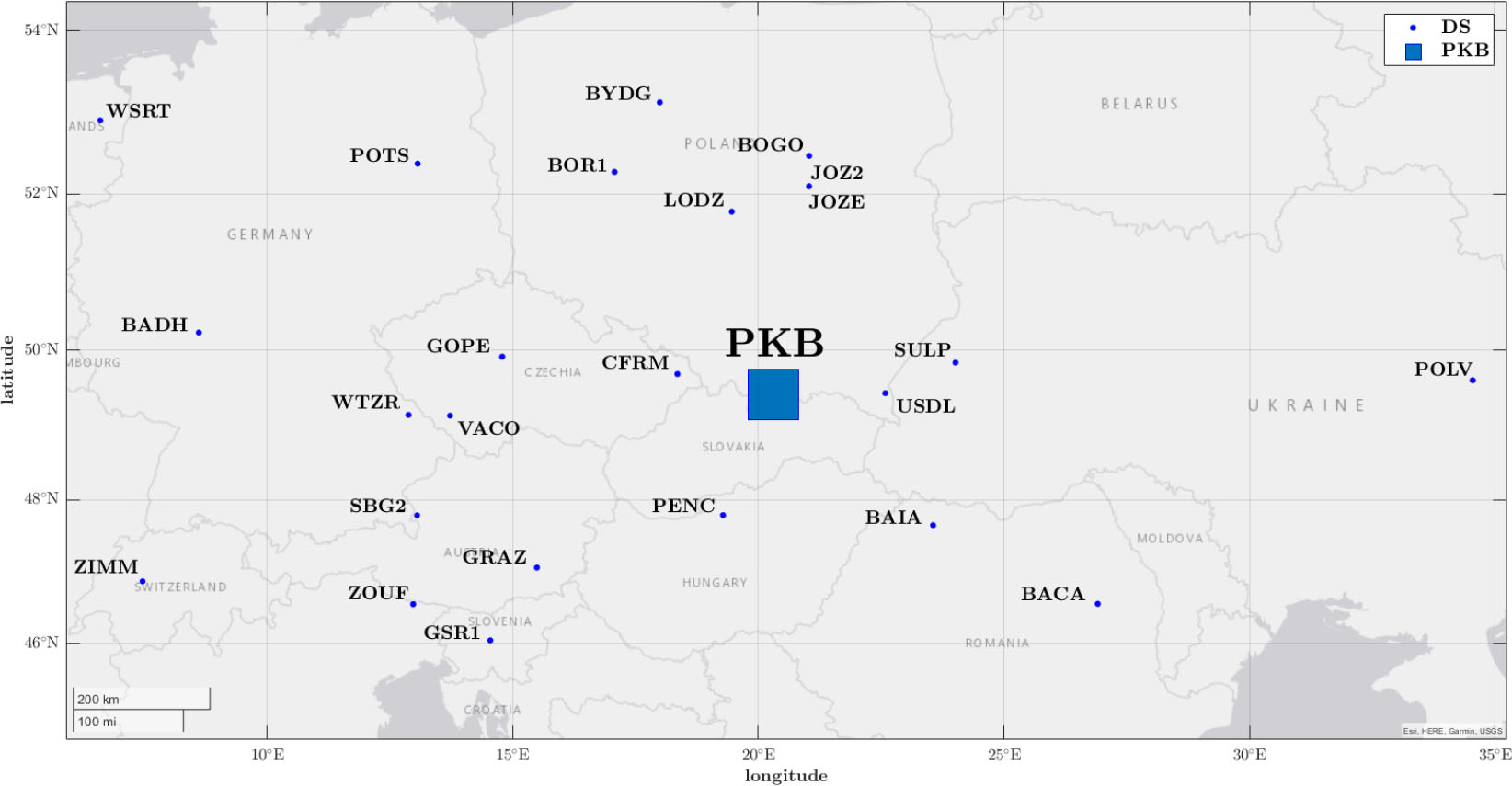
Figure 5.
The map of datum definition sites
Table 2.
Number of discontinuities for EUREF’s stations
| Number of discontinuities | Station |
|---|---|
| 0 | BOGO ZIMM ZOUF |
| 1 | BACA BADH BAIA BOR1 CFRM GSR1 JOZ2 LODZ |
| PENC POLV SULP USDL VACO WSRT | |
| 2 | BYDG GOPE JOZE SBG2 WTZR |
| 4 | GRAZ POTS |
Table 3.
The GNSS processing parameters
| Observation modeling | |
| Epoch | 01 01 2010 |
| Observations | GPS, GLONASS, Galileo |
| Satellite orbits | CODE, IGS Reprocessing 2 |
| Baseline creation strategy | max. number of common obs. |
| Amibiguity observation strategy | QIF |
| Sampling interval | 300 |
| Ionospheric model | CODE |
| Phase center variations | igs14.atx |
| Reference frame | IGb14 |
| PCV model | I14 |
| Earth orientation parameters | |
| Nutation model | IERS2010 |
| UT1–UTC | IGS (IERS) |
| Orbit modeling | |
| Coeff. of Earth potential | EGM 2008 |
| Subdaly pole model | IERS 2010 |
| Ocean loading corrections | FES2004 |
| Planetary ephemeris file | DE405 |
| Station movement | |
| Ocean tidal loading | FES2004 |
| Subdaily pole model | IERS 2010 |
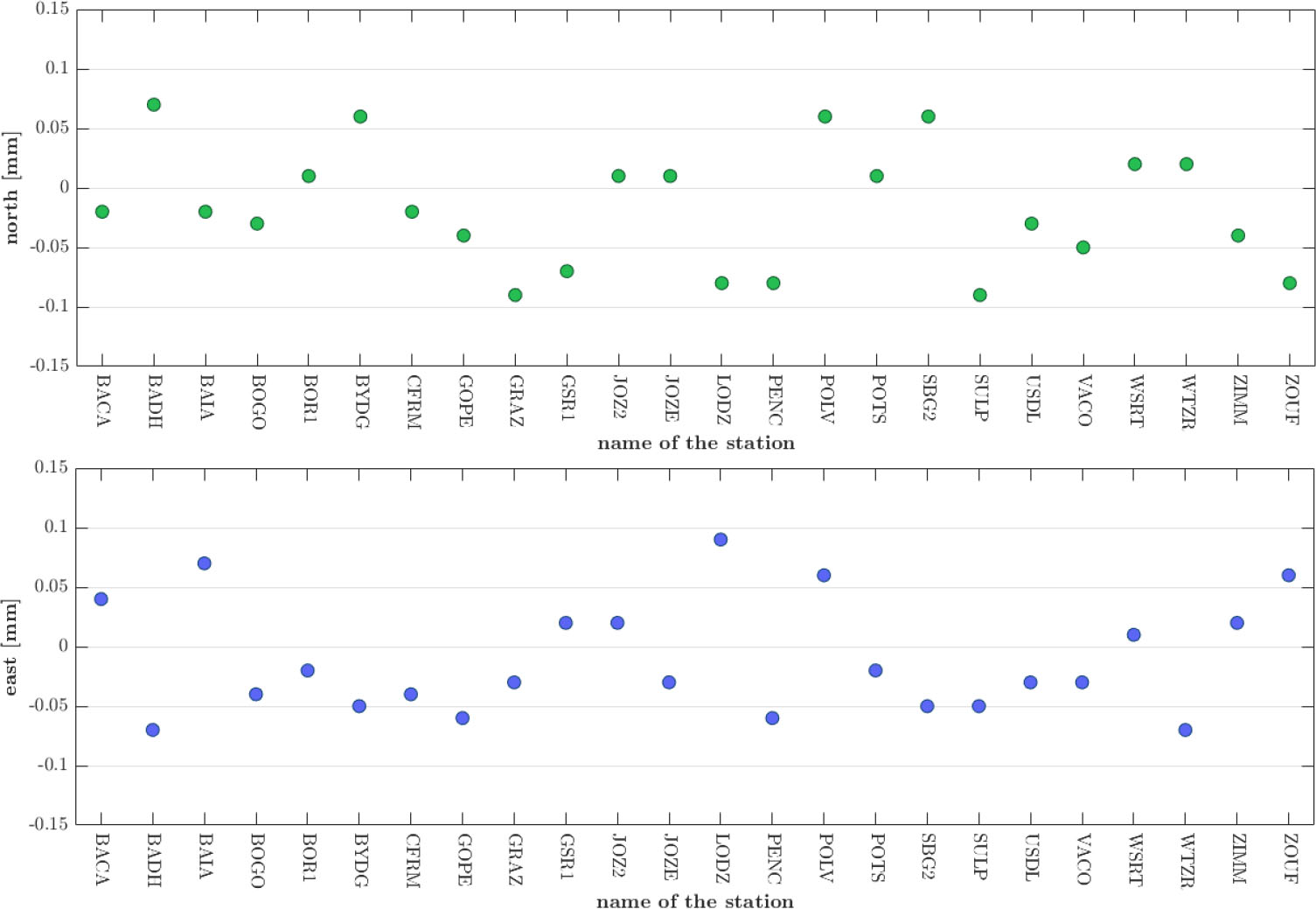
Figure 6.
The residual horizontal velocity values from EUREF model for the North (upper plot) and East (bottom plot) components
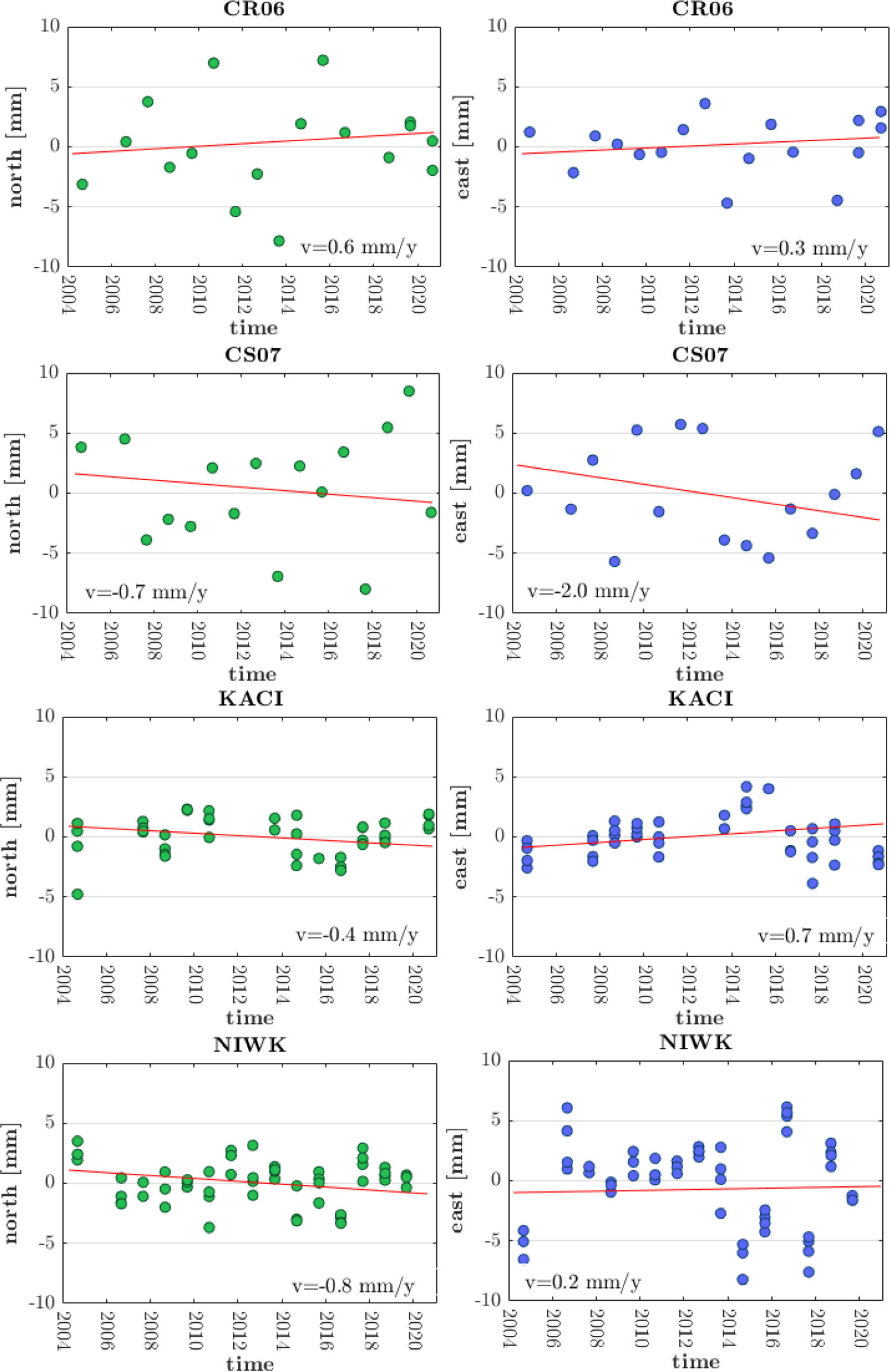
Figure 7.
The residual horizontal velocities with trend line for the CR06, CS07, KACI and NIWK stations in each direction (north–south and east–west)
Table 4.
The summary of residual horizontal velocity
| Station | Unit | Residual velocity | Residual velocity error | ||
|---|---|---|---|---|---|
| North [mm/year] | East [mm/year] | North [mm/year] | East [mm/year] | ||
| CR01 | PKB | 0.1 | −0.3 | ±0.30 | ±0.14 |
| CR02 | −0.5 | −0.5 | ±0.38 | ±0.20 | |
| CR4N | −0.4 | 1.6 | ±0.41 | ±0.14 | |
| CR05 | -1.3 | −0.7 | ±0.39 | ±0.20 | |
| CR06 | 0.6 | 0.3 | ±0.16 | ±0.08 | |
| CR11 | -1.0 | 1.5 | ±0.43 | ±0.23 | |
| Mean | −0.4 | 0.3 | ±0.35 | ±0.17 | |
| NIWK | MN | −0.8 | 0.2 | ±0.07 | ±0.04 |
| WDZA | −0.4 | 0.5 | ±0.06 | ±0.04 | |
| CN02 | 0.2 | 0.4 | ±0.40 | ±0.28 | |
| Mean | −0.3 | 0.4 | ±0.21 | ±0.12 | |
| KACI | FP | −0.4 | 0.7 | ±0.05 | ±0.03 |
| CS04 | −0.8 | −0.2 | ±0.55 | ±0.28 | |
| CS07 | −0.7 | -2.0 | ±0.27 | ±0.12 | |
| Mean | −0.6 | −0.5 | ±0.29 | ±0.14 | |
| GUBA | TM | −0.4 | 0.0 | ±0.14 | ±0.07 |
| HAGA | −0.1 | −0.3 | ±0.09 | ±0.05 | |
| KAWI | 0.8 | 0.5 | ±0.13 | ±0.06 | |
| Mean | 0.1 | 0.1 | ±0.12 | ±0.06 | |
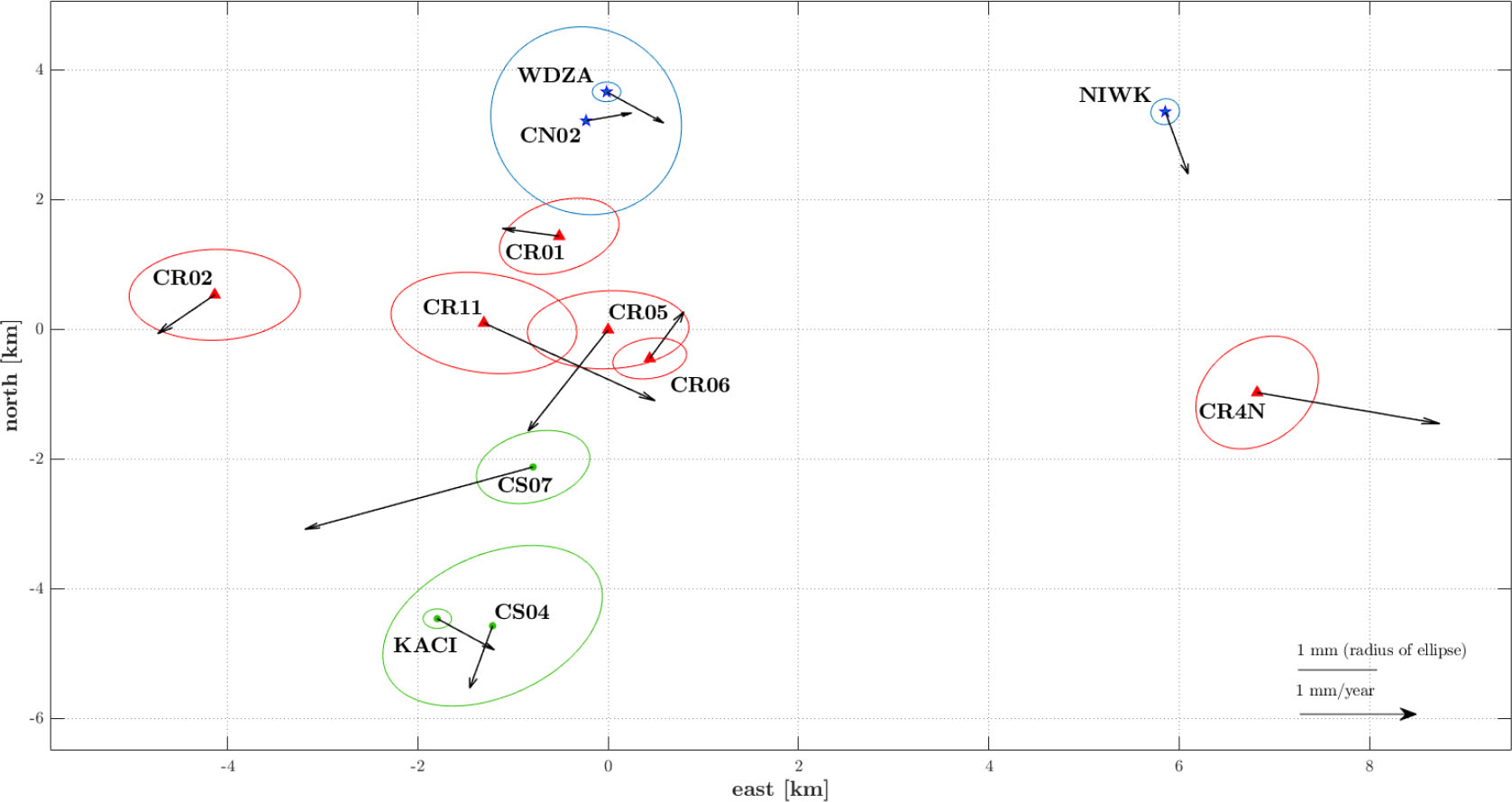
Figure 8.
The map of the residual horizontal velocity vectors end of the velocity error ellipses for stations in the Pieniny Klippen Belt (red triangles), the Magura Nappe (blue stars), and the Podhale Flysh (green circles)
Table 5.
The comparison residual horizonal velocities from the current study and from the previous one in the IGS08 system
| Station | Study 2016 | Study 2022 | Difference | |||
|---|---|---|---|---|---|---|
| North [mm/year] | East [mm/year] | North [mm/year] | East [mm/year] | North [mm/year] | East [mm/year] | |
| CN02 | 0.0 | 0.5 | 0.1 | 0.5 | 0.1 | 0.0 |
| CR01 | 0.1 | −0.2 | 0.1 | −0.3 | 0.0 | −0.1 |
| CR02 | −0.2 | −0.3 | −0.4 | −0.3 | −0.2 | 0.0 |
| CR05 | -1.1 | −0.4 | -1.2 | −0.5 | −0.1 | −0.1 |
| CR06 | 0.4 | 0.2 | 0.4 | 0.3 | 0.0 | 0.1 |
| CR11 | -1.1 | 1.8 | -1.2 | 1.6 | −0.1 | −0.2 |
| CR4N | −0.3 | 1.8 | −0.4 | 1.7 | −0.1 | −0.1 |
| CS04 | −0.9 | −0.2 | −0.8 | −0.3 | 0.1 | −0.1 |
| CS07 | −0.9 | -2.2 | −0.7 | -2.0 | 0.2 | 0.2 |
| KACI | −0.2 | 0.6 | −0.3 | 0.6 | −0.1 | 0.0 |
| NIWK | −0.8 | 0.4 | −0.8 | 0.3 | 0.0 | −0.1 |
| WDZA | −0.3 | 0.5 | −0.2 | 0.4 | 0.1 | −0.1 |
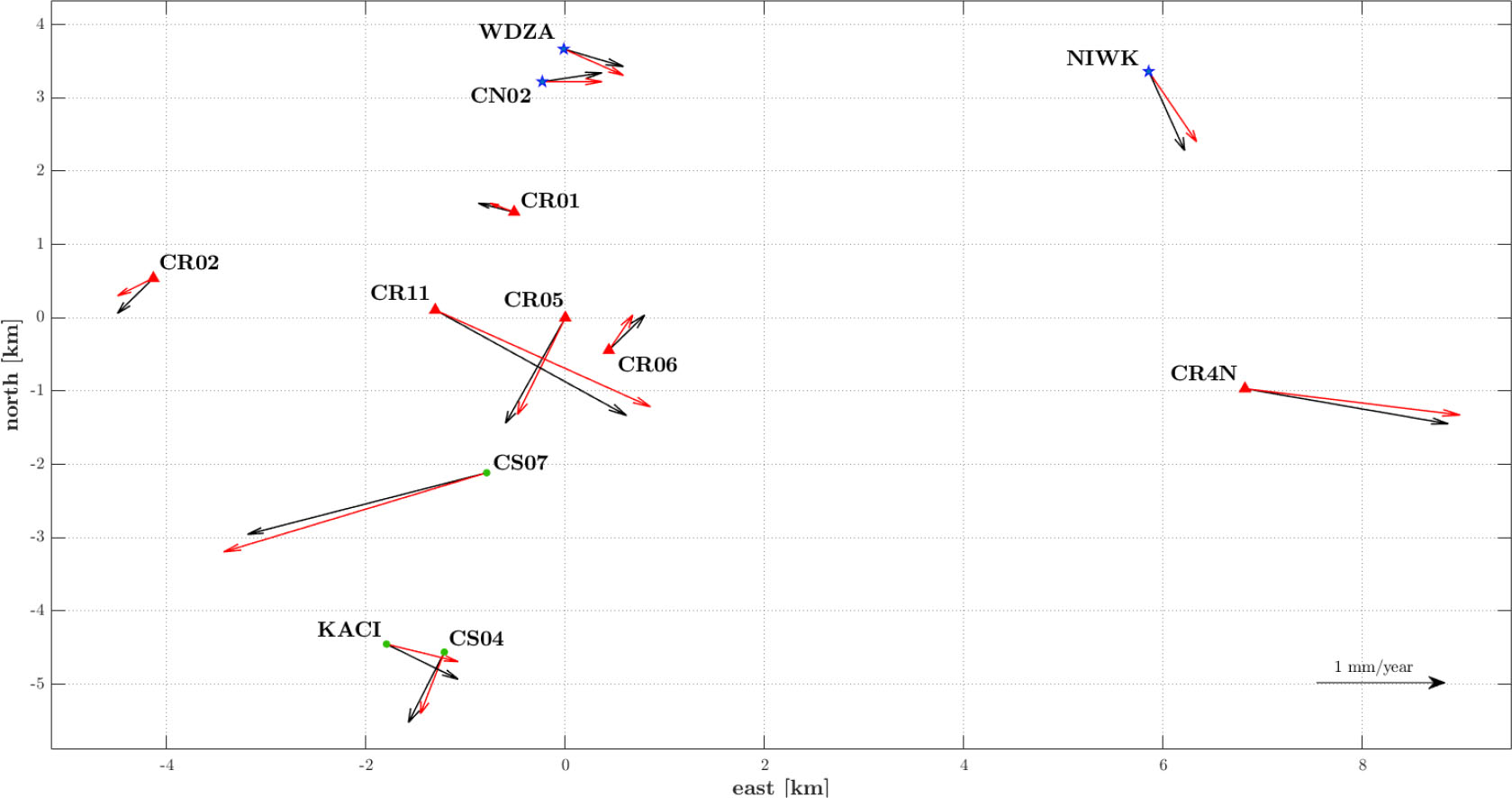
Figure 9.
The differences between residual horizonal velocities from the current study (black vectors) and from the previous one (red vectors) for stations in the Pieniny Klippen Belt (red triangles), the Magura Nappe (blue stars), and the Podhale Flysh (green circles)