
Introduction
Orthodontic relapse is considered a common phenomenon in orthodontics. It is understood that the quality of final occlusion is paramount to the provision of stability of the orthodontic outcome.1 While patient compliance is also considered essential to ensuring the minimization of positional change, it is shown that when retention appliances were not used, deterioration of the corrected dental position was seen in as little as four weeks following orthodontic treatment.2 As a patient may experience relapse, undesirable tooth position may dictate the need for subsequent orthodontic therapy. Clear orthodontic aligners (COA) have seen increasing popularity in contemporary dental practice due to their advantage over fixed-orthodontics in that they are more aesthetic, are suggested to be more comfortable and allow for improved oral and periodontal health.3,4
COA were first introduced in 19645 and have since become a mainstay of contemporaneous orthodontic therapy. This is arguably driven by an increase in aesthetic demand and has seen multiple systems introduced since its inception. While conventional fixed-orthodontic therapy consists of an active wire to exert force upon the clinical crown, aligners rely on the elasticity provided by the deflected thermoformed polyethylene terephthalate glycol (PET-G) or polyurethane material during insertion, to place a prescribed force and moment on a tooth.6 This desired tooth movement is usually conceived prior to fabrication of the clear aligner, usually on the patients digital/die stone dental cast, with the thermoform appliance then used to translate this change to the mouth. Despite this, several factors must be considered when trying to predict successful COA therapy. These include the provision of attachments (shape and position), aligner material and thickness, the amount of activation present in each aligner, and the technique used for the aligners production.4,7
Intrusion of a single incisor can be difficult in orthodontics, as conventional orthodontics inadvertently place extrusive forces on the adjacent dentition. In addition, COA usually require the use of attachments and multiple aligners to perform such intrusion. Despite their benefits and limitations, the use of conventional orthodontic appliances in the intrusion of a single tooth can be expensive and timely to the patient and clinician alike. This case therefore aims to identify a simple method of individual incisor tooth intrusion using a modified thermoplastic aligner.
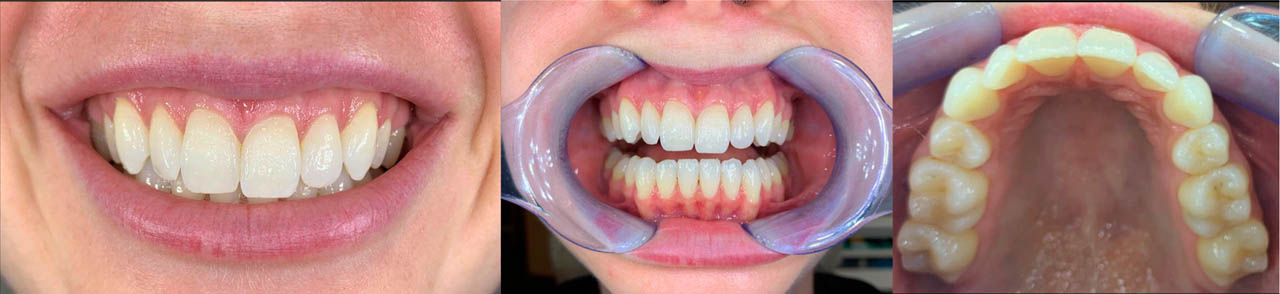
Figure 1.
Initial a) smile, b) retracted frontal, c) maxillary occlusal view.
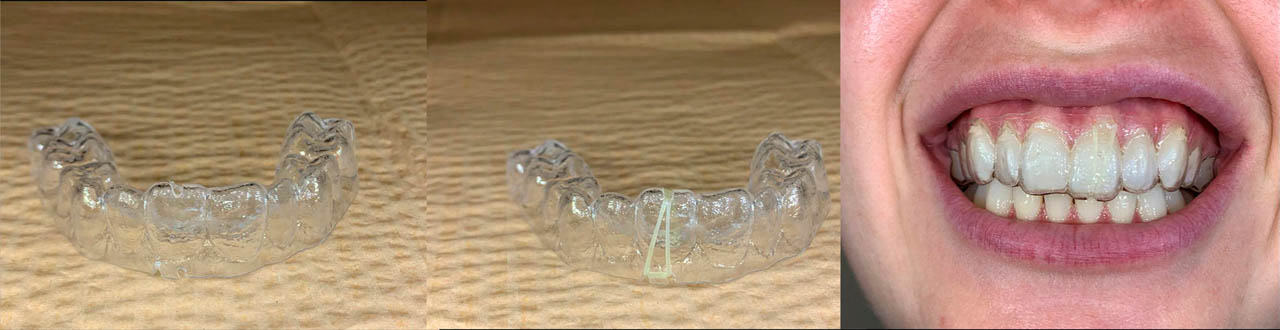
Figure 2.
a) Appliance design, b) elastic loaded into appliance, c) appliance fitted.
Case report
A 24-year-old Caucasian female patient presented to a private general dental practice for dental examination with concern regarding a single front tooth being ‘lower’ than the other. The patient presents with quadrilateral first premolar extractions following orthodontic treatment reported to be concluded approximately 10-years prior. Following dental examination, the patient's upper left central incisor (FDI 21) is positioned 1.2mm incisally than the adjacent central incisor, with this incisal positioning being extended to the gingival margin (Figure 1). In addition, the patient presented with an otherwise unremarkable dental and medical history.
The position of the 21 was questioned following clinical examination, with the patient stating that this was due to orthodontic relapse. Though relapse was detected on additional teeth, the patient was solely concerned with the 21. Treatment planning was performed in consultation, in order to determine and provide an exhaustive list of treatment options. Non-orthodontic treatment methods included enamoplasty, gingivectomy, composite bonding on the adjacent central incisor; in addition to orthodontic treatment. During treatment presentation to the patient, the patient was conscious of the aesthetic and monetary implications, in addition to wanting a definitive treatment. The patient wanted the tooth orthodontically intruded however was unwilling to have orthodontic brackets placed, nor the quotation associated with formal COA therapy. Therefore, the use of a modified thermoplastic aligner to slowly intrude the 21 was chosen in agreement with the patient.
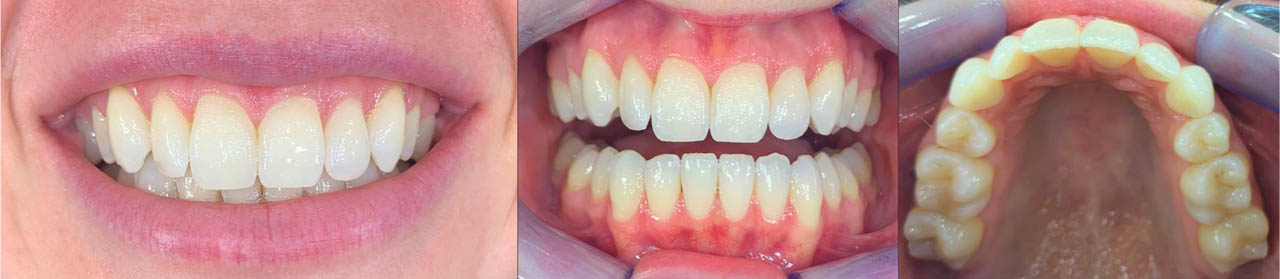
Figure 3.
Final a) smile, b) retracted frontal, c) maxillary occlusal view.
Following primary impressions, a vacuum-formed thermoplastic aligner was fabricated for the upper arch using the 1mm Erkodur (Erkodent, Australia). Modifications to this aligner then ensued using a high-speed handpiece and flat fissure diamond bur to the labial and palatal flanges (2mm), and incisal portion of the aligner (1mm) (Figure 2). A 3/16″, 2oz latex elastic (Otter, Ormco) was then applied to the labial and palatal flanges, and then threaded through the incisal modification (Figure 3). The patient was initially instructed to place a single loop of the elastic through the incisal modification for two weeks, then both following. The incisal modification/groove was performed in such a way that over correction could not occur due to the thermoplastic aligner. The patient reported minimal discomfort with the appliance, both dentally and gingivally. The patient was reviewed two-weekly and advised to closely monitor the incisal position, presenting to the practice if the ideal incisal position is reached prior to their next appointment. At each appointment, the 21's incisal position was assessed with respect to the incisal aligner groove and, if needed, the groove was deepened slightly. The patient presented for review after six weeks of active treatment, with the 21 in what she perceived as the optimum position (Figure 3). As such, a final alginate impression was taken and fixed palatal orthodontic retainer1 was fabricated and adhered, maintaining the incisal position.
Discussion
Through the use of a modified thermoplastic aligner, the patient's aesthetic and monetary problems were solved. Orthodontic relapse in this instance presented as the passive overeruption of the upper left central incisor, with the patient deeming its position to be aesthetically unacceptable. The management of this tooth was considered in-keeping with the patient's limitations of treatment and the patient was very pleased with the final position. The guidance of the orthodontic elastic by the thermoplastic aligner limited any unwanted tooth movement during therapy, such as torque and rotation (Figure 3). Importantly, the appliance was designed in order to limit any unwanted effect of orthodontic treatment such as pain and root resorption, whilst achieving a satisfactory result in a timely manner to reduce patient ‘burn out’. Like fixed orthodontics, COA has the capacity to cause orthodontic root resorption.8
The clinician must be therefore be cognizant and limit the force used.8,9 This was provided by controlling both, the orthodontic force by selecting an appropriate elastic and the depth of the incisal groove created.
A large benefit to this method of orthodontic treatment includes the limited effect on the enamel of the tooth. COA therapy traditionally employs the use of a myriad of different attachments of varying shapes and sizes. Unfortunately, there is an inherent risk of enamel damage. Damage to the labial/buccal enamel is of concern and namely attributed to the use of abrasive for enamel priming, acid etchants, enamel fracture due to adhesive removal, or damage caused by the removal of the remaining composite resin. This damage has also shown to lead to the production of scratches, cracks, grooves, removal of fluoride-rich external enamel layer, and increasing the enamel roughness. 10 Conversely, insufficient attachment removal can leave a rough enamel surface which inhibits proper cleaning and thus invites plaque deposition, bacterial retention, stain formation, and thus dampening the aesthetic appearance of the teeth.10,11 It is therefore ideal if orthodontic treatment can be performed without altering the enamel's original morphology, rendering this form of treatment ideal. As displayed in the patient's initial presentation, relapse affecting single tooth is possible. This is mitigated by the bonding of a bonded palatal wire retainer, by removing the compliance factor associated with post-orthodontic retention.1 Fixed bonded retainers have been shown to result in no deleterious effect on the adjacent hard and soft tissues,12 though have also been associated with long term failure of adhesion to one tooth or more.1 Therefore, despite fixed-wire retention, regular review of the incisal position, retainer adhesive and oral hygiene should be performed. Limitations of this technique include patient compliance and/or if further first or second order movements are required, or if limited coronal tooth structure remain to receive the elastomeric force. It is believed this technique may also provide a low-cost solution to pre-prosthetic gingival margin correction, interocclusal space or reduced incisal/occlusal reduction. In addition, it may be used as an adjunctive to intrusion in clear aligner therapy.
Conclusion
The use of a modified thermoplastic aligner, in addition to an orthodontic elastic, is shown to be a reliable device for the intrusion of a single incisor. The design is favourable in that it requires a lower cost of fabrication and implementation for clinician and patient alike. Without causing positional change to the adjacent dentition, this appliance can be considered a front-line treatment option for intrusion. The orthodontic elastic and incisal groove lower the risk of excessive activation and over intrusion of the particular tooth.