
Table I.
Pre-treatment characteristics of patients with impacted canines, and patients without impacted canines (controls)
Table II.
Pre-treatment characteristics of patients with impacted canines
| Impacted canine patients | ||
|---|---|---|
| Characteristic | n | % |
| Treatment factors | ||
| Multiple sites | ||
| Unilateral impaction | 55 | 75 |
| Bilateral impaction | 18 | 25 |
| Right sided impaction | 36 | 49 |
| Site | ||
| Palatal | 52 | 71 |
| Labial/mid-alveolar | 21 | 29 |
| Treatment modality | ||
| Orthodontic space opening (OT) | 49 | 67 |
| Surgery from outset (S) | 11 | 15 |
| Orthodontic space opening, mid-treatment surgery (OT + S) | 13 | 18 |
| Radiographic factors | ||
| Sector | ||
| I | 14 | 19 |
| II | 20 | 27 |
| III | 13 | 17 |
| IV | 26 | 35 |
| Vertical (KPG) | ||
| 1 | 9 | 12 |
| 2 | 46 | 63 |
| 3 | 14 | 19 |
| 4 | 4 | 5 |
| α-angle (°)a | 30.66 (17.22) | |
| β-angle (°)a | 40.04 (16.42) | |
| Vertical (mm)a,b | 14.01 (3.40) | |
| Horizontal (mm)a,b | 8.70 (4.46) | |
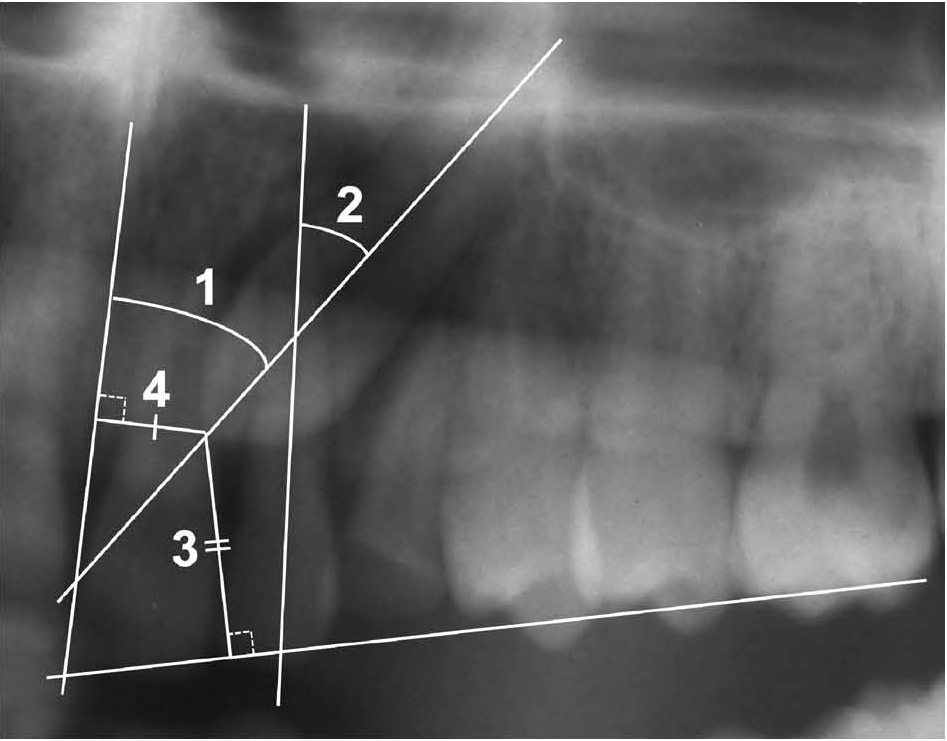
Figure 1.
OPG and reconstructed OPG measurements – linear and angular measures (1) α-angle (°): Angulation of the canine according to the angle formed by the long axis of the impacted maxillary canine, and a line bisecting the central incisor axes (2) β-angle (°): Angulation of the canine according to the angle formed by the long axis of the impacted maxillary canine, and the long axis of the adjacent lateral incisor. (3) Vertical (mm): Absolute distance from the occlusal plane, measured perpendicularly from the canine cusp tip to the occlusal plane (defined as the plane connecting the mesiobuccal cusp of the upper first permanent molar, and the disto-incisal edge of the upper central incisor on the same side). (4) Horizontal (mm): Absolute distance from the mid-sagittal plane, measured perpendicularly from the line bisecting the central incisor axes and the canine cusp tip.
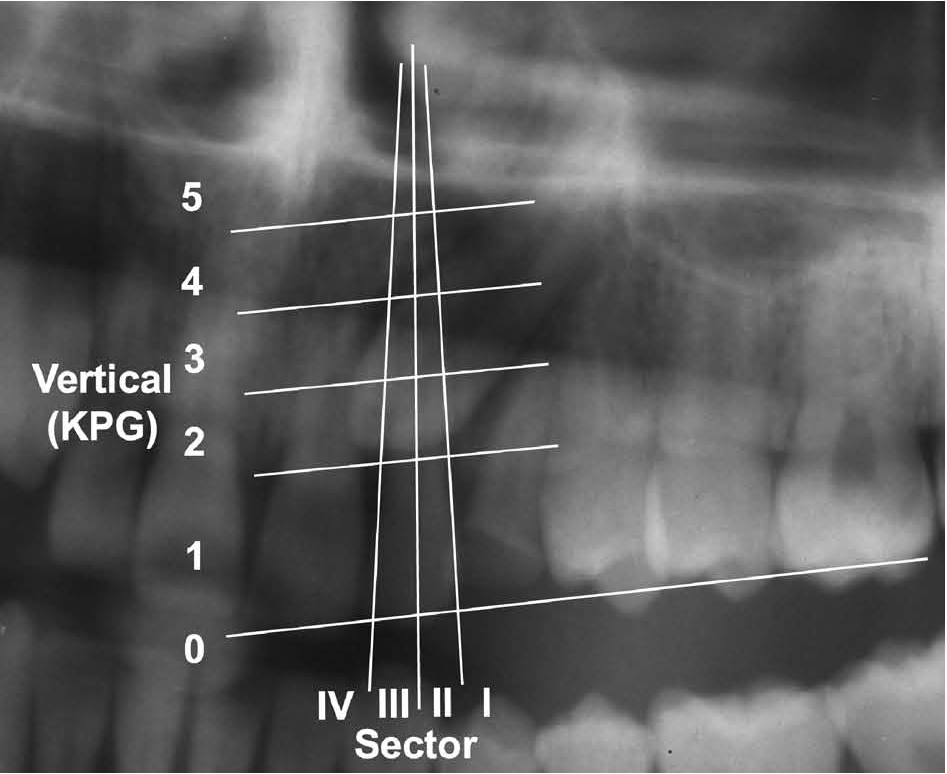
Figure 2.
OPG and reconstructed OPG measurements – Sector and Vertical (KPG). Vertical (KPG): The vertical component of the KPG index categorises the perpendicular distance of the canine cusp tip to the occlusal plane, relative to the central incisor (after Kau, Pan, Gallerano et al. 2009).29 Grade 0: Canine cusp tip is in the proper vertical position. Grade 1: Cusp tip is in the coronal region. Grade 2: Cusp tip lies in a horizontal plane adjacent to the cervical third of the incisor root. Grade 3: Cusp tip lies in a horizontal plane adjacent to the middle third of the incisor root. Grade 4: Cusp tip lies in a horizontal plane adjacent to the apical third of the incisor root. Grade 5: Cusp tip is supra-apical to the incisor root. Sector: The sector classification categorises the horizontal displacement of the canine cusp tip, relative to the lateral incisor (after Lindauer et al. 1992’s modification28 to Ericson and Kurol’s original classification). Sector I: canine cusp tip is distal to the distal outline of the lateral incisor root. Sector II: canine cusp tip is mesial to the distal outline of the lateral incisor root, but distal to the long axis of the lateral incisor. Sector III: canine cusp tip is mesial to the long axis of the lateral incisor, but distal to the mesial outline of the lateral incisor root. Sector IV: canine cusp tip is mesial to the mesial outline of the lateral incisor root.
Table III.
Intra-examiner reliability
| Variable | Estimate | 95% CI |
|---|---|---|
| Sector | -0.087 | -0.236, 0.062 |
| Vertical (KPG) | 0.000 | -0.153, 0.153 |
| α-angle (°) | -0.374 | -0.983, 0.236 |
| β-angle (°) | 0.109 | -0.966, 1.183 |
| Vertical (mm) | 0.070 | -0.077, 0.216 |
| Horizontal (mm) | 0.052 | -0.099, 0.204 |
Table IV.
Effect of site of canine impaction on treatment time, as compared to controls without an impacted canine
Table V.
Pre-treatment predictors of overall treatment time
| Variable | Estimate | Sth. Error | t value | p-value |
|---|---|---|---|---|
| (Intercept) | 134.371 | 51.545 | 2.607 | 0.012 * |
| Demographic factors | ||||
| Age | -2.044 | 3.022 | -0.676 | 0.502 |
| Sex | -0.292 | 10.692 | -0.027 | 0.978 |
| Treatment factors | ||||
| Bilateral impaction | 15.469 | 11.953 | 1.294 | 0.201 |
| Side | -0.813 | 8.391 | -0.097 | 0.923 |
| Site | -4.425 | 15.681 | -0.282 | 0.779 |
| Treatment modality | ||||
| S | -32.343 | 17.217 | -1.879 | 0.066. |
| OT + S | -17.269 | 15.502 | -1.114 | 0.270 |
| Radiographic factors | ||||
| Sector | ||||
| II | 1.437 | 12.352 | 0.116 | 0.908 |
| III | -7.786 | 14.047 | -0.554 | 0.582 |
| IV | -5.056 | 19.467 | -0.260 | 0.796 |
| Vertical (KPG) | ||||
| 2 | 35.904 | 13.782 | 2.605 | 0.012* |
| 3 | 27.976 | 24.094 | 1.161 | 0.251 |
| 4 | 43.922 | 30.218 | 1.454 | 0.152 |
| α-angle (°) | -0.143 | 0.714 | -0.201 | 0.842 |
| β-angle (°) | 0.092 | 0.689 | 0.133 | 0.894 |
| Vertical (mm) | 2.391 | 2.603 | 0.918 | 0.363 |
| Horizontal (mm) | -2.959 | 2.270 | -1.304 | 0.198 |
1 The base classes for dummy variables characterizing sex, bilateral impaction, side, site, treatment modality, sector classification, and vertical (KPG) classification are as follows: female, unilateral, left-hand side, palatal, orthodontic space opening only, sector I classification, and vertical (KPG) I classification respectively.
Table VI.
Analysis of multicollinearity
| Variable | Generalised VIF | Df | GVIF^(1/(2*Df)) |
|---|---|---|---|
| Demographic factors | |||
| Age | 1.402 | 1 | 1.184 |
| Sex | 1.258 | 1 | 1.122 |
| Treatment factors | |||
| Unilateral/bilateral impaction | 1.268 | 1 | 1.126 |
| Side | 1.264 | 1 | 1.124 |
| Site | 2.242 | 1 | 1.497 |
| Treatment modality | 3.367 | 2 | 1.355 |
| Radiographic factors | |||
| Sector | 9.296 | 3 | 1.450 |
| Vertical (KPG) | 3.632 | 3 | 1.240 |
| α-angle (°) | 10.048 | 1 | 3.170 |
| β-angle (°) | 9.559 | 1 | 3.092 |
| Vertical (mm) | 3.680 | 1 | 1.918 |
| Horizontal (mm) | 5.151 | 1 | 2.270 |
Table VII.
Pre-treatment characteristics of patients with an impacted canine (palatal or labial/mid-alveolar), stratified according to the requirement for surgical exposure
| Surgical exposure (from outset, or after orthodontics) | Orthodontics only | |||
|---|---|---|---|---|
| Characteristic | n | % | n | % |
| Age | 24 | 14.5 (1.3)a | 49 | 13.0 (1.5)a |
| Sex | ||||
| Male | 6 | 25 | 12 | 24 |
| Female | 18 | 75 | 37 | 76 |
| Multiple sites | ||||
| Unilateral | 17 | 71 | 38 | 78 |
| Bilateral | 7 | 29 | 11 | 22 |
| Sitec | ||||
| Palatal | 24 | 46 | 28 | 54 |
| Labial/Mid-alveolar | 0 | 0 | 21 | 100 |
| Treatment timeb | 136.00 (113.04, 154.82) | 128.86 (102.86, 153.14) | ||
Table VIII.
Pre-treatment characteristics of patients with a palatally impacted canine, stratified according to the requirement for surgical exposure
| Surgical exposure (from outset, or after orthodontics) | Orthodontics only | |||
|---|---|---|---|---|
| Characteristic | n | % | n | % |
| Age | 24 | 14.5 (1.3)a | 28 | 13.3 (1.6)a |
| Sex | ||||
| Male | 6 | 25 | 5 | 18 |
| Female | 18 | 75 | 23 | 82 |
| Multiple sites | ||||
| Unilateral | 17 | 71 | 22 | 79 |
| Bilateral | 7 | 29 | 6 | 21 |
| Sectorc | ||||
| I | 0 | 0 | 2 | 100 |
| II | 0 | 0 | 13 | 100 |
| III | 4 | 33 | 8 | 67 |
| IV | 20 | 80 | 5 | 20 |
| Vertical (KPG)c | ||||
| 1 | 0 | 0 | 4 | 100 |
| 2 | 14 | 41 | 20 | 59 |
| 3 | 7 | 64 | 4 | 36 |
| 4 | 3 | 100 | 0 | 0 |
| α-angle (°)a | 45.36 (12.21) | 25.08 (12.60) | ||
| β-angle (°)a | 53.11 (12.03) | 35.36 (12.57) | ||
| Vertical (mm)a | 15.39 (2.82) | 12.69 (3.05) | ||
| Horizontal (mm)a | 5.55 (3.45) | 10.21 (3.16) | ||
| Treatment timeb | 136.00 (113.04, 154.82) | 129.07 (112.25, 157.18) | ||
Table IX.
Pre-treatment predictors for the need for surgical exposure of an impacted canine
| Variable | Estimate | Sth. Error | z value | p-value |
|---|---|---|---|---|
| (Intercept) | -12.343 | 8.020 | -1.539 | 0.124 |
| Demographic factors | ||||
| Age | 0.551 | 0.325 | 1.696 | 0.090. |
| Sex | 2.249 | 1.492 | 1.507 | 0.132 |
| Treatment factors | ||||
| Bilateral impaction | 0.060 | 0.951 | 0.063 | 0.950 |
| Side | 1.500 | 1.493 | 1.005 | 0.315 |
| Radiographic factors | ||||
| Sector IV | 3.215 | 1.718 | 1.871 | 0.061. |
| Vertical (KPG) 3 | -0.447 | 0.997 | -0.448 | 0.654 |
| α-angle (°) | 0.032 | 0.082 | 0.390 | 0.697 |
| β-angle (°) | 0.026 | 0.081 | 0.326 | 0.745 |
| Vertical (mm) | -0.071 | 0.285 | -0.250 | 0.803 |
| Horizontal (mm) | 0.141 | 0.339 | 0.418 | 0.676 |
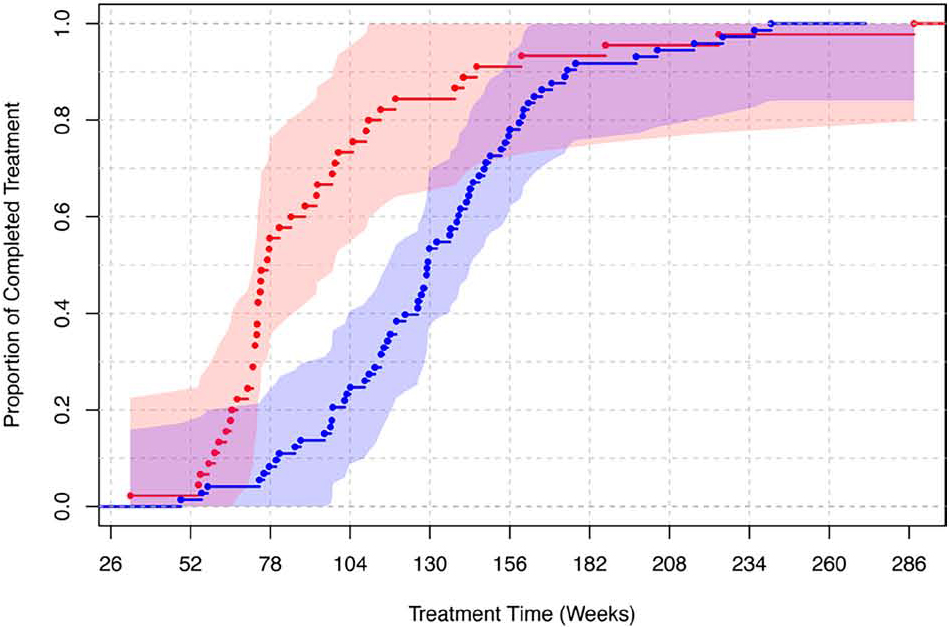
Figure 3.
Empirical cumulative distribution function with Dvoretzky-Kief-er-Wolfowitz-Massart simultaneous confidence bounds, demonstrating the treatment times for patients treated with an impacted canine (blue) and without an impacted canine (red).
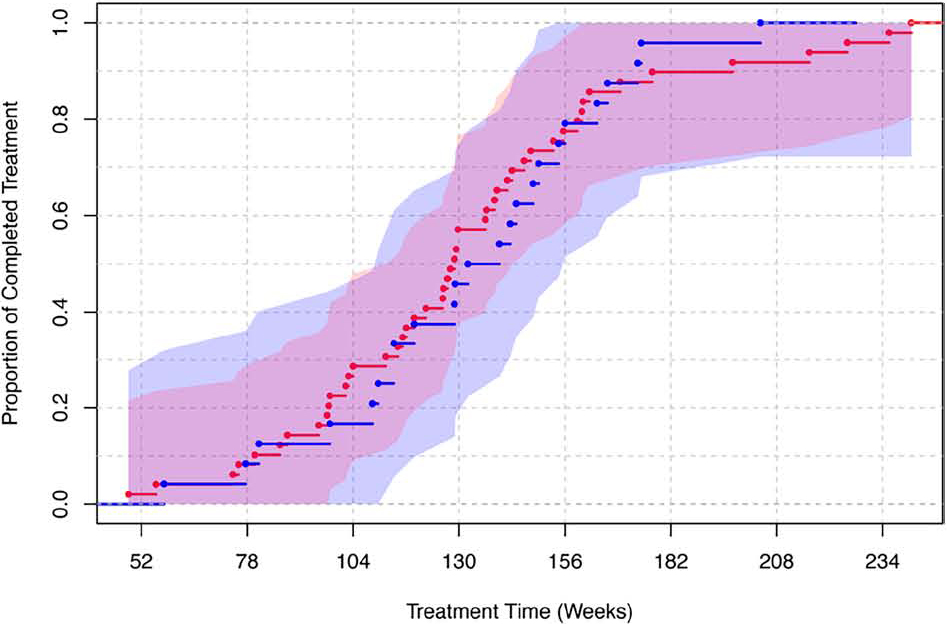
Figure 4.
Empirical cumulative distribution function with Dvoretzky-Kief-er-Wolfowitz-Massart simultaneous confidence bounds, demonstrating the treatment times for patients treated with orthodontic space opening alone (red), or surgical exposure (either from the outset or after initial orthodontic space opening – blue).