
Introduction
Impacted maxillary canines may be defined as those teeth that may have completed root development, but unaided eruption is not expected to occur.1 In European populations, the prevalence of maxillary canine impaction is approximately 2 per cent,2,3 with a 2:1 female bias.4 Approximately 85 per cent of ectopic canines lie palatally, and this is thought to result from a genetic pre-disposition,5,6 as well as environmental influences in the form of unfavourable guidance provided by the maxillary lateral incisor.7,8 In Asian populations however, labial canine impaction is more common than palatal impaction, and is associated with a tooth-size archlength discrepancy.9 While palatal sites of impaction have been discussed extensively in the orthodontic literature, the impaction of canines in a labial site has been rarely investigated.
The management options for palatally-impacted canines involve interception by the extraction of the deciduous canine,10–12 space opening using fixed appliances or rapid maxillary expansion,13,14 leeway space maintenance using headgear or a transpalatal arch,15,16 or a combination of techniques.16–18 For those canines that fail to favourably respond, surgical exposure or removal is likely required.19 While surgical exposure is the definitive management for impacted maxillary canines, this is associated with additional financial expense, and patients report significant pain and morbidity following the surgical procedure.20,21 Techniques that successfully avoid surgical exposure are therefore preferred.22
Olive14 first presented a technique involving the opening of extra space to assist the eruption of a palatally-displaced canine. It was found that 75 per cent of cases were successfully managed by space opening alone, while the remaining 25 per cent requiring surgical exposure. Even if space-opening was unsuccessful, the severity of canine impaction and the extent of required surgical exposure was reduced. The success and time for canine eruption by applying space opening was predominantly related to the sector of tooth displacement.23 However, only the time to canine eruption was evaluated, and the sample size was limited to include only palatally-impacted canines.
While patients may desire non-surgical intervention, shorter treatments are also preferred as long treatment times are associated with an increased risk of tooth decalcification and root resorption.24 A total treatment time is also a proxy indicator for case complexity, and may influence the decision to proceed immediately with surgical exposure, or indeed, canine extraction.
Given the importance of treatment time in the management of impacted canines, the aim of the present study was threefold.
Firstly, to identify whether patients who presented with impacted maxillary canines take longer to treat than patients without impacted canines.
If overall treatment duration was found to be increased, it was subsequently sought to identify patient and radiographic factors that might be contributory.
It was finally sought to describe pre-treatment characteristics of patients predictably treated with space-opening, as an alternative non-surgical management strategy for impacted maxillary canines.
These aims were investigated in a sample involving both labially- and palatally-impacted canines.
Materials and methods
The present retrospective study involved an analysis of clinical and radiographic records collected from the practice of a specialist orthodontist (RO). Ethical approval to conduct this research was received from the University of Queensland Human Research Ethics Committee B (approval number 2017002083) in February 2018.
All patients were diagnosed as having at least one impacted maxillary canine, which was retrieved either non-surgically or surgically, using fixed edgewise appliances to conduct treatment.
The inclusion criteria included:
The presence of at least one impacted maxillary canine
The patient’s age less than 21 years at the commencement of treatment
Treatment successfully completed using fixed edgewise appliances
Radiographic records permitting three-dimensional location of the impacted canine: i.e., orthopantomogram (OPG), with supplemental periapical, occlusal or lateral cephalometric radiographs
All patients identified with impacted canines and available records were considered for inclusion.
Patients were then excluded if:
The ectopic canine was woven25 or transposed, or if it was extracted as part of orthodontic treatment (n=2)
There was a significant delay between the inter-ceptive phase (and associated radiographic imaging) and the comprehensive phase of treatment (n=3)
The patient required later re-treatment (n=1)
The treatment or radiographic records were incomplete (n=3)
After the application of the criteria, the selected cases comprised 73 patients (55 female and 18 male) whose mean age was 13.5 years. In addition, a sample of age- and gender-matched control patients without impacted maxillary canines was collected. These patients were also successfully treated by the same clinician using fixed edgewise appliances. The control sample consisted of 45 patients whose mean age was 13.3 years and comprised 33 females and 12 males. For all patients, the age at the start of treatment, gender, and total treatment duration were recorded. Table I outlines the pre-treatment characteristics of the impacted canine cases, and the matched control group.
Table I.
Pre-treatment characteristics of patients with impacted canines, and patients without impacted canines (controls)
| Characteristic | Impacted canine patients | Non-impacted canine controls |
|---|---|---|
| n | 73 | 45 |
| Agea | 13.5 (1.6) | 13.3 (1.9) |
| Sex | ||
| Male | 18 (25%) | 12 (27%) |
| Female | 55 (75%) | 33 (73%) |
| Overall treatment timeb | 129 (109, 154) | 77 (72, 105) |
Patients with an impacted canine were managed either surgically or non-surgically. The treatment modality was classified as either conventional orthodontic treatment only (OT; n=49), surgical exposure at the commencement of treatment (S; n=11), or initial conventional orthodontics with subsequent surgical exposure (OT + S; n=13). Orthodontic treatment in the OT and OT + S groups was previously reported and involved the extraction of the deciduous canine, followed by fixed appliances and an open-coil spring to create significant space in the canine region for all cases.14,23,25–27 In addition, 12 patients were treated using rapid maxillary expansion, one patient was treated with a high-pull headgear, one patient was treated using a Clark Twin Block, and two cases were managed by premolar extractions. If space opening successfully resulted in canine disimpaction, treatment was deemed to have commenced at the beginning of this initial phase. If the space opening was not successful (but immediately followed by further treatment involving surgical canine exposure), the starting date of treatment was still taken from the commencement of the initial attempt at space opening. The decision that non-surgical space opening had been unsuccessful (with the need for subsequent surgical exposure) was a patient-centred decision consistent with the guidelines presented by Olive in 2002.14 Surgically managed canines underwent open exposure with power thread applied to traction the canine towards a rigid base archwire. Active treatment was deemed to have been successfully completed when the patient’s and orthodontist’s clinical goals of well aligned arches and the correction of the impacted canine were met on removal of the fixed appliances.
Twenty-five per cent of impacted canine patients demonstrated bilateral impaction. If both maxillary canines were impacted, the bilateral status was recorded, but only the more severely impacted canine (based on sector, height above the occlusal plane, and α-angle) was chosen for radiographic analysis.
The site of impaction was noted from the orthodontist’s clinical examination, and via radiographic localisation determined by the principal researcher. As labial and mid-alveolar position was likely to have a similar clinical appearance, there was no separation into labial or mid-alveolar sites. Of the impacted canine sample, 71 per cent of impactions were palatal, and 29 per cent were in a mid-alveolar/labial position.
Table II describes the pre-treatment characteristics of the impacted canine patients within the sample.
Table II.
Pre-treatment characteristics of patients with impacted canines
| Impacted canine patients | ||
|---|---|---|
| Characteristic | n | % |
| Treatment factors | ||
| Multiple sites | ||
| Unilateral impaction | 55 | 75 |
| Bilateral impaction | 18 | 25 |
| Right sided impaction | 36 | 49 |
| Site | ||
| Palatal | 52 | 71 |
| Labial/mid-alveolar | 21 | 29 |
| Treatment modality | ||
| Orthodontic space opening (OT) | 49 | 67 |
| Surgery from outset (S) | 11 | 15 |
| Orthodontic space opening, mid-treatment surgery (OT + S) | 13 | 18 |
| Radiographic factors | ||
| Sector | ||
| I | 14 | 19 |
| II | 20 | 27 |
| III | 13 | 17 |
| IV | 26 | 35 |
| Vertical (KPG) | ||
| 1 | 9 | 12 |
| 2 | 46 | 63 |
| 3 | 14 | 19 |
| 4 | 4 | 5 |
| α-angle (°)a | 30.66 (17.22) | |
| β-angle (°)a | 40.04 (16.42) | |
| Vertical (mm)a,b | 14.01 (3.40) | |
| Horizontal (mm)a,b | 8.70 (4.46) | |
Radiographs obtained immediately prior to treatment for the impacted canine patients were digitally analysed, after analogue radiographs were first converted into a digital format. Two-dimensional radiographs were imported into Dolphin Imaging software (Patterson Dental; Chatsworth, CA, USA) for the determination of angular and linear measurements. If radiographs were only available in digital format without an attached scale, angular variables and categorical classifications were conducted, but no linear measurements were undertaken. Figure 1 (and associated footnote) outlines the variables assessed on the OPGs using conventional measurement techniques. Figure 2 (and associated footnote) outlines the classification system employed to describe horizontal and vertical canine displacement, with the horizontal sector classified according to Lindauer’s modification,14,28 and the vertical displacement classified according to the KPG index initially proposed by Kau et al.29
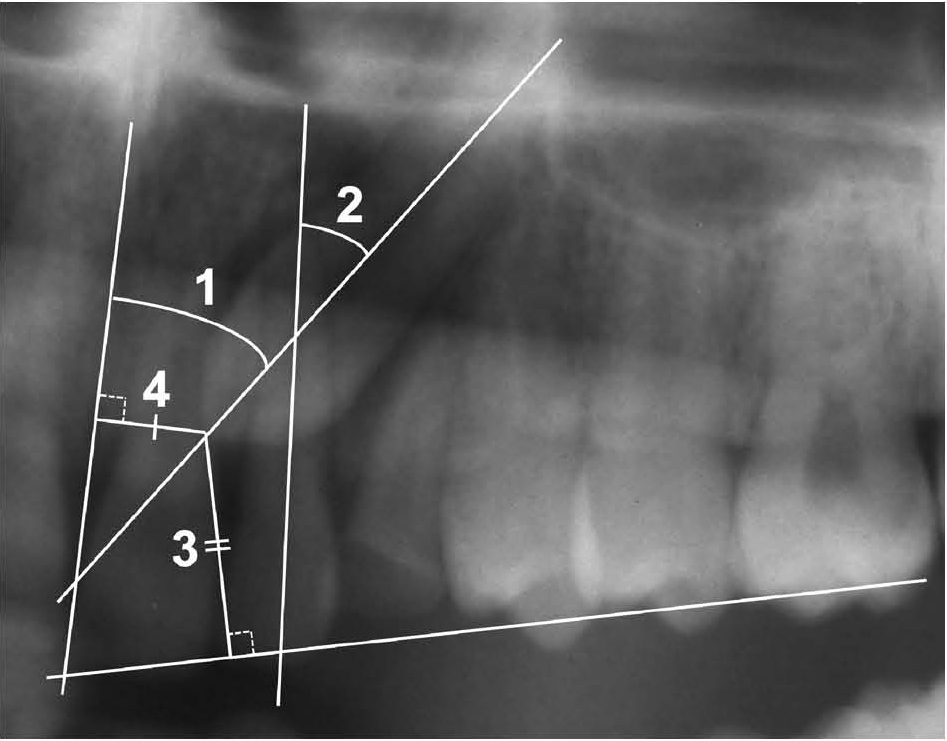
Figure 1.
OPG and reconstructed OPG measurements – linear and angular measures (1) α-angle (°): Angulation of the canine according to the angle formed by the long axis of the impacted maxillary canine, and a line bisecting the central incisor axes (2) β-angle (°): Angulation of the canine according to the angle formed by the long axis of the impacted maxillary canine, and the long axis of the adjacent lateral incisor. (3) Vertical (mm): Absolute distance from the occlusal plane, measured perpendicularly from the canine cusp tip to the occlusal plane (defined as the plane connecting the mesiobuccal cusp of the upper first permanent molar, and the disto-incisal edge of the upper central incisor on the same side). (4) Horizontal (mm): Absolute distance from the mid-sagittal plane, measured perpendicularly from the line bisecting the central incisor axes and the canine cusp tip.
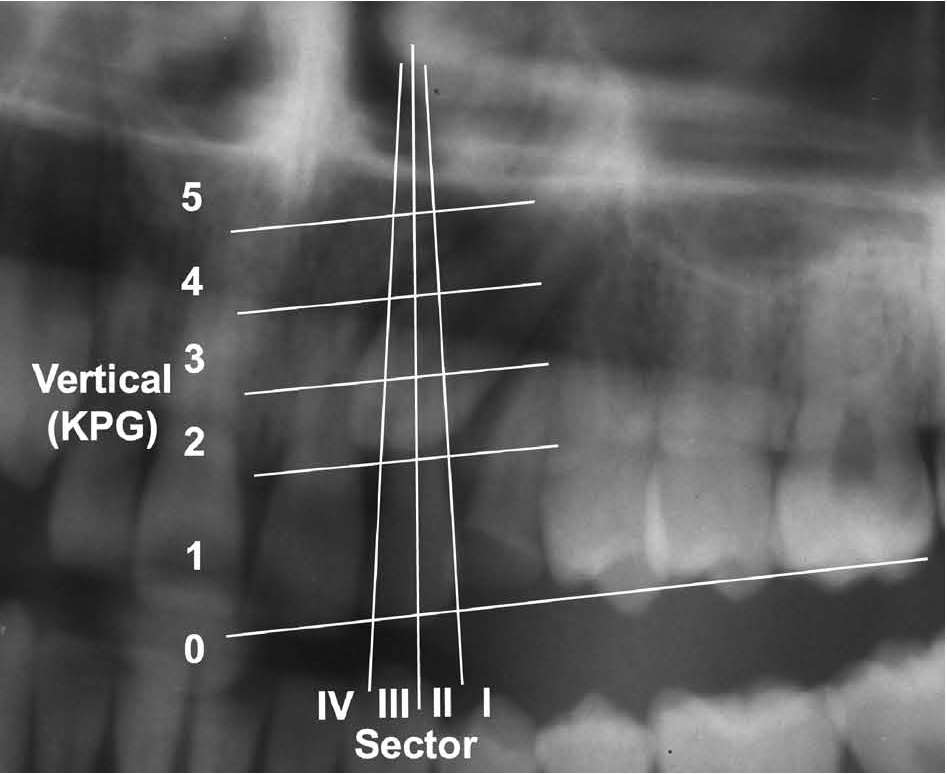
Figure 2.
OPG and reconstructed OPG measurements – Sector and Vertical (KPG). Vertical (KPG): The vertical component of the KPG index categorises the perpendicular distance of the canine cusp tip to the occlusal plane, relative to the central incisor (after Kau, Pan, Gallerano et al. 2009).29 Grade 0: Canine cusp tip is in the proper vertical position. Grade 1: Cusp tip is in the coronal region. Grade 2: Cusp tip lies in a horizontal plane adjacent to the cervical third of the incisor root. Grade 3: Cusp tip lies in a horizontal plane adjacent to the middle third of the incisor root. Grade 4: Cusp tip lies in a horizontal plane adjacent to the apical third of the incisor root. Grade 5: Cusp tip is supra-apical to the incisor root. Sector: The sector classification categorises the horizontal displacement of the canine cusp tip, relative to the lateral incisor (after Lindauer et al. 1992’s modification28 to Ericson and Kurol’s original classification). Sector I: canine cusp tip is distal to the distal outline of the lateral incisor root. Sector II: canine cusp tip is mesial to the distal outline of the lateral incisor root, but distal to the long axis of the lateral incisor. Sector III: canine cusp tip is mesial to the long axis of the lateral incisor, but distal to the mesial outline of the lateral incisor root. Sector IV: canine cusp tip is mesial to the mesial outline of the lateral incisor root.
Statistical analysis
The intra-examiner reliability for radiographically-derived variables was assessed from repeated measurements taken at least two weeks apart for 23 randomly-selected patients. The mean difference was assessed using a chi -squared test of Hotelling’s T2 statistic (Table III).
Table III.
Intra-examiner reliability
| Variable | Estimate | 95% CI |
|---|---|---|
| Sector | -0.087 | -0.236, 0.062 |
| Vertical (KPG) | 0.000 | -0.153, 0.153 |
| α-angle (°) | -0.374 | -0.983, 0.236 |
| β-angle (°) | 0.109 | -0.966, 1.183 |
| Vertical (mm) | 0.070 | -0.077, 0.216 |
| Horizontal (mm) | 0.052 | -0.099, 0.204 |
Linear regression was employed to assess whether cases involving the management of an impacted canine take longer to treat, compared to age- and gender-matched control patients without an impacted canine (Table IV). All regressionbased statistical tests were conducted under the misspecification-robust framework of White, making the inference correct in the presence of missing covariates and mild deviations from linearity assumptions.30,31
Table IV.
Effect of site of canine impaction on treatment time, as compared to controls without an impacted canine
| Estimate | Sth. Error | t value | p-value | |
|---|---|---|---|---|
| (Intercept) | 120.021 | 28.742 | 4.176 | 5.868x10−05 *** |
| Age | -2.166 | 2.010 | -1.077 | 0.284 |
| Sex | 5.204 | 7.547 | 0.690 | 0.492 |
| Palatal site | 43.529 | 8.856 | 4.915 | 3.030x10−06 *** |
| Labial/mid-alveolar site | 32.115 | 9.914 | 3.239 | 0.002 ** |
Of the patients with an impacted canine, linear regression was performed to assess the effect of the independent variables on treatment time (Table V). It was noted that 23 of the 73 observations were missing absolute measurements (horizontal (mm) and vertical (mm)) due to an unknown magnification factor. Rather than discarding these patients, a k-nearest neighbour imputation was performed using the other OPG measurements (matched on covariates, only; i.e., without consideration of the treatment time).32 In interpreting the results of this (and subsequent) regressions, the variables describing the radiographic location of the impacted canine were suspected of being highly correlated with each other. In order to assess for the effect of multicollinearity, generalised variance inflation factors (VIF) were calculated (Table VI).33 If VIFs were found to be high, the significance and explanatory power of inter-correlated variables was assessed as a collection of related variables, through joint hypothesis testing and R2 decomposition.
Table V.
Pre-treatment predictors of overall treatment time
| Variable | Estimate | Sth. Error | t value | p-value |
|---|---|---|---|---|
| (Intercept) | 134.371 | 51.545 | 2.607 | 0.012 * |
| Demographic factors | ||||
| Age | -2.044 | 3.022 | -0.676 | 0.502 |
| Sex | -0.292 | 10.692 | -0.027 | 0.978 |
| Treatment factors | ||||
| Bilateral impaction | 15.469 | 11.953 | 1.294 | 0.201 |
| Side | -0.813 | 8.391 | -0.097 | 0.923 |
| Site | -4.425 | 15.681 | -0.282 | 0.779 |
| Treatment modality | ||||
| S | -32.343 | 17.217 | -1.879 | 0.066. |
| OT + S | -17.269 | 15.502 | -1.114 | 0.270 |
| Radiographic factors | ||||
| Sector | ||||
| II | 1.437 | 12.352 | 0.116 | 0.908 |
| III | -7.786 | 14.047 | -0.554 | 0.582 |
| IV | -5.056 | 19.467 | -0.260 | 0.796 |
| Vertical (KPG) | ||||
| 2 | 35.904 | 13.782 | 2.605 | 0.012* |
| 3 | 27.976 | 24.094 | 1.161 | 0.251 |
| 4 | 43.922 | 30.218 | 1.454 | 0.152 |
| α-angle (°) | -0.143 | 0.714 | -0.201 | 0.842 |
| β-angle (°) | 0.092 | 0.689 | 0.133 | 0.894 |
| Vertical (mm) | 2.391 | 2.603 | 0.918 | 0.363 |
| Horizontal (mm) | -2.959 | 2.270 | -1.304 | 0.198 |
1 The base classes for dummy variables characterizing sex, bilateral impaction, side, site, treatment modality, sector classification, and vertical (KPG) classification are as follows: female, unilateral, left-hand side, palatal, orthodontic space opening only, sector I classification, and vertical (KPG) I classification respectively.
Table VI.
Analysis of multicollinearity
| Variable | Generalised VIF | Df | GVIF^(1/(2*Df)) |
|---|---|---|---|
| Demographic factors | |||
| Age | 1.402 | 1 | 1.184 |
| Sex | 1.258 | 1 | 1.122 |
| Treatment factors | |||
| Unilateral/bilateral impaction | 1.268 | 1 | 1.126 |
| Side | 1.264 | 1 | 1.124 |
| Site | 2.242 | 1 | 1.497 |
| Treatment modality | 3.367 | 2 | 1.355 |
| Radiographic factors | |||
| Sector | 9.296 | 3 | 1.450 |
| Vertical (KPG) | 3.632 | 3 | 1.240 |
| α-angle (°) | 10.048 | 1 | 3.170 |
| β-angle (°) | 9.559 | 1 | 3.092 |
| Vertical (mm) | 3.680 | 1 | 1.918 |
| Horizontal (mm) | 5.151 | 1 | 2.270 |
The sample was stratified, and descriptive statistics were applied to characterise patients successfully treated by orthodontic space opening for the impacted canine alone, or those who required surgical exposure (Tables VII and VIII). This analysis was then used to inform a logistic regression to assess for factors that might be predictive of the need for surgical exposure within a limited subset of patients (Table IX). The joint hypothesis testing and R2 decomposition approaches were re-applied to assess the significance and explanatory power of inter-correlated variables.
Table VII.
Pre-treatment characteristics of patients with an impacted canine (palatal or labial/mid-alveolar), stratified according to the requirement for surgical exposure
| Surgical exposure (from outset, or after orthodontics) | Orthodontics only | |||
|---|---|---|---|---|
| Characteristic | n | % | n | % |
| Age | 24 | 14.5 (1.3)a | 49 | 13.0 (1.5)a |
| Sex | ||||
| Male | 6 | 25 | 12 | 24 |
| Female | 18 | 75 | 37 | 76 |
| Multiple sites | ||||
| Unilateral | 17 | 71 | 38 | 78 |
| Bilateral | 7 | 29 | 11 | 22 |
| Sitec | ||||
| Palatal | 24 | 46 | 28 | 54 |
| Labial/Mid-alveolar | 0 | 0 | 21 | 100 |
| Treatment timeb | 136.00 (113.04, 154.82) | 128.86 (102.86, 153.14) | ||
Table VIII.
Pre-treatment characteristics of patients with a palatally impacted canine, stratified according to the requirement for surgical exposure
| Surgical exposure (from outset, or after orthodontics) | Orthodontics only | |||
|---|---|---|---|---|
| Characteristic | n | % | n | % |
| Age | 24 | 14.5 (1.3)a | 28 | 13.3 (1.6)a |
| Sex | ||||
| Male | 6 | 25 | 5 | 18 |
| Female | 18 | 75 | 23 | 82 |
| Multiple sites | ||||
| Unilateral | 17 | 71 | 22 | 79 |
| Bilateral | 7 | 29 | 6 | 21 |
| Sectorc | ||||
| I | 0 | 0 | 2 | 100 |
| II | 0 | 0 | 13 | 100 |
| III | 4 | 33 | 8 | 67 |
| IV | 20 | 80 | 5 | 20 |
| Vertical (KPG)c | ||||
| 1 | 0 | 0 | 4 | 100 |
| 2 | 14 | 41 | 20 | 59 |
| 3 | 7 | 64 | 4 | 36 |
| 4 | 3 | 100 | 0 | 0 |
| α-angle (°)a | 45.36 (12.21) | 25.08 (12.60) | ||
| β-angle (°)a | 53.11 (12.03) | 35.36 (12.57) | ||
| Vertical (mm)a | 15.39 (2.82) | 12.69 (3.05) | ||
| Horizontal (mm)a | 5.55 (3.45) | 10.21 (3.16) | ||
| Treatment timeb | 136.00 (113.04, 154.82) | 129.07 (112.25, 157.18) | ||
Table IX.
Pre-treatment predictors for the need for surgical exposure of an impacted canine
| Variable | Estimate | Sth. Error | z value | p-value |
|---|---|---|---|---|
| (Intercept) | -12.343 | 8.020 | -1.539 | 0.124 |
| Demographic factors | ||||
| Age | 0.551 | 0.325 | 1.696 | 0.090. |
| Sex | 2.249 | 1.492 | 1.507 | 0.132 |
| Treatment factors | ||||
| Bilateral impaction | 0.060 | 0.951 | 0.063 | 0.950 |
| Side | 1.500 | 1.493 | 1.005 | 0.315 |
| Radiographic factors | ||||
| Sector IV | 3.215 | 1.718 | 1.871 | 0.061. |
| Vertical (KPG) 3 | -0.447 | 0.997 | -0.448 | 0.654 |
| α-angle (°) | 0.032 | 0.082 | 0.390 | 0.697 |
| β-angle (°) | 0.026 | 0.081 | 0.326 | 0.745 |
| Vertical (mm) | -0.071 | 0.285 | -0.250 | 0.803 |
| Horizontal (mm) | 0.141 | 0.339 | 0.418 | 0.676 |
Results
Intra-examiner reliability analysis
The intra-examiner reliability analysis revealed no systematic reliability concerns in the measurement of OPG related variables (Table III).
Effect of canine impaction on treatment duration versus a conventional (non-impacted) control case
Controlling for the effects of age and gender, the presence of an impacted canine significantly prolonged treatment duration compared to control patients who did not have an impacted canine (p<0.002) (Table IV). This is visually demonstrated in the empirical cumulative distribution function (Figure 3). Palatally-impacted canine cases take an additional 43.53 weeks longer to treat than conventional orthodontic patients [95% CI: 26.17, 60.88], while treatment of labial/mid-alveolar sites of impaction was prolonged by 32.11 weeks compared to conventional control patients [95% CI: 12.68, 51.55]. The overlapping confidence intervals indicated that there was no significant difference in treatment duration between a palatal or labial/mid-alveolar site of canine impaction, and this was confirmed by testing the respective linear contrast (p=0.258).
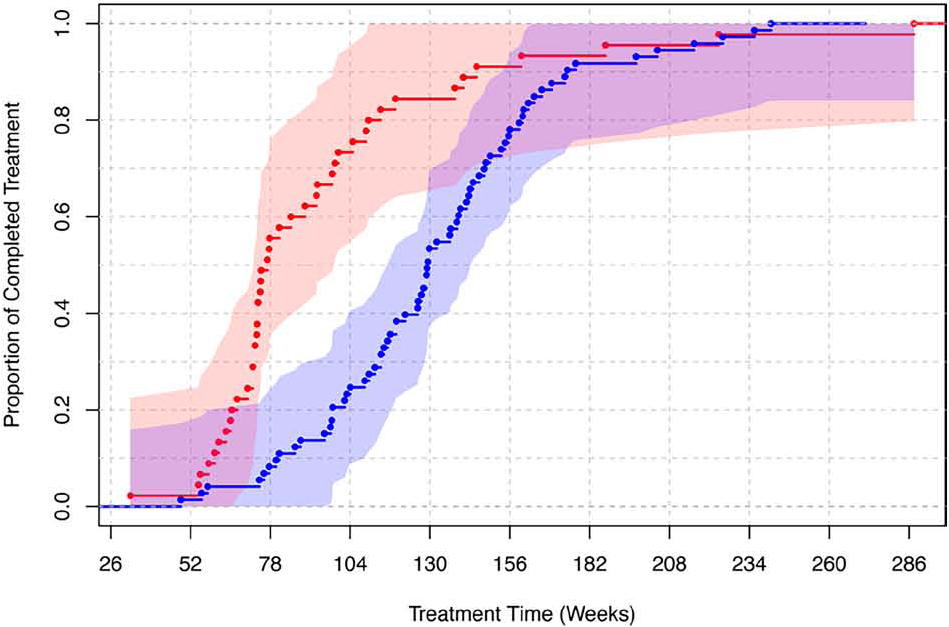
Figure 3.
Empirical cumulative distribution function with Dvoretzky-Kief-er-Wolfowitz-Massart simultaneous confidence bounds, demonstrating the treatment times for patients treated with an impacted canine (blue) and without an impacted canine (red).
Predictors of increased treatment duration amongst patients with an impacted canine
The influence of independent variables on treatment duration was assessed in the impacted canine group (Table V). Neither age, gender, side of impaction, nor buccopalatal site of impaction appeared to significantly predict an increase in treatment duration. Bilateral impaction was associated with a 15.47 week increase in treatment time over unilaterally impacted cases [95% CI: -7.96, 38.90]. The statistical insignificance of this finding should be weighed against the relatively low number of bilaterally impacted cases within this sample.
Cases that commenced treatment by surgical exposure completed treatment a statistically insignificant 32.34 weeks [95% CI: -1.39, 66.08] faster than cases treated by orthodontic space opening alone (p=0.07). In the cases that required midtreatment surgical exposure, a 17.27-week reduction in treatment time was observed, when compared to those patients successfully treated by space opening alone, although the effect size was statistically insignificant (p=0.27; 95%: CI -13.12, 47.65). It was noted that cases commencing with surgical exposure completed treatment in 15.07 fewer weeks than those who underwent mid-treatment surgical exposure, which was also statistically insignificant given the insignificance of the treatment modality variables. While these effect sizes were statistically insignificant, careful interpretation should be applied considering the relatively small number of patients requiring canine exposure surgery (either mid-treatment or from the outset) in this sample.
Compared to canines of a vertical classification of 1, a vertical (KPG) classification of 2 was statistically associated with a 35.90 week increase in treatment duration (p=0.01, 95% CI: 8.89, 62.92). However, despite this finding of potential significance, an analysis of VIFs found significant multicollinearity among the variables which described the radiographic position of the impacted canine (Table VI). This implied that this group of highly correlated covariables confound each other’s individual effect sizes and significance tests, and therefore an inference regarding these variables individually cannot be reliably drawn. The treatment modality also had a moderately high VIF which was not surprising, given that the need for surgery might be expected to be related to the radiographic severity of impaction.
Because of the significant correlation between the covariates, it must be stressed that the specific relationship between an individual measurement describing radiographic location and treatment time cannot be deduced from the current dataset. Instead, a joint Wald’s test indicated that the OPG variables which described the radiographic severity of impaction were collectively (and highly significantly) related to treatment duration (p=2.8x10−07). The R2 indicated that the group of variables describing the radiographic position of the impacted canine accounted for 24.03 per cent of the overall total variability in treatment time. Demographic factors collectively accounted for 0.46 per cent, and the combined effect of treatment-related factors accounted for 8.34 per cent. In total, the linear regression model explained 32.83 per cent of the total variability in treatment duration.
Predictors for the need for surgical exposure
The results from Table V indicate that there were no statistically significant differences in treatment time between palatally-impacted canines treated by orthodontics alone, initial space opening followed by subsequent surgical exposure, or surgery from the outset. Even when combining the surgical groups, there was no significant difference in overall treatment time between those who were successfully treated by conventional orthodontics, and those who required surgery (Figure 4).
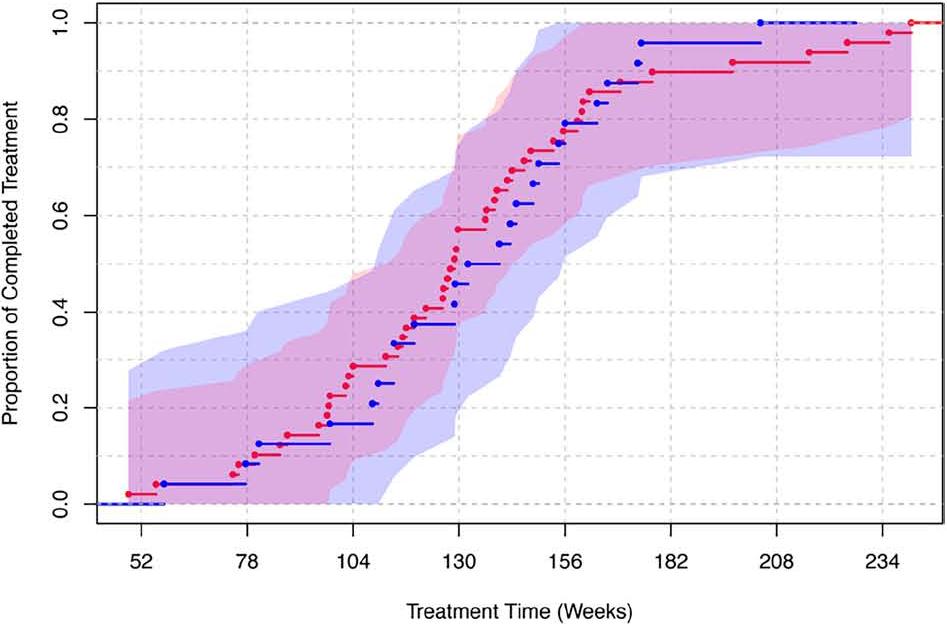
Figure 4.
Empirical cumulative distribution function with Dvoretzky-Kief-er-Wolfowitz-Massart simultaneous confidence bounds, demonstrating the treatment times for patients treated with orthodontic space opening alone (red), or surgical exposure (either from the outset or after initial orthodontic space opening – blue).
Because the different treatment groups might differ in characteristics other than overall treatment time, further analysis by treatment modality was still warranted. Therefore, the sample was stratified according to treatment modality, to permit an analysis of factors that differentiated canines suitably treated by space opening, and patients ideally treated by surgical exposure. The results presented in Tables VII and VIII assessed the factors which differentiated patients who were successfully treated with and without surgical exposure.
Without the need for statistical analysis, it was observed that 100 per cent of patients with a labial or mid-alveolar site of impaction were successfully treated non-surgically (Table VII). As a result, there was insufficient variation to calculate statistical estimators or perform tests in this context. Including these data in the logistic regression model caused rank deficiency, and so the observations were excluded from further analysis.
Of those patients who presented with a palatally-impacted canine (Table VIII), it was also observed that 100 per cent of the canines positioned in sectors I or II, or vertical (KPG) classification 1, were successfully treated non-surgically. Similarly, all canines with a vertical (KPG) classification of 4 were treated by surgical exposure.
Given the extremely strong predictive potential of classification within sectors I and II, and vertical (KPG) 1 and 4, logistic regression was subsequently used to assess for factors that might be predictive of the need for surgery among patients with different sector and vertical classifications (i.e. excluding those patients with a canine located in sector I or II, or vertical (KPG) classification of 1 or 4).
Although a cursory analysis of Tables VII and VIII would have initially suggested that surgical exposure was more likely in patients with a greater severity of radiographic impaction, the regression analysis on the remaining 33 patients (Table IX) indicated that there was little explanatory power left in the radiographic variables once account was considered that sectors I and II, and vertical (KPG) classifications of 1 and 4 were entirely predictive in the data (and thereafter excluded). Furthermore, when accounting for multicollinearity and correlation between OPG radiographic variables, joint hypothesis testing of the combined group of radiographic variables concluded that the group of variables were not statistically significant as predictors of the need for surgery (p=0.08) in this subset of patients. Therefore, the extremes of sector and vertical classification were the most significant predictors of surgical exposure.
In the regression analysis of this subset of patients (Table IX), there was an additional statistically insignificant tendency for increasing age to correlate with the need for surgical exposure (p=0.09). Of all patients with palatally-impacted canines, surgically treated patients were 1.2 years older on average than patients who were successfully treated by orthodontics alone (Table VIII).
In examining all patients with a palatally-impacted canine (Table VIII), the overall treatment time was neither clinically nor statistically different between those successfully treated with or without surgical exposure (136.00 weeks for patients requiring surgical exposure, and 129.07 weeks for those treated by orthodontics alone).
Discussion
It was suspected that there might be a correlation between the various radiographic factors which collectively described canine impaction severity.34 For example, the α-angle and β-angle measurements both assess the same characteristic of canine angulation, and an angle change around a given centre of rotation will geometrically alter both the vertical and horizontal position of the canine cusp tip. Multicollinearity describes a situation in which two or more supposedly ‘independent’ variables are highly (but not perfectly) correlated, making statistical discernment of their individual effects impossible.35 The present analysis of multicollinearity confirmed previous findings,34,36–38 and the current theory that the various canine radiographic measurements were highly correlated with one another. Clinically, this would support the assessment of a canine’s overall severity of impaction to predict the treatment duration, as opposed to the evaluation of individual variables (as is performed in research contexts). Nevertheless, the R2 indicated that the group of variables describing radiographic position of the impacted canine accounted for just 24.03 per cent of the variability in treatment time. In total, all available variables were able to explain only 32.83 per cent of the total variability in treatment duration. This might indicate that there were important (i.e. biological) variables unaccounted for in the model; alternatively or in conjunction, treatment time is naturally highly variable and unpredictable, even in the presence of available covariates.
Many of the proposed interceptive techniques for ectopic canines operate through the creation or maintenance of arch circumference, yet the appropriateness of each may vary depending on the individual patient’s inter-arch transverse coordination, anteroposterior molar and skeletal relationship, and available leeway space. Given that labial sites of impaction are associated with arch-length discrepancies, the success of space opening (either with or without premolar extractions) in the management of canine impactions would seem intuitive. While palatal sites of impaction are aetiologically distinct, it is hypothesised that the removal of any obstruction or deciduous tooth creates a favourable environment and pathway for permanent canine eruption; the creation of space generates tension within the transseptal fibres connecting the ectopic canine and adjacent first premolar and lateral incisor, and thereby applying a force to encourage the ectopic canine to improve its position.39,40 Space opening via fixed appliances works similarly to other interceptive techniques, although the magnitude of space creation is larger, and space is created in the precise location required. While an excess of space is initially created, the increase in overjet and midline deviation is temporary,26 with resolution occurring following alignment of the canine, closure of residual spaces, and conventional correction of the malocclusion. The present findings indicated that space opening was not a panacea for all patients presenting with impacted canines, but that appropriate case selection and treatment implementation are crucial. The present study did not seek to highlight the superiority of one treatment modality for every case of canine impaction. Instead, it was considered beneficial to identify those patients who would benefit from conservative orthodontic space opening, and conversely, confirm the severity of canine displacement warranting appropriate surgical exposure.
Space opening is likely to be successful in the management of most labially-impacted canines, and for palatally-impacted canines found in sectors I and II or vertical (KPG) classification 1. All such patients in the present study cohort were able to be managed non-surgically. The average age of patients who were treated by space-opening was slightly reduced, which potentially indicated a greater responsiveness to non-surgical intervention. In a clinical assessment of a subset of the same patients, Ling et al. compared the pulpal, periodontal, and aesthetic outcomes between space opening and accompanying spontaneous eruption, with surgical exposure and orthodontic traction.26,27 Both treatment modalities had comparable periodontal and pulpal outcomes; however, surgically exposed and extruded canines had poorer alignment (related to greater intrusion, and significantly greater rotation) than canines that spontaneously erupted after space opening. These aesthetic differences resulted in assessors being more likely to correctly identify a previously impacted canine in the surgically-treated group, than the space opening group. Importantly, subjects were generally satisfied or very satisfied with the colour and position of the treated canines. The reduced morbidity, as well as the aesthetic and stability benefits, strongly suggest conservative orthodontic space opening as the initial management option of choice for appropriately identified patients.
A surgical exposure was more likely to be recommended for patients who were older, and who presented with a vertical (KPG) classification of 4, or a high sector classification. Notwithstanding that 20 per cent of patients with a sector IV classification were successfully treated by orthodontic space opening alone, surgical exposure had greater predictability in the management of such severe impactions.
The linear regression analysis presented in Table V indicated a statistically insignificant tendency for space opening to take longer compared to surgical exposure, all other factors (including severity of impaction) being equal. However, the cases that are recommended for conservative space opening and surgical exposure are not equivalent, as all but the most severely impacted cases were successfully managed conservatively. The results from Table VIII indicate that there were no significant differences in treatment time between the surgical and non-surgical management of palatally-impacted canines, given appropriate case selection. Even though there was a tendency for faster treatment in surgical cases, this was likely offset by the severity of the impaction. Treatment time is therefore similar for the surgical and conservative management of the “clear-cut” surgical (S) and non-surgical (OT) cases, respectively. However, a clinical dilemma arises in those patients with “borderline” impactions which may be reasonably treated either surgically or non-surgically. In the present study, 67 per cent of sector III canines responded favourably to space opening and erupted without surgical intervention. For these cases, clinician and patient related preferences might sway the decision between surgical exposure from the outset, or conservative space opening and reassessment during treatment. Even so, the treatment modality (and related factors) explained only 8.34 per cent of the variation in treatment time. Given these findings, conservative space opening is recommended as the initial treatment of choice for all but the most severely impacted maxillary canines. Even if surgical exposure was required after initial space opening, it is suggested that canines often improve in their radiographic position, which subsequently facilitates a reduction in the extent of required exposure.
The present study contributes significantly to the existing knowledge base regarding impacted canines. Overall treatment duration was investigated, rather than the time for canine eruption or alignment. The alignment of an impacted canine is only the first stage of therapy, and patients perceive that treatment is ongoing until fixed appliances have been removed, and hence a report on overall treatment time is important. Secondly, the presented method of space opening carries significantly less morbidity than surgical exposure and was found to be effective and comparably efficient for a significant number of impacted canines. Finally, the current work includes, and significantly expands, upon the original samples of patients from 2002 and 2005.14,23 This expanded sample includes both non-surgical and surgically managed patients, as well as palatal and labial/mid-alveolar sites of impaction (the latter of which is underreported in the broader literature). Considering the promising initial findings, the data from this larger cohort also represents progressiveness in the application of the originally-described technique with more severe cases recommended and both patient and orthodontist prepared to persevere with space opening.
However, it is acknowledged that a significant limitation of the present research was its retrospective nature, and the likely associated bias in favour of the intervention being reported.41 The overall malocclusion and extraction/non-extraction treatment plan may have influenced treatment duration, for which there was no account. Only treatment time was assessed, but not the appointment interval nor the number of patient appointments. While it is important to discuss overall treatment duration, the effect of the treatment modality or the pre-treatment level of impaction on the duration of treatment might be diluted to insignificance over the entire course of treatment, as these variables would only delay the time required for initial alignment of the canine. While clinically useful conclusions have be drawn, a larger sample size would have afforded even greater statistical power for analyses involving surgical subgroups with limited numbers of patients. Care was taken in the analysis to provide 95% confidence intervals so that readers might independently evaluate the potential effect sizes for clinical significance, likelihood of statistical significance, and the degree of certainty. Nonetheless, the sample was as large as practical, comprising the complete sample of relevant patients collected over a single orthodontist’s practicing career. Finally, only treatment duration was assessed to evaluate the success and efficiency of space opening mechanics. Other patient-centred factors including acceptance of surgical morbidity, aesthetic perception of spacing while awaiting canine eruption, or emphasis given to treatment efficiency were not evaluated, and this warrants further investigation and comparison with surgical exposure.
Ultimately, the findings of the present study reinforce the responsibility of all clinicians to screen for canine impaction in all of their patients, as early diagnosis (at a younger age, and before worsening ectopia) maximises the potential for effective, non-surgical management. The promising study findings indicate the need for prospective randomised controlled trials to properly clarify the utility of orthodontic space opening for the management of impacted maxillary canines.22
Conclusions
Patients presenting with impacted maxillary canines, both labial/mid-alveolar and palatal, take significantly longer to treat than conventional orthodontic cases without impacted canines.
Radiographic variables describing canine position are highly correlated, and this collection of variables has a significant influence on treatment duration.
Overall, treatment duration is highly variable, as only a third of this variability is explained by the examined factors.
There was a statistically insignificant tendency for surgically-exposed canines to be treated faster than non-surgically managed canines. However, case selection differed substantially.
Orthodontic space opening is likely to be successful for labially-impacted canines, and all but the most severely palatally-impacted canines. For appropriately treatment planned cases, successful orthodontic space opening has a similar treatment time compared to cases that require surgical exposure.
Notes
[24] Conflicts of interest Conflict of interest
The authors declare that there is no conflict of interest.
Acknowledgements
This work was supported by the University of Queensland and the Australian Society of Orthodontists Foundation for Research and Education.