
Table I.
Prevalence of MIH by country
| Country | Author (date) | Age | N | Criteria | %MIH |
|---|---|---|---|---|---|
| Argentina | Biondi et al. (2011)14 | 11 | 1098 | DDE | 15.9 |
| Brazil | Souza et al. (2013)15 | 7 –12 | 1151 | EAPD | 12.3 |
| Brazil | Tourino et al. (2016)16 | 8 –9 | 1181 | EAPD | 20.4 |
| Bulgaria | Kukleva et al. (2008)17 | 7 –14 | 2960 | 3.6 | |
| Chile | Harz et al. (2023)18 | 6 –12 | 1270 | EAPD Mathu-Muju | 12.8 |
| China | Yi et al. (2021)19 | 12 –15 | 6523 | EAPD | 10 |
| Jordan | Hamdan et al. (2020)20 | 8 –9 | 1412 | EAPD | 13.2 |
| Germany | Dietrich et al. (2003)21 | 10 –17 | 2408 | mDDE | 5.6 |
| Germany | Preusser et al. (2007)22 | 6 –12 | 1022 | 5.9 | |
| Germany | Petrou et al. (2014)23 | 8 –9 | 2395 | EAPD | 10.1 |
| Germany | Kühnisch et al. (2015)24 | 10 | 1048 | EAPD | 13.6 |
| Germany | Amend et al. (2020)25 | 10 –17 | 2408 | EAPD | 5.6 |
| Greece | Lygidakis et al. (2008)26 | 5.5 –12 | 3518 | 10.2 | |
| Greece | Kevrekidou et al. (2015)27 | 8 –14 | 2335 | EAPD | 21 |
| Hong Kong | Cho et al. (2008)28 | 11 –14 | 2635 | 2.8 | |
| India | Parikh et al. (2012)29 | 8 –12 | 1366 | EAPD | 9.2 |
| India | Mittal et al. (2014)30 | 6 –9 | 1792 | EAPD | 6.3 |
| India | Krishnan et al. (2015)31 | 9 –14 | 4989 | EAPD | 7.3 |
| India | Yannam et al. (2016)32 | 8 –12 | 2864 | EAPD | 9.7 |
| India (Kerala) | Emmatty et al. (2020)33 | 8 –15 | 5318 | EAPD | 4.1 |
| Iran | Shojaeepour et al. (2020)34 | 8 –12 | 2507 | EAPD | 5.1 |
| Italy | Condò et al. (2012)35 | 4 –15 | 1500 | Unclear | 7.3 |
| Italy | Nisii et al. (2022)36 | 7 –8 | 3611 | MIH-SSS | 18.2 |
| Japan | Sakurai and Shintani (2014)37 | 6 –12 | 1753 | 11.9 | |
| Japan | Saitoh et al. (2018)38 | 7 –9 | 4496 | EAPD | 19.8 |
| Jordan | Zawaideh et al. (2011)39 | 7 –9 | 3241 | 17.6 | |
| Kenya | Kemoli et al. (2008)40 | 6 –8 | 3591 | Visual inspection from photographs | 13.7 |
| Lithuania | Jasulaityte et al. (2007)41 | 7 –9 | 1277 | EAPD | 14.9 |
| Nigeria | Oyedele et al. (2015)42 | 8 –16 | 2107 | 12.7 | |
| Norway | Afzal et al. (2023)43 | 8 –9 | 3013 | EAPD | 28.2 |
| Saudi Arabia | Almuallem et al. (2022)44 | 8 –12 | 1562 | EAPD short form | 15.2 |
| Singapore | Ng et al. (2014)45 | 7 –8 | 1083 | EAPD | 12.5 |
| Switzerland | Grieshaber et al. (2022)46 | 7.4 –15.7 | 1252 | MIH TNI | 14.8 |
| Switzerland | Abdelaziz et al. (2022)47 | 4 –12 | 32142 | Index devised by researchers | 6.6 |
| Syria | Al-Nerabieah et al. (2023)48 | 8 –11 | 1138 | EAPD | 39.9 |
| Turkey | Sönmez et al. (2013)49 | 7 –12 | 4049 | 7.7 | |
| Turkey | Koruyucu et al. (2018)50 | 8 –11 | 1511 | EAPD | 14.2 |
| Turkey | Kılınç et al. (2019)51 | 9 –10 | 1237 | EAPD | 11.5 |
| UK | Balmer et al. (2012)52 | 12 | 3233 | mDDE | 15.9 |
Table II.
Prevalence of MIH in Australia and New Zealand
| Country | Author (date) | Children (n) | Criteria | MIH (%) |
|---|---|---|---|---|
| Australia | Gambetta-Tessini, Marino et al. (2018)53 | 327 | EAPD | 14.7 |
| New Zealand | Mahoney and Morrison (2009)54 | 850 | mDDE | 14.9 |
| New Zealand | Mahoney and Morrison (2011)55 | 235 | mDDE | 18.8 |
| Australia | Arrow (2008)56 | 550 | mDDE | 22 |
| Australia | Balmer, Laskey et al. (2005)57 | 24 | mDDE | 44 |
| New Zealand | Beckett, Wheeler et al. (2022)58 | 82 | EAPD | 77 |
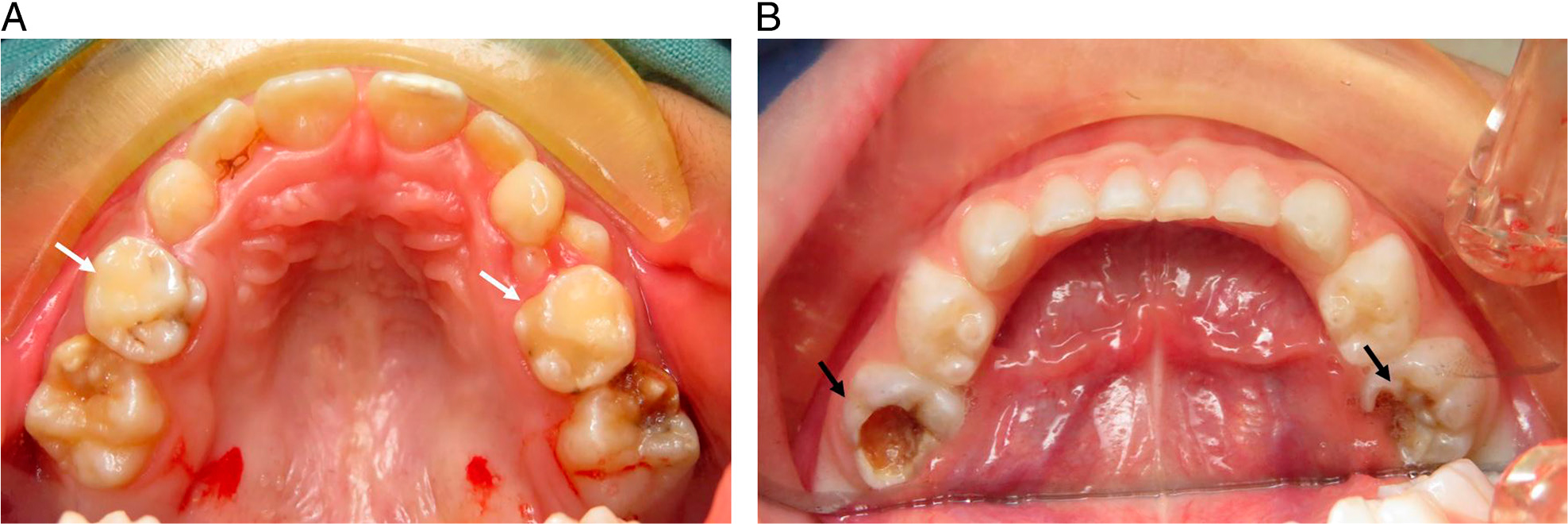
Figure 1.
Clinical photographs of (A) upper second primary molars affected with mild hypomineralisation of yellow/white demarcated defects and previous atypical restorations (white arrows) with affected first permanent molars and (B) lower first primary molars with large, atypical caries affecting the occlusal, buccal and lingual surfaces (black arrows).
Table III.
A proposed charting system to record observation as per the EAPD diagnostic criteria. (Adapted from59)
| Criteria | |
|---|---|
| 0 | No visible enamel defect |
| 1 | Enamel defect, not MIH/HSPM |
| 11 | Diffuse opacities |
| 12 | Hypoplasia |
| 13 | Amelogenesis imperfecta |
| 14 | Hypomineralisation defect (not MIH/HSPM) |
| 2 | Demarcated opacities |
| 21 | White or creamy demarcated opacities |
| 22 | Yellow or brown demarcated opacities |
| 3 | Post eruptive breakdown |
| 4 | Atypical restoration |
| 5 | Atypical caries |
| 6 | Missing due to MIH/HSPM |
| 7 | Cannot be scored |
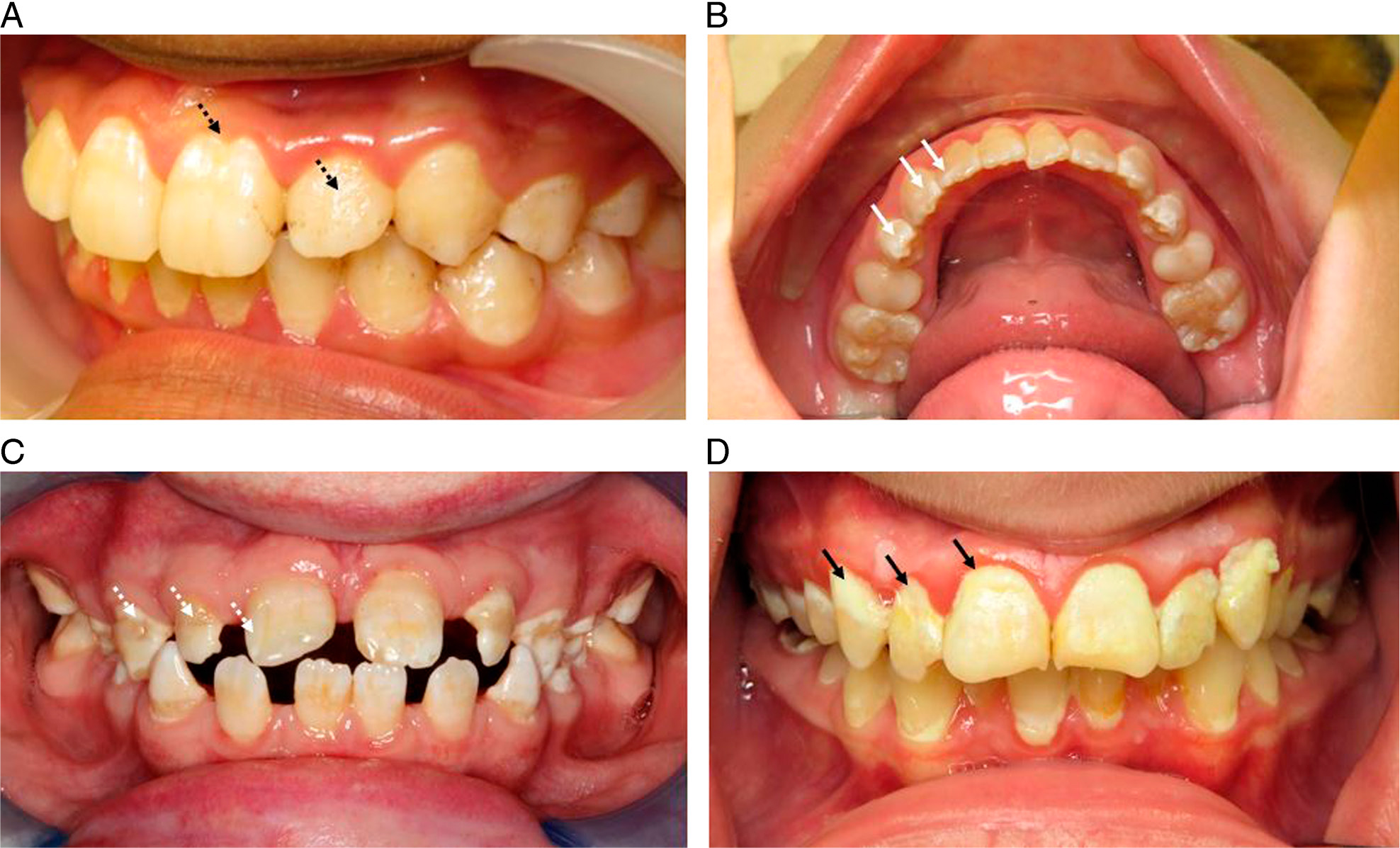
Figure 2.
Clinical photographs of (A) hypoplastic quantitative defect on the upper left central incisor and diffuse defect across all other maxillary teeth (black dashed arrows), (B) fluorosis with diffuse, opaque defects (white arrows) affecting all of the lower permanent dentition, (C) amelogenesis imperfecta with diffuse areas of white and brown defects (white dashed arrow) affecting all permanent dentition, (D) white-spot caries lesions at the gingival margins of multiple teeth (black arrows).
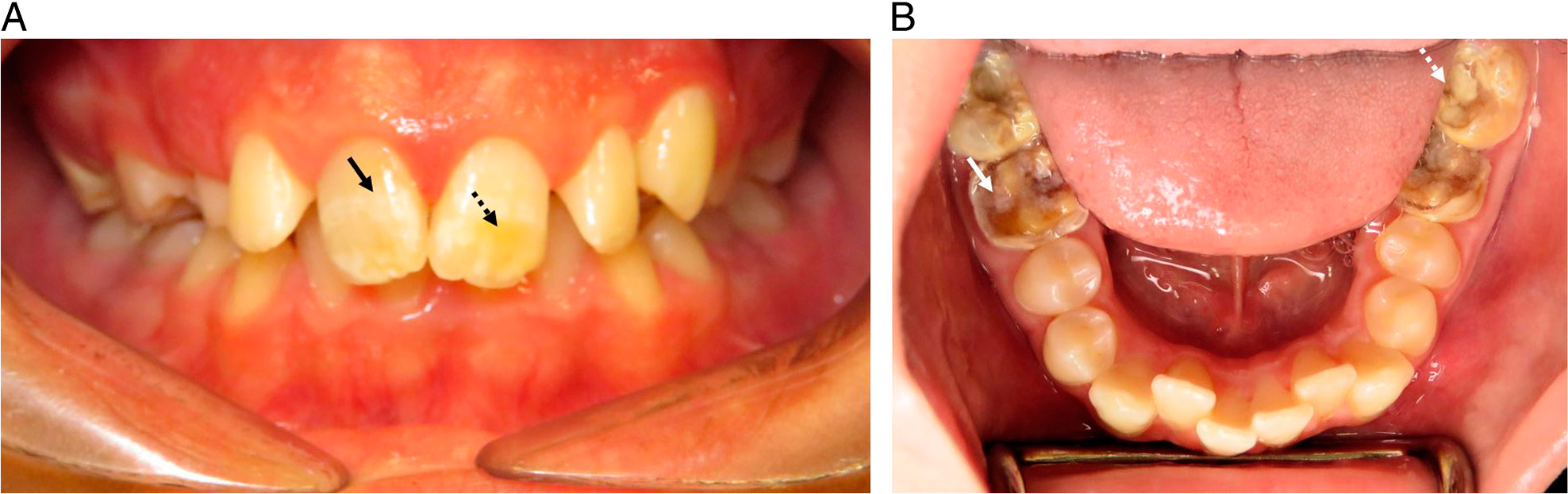
Figure 3.
Clinical photographs of (A) upper central incisors with white (black arrow) and yellow (black dashed arrow) demarcated defects and (A) lower first and second permanent molars with posteruptive breakdown of the occlusal and buccal surfaces (white arrow) and an atypical restoration (white dashed arrow).
Table IV.
Classification of MIH60
| Category | Characteristics |
|---|---|
| Mild |
|
| Moderate |
|
| Severe |
|
Table V.
Wurzburg Working Group treatment guide
| Index | Description |
|---|---|
| 0 | No MIH |
| 1 | MIH |
| • No breakdown | |
| • No hypersensitivity | |
| 2 | MIH |
| • Breakdown | |
| • No hypersensitivity | |
| 2a | • Extension of defect < 1/3 |
| 2b | • Extension of defect e 1/3 to < 2/3 |
| 2c | • Extension of defect ≥ 2/3 or/and defect close to the pulp or extraction or atypical restoration |
| 3 | MIH |
| • No breakdown | |
| • Hypersensitivity | |
| 4 | MIH |
| 4a | • No breakdown |
| 4b | • Hypersensitivity |
| 4c | • Extension of defect < 1/3 |
| • Extension of defect ≥ 1/3 to < 2/3 | |
| • Extension of defect ≥ 2/3 or/and defect close to the pulp or extraction or atypical restoration |