
Introduction
Molar-incisor-hypomineralisation (MIH) is an established term to describe a range of developmental defects of enamel (DDE) found on first permanent molars (FPM) and, frequently, the permanent incisors.1 The defects have previously been described as “hypomineralised permanent first molars”, “idiopathic enamel hypomineralisation in permanent first molars”, “non-fluoride hypomineralisation in permanent first molars” and “cheese molars”. The all-encompassing name, MIH, was proposed in 2001 to describe hypomineralised enamel of systemic origin affecting 1 to 4 FPMs, commonly associated with incisors, to be used by clinicians and in epidemiological research.1
Recent evidence, however, indicates that the enamel defect may also be diagnosed in second primary molars, the tips of permanent canine cusps, premolars and second permanent molars and so the term and its definition may require revision.2
MIH is of consequence as it may have a deleterious impact on the general health, psychosocial well-being and the quality of life of young children who are affected by the condition.3 It is commonly associated with poor aesthetics, tooth hypersensitivity, dental pain and rapid tooth destruction due to increased enamel porosity and/or dental caries. The management of the condition presents significant challenges for dental clinicians, patients and their families. Orthodontists may encounter specific difficulties related to enamel bond strength, compromised anchorage and the timing of extractions of affected teeth.4 These issues were reflected in the establishment of a translational research and education network known as the “D3 group”, initially across Australia and New Zealand, but now spanning globally.5 The concept was to provide education and advocacy for research and healthcare of DDE, including MIH, with a focus on prevention.
Therefore, the objectives of the present paper are to:
Describe the prevalence, aetiology and classification systems of MIH.
Outline the diagnosis, related psychosocial issues and dental and orthodontic management considerations plus treatment options for the condition.
Materials and methods
The current narrative review was conducted with reference to the principles of the Scale for the Assessment of Narrative Review Articles (SANRA) with the intent of ensuring optimal quality and robustness.6 This approach was selected in order to synthesise the current literature in a clinically accessible manner for orthodontists and general dental practitioners. Whilst it does not follow a systematic review format, key studies were identified using structured searches and selected for their relevance from both paediatric and orthodontic perspectives.
The PubMed, Scopus and Web of Science databases were searched using the terms “molar incisor hypomineralisation,” “hypomineralised second primary molars” and “hypomineralised second primary molars” and was restricted to publications in the English language. Case studies, epidemiological studies, retrospective and prospective studies, cross-sectional investigations and systematic reviews were included. Moreover, guidelines published by educational or other institutions, editorials and commentaries were also considered.
Prevalence
Care is required when assessing reports of MIH prevalence rates as methodological variation between studies may hinder accurate documentation of the condition and may explain why epidemiological prevalence studies of MIH vary widely.7 The use of several classification systems, such as the modified DDE index,8 the European Academy of Paediatric Dentistry (EAPD) criteria for MIH9 or individual classification or sub-classification systems may further preclude accurate reporting. Several epidemiological studies, for example, exclude carious or restored teeth which may also lead to an underestimation of the condition’s prevalence.10 Some studies include fully erupted FPMs whilst others also assess second primary molars. Additionally, differences in examiner calibration, the exclusion of carious or restored teeth and population specific variables may influence prevalence rates. This may be reflected in clinical presentation rates within orthodontic practices depending on regional demographics, the structure of referral pathways and potentially the patient populations from either public or private practice. This variation between prevalence studies may be explained by differences in study populations, diagnostic criteria and methodology.11
The World Dental Federation established the DDE index in 1982. This was subsequently modified for epidemiological studies to provide consistency throughout the literature.8 However, this index system does not differentiate between the broad range of aetiologies for the defects and relies on clinical description. Although the current terminology of MIH was established in 2001,1 the EAPD criteria was first described in 2003,12 and modified in 20097 and 2015.9
Suggested protocols for reporting the prevalence of MIH comprise the inclusion of a minimum of 300 children at age 8 years for optimum examination age.13 Table I outlines a range of large scale prevalence studies conducted throughout the world over the past 20 years.
Table I.
Prevalence of MIH by country
| Country | Author (date) | Age | N | Criteria | %MIH |
|---|---|---|---|---|---|
| Argentina | Biondi et al. (2011)14 | 11 | 1098 | DDE | 15.9 |
| Brazil | Souza et al. (2013)15 | 7 –12 | 1151 | EAPD | 12.3 |
| Brazil | Tourino et al. (2016)16 | 8 –9 | 1181 | EAPD | 20.4 |
| Bulgaria | Kukleva et al. (2008)17 | 7 –14 | 2960 | 3.6 | |
| Chile | Harz et al. (2023)18 | 6 –12 | 1270 | EAPD Mathu-Muju | 12.8 |
| China | Yi et al. (2021)19 | 12 –15 | 6523 | EAPD | 10 |
| Jordan | Hamdan et al. (2020)20 | 8 –9 | 1412 | EAPD | 13.2 |
| Germany | Dietrich et al. (2003)21 | 10 –17 | 2408 | mDDE | 5.6 |
| Germany | Preusser et al. (2007)22 | 6 –12 | 1022 | 5.9 | |
| Germany | Petrou et al. (2014)23 | 8 –9 | 2395 | EAPD | 10.1 |
| Germany | Kühnisch et al. (2015)24 | 10 | 1048 | EAPD | 13.6 |
| Germany | Amend et al. (2020)25 | 10 –17 | 2408 | EAPD | 5.6 |
| Greece | Lygidakis et al. (2008)26 | 5.5 –12 | 3518 | 10.2 | |
| Greece | Kevrekidou et al. (2015)27 | 8 –14 | 2335 | EAPD | 21 |
| Hong Kong | Cho et al. (2008)28 | 11 –14 | 2635 | 2.8 | |
| India | Parikh et al. (2012)29 | 8 –12 | 1366 | EAPD | 9.2 |
| India | Mittal et al. (2014)30 | 6 –9 | 1792 | EAPD | 6.3 |
| India | Krishnan et al. (2015)31 | 9 –14 | 4989 | EAPD | 7.3 |
| India | Yannam et al. (2016)32 | 8 –12 | 2864 | EAPD | 9.7 |
| India (Kerala) | Emmatty et al. (2020)33 | 8 –15 | 5318 | EAPD | 4.1 |
| Iran | Shojaeepour et al. (2020)34 | 8 –12 | 2507 | EAPD | 5.1 |
| Italy | Condò et al. (2012)35 | 4 –15 | 1500 | Unclear | 7.3 |
| Italy | Nisii et al. (2022)36 | 7 –8 | 3611 | MIH-SSS | 18.2 |
| Japan | Sakurai and Shintani (2014)37 | 6 –12 | 1753 | 11.9 | |
| Japan | Saitoh et al. (2018)38 | 7 –9 | 4496 | EAPD | 19.8 |
| Jordan | Zawaideh et al. (2011)39 | 7 –9 | 3241 | 17.6 | |
| Kenya | Kemoli et al. (2008)40 | 6 –8 | 3591 | Visual inspection from photographs | 13.7 |
| Lithuania | Jasulaityte et al. (2007)41 | 7 –9 | 1277 | EAPD | 14.9 |
| Nigeria | Oyedele et al. (2015)42 | 8 –16 | 2107 | 12.7 | |
| Norway | Afzal et al. (2023)43 | 8 –9 | 3013 | EAPD | 28.2 |
| Saudi Arabia | Almuallem et al. (2022)44 | 8 –12 | 1562 | EAPD short form | 15.2 |
| Singapore | Ng et al. (2014)45 | 7 –8 | 1083 | EAPD | 12.5 |
| Switzerland | Grieshaber et al. (2022)46 | 7.4 –15.7 | 1252 | MIH TNI | 14.8 |
| Switzerland | Abdelaziz et al. (2022)47 | 4 –12 | 32142 | Index devised by researchers | 6.6 |
| Syria | Al-Nerabieah et al. (2023)48 | 8 –11 | 1138 | EAPD | 39.9 |
| Turkey | Sönmez et al. (2013)49 | 7 –12 | 4049 | 7.7 | |
| Turkey | Koruyucu et al. (2018)50 | 8 –11 | 1511 | EAPD | 14.2 |
| Turkey | Kılınç et al. (2019)51 | 9 –10 | 1237 | EAPD | 11.5 |
| UK | Balmer et al. (2012)52 | 12 | 3233 | mDDE | 15.9 |
A systematic review and meta-analysis of 70 studies reported the global prevalence of MIH to be 14.2%.14 Within this meta-analysis, South America recorded the highest prevalence and Africa the lowest. However, various classification systems were used within the included studies and pooled for analysis. A subsequent systematic review reported values based solely on the EAPD classification and found a global prevalence of 13.5%.15 Nevertheless, the similar prevalence findings reported on a global level suggest an estimation of 14%.
Table II indicates that national investigations carried out in Australia and New Zealand show that prevalence rates of MIH have ranged from 14.7% to 77%. The included studies mainly applied a modified DDE classification and only two used the EAPD classification system.16,17 In addition, the prevalence of MIH in a cohort of Australian children with type 1 diabetes was reported at 19.2% after using the EAPD criteria.18 Early Australian studies reported the prevalence of DDE without differentiating MIH. A Victorian study found 82% of children with a medical comorbidity had DDE.19 A Queensland study reported a 25% and 58% prevalence of DDE in the primary and permanent dentitions, respectively.20
Table II.
Prevalence of MIH in Australia and New Zealand
| Country | Author (date) | Children (n) | Criteria | MIH (%) |
|---|---|---|---|---|
| Australia | Gambetta-Tessini, Marino et al. (2018)53 | 327 | EAPD | 14.7 |
| New Zealand | Mahoney and Morrison (2009)54 | 850 | mDDE | 14.9 |
| New Zealand | Mahoney and Morrison (2011)55 | 235 | mDDE | 18.8 |
| Australia | Arrow (2008)56 | 550 | mDDE | 22 |
| Australia | Balmer, Laskey et al. (2005)57 | 24 | mDDE | 44 |
| New Zealand | Beckett, Wheeler et al. (2022)58 | 82 | EAPD | 77 |
Aetiology
The precise aetiology of MIH is largely unknown. However, it is generally accepted that the condition is likely to be of multifactorial origin.8
Environmental factors
Several systematic reviews have attempted to identify the aetiology of DDE and MIH with regard to environmental disruption during the pre-, peri- and postnatal periods.21–26 Prenatal factors related to MIH include maternal smoking during pregnancy, maternal illness during pregnancy and maternal medication, but all factors were not found to be statistically significantly associated with the condition.24 Maternal stress had a higher association with MIH but this has not been corroborated elsewhere.27 Perinatal exposures such as prematurity, low birthweight, caesarean delivery and birth complications have been associated but based on low quality evidence.23,24 An association between a long duration of breastfeeding and exposure of the infant to dioxins has been discussed widely28 but later attributed non-significant findings to a decrease in levels of dioxin pollution.29
Early childhood illnesses have been extensively studied but ranged between specific conditions such as asthma and hay fever to studies which reported “general health” or “general illness” under the age of 3 to 4 years. Childhood illnesses have a positive association without significance to MIH.30 Research in Japan has also explored potential environmental and genetic factors contributing to MIH, with particular interest in the impact of regional dietary practices and healthcare access.31 The lack of detail and consistency between an exposure to environmental factors and the recall of information in a questionnaire format for the majority of studies limit the quality of available evidence regarding the aetiology of MIH.
Genetic factors
Genetic predisposition and epigenetic factors are likely to contributes to the multifactorial nature of MIH but require further investigation.32–34 Genes that have been associated with the condition include tuftelin 1 (TUFT1), enamelin (ENAM) and tuftelin interacting protein 11 (TFIP11).35,36
The genetic or epigenetic involvement in the condition’s aetiology has been potentially strengthened by the finding of a recent study which indicated an association between MIH and dental agenesis. The study, based in a UK dental hospital, found that the prevalence of tooth agenesis in children with MIH was twice that found in other populations.37 However, this finding was not reflected in two similar observational studies.38,39 A recently published protocol has outlined details of a large scale prospective study to explore the potential association between MIH and other dental developmental anomalies and is expected to provide more robust evidence.40
Hypomineralised second primary molars
Second primary molars may present with enamel hypomineralisation, termed hypomineralised second primary molars (HSPM) in which defects are similar to those seen in MIH.41 The aetiology of HSPM also remains unclear, but due to the overlap of mineralisation of FPM and second primary molars, risk factors and genetic pathways are likely to be similar. The presence of HSPM has been found to be a predictor for the diagnosis of MIH (Figure 1a,b).42 The identification of demarcated opacities on second primary molars, or mild HSPM, is a noted greater predictor of MIH of the FPM. A prevalence of 14.1% has been reported within a cohort of children in Australia, the study of which also found a positive correlation between HSPM and caries severity.43
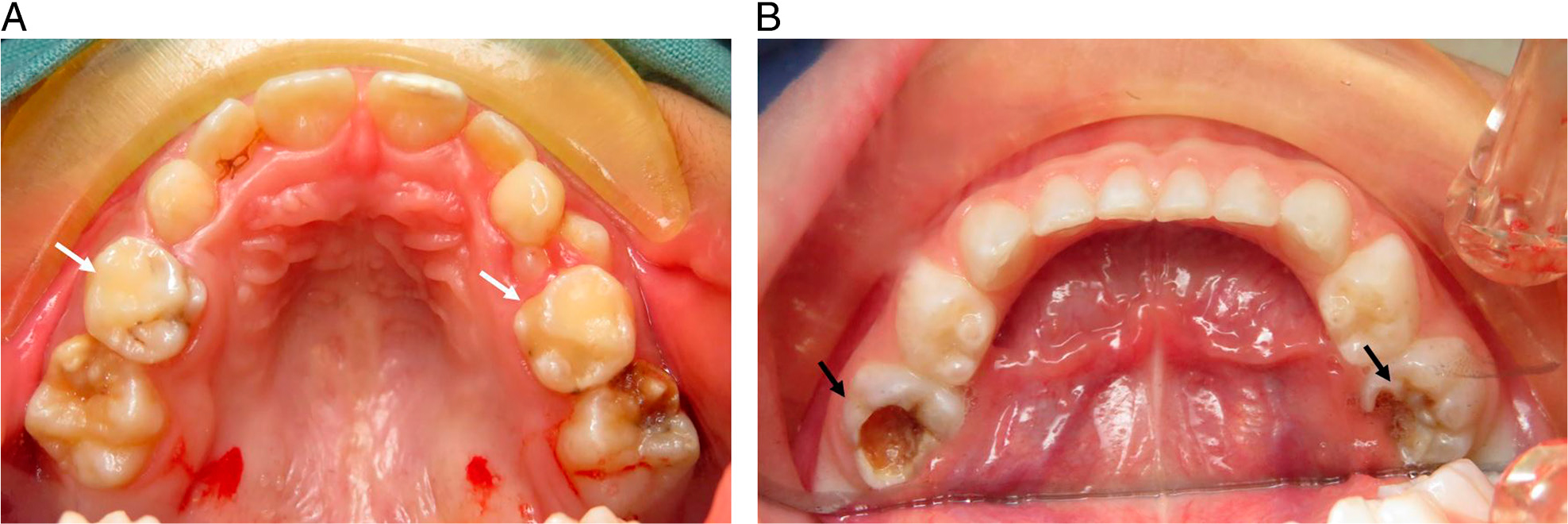
Figure 1.
Clinical photographs of (A) upper second primary molars affected with mild hypomineralisation of yellow/white demarcated defects and previous atypical restorations (white arrows) with affected first permanent molars and (B) lower first primary molars with large, atypical caries affecting the occlusal, buccal and lingual surfaces (black arrows).
Diagnosis
The diagnosis of MIH may be guided by the EAPD criteria.9 Between 1 – 4 FPM must show hypomineralisation of the enamel. Permanent incisors may or may not be affected. The presentation and severity of MIH is dependent on the extent and duration of the disruption to the enamel formation process of amelogenesis.9
The diagnostic criteria, summarised in Table III, can be used for MIH and HSPM and is useful for clinical charting and record keeping. It is important to note that the teeth should be clean but remain moist for the diagnosis of MIH and HSPM. This contrasts to caries diagnosis in which a dry tooth is recommended.
Table III.
A proposed charting system to record observation as per the EAPD diagnostic criteria. (Adapted from59)
| Criteria | |
|---|---|
| 0 | No visible enamel defect |
| 1 | Enamel defect, not MIH/HSPM |
| 11 | Diffuse opacities |
| 12 | Hypoplasia |
| 13 | Amelogenesis imperfecta |
| 14 | Hypomineralisation defect (not MIH/HSPM) |
| 2 | Demarcated opacities |
| 21 | White or creamy demarcated opacities |
| 22 | Yellow or brown demarcated opacities |
| 3 | Post eruptive breakdown |
| 4 | Atypical restoration |
| 5 | Atypical caries |
| 6 | Missing due to MIH/HSPM |
| 7 | Cannot be scored |
Differential diagnosis
Caution is required to ensure that enamel hypoplasia is not erroneously diagnosed as MIH. Enamel hypoplasia is a quantitative enamel defect (Figure 2a) and results from systemic and/or local impacts during formation of the enamel matrix and the tooth’s maturation phases.44
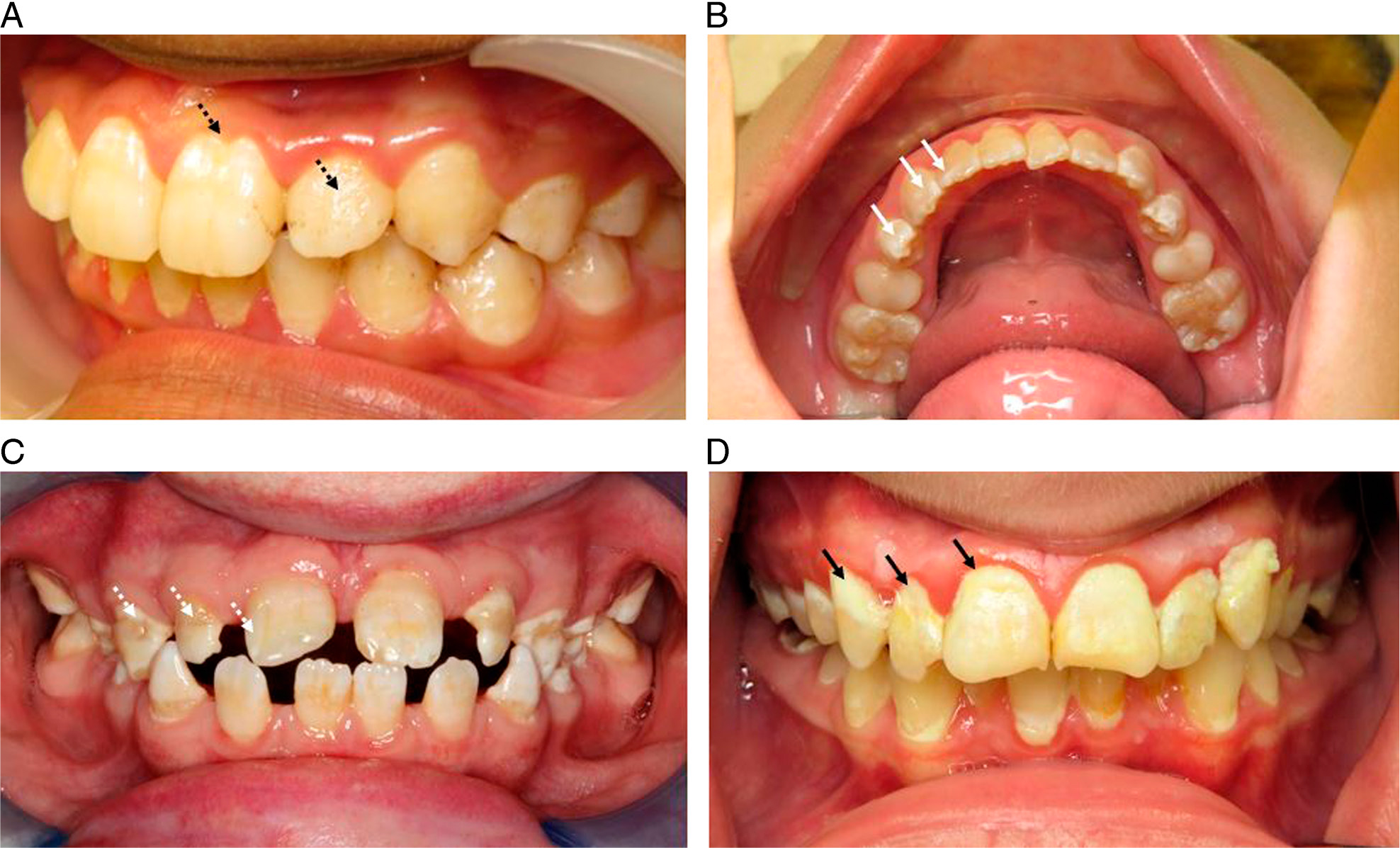
Figure 2.
Clinical photographs of (A) hypoplastic quantitative defect on the upper left central incisor and diffuse defect across all other maxillary teeth (black dashed arrows), (B) fluorosis with diffuse, opaque defects (white arrows) affecting all of the lower permanent dentition, (C) amelogenesis imperfecta with diffuse areas of white and brown defects (white dashed arrow) affecting all permanent dentition, (D) white-spot caries lesions at the gingival margins of multiple teeth (black arrows).
Several conditions may present with tooth hypomineralisation and so care is required to accurately diagnose MIH from other DDE such as fluorosis, amelogenesis imperfecta, white spot lesions and traumatic hypomineralisation. Fluorosis is related to fluoride ingestion during amelogenesis and usually presents as diffuse, uniformly distributed enamel opacities (Figure 2b). The primary dentition remains unaffected whilst multiple permanent teeth tend to be involved, without the typical pattern of molars and incisors as seen with MIH. Amelogenesis imperfecta is a heterogenous group of conditions resulting in qualitative and quantitative defects, with 10 different genetic codes identified for the multiple phenotypes (Figure 2c).45
There will often be a family history of the condition and most of the primary and permanent teeth are affected. White spot carious lesions can appear chalky, matt and opaque compared to adjacent healthy enamel but typically arise in regions of plaque accumulation such as the adjacent the gingival margin of the teeth (Figure 2d). Traumatic hypomineralisation can occur when the developing permanent tooth germ is impacted following trauma to the primary predecessor.
Clinical features/presentation of MIH
The clinical appearance of MIH and HSPM is consistent with a qualitative defect within the enamel as affected teeth clearly show demarcated opacities (a change in translucency of the enamel) of various colour and size (greater than 1 mm), and typically on the buccal and occlusal aspects of the tooth crown (Figure 3a). The discolouration may be white, cream, yellow or brown and may vary from negligible to the involvement of most of the clinical crown. Typically, the surface appears porous or chalky and without the usual shine of healthy enamel. The porous enamel is prone to fracture and is associated with post-eruptive breakdown (Figure 3b). The pattern is not always consistent with the usual presentation of caries and an existing restoration may be present and appear “atypical” with unaffected teeth healthy and oral health otherwise optimal.
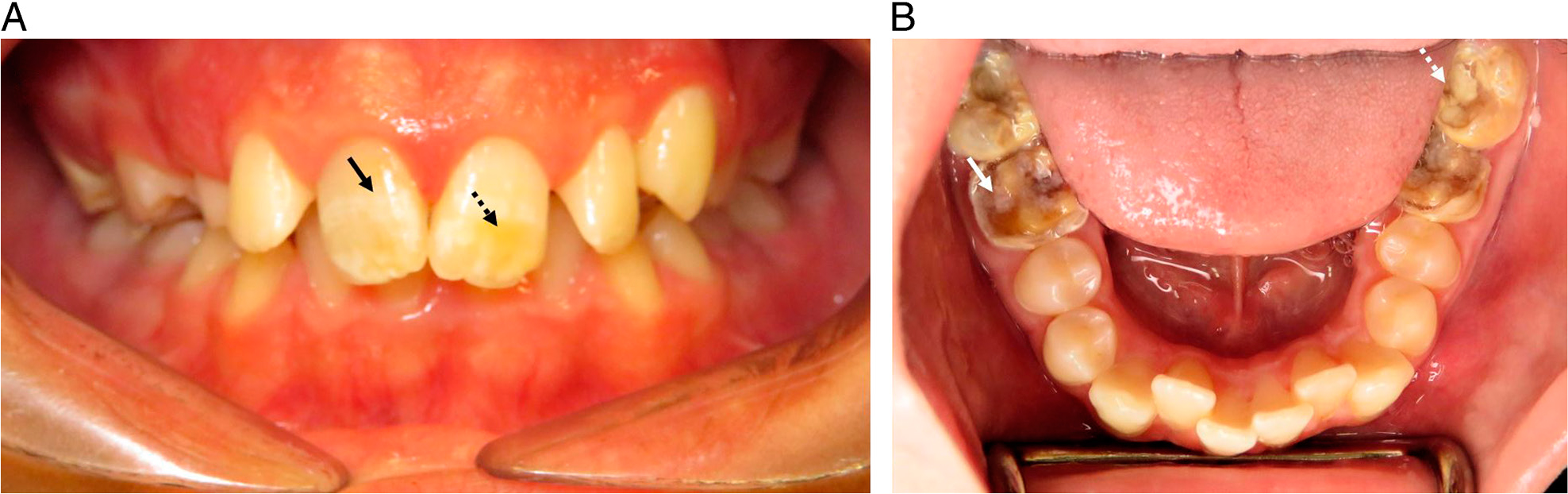
Figure 3.
Clinical photographs of (A) upper central incisors with white (black arrow) and yellow (black dashed arrow) demarcated defects and (A) lower first and second permanent molars with posteruptive breakdown of the occlusal and buccal surfaces (white arrow) and an atypical restoration (white dashed arrow).
The breakdown of enamel can occur directly following eruption or under masticatory forces. This contrasts with hypoplasia which presents as areas of pitted or broken enamel present from the time of eruption.
Classification
Severity of MIH
The severity of MIH can vary between teeth within an affected patient. Mathu-Muju and Wright developed a scale to classify affected teeth into mild, moderate or severe (Table IV).46
Table IV.
Classification of MIH60
| Category | Characteristics |
|---|---|
| Mild |
|
| Moderate |
|
| Severe |
|
Treatment need
The need for treatment of affected MIH teeth is usually influenced by dentine sensitivity, the risk of tooth fracture or aesthetic concerns.47 The Wurzburg Working Group developed an index to guide treatment decision making based on the parameters of opacity, substance loss and dentine sensitivity (Table V). The treatment-need index uses a sextant scoring system with a value depending on the level of the defect extension, with and without dentine hypersensitivity. A visual determination of which teeth and sextants require treatment will assist clinicians in developing treatment plans with management options which employ short-term and longer-term strategies and range from prevention to restorative intervention or potentially extraction.
Table V.
Wurzburg Working Group treatment guide
| Index | Description |
|---|---|
| 0 | No MIH |
| 1 | MIH |
| • No breakdown | |
| • No hypersensitivity | |
| 2 | MIH |
| • Breakdown | |
| • No hypersensitivity | |
| 2a | • Extension of defect < 1/3 |
| 2b | • Extension of defect e 1/3 to < 2/3 |
| 2c | • Extension of defect ≥ 2/3 or/and defect close to the pulp or extraction or atypical restoration |
| 3 | MIH |
| • No breakdown | |
| • Hypersensitivity | |
| 4 | MIH |
| 4a | • No breakdown |
| 4b | • Hypersensitivity |
| 4c | • Extension of defect < 1/3 |
| • Extension of defect ≥ 1/3 to < 2/3 | |
| • Extension of defect ≥ 2/3 or/and defect close to the pulp or extraction or atypical restoration |
Psychosocial impact of MIH
Research has indicated that 8–10-year-old children with moderate-to-severe MIH commonly experience poorer oral health-related quality of life (OHRQoL) compared with unaffected children.48–50 This is largely a result of the negative functional limitations associated with the affected molars. The deleterious emotional and social effects related to visible incisor opacities was highlighted in a 2017 study in which 131 children aged between 7 and 13 and with incisor opacities reported avoidance of smiling due to the unaesthetic appearance of their teeth.51
A recent prospective study involving 39 children aged between 8 and 18 years indicated that masking of the opacities in the permanent incisors by resin infiltration can improve social wellbeing.52 This echoed similarly positive impacts found in a 2018 prospective study of 93, 7-to-16-year-old children who underwent minimally invasive dental intervention to mask visible opacities in the incisor teeth.53
Management
Robust high-quality evidence regarding the management of MIH is lacking as treatment approaches are mainly based on expert opinion in the form of clinical guidelines authored by paediatric dentists and orthodontists.58,61
The clinical management of MIH requires considerations of the patient, family and social factors in a shared decision-making environment.62 An interdisciplinary approach is often required with an orthodontic evaluation necessary to determine decisions regarding extraction.63 As it is often difficult to obtain sufficient levels of analgesia for the treatment of affected teeth, care is required to minimise the exacerbation of dental anxiety by failure to adequately anaesthetise the teeth during treatment,54 and so a referral to a paediatric dental specialist may be appropriate for many patients.
A knowledge of the pathogenesis and the histology of MIH-affected teeth is essential for optimal understanding and management of the condition.55 Amelogenesis occurs during the late ‘bell’ stage of tooth development after ameloblasts differentiate from the inner enamel epithelium.56 Enamel formation is a two-step process involving initial mineralisation and then subsequent maturation followed by further mineralisation. Teeth affected by MIH have changes to the structural properties of both the affected and unaffected enamel.55 A 2016 systematic review indicated that enamel that exhibited white or creamy defects had an increased porosity of 5 – 25% of normal enamel, and teeth without post-eruptive breakdown were the least porous.57 The increased porosity of enamel is suggested to lead to subclinical inflammation within the pulp which can result in problems of dentine hypersensitivity and difficulty in achieving anaesthesia in MIH affected teeth.54
Previous research has indicated that affected enamel has a looser prism structure, a partial loss of prismatic pattern, less densely packed crystals and less well-defined prism borders.64 Micro-computed tomography has shown that teeth affected by MIH have a 20% reduced mineral density when compared with normal enamel.55 Interestingly, clinically sound enamel adjacent to an MIH defect had fewer mineralised prism sheaths.65 The prismatic change in teeth affected by MIH is suggested to cause alterations in enamel mechanical characteristics such as the modulus of elasticity and hardness.55 The acid-etching pattern of enamel affected by MIH is varied as a more uniform removal of enamel may occur compared with the usual differential pattern of etched and sound enamel. The cause may be due to a fault in the enamel maturation process in which organic matrix is usually resorbed and an increase in the mineral content of hydroxyapatite crystals occurs. A substitution or loss of carbonate in hydroxyapatite can increase its solubility during acid etching. A specific etching pattern is required to provide retention and clinical certainty of adhesion at the margin of dental bonding resins. Caution, however, is required in the interpretation of this evidence as much of it was reported as in-vitro studies and carried out on extracted first permanent molars only.66
Individuals who experience MIH-affected enamel can, therefore, have dentine sensitivity, difficulty in achieving anaesthesia during restorative procedures and problems with adhesive-based bonded restorations. The need for repeated appointments for failed restorations, continued discomfort during examination or treatment appointments can lead to changes in patient acceptance of dental treatment and ultimately generate dental fear or anxiety.54 Behaviour management problems have been reported to be higher at 44% in a cohort of children with MIH, compared with their counterparts at 2%. However, a 9-year follow up of the same children found a higher rate of caries but no difference in dental anxiety compared to those without the condition.67
Individuals typically affected by MIH are likely to be children, with the added confounders of parental anxiety, general anxiety and temperamental traits of affected individuals. An early diagnosis of MIH and planning including preventative strategies may be a way to reduce dental anxiety and behaviour management problems. Adjunctive behaviour management tools, such as the use of nitrous oxide, have been suggested to potentially improve the effectiveness of local anaesthesia.68
Options for the management of MIH range widely. Treatment depends on the extent of the defects and the level of dentine sensitivity as well as patient age and parental expectations, from prevention and restoration to extraction.2 The goal of minimising structural damage to affected teeth should be the aim of intervention, especially before caries or post-eruptive breakdown occurs. However, depending on the presentation of the affected teeth and with careful treatment planning, more aggressive restorative or extraction options may be required.
Preventative measures
Teeth affected by MIH may result in dentine sensitivity, post-eruptive breakdown and the loss of coronal tooth structure and have an increased susceptibility to caries. An early diagnosis of MIH can allow preventative measures to be implemented before adverse outcomes occur. Risk factors for caries should be addressed with preventative approaches including dietary advice, fluoride exposure and applications of other desensitising and remineralising agents such as casein phosphopeptide-amorphous calcium phosphate (CPP-ACP) paste.2 The application of CPP-ACP paste, with or without fluoride, has improved the mineral content and reduced porosities associated with MIH-affected enamel.69 However, the increased cost when compared with fluoridated toothpaste may be prohibitive for some individuals.70 Exposure to regular daily fluoride from toothpaste and the application of professional topical agents (varnish or gels) may also help to reduce dentine sensitivity.2
Preventative management of FPM with MIH includes the use of fissure sealants.71 However, the retention of fissure sealants on MIH-affected enamel may be reduced due to sub-optimal bonding. There is evidence that retention is greater after 4 years using single-step systems (70.2%) compared with three-step resin bonding systems (25.5%).71 A pre-treatment protocol using 5% sodium hypochlorite prior to acid etching found an enhanced etching pattern using a single etch, but the evidence is limited.72 Glass ionomer cements (GIC) provide an alternative for initial fissure sealants, particularly in the presence of compromised moisture control, such as when a FPM is partially erupted. Teeth which already have caries present may also benefit from the application of silver diamine fluoride (SDF; 38%) to arrest caries prior to the application of a GIC fissure sealant.73
Restorative and orthodontic considerations
Restorative considerations
Strategies to improve the appearance of MIH-affected incisors include bleaching, micro-abrasion and resin infiltration systems. Bleaching, using carbamide peroxide, has been found to improve the yellow and yellow-brown defects of MIH due to the release of hydrogen peroxide anions, free radicals and reactive oxygen molecules.74 The combination of bleaching and micro-abrasion has also been shown to be effective. Micro-abrasion involves the application of an acidic pumice to remove the outermost 100μm of enamel over 1-2 appointments.75 Creamy-yellow or whiteish-creamy MIH defects appear to be less porous, but vary in depth, and may respond to micro-abrasion using 18% hydrochloric acid or 37.5% phosphoric acid coupled with an abrasive paste.76 Resin infiltration systems have improved the yellow-brown discolouration defects by altering the refractive index.77 The low viscosity tri-ethylene glycol dimethacrylate (TEGMA) resin may penetrate into the enamel with preliminary results suggesting up to the level of the dento-enamel junction which may then seal the affected resin from the oral environment and subsequently improve the mechanical properties.78
The restoration of teeth affected by MIH may be required following post-eruptive breakdown or when dentine sensitivity cannot be controlled by preventative measures. Two approaches may be considered when providing direct restorations on teeth with MIH:
• Removal of all affected enamel or
• Removal limited to only porous enamel until resistance to a probe or a bur is experienced.2
The removal of all defective enamel provides sound enamel for bonding, but excess enamel may be removed in the process. Alternatively, the removal of obviously affected enamel only risks further breakdown at the margins due to defective bonding. For this reason, amalgam restorations have not been recommended due to marginal leakage, poor insulation of the immature pulp and minimal support for the adjacent enamel.79 Regardless of the material, cusp and marginal ridge fracture is common and cusp coverage should be considered in stress-bearing areas.73
For teeth affected by severe MIH, extensive enamel destruction and caries development, stainless-steel crowns and cast restorations may be indicated. The advantages of these approaches include thermal protection of the pulp to enable pupal maturation, protection from post-eruptive breakdown, maintenance of the occlusion and vertical eruption.80 The success rate has been reported to be 90% at 4 years post treatment of the FPM.81 The Hall technique of stainless steel crown placement has not been validated for use in permanent teeth affected by caries or MIH.82 Composite, ceramic and cast restorations require further longitudinal research but preliminary results have found promising longevity and potentially less destructive tooth preparation compared to full coverage crowns.83 Adequate sealing and restoration of affected teeth is essential to reduce pain experience from dentine sensitivity and, although considered a long-term restorative treatment option, may also be required for interim situations if extractions are being considered.
Orthodontic considerations
For orthodontists, MIH presents several distinct clinical challenges. Care is required in the use of cold air, water and heat from light-curing units directed at MIHS-affected teeth. In addition, the compromised bonding ability of hypomineralised enamel can reduce the effectiveness of fixed orthodontic appliances and increase the risk of bracket failure or clear aligner therapy attachment failure. This necessitates modified bonding protocols, such as the use of resin-modified glass ionomer cements or additional enamel pretreatment.4 The employment of deproteinisation using sodium hypochlorite applied for 60 seconds following etching, especially for an etch-and-rinse adhesive, has been suggested as a mechanism for improving bond strength.84 The use of bands instead of bonded tubes has also been recommended as a strategy for overcoming adhesion issues related to MIH affected molars.85
Planning for anchorage becomes more complex, particularly when FPMs are severely affected or require extraction. In such cases, a careful orthodontic assessment of the impact on the dental arch is required along with a consideration of alternative anchorage strategies. The long-term implications for occlusal stability must also be considered, as the early loss or extraction of affected molars may impact eruption patterns, space closure and alignment outcomes. These factors underscore the importance of early interdisciplinary consultation between paediatric dentists and orthodontists when managing children with MIH.
Extraction of MIH-affected teeth
Careful and further orthodontic evaluation prior to the management of MIH is required.59 The decision to restore or extract affected FPMs is determined by the patient’s general and dental health, other malocclusion features and social and family circumstances.86,87 The evidence base regarding the management of affected FPMs is weak as no published data from prospective studies are available. Guidelines published by the Royal College of Surgeons (RCS) in England, however, can assist with decision-making when considering extraction of FPMs in children.60
From an orthodontic perspective, the timing of the extraction of FPMs of poor prognosis is based on whether space is or will be required to address a malocclusion.85 If space will be required, the FPMs should ideally be maintained until the second permanent molars have erupted. If space is not required, extraction at the ‘optimum’ time may be considered.
The RCS guidelines emphasise the importance of the appropriate timing of the extraction of the lower FPM in situations in which there is otherwise little need for extraction to address the features of a malocclusion. The timing of upper FPM extractions in the same situation is less critical. The suggested optimal timing for the lower FPM extraction corresponds to a chronological age of around 8-10 years and coincides with radiographic evidence of early calcification of the dentine within the bifurcation of the second molar root. The rationale is that timely extraction may facilitate the maximum amount of space closure and favourable ‘mesialisation’ of the second molar, thus reducing the need for orthodontic treatment when the child is older.85
In cases of Class I malocclusions with minimal crowding, the consideration is required of a ‘compensating’ extraction of the upper FPM if removal of the lower FPM is necessary. This is to avert the risk of the upper FPM over-erupting and blocking the lower second molar from moving forward.88 It is important to be aware that overeruption does not always occur so it may be prudent to delay the decision regarding the extraction of the upper FPM.89 The evidence, however, indicates that a ‘balancing’ extraction of a healthy FPM in order to preserve the dental centreline is seldom necessary.89,90
In cases in which crowding is greater (particularly in the labial segment) and in Class II division 1 cases in which maxillary space is required for the relief of crowding and the reduction of an increased overjet, respectively, the extraction of FPMs should ideally be delayed until after the eruption of the second permanent molars. With the aid of fixed appliance therapy, extraction spaces can be used to satisfy these treatment objectives.91 In general, the extraction of maxillary FPMs in Class III patients should ideally be avoided, or postponed until after an orthodontic evaluation.61
Nevertheless, it may be prudent to extract affected FPMs at a ‘non-optimum’ time if the conservation of the teeth for orthodontic purposes is associated with ongoing dental hypersensitivity and/or requires repeated restoration.
Conclusion
MIH is a frequently encountered condition in the dental field and in orthodontic patients. The present overview has summarised the prevalence, aetiology, diagnosis and management of those presenting with MIH with reference to the current evidence-base. Although there is a need for high-quality research to identify its specific aetiology and management, it is apparent that the condition can have considerable psycho-social, quality of life, dental and orthodontic impacts. The high global prevalence of MIH adds emphasis to the importance of collaborative efforts to address the condition.
An early diagnosis of MIH allows dental practitioners to commence a dialogue with children and their parents regarding the short- and long-term management of affected teeth. Conversations and decisions must be made in a shared decision-making environment which incorporates patient, family and social considerations. World-leading initiatives, such as from the D3 Group, play a crucial role in advancing research, education, and clinical guidance for MIH and other developmental dental defects. Through global collaboration, the centre has significantly contributed to raising awareness, supporting clinicians, and advocating for improved prevention and management options. Preventative strategies can be implemented immediately to reduce potentially devastating outcomes. For moderate to severe cases involving dentine sensitivity and aesthetic concerns, orthodontic and restorative considerations must be part of the long-term treatment plan for these children.
Notes
[6] Conflicts of interest Conflict of interest
The authors declare that there is no conflict of interest.