
Table I.
Soft tissue landmarks and measurements used in the study
| Landmark | Abbreviation | Definition |
|---|---|---|
| Trichion | Tr | Point of intersection of the normal hairline and the middle line of the forehead. |
| Glabella | G’ | Most anterior soft tissue point on the frontal bone. |
| Soft tissue Nasion | N’ | The soft tissue point which is located in front of the bony Nasion at the midline of both the nasal root and the nasofrontal suture. |
| Soft tissue Orbitale | Or | The soft tissue point located at the most inferior level of each infraorbital rim, located at the level of the hard tissue cephalometric Orbitale landmark. |
| Porion | Po | The highest point of the ear canal; most superior point of the external auditory meatus. |
| Columella | C | The line that links the nasal tip to the nasal base. It is the inferior margin of the nasal septum. |
| Subnasale | Sn | The midpoint of the angle at the columella base where the lower border of the nasal septum and the surface of the upper lip meet. |
| Upper lip | UL | The most anterior point on the curve of the upper lip. |
| Lower lip | LL | The most anterior point on the curve of the lower lip. |
| Soft tissue B point | B’ | The soft tissue point located in front of (B point) which is the most concave point between lower lip and the soft tissue chin. |
| Soft tissue pogonion | Pg’ | The most anterior point on the curve of the soft tissue chin. |
| Soft tissue Menton | Me’ | The most inferior point of the soft tissue chin. |
| Gonion | Go | The most convex point where the posterior and inferior curves of the ramus meet. |
| Measurement | Description | |
| Facial thirds | Upper third; Trichion (Tr) to soft tissue nasion (N’). Middle third; Soft tissue nasion (N’) to subnasal (Sn). Lower third; Subnasal (Sn) to Soft tissue menton (Me’). | |
| Profile angle | The angle between Soft tissue glabella (G’), subnasal (Sn) and Soft tissue pogonion (Pg’). | |
| Nasolabial Angle | Intersection of upper lip (UL) and columella (C) at subnasal (Sn). | |
| Mentolabial Angle | Intersection of lower lip (LL) and soft tissue pogonion (Pg’) at soft tissue B point (B’). | |
| Mandibular plane angle | The angle between Frankfurt plane (Line between orbitale (Or) and Porion (Po)) and Mandibular plane (Line between menton (Me) and gonion (Go)). | |
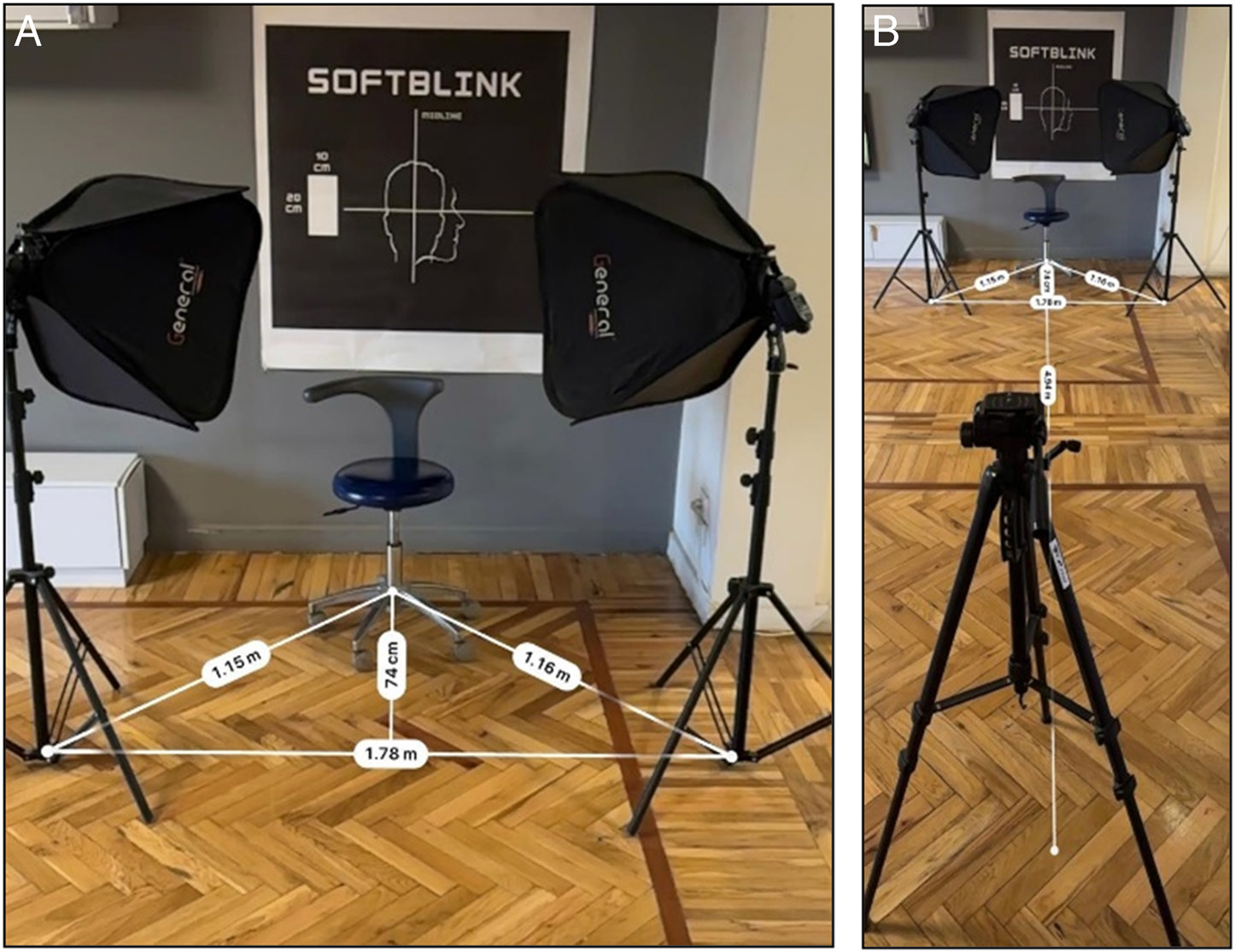
Figure 1.
The Camera setup used in the study; The distance between the two soft boxes arms is (1.78 m), the distance between the arm of the soft box and the chair position is (1.16 m), the distance between the tripod holding camera and the chair position is (4.94 m).
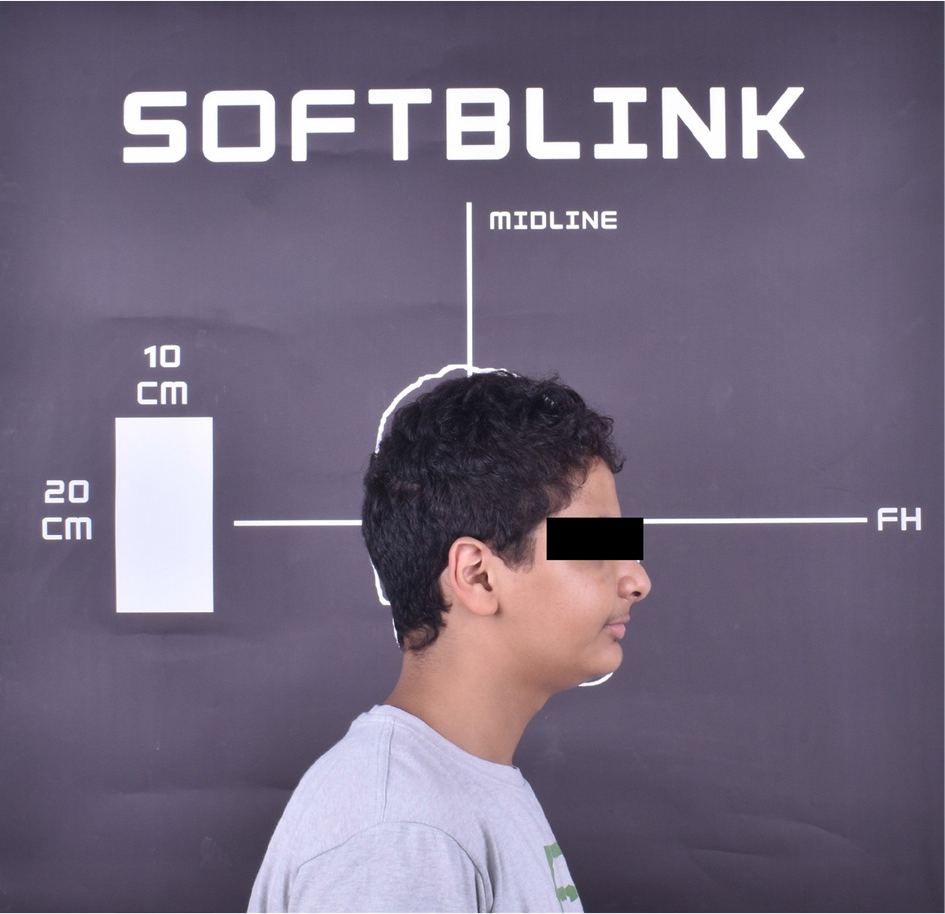
Figure 2.
The newly designed SOFTBLINK banner used in the study.
Table II.
Diagnostic chart of linear and angular soft tissue measurements
| Soft Tissue Measurement | Norm | Diagnosis | Clinical Indication |
|---|---|---|---|
| Profile Angle | 165-175° |
|
|
| Facial thirds (Profile) Lower third to Middle third | 55 ± 12% |
|
|
| Mandibular plane angle | 30.5 ± 6° |
|
|
| Nasolabial angle | 102 ± 8° |
|
|
| Mentolabial Angle | 120 ± 10° |
|
|
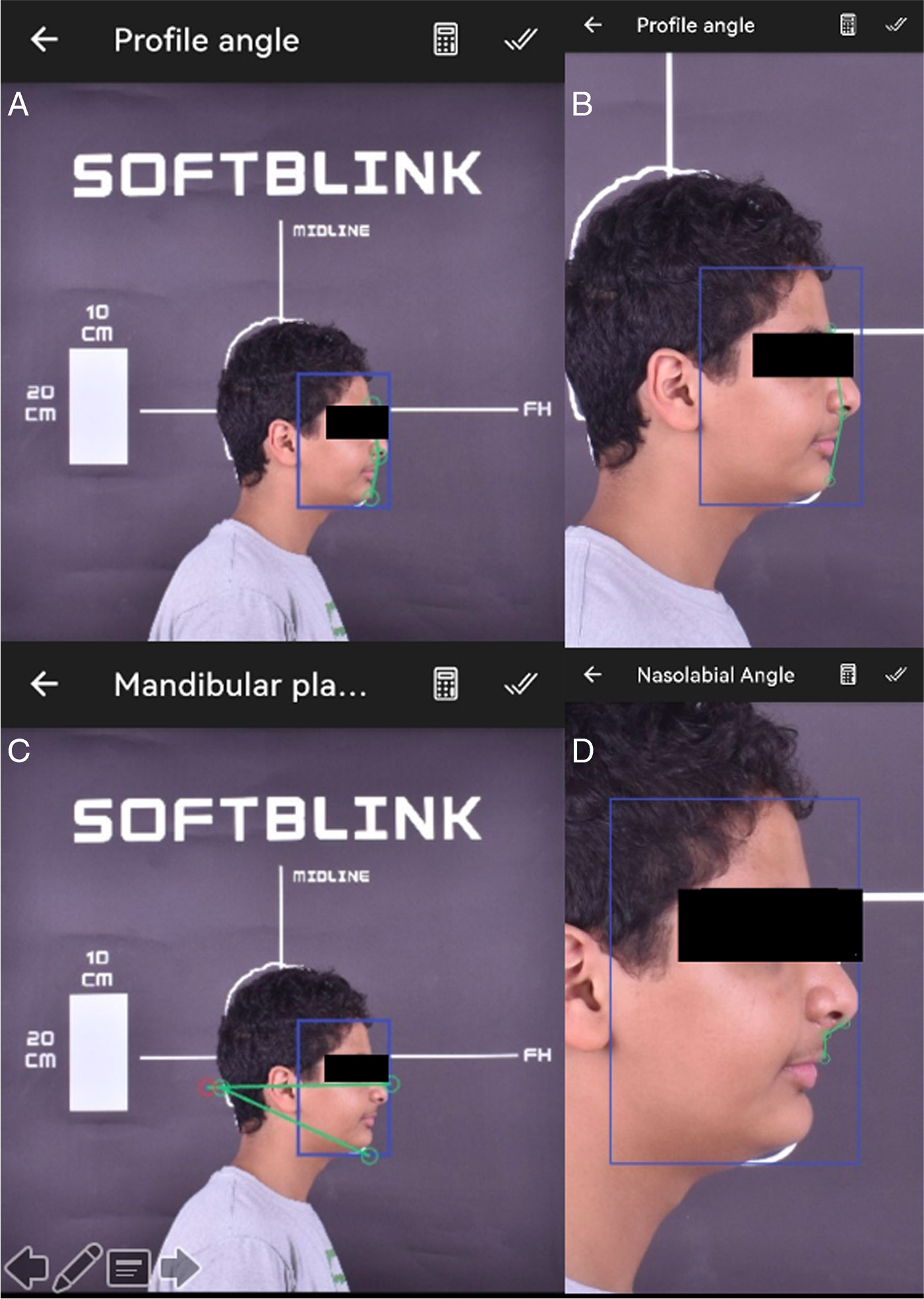
Figure 3.
Soft tissue measurements calculated using the SOFTBLINK application; A&B showing the profile angle, C showing the mandibular plane angle and D showing the nasolabial angle.
Table III.
Descriptive statistics (MANOVA) and multiple pairwise comparison tests of the soft tissue measurements using the three comparative methods of the study
| Profile Facial Thirds | ||||
|---|---|---|---|---|
| Mean ± SD | ||||
| Dolphin | 51.90 ± 2.221 | |||
| Web Ceph | 50.83 ± 1.772 | |||
| SOFTBLINK | 50.500 ± 2.664 | |||
| Repeated measure MANOVA (within subject effect) | F = 1.836 | |||
| P = 0.209 | ||||
| Multiple pairwise Comparison test | ||||
| Mean difference | Std. error | P value | ||
| Dolphin Vs. Web Ceph | 1.067 | 0.630 | 0.454 | |
| Dolphin Vs SOFTBLINK | 1.400 | 0.986 | 0.645 | |
| Web Ceph Vs. SOFTBLINK | 0.333 | 0.615 | 1.000 | |
| Profile angle | ||||
| Mean ± SD | ||||
| Dolphin | 163.00 ± 4.604 | |||
| Web Ceph | 165.166 ± 2.714 | |||
| SOFTBLINK | 165.166 ± 2.857 | |||
| Repeated measure MANOVA (within subject effect) | F = 6.450 | |||
| P = 0.016* | ||||
| Multiple pairwise Comparison test | ||||
| Mean difference | Std. error | P value | ||
| Dolphin Vs. Web Ceph | -2.167 | 0.792 | 0.123 | |
| Dolphin Vs SOFTBLINK | -2.167 | 0.833 | 0.145 | |
| Web Ceph Vs. SOFTBLINK | 0.001 | 0.356 | 1.000 | |
| Nasolabial angle | ||||
| Mean ± SD | ||||
| Dolphin | 105.33 ± 14.094 | |||
| Web Ceph | 97.33 ± 17.385 | |||
| SOFTBLINK | 98.00 ± 17.515 | |||
| Repeated measure MANOVA (within subject effect) | F = 5.624 | |||
| P = 0.060 | ||||
| Multiple pairwise Comparison test | ||||
| Mean difference | Std. error | P value | ||
| Dolphin Vs. Web Ceph | 8.000 | 3.296 | 0.179 | |
| Dolphin Vs SOFTBLINK | 7.33 | 3.116 | 0.196 | |
| Web Ceph Vs. SOFTBLINK | -0.667 | 0.667 | 1.000 | |
| Mentolabial angle | ||||
| Mean ± SD | ||||
| Dolphin | 129.83 ± 25.119 | |||
| Web Ceph | 127.600 ± 19.258 | |||
| SOFTBLINK | 125.00 ± 22.226 | |||
| Repeated measure MANOVA (within subject effect) | F = 0.729 | |||
| P = 0.507 | ||||
| Multiple pairwise Comparison test | ||||
| Mean difference | Std. error | P value | ||
| Dolphin Vs. Web Ceph | 2.233 | 3.868 | 1.000 | |
| Dolphin Vs SOFTBLINK | 4.833 | 5.089 | 1.000 | |
| Web Ceph Vs. SOFTBLINK | 2.600 | 2.709 | 1.000 | |
| Mandibular plane angle | ||||
| Mean ± SD | ||||
| Dolphin | 26.31 ± 8.196 | |||
| Web Ceph | 19.833 ± 2.786 | |||
| SOFTBLINK | 22.833 ± 2.639 | |||
| Repeated measure MANOVA (within subject effect) | F = 2.930 | |||
| P = 0.100 | ||||
| Multiple pairwise Comparison test | ||||
| Mean difference | Std. error | P value | ||
| Dolphin Vs. Web Ceph | 6.483 | 3.476 | 0.364 | |
| Dolphin Vs SOFTBLINK | 3.483 | 2.912 | 0.856 | |
| Web Ceph Vs. SOFTBLINK | -3.000 | 1.000 | 0.090 | |