
Introduction
Traditionally, occlusal and hard tissue relationships serve as the foundation of orthodontic diagnosis and treatment planning.1 However, in contemporary orthodontics, a soft tissue evaluation is just as crucial, in which facial aesthetics has become an important contributor to clinical decision making.2 A soft tissue analysis is regarded as essential when considering the need for extractions or orthognathic surgery.1,2 In addition, a soft tissue evaluation is essential for appropriate post-treatment retention since the oral musculature is a key factor in establishing stable tooth positions.3
Originally, the majority of soft-tissue analyses were carried out on a lateral cephalogram which is considered a standard diagnostic record in orthodontics that also explores sagittal and vertical craniofacial patterns. Despite its extensive application, lateral cephalometry is prone to systematic and random errors.4 Previous studies have revealed that cephalometric radiographs have little, if any, influence on treatment planning decisions.1,2,4,5 Moreover, cephalometric radiology invites the risk of ionising radiation exposure that should be taken into consideration particularly for paediatric patients. The British Orthodontic Society has recommended the use of cephalometric radiographs only for specific cases rather than for a routine pre-treatment diagnostic evaluation.6
Many parameters of the soft-tissue cephalometric analysis can equally be assessed on a patient’s profile photograph. When a cephalometric radiograph is not requested, a photograph-based soft tissue profile analysis has proven to be a reliable tool for orthodontic treatment planning.5,7 However, manual landmark identification and interpretation is time-consuming and demands professional experience.8 Recently, numerous studies have been conducted to explore automated landmark localisation using artificial intelligence (AI) which has displayed promising results.9,10 Smartphone applications (Apps) such as OneCeph, CephNinja, SmileCeph and WebCeph are now available and enable orthodontists to perform cephalometric analyses 80 times faster than a manual cephalometric analysis.11 Due to their speedy access, ability to update, and portability, the Apps are valuable tools for rapid reference.11–13 The use of digital technology provides great support to orthodontists by facilitating treatment planning as well as enhancing the treatment outcome.
Given the expansion in App usage, there is a need to provide a newly-designed mobile application for soft-tissue analysis. To date, no mobile application has been developed for an orthodontic photograph-based soft tissue analysis. The current study therefore aimed to develop and test a smartphone application for orthodontic soft-tissue analysis as a replacement of the conventional digital cephalometric programs. In addition, a further aim was to compare the accuracy of soft-tissue measurements derived from the developed smartphone-based application with the measurements acquired from conventional cephalometric analysis programs.
Materials and methods
The current observational study was approved by the Research Ethics Committee of Cairo University, Egypt. The study was conducted on 26 patients (14-30 years old) who sought orthodontic treatment. Patients were excluded from the study if they had a facial asymmetry, a facial skin lesion, a craniofacial deformity, previous facial surgery, prosthodontic treatment, or previous orthodontic treatment. All patients who met the inclusion criteria and agreed to participate signed an informed consent form which stated and clarified the goals and methods of the study.
Oriented in natural head position with the lips at rest and the teeth in centric occlusion, extra-oral photographs of the facial profile at rest and lateral cephalometric radiographs were captured for each patient. The records were subjected to three methods of soft tissue analysis, the first of which was the Dolphin Imaging program which utilised the lateral cephalogram, and the two other methods utilised the lateral profile photographs which applied the WebCeph software, and a Smartphone App specifically designed for this purpose. The landmarks and measurements comprising the soft tissue analysis and applying the three methods are presented in Table I.
Table I.
Soft tissue landmarks and measurements used in the study
| Landmark | Abbreviation | Definition |
|---|---|---|
| Trichion | Tr | Point of intersection of the normal hairline and the middle line of the forehead. |
| Glabella | G’ | Most anterior soft tissue point on the frontal bone. |
| Soft tissue Nasion | N’ | The soft tissue point which is located in front of the bony Nasion at the midline of both the nasal root and the nasofrontal suture. |
| Soft tissue Orbitale | Or | The soft tissue point located at the most inferior level of each infraorbital rim, located at the level of the hard tissue cephalometric Orbitale landmark. |
| Porion | Po | The highest point of the ear canal; most superior point of the external auditory meatus. |
| Columella | C | The line that links the nasal tip to the nasal base. It is the inferior margin of the nasal septum. |
| Subnasale | Sn | The midpoint of the angle at the columella base where the lower border of the nasal septum and the surface of the upper lip meet. |
| Upper lip | UL | The most anterior point on the curve of the upper lip. |
| Lower lip | LL | The most anterior point on the curve of the lower lip. |
| Soft tissue B point | B’ | The soft tissue point located in front of (B point) which is the most concave point between lower lip and the soft tissue chin. |
| Soft tissue pogonion | Pg’ | The most anterior point on the curve of the soft tissue chin. |
| Soft tissue Menton | Me’ | The most inferior point of the soft tissue chin. |
| Gonion | Go | The most convex point where the posterior and inferior curves of the ramus meet. |
| Measurement | Description | |
| Facial thirds | Upper third; Trichion (Tr) to soft tissue nasion (N’). Middle third; Soft tissue nasion (N’) to subnasal (Sn). Lower third; Subnasal (Sn) to Soft tissue menton (Me’). | |
| Profile angle | The angle between Soft tissue glabella (G’), subnasal (Sn) and Soft tissue pogonion (Pg’). | |
| Nasolabial Angle | Intersection of upper lip (UL) and columella (C) at subnasal (Sn). | |
| Mentolabial Angle | Intersection of lower lip (LL) and soft tissue pogonion (Pg’) at soft tissue B point (B’). | |
| Mandibular plane angle | The angle between Frankfurt plane (Line between orbitale (Or) and Porion (Po)) and Mandibular plane (Line between menton (Me) and gonion (Go)). | |
Lateral cephalometric radiograph set-up and analysis
Identical exposure settings (KvP - 66, mA-10, exposure period: 10.5 seconds) were used for all lateral cephalograms (Planmeca Promax Proface 2021, Finland). The patient’s head was stabilised in natural head position using the cephalostat, with the ear rods placed inside the ears, and the nasal support placed on soft tissue nasion. The patients were instructed to bite in centric occlusion and relax their lips. The scan was acquired and its quality checked. A digital tracing was carried out using Dolphin Imaging Software Version 11.5 (Chatsworth, CA, USA) by locating the required landmarks and selecting the measurements of interest (Table I).
Digital photogrammetric set-up and analysis
The camera setup used in the study is presented in Figure 1. Each subject was instructed to sit on a chair which was framed by a banner especially designed and printed for the study (Figure 2). The profile photograph of each patient was traced using the Webceph software (webceph.com, Gyeonggi-do, Republic of Korea) by uploading the photograph, after which, landmark identification was automatically performed by choosing the analyse button. The landmarks listed in the analysis were added to the program. Manual adjustment of the landmarks was conducted to ensure accurate identification.
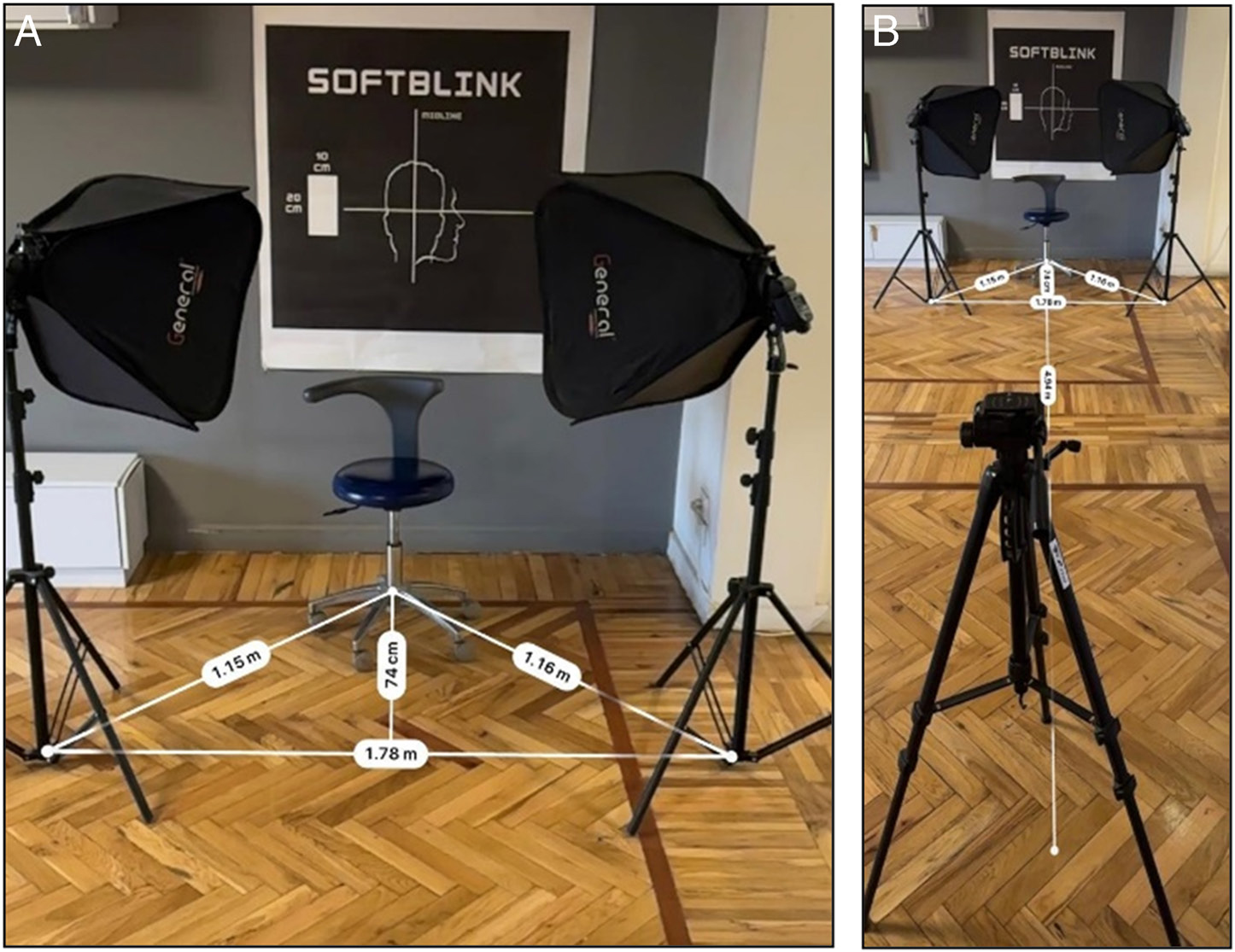
Figure 1.
The Camera setup used in the study; The distance between the two soft boxes arms is (1.78 m), the distance between the arm of the soft box and the chair position is (1.16 m), the distance between the tripod holding camera and the chair position is (4.94 m).
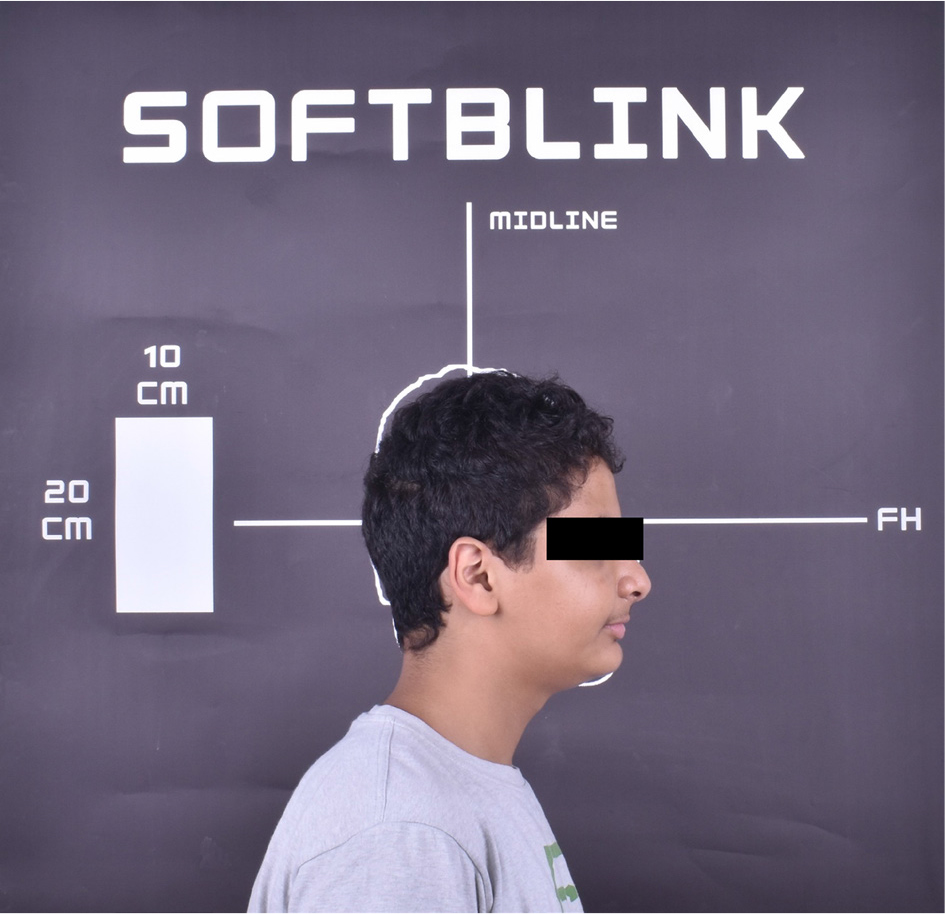
Figure 2.
The newly designed SOFTBLINK banner used in the study.
Smartphone App tracing measurements
The smartphone application (SOFTBLINK) used for the orthodontic soft tissue analysis was established by the first author.
The steps associated with the development of the mobile application:
Landmarks and measurements identification
By reviewing the literature and by identifying the normal values, landmarks and measurements related to the soft tissue analysis were selected. A chart of the development of the mobile application was created by the authors14 (Table II) and sent to the software developer to create a prototype of the application such that it would provide a soft tissue diagnostic report along with a treatment recommendation.
Table II.
Diagnostic chart of linear and angular soft tissue measurements
| Soft Tissue Measurement | Norm | Diagnosis | Clinical Indication |
|---|---|---|---|
| Profile Angle | 165-175° |
|
|
| Facial thirds (Profile) Lower third to Middle third | 55 ± 12% |
|
|
| Mandibular plane angle | 30.5 ± 6° |
|
|
| Nasolabial angle | 102 ± 8° |
|
|
| Mentolabial Angle | 120 ± 10° |
|
|
Prototype creation (preliminary version derived by the developer)
In collaboration with a software designer and developer,15 who were responsible for software design, mapping, and coding, the software program was established. A preliminary prototype that could detect facial outlines was used to test the functionality of the ‘App’. The prototype could be easily modified, so that any errors could be subsequently corrected to produce a fully functional version of the App. In addition, the App could detect points and lines automatically but was created so that minor landmark adjustments could be performed by the user if required. After refining all of the landmarks and activating the analysis, a description of the soft tissue characteristics was then displayed. The application presented a detailed report of the soft tissues along with diagnosis and treatment recommendations in the form of a PDF file.
Design of the photography background (SOFTBLINK Banner)
For standardisation, the background banner included the following items (Figure 2):
A vertical midline perpendicular to the floor for adjustment of the frontal image.
A horizontal Frankfort line parallel to the floor for adjustment of the profile image.
A facial outline (frontal and profile) to assist patient positioning.
A rectangular shape with known measurements (20 cm vertical length and 10 cm horizontal length) to enable the calculation of linear measurements.
The smartphone app photographic analyses
The digital images of the patient profile views were sent to the phone via an e-mail from the main server on which the data were stored. The images were downloaded and saved in the photo gallery of the application (SOFTBLINK) without an alteration of image quality.
A ‘new patient’ option in the menu toolbar allowed the selection of the preferred images, which were uploaded from the mobile photo gallery. The required points for the profile view analysis were automatically located by the application, thereby allowing the user to modify the landmark as required. The application allowed the necessary magnification for accurate landmark positioning but without altering the position of any point. The ‘analysis’ button was then finally selected and the soft tissue analysis was derived (Figure 3). Data were exported in the form of an Excel Spreadsheet for statistical analysis and comparison with the other methods of measurement.
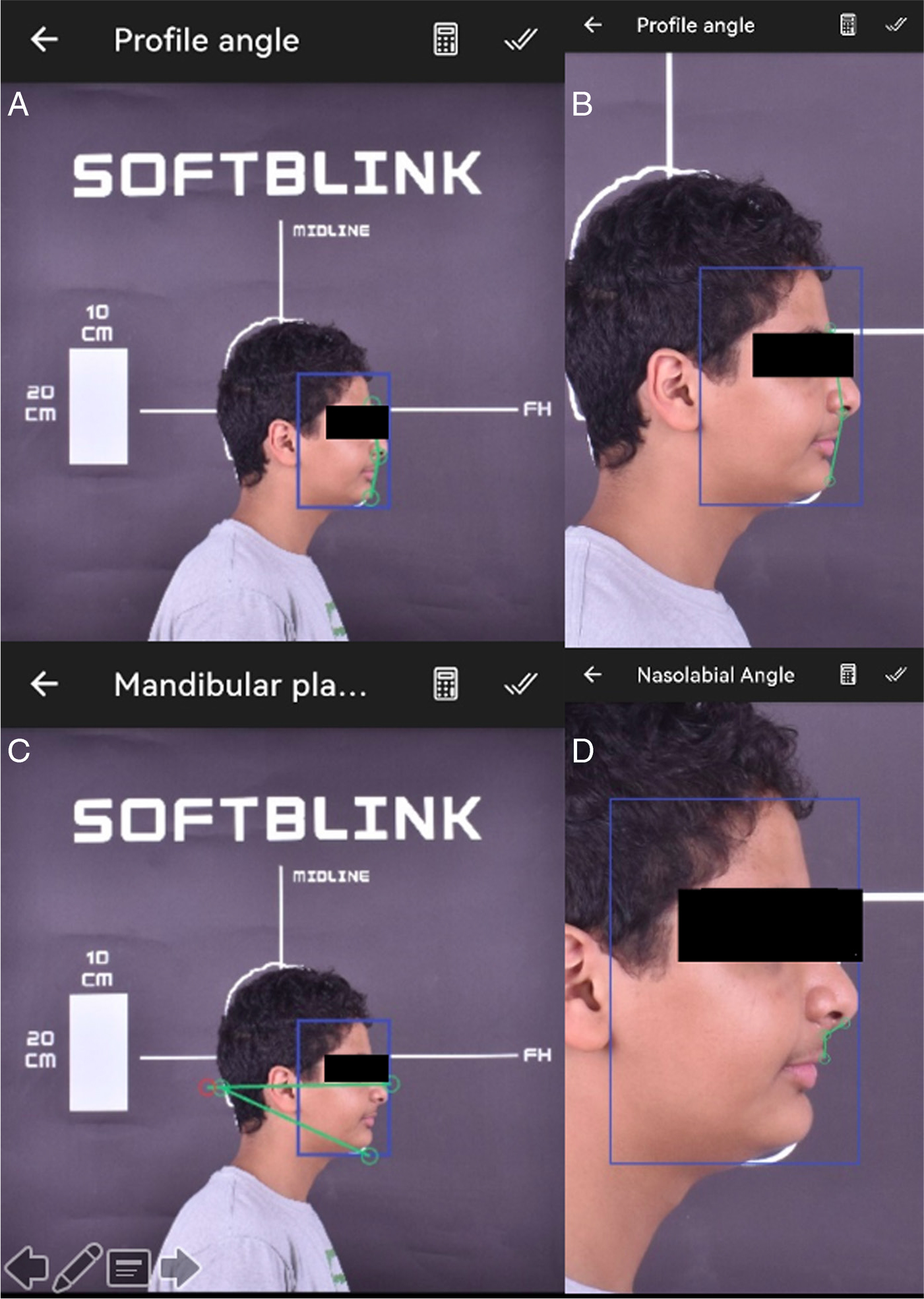
Figure 3.
Soft tissue measurements calculated using the SOFTBLINK application; A&B showing the profile angle, C showing the mandibular plane angle and D showing the nasolabial angle.
Sample size estimation
Based on a pilot study performed on ten participants, a total sample size of 25 participants was anticipated to detect the difference in the soft-tissue measurements derived from the Dolphin imaging software, WebCeph, and the SOFTBLINK application with a power of 80 per cent and a significance level of 5 per cent. The sample size was calculated using the G*Power program (Heinrich Heine Universität, Düsseldorf, Germany).
Statistical analysis
SPSS®IBM® Version 24 (IBM Corp, Armonk, NY, USA) and MedCalc® version 12.1 for Windows (MedCalc Software Ltd, NY, USA) were used for statistical analysis. To check data normality, the Kolmogorov, Smirnov, and Shapiro-Wilk tests were applied. The Parametric test repeated measures multivariate analysis of variance (MANOVA) was used to assess normally distributed data. The values obtained from the Dolphin imaging software, WebCeph, and SOFTBLINK application were compared with the assessment of measurements of various parameters by repeated measures MANOVA. To identify the source of significance for each of the dependent variables, multiple pairwise comparison tests with subsequent Bonferroni corrections to an alpha level of 0.05 were carried out. Variables were described by the mean, standard deviation (SD), standard error (SE), at the 95 per cent confidence interval of the mean values and range (Minimum – Maximum). In all the above statistical tests, a probability value of 0.05 was considered significant.
Results
The 26 study participants comprised 16 females with a mean age of 24.79 years and 10 males with a mean age of 25.56 years. Summary statistics for the linear and angular measurements obtained from the three methods of soft tissue analyses are presented in Table III. Although the mean values obtained by the Dolphin software were slightly higher than the two other methods, the MANOVA and the pairwise comparison revealed a statistically non-significant difference between the three methods.
Table III.
Descriptive statistics (MANOVA) and multiple pairwise comparison tests of the soft tissue measurements using the three comparative methods of the study
| Profile Facial Thirds | ||||
|---|---|---|---|---|
| Mean ± SD | ||||
| Dolphin | 51.90 ± 2.221 | |||
| Web Ceph | 50.83 ± 1.772 | |||
| SOFTBLINK | 50.500 ± 2.664 | |||
| Repeated measure MANOVA (within subject effect) | F = 1.836 | |||
| P = 0.209 | ||||
| Multiple pairwise Comparison test | ||||
| Mean difference | Std. error | P value | ||
| Dolphin Vs. Web Ceph | 1.067 | 0.630 | 0.454 | |
| Dolphin Vs SOFTBLINK | 1.400 | 0.986 | 0.645 | |
| Web Ceph Vs. SOFTBLINK | 0.333 | 0.615 | 1.000 | |
| Profile angle | ||||
| Mean ± SD | ||||
| Dolphin | 163.00 ± 4.604 | |||
| Web Ceph | 165.166 ± 2.714 | |||
| SOFTBLINK | 165.166 ± 2.857 | |||
| Repeated measure MANOVA (within subject effect) | F = 6.450 | |||
| P = 0.016* | ||||
| Multiple pairwise Comparison test | ||||
| Mean difference | Std. error | P value | ||
| Dolphin Vs. Web Ceph | -2.167 | 0.792 | 0.123 | |
| Dolphin Vs SOFTBLINK | -2.167 | 0.833 | 0.145 | |
| Web Ceph Vs. SOFTBLINK | 0.001 | 0.356 | 1.000 | |
| Nasolabial angle | ||||
| Mean ± SD | ||||
| Dolphin | 105.33 ± 14.094 | |||
| Web Ceph | 97.33 ± 17.385 | |||
| SOFTBLINK | 98.00 ± 17.515 | |||
| Repeated measure MANOVA (within subject effect) | F = 5.624 | |||
| P = 0.060 | ||||
| Multiple pairwise Comparison test | ||||
| Mean difference | Std. error | P value | ||
| Dolphin Vs. Web Ceph | 8.000 | 3.296 | 0.179 | |
| Dolphin Vs SOFTBLINK | 7.33 | 3.116 | 0.196 | |
| Web Ceph Vs. SOFTBLINK | -0.667 | 0.667 | 1.000 | |
| Mentolabial angle | ||||
| Mean ± SD | ||||
| Dolphin | 129.83 ± 25.119 | |||
| Web Ceph | 127.600 ± 19.258 | |||
| SOFTBLINK | 125.00 ± 22.226 | |||
| Repeated measure MANOVA (within subject effect) | F = 0.729 | |||
| P = 0.507 | ||||
| Multiple pairwise Comparison test | ||||
| Mean difference | Std. error | P value | ||
| Dolphin Vs. Web Ceph | 2.233 | 3.868 | 1.000 | |
| Dolphin Vs SOFTBLINK | 4.833 | 5.089 | 1.000 | |
| Web Ceph Vs. SOFTBLINK | 2.600 | 2.709 | 1.000 | |
| Mandibular plane angle | ||||
| Mean ± SD | ||||
| Dolphin | 26.31 ± 8.196 | |||
| Web Ceph | 19.833 ± 2.786 | |||
| SOFTBLINK | 22.833 ± 2.639 | |||
| Repeated measure MANOVA (within subject effect) | F = 2.930 | |||
| P = 0.100 | ||||
| Multiple pairwise Comparison test | ||||
| Mean difference | Std. error | P value | ||
| Dolphin Vs. Web Ceph | 6.483 | 3.476 | 0.364 | |
| Dolphin Vs SOFTBLINK | 3.483 | 2.912 | 0.856 | |
| Web Ceph Vs. SOFTBLINK | -3.000 | 1.000 | 0.090 | |
Discussion
Computerised software employing artificial intelligence (AI) technology have recently been introduced to orthodontics.16,17 However, despite the advantages, computer-assisted cephalometric programs are still relatively expensive, and require a laptop computer, which is less portable in comparison with smartphones. In addition, an analysis requires considerable time often under professional supervision.18 Recently, the usage of smartphones with an ability to download custom-built software applications (Apps) has created opportunities for orthodontists to employ this technology in planning treatment. Intrigued by the possibility of using smartphones for this purpose, an Android-based App called SOFTBLINK was developed to help simplify the process of soft tissue analysis and provide easy access to various landmarks and parameters.
Obtaining measurements of the facial soft tissue is important in assessing aesthetics. Different sagittal skeletal patterns have been shown to demonstrate characteristics in soft-tissue patterns, which highlight the importance of a soft tissue evaluation during clinical decision making.19 In addition, the soft tissues should be analysed relative to the underlying skeletal discrepancy, to detect individual differences in soft tissue thickness, which may alter the input of the underlying skeleton on facial aesthetics.20 Soft tissue landmarks that were easily identified in both facial images and radiographs were selected for comparison. Since Dolphin software’s dependability, reliability and validity for analysis have already been established, it currently serves as the industry standard for evaluating similar software and smartphone applications.21
The results of the current study revealed a statistically non-significant difference (p>0.05) between the three methods of soft tissue analysis: Dolphin software, WebCeph, and SOFTBLINK in relation to the tested linear and angular measurements; the profile facial thirds, profile angle, nasolabial angle, mentolabial angle, and the mandibular plane angle.
The findings of the current study are in agreement with those of Katyal and Balakrishnan,22 who sought to assess the accuracy and reliability of WebCeph as a completely automated AI-based program, and a semi-automated digital cephalometric program and manual tracing. No significant differences were demonstrated in the measured soft-tissue parameters using the three alternative methods.
Similarly, a recent study conducted by Mahto et al.23 evaluated the accuracy and reliability of cephalometric measurements derived from the WebCeph software compared to manual tracing using the Intraclass Correlation Coefficient (ICC). It was indicated that angular and linear measurements obtained from the WebCeph ‘App’ were accurate when compared to manual tracing, since all measurements had an ICC value above 0.75. Seven parameters: ANB, FMA, IMPA, S-N to Go-Gn, L1 to NB (°), LL to E-line, L1 to NB (mm), displayed excellent reliability (ICC >0.9), whereas five parameters; UL to E-line, U1 to NA (mm), SNA, SNB, U1 to NA (°) showed good reliability (ICC value between 0.75 and 0.90).
Bao et al.24 compared the accuracy of AI cephalometric landmark localisation using the Planmeca Romexis 6.2 program against the Dolphin software. It was determined that AI cephalometric measurements performed reasonably well for precision and consistency compared to the digitally-assisted manual analysis. However, it was indicated that the dental measurements displayed a greater discrepancy in comparison to manual tracing than soft tissue measurements, which were relatively equivalent using both methods.
The accuracy of landmark localisation obtained by the SOFTBLINK App was attributed to the design of the background (banner) which improved measurement precision. The design included a horizontal line parallel to the floor (Frankfort line) for adjustment of the profile image, a facial outline (frontal and profile) to help in patient positioning, and a rectangular shape with known dimensions to enable the calculation of linear measurements.
It may be concluded that the SOFTBLINK App is as reliable as the Dolphin cephalometric method of soft-tissue measurements. As the App is user-friendly it makes it easier for the clinician to frequently apply. Photogrammetric analysis techniques based on artificial intelligence can therefore facilitate the examination process and improve orthodontic treatment planning.
Limitations
While soft tissue photographic analysis imparts valuable information regarding a patient’s profile and the underlying dentoskeletal tissues, several angles show differences between the genders and ethnic groups which should be taken into consideration during treatment planning.25,26 This current pilot study represents a preliminary soft tissue analysis using mobile applications for orthodontic purposes; however, a larger number of soft tissue landmarks and measurements of a greater sample size are required for substantiation. In addition, discrete norms should be standardised for the genders to enable a more accurate diagnosis.
Conclusion
Within the limitations of the current pilot study, the following conclusions may be drawn:
No significant differences were detected in the linear and angular soft tissue measurements obtained by the Dolphin imaging software, WebCeph, and the newly-developed SOFTBLINK application.
User-friendly mobile applications may be applied with sufficient accuracy to analyse soft tissues in clinical orthodontic practice.
Acknowledgment
The authors thank all patients in the study who provided their informed consent and for their co-operation.
Notes
[3] Conflicts of interest Conflict of interest
The authors declare that they have no competing interests.
[4] Ethics approval and consent to participate
This study was approved by the Research Ethics Committee of Cairo University in Egypt. All patients included in the study signed an informed consent that allowed the use of their treatment records for research purpose.
[5] Consent for publication
A written informed consent was provided by the patient, whose photo was included in the study.
[6] Availability of data and material
All the dataset used and analyzed are available from the corresponding author upon request.
[7] Contributed by Authors contributions
Mahmoud Ahmed Moustafa Elfeky: Establishing the smartphone application (SOFTBLINK), Methodology, Data curation and Writing-Original draft preparation. Amira Ahmed Aboalnaga: Investigation, Validation, Reviewing, and Editing. Faten Hussein Kamel Eid: Visualisation, Reviewing, and Editing. Yehia Mostafa: Conceptualisation, Supervision, Reviewing, and Editing.