
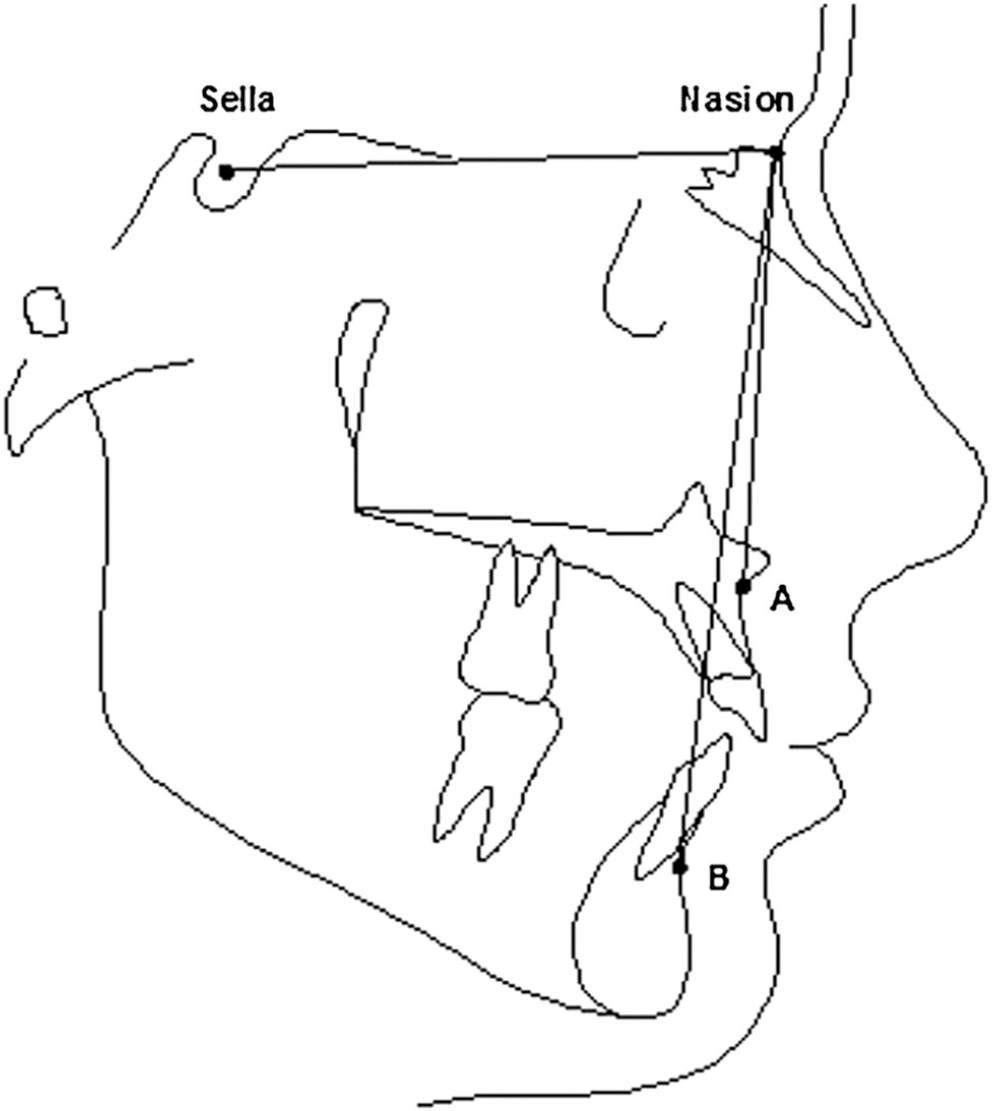
Figure 1.
Subspinale (A), Nasion (N), Supramentale (B) and the ANB angle was used to classify the sagittal skeletal relationship as follows: Class I (1°< ANB <4°), Class II (ANB >4°), and Class III (ANB <1°).
Table I.
Breakdown of the malocclusions and sagittal skeletal patterns in the Turkish and Iranian orthognathic samples
| Malocclusion | ||||
| Country | I | II | III | Total |
| Iran | 12 (5.9%) | 78 (38.4%) | 113 (55.7%) | 203 |
| Turkey | 27 (13.5%) | 35 (17.5%) | 138 (69%) | 200 |
| Sagittal skeletal pattern | ||||
| I | II | III | ||
| Iran | 5 (2.5%) | 85 (41.9%) | 113 (55.7%) | 203 |
| Turkey | 24 (12%) | 38 (19%) | 138 (69%) | 200 |
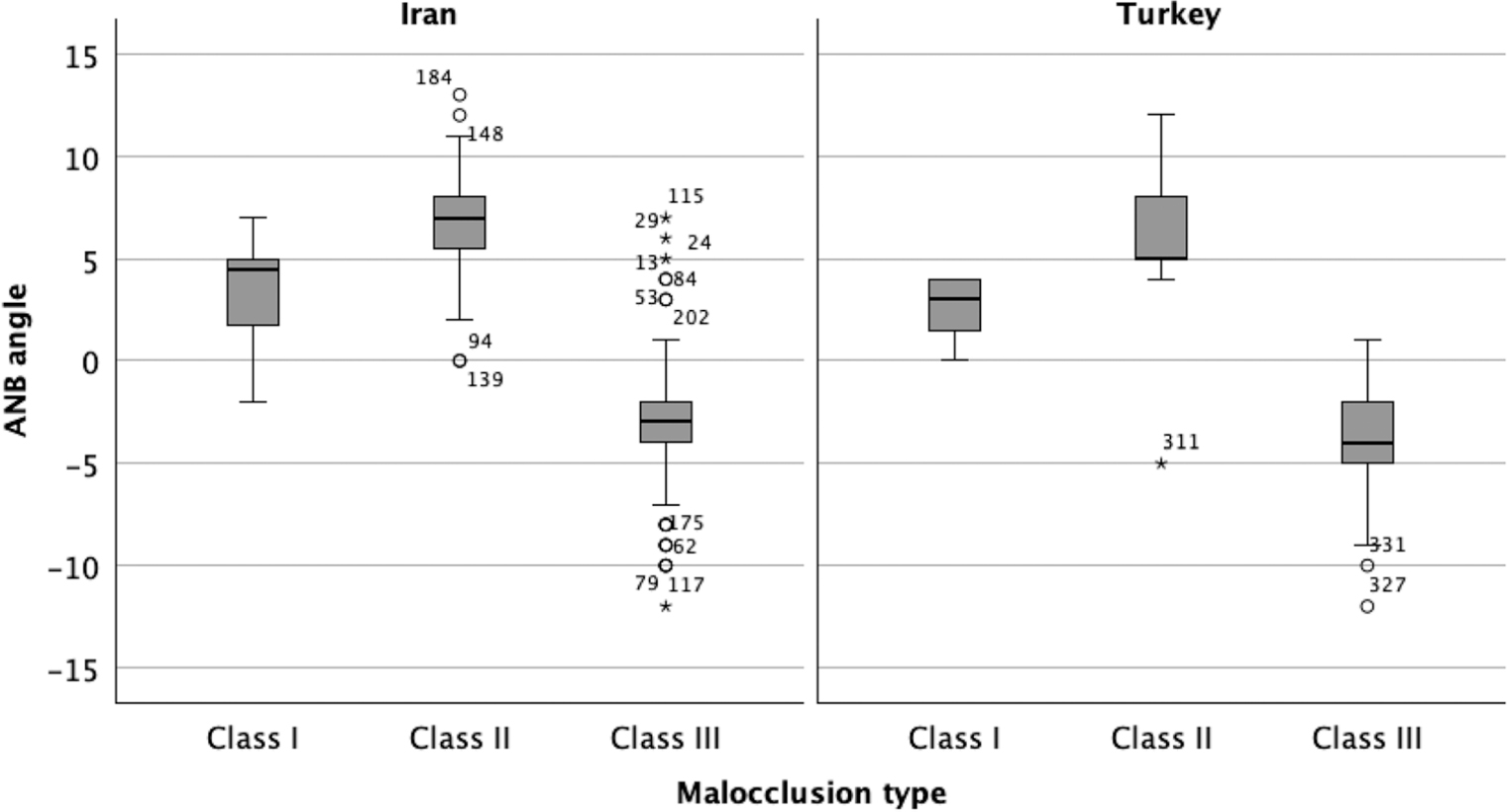
Figure 2.
Box plots of the different malocclusions (I, II, III) in the Iranian and Turkish orthognathic samples.
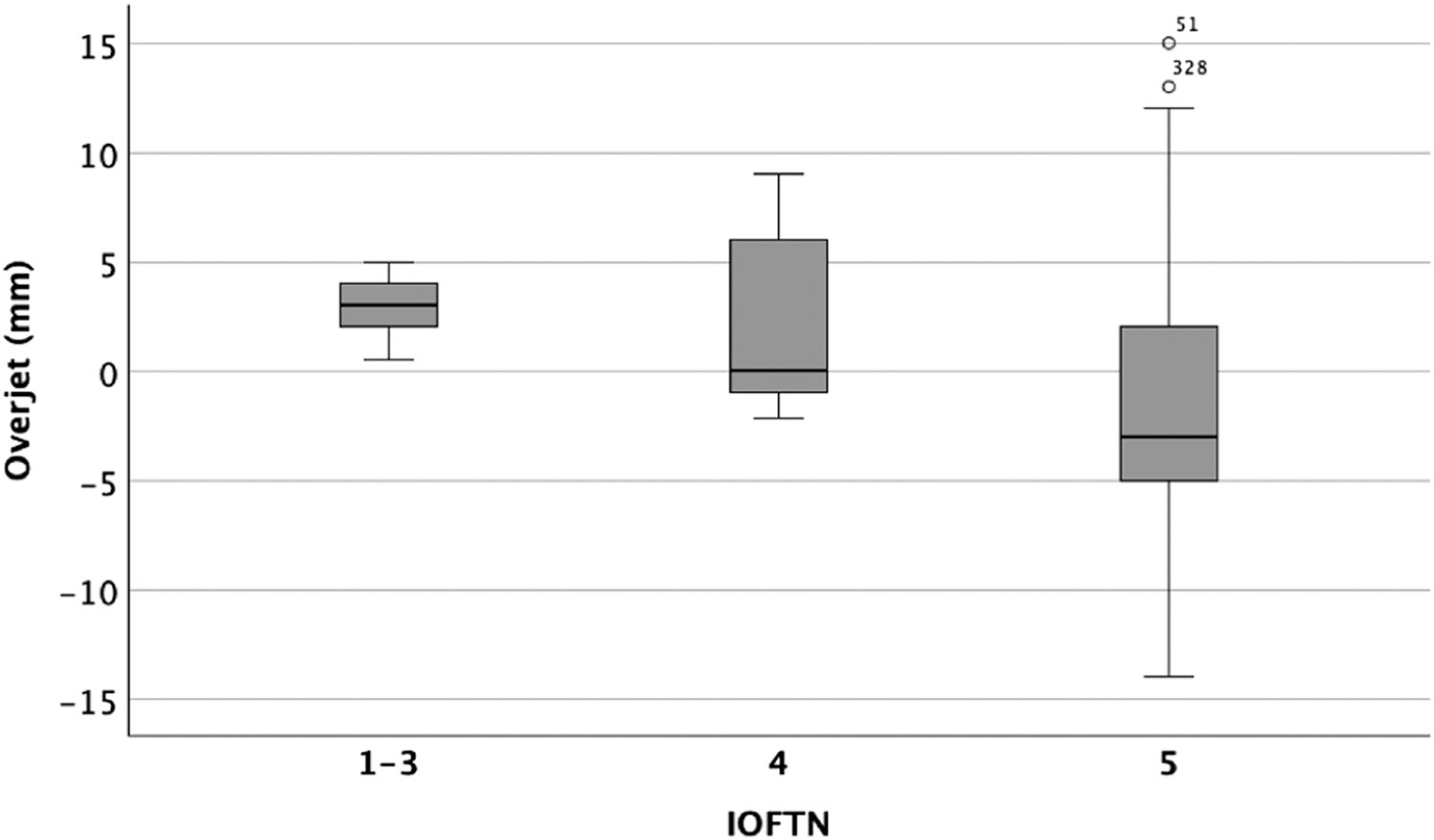
Figure 3.
Box plots of overjet values (mm) in the 3 categories of IOFTN [5 (n = 214), 4 (n = 164), and 1–3 (n = 25)] showing a near normal range of overjet in IOFTN 1–3 category.
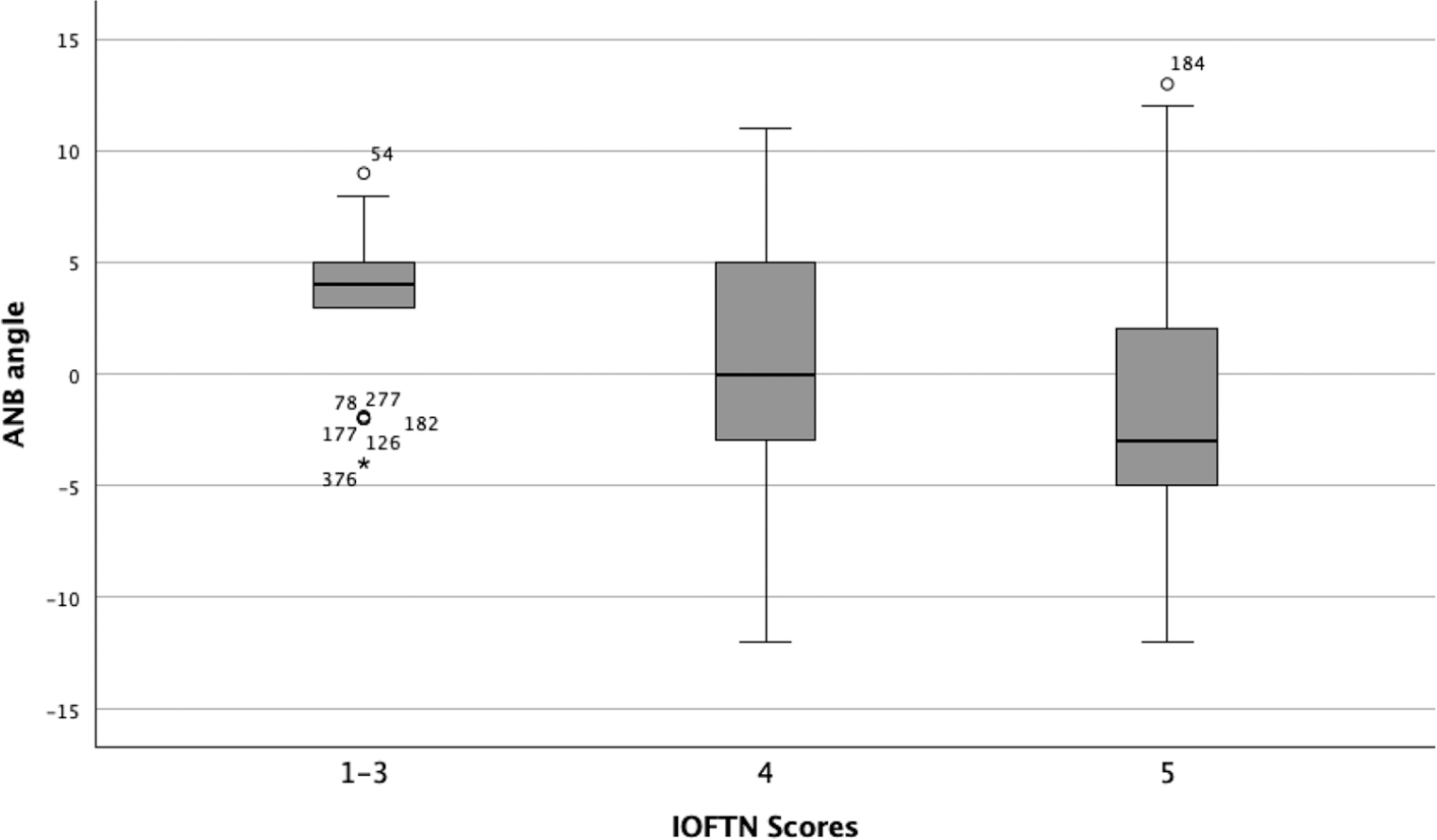
Figure 4.
Box plots of ANB angles in the 3 categories of IOFTN [5 (n = 214), 4 (n = 164), and 1–3 (n = 25)] demonstrating a wide range of ANB angles in the IOFTN 1–3 category [mean (SD) = 3.44° (3.86°), 95% CI, 1.85°-5.04°, range = -4° to 9°].
Table II.
Breakdown of patients with a low IOFTN score (<4) in the Turkish and Iranian orthognathic samples and previous studies which reported the sub-categories of the IOFTN
| James et. al.18 | Soh et. al.19 | Hasebe et. al.20 | Almoammar et al.21 | Total | ||
|---|---|---|---|---|---|---|
| IOFTN score | n (%) | n (%) | ||||
| 3.3 (Reverse overjet > 0 mm and | ||||||
| < 3 mm with no functional difficulties) | 2 (8%) | 9 | 6 | 4 | 5 | 26 (40.63%) |
| 3.4 (Open bite <4 mm with no functional difficulties) | 1 | 1 | 2 | 1 | 5 (7.81%) | |
| 3.9 (Upper labial segment gingival exposure <3 mm at rest, but with evidence of gingival/periodontal effects) | 1 (4%) | 1 (1.56%) | ||||
| 3.10 (Facial asymmetry with no occlusal disturbance) | 10 (40%) | 1 | 11 (17.19%) | |||
| 2.8 (Increased overbite, but no evidence of dental or soft tissue trauma) | 7 (28%) | 3 | 10 (15.63%) | |||
| 2.9 (Upper labial segment gingival exposure < 3 mm at rest with no evidence of gingival/periodontal effects) | 1 | 1 (1.56%) | ||||
| 2.11 (Marked occlusal cant with no effect on the occlusion) | 1 | 1 (1.56%) | ||||
| 1.14 (Occlusal features not classified in the IOFTN need categories) | 5 (20%) | 4 | 9 (14.06%) | |||
| Total | 25 (100%) | 64 (100%) | ||||