
Table I.
Eligibility criteria
| Criteria | Inclusion criteria | Exclusion criteria |
|---|---|---|
| Population | Laypeople and/or dental clinicians | |
| Intervention | Likert Scale and VAS used in assessing facial aesthetic | |
| Outcome measures | 1.Validity and/or reliability of both scale 2.Patient and/or clinician’s preference between Likert Scale and VAS | |
| Study design | Randomized controlled trial, cross sectional study | Reviews, case reports, letters to editor, and all other non-peer-reviewed articles |
| Others | All language article |
Table III.
Study methodology, population, intervention characteristics, and outcome measure(s)
| Study | Study Methodology | Study Population | Intervention Charateristics | Outcome Measure(s) |
|---|---|---|---|---|
| Fudalej et al. (2017)15 | Randomized controlled trial | Eight junior orthodontic residents without any experience in treatment of CLP. Age: 25 to 31 years old (four male and four female). | Extra-oral images of 60 non-syndromic complete unilateral cleft lip and palate (CLP) patients were taken from the frontal and profile views and were cropped. Photographs (N = 60) were divided into three groups (A, B and C) equally. Afterwards, three subgroups were formed within each group (A1, A2, A3; B1, B2, B3; and C1, C2, C3). The order of images in subgroups were arranged using random numbers generated online. Images from subgroups designated 1 were rated with VAS, images from subgroups designated 2 were rated with esthetic index (5-point Likert scale), and images from subgroups designated 3 were rated with reference score which used numerical scale from 0 to 200 and a reference photograph | Reliability was measured by using intraclass correlation coefficient (ICC) in assessing nasolabial appearance. |
| Asik & Kök (2021)13 | Cross-sectional | 195 participants (52 laypersons, 50 patient’s - relatives, 51dentists, and 42 orthodontists) from the Necmettin Erbakan University Faculty of Dentistry, Department of Orthodontics. Gender: 102 females, 93 males Age groups: 20-30, 30-40, 40-50 and over 50 years. | Photographs of a female frontal posed smile were cropped to include only mouth and teeth produced a base image. Dental midline was adjusted 1, 2, 3, and 4mm to the left and right sides using Adobe Photoshop CC 2014 software resulting in 8 modified smile images. 11images with eight modified smile photographs, one base photograph and 2 repeating photographs were randomly listed. Eye tracking device was used to detect participants’ eyes on the screen. Volunteers evaluated each image from an aesthetic point of view using survey forms consisting of VAS and Likert Scales | Effect of dental midline deviation on the perception of smile aesthetics by orthodontist, dentists, patient relatives, and layperson. Reliability of eye tracking data, VAS and Likert scale was measured using intraclass correlation coefficients (ICC). Age and gender effect towards VAS and Likert scale scores in assessing dental midline. |
| Hatch et al. (2017)12 | Cross-sectional | Ten university students and staff (5 females and 5 males) identified from convenience sampling approach | Frontal and lateral views of images of 313 adults in Iowa were presented to the raters. The rates evaluated the overall facial attractiveness on a 5-point Likert scale and a VAS | Reliability of both scales by using test-retest reliability in measuring overall facial attractiveness. Correlation between Likert Scale and VAS. |
| Dourado et al. (2021)8 | Cross-sectional | 90 evaluators divided into 3 groups equally: Lay people (20-67 years old) Orthodontist (27-45 years old) Oral and maxillofacial surgeon (26-51 years old). | Evaluation on facial pleasantness was done on 10 adult patients’ photographs that underwent orthodontic treatment for different facial discrepancies compiled in an album. Each evaluator will assess the album at 2 different times 15-30 days apart. | Reliability of Likert scale and VAS was measured through intra examiner error analysis. Correlation between both scales was measured using the Spearman correlation coefficient. Compare preference of both scales from the perspective of orthodontist, oral maxillofacial surgeons and laypeople. |
| Eslamipour et al. (2017)14 | Cross-sectional | 993 freshman students from Isfahan University were randomly selected and examined to assess the dental health component (DHC) index of the Index of orthodontic treatment need (IOTN) Examination was done by two examiners. | Questionnaire divide into three sections: Demographic, index of oral aesthetic subjective index scale (OASIS) using 7-point Likert scale, VAS and IOTN. | Determination of most reliable self-perceived indices by using intraclass coefficients. To assess sensitivity and specificity of self-perceived indices (Aesthetic component, OASIS and VAS) in comparison to DHC as normative index in young adults. |
Table II.
Risk of bias (RoB) with STROBE checklist
| STROBE | |||
|---|---|---|---|
| Paper | Study | Score | Paper |
| Perception of dental midline deviation and smile attractiveness by eye-tracking and aesthetic ratings | Aşik & Kök (2021)13 | 78.5% | Good |
| Effects of objective 3D measures of facial shape and symmetry on perceptions of facial attractiveness | Hatch et al. (2017)12 | 75.3% | Good |
| Likert scale vs visual analog scale for assessing facial pleasantness | Dourado et al. (2021)8 | 85.18% | Excellent |
| Correlation coefficients of three self-perceived orthodontic treatment need indices | Eslamipour et al. (2017)14 | 85.18% | Excellent |
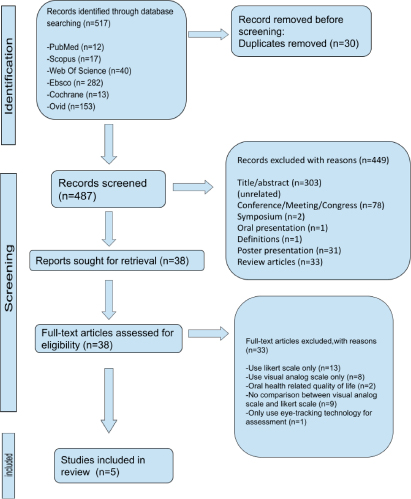
Figure 1.
Study selection according to the Preferred reporting items for systematic reviews and meta-analysis (PRISMA) flowchart.
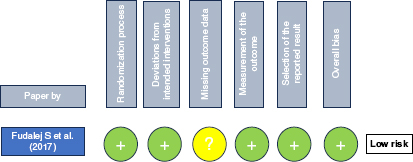
Figure 2.
Risk of bias according to the Cochrane Risk of Bias Tool for Randomised Trials (RoB 2).
Table IV.
Summary of research outcomes
| Study | Title | Outcomes |
|---|---|---|
| Aşik & Kök (2021)13 | Perception of dental midline deviation and smile attractiveness by eye-tracking and aesthetic ratings | The ICC was 0.805 for the VAS, and 0.760 for the Likert Scale No statistically significant difference between the genders VAS and Likert scores were consistent with the eye-tracking data. No statistically significant difference between the age groups. |
| Hatch et al. (2017)12 | Effects of objective 3D measures of facial shape and symmetry on perceptions of facial attractiveness | The test-retest reliability for overall facial attractiveness ratings was 0.69 on the Likert-scale and 0.75 on the VAS. |
| Dourado et al. (2021)8 | Likert scale vs visual analog scale for assessing facial pleasantness | Intra examiner errors were 0.70 and 0.69 for the Likert scale and VAS, respectively. Good correlation was observed between both the scales. Laypeople presented the lowest correlation (moderate) among the 3 groups. 75% of the examiners preferred the Likert scale. VAS requires some time to measure. Regardless of sex, the evaluators were able to assess similarly using the 2 methods. |
| Eslamipour et al. (2017)14 | Correlation coefficients of three self-perceived orthodontic treatment need indices | The intraclass coefficient for each examiner was over 0.9. VAS had the highest sensitivity (44.6%). VAS is an easy and understandable index for all age groups and social levels. Age and gender of the patient, and also the economic status of the family had no significant correlation with these indices. |
| Fudalej et al. (2017)15 | Comparison of three methods of rating nasolabial appearance in cleft lip and palate | The VAS method was in turn more reproducible than Likert scale. Results imply that a 5-point esthetic index is not optimal for esthetic rating of the nasolabial region in CLP. Recommend the use of reference. photographs along with the VAS. Likert-type scales seem to produce the most variable results |