
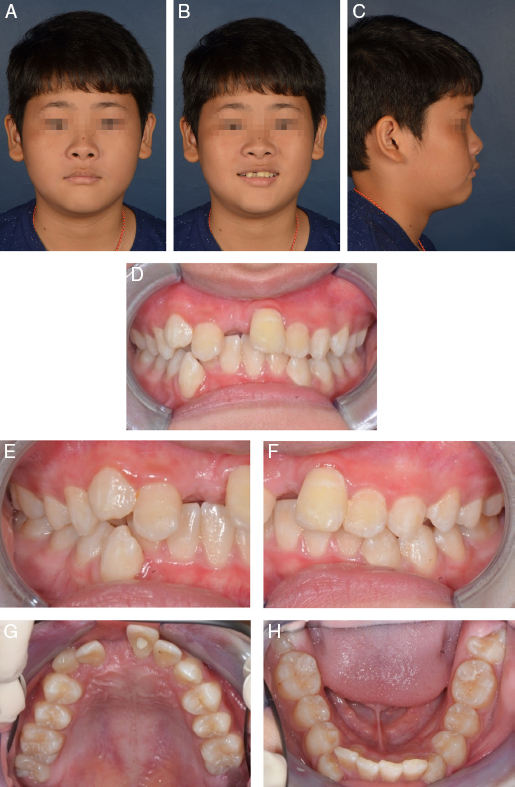
Figure 1.
(A–C) Pretreatment extra-oral photographs. (D—H) Pretreatment intra-oral photographs.
Table I.
Cephalometric measurements (Case 1)
| Pretreatment | Posttreatment | |
|---|---|---|
| SNA (°) | 82.5 | 81.5 |
| SNB (°) | 78.0 | 78.0 |
| ANB (°) | 4.5 | 3.5 |
| WITS appraisal (mm) | -2.0 | -2.5 |
| FMA (°) | 22.5 | 23.5 |
| Lower anterior face height (%) | 52.7 | 54.3 |
| U1 to FH (°) | 135.0 | 112.0 |
| IMPA (°) | 97.0 | 99.0 |
| Interincisal angle (°) | 106.0 | 130.0 |
| Upper lip to E-line (mm) | 6.0 | 2.0 |
| Lower lip to E-line (mm) | 3.0 | 0.0 |
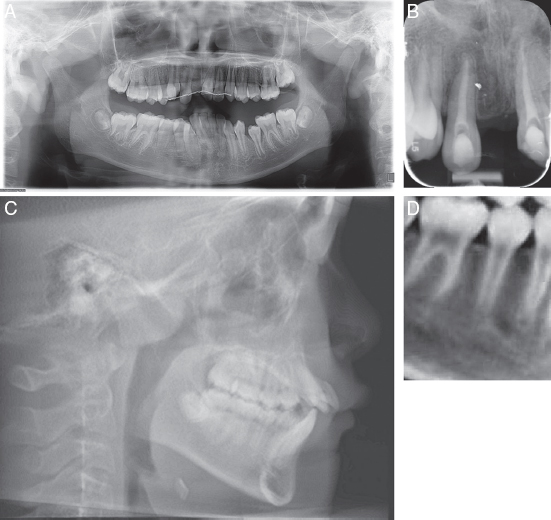
Figure 2.
(A) Pretreatment dental panoramic radiograph. (B) Periapical radiograph showing resorption on the apical surfaces of #12 and #21. (C) Lateral cephalogram. (D) CBCT section showing developing tooth #45 with ¾ root length.
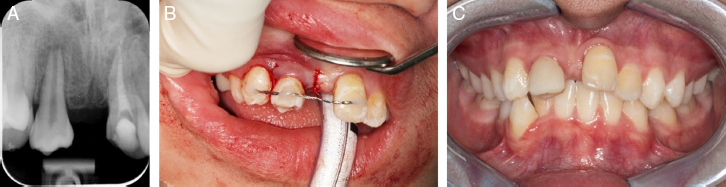
Figure 3.
(A) Periapical radiograph taken 2 weeks post-autotransplantation. (B)Transplanted tooth secured with a flexible wire splint. (C) Composite build-up of the transplanted tooth 1-month post-autotransplantation.
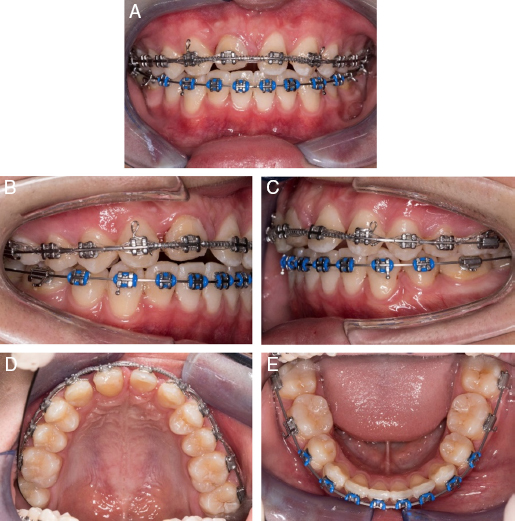
Figure 4.
(A–E) Midtreatment intra-oral photographs.
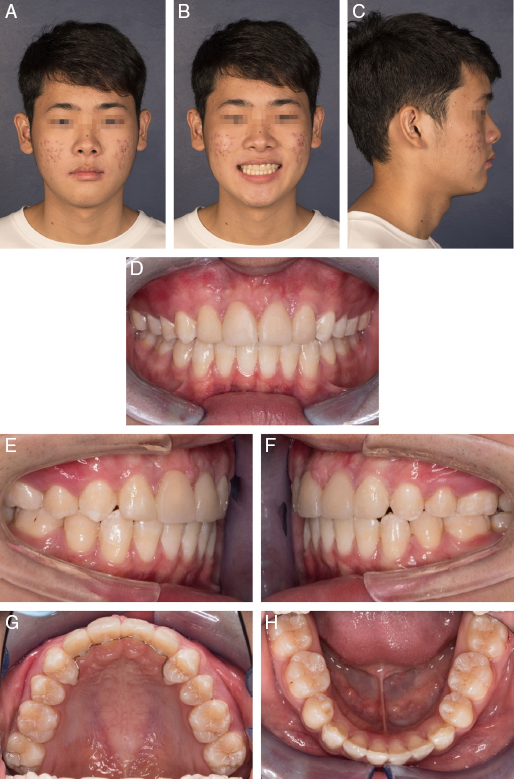
Figure 5.
(A-C) Posttreatment extra-oral photographs. (D-G) Posttreatment intra-oral photographs.
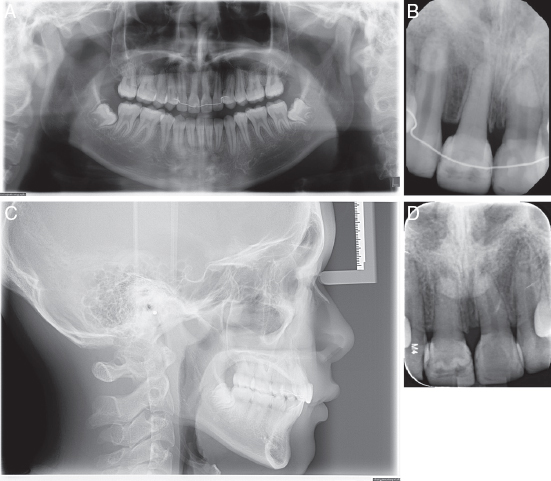
Figure 6.
(A) Posttreatment panoramic radiograph. (B) Periapical radiograph of transplanted tooth showing good root length and pulp canal obliteration. (C) Lateral cephalogram. (D) 4-year follow-up of the transplanted tooth #45 showed blunting of the root apex and a localized concavity on the mesial aspect of the root. The tooth should be reviewed in the longer term to assess for any developing signs of root resorption.
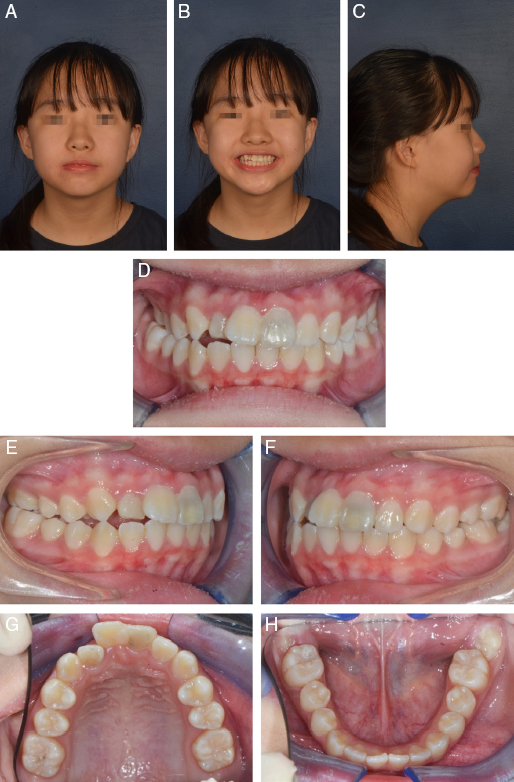
Figure 7.
(A-C) Pretreatment extra-oral photographs. (D-H) Pretreatment intra-oral photographs.
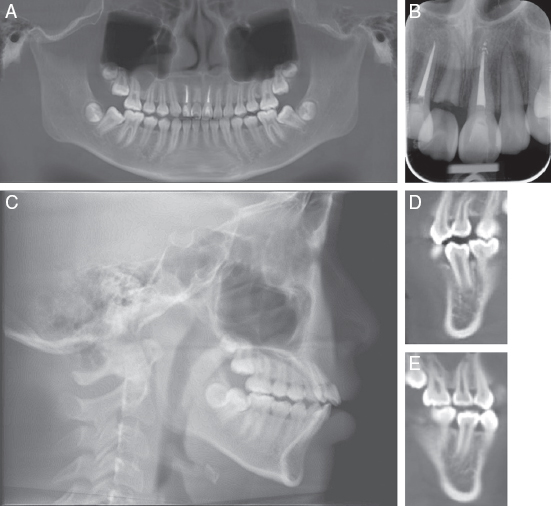
Figure 8.
(A) Pretreatment panoramic radiograph. (B) Periapical radiograph showing decoronated #11 and crown attached; Resorption on the apical surfaces of #12 and #21. (C) Lateral cephalogram. (D) CBCT section showing developing tooth #35 with ⅔ root length and (E) Developing tooth #45 with ¾ root length.
Table II.
Cephalometric measurements (Case 2)
| Pretreatment | Posttreatment | |
|---|---|---|
| SNA (°) | 84.5 | 84.0 |
| SNB (°) | 84.0 | 83.0 |
| ANB (°) | 0.5 | 1.0 |
| WITS appraisal (mm) | -2.5 | -2.0 |
| FMA (°) | 26.0 | 26.0 |
| Lower anterior face height (%) | 57.6 | 55.2 |
| U1 to FH (°) | 124.0 | 119.0 |
| IMPA (°) | 99.5 | 94.0 |
| Interincisal angle (°) | 117.0 | 123.0 |
| Upper lip to E-line (mm) | -1.0 | -1.0 |
| Lower lip to E-line (mm) | 3.0 | 1.0 |
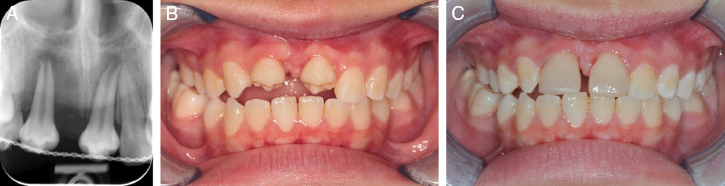
Figure 9.
(A) Periapical radiograph taken 1 week post-autotransplantation; teeth #35 and #45 secured with a flexible wire splint. (B) Lower second premolars transplanted into the anterior maxilla region. (C) Composite build-up 2 months post-autrotransplantation.
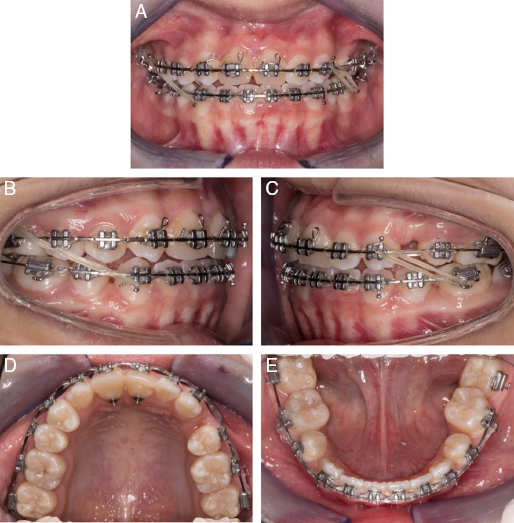
Figure 10.
(A-E) Midtreatment intra-oral photographs.
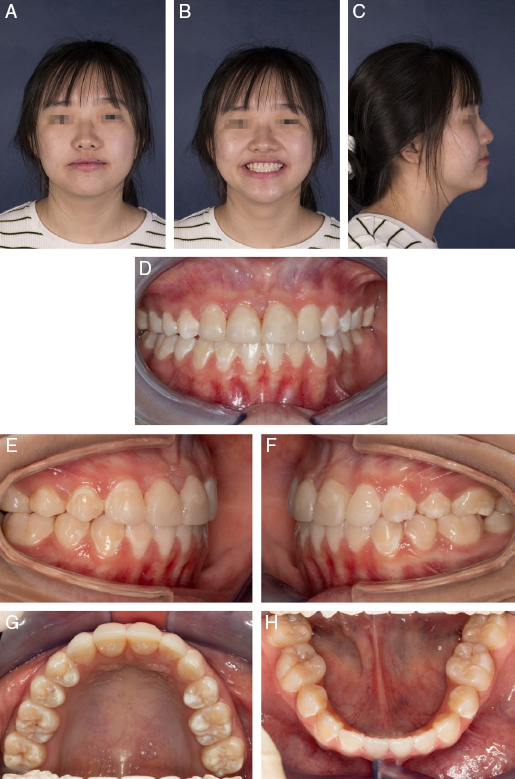
Figure 11.
(A-C) Posttreatment extra-oral photographs. (D-H) Posttreatment intra-oral photographs.
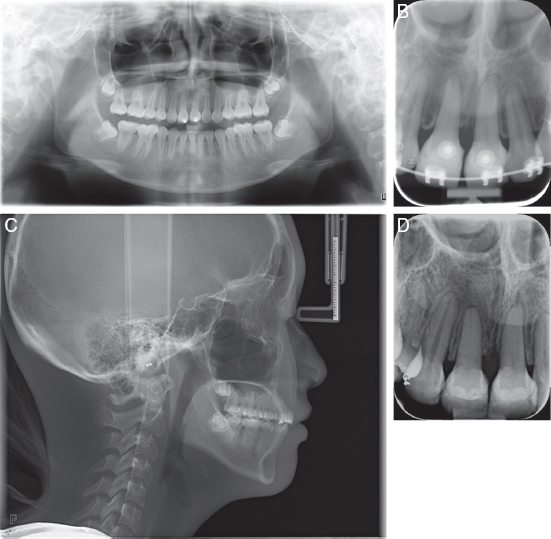
Figure 12.
(A) Posttreatment panoramic radiograph. (B) Periapical radiograph of autotransplanted teeth showing good root length and pulp canal obliteration. (C) Lateral cephalogram. (D) 4-year follow-up of the transplanted teeth showing adequate root lengths and optimal intra-crestal bone levels. Pulp canal obliteration was seen in both transplanted teeth.