
1. Introduction
Food safety in poultry products is crucial due to the potential presence of various pathogens causing foodborne diseases. The main goal of the global poultry industry is to produce safe food for consumers in an economically sustainable environment while applying antibiotics rationally. Poland, as the main poultry producer among European Union (EU) countries, is responsible for about 70% of poultry exports to other countries, including those outside the EU (Eurostat, 2025). This trend has persisted since at least 2023, and according to estimates, Poland will remain the largest poultry meat producer in the EU in 2025, accounting for more than 22% of all EU production (Eurostat, 2025).
The bacteria most frequently isolated from poultry, which due to their significant risks for human health are subject to obligatory antimicrobial resistance (AMR) monitoring in food-producing animals (Commission Implementing Decisions 2013/652/EU and (EU) 2020/1729), include Salmonella spp., Campylobacter jejuni, Campylobacter coli, and Escherichia coli (European Centre for Disease Prevention and Control et al., 2024). Another major threat is posed by Staphylococcus spp. and L. monocytogenes strains, which can also contaminate poultry during processing, leading to serious health problems after consumption. Salmonella and Campylobacter, for example, are classified as common bacteria in poultry and humans causing gastrointestinal diseases with diarrhoea, high fever, and severe abdominal cramps (Dlamini et al., 2024).
Pathogens counted among drug-resistant bacteria pose a particular threat to effective control of infections. These include Enterococcus faecium, Staphylococcus aureus, Klebsiella pneumoniae, Acinetobacter baumannii, Pseudomonas aeruginosa, and Enterobacter spp., known as the ESKAPE pathogens (Hao et al., 2024). Bacteria belonging to this group are able to rapidly acquire resistance to commonly used antimicrobials, including broad-spectrum antibiotics, such as beta-lactams, carbapenems, glycopeptides, fluoroquinolones, and aminoglycosides, as well as certain biocidal solutions (Hao et al., 2024).
The phenomenon of drug resistance is particularly pronounced in intensive poultry production, and in some countries, the use of antimicrobials for this purpose can reach even 70–80% of their total consumption in animal production (Tiseo et al., 2020). According to the latest literature data, the lowest drug resistance among pathogens isolated from poultry in EU countries is noted for macrolides and aminoglycosides, ranging from 0% to 14%, while by far, the highest drug resistance was noted against quinolone and tetracycline (TET), ranging from 41% to 70% (Abou-Jaoudeh et al., 2024).
Under the One Health strategy developed and implemented by EU countries, the EU Council Recommendation “on stepping up EU actions to combat antimicrobial resistance in a One Health approach” (Council of the European Union (2023)/C 220/01) was adopted in 2023. These recommendations cover 10 core areas for fighting drug resistance among bacteria, including introducing national action plans for curbing resistance to antimicrobials; preventing and controlling infections through continual monitoring, preventing the spread of resistant pathogens, and undertaking measures to improve animal health and welfare; management and rational use of antimicrobials, e.g. limiting their widespread application in animal production, replacing metaphylaxis with prophylaxis aimed at improving animals’ natural immunity, and also developing alternatives to antibiotics; raising public awareness and education regarding the threats arising from the uncontrolled use of antimicrobials, as well as conducting and funding research aimed at developing modern methods for counteracting the development of antimicrobial resistance; and continual cooperation with EU member states, e.g. by sending current data on resistance to antimicrobials and their sale and consumption to the global antimicrobial resistance surveillance system. The recommendation recognized that it was crucial for EU countries, as well as developing and highly developed countries, to carry out global measures for developing and implementing international standards and guidelines, e.g. on the responsible and prudent use of antimicrobials in veterinary medicine, rational use of antimicrobials for phytosanitary purposes, and minimization and containment of drug resistance in bacteria present in food (2023/C 220/01 – Council Recommendation; World Organisation for Animal Health, 2024).
In 2024, all countries sent data on the use of these preparations for chickens at the category level (Figure 1). According to ESVAC reports (2020), European Medicines Agency (2021), European Medicines Agency (2022a), European Medicines Agency (2022b) Poland, as the main poultry producer in the EU, consumed the largest quantity of antimicrobials in poultry production among European countries up to 2022 (Pyzik et al., 2024). In 2023, however, this level had significantly decreased to 53.1 tonnes of active substance, and further decreased to 41.2 tonnes in 2024. This currently places the country sixth among EU member states, with the highest rate of consumption of antibacterial substances recorded for Germany (142.4 tonnes of active substance in 2023 and 139.6 in 2024; Figure 2).
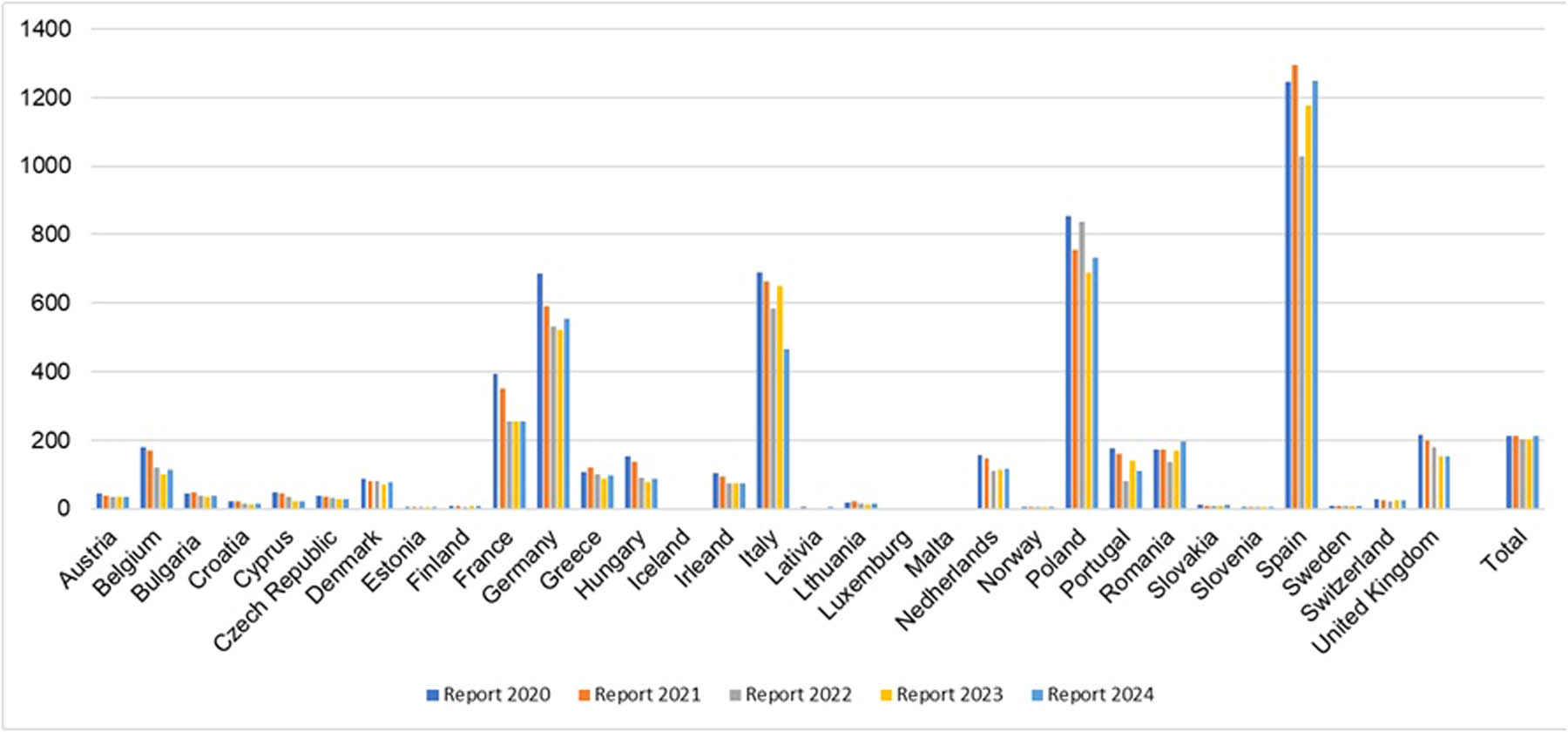
Figure 1
Sales report of antimicrobial active substances for food-producing animals of (tonnes).
Source: European Medicines Agency – ESVAC reports 2020, 2021, 2022.
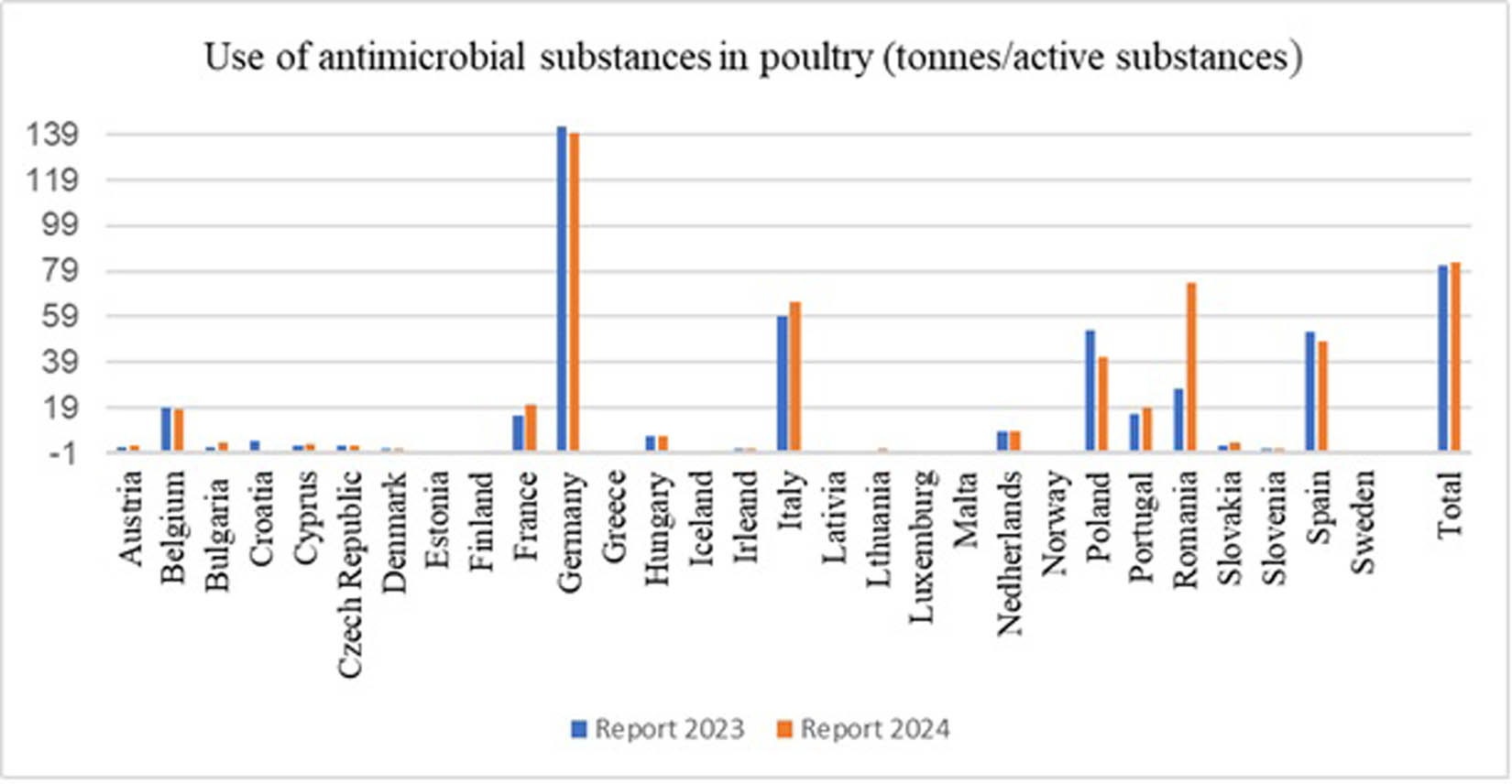
Figure 2
Average consumption (in tonnes) of antimicrobial active substances in poultry production in EU countries in 2023–24 (European Sales and Use of Antimicrobials for Veterinary Medicine ESUAvet, 2023, 2024).
Under the farm-to-fork strategy implemented by the EU, aimed at reducing the overall use of antimicrobials by 50% in farm animals and aquaculture by 2030, comprehensive legislative action has been undertaken, resulting in Regulation (EU) 2021/1756 on official controls, aimed at ensuring compliance with the ban on the use of certain antimicrobial agents. The objectives of the regulation include the introduction of a ban on the preventive use of antibiotics in various animal species, including poultry. On 28 January 2022, a new legal framework was implemented for Regulation (EU) 2019/6 on veterinary medicinal products (VMP), focusing on establishing a modern, innovative, and tailored legal framework for VMP, providing incentives to stimulate innovation in VMP and increase their availability, and strengthening EU measures for preventing the spread of drug resistance among bacteria (USDA, 2024). These measures were continued by Commission Delegated Regulation (EU) 2021/1760 of 6 October 2021, establishing the criteria to designate the antimicrobials to be reserved for human use. The European Commission followed this up by adopting Implementing Regulation (EU) 2022/1255 of July 2022, listing antimicrobials reserved for treatment of infections in humans. In February 2023, the European Commission adopted Delegated Act 2023/905 implementing Article 118 of the VMP Regulation, which imposes restrictions on the use of antimicrobials in animals transported from third countries into the EU (USDA, 2024).
In the era of the global crisis of multidrug resistance (MDR) to antimicrobials, alternative methods of controlling infections have begun to play an important role in animal production. One such approach is the use of bacteriophages, natural bacterial viruses exhibiting affinity for specific species of bacteria. Bacteriophages are ubiquitous, simple bacterial viruses and the most commonly occurring microbes in various natural ecosystems, including fresh water and seawater (Wessels et al., 2021). The total number of bacteriophages is estimated at about 1032, which is ten times the number of bacteria (Alomari et al., 2021). The presence of bacteriophages has also been confirmed in many available products, e.g. in fermented food and fresh vegetables, and in soil. Their presence has also been demonstrated in simple and more complex living organisms, such as reptiles, amphibians, birds, and mammals, including primates. This means that both animals and humans are constantly exposed to bacteriophages, e.g. through consumption of foods of plant and animal origin or direct contact with the natural environment. Moreover, bacteriophages make up a significant part of the microbiota of living organisms and ecosystems, regulating its homeostasis (Łusiak-Szelachowska et al., 2017; Urban-Chmiel & Pyzik, 2025). The mechanism of action of bacteriophages involves lysis of the target bacterial cell hosting a given phage by attaching to specific phage receptors present on the surface of bacterial cells (Endersen & Coffey, 2020).
2. Trends in drug resistance among the most commonly occurring bacteria in poultry production
2.1. E. coli
Pathogenic strains of E. coli exhibit a high level of drug resistance, most often to several groups of antimicrobial agents simultaneously. Our own research (Stępień-Pyśniak et al., 2025) determining the drug resistance profiles of avian pathogenic Escherichia coli (APEC) strains isolated from laying hens, breeding hens, broiler chickens, and turkeys in Poland revealed a high rate of resistance to the drugs tested, including amoxicillin (AMX, 100%), doxycycline (100%), enrofloxacin (ENR, 85%), chloramphenicol (75%), AMX + clavulanic acid (55%), sulfamethoxazole/trimethoprim (STX, 45%), and neomycin (NEO, 40%) (Table 1). Another of our studies (Nowaczek et al., 2021), using E. coli strains isolated from wild birds in Poland, confirmed resistance to three or more groups of antibiotics in more than 31% of strains tested. The most common resistance profile was simultaneous resistance to TET, STX, and ampicillin (AMP). It should be stressed that wild birds are most often reservoirs of pathogenic microbes, including E. coli strains, and are a very important vector in the transmission of drug resistance.
Table 1
Current trends in drug resistance among E. coli strains isolated from poultry in the years 2021–2025
| Type of strain/type of infection | Species of bird | Country | Most frequently detected resistance genes | Antibiotic resistance | Most effective antibiotics | References |
|---|---|---|---|---|---|---|
| E. coli APEC/colibacillosis | Broiler chickens | Poland | nd | AMX, AMX + clavulanic acid, colistin, ENR, NEO, norfloxacin, spectinomycin, and STX | Colistin (84.64%), NEO (80.62%), AMX + clavulanic acid (73%) | Majewski et al. (2021) |
| E. coli APEC/colibacillosis | Laying hens, breeding hens, broiler chickens, turkey broilers | Poland | blaTEM, tetB, sul2, tetA, tetB, strA/strB, aphA1, floR, catA1, aadA | AMX, AMX + clavulanic acid, doxycycline, ENR, chloramphenicol | NEO | Stępień-Pyśniak et al. (2025) |
| STX | ||||||
| Pathogenic E. coli strains | Mallard, white-tailed eagle, common buzzard, Eurasian sparrow hawk, Eurasian tawny owl, mute swan, little bittern, little owl, short-eared owl, great spotted woodpecker, lesser spotted woodpecker, European green woodpecker, Bohemian waxwing, western capercaillie, grey heron, Eurasian golden oriole | Poland | sul2, blaTEM; tet(A), aphA1 | TET (50%), ciprofloxacin (46.8%), GEN (34.3%), AMP (28.1%) | Chloramphenicol | Nowaczek et al. (2021) |
| E. coli APEC/colibacillosis | Broilers, layers and breeder chickens | Spain | mcr-1, mcr-2, | colistin (58.3), β-lactams (99.1%), macrolides (99.2%), lincosamides (98.9%), TETs (38%) | nd | Monroy et al. (2025) |
| E. coli APEC/colibacillosis | Necropsied chickens | India | blaTEM | ENR (72.46%), levofloxacin (69.56%), ciprofloxacin (66.66%), AMX + clavulanic acid (63.77%), TET (59.42%) | Ceftriaxone + sulbactam (63.77) | Patel et al. (2024) |
| blaCTX-M-G9 g | AMP + sulbactam (65.22%) | |||||
| E. coli APEC/colibacillosis | Necropsied chickens | Brazil | nd | AMX (66.1%), ceftiofur (56.9%), norfloxacin (47.7%), TET (33.9%), ciprofloxacin (31.2%), FLO (25.7%), doxycycline (23.9%), ENR (22.9%) | GEN (97.1%), NEO (85.3%), ENR (77.1%) | Lúcio et al. (2025) |
| E. coli strains | Broiler meat | Nepal | nd | GEN (90.2%), TET (67.2%), AMP (54.1%) | Ciprofloxacin (93.4%), amikacin (98.4%) | Ranabhat et al. (2024) |
| APEC | Chicken samples | Algeria | AMP (97.96%), AMX + clavulanic acid (96.94%), nalidixic acid (94.90%), TET (90.82%), ciprofloxacin (79.59%), trimethoprim/sulfamethoxazole (67.35%), kanamycin (61.22%) | Chloramphenicol (78.60%), GEN (79.60%), cefotaxime (82.70%) | Boulbair et al. (2025) | |
| APEC | Broilers, layers, broiler breeders | Ukraine | nd | AMX (78.4%), AMX + clavulanic acid (69.3%), doxycycline (58.3%), oxytetracycline (75.6%), flumequine (78.5%) ENR (55.9%) | Colistin (91.6%), GEN (85.6%), ceftiofur (63.9%), FLO (61.0%) | Nechypurenko et al. (2024) |
| E. coli | Broilers | Sweden | bla TEM -1B, bla TEM -1C | AMP 34.0%, sulfamethoxazole 32.1%, | Ciprofloxacin 92.7% | Davam et al. (2026) |
| dfrA1, dfrA5 | ||||||
| Nalidixic acid | ||||||
| tet(A) | ||||||
| sul2 | ||||||
| aadA1 | ||||||
| aph(3′)-Ia, aph(3′‘)-Ib | ||||||
| aph(6)-Id | Trimethoprim 28.4%, | 93.6% | ||||
| qnrS1 | ||||||
| gyrA (p.S83L) | TET 18.3% | |||||
| parC (p.S57T), parE (p.I355T) | ||||||
| APEC | Birds | Italy | nd | AMP (45%), nalidixic acid (45%), TET (43%), sulfonamide (41%), flumequine (33%) | Cefotaxime (100%) | Sgariglia et al. (2019) |
| Cefepime (100%) | ||||||
| Cefoxitin (98%) | ||||||
| Ceftazidime (98%) | ||||||
| APEC | Laying hens | China | tet(A), floR, sul2, aph(3′‘)-Ib, aph(6)-Id, bla TEM -1B, qnrS1 | TET (95.0%), | Colistin (100%) | Tian et al. (2025) |
| AMP (84.6%), FLO (80.0%), sulfisoxazole (80.0%), ceftiofur (73.1%) | ||||||
| AMX + clavulanic acid (95%) | ||||||
| APEC | Broiler breeder hens | USA | B-lactamase inhibitors (blaTEM), cephalosporins (blaCTX-M), aminoglycosides (aac3Vla, aph3IA, and aadA), TETs (tetA), sulfonamides (dfr7, sul1), quinolones (qnr), phenicols (cat1) | TET (28.6%) | STX 96.4% | Joseph et al. (2023) |
| Streptomycin (18%) | ||||||
| Kanamycin (14.3%) | ||||||
| GEN (7.1%) | ||||||
| E. coli | Broiler chickens | Canada | nd | Sulfisoxazole (57.3%) | Azithromycin (99.9%) | Romero-Barrios et al. (2020) |
| Streptomycin (51.6%)AMP (51.2%) | ||||||
| Ciprofloxacin (99.8%) | ||||||
| TET (46.1%) | ||||||
| Ceftriaxone (36.2%), cefoxitin (35.9%), AMX + clavulanic acid (35.8%), GEN (30.2%) | ||||||
| APEC | Birds | Iran | blaCTX-M-15, blaTEM-1A, blaVEB, and blaSHV | AMP (84.2%), STX (65.70%), | Imipenem (100%) | Ghorbani et al. (2022) |
| GEN (97.2%) | ||||||
| tetA, tetB, and tetC, | TET (62.80%), | |||||
| sul1 and sul2, dfrA1, | Cefoxitin (60.00%), | |||||
| Nalidixic acid (60.00%) | ||||||
| ereA, qnrA | ||||||
| E. coli strains | Broilers | Egypt | blaTEM, blaSHV, blaCTXM, mcr1, qnrA, qnrB, papC | AMP 97.8%, doxycycline 85.5%, chloramphenicol 80.9%, | Colistin sulphate 50.7% | Abdel-Rahman et al. (2023) |
| Ciprofloxacin 73.5%, danofloxacin 84.3%, fosfomycin 85.5%, | ||||||
| Levofloxacin 69.7%, | ||||||
| Nalidixic acid 92.2%, norfloxacin 73.2%, PEN 95%, streptomycin 82.5%, | ||||||
| TET 94.8%, | ||||||
| STX 88.5%, ENR 82.4%, | ||||||
| Cefotaxime 86.7%, imipenem 72.8%, AMX + clavulanate 89% | ||||||
| E. coli strains | Broiler poultry | China | nd | AMX (95.47%), AMP (95.08%), FLO (85.43%), | Ofloxacin (24.41%) | Liu et al. (2025a) |
| Chloramphenicol (84.06%), | ||||||
| TET (84.06%), cefotaxime (80.12%), cefazolin (85.43%) | ||||||
| GEN (36.81%) | ||||||
| APEC | Broiler and layer farms | Java | nd | AMX (66.7%), ENR (57.1%), streptomycin (52.4%), STXazole (52.4%), nalidixic acid (47.6%), oxytetracycline (47.6%), TET (42.9%), GEN (42.9%) | NEO (23.8%) | Timur et al. (2025) |
| Yogyakarta | ||||||
| Indonesia |
nd – not detected.
Earlier research conducted in Poland (Racewicz et al., 2022), in which commensal E. coli strains were isolated in 2019–2020 from litter swabs taken in poultry litter, showed the highest resistance against AMP and doxycycline (100%). In the case of E. coli isolate obtained from cloacal swabs, the highest resistance was observed against AMP (100%) and ciprofloxacin (CIP) (92%). The highest resistance to AMP (100%) and STX (94.7%) was observed in the case of strains isolated from chicken meat from slaughterhouses, while the lowest resistance was shown for gentamicin (GEN 12.5%, 36%, and 36.8%, respectively). Other research (Majewski et al., 2021) using pathogenic E. coli strains isolated from poultry in Poland, including APEC strains, confirmed high resistance to AMX (73.64%) and doxycycline (52.08%), whereas a high percentage of strains were susceptible to colistin (85.64%), NEO (80.62%), and AMX + clavulanic acid (73.05%).
Findings from Poland are largely consistent with the results of studies carried out by other research centres within and outside of Europe. For example, a study conducted in Portugal (Oliveira et al., 2022) using APEC strains from broiler chickens in the years 2009–2018 showed that resistance to the antimicrobials most often used in poultry ranged from 32.6% to 78%, i.e. 78% for AMX, 73.5% for AMP, 63.3% TET, 68.2% NEO, and 32.6% for ENR (Table 1). A study conducted in 2023–2024 in Spain, using E. coli strains isolated from broiler chickens, layers, and breeders (the drug susceptibility of 898 isolates in total was tested, among which 59.5% were classified as APEC), showed a high percentage of strains resistant to colistin (58.3%), β-lactams (99.1%), macrolides (99.2%), lincosamides (98.9%), and TETs (38%) (Monroy et al., 2025). A concerning finding is that as many as 99.3% of strains were classified as MDR, showing resistance to at least three families of antibiotics – β-lactams, macrolides, and lincosamides – at a rate of nearly 100%.
In Asian countries such as Nepal, the problem of drug resistance in E. coli from poultry was analysed in a study conducted on strains isolated from broiler chicken carcasses in 2021, which confirmed the presence of strains showing high resistance to GEN (90.2%), TET (67.2%), and AMP (54.1%) (Ranabhat et al., 2024). A study carried out in India (Patel et al., 2024), using E. coli strains isolated in 2019–2021 from chickens that had died with colibacillosis symptoms, confirmed high resistance to ENR (72.46%), levofloxacin (69.56%), ciprofloxacin (66.66%), AMX + clavulanic acid (63.77%), and TET (59.42%). Lower resistance was observed in the case of AMP + sulbactam (34.78%) and ceftriaxone + sulbactam (36.23%). The latest research conducted by Chinese scientists on APEC strains obtained in 2024 (Tian et al., 2025) also confirmed high resistance of isolates to TET (95%), AMP (84.6%), ceftiofur (73.1%), florfenicol (FLO, 80%), sulfisoxazole (80%), and STX (63.3%). MDR was observed in 74% of APEC strains (Table 1).
An equally high rate of drug resistance among APEC strains was observed by researchers in Brazil in 2022–2023, based on samples obtained from birds that had died with colibacillosis symptoms. The most frequently observed MDR profile was simultaneous resistance to β-lactams, fluoroquinolones, TETs, and aminoglycosides (Lúcio et al., 2025). The highest drug resistance was recorded for AMX (66.1%), ceftiofur (56.9%), and norfloxacin (47.7%), while resistance to FLO (25.7%), doxycycline (23.9%), and ENR (22.9%) was markedly lower (Table 1).
The problem of drug resistance in pathogenic E. coli strains isolated from poultry has also been demonstrated in Australia and Thailand (Thomrongsuwannakij et al., 2020). In that study, more than 60% of APEC strains isolated in Thailand were resistant to more than three antibiotics, whereas the percentage of MDR strains isolated in Australia was 10.7%. The highest drug resistance in strains isolated in Thailand was observed for TET (84.5%), AMX (70.2%), and STX (51.2%). In the case of Australian strains, the rates of resistance to these antibiotics were 36.9%, 29.8%, and 17.86%, respectively (Thomrongsuwannakij et al., 2020).
In a study using samples obtained in Algeria in 2019–2020 (Boulbair et al., 2025), 98 APEC strains isolated from chicken samples with characteristic colibacillosis signs showed the highest resistance rates for AMP (97.96%), AMX + clavulanic acid (96.94%), nalidixic acid (94.90%), TET (90.82%), and ciprofloxacin (79.59%). It is concerning that 92.86% of APEC strains showed resistance to at least three of the antibiotics tested, which is indicative of the serious problem resulting from the common use of antimicrobials on poultry farms in Algeria and the need for changes in flock health management, especially in poultry production.
Comparison of research results on the drug resistance of E. coli strains isolated from poultry in Poland and around the world reveals that the acquisition of resistance to antibiotics commonly used in poultry is trending upward (Table 1). In Poland as well, as the largest poultry producer in the EU, studies indicate a significant increase in the resistance of E. coli, including APEC strains, to the most important antibiotics in poultry production, such as TET, AMX, AMX + clavulanic acid, and colistin (Majewski et al., 2021). A similar opinion is shared by Ukrainian researchers (Nechypurenko et al., 2024), whose study of APEC strains isolated from broilers in 2015–2022 showed that the number of isolates resistant to colistin decreased in the years 2017–2018, but again increased from 2021 to 2022. In the case of AMX, AMX + clavulanic acid, spectinomycin, and doxycycline, a pronounced upward trend in drug resistance was observed in the years 2015–2022. The highest percentage of APEC strains exhibited resistance to flumequine (78.5%), AMX (78.4%), amoxiclav (69.3%), oxytetracycline (75.5%), and doxycycline (58.3%). This concerning phenomenon was again observed in 2022 in more than 40% of isolates, which showed MDR to more than ten antibiotics among polypeptides, aminoglycosides, TETs, beta-lactams, quinolones, and cephalosporins (Nechypurenko et al., 2024).
2.2. Campylobacter spp.
Infections caused by Campylobacter spp., especially Campylobacter jejuni (C. jejuni) and Campylobacter coli (C. coli), are a significant public health problem around the world. According to the World Health Organization (WHO), Campylobacter spp. are one of the four main causes of diarrhoeal diseases in the world, leading to gastroenteritis in humans, as well as extraintestinal complications such as Guillain-Barré syndrome, Miller Fisher syndrome (Yuki, 2001), and reactive arthritis (Keithlin et al., 2014). A report published by the European Food Safety Authority (EFSA) in November 2025 and a report created by the Foodborne Diseases Active Surveillance Network (FoodNet) in cooperation with the Centres for Disease Control and Prevention (CDC) in 2023 confirmed that campylobacteriosis is the most common zoonosis in EU countries and the United States (European Food Safety Authority, & European Centre for Disease Prevention and Control, 2025c; Delahoy et al., 2023). The main reservoirs for the microbes are poultry, pigs, and cattle (Al Hakeem et al., 2022; Wieczorek et al., 2021). The first-line drugs for treatment of Campylobacter spp. infections are usually macrolides (erythromycin, ERY and azithromycin), which have largely displaced fluoroquinolones. Fluoroquinolones, due to their widespread use in veterinary medicine, their non-selective use in treatment of humans, and the possibility of inducing drug resistance, are used as second-line drugs (Nunes et al., 2023).
Mechanisms of resistance transfer in Campylobacter spp., including both chromosomal mutations and horizontal gene transfer (HGT), have been described in detail in the literature (Urban-Chmiel et al., 2022). However, trends in the resistance of Campylobacter spp. strains to specific groups of antibiotics are continually changing. For example, a study conducted by Australian researchers using C. jejuni and C. coli strains isolated from chicken broilers showed that most strains of both C. jejuni (63%) and C. coli (86.5%) were susceptible to the antibiotics used in the study, i.e. FLO, GEN, azithromycin, ERY, clindamycin, and telithromycin, with C. coli strains shown to be much more susceptible than C. jejuni. A large discrepancy in resistance was noted for TET, 22.2% for C. jejuni but only 3.1% in C. coli. The level of resistance to both ciprofloxacin and nalidixic acid was 14.8% for C. jejuni and 5.2% for C. coli. The results also confirmed the presence of strains resistant to fluoroquinolones, which are not approved for use in poultry production in Australia. The authors emphasize that the ban on the use of fluoroquinolones in poultry farming does not itself guarantee that bacteria will not be resistant, if there are other routes by which resistant strains can be introduced, such as humans, pests, or wild birds. Genetic analysis of the isolates showed that the most frequently detected resistance gene was bla OXA, determining resistance to β-lactam antibiotics. Its presence was confirmed in 64.8% of C. jejuni isolates and in 72% of C. coli isolates (Table 2). A mutation in the gene encoding the DNA gyrase A subunit (gyrA) was detected in all C. jejuni and C. coli strains resistant to fluoroquinolones. The tetO gene, determining resistance to TETs, was identified in 28.4% of C. jejuni isolates, which was correlated with the phenotypic assessment of resistance to TET (22.2%). In C. coli, the TET resistance gene was detected in only one isolate (Abraham et al., 2020).
Table 2
Current trends in drug resistance among Campylobacter spp. strains isolated from poultry
| Type of strains | Type of sample | Number of samples | Country | Most frequently detected resistance genes | Resistance to antibiotics | Most effective antibiotics | References |
|---|---|---|---|---|---|---|---|
| Campylobacter jejuni | Caecal samples from chickens | n = 108 | Australia | TetO, bla OXA, gyrA | Ciprofloxacin (14.8%), nalidixic acid (14.8%), TET (22.2%) | FLO (100%), ERY (99.1%), GEN (100%), azithromycin (99.1%), clindamycin (99.1%), telithromycin (99.1%) | Abraham et al. (2020) |
| Campylobacter coli | Caecal samples from chickens | n = 96 | Australia | TetO, bla OXA, gyrA | TET (22.22%) | FLO (100%), ERY (94.8%), ciprofloxacin (94.8%), nalidixic acid (94.8%), GEN (100%), TET (96.9%), azithromycin (94.8%), clindamycin (94.8%), telithromycin (95.8%), | Abraham et al. (2020) |
| C. jejuni | Chickens | n = 45 | China | GyrA, TetO, TetA, ermB | Ciprofloxacin (66.7%), nalidixic acid (80%), ERY (62.2%), azithromycin (60%), TET (71.1%), clindamycin (62.2%), GEN (68,9%) | FLO (93.3%) | Tang et al. (2020) |
| C. coli | Chicken | n = 25 | China | GyrA, TetO, tetA, ermB | Ciprofloxacin (100%), nalidixic acid (92%), ERY (76%), azithromycin (64%), TET (88%), clindamycin (64%), GEN (60%) | FLO (92%) | Tang et al. (2020) |
| C. jejuni | Carcass, chicken cuts, cloacal swabs, pre-chiller water | n = 54 | Brazil | GyrA, tetO | Ciprofloxacin (94.4%), nalidixic acid (94.4%), ERY (51.9-53.7%)a, TET (51.9-57.4%)a | GEN (100%), chloramphenicol (100%) | Paravisi et al. (2020) |
| Campylobacter jejuni | Chicken meat samples | n = 75 | Chile | bla OXA-61, lnuC, gyrA, tet(O) | Ciprofloxacin (37.3%), TET (20%) | ERY (100%), GEN (100%) | Concha-Toloza et al. (2023) |
| Campylobacter coli | Chicken meat samples | n = 43 | Chile | aph(3’)-III, aadE-Cc, cfrC, bla OXA-61, gyrA,tetO | Ciprofloxacin (55.8%), ERY (16.3%), TET (4.7%) | GEN (100%) | Concha-Toloza et al. (2023) |
| C. jejuni | retail raw chicken samples, Farm samples: litter, faeces, cloacal swabs | n = 59 | United States | GyrA, tetOaph(3′)-IIIa, bla OXA-184, bla OXA-61 | nalidixic acid (49.2%) | ERY (83.1%) Ciprofloxacin (84.7%), GEN (93.2%), TET (76.3%), clindamycin (83.1%) | Poudel et al. (2022) |
| C. lari | Retail raw chicken samples, farm samples: litter, faeces, cloacal swabs | n = 7 | United States | bla OXA-61 | Nalidixic acid (71.4%), ciprofloxacin (57.1%), TET (57.1%) | ERY (85.3%), GEN (85.3%), azithromycin (85.3%) | Poudel et al. (2022) |
| Campylobacter spp. | Chicken faeces | n = 26 | Ukraine | nd | Ciprofloxacin (57.7%), ERY (73%), TET (88.5%) | Shchur et al. (2023) | |
| Campylobacter spp. | Poultry caecal swabs | n = 36 | Iraq | nd | Nalidixic acid (100%), ciprofloxacin (100%) , TET (88.8%), AMP (83.3%), sulfa/trimethoprim (80.5%), ERY (50%), ceftriaxone (50%) | GEN (69.5%), chloramphenicol (77.8%), AMX/clavulanic acid (72.3%) | Shakir et al. (2021) |
| C. jejuni | Swab samples from broiler carcasses | n = 525 | Poland | nd | Ciprofloxacin (92.0%), nalidixic acid (90.3%), TET (64.8%) | ERY (98.9%), GEN (98.7%), streptomycin (79.8%) | Wieczorek et al. (2020) |
| C. coli | Swab samples from broiler carcasses | n = 738 | Poland | nd | Ciprofloxacin (93.9%), nalidixic acid (93.8%), TET (75.3%) | ERY (93.6%), GEN (99.6%), streptomycin (72.9%) | Wieczorek et al. (2020) |
| C. jejuni | Cloacal swabs from laying hens | n = 76 | Germany | nd | Ciprofloxacin (81.6%), nalidixic acid ( 86.9%), enrofloksacin (88.2%), sulfa/trimethoprim (86.9%) | ERY (98.7%), gentamycin (100%), TET (94.7%), azithromycin (100%), chloramphenicol (98.7%) | Casalino et al. (2022) |
| C. coli | Cloacal swabs from laying hens | n = 63 | Germany | nd | Ciprofloxacin (79.4%), nalidixic acid (82.5%), ENR (84.1%), TET (60.3%) | ERY (100%), GEN (100%), azithromycin (98.5%), chloramphenicol (100%), sulfa/trimethoprim (90.5%), | Casalino et al. (2022) |
aDepending on the criteria (CLSI or EUCAST).
Another study, conducted in China (Tang et al., 2020) using 70 strains of Campylobacter spp., confirmed a high rate of resistance to fluoroquinolones, in which the resistance of C. jejuni to ciprofloxacin and nalidixic acid was high, at 66.7% and 80%, respectively. For C. coli strains, the values were 100% and 92%, respectively (Table 2), which is an alarming phenomenon and, as stressed by the authors, directly linked to the intensive use of these drugs in the poultry sector. High resistance to ERY, clindamycin, azithromycin, GEN, and TET was also noted among Campylobacter spp. strains, ranging from 60% to 80% (Table 2). Genetic testing identified key mechanisms of resistance in Campylobacter spp., such as a point mutation in the gyrA gene (C257T), detected in all strains that were phenotypically resistant to ciprofloxacin and/or nalidixic acid, mutation A2075G in the V domain of the 23S rRNA gene in both C. jejuni and C. coli isolates that were highly resistant to macrolides, and the presence of the gene ermB in nearly 65.7% of strains (Table 2). Among genes responsible for TET resistance, the genes tetO and tetA were detected (Abraham et al., 2020). Similar drug resistance results in Campylobacter spp. strains were obtained in a study carried out in Brazil (Paravisi et al., 2020) on 54 strains of C. jejuni, obtained from bird carcasses, cloacal swabs, and environmental samples. One strain was shown to be susceptible to all antimicrobials tested: ciprofloxacin, nalidixic acid, ERY, TET, GEN, and chloramphenicol. The study showed an extremely high level of resistance to ciprofloxacin (94.4%) and nalidixic acid (94.4% according to CLSI criteria), which was linked to specific mutations in the gyrA gene. In the case of other antimicrobials, the level of resistance varied depending on the standards used Clinical and Laboratory Standards Institute (CLSI) vs European Committee on Antimicrobial Susceptibility Testing (EUCAST) and ranged from 46.3% to 51.8% for TET and from 42.6% to 48.1% for ERY (Table 2). Only 42.8% of strains phenotypically resistant to TET possessed the gene tetO, which suggests that other mechanisms, such as efflux pumps, may be responsible for resistance in the remaining strains (Paravisi et al., 2020). All strains were shown to be clinically susceptible to GEN and chloramphenicol, which the authors link to bans or restrictions on their use in poultry production in Brazil. A particularly concerning phenomenon is the high resistance to ERY and ciprofloxacin shown in the study, as both of these substances are first-line drugs for campylobacteriosis treatment in humans. In addition, the multiple antibiotic resistance (MAR) index of 0.5 suggests high selection pressure in the study area resulting from frequent use of antibiotics in poultry farming (Paravisi et al., 2020). The results are also similar to those of a study conducted in Chile on 118 Campylobacter strains (C. jejuni n = 75, C. coli n = 43) isolated from poultry carcasses (Concha-Toloza et al., 2023). C. jejuni strains showed the highest resistance to ciprofloxacin (37.3%) and TET (20%), and 5.3% of strains were resistant to both antibiotics (Table 2). C. coli strains showed the highest rate of resistance to ciprofloxacin (55.8%), while by far the lowest percentage of strains were resistant to TET (4.7%). In addition, 16.3% of isolates were resistant to ERY, and all of these strains were also resistant to ciprofloxacin. A much lower percentage of C. coli strains showed simultaneous resistance to ciprofloxacin and TET (2.3%) than in the case of C. jejuni, but all strains of Campylobacter spp. were susceptible to GEN, and C. jejuni was additionally susceptible to ERY (Table 2). The genetic analysis detected molecular determinants of resistance to antibiotics; in all Campylobacter spp. strains resistant to ciprofloxacin, the C257T mutation was detected in the quinolone resistance-determining regions (QRDR) of the gyrA gene. The tetO gene was also present in all TET-resistant strains. In addition, determinants of resistance to antimicrobials that were not tested phenotypically were present: lnuC determining resistance to lincomycin (LIN), bla OXA-61, which encodes the enzyme oxacillinase responsible for Campylobacter resistance to β-lactam antibiotics, aph(3’)-III and aadE-Cc, responsible for resistance to some aminoglycoside antibiotics, and cfrC, associated with resistance to linezolid and phenicols (Concha-Toloza et al., 2023).
In a study conducted in the United States, Poudel et al. (2022) tested 414 samples from conventional chicken farming and farming without antibiotics for the presence of Campylobacter spp. The overall prevalence of Campylobacter was 25.4%. C. jejuni was the dominant species, accounting for 78.1%. C. lari and C. volucris were isolated as well, accounting for 6.7% and 1.9%, respectively. C. coli was not detected in that study. Among the C. jejuni isolates, 13.6% were resistant to three or more classes of antibiotics. C. jejuni showed the highest resistance to nalidixic acid (49.2%) and the highest susceptibility to GEN, ciprofloxacin, ERY, clindamycin, and TET, ranging from 76% to 93%. In C. lari, the highest rate of resistance was noted for nalidixic acid (71.4%) and for ciprofloxacin and TET (57.1%), and the lowest for ERY, azithromycin, and GEN (14.3%). Among 82 C. jejuni isolates, 52.4% possessed the gyrA gene. Other resistance genes were detected as well: tetO, aph(3′)-IIIa, bla OXA-184, and bla OXA-61. Only bla OXA-61 was identified in C. lari. The study demonstrated that Campylobacter spp. is present on farms without antibiotics, and antibiotic resistance, while lower than in conventional farming, still occurs; the absence of antibiotics reduces but does not fully eliminate the problem of resistance (Poudel et al., 2022).
Findings obtained by researches from Iraq (Shakir et al., 2021) for 36 Campylobacter spp. strains isolated from 179 samples (including 150 faecal samples and 29 cloacal swabs) also revealed an alarmingly high level of resistance to commonly used drugs, including 100% resistance to representatives of quinolones – nalidixic acid – and fluoroquinolones – ciprofloxacin (Table 2). High resistance to TET (88.8%), AMP (83.3%), and STX (80.5%) was noted as well. Half of the strains were resistant to ERY (50%) and ceftriaxone (50%). The study confirmed MDR among the Campylobacter spp. strains. The researchers also determined the MAR index, which was 0.3 or higher in 97.2% of isolates, suggesting that these bacteria come from environments in which antibiotics are overused (Shakir et al., 2021).
A large study using 2,367 swabs collected from broiler chicken carcasses in Poland (Wieczorek et al., 2020) showed a very high (>50%) prevalence of Campylobacter spp. strains, among which the dominant species was C. coli (n = 738). Among C. jejuni isolates, 108 (20.6%) were resistant to three or more classes of antibiotics; for most strains (17.9%), the resistance profile included ciprofloxacin, nalidixic acid, streptomycin, and TET. In the case of C. coli, 25.1% of isolates exhibited MDR; the resistance pattern was identical to that of C. jejuni and was found in 18.8% of strains. Only two C. jejuni isolates and one C. coli strain proved to be resistant to all antimicrobials used in the study (Wieczorek et al., 2020). In another study (Casalino et al., 2022), German researchers demonstrated high prevalence of Campylobacter spp. strains (90.4%), which were isolated from 177 of samples collected from layers. C. jejuni was identified in 43.5%, C. coli was detected in 38.9%, and mixed infections were shown in 7.9% of birds. Resistance to antimicrobials was considerable and more often observed in C. coli than in C. jejuni. Higher values for fluoroquinolones were noted in C. coli, amounting to 20.6% for ciprofloxacin, 17.5% for nalidixic acid, and 15.9% for ENR. In C. jejuni, resistance to this group of antibiotics was lower: 18.4% for ciprofloxacin, 13.1% for nalidixic acid, and 11.8% for ENR. Significant differences were also observed for TET resistance, which was much higher in C. coli (39.7%), while only 5.3% of C. jejuni strains were not susceptible to this antibiotic. Resistance to STX was detected in 13.1% of C. jejuni strains and 9.5% of C. coli strains. In the case of ERY, chloramphenicol, and azithromycin, resistance was only observed in single strains, and resistance to GEN was not found in either species. Despite the fact that resistance was higher in C. coli, MDR was shown in more strains of C. jejuni (19.7%) than C. coli (17.5%) (Casalino et al., 2022). A high rate of resistance to TET: 88.5%, ERY (73%), and ciprofloxacin (57.7%) was also observed in a study conducted on 26 Campylobacter spp. isolates from samples of caecal contents collected from poultry in Ukraine (Shchur et al., 2023).
To sum up, resistance of Campylobacter spp. to antimicrobials is dynamic, changing constantly depending on the region, time, and type of antibiotic use. The findings of research conducted in the last 5 years in various parts of the world show a clear upward trend in the acquisition of drug resistance among Campylobacter spp. strains, particularly to ciprofloxacin and nalidixic acid, for which it often exceeds 80–90%, and in some cases, even reaches 100%. This is indicative of the global nature of the problem of drug resistance among Campylobacter spp. isolated from poultry. At present, studies indicate that the efficacy of macrolides remains relatively high, but the appearance of localized cases of resistance indicate that it will gradually decline in the future. Differences in resistance profiles between countries (very high values in Asia vs lower ones in parts of Europe and Australia) confirm the impact of local farming practices and antibiotic policies. The presence of resistant strains is observed even in countries with restrictive antibiotic policies (Australia), which suggests the role of alternative routes of transmission among bacteria. Especially increasing occurrence of MDR strains indicates a growing treatment problem and may limit available treatment options. The trends observed suggest that without effective control measures (rational antibiotic therapy, epidemiological supervision, and biosecurity), the level of resistance may continue to rise.
2.3. Enterococcus spp.
Bacteria of the genus Enterococcus are part of the gut microbiota in poultry. Due to high genome adaptability and plasticity, they are an important reservoir of resistance genes in the animal production environment. In recent years, the role of enterococci in the epidemiology of resistance to antimicrobials has been clearly highlighted in both the scientific literature and reports of European institutions functioning within the framework of the integrated One Health approach (European Food Safety Authority, & European Centre for Disease Prevention and Control, 2023b, 2025b). Despite the decrease in selection pressure associated with the use of antibiotics, resistance to many classes of antimicrobial agents among Enterococcus spp. isolated from poultry remains high. This is due to several overlapping mechanisms, i.e. the durability of resistance determinants encoded on mobile elements (plasmids and transposons), the capacity of enterococci for horizontal transfer of resistance genes, and their natural adaptation to the environment of the digestive tract of animals (Clewell et al., 2014; Partridge et al., 2018). In addition, the phenomenon of co-selection makes exposure to factors other than antibiotics (e.g. heavy metals) conducive to the persistence of resistance genes. In consequence, restricting the use of antibiotics does not always eliminate resistance, which may persist in bacterial populations for a long time (Seiler & Berendonk, 2012). This underscores the need for continued monitoring and the implementation of comprehensive measures within the framework of the One Health approach, encompassing the health of animals, humans, and the environment.
Enterococcus faecalis and Enterococcus faecium are among the enterococcal species most commonly isolated from the gut of poultry. In recent years, other species have increasingly been identified as well, including those of clinical importance in poultry, such as Enterococcus cecorum, Enterococcus hirae, Enterococcus durans, Enterococcus gallinarum, and Enterococcus thailandicus (Stępień-Pyśniak et al., 2016; Velhner et al., 2024; Wigmore et al., 2024). Enterococci are used as indicator bacteria to assess the selection pressure of antibiotics, which results from their ability to accumulate and transfer resistance genes (Hollenbeck & Rice, 2012). Reports by the European Food Safety Authority and the European Centre for Disease Prevention and Control from the years 2020 to 2023 indicate significant geographic variation in levels of resistance in Enterococcus spp. in EU member states (European Food Safety Authority, & European Centre for Disease Prevention and Control, 2023a, 2024a, 2025c). This may be linked to differences in antibiotic use practices, animal production systems, and degrees of implementation of surveillance programmes. Nevertheless, a common feature observed in all regions is the high occurrence of MDR strains, defined as resistant to at least three classes of antibiotics. Especially high MDR levels are noted in isolates from poultry farms, where environmental selection and stocking density are conducive to the persistence and spread of resistance. In many cases, genes of resistance to antibiotics of critical importance for human medicine co-occur, which underscores the importance of the One Health approach in monitoring and curbing this phenomenon.
3. TETs, macrolide–lincosamide–streptogramin B (MLSB), and aminoglycosides – phenotypic and molecular analysis
The dominant resistance phenotypes observed in populations of enterococci associated with poultry production are resistant to TETs, macrolides, and aminoglycosides, often occurring together, creating MDR profiles. Among these groups of drugs, the most common phenotype is TET resistance. Numerous epidemiological studies carried out in Europe and in other parts of the world have shown that the percentage of Enterococcus strains resistant to this group of antibiotics often exceeds 70–80% (European Food Safety Authority, & European Centre for Disease Prevention and Control, 2023a; Garcia-Llorens et al., 2024; Velhner et al., 2024). A high frequency of resistance is observed irrespective of the type of biological material, including isolates from intestinal contents, faeces, swabs from the cloaca and other internal organs, and the poultry farm environment. Analysis of isolates from broiler cloacae in turkey revealed TET resistance in 81.3% of Enterococcus spp. strains and ERY resistance in 77.1% (Aslantaş, 2019). Similar observations were made in a study carried out on poultry farms in Zambia, in which TET resistance was found in 89.2% of E. faecalis and E. faecium isolates, and resistance to AMP and ERY was shown in 68.9% (Mwikuma et al., 2023). Clinical isolates from internal organs (mainly hearts of broilers up to 10 days of age) were resistant to tylosin (71.4%) and doxycycline (67.3%) (Stępień-Pyśniak et al., 2016). Similar results were obtained in a study in turkeys in Hungary, which showed high phenotypic resistance to tylosin (62.6%), FLO (51.1%), doxycycline (48.7%), and ENR (45.5%) (Kerek et al., 2025a). Together, the data indicate that resistance to TETs and co-occurring mechanisms of resistance to other groups of antimicrobials persist, irrespective of geographic location, the source of isolation, or the type of production system.
At the molecular level, determinants belonging to the tet gene family, mainly tet(M) and tet(L), play a key role in TET resistance. The tet(M) gene encodes a ribosomal protection protein responsible for reducing the ability of TET to inhibit the translation process, while tet(L) is involved in active removal of the antibiotic from the bacterial cell by efflux systems. Other determinants are identified as well, such as tet(O), tet(K), and tet(S), which indicates that a wide variety of genetic mechanisms are responsible for resistance within the animal-derived Enterococcus population (Rehman et al., 2018; Ahmed et al., 2020).
At the same time, resistance to macrolides and antibiotics of the MLSB group is the second dominant resistance phenotype observed in enterococci associated with poultry production. ERY resistance is commonly identified both within and outside of Europe, attaining values exceeding 40–60% of all isolates tested (European Food Safety Authority, & European Centre for Disease Prevention and Control, 2023a; Garcia-Llorens et al., 2024; Velhner et al., 2024). The dominant molecular mechanism remains methylation of 23S ribosomal RNA, encoded mainly by genes of the erm family, primarily erm(B) and less often erm(A) and erm(TR). Expression of these determinants leads to the MLSB phenotype, i.e. cross-resistance to macrolides, lincosamides, and streptogramin B. The occurrence of erm genes has been widely documented in E. faecalis, E. faecium, and other species of enterococci isolated from poultry, and their spread remains closely linked to selection pressure occurring in intensive production systems (Molechan et al., 2019).
A particularly important aspect of the epidemiology of resistance in enterococci is the frequent co-localization of determinants of resistance to TETs and macrolides, represented mainly by tet and erm genes, on shared mobile genetic elements (MGEs) such as plasmids and conjugative transposons. This phenomenon plays a key role in the co-selection and horizontal transfer of resistance genes, promoting the simultaneous spread of multiple determinants within bacterial populations. This mechanism is confirmed by Fatoba et al. (2022), who used genome analyses to show the presence of the tet(M), tet(L), and erm(B) genes located on plasmids, at the same time indicating their role in the transmission of resistance determinants from poultry farm litter to soil. These findings indicate that mobile resistance determinants are an important factor responsible for preserving and spreading MDR phenotypes in enterococci populations of animal origin.
Another important component of the MDR phenotype of enterococci isolated from poultry is resistance to aminoglycosides, especially a high level of resistance to GEN and streptomycin (high-level aminoglycoside resistance, HLAR). The dominant molecular mechanism responsible for this phenotype is enzymatic modification of the antibiotic molecule, including acetylation, phosphorylation, and adenylation. Key epidemiological importance is ascribed to genes encoding aminoglycoside-modifying enzymes, including aac(6′)-Ie-aph(2″)-Ia, aph(3′) and ant(6)-Ia (Arias & Murray, 2012; Lebreton et al., 2014). The gene aac(6′)-Ie-aph(2″)-Ia, determining resistance to most aminoglycosides, except for streptomycin, is of particular clinical importance.
Studies conducted in Europe in recent years indicate a persistently high prevalence of the HLAR phenotype in enterococci isolated from poultry. In Serbia and Hungary, 20–30% of isolates tested showed a high level of resistance to aminoglycosides (Kerek et al., 2024; Velhner et al., 2024), while in Czechia this percentage reached 20–40% in isolates from chicks of various production types (Bzdil et al., 2023). Even higher values have been observed outside Europe, especially in intensive production systems in Asia and South America, where the percentage of strains resistant to high concentrations of GEN exceeded 60–70% (Hammerum, 2012). The study also showed frequent co-occurrence of determinants of the HLAR phenotype with the erm(B) and tet(M) genes, which additionally increases the potential for the spread of MDR.
4. Glycopeptides and vancomycin resistance status in enterococci (VRE)
Glycopeptides, i.e. vancomycin and teicoplanin, are antibiotics of key clinical importance, as last-resort drugs used to treat severe infections induced by multidrug-resistant gram-positive bacteria. Therefore, the development of resistance to this group of antimicrobial compounds is considered a serious public health problem, reaching beyond the clinical environment and affecting the animal production sector as well. In the case of enterococci, mechanisms of resistance to glycopeptides are most often associated with the presence of vanA and vanB operons, which encode an alternative pathway of peptidoglycan biosynthesis leading to modification of the final structures of cell wall precursors, thus reducing the antibiotic’s affinity for the target site (Palmer & Gilmore, 2010; García-Solache & Rice, 2019).
Data from European antimicrobial resistance monitoring systems indicate that the prevalence of vancomycin-resistant enterococci in poultry is currently relatively low and stable (European Food Safety Authority, & European Centre for Disease Prevention and Control, 2025c). It is also markedly lower than that observed in clinical human isolates (EFSA Panel on Biological Hazards BIOHAZ et al., 2021). The withdrawal of avoparcin used as a growth promoter in animal production was particularly important. The elimination of this antibiotic has led to a significant reduction in selection pressure and a lasting reduction in the spread of glycopeptide-resistant enterococci in livestock populations. This effect has been documented in detail in Scandinavian countries, mainly Denmark, where a significant decline in the number of VRE isolates was noted following the withdrawal of avoparcin (Bager et al., 1997; Aarestrup et al., 2001). Despite the improvement in the epidemiological situation, determinants of resistance to glycopeptides have not been fully eliminated (Bortolaia et al., 2015; Ünal et al., 2020; Ben Yahia et al., 2024). Studies conducted in various EU countries indicate the persistence of sporadic cases of VRE and locally varied patterns of their occurrence. Woźniak-Biel et al. (2019) reported vancomycin resistance in 15.69% of strains isolated from turkeys, additionally identifying the vanA gene in some isolates. The presence of vancomycin-resistant E. faecium has also been shown in samples collected from broilers and from farm environments (Bortolaia et al., 2015; Ünal et al., 2020). In contrast, other European studies have shown only a marginal level of resistance or the complete absence of the vanA and vanB genes (Kasimoglu-Dogru et al., 2010; Aslantaş, 2019; Stępień-Pyśniak et al., 2021). These data suggest that the current European epidemiological situation is significantly regionally varied and does not reflect a uniform pattern of VRE prevalence. On a global scale, the epidemiological situation is even more diverse. In Zambia, for example, most enterococcal isolates have been shown to be susceptible to vancomycin (Mwikuma et al., 2023). Similar observations have been made in Australia, where no significant spread of resistance to last-resort antibiotics was shown (Wigmore et al., 2024). In contrast, in parts of the world with less restrictive policies on antibiotic use, the VRE rate remains high. Particularly concerning data are reported in Egypt, where an increased prevalence of vancomycin-resistant strains and numerous resistance determinants, including vanB and vanC1, have been observed (Ahmed et al., 2020).
The epidemiological significance of even sporadically detected resistance determinants is mainly due to their location on MGEs, such as transposons of the Tn1546 family and conjugative plasmids, which enable effective horizontal transfer between gut-colonizing bacteria (López et al., 2010). In addition, VRE isolates from animals often co-occur with determinants of resistance to other groups of antibiotics (Garcia-Llorens et al., 2024; European Food Safety Authority, & European Centre for Disease Prevention and Control, 2025c). This is also confirmed by the latest molecular research, in which apart from genes associated with glycopeptide resistance, determinants of resistance to oxazolidinones, TETs, macrolides, and aminoglycosides were identified as well (Ben Yahia et al., 2024). This phenomenon is indicative of the important role of co-selection, in which pressure exerted by various classes of antibiotics can favour the persistence of MGEs containing numerous resistance determinants even when there is no direct exposure to glycopeptides (García-Solache & Rice, 2019). In consequence, vancomycin resistance, despite its currently limited prevalence in poultry populations, remains one of the important epidemiological markers used to monitor the long-term consequences of selection pressure and potential transfer of clinically important lines of Enterococcus in the food chain.
5. New challenges: amphenicols, oxazolidinones, and the Phenicols–Lincosamides–Oxazolidinones–Pleuromutilins–Streptogramin A (PhLOPSA) phenotype
FLO is a fluorinated derivative of thiamphenicol used exclusively in veterinary medicine. Resistance to amphenicols in bacteria, including Enterococcus spp., can develop via various molecular mechanisms. The most important of these is reducing intracellular accumulation of the antibiotic through active transport systems (efflux). Resistance may also result from enzymatic inactivation of the antibiotic, modification of its target site within the ribosome, and ribosomal protection mechanisms associated with the presence of specific genetic determinants of resistance to this group of drugs (Schwarz et al., 2004).
An increase in the prevalence of genes associated with amphenicol resistance, especially fexA and floR, has recently been observed in various parts of the world among bacteria isolated from livestock, including poultry (European Food Safety Authority, & European Centre for Disease Prevention and Control 2023a; Tyson et al., 2018). In addition, studies conducted on Enterococcus isolates from animals have shown frequent co-occurrence of determinants of resistance to amphenicols and genes determining resistance to other classes of antimicrobials (Li et al., 2022; Ben Yahia et al., 2024). The simultaneous presence of the fexA, optrA, tet(M), tet(L), and erm(B) genes has been shown among isolates from poultry and other farm animals. These observations indicate that selection pressure exerted by specific groups of antibiotics can lead to the persistence and spread of genes of resistance to various classes of antibacterial drugs simultaneously, even in the absence of direct exposure to a given substance. Particular epidemiological importance is ascribed to the co-occurrence of determinants of amphenicol resistance and genes determining oxazolidinone resistance, primarily optrA and poxtA. The optrA gene encodes a protein belonging to the ABC-F family, whose mechanism of action involves protecting the ribosome against the action of oxazolidinones and phenicols, while poxtA encodes a protein with a similar function, additionally associated with TET resistance. These determinants are often located on MGEs, such as conjugative plasmids, transposons, and insertion sequences, which increases their potential for horizontal transfer between bacteria belonging to different species and colonizing different ecological niches (Antonelli et al., 2018; Elghaieb et al., 2019; Li et al., 2022).
An important epidemiological issue is the possibility of indirect co-selection of determinants of linezolid resistance due to the use of FLO. Despite the fact that oxazolidinones are not used in veterinary medicine, the use of FLO can generate selection pressure conducive to the persistence and spread of determinants of resistance to this group of drugs. An additional factor increasing the clinical importance of this phenomenon is the presence of the cfr gene and its variants, which can lead to the development of the PhLOPSA MDR phenotype. The cfr gene encodes 23S rRNA methyltransferase, responsible for modifying the binding site of antibiotics in the 50S ribosomal subunit, which decreases the affinity of many classes of antibacterial drugs to the target site, thus leading to the development cross-resistance (Tang et al., 2023). Studies on Enterococcus isolates from livestock, including poultry, have shown the co-occurrence of the gene optrA with genes fexA, cfr, cfr(D), and poxtA2 within the same MGEs (Li et al., 2022; Tang et al., 2023; Meng et al., 2025). This increases the risk of simultaneous transfer of multiple resistance determinants and is conducive to the spread of multidrug-resistant strains in the food chain (Elghaieb et al., 2019).
A review of recent literature confirms that Enterococcus spp. isolated from poultry are an important and lasting reservoir of antimicrobial resistance determinants, including genes of critical importance for the effectiveness of treatments used in human medicine. The persistence of a high level of resistance to macrolides and TETs, as well as the increasing occurrence of genes of resistance to oxazolidinones, such as optrA, poxtA, and cfr variants (including cfr(D)), indicate the progressive complexity of resistance profiles in populations of enterococci isolated from poultry. This underscores the need for further enhancement of integrated antimicrobial resistance monitoring systems, strict rationalization of antibiotic use in poultry production, and the implementation of strategies consistent with One Health objectives.
5.1. Listeria spp.
Antibiotic resistance in Listeria spp., as described in earlier works (Charpentier & Courvalin, 1999; Urban-Chmiel et al., 2022), is primarily determined by the presence of resistance genes in mobile fragments and by plasmid transfer through conjugation with plasmids present in bacteria, mainly Enterococcus spp., Staphylococcus spp., and Streptococcus spp. Drug resistance in Listeria is also associated with transposons carrying resistance genes from the above-mentioned bacterial species to Listeria, or between Listeria species. Changes in determinants of drug resistance acquisition in those bacterial species also influence resistance in Listeria. These mechanisms, known as efflux pumps, are significantly linked to the occurrence of resistance to fluoroquinolones, macrolides, and cefotaxime in L. monocytogenes.
Drug resistance in Listeria spp. is highly varied, and as shown in the studies cited below, depends on the part of the world where the bacteria are isolated. A recent study conducted by Chinese researchers in 2024 (Chen et al., 2024) showed a considerable decrease in the percentage of strains resistant to β-lactams, whose resistance was at a level of 5.26% in 2020 but is currently zero. Similarly, in the case of ERY, representing macrolides, previous research showed a resistance rate of 15.79%, but current values are close to 0 (Chen et al., 2024). In the case of LIN and TET, resistance rates have increased, amounting to 36.36% and 18.18%, respectively, while earlier resistance was at 10.53% for LIN and 15.70% for TET.
Previous research by Hailu et al. (2021) showed that L. monocytogenes strains obtained from poultry manure were 100% resistant to kanamycin, nalidixic acid, and levofloxacin, with MDR to cephem, LIN, antitubercular drugs, folic acid antagonists, penems, and macrolides. Research conducted previously in Poland (Skowron et al., 2020) also confirmed high resistance of L. monocytogenes to cotrimoxazole (45.8%), meropenem (43.3%), ERY (40.0%), penicillin (PEN, 25.8%), and AMP (17.5%).
In Spain, the latest research (Panera-Martínez et al., 2022; Martinez-Laorden et al., 2024) has demonstrated very high resistance of L. monocytogenes strains to cephalosporins and beta-lactams (Table 3). The prevalence of resistance to oxacillin, cefoxitin, cefotaxime, cefepime, ciprofloxacin, ENR, and nitrofurantoin in the Listeria isolates ranged from 97.3% to 100%. The authors cited (Panera-Martínez et al., 2022) suggest that the increase in drug resistance observed in these strains in recent years in comparison to the period before 2020 seems to be due in part to the activation of MGEs associated with plasmids or transposons, through horizontal transfer mechanisms. A fairly concerning phenomenon is the appearance of L. monocytogenes resistance to nitrofurantoin, a substance whose use in livestock has been banned for many years. The authors cited indicate that this may be due to mechanisms of cross-resistance or co-resistance, which could have contributed to the persistence of resistance genes over time. The latest research (Martinez-Laorden et al., 2024) revealed a significant increase in the drug resistance of L. monocytogenes to oxacillin, to 100%, in contrast to data from 2015, in which drug resistance ranged from 75% to 93.3% (Aras & Ardıç, 2015). These findings clearly indicate a concerning phenomenon of intensive acquisition of resistance to an increasingly large group of antimicrobials among Listeria spp. strains.
Table 3
Current trends in drug resistance among Listeria spp. strains isolated from poultry
| Type of strain/type of infection | Species of bird | Country | Most frequently detected resistance genes | Antibiotic resistance | Most effective antibiotics | References |
|---|---|---|---|---|---|---|
| L. monocytogenes | Chicken and turkey | Spain | nd | Oxacillin (98.5%), cefotaxime (97.5%), cefoxitin (93%), cefepime (97.3%) | Chloramphenicol (97.5%), AMP (97.5%), TET (∼94%), gentamycin (∼89%) | Panera-Martínez et al. (2022) |
| L. mobocytogenes, L. innocua, L. welshimeri | Chicken, duck, quail, turkey | Spain | nd | Cefotaxime (100%), oxacillin (100%) | Vancomycin (100%), SXT (98.31%), AMP (96.62) | Martinez-Laorden et al. (2024) |
| L. monocytogenes | Poultry meats: goose, chicken, pigeon, duck | China | nd | Cefoxitin (100%), oxacillin (17.7%), clindamycin (17.7%) | STX(SXT 100%), GEN (100%), AMP (100%), chloramphenicol (100%), ciprofloxacin (100%) | Chen et al. (2024) |
| L. monocytogenes L. welshimeri L. innocu | Broiler chickens | Zambia | nd | Clindamycin (61%), TET (30%), ERY (13%) | GEN (100%), chloramphenicol (100%), levofloxacin (100%) | Mpundu et al. (2022 |
| L. monocytogenes | Chicken meat | Indonesia | nd | AMX + sulbactam (100%), STX (100%), AMP (100%), | Sefotaxime (100%), meropenem (66.67%) | Aksono et al. (2020) |
| L. monocytogenes | Broiler meat | Egypt | nd | PEN (100%), AMP (100%), TET (88.8%), AMX/clavulanic acid (55.5%), ERY (66.6%) | STX (88.8%), streptomycin (77.7%), chloramphenicol (66.6%) | Aziz & Mohamed (2020) |
nd – not detected.
5.2. Staphylococcus spp.
Bacteria of the genus Staphylococcus are ubiquitous in the environment, including in the water, soil, and air, and are isolated from various animal species, including poultry, in which they colonize the digestive and respiratory systems and are present as physiological flora on the skin and mucous membranes. In the external environment, they can be present in the air, dust, soil, water, and wastewater (Götz et al., 2006). The latest phylogenetic analysis of Staphylococcus led to the separation of a new genus, Mammaliicoccus, within this group of bacteria. The species previously called Staphylococcus sciuri, S. fleurettii, S. lentus, S. stepanovicii, and S. vitulinus were assigned to the new genus Mammaliicoccus, with M. sciuri as the type species (Lory, 2014; Madhaiyan et al., 2020). Coagulase-negative species belonging to both genera can be harmless commensals in poultry and wild birds or invasive opportunistic pathogens with varying virulence potential (Becker, 2020). Among coagulase-positive staphylococci, Staphylococcus aureus is regarded as the most pathogenic, causing a wide range of illnesses, not only in birds, from superficial skin infections to life-threatening conditions such as toxic shock syndrome and sepsis (Mehrotra et al., 2000). Infections caused by S. aureus are a worldwide problem in poultry production and encompass arthritis, synovitis, chondronecrosis, osteomyelitis, gangrenous dermatitis, subcutaneous abscesses, and sepsis (Meyer et al., 2021; Mohibbullah et al., 2022). In addition, strains producing enterotoxins can cause food poisoning in consumers of poultry meat (Franjus et al., 2026). Of particular concern, however, is the growing frequency of isolation of multidrug-resistant Staphylococcus strains, both coagulase-positive and coagulase-negative, including methicillin-resistant Staphylococcus aureus (MRSA) and methicillin-resistant coagulase-negative Staphylococcus (CoNS) strains (Gómez-Sanz et al., 2013; Katkowska et al., 2025). Poultry is currently regarded as an important reservoir of livestock-associated MRSA (LA-MRSA) strains (Hado & Assafi, 2021). According to the latest estimates, the prevalence of LA-MRSA is 2.5% in chickens and 5% in turkeys (Chen & Wu, 2021). LA-MRSA strains have also been isolated from poultry products, which indicates that LA-MRSA can spread between humans and animals (da Silva et al., 2020; Tuominen et al., 2022). The local environment is also a significant factor. According to research carried out in Denmark by Friese et al. (2013), residents living in the vicinity of poultry farms are at 15% greater risk of LA-MRSA exposure. One reason for this is undoubtedly the use of poultry manure to fertilize crop fields, but various insects and rodents can also be vectors for these bacteria (Hamza et al., 2020).
An alternative PEN-binding protein 2a, encoded mainly by the gene mecA and displaying low affinity for β-lactam antibiotics, underlies resistance to methicillin in staphylococci (Katayama et al., 2000). The mecA gene is part of the mec complex located on MGEs known as staphylococcal chromosomal cassette mec (SCCmec) (Lakhundi & Zhang, 2018). In 2011, a new type of mec gene was discovered in S. aureus, showing about 70% overlap with the nucleotide sequence of mecA (Shore & Coleman, 2013). This mec homologue was initially called mecALGA251, and later renamed mecC. A plasmid-borne mecB gene has also recently been identified in S. aureus (Becker et al., 2018). The presence of the methicillin resistance gene mecC in coagulase-negative bacteria of the genera Staphylococcus spp. and Mammaliicoccus spp. is rare. In practice, the fact that phenotypic resistance to cefoxitin and oxacillin has been demonstrated in Staphylococcus aureus isolates suggests methicillin resistance (MRSA), which can be confirmed by the detection of mecA or mecC at the molecular level (Fernandes et al., 2005). A much less common and less known phenotype is borderline oxacillin-resistant Staphylococcus aureus (BORSA). BORSA strains show reduced oxacillin susceptibility, with minimum inhibitory concentrations (MICs) ranging from 1 to 8 mg/l. While S. aureus strains with MIC > 2 mg/l are generally considered methicillin-resistant due to the presence of mecA or mecC, BORSA strains do not possess these genes (Hryniewicz & Garbacz, 2017).
One of the factors that can contribute to an increase in bacterial resistance is the widespread use of subtherapeutic doses of antibiotics in poultry production. This is often referred to as “metaphylaxis” and is aimed at preventing the consequences of infections before clinical symptoms or a reduction in production are observed in the flock. The antibiotics most commonly used in high-risk situations, such as transport or the post-vaccination period, include TETs, aminoglycosides, macrolides, and quinolones, which may explain the high rate of resistance to them in Staphylococcus strains isolated from poultry (Van Cuong et al., 2021; Singh et al., 2025). Due to the conditions mentioned above, the level of resistance in both commensal and pathogenic Staphylococcus and Mammaliicoccus strains of various species isolated from birds and from henhouse environments varies depending on geographic location, the degree of development of a given region, and awareness among farmers and veterinarians. It most likely also depends on the source of the samples (henhouse environment, dead birds, healthy birds, or slaughterhouse) and on poultry species and production types, probably due to differences in antibiotic use practices and management systems. Another factor is the legal provisions in force in a given country, particularly discrepancies in regulations between the EU and countries outside the EU. These determinants underscore the importance of regional programmes for monitoring antibiotic resistance in bacteria and the need to tailor strategies for combating antimicrobial resistance to local conditions. The collection and analysis of data on antibiotic resistance is a difficult challenge given the large number of Staphylococcus and Mammaliicoccus species, which can constitute microflora colonizing the skin and mucous membranes or can be pathogens in poultry. Currently available literature from various parts of the world indicates that the frequency of isolation of Staphylococcus bacteria in samples from farming environments and from birds has ranged from 29% to 64%, with S. aureus being the dominant species. The percentage of MRSA strains on poultry farms ranged from about 30% in Algeria to 95% in samples collected in Egypt (Benrabia et al., 2020; Ahmed et al., 2021). Analysis of samples of retail poultry meat has shown widespread contamination with Staphylococcus aureus (34–57% of samples), with MRSA strains identified in 1.8–21% of isolates, depending on the country and the study. The typical resistance patterns in staphylococci isolated from poultry show a high percentage (53–97%) of strains resistant to β-lactam antibiotics (PEN G, AMP, and oxacillin), and in most cases, these were MRSA strains in which the gene mecA was detected. Many MRSA strains and coagulase-negative Staphylococcus strains possessing the mecA gene also harboured other genes of resistance, to TETs (tetK/L/M/O) and macrolides (ermA/B/C and mphC). The percentage of strains resistant to antibiotics of the TET group (TET and doxycycline) ranged from 60% to 95%. A similar percentage (∼50–95%) was shown for strains resistant to macrolides and lincosamides (ERY and clindamycin), while the percentage of staphylococci resistant to fluorinated quinolones (ciprofloxacin and ENR) ranged from 23% to 66%. Moreover, several studies have shown MDR ( ≥ 3 classes of antibiotics) in 39–95% of isolates. The examples of data presented in Table 4 reveal higher rates of resistance among staphylococci isolated from poultry or poultry products and from the environment. For example, studies of retail chicken and turkey meat samples in Czechia in 2017–2018 showed a very high percentage (36.4%) of methicillin-resistant S. aureus strains (Tegegne et al., 2021). Data gathered in 2022 by the EFSA indicate that a high percentage of Staphylococcus and Mammaliicoccus strains in EU countries are resistant to TETs (even 96.7%), clindamycin (95%), trimethoprim (88.3%), and ERY (85%) (Annex E – EUSR on AMR, 2025). A similar high percentage of tiamulin (TIA)-resistant strains (90%) was reported, particularly in turkey samples (Kovács et al., 2025). European strains showed the lowest rate of resistance to vancomycin and chloramphenicol. The low resistance to vancomycin is most likely due to the fact that its use has been highly restricted in veterinary practice, as it has never been approved for use in poultry and is currently banned for use to protect animal health due to its critical importance in human medicine. Strains isolated from poultry and poultry products in other parts of the world (Asia, the Near East, and Africa) have also showed varying degrees of resistance to antibiotics. A study conducted in Egypt showed a 95% MRSA rate in strains isolated from samples from broiler farms, poultry hatcheries, and slaughterhouses (Ahmed et al., 2021). Available data also indicate a high percentage of strains resistant to β-lactam antibiotics. For example, a study of samples collected from poultry carcasses in Nigeria in 2018–2019 showed 100% resistance to PEN and other β-lactam antibiotics among S. aureus isolates (Igbinosa et al., 2023). The high prevalence of resistance to AMX, an antibiotic commonly used to treat bacterial infections in humans, raises particular concern. Troubling data from 2025 from South America indicated that 100% of S. aureus strains isolated from samples of retail chicken meat sold on street markets and in butcher shops in Brazil were resistant to several groups of antibiotics (macrolides, aminoglycosides, lincosamides, and TETs). In contrast, a low percentage of strains (Table 4) were resistant to fluorinated quinolones, sulfonamides with trimethoprim, and chloramphenicol (da Silva et al., 2025). The authors of most of the studies cited also demonstrated the presence of isolates resistant to more than three groups of antibiotics, which indicates MDR in these strains and suggests high selection pressure resulting from long-term or improper exposure to antibiotics. This finding additionally underscores the possibility of horizontal transfer of resistance genes via plasmids, transposons, and various other MGEs. Molecular detection of resistance genes reveals the common occurrence of mecA, blaZ, ermA, ermB, ermC, msr(A), and tet(K/L\M\O), which mediate resistance to these antibiotics, in staphylococci (Krupa et al., 2015; Silva et al., 2022; Syed et al., 2020; Seyedeh Mozhgan et al., 2025).
Table 4
Antimicrobial resistance in Staphylococcus and Mammaliicoccus bacteria isolated from poultry
| Country | Years | Type of material | Number of flocks/samples | Isolated strains | Phenotypic resistance | Resistance genes | References | |
|---|---|---|---|---|---|---|---|---|
| CoPS | CoNS | |||||||
| Poland | 2016–2017 | Broiler chickens, turkeys –internal organs | 173 flocks | S. cohnii, S. saprophyticus, S. epidermidis, S. xylosus, M. lentus, M. sciuri, S. chromogenes, S. simulans, S. haemolyticus, S. hominis | TET 59%, PEN G 54%, AMP 49.6%, AMX 21.3%, GEN 25.2%, cefoxitin 16.5%, ERY 14.1%, AMX/clavulanic acid 7.9%, STX 7.1%, clindamycin 5.5%, chloramphenicol 3.1% | tetK, tetL, tetM, tetO, ermA, ermB, aac (6′)-Ie, aph (2″)-Ia, msr, A/B, Cfr, BlaZ, mecA 27.5% | Pyzik et al. (2019) | |
| Hungary | 2022–2023 | Layers, breeding flocks, broilers | 8 flocks, 7 flocks, 8 flocks | S. aureus, n = 227 | TIA 82.8%, doxycycline 74.4%, ENR 68.7%, STX 60.2%, AMX 58.6%, ENR 55.1%, AMX/clavulanic acid 35.7% | No data | Szabó et al. (2025) | |
| 2022–2023 | Turkeys | 7 breeding farms, 14 broiler farms | S. aureus n = 166 | TIA 90.4%, doxycycline 79.5%, AMX 63,3%, AMX/clavulanic acid 60.8%, tylosin 41%, vancomycin 18.1% | No data | Kovács et al. (2025) | ||
| Czechia | 2017–2018 | Turkey and chicken meat | 33 flocks | S. aureus | MRSA 36.4% | No data | Tegegne et al. (2021) | |
| Belgium | 2023 | Chicken broilers | 96 flocks | MRSA n = 1 | MRSA 1% | No data | EFSA (2022, 2023) | |
| Commercial layers | 33 flocks | nd | nd | nd | nd | |||
| Meat turkeys | 27 flocks | MRSA n = 5 | MRSA 18.5% | |||||
| Germany | 2022 | Chicken broilers – carcasses | — | MRSA n = 60 | TET 96.7%, clindamycin 95%, trimethoprim 88.3%, ERY 85%, TIA 76.7%, quinupristin/dalfopristin 75%, GEN 11.7%, ciprofloxacin 10%, streptomycin 8.3%, rifampicin 1.7%, sulfamethoxazole 1.7%, chloramphenicol 0% | No data | ||
| Meat turkeys – carcasses | MRSA n = 219 | TET 92.2%, clindamycin 80.8%, trimethoprim 77.6%, ERY 79.5%, TIA 79%, quinupristin/dalfopristin 69.4%, GEN 6.4%, ciprofloxacin 38.4%, streptomycin 9.1%, rifampicin 0.5%, sulfamethoxazole 1.8%, kanamycin 5.9%, chloramphenicol 0% | No data | |||||
| Autonomous Province of Vojvodina in Serbia | 2021 | Chicken broilers – meat | S. aureus n = 34 | Cloxacillin 100%, AMX 100%, AMX/clavulanic acid 100%, ERY 82.35%, chloramphenicol 61.77%, STX 38.24%, TET 34%, GEN 23.53% | No data | Lika et al. (2021) | ||
| Portugal | 2020 | Swabs from slaughterhouses | 100 quails; 50 commercial chickens; 70 homebred chickens | Methicillin-resistant, M. lentus, S. urealyticus, M. sciuri, S. haemolyticus | 73 (97.3%) isolates MDR (resistant to at least 3 or more classes of antibiotics): 11 strains of S. lentus, 21 S. urealyticus, 14 S. sciuri, and 3 S. haemolyticus with phenotypic resistance to PEN; 40% of isolates were resistant to aminoglycosides. All strains of S. lentus and S. urealyticus, 14 M. sciuri and 2 S. haemolyticus resistant to macrolides and lincosamides.All strains of S. urealyticus, S. sciuri ,and S. haemolyticus and 25 (69.4%) of S. lentus resistant to TET.No resistance to vancomycin | - mecA, - aph(3)-IIIa, ant(4)-Ia, -ermA, -ermB, -ermC, -mphC, -tetK, -tetL, -tetM, -tetO, - cat p194 in one S. lentus isolate, -dfrK, -dfrD, -cfr one M. sciuri strain | Silva et al. (2022) | |
| Iran | 2023 | 523 samples of meat and edible viscera from broiler chickens | Thigh and breast meat, liver, stomach, heart, shank | S. aureus n = 267 | TET (94.37%), AMP (88.73%), PEN (71.83%). | -mecA 53.2% | Seyedeh Mozhgan et al. (2025) | |
| Pakistan – Khyber Pakhtunkhwa province | 2017 | 100 small-intestinal samples from broiler chickens | 50 samples from farm chickens, 50 samples from household chickens | S. carnosus, S. xylosus, S. cohnii S. lentus, S. saprophyticus, S. simulans, S. gallinarum, S. chromogenes, S. warneri. | Over 50% isolates resistant to four antimicrobials, including, ERY 66.7% and 69.8%, clindamycin 68.6% and 72.1%, TET 66.7% and 65.1% and tygecycline 74.5% and 58.1%, for breeding and homebred chickens, respectively. | -mecA 15.8%, -ermC, -ermA, -tet K, -tetM, -aacA-aphD. | Syed et al. (2020) | |
| Egypt | 2020 | 396 samples from broiler chickens | Samples from broiler farms, runs, hatcheries, slaughterhouses | S. aureus (n = 40) | nd | Clindamycin (97.5%), ERY (95%), TET (90%), PEN and oxacillin (82.5%), 95% strains MRSA, | No data | Ahmed et al. (2021) |
| Algeria | 2011–2018 | 4,248 nasal swabs from birds | 840 poultry farms, breeding hens (n = 654 samples), layer hens (n = 838 samples), chicken broilers (n = 1,614), turkeys (n = 1,142) | S. aureus, n = 1,276 | nd | MRSA: 100% MRSA isolates (n = 252) resistant to PEN G, AMX/clavulanic acid, oxacillin, and cefoxitin. TET (82.5%). ERY (70.6%). Clindamycin (68.6%), ciprofloxacin (50%). All MRSA isolates susceptible to vancomycin, mupirocin and rifampicin, except 2 isolates from turkeys, which were resistant to rifampicin. About 82.3% of strains were susceptible to chloramphenicol, 76.1% to GEN, 75.8% to streptomycin, 72.6% to STX and 58.73% to kanamycin. 50% susceptible to ciprofloxacin. All isolates were MDR. | No data | Benrabia et al. (2020) |
| Nigeria | June 2018 to April 2019 | Frozen turkey samples Broiler chickens, n = 368 | MRSA n = 110 | PEN G 110 (100%), clarithromycin 53 (48.2%), doxycycline 58 (52.7%), minocycline 53 (48.2%), TET 64 (58.2%), ciprofloxacin 71 (64.6%), levofloxacin 84 (76.4%), moxifloxacin 88 (80%), clindamycin 62 (56.4%), sulfonamides 53 (48.2%), trimethoprim 71 (64.6%) and rifampicin 103 (93.6%), ceftaroline 54 (49.1%), GEN 51 (46.4%), amikacin 64 (58.2%), kanamycin 56 (50.9%), nitrofurantoin 100 (90.9%), STX 58 (52.7%), chloramphenicol 78 (70.9%), linezolid 83 (75.5%). All isolates were susceptible to vancomycin, oritavancin, teicoplanin, daptomycin, and tedizolid. 89 (80.9%) MDR isolates in total | No data | Igbinosa et al. (2023) | ||
| 2017 | Faecal samples from healthy broiler chickens | Four broiler chicken farms | 14 strains of S. epidermidis, S. saprophyticus, M. sciuri | M. sciuri PEN 87.5%. M sciuri cefoxitin 37.5% | -mecA, -blaZ | Jesumirhewe et al. (2024) | ||
| South Africa | 2019 | 384 samples from poultry farms, transport, abattoir, and retail outlets | S. aureus n = 120: farm (40 strains), transport (15 strains), abattoir (30 strains), retail outlet (35 strains) | TET (61.67%), PEN G (55.83%), ERY (54.17%), clindamycin (43.33%), doxycycline (36.67%), AMP (34.17%), moxifloxacin (30.83%), amikacin (30.83%), STX(30.00%), levofloxacin (23.33%). All isolates were 100% susceptible to tigecycline, teicoplanin, vancomycin, nitrofurantoin, chloramphenicol, and linezolid. Mdr 39.17% | Amoako et al. (2020) | |||
| Ethiopia | 2021 | 222 samples: 101 cloacal swabs, 90 tracheal swabs, 17 pooled litter swabs | Broiler chickens | 40 S. aureus strains | 11 strains of S. hyicus 13 strains of other CoNS species | PEN G (96.9%), TET (78.1%), AMX 65.6%, ERY 65.6%. Most isolates were highly susceptible to ciprofloxacin (95.3%). SFX (85.9%) 95.3% resistant to three or more drugs | No data | Abunna et al. (2022) |
| USA | 2010 | Retail chicken and turkey broiler carcasses | 114 samples from chicken broilers and 53 from turkeys | 168 Staphylococcus aureus isolates (101 from chickens and 67 from turkeys) | 12 MRSA isolates (7.1%), AMP (94.6%), TET (72%). PEN (70.8%). doxycycline (62.5%). oxacillin with 2% NaCl (47.6%). azithromycin (44.6%). ERY (44.6%). vancomycin (36.8%). cyprofloxacin (32.1%). cefoxitin with 2% NaCl (31%). GEN (25.6%). kanamycin (26.8%). clindamycin (20.8%). rifampicin (14.9%). STX. chloramphenicol (5.4%). | mecA 1.8% | Abdalrahman et al. (2015) | |
| Canada | 2022–2024 | Air samples from chicken barns, chickens aged 7–15 weeks, and layers from 44 to 64 weeks | 15 chicken barns | S. equorum n = 7, S. shinii n = 5, S. cohnii n = 1, S. pseudoxylosus n = 1, S. gallinarum n = 1 | LIN 73.3%,, TET 66.7%,, streptomycin 33.3%,, ERY 20%,, GEN 6.25%. All isolates susceptible to ciprofloxacin, chloramphenicol, daptomycin, nitrofurantoin, linezolid, PEN, synercid, vancomycin, and tigecycline., 40% of isolates were MDR | tetk 66.7%, LnuA 66.7%, mphC 66.7%, str 33.3%, msrA 20%, fosD 13.1%, aac (6′)-aph (2′‘) 6.67%, fusF 6.7% | Ghaffar et al. (2025) | |
| Brazil | Chicken meat samples | S. aureus | ERY 100%, GEN 100%, clindamycin 100%, doxycycline 100%, TET 100% | norC, tet, nora, blaZ. | da Silva et al. (2025) | |||
5.3. Salmonella spp.
Salmonellosis is globally reported as a major foodborne gastrointestinal infection in humans, with an estimated 90 million cases of gastroenteritis worldwide annually and approximately 155,000 deaths (Majowicz et al., 2010). In 2024, salmonellosis was the second most frequently reported zoonotic disease in Europe, with 79,703 confirmed cases in the EU The overall trend for Salmonella infections in Europe showed a significant increase in the years 2020–2024 (European Food Safety Authority, & European Centre for Disease Prevention and Control 2025c). Poultry and its products continue to be the primary source of Salmonella, with eggs and egg products identified as infection vehicles in strong-evidence outbreaks (European Food Safety Authority, & European Centre for Disease Prevention and Control, 2023a, 2024a, 2025c).
The Salmonella genus consists of over 2,600 serovars, classified into typhoidal (S. enterica subspecies enterica serovar Typhi) and non-typhoidal serotypes (NTS) (Grimont & Weill, 2007). All serovars have pathogenic potential and are considered potentially harmful to human health. NTS are the most predominant zoonotic pathogens and can easily adapt to a wide range of hosts. Various Salmonella serovars are identified in various poultry species, among which S. Gallinarum and S. Pullorum are host-adapted and cause disease in chickens. In Gallus gallus (chickens), several Salmonella enterica serovars are especially common and important for both poultry health and human food safety. The distribution varies by region, production system, and control programmes, but S. enteritidis, S. typhimurium, and S. infantis consistently rank among the most significant globally (European Food Safety Authority, & European Centre for Disease Prevention and Control 2023a, 2024a, 2025c; Borges et al., 2019). In Europe, S. enteritidis is associated with laying hens, whose eggs are the source, while S. infant is is strongly associated with chicken consumption (Table 5) (European Food Safety Authority, & European Centre for Disease Prevention and Control, 2025a, 2025c). Turkeys are more commonly linked with S. agona, S. infantis, or S. kentucky, but S. Reading was commonly noted in the USA (Cason et al., 2024). In China, S. enteritidis is associated with broilers (Wang et al., 2024, Liu et al., 2025a), whereas S. kentucky was the dominant serovar in the USA (Table 1) (Obe et al., 2023). Duck production is mainly associated with Asian countries, where S. typhimurium and S. indiana are frequently isolated (Song et al., 2024; Chu et al., 2024).
Table 5
Percentage of MDR Salmonella, the most common antimicrobial resistance, and the most prevalent Salmonella serovars in different poultry sectors from selected countries
| Poultry sector | Country | MDR Salmonella prevalence (%) | Common resistance | Reference | Dominant Salmonella serovar (%) | References |
|---|---|---|---|---|---|---|
| Broiler chickens | EU | 35.1–43% | Ciprofloxacin, sulfonamides, TET | European Food Safety Authority, & European Centre for Disease Prevention and Control (2025a, 2025b) | Infantis (57.9%) | EFSA & ECDC (2024) |
| China | 61.6–70.6% | Sulfisoxazole, nalidixic acid, TET | Wang et al. (2024); Liu et al. (2025b) | Enteritidis (34.3%–37.5%) | Wang et al. (2024); Liu et al. (2025b) | |
| USA | 47.4% | TET, sulfamethoxazole-sulfisoxazole, ciprofloxacin | Food and Drug Administration (2026) | Kentucky (nd) | Obe et al. (2023) | |
| Egypt | 100% | Ceftazidime, cefepime, and ERY | Salem et al. (2025) | Kentucky (52.6%) | Salem et al. (2025) | |
| Brazil | 50.7–77.3% | Ciprofloxacin | Rau et al. (2021) | Heidelberg (37.7%–54.6%) | Rau et al. (2021) | |
| Thailand | 29.1% | Doxycycline, colistin | Noenchat et al. (2023) | Enteritidis (73.36%) | Noenchat et al. (2023) | |
| Japan | 0% | Not detected | Noenchat et al. (2023) | Schwarzengrund (100%) | Noenchat et al. (2023) | |
| Laying hens | Europe | 6.0–7.5% | Ciprofloxacin, sulfonamides, TET | European Food Safety Authority, & European Centre for Disease Prevention and Control (2025a, 2025b) | Enteritidis (38.5%) | EFSA & ECDC, 2024 |
| China | 5.1% | Sulfisoxazole, nalidixic acid, TET | Wang et al. (2024) | Newport (51.2%) | Wang et al. (2024) | |
| Egypt | 100% | NEO, nalidixic acid, cefoxitin | Elsayed et al. (2024) | Enteritidis (nd) | Elsayed et al. (2024) | |
| Brazil | 51.1% | Sulfamethoxazole, sulfonamides, ceftiofur | Moraes et al. (2024) | Agona (31.1%) | Moraes et al. (2024) | |
| Turkey | Europe | 22.9–38,9% | Ciprofloxacin, AMP, TET | European Food Safety Authority, & European Centre for Disease Prevention and Control (2025a) | Agona (46.1%) | EFSA & ECDC, 2024 |
| USA | 16.2% | TET, sulfamethoxazole-sulfisoxazole, AMP | FDA, 2026 | Reading (11.3%) | Cason et al. (2024) | |
| Ducks | China | 97.3% | AMP, TET, ciprofloxacin | Chu et al. (2024) | Indiana (29.0%), Typhimurium (30.15%) | Chu et al. (2024); Song et al. (2024) |
AMR has contributed to the emergence and proliferation of individual NTS serovars and strains within animal and human populations (Ao et al., 2015) The occurrence of resistance in Salmonella depends on several important factors, including the serovar, selective pressure from antimicrobial use in animal populations, the clonal spread of resistant strains within production sectors, and the horizontal transfer and dissemination of resistance determinants, such as resistance plasmids. The importance of resistance to last-resort antimicrobials such as cephalosporins, carbapenems, quinolones, or polymyxins was underlined in the WHO Bacterial Priority Pathogens List (World Health Organization 2024). Fluoroquinolone-resistant Salmonella enterica is classified as a high-priority pathogen because of its increasing resistance trends, global disease burden, and limited treatment options. Moreover, isolates resistant to cephalosporins or carbapenems are ranked as a “critical group” on the priority pathogens list (World Health Organization 2024). Levels of antimicrobial resistance remain consistently high, varying between regions and countries. Resistance levels in laying hens are generally lower than in broilers, but infections may persist longer because laying hens remain in production for extended periods (Table 5).
In Europe, Salmonella most commonly shows resistance to ciprofloxacin, TET, and AMP, ranging from moderate to very high in isolates from food-producing animals and imported poultry meat (Table 6). The exception was in laying hens, where low levels of resistance were reported. Large differences in resistance levels between countries were observed, especially in Salmonella isolates from broilers (European Food Safety Authority, & European Centre for Disease Prevention and Control, 2025a, 2025c). At the EU level, a statistically significant decreasing trend in TET resistance was observed in Salmonella from broilers. Between 2022 and 2024, a decreasing trend in AMP resistance was identified in isolates from turkeys and broilers, while in the case of laying hens, no changes in resistance to these antimicrobials were observed. A significant decrease in ciprofloxacin resistance was also noted in broilers and turkeys. In contrast, laying hens showed a statistically significant increasing trend in ciprofloxacin resistance (European Food Safety Authority, & European Centre for Disease Prevention and Control, 2025c). For cefotaxime and ceftazidime, representing third-generation cephalosporins, resistance levels were generally low among Salmonella spp. The occurrence of presumptive extended spectrum beta lactamases (ESBL)-/AmpC beta-lactamases (AmpC)-producing Salmonella was low in 2024, ranging from 0.2% in turkeys to 1.2% in broilers. Only a few countries, mainly Italy and Malta, reported moderate cephalosporin resistance. Analysis of WGS data for Salmonella spp. reported by Germany, Italy, and the Netherlands revealed the bla CTX-M-1 gene to be the most common resistance determinant. No carbapenem-resistant isolates derived from poultry have been identified thus far in European countries (European Food Safety Authority, & European Centre for Disease Prevention and Control, 2025a, 2025c). In the USA in 2024, resistance among Salmonella chicken isolates was most commonly reported against TET (60.7%), sulfamethoxazole-sulfisoxazole (46.8%), AMP (15.6%), and ceftriaxone (15.6%), as compared to 51.4%, 17.6%, 16.2%, and 6.8%, respectively, in turkey isolates. A total of 4.5% chicken and 2.7% turkey isolates were resistant to cefoxitin (Food and Drug Administration, 2026). Isolates were frequently resistant to at least one antibiotic (91.2%) or MDR (45.5%). Resistance was observed to TET (82.8%), minocycline (42.3%), nitrofurantoin (40.3%), cefazolin (38.3%), AMP (32.1%), and ceftriaxone (26%). All isolates were susceptible to fluoroquinolones, carbapenems, and glycylcyclines (Food and Drug Administration 2026).
Table 6
Percentage of Salmonella isolates resistant to selected antimicrobials isolated from poultry and tested in the harmonized AMR monitoring in Europe (https://www.efsa.europa.eu/en/microstrategy/dashboard-antimicrobial-resistance)
| Antimicrobial | AMP | Ciprofloxacin | Colistin | TET | Cefotaxime | |||||
|---|---|---|---|---|---|---|---|---|---|---|
| Year | 2022 | 2024 | 2022 | 2024 | 2022 | 2024 | 2022 | 2024 | 2022 | 2024 |
| Broilers | 19% | 17% | 55% | 50% | 4% | 4% | 40% | 32% | 1% | 1% |
| Laying hens | 5% | 5% | 25% | 22% | 5% | 7% | 9% | 7% | 0% | 0% |
| Turkeys | 50% | 28% | 58% | 33% | 0% | 1% | 41% | 26% | 2% | 0% |
Research conducted on the Brazilian poultry production chain demonstrated a high prevalence of resistance in Salmonella isolates, with the highest resistance percentage noted for sulfamethoxazole (91%), followed by sulfonamides (51%) and ceftiofur (28.9%). The serovars showed no resistance to ciprofloxacin (Moraes et al., 2024). In the case of China’s study, research from broiler farms, layer farms, slaughterhouses, and retail chicken meat consistently shows high levels of Salmonella resistance to sulfisoxazole (100%), nalidixic acid (54.3%), TET (47.8%), streptomycin (39.86%), AMP (39.1%), and chloramphenicol (30.4%) (Wang et al., 2024). Other studies have found that 41–62.5% of isolates were ESBL-producing strains (Shu et al., 2023; Zhou et al., 2025). Three serotypes of carbapenem-resistant Salmonella from chickens, S. Kentucky, S. Indiana, and S. Idikan, were shown to carry bla NDM-5 (Zhou et al., 2025). In India, AMR was observed across regions, revealing substantial variation. Studies have reported high resistance to antibiotics such as AMP, TET, and colistin (Shil et al. 2026).
Research in Bangladesh found that S. enterica prevalence in layers was significantly higher than in broilers. Broiler isolates showed considerable resistance, particularly to sulfamethoxazole (100%), streptomycin/sulfonamide (88.9%), nitrofurantoin (66.7%), and AMP (55.6%). Layer isolates demonstrated lower resistance overall, though resistance to AMP (52%) and sulfonamide/sulfamethoxazole (92%) was still prevalent (Popy et al. 2025). Most Salmonella isolated from Thai poultry samples were phenotypically resistant to doxycycline (84.4%) and colistin (68.75%), while the same study showed no resistance in isolates obtained in Japan (Noenchat et al., 2023). Interestingly, higher NTS prevalence in Vietnam was reported in ducks (94.3%) than in chickens (64.7%), with a high rate of resistance to TET (58.5%), STX (58.1%), streptomycin (47.3%), AMP (39.8%), and chloramphenicol (37.3%). The diversity of Salmonella serotypes may reflect differences in geographic location, collection time, or identification methods (Starkova et al., 2025).
Among African countries, AMR testing of Salmonella serovars in Egypt revealed that all isolates were completely resistant (100%) to ceftazidime, cefepime, and ERY. High resistance was also observed against AMX (94.7%), AMX + clavulanic acid (94.7%), ceftriaxone (84.2%), chloramphenicol (84.2%), doxycycline (84.2%), ciprofloxacin (89.5%), GEN (89.5%), streptomycin (89.5%), and STX (94.7%). In contrast, a high level of sensitivity to meropenem was observed (Salem et al., 2025). In another Egyptian study, S. enteritidis isolates from broiler and layer farms were found to be extremely resistant to NEO (100%), nalidixic acid and cefoxitin (95.4%), norfloxacin (86.3%), cefotaxime (81.8%), AMX (77.2%), amikacin (72.7%), and ERY (68.1%). The presence of the bla CTX-M gene and gyrA mutation was high (Elsayed et al., 2024). In Uganda, Salmonella species isolated from broiler samples were highly resistant to AMP (80%), ERY (70%), TET (67.5%), and ciprofloxacin (62.5%) (Ssemakadde et al., 2025). Similarly, in Tanzania, the highest resistance was also observed against AMP (92.9%), followed by TET (71.43%), ciprofloxacin (42.9%), sulfonamide (42.85%), GEN (35.7%), and azithromycin (28.9%) (Mwambene et al., 2025).
The widespread use of antimicrobials to enhance poultry meat production has facilitated the increase in MDR Salmonella spp. Studies show significant differences among MDR Salmonella spp. strains isolated from various poultry species and geographic regions (Di Taranto et al., 2025). In general, Asian and African countries have reported increasing levels of MDR Salmonella on poultry farms and in poultry meat. Broilers consistently show the highest MDR prevalence globally. S. Infantis, S. Enteritidis, S. Typhimurium, and S. Heidelberg are the dominant poultry MDR Salmonella serovars worldwide. In European countries, a slight decrease in MDR Salmonella was observed between 2022 and 2024 (European Food Safety Authority, & European Centre for Disease Prevention and Control 2025a, 2025c). MDR was observed at high levels in Salmonella spp. recovered from broilers and turkeys in 2024 (35.1% and 22.9%, respectively). Salmonella spp. isolates from laying hens showed a markedly lower MDR level (6.0%). The highest levels of MDR were observed in S. Infantis isolates, particularly those derived from broilers and turkeys (European Food Safety Authority, & European Centre for Disease Prevention and Control, 2025c). In the USA, the MDR Salmonella rate in 2024 was higher in isolates recovered from chickens (47.4%) compared to turkeys (16.2%). In Brazil, depending on the study, approximately 18–51.1% of Salmonella strains were classified as MDR strains. The majority of MDR strains belonged to the serotypes S. Enteritidis, S. Typhimurium, S. Bredeney, or S. Agona (Borges et al., 2019; Moraes et al., 2024). Asia and Africa often report high MDR prevalence linked to intensive antibiotic use and poorer antimicrobial stewardship. The highest MDR rates have been noted in South and Southeast Asia (Starkova et al., 2025). China has reported extensive MDR Salmonella circulation, with antimicrobial resistance profiles showing a 61.6% MDR rate in Salmonella from broilers (Shu et al., 2023). Similarly, India reports an alarming increase in MDR isolates in 2021–2025, particularly in resistance to commonly used antibiotics such as TET, AMP, and third-generation cephalosporin, and especially in S. Typhimurium (Shil et al., 2026). Research conducted in Bangladesh classified 86.1% of isolates as multidrug-resistant (Popy et al., 2025), whereas a 29.1% rate of MDR Salmonella was noted in Thailand, and no MDR isolates were identified among Japanese Salmonella isolates (Noenchat et al., 2023). In Africa, MDR Salmonella isolates have been detected in many studies, with prevalence ranging from 12.1% in Zimbabwe to 100% in Egypt, Ethiopia, Nigeria, Senegal, and South Africa (Salem et al., 2025; Ramtahal et al., 2022). In contrast to broiler chickens and turkeys, MDR prevalence in laying hens is comparatively lower. In Europe, surveillance programmes, vaccination programmes, and stricter antimicrobial regulation have contributed to relatively lower MDR Salmonella prevalence (European Food Safety Authority, & European Centre for Disease Prevention and Control 2025c). Similarly, in North America, the prevalence of MDR Salmonella in laying hens is generally lower than in broilers and turkeys due to long-term surveillance and control programmes. In Asia and Africa, MDR Salmonella isolated from laying hens is reported more frequently than in North America or Europe, but is lower than in chickens. Recent global analyses suggest that the intensification of poultry production, inadequate antimicrobial stewardship, and limited surveillance systems may contribute substantially to the spread of MDR Salmonella across continents.
6. Other pathogens
6.1. Erysipelothrix rhusiopathiae
Erysipelothrix rhusiopathiae is a gram-positive, facultatively anaerobic bacillus responsible for erysipelas, an infectious disease affecting humans and numerous animal species, including birds. In poultry, erysipelas is most commonly reported in domestic geese, ducks, turkeys, and laying hens. Infection is believed to occur primarily via ingestion of contaminated feed or water, or through damaged skin resulting from feather pecking, scratching, or cannibalism. In laying hens, the poultry red mite, Dermanyssus gallinae, has also been suggested as a potential mechanical vector (Jordan & Bisgaard, 2011; Eriksson et al., 2025). The disease typically manifests as acute septicaemia with sudden mortality, accompanied by splenomegaly, hepatomegaly, renal enlargement, and multifocal haemorrhages. Flock mortality ranges from 1% to as high as 50%, depending largely on how quickly appropriate treatment is implemented (Jordan & Bisgaard, 2011; Bobrek et al., 2016; Nowak et al., 2024). The disease is observed mainly in maturing and adult birds. In commercial goose flocks in Poland, most outbreaks occur in younger birds aged 11–13 weeks, particularly between August and September, indicating a strong seasonal pattern associated with intensive production periods (Jordan & Bisgaard, 2011; Nowak et al., 2024). Importantly, erysipelas is a zoonotic disease, and E. rhusiopathiae may be transmitted from infected birds or contaminated biological material to humans, typically through skin injuries. Such infections may result in localized erysipeloid or, less commonly, systemic disease such as septicaemia or endocarditis (Rostamian et al., 2022).
As standard erysipelas treatment involves the administration of antibiotics, continuous monitoring of antimicrobial susceptibility in E. rhusiopathiae is essential. In particular, it is important to track the prevalence of resistant strains, identify their resistance mechanisms, and better understand the processes involved in the horizontal transfer of resistance genes. Currently available evidence indicates that poultry-derived E. rhusiopathiae isolates retain high susceptibility to β-lactam antibiotics, including PEN, AMP, and AMX, confirming that these agents remain the cornerstone of erysipelas treatment in poultry production (Bobrek & Gaweł, 2023; Dec et al., 2024a; Kerek et al., 2025b). In contrast, E. rhusiopathiae strains frequently exhibit high levels of resistance to TETs and fluoroquinolones. In a study by Dec et al. (2024a) involving 60 isolates from geese and ducks in Poland, 85.0% of isolates were resistant to TET and 80.0% to ENR. Similarly, Bobrek & Gaweł (2023) reported that among 47 goose-derived isolates, 76.6% were resistant to ENR, and nearly 64% exhibited resistance to TET. Interestingly, markedly lower resistance rates to these antimicrobials have been reported in poultry isolates from Hungary. According to Kerek et al. (2025b), only 10.5% of isolates were resistant to TET and 2.6% to ENR, indicating substantial geographic differences in resistance patterns, likely reflecting variation in antimicrobial use practices (Table 7). Acquired resistance to other antimicrobial classes, including macrolides (0–7.9%), lincosamides (2.6–16.5%), pleuromutilins (7.9–15%), and phenicols (0–5.3%), remains relatively uncommon in poultry-derived E. rhusiopathiae isolates in both Poland and Hungary (Dec et al., 2024a; Bobrek & Gaweł, 2023; Kerek et al., 2025b). However, co-occurrence of resistance to these agents alongside resistance to TETs and fluoroquinolones contributes to the emergence and spread of MDR strains. In Polish waterfowl isolates collected between 2019 and 2021, the proportion of MDR strains was estimated at 16.7% (Dec et al., 2024a), highlighting a growing concern for antimicrobial therapy and disease control (Table 7). In addition to acquired antimicrobial resistance mechanisms, E. rhusiopathiae exhibits intrinsic resistance to several antimicrobial classes that should be considered when selecting therapeutic agents. Notably, these bacteria are regarded as naturally resistant to aminoglycosides (gentamycin and NEO) and folate pathway inhibitors (STX) (MIC ≥ 512 µg/ml) (Dec et al., 2024a).
Table 7
Summary of antimicrobial resistance characteristics of poultry-derived E. rhusiopathiae isolates
| Country | Number of isolates | Source of isolation; year of isolate collection | Serotypes – % distribution | Antimicrobial resistance (%) | MDR frequency | Detected resistance genes and MGEs containing resistance genes | Source |
|---|---|---|---|---|---|---|---|
| Poland | 60 | Domestic geese (n = 55) and ducks (n = 5); 2019–2021 | 5–38.3%; 1b – 28.3%; 8–15.0% 2–10% others – 8.3% | TET 85.0%; ENR 80.0%; ERY 3.3%; LIN 16.7%; TIA 15%; PEN, AMP and AMX 0%; FLO 0%; intrinsic resistance to aminoglycosides (GEN, NEO) and STX | 16.7% (mainly serotype 8) | tetM, lnuB, lsaE, ant(6)-Ia, spw, erm47; mutated genes gyrA and parB; Tn916 (18 kb); ICEEr1023 (130 kb); ICEEr1012 (74 kb); GI_Er147 (98 kb), prophage φEr670 (53 kb) | Dec et al. (2024a); Dec et al. (2024b); Dec et al. (2026) |
| Poland | 47 | Domestic geese (n = 47); 2008–2018 | 1b – 55.3%; 2–27.7%; 5–17% | ENR 76.6%; TET – 63.8%; ERY 0%; AMX 0%; | 0% | tetM, mutated gene gyrA; | Bobrek & Gaweł (2023) |
| Hungary | 38 | Domestic geese (n = 32), ducks (n = 2) and turkeys (n = 4); 2024 | ND | TET 10.5%; ENR 2.6%; LIN 2.6%; TYL 7.9%; TIA 7.9%; FLO 5.3%; PEN and AMX 0% | ND | tetM, tetT, erm47; Tn6009, ISErh6 | Kerek et al., 2025 |
TET – tetracycline; ENR – enrofloxacin; ERY – erythromycin; LIN – lincomycin; TIA – tiamulin; PEN – penicillin; AMP – ampicillin; AMX – amoxicillin; GEN – gentamicin; NEO – neomycin; FLO – florfenicol; STX – trimethoprim/sulfamethoxazole; ND – not determined.
Whole-genome sequencing studies have revealed that resistance determinants identified in poultry-derived E. rhusiopathiae strains are located within various MGEs, whereas resistance to fluoroquinolones is associated with mutations in the gyrA and parC genes (Dec et al., 2024a, b; Borek & Gaweł, 2023). Resistance to TET is associated with the presence of the ribosomal protection protein gene tet(M), which in E. rhusiopathiae is typically carried on the 18-kb Tn916 transposon. This transposon may occur as an independent MGE or be integrated into larger genomic islands, such as 130-kb ICEEr1023, 74-kb ICEEr1012, and 98-kb GI_Er147. These MGEs may additionally harbour other resistance genes present either individually (erm(47)) or in MDR clusters (e.g. lsa(E)-lnu(B)-ant(6)-Ia-spw) (Dec et al., 2024b). Furthermore, the lincosamide and pleuromutilin resistance genes lsa(E) and lnu(B) identified in poultry-derived E. rhusiopathiae isolates may also be located within prophage-associated DNA regions, such as the 53-kb φEr670 prophage identified in MDR isolates belonging to serotype 8 (Dec et al., 2026) (Table 7). The presence of transposons, genomic islands, and prophage-associated DNA carrying resistance genes indicates that HGT plays a central role in the dissemination of antimicrobial resistance in E. rhusiopathiae.
Taken together, these findings indicate that although β-lactam susceptibility remains well preserved, the progressive emergence of MDR E. rhusiopathiae strains in poultry warrants continuous surveillance of antimicrobial susceptibility profiles and prudent antimicrobial stewardship to limit further spread of resistance in this zoonotic pathogen.
6.2. Riemerella anatipestifera corrig (R. anatipestifera)
Infections caused by Riemerella anatipestifera corrig (R. anatipestifera), previously called R. anatipestifer (https://lpsn.dsmz.de/species/riemerella-anatipestifera), are an important health and economic problem in poultry production, especially duck and goose farming. This bacterium is an etiological agent of disease with a high mortality rate, especially in young birds (Ruiz & Sandhu, 2013). The clinical picture includes sepsis, meningitis, airsacculitis, and fibrinous lesions in internal organs (Hao et al., 2025). The importance of R. anatipestifera in veterinary practice results not only from the severe disease course, but also from its high serotype variability, which makes it difficult to develop effective methods of immunoprophylaxis (Yang et al., 2024a). An additional challenge is growing resistance to antimicrobials, which limits therapeutic options and underscores the need for rational use of antibiotics (Hao et al., 2025).
R. anatipestifera shows a high capacity to acquire resistance owing to HGT, supported by an open pan-genome and mechanisms such as natural transformation and outer membrane vesicles (Huang et al., 2021; Wang et al., 2025). Resistance genes can originate in the core genome or be acquired by mobile elements, such as genomic islands. Resistance to fluoroquinolones is mainly due to mutations in the genes gyrA, parC, and parE, while plasmid-mediated mechanisms (plasmid-mediated quinolone resistance) play a smaller role (Pathomchai-Umporn et al., 2025; Zhu et al., 2019). Efflux pumps also play an important role (Li et al., 2016). In the case of aminoglycosides, the dominant mechanisms are modifying enzymes – aminoglycoside phosphotransferases, acetyltransferases, and nucleotidyltransferases – and efflux systems (e.g. RanB and RaeB) (Zhou et al., 2026; Li et al., 2020). TET resistance is associated mainly with the tetX gene, efflux pumps, and ribosomal protection proteins (Zhu et al., 2018). Macrolides and lincosamides lose their efficacy mainly through rRNA methylation (erm genes) and enzymatic inactivation by the enzyme lincosamide nucleotidyltransferase (lnu gene) (Luo et al., 2018; Yang et al., 2024b). Resistance to β-lactams results from the presence of β-lactamases (e.g. RAA-1, RASA-1, or RAD-1) (Luo et al., 2022a, b; Li et al., 2023), while resistance to sulfonamides and trimethoprim is associated with the genes sul and dfr (Ma et al., 2026; Jiang et al., 2023), and resistance to phenicols is associated with the cat and floR genes (Huang et al., 2017). R. anatipestifera makes use of numerous, often co-occurring resistance mechanisms, which promotes the rapid spread of MDR strains.
The results of research carried out in 2020–2022 in China provide detailed information on the phenotypic and genotypic resistance of R. anatipestifera in ducks. Testing of 74 representative strains showed very high resistance to commonly used drugs. The highest rates of resistance were noted for GEN (77%), ENR (73%), kanamycin (62.2%), and streptomycin (58.1%). All strains were susceptible to ceftriaxone. Ceftiofur (98.6%) and FLO (64.9%) were also highly effective. As many of 81.1% isolates were resistant to at least three classes of antibiotics. Genes determining resistance to specific groups were very common among the bacteria. The most frequently noted was tetX, associated with TET resistance, detected in as many as 95.9% of strains. The ermF gene determining resistance to macrolides was present in 77% of strains, half of the strains possessed the floR gene associated with resistance to amphenicols, and bla TEM was detected in 10.8% of strains (Lyu et al., 2023).
Another study (Yan et al., 2026) analysed 88 R. anatipestifera strains isolated from ducks in 2023–2024. The highest resistance rates were noted for polymyxin B (97%), amikacin (91%), kanamycin (90%), and fluoroquinolones (about 90%). Resistance to TETs and doxycycline were 80% and 75%, respectively. More than half of strains were resistant to β-lactam antibiotics, including cefotaxime (60%), ceftazidime (55%), and ceftiofur (53%). Susceptibility to rifampicin was relatively high (78%). All strains were classified as MDR. Nearly half of strains (n = 41) were resistant to 6 antimicrobials. Three genes, tetX, floR and ermF, were detected the most often (90–95%). The presence of qnrS in 16% of strains and rmtB in 5% of isolates was noted as well (Table 8). However, the other authors (Xihui et al., 2023) in the study on 51 R. anatipestifera strains from ducks revealed 100% resistance to most aminoglycosides. A high level of resistance was also shown for amikacin, with only a few strains found to be susceptible. In addition, nearly total resistance to polymyxin B (98%), LIN (94%), and tobramycin (94%) was observed. In the case of azithromycin, resistance was at a level of 88%. Among quinolones, resistance to norfloxacin (55%) and ENR (45%) was highest. The strains largely remained susceptible to β-lactam antibiotics such as cefotaxime or cefepime, as resistance did not exceed 10%. All strains were classified as MDR, among which 88% were resistant to at least five different classes of drugs, and the most resistant strain showed resistance to as many as seven classes. The study identified a number of genes responsible for these phenotypes, which was confirmed by the presence of dominant genes in most strains, including ranB (98%), ranA (96%), and aadS (88%) associated with aminoglycoside resistance, as well as bla OXA-209, tetX4, ermF, floR, ereD, and tetQ (Table 8). Another study carried out in China (Dong et al., 2024) on 157 strains of goose- and duck-derived R. anatipestifera confirmed previous findings on phenotypic and genotypic antimicrobial resistance. The strains were resistant to kanamycin (98.73%), amikacin (98.09%), GEN (98.09%), and streptomycin (94.91%). The most effective drugs proved to be FLO, ceftriaxone, spectinomycin, sulfafurazole, and cefepime. Each of the 157 strains possessed from 42 to 55 genes determining drug resistance, predominantly TET resistance genes (19), genes encoding efflux pumps (15), glycopeptide resistance genes (11), and macrolide resistance genes (7) (Table 8). The study showed a high level of agreement between the presence of genes and actual resistance for most drugs. For TET and polymyxin B, a 100% correlation was noted for tetB(P), tetM, tetT, and mcr-8.1. In the case of macrolides, the ermF, ermX, and ermE genes showed more than 91% correlation for ERY and azithromycin. For aminoglycosides, agreement between genes (aac(3)-Ig, aadS, and aac(3)-Ic) and phenotypic resistance was below 43%, which suggests the presence of as yet undiscovered mechanisms of resistance to these antibiotics in R. anatipestifera (Dong et al., 2024).
Table 8
Antimicrobial resistance in Riemerella spp. bacteria isolated from poultry
| Type of strains | Type of sample | Number of samples | Country | Most frequently detected resistance genes | Resistance to antibiotics | Most effective antibiotics | References |
|---|---|---|---|---|---|---|---|
| R. anatipestifera | Duck brain and liver | n = 74 | China | tetX, ermF, floR, bla TEM | GEN (77%), ENR (73%), kanamycin (62.2%), streptomycin (58.1%) | Ceftriaxone (100%) ceftiofur (98.6%) FLO (64.9%) | Lyu et al. (2023) |
| R. anatipestifera | Duck brain, chicken embryos | n = 88 | China | tetX, floR, ermF, qnrS rmtB | Polymyxin B (97%), amikacin (91%), kanamycin (90%), ciprofloxacin (90%), ENR (89%), TET (80%), doxycycline (75%), GEN (74%), cefotaxime (60%), ceftazidime (55%), ceftiofur (53%), chloramphenicol (47%), FLO (55%) | Rifampicin (78%) | Yan et al. (2026) |
| R. anatipestifera | Duck brain | n = 51 | China | ranA, ranB, aadS, ermF, floR, tetX, tetX6, tetX, tetQ, mef, ereD, bla OXA-209 | GEN (100%), kanamycin (100%), streptomycin (100%), NEO (100%), LIN (94%), tobramycin (94%), polymyxin B (98%), azithromycin (78%), norfloxacin (55%), ENR (45%), methicillin (88%) | Levofloxacin (90.2%), ciprofloxacin (90.2%), cefotaxime (90%), cefepime (90%) | Xihui et al. (2023) |
| R. anatipestifera | Geese ducks | n = 157 | China | tetX, tetX2, tetB(P), tetO, tetS, tetT, tetM, tetW, tet30, tet35, tet41, tetB(46), tetA(60), tetB(60), tetA(58), tetX3, tetX4, tetX5, tetX6, vanH_in_vanA_cl, vanH_in_vanF_cl, vanZ_in_vanA_cl, vanE, vanR_in_vanE_cl, vanR_in_vanF_cl, vanG, vanT_in_vanG_cl, vanS_in_vanC_cl, vanS_in_vanL_cl, vanS_in_vanN_cl, ermE, ermF, ermR, ermX, erm(35), erm(47), ereD, bla GOB-5 , bla GOB-12 , bla OXA-209 , bla OXA-464 , vatB, vatE, vatF vatH, aac(3)-Ig, aac(3)-Ic, aadS, mcr-8.1, bcrA, bacA, pgpB, arr-1, dfrA36, dfrA38, blaTLA-1, blaVEB-10, floR, sul4, lsaE, lsaC, lnuG, optrA, cfrA, cfrB, poxtA, sat-4, fosB2, salA, catB8 | AMP (47.77%), kanamycin (98.73%), amikacin (98.09%), GEN (98.09%), streptomycin (94.91%), TET (62.42%), norfloxacin (78.34%), ciprofloxacin (68.15%), lomefloxacin (81.53%), STX (57.33%), trimethoprim (59.87%), polymyxin b (61.78%), clindamycin (82.8%) | Cephalothin (93.63%), ceftriaxone (98.73%), ceftazidime (92.99%), cefepime (95.54%), spectinomycin (95.54%), chloramphenicol (92%), FLO (98.73%), ERY (73.25%), azithromycin (86.62%), sulfafurazole (94.9%), rifampicin (75.16%) | Dong et al. (2024) |
| R. anatipestifera | Brain, heart, lungs, liver, blood from ducks | n = 69 | Vietnam | nd | Nalidixic acid (97.1%), norfloxacin (94.2%), ERY (89.9%), kanamycin (81.1%), streptomycin (78.3%), ciprofloxacin (72.5%), TET (68.1%), NEO (56.5%), STX (53.6%), PEN (50.7%), GEN (49.3%), oxacilin (49.3%), amikacin (30.4%) | AMX/clavulanic acid (100%), imipenem (100%) FLO (91.3%), cefoperazone (89.9%), piperacillin (89.9%), ceftazidime (89.9%), cefepime (87%), cephalecin (87%), doxycycline (87%), cephalothin (78.3%), ceftriaxone (72.5%), ofloxacin (72.5%) | Vo et al. (2022) |
| R. anatipestifera | Trachea, lungs, brain, infraorbital sinus, hock joint from turkeys, chickens, geese, and ducks | n = 24 | Poland | nd | Amikacin (100%), streptomycin (100%), spectinomycin (62.5%), clindamycin (91.6%), ERY (95.8%), doxycycline (91.6%), ENR (100%), chloramphenicol (95.7%) | AMP (75%)b, PEN (66%)b, cephalexin (95.8%)b, ceftazidime (95.8%)b, cefuroxime (95.8%)b, STX (83.3%)b | Tyc et al. (2026) |
nd – not detected.
In another study conducted in Asia, using 69 strains of R. anatipestifera, most of the strains were resistant to nalidixic acid (89.9%), streptomycin (75.4%), norfloxacin (72.5%), and kanamycin (65.2%). All isolates were susceptible to AMX + clavulanic acid and imipenem. High susceptibility to piperacillin, cefoperazone, cefepime, cephalexin, FLO, and doxycycline (87–91.3%) was noted as well (Vo et al., 2022). A study carried out in Thailand on 37 strains of R. anatipestifera from ducks showed high MIC values for nalidixic acid, ranging from 16 µg/ml to ≥ 128 µg/ml, and low MIC values for ciprofloxacin and ENR, with values of 8 µg/ml and 4 µg/ml, respectively. The main resistance mechanism identified in the study was chromosomal mutations in the gene gyrA, where all isolates possessed a single point mutation in codon 83. Neither mutations in the QRDR region of the parC gene nor the presence of genes PMQR was noted in any of the strains (Pathomchai-Umporn et al., 2025).
Analysis of the literature reveals that research on resistance in R. anatipestifera is mainly concentrated in Asia, whereas other geographic regions remain little studied, which may influence the global assessment of the problem. A study using R. anatipestifera strains from Poland (Nowaczek et al., 2023), assessing phenotypic resistance of bacteria by determining MICs, showed very high MIC values for GEN, amikacin, and colistin ( ≥ 128 µg/ml). Low MICs, indicating that the antibiotics were effective, were obtained for AMX, cefuroxime, cefoperazone, piperacillin, and the STX combination. At least one resistance gene was detected in 72% of isolates; tetX and ermF were the most frequently identified. The presence of other resistance genes was noted as well: aph(3′)-VII, aac(3′)-IV, cmlA bla TEM, aadA, strA/strB, and sulI (Table 8). Another study, conducted in Poland (Tyc et al., 2026) using the disc-diffusion method, showed considerable variation in resistance between strains, with the largest inhibition zone diameters noted for cephalexin and ceftazidime. Antibiotics with moderate inhibition zones, measuring 20 mm, included amikacin and chloramphenicol. More than 70% of strains showed no visible growth inhibition zone in response to ENR, clindamycin, ERY, or streptomycin (Tyc et al., 2026).
It can be concluded from the studies cited that R. anatipestifera is a significant and growing problem in the context of antimicrobial resistance. Analysis of the results clearly reveals the widespread occurrence of MDR, irrespective of geographic region, although the phenomenon is particularly well documented in Asian countries. The highest level of resistance is shown mainly against aminoglycosides, polymyxins, TETs, and fluoroquinolones. At the same time, some β-lactam antibiotics, FLO, and certain drug combinations (e.g. AMX + clavulanic acid) remain relatively effective, which may be of importance in treating infections. Genotype testing confirms wide dissemination of resistance genes, especially tetX, ermF, and floR, present in most strains analysed. The high number of resistance genes and their diversity suggest strong selection pressure resulting from the use of antibiotics in poultry farming.
7. Experimental use of bacteriophages to control infections in poultry production
In poultry production, “phage cocktails” are most often used against target bacteria, mainly Escherichia coli, Salmonella spp., Campylobacter spp., and Listeria spp. The use of phage cocktails in a titre range from 105 to 1010 PFU/ml even to 1014 PFU/ml (Kuźmińska-Bajor et al, 2023), provides a broad spectrum of antibacterial activity while at the same time enhancing the biocidal effect, thus significantly reducing the concentration of bacteria by 0.4–5.0 log10 CFU/ml in faeces, meat, and the external and internal organs of animals, even up to total elimination (Melaku et al., 2025). In most previous studies, experimental phage preparations have been used in the form of cocktails with lytic titres in a range from 105 to 1011 PFU/ml (Rahman et al., 2026). Over the last 25 years, the use of phage preparations in animal production, including in poultry, has been the subject of many studies, in which they were mainly used experimentally. Apart from experimental phage therapies, commercial phage preparations are also used in some EU countries, mainly added to feed or water or applied directly to the environment (Wernicki et al., 2017; Dec et al., 2020; Alomari et al., 2021). Bacteriophages specific for Campylobacter jejuni, Salmonella enterica serovar Enteritidis (S. Enteritidis), Salmonella enterica serovar Typhimurium (S. Typhimurium), E. coli, and Clostridium perfringens are by far the most commonly used in experimental phage therapies (Muneeb et al., 2025; Melaku et al., 2025), because these bacteria can be transferred via poultry products.
Experimental phage preparations in poultry are usually applied in the form of phage cocktails added to feed or drinking water (Table 9). In some cases, however, preparations containing bacteriophages are administered as injections, e.g. intraperitoneal application of an experimental phage preparation with 10 APEC-specific bacteriophages in 1 day broiler chicks in Kazakhstan (Alexyuk et al., 2024). In that case, the survival rate of chicks exposed to infection was 100%. The efficacy of bacteriophage preparations used in experimental therapy is varied. The concentration of specific pathogens in the gastrointestinal tract and other internal organs usually decreases significantly, as in the case of Salmonella, Campylobacter, and E. coli (Table 9). In the case of Listeria monocytogenes, phage preparations are used mainly for control of food products, as Listeria spp. bacteria are intracellular pathogens, which precludes phage therapies (Kawacka et al., 2020). Previously published studies have shown a significant effect of phages on bacterial biofilm contaminating food products, including poultry products – mainly broiler chicken carcasses (Efenberger-Szmechtyk & Nowak, 2025).
Table 9
Experimental phage therapies in poultry
| Poultry species | Country | Type of phage | Host pathogens | Form of application | Scope of use (therapy, prophylaxis, other) | Effect on bacteria | References |
|---|---|---|---|---|---|---|---|
| Broiler chickens | Thailand | vB_SenS_KP001 vB_SenS_KP005, vB_SenS_WP110 | S. Anatum, S. Kentucky | Phage cocktail, final concentration 7 log PFU/ml, 1 l of 1010 PFU/ml added to 1,000 l of drinking water 3 times (4, 13, 16 days of grow-out) | Prophylaxis and other, i.e. elimination of bacteria from digestive tract | From 0 to 17 days of experiment total elimination of Salmonella in cloacal samples (0% prevalence) | Pelyuntha et al. (2024) |
| Broiler chickens | China | vB_SalP_LDW16 | S. Enteritidis, S. Pullorum, S. Typhimurium | Application of 100 µl of phage at 106 PFU/ml with feed | Prophylaxis and other, i.e. elimination of bacteria from digestive tract | Prevention of Salmonella proliferation in vivo; survival rate after S. Enteritidis challenge was 100% after 1 week; all tissues and organs in the phage treatment group and phage control group could develop normally | Cao et al. (2022) |
| 7-days-old broiler chickens | Poland | vB_SenM-2 vB_Sen-TO17 | S. Typhimurium | Phage cocktail for 14 days, 1 ml of phage suspension of 2 × 10⁹ PFU/ml 1 × 10⁹ PFU/ml of each phage per os | Therapy against experimental challenge with S. Typhimurium | Enrichment of natural intestinal microbiome in birds; early administration of phages (1 day after infection) completely eliminated bacteria, application of phages 2 days after infection only partially eliminated bacteria | Kosznik-Kwaśnicka et al. (2022) |
| 7-dayS-old, Salmonella-free ROSS 308 broiler chickens | Poland | UPWr_S1, S2, S4 | S. Enteritidis A28 | Phage cocktail UPWr_S1, UPWr_S3, UPWr_S4, inoculated with a pool of 1 × 10⁷ PFU/ml of each phage at 1, 4, 7, 10 and 13 days post-infection | Therapy against experimental challenge with S. Enteritidis | Effectively reduced the number of organs infected with Salmonella and the pathogen load in internal organs, e.g. spleen, liver, bursa of Fabricius, and caecal tonsils. | Kuźmińska- Bajor et al., 2023 |
| 1-day-old female SPF White Leghorn chicks | China | Salmonella virulent phage PLL1; nonproductive phage F118P13 | S. Typhimurium ST149, S. Enteritidis SE3377 | Phage cocktail 0.5 × 10⁸ PFU/ml applied orally at 8 h, 32 h, 54 h after challenge | Therapeutic effect against S. Typhimurium ST149 post-infection | 100% survival of chicks after infection; significant decrease in concentration of S. Typhimurium strains in spleen and bursa | Hao et al. (2023) |
| 1-day-old chickens | India | vB_EcoS_PJ16 | E. coli APEC-P02 | Application of phage orally at 2, 7, 14 or 2, 3, 4, 5 days of age 1.12 × 10¹⁰ PFU/ml | Therapeutic and prophylactic effect against experimental challenge with E. coli APEC P02 strain | 20% reduction in mortality compared to infected untreated control group; significantly higher weight gain in birds treated with phages | Jhandai et al. (2024 |
| )14-days-old male and female Ross 308 broiler chickens | Poland | UPWr_E1 UPWr_E2 UPWr_E3 UPWr_E4 | E. coli | Application of 4-phage cocktail 108–109 PFU/ml to litter for 4 weeks | Preventive effect (E. coli elimination); improved production parameters and performance | Significant reduction in total E. coli by 3.2 log10 CFU/g in litter, liver, caecal contents, faeces | Kuźmińska-Bajor et al. (2025) |
| Chicken meat | Germany | vB_Eco_LmqsKl31-21, vB_Eco_LmqsKl33-12, vB_Sty-LmqsSP6 | E. coli 3981/1/22, E. coli 3617/1/22, Salmonella LT2 | Application of phage cocktail directly to raw chicken fillets | E. coli and Salmonella food contamination control | Maximum reduction of 1.56 log10 CFU/ml of Salmonella BfR 20-SA00418 and 1.48 log10 CFU/ml of E. coli 19/302/1/A after 72 h | Berhilevych et al. (2026) |
| 1-day-old chickens (Leghorn) | Kazakhstan | 10 lytic E. coli bacteriophages belonging to different phylogroups (B1, B2, and D) | E. coli APEC | Intraperitoneal injection of cocktail of 10 E. coli phages titre 108 pfu/ml | Therapeutic effect | 100% survival of chickens infected with APEC strains | Alexyuk et al. (2024) |
| 1-day-old Ross 308 broilers | Iraq | E. coli strains | Application of E. coli bacteriophage titres 3.2 × 10⁸ PFU/g through feeding | Prophylactic effect; improved production parameters | Higher gut Lactobacillus and reduced coliform counts; significant (P < 0.05) increase in body weight, weight gain, feed consumption, and feed conversion | Aljuhaishi & Albawi (2024) | |
| Broiler chickens 1 week old | Australia | PH5, PH8, PH11, PH13, PH18, and PH19 (Farm B) | C. jejuni NCTC 12662, C. jejuni NC 3142, C. coli NC 2934 | 3 ml of phage cocktail, final concentration 107 PFU/ml by oral gavage in water | Prophylaxis and elimination of bacteria from digestive tract | Decrease in intestinal Campylobacter in caecum by 1–3 log10 CFU/g in market-ready chickens | Chinivasagam et al. (2020) |
| 25-dayS-old Ross 308 chickens | Germany | Phage NCTC 12673 phage vB_CcM-LmqsCPL1/1 | C. jejuni NCTC 12662, C. coli NCTC 12667 | Phage cocktails via drinking water | Prophylaxis and elimination of bacteria from digestive tract | Significant reductions of Campylobacter strains up to 1.1 log10 CFU/ml in faecal samples 1 day after dosing | Bogun et al. (2024) |
| 38-dayS-old broiler chickens | Italy | Phages: Φ7-izsam, Φ16-izsam | C. jejuni 252 gM/12 A | Application of phages via oral gavage φ16-izsam (107–108 PFU/ml) | Preventive effect on Campylobacter | Reduction in total bacterial contamination by up to 2 log10 | D’Angelantonio et al. (2021) |
| Meat samples from broiler chickens | China | phage CP6 | C. jejuni, C. coli | phage suspension (107–109 PFU/g) dropped onto chicken meat | Prevented Campylobacter contamination of chicken breast meat | Reduction in number of live Campylobacter bacteria by 1.02–1.23 log after 6 h; inhibition of growth of C. coli Cc512 at 4 °C after 24 h | Zhang et al. (2024) |
| Adult boiler chickens | Netherlands | Phage #7 | C. perfringens LMG 11264 | Phage #7 introduced at 104 PFU/mL | Preventive effect – Clostridium spp. control | Significant inhibition of growth of C. perfringens LMG 11264 in vitro | Wiese et al. (2025) |
| 1-day-old Ross 308 broilers | Australia | Clostridium spp. phages | C. perfringens NE14 NE18 NE21 NE36 | Orally gavaged with 1 × 10⁶ units of cocktail of three C. perfringens phages | Protective effect against experimental challenge | significantly reduced lesion scores of birds challenged with NE (P < 0.01) | Keerqin et al. (2022) |
| 1-day-old male broiler chicks (Ross 308) | South Korea | C. perfringens φCJ22 phage | C. perfringens wildtype strains | Application of phage titre 107 BP PFU/kg to feed for 5 weeks | Protective effect against experimental challenge | Reduction in number of lesions and mortality rates with no changes in performance at the end of experimental period | Bae et al. (2021) |
Recent studies confirm that bacteriophages are beginning to play an important role in food preservation, and their use in poultry products significantly reduces the number of bacteria, leading to their total elimination (Urban-Chmiel et al., 2025). In one study, for example, treatment of poultry with an experimental phage cocktail, e.g. phages specific for strains of Salmonella Enteritidis, Typhimurium, Paratyphi A, San Diego, and Typhi (CAU-SEP-1, CAU-SEP-2, CAU-SEP-3, and CAU-SEP-4) at titres of 108 PFU/ml, significantly reduced the bacterial count to 3.12 log CFU/ml after 6 h of treatment (Kim et al., 2020). Similar results were observed following the use of experimental phage cocktails against strains of Shigella (Shahin & Bouzari, 2018) and Clostridium perfringens (Mohammadi et al., 2022). The reduction in the number of bacteria in meat and carcasses ranged from 1.2 to 2.5 log CFU/bird. In the case of pathogenic E. coli strains, the use of a cocktail of two phages at a titre of 109 PFU/ml reduced bacteria by 1.48 log10 CFU/ml (Berhilevych et al., 2026). For Campylobacter spp. strains, the application of a phage cocktail to skin and meat obtained from chicken broilers after slaughter reduced bacteria to 0.79 log10 CFU/ml (Zampara et al., 2017). The results of experimental phage therapies, presented in Table 9, are indicative of a significant, beneficial effect of bacteriophages in preventing contamination of poultry products.
An interesting solution is the use of bacteriophages to control microbes in the poultry housing environment. An example is our own research (Pyzik et al., 2023) assessing the efficacy of an experimental preparation containing nine phages at titres of 109 PFU/ml, isolated from various poultry species and from humans, to support disinfection and improve welfare conditions in poultry housing environments by eliminating pathogenic E. coli strains. Sprinkling with the preparation reduced the number of APEC strains in laboratory conditions. The efficacy of the preparation containing bacteriophages isolated from housing environments of broilers, ducks, and chickens was more than 83%. A similar study carried out in Poland by a research centre in Wrocław (Kuźmińska-Bajor et al., 2025), in which a cocktail of four phages specific for E. coli strains was applied directly to litter, caused a substantial reduction in the total number of bacteria, by 3.2 log10 CFU/g in both the litter and the internal organs of broiler chickens (Table 9).
Owing to the highly significant beneficial results of the use of bacteriophages to control infections in poultry production, commercial phage preparations have been developed and introduced to the market, especially for food quality control. However, a very important factor significantly hindering the possibility of introducing phages in poultry production in the EU are legislative restrictions, in which phage preparations are treated as VMP requiring a complicated and cost-intensive registration procedure.
8. Commercial phage preparations
There are currently many commercially available phage preparations used to prevent food contamination, mainly by E. coli, Salmonella spp., Campylobacter spp., L. monocytogenes, and Clostridium perfringens (Urban-Chmiel et al., 2025; de Melo et al., 2018). It should be stressed that many commercial phage preparations have obtained Generally Recognized as Safe (GRAS) certification and U.S. Food and Drug Administration (FDA) approval, authorizing their use in the United States, as well as Food Standards Australia New Zealand (FSANZ) certification.
Some commercial phage preparations have also been approved for use in the EU for food control and as feed additives to control infections caused by S. Enteritidis, S. Typhimurium, E. coli, and L. monocytogenes. Examples of such preparations are Listex™ P100, and ListShield™, produced by Intralytix Inc., Baltimore, MD (USA) (Wittebole et al., 2014).
Commercial phage preparations intended for live poultry are also produced in Poland, by Proteon Pharmaceuticals S.A., and are registered for use as feed additives in all species of birds, providing protection against infections caused by APEC strains (BAFACOL™) and Salmonella (BAFASAL + G or BAFASAL®) and also improving the microbiome, which translates to improved productivity and performance (Proteon Pharmaceuticals).
A very large number of phage preparations intended for use in live poultry are produced for markets outside of Europe, due to legal restrictions on their use in the EU (Fokas et al., 2026). The most phage preparations by far have been registered in the United States, Canada, and Australia. These preparations predominantly contain bacteriophages that are mainly lytic for Salmonella spp. and E. coli strains (Table 10). It should be noted that by far the largest group comprises preparations intended for food preservation after slaughter. For poultry, preparations containing phage cocktails are available for preventing contamination with Salmonella (SalmoFREE®, SalmoFresh™, SalmoPro®, Salmonelex™, BacWashTM, Bafasal®, and Biotector® S), E. coli (Ecolicide PX™ and EcoShieldTM), and Listeria monocytogenes (ListShieldTM and Listex™ P100) (Table 10). It should also be noted that commercial phage preparations targeting several pathogens at the same time are available as well, e.g. Phagex-ES, containing bacteriophages specific for Salmonella and E. coli (Vaster Life Sciences, 2025), and Phagovet, which contains phages lytic for Salmonella, E. coli, Enterococcus spp., Staphylococcus spp., Streptococcus spp., Pseudomonas, and Proteus (MicroMir, 2022). However, apart from Phagovet, available in Russia, which contains phages specific for Staphylococcus spp. strains, and despite the fact that in vitro studies have shown high phage specificity for Staphylococcus strains, some of the bacteriophages tested contained enterotoxigenic genes, which completely precludes their use in phage therapies (Marek et al., 2019).
Table 10
Examples of commercial phage preparations approved for use in live and post-slaughter poultry to prevent food contamination
| Name of phage preparation | Foodborne pathogens | Target food product/poultry species | Company | Certificates/Country of approval for use | Efficacy | Producer website/References |
|---|---|---|---|---|---|---|
| EcoShield PX™ Phage cocktail | E. coli O157:H7 STEC | Poultry and beef products, fish, cheese, vegetables | Intralytix, Inc. | FDA, FCN No. 1018 certified kosher product Generally Recognized as Safe (GRAS Notice No. 528) | Reduction in bacteria (by 3.0 log CFU/g in beef, chicken breast, boiled chicken, salmon, cheese, cantaloupe, and romaine lettuce | Vikram et al. (2022) |
| Secure Shield E1 | Pathogenic E. coli strains | Beef meat, turkey products, and other foods | FINK TEC; GmbH (GER) | FDA/GRN 724, USDA, FSIS Directive 7120.1 | Significant reduction in bacteria (by 3.2 log CFU/g) in beef. Total elimination of bacteria from products. | Oluwarinde et al. (2023) |
| FORMIDA® | Pathogenic E. coli | Feed additive for poultry | PhageLab Chile, Brazil, Peru, Mexico, Europe, United Kingdom, Argentina, USA | Notified Veterinary Bio-control | Significant reduction in mortality. Supports prevention of colibacillosis. Improves weight gain and rearing performance. | Fokas et al. (2026) |
| BAFACOL™ | APEC | Feed additive for all poultry species, including chickens, turkeys, ducks, and pigeons. | Proteon Pharmaceuticals SA, Poland | EFSA acceptance, registered in Brazil and Poland | Reduces morbidity. Supports prevention of colibacillosis. Significant reduction in mortality. Improves weight gain and rearing performance. Natural alternative to antibiotics without disturbing the microbiome. | Proteonpharma website |
| BacWashTM | Salmonella spp. | Applied in the form of washing liquid, mist, or spray directly onto animals before slaughter. | OmniLytics Inc., USA | Effective antimicrobial for surface disinfection and reducing pathogens in animal production – in living animals and post-mortem. Reduces the risk of Salmonella in poultry. | Żbikowska et al. (2020); OmniLytics website | |
| Salmonelex™ | Salmonella spp. | Application to food and water as antimicrobial agent to fight Salmonella in doses up to 108 PFU/g of food Can also be sprayed onto the environment | Micreos Food Safety BV (the Netherlands) | FDA-approved, GRAS status | Improves growth rates. Reduces Salmonella up to total elimination. | Micreos Food Safety BV website; Żbikowska et al. (2020) |
| PHAGEX-ES | Salmonella and E. coli | Oral application in water and feed, therapeutic and prophylactic agent against indigenous Salmonella and E. coli | Vaster Life Sciences, India | India | Effective control of antimicrobial-resistant bacteria strains. Help to control transmission of Salmonella and E. coli on farm/in hatchery/indoor spaces. Reduces contamination in hatching rooms and other indoor spaces. Improves feeding efficiency and liver weight, reduces pathogens in broilers. Improves egg production and egg quality in layer hens. Natural, nontoxic, feasible, and inexpensive alternative to antibiotics. Use of bacteriophages as alternative to antibiotics and disinfectants. | Vaster Life Sciences website |
| BAFASAL + G | Salmonella Enteritidis, Salmonella Typhimurium and Salmonella Gallinarum | All poultry species, including chickens, turkeys, ducks, and pigeons Feed additive to treat the digestive tract of poultry | Proteon Pharmaceuticals SA, Poland | EFSA acceptance, registered in Brazil, Ukraine | Effectively prevents Salmonella infections while preserving the natural gut microbiota of birds. Regular use improves production parameters and increases rearing performance | Proteonpharma website |
| BAFASAL® | Salmonella Enteritidis and Salmonella Typhimurium | All poultry species, including chickens, turkeys, ducks, and pigeons | Proteon Pharmaceuticals SA, Poland | EFSA acceptance, Registered in Brazil, Ukraine | Supports prevention of Salmonella and loss of productivity with no negative effect on the microbiome, thus improving growth, productivity, and performance. | Proteonpharma website |
| PhageGuard S™ (previously Salmonelex™) | Salmonella sp. | Eggs, chicken, and turkey meat surface of poultry meat products | Phageguard Micreos Food Safety (Wageningen, Netherlands) | Australia/New Zealand. FSANZ processing aid – 2012 USA, FDA GRAS (GRN 468) – 2013 USA, USDA approved processing aid (Directive 7120.1) – 2016 Canada, Health Canada: Processing aid – 2016 India, FSSI: food contact surfaces and processing aid – 2021 Chile, Undersecretary of Public Health (MINSAL) (ORD. B34/N794) – 2022 Egypt, National Authority of Food Safety Egypt: Approved use in poultry production – 2023 Notified Processing Aid Vietnam, HCMC Food Safety Department – 2025 Dubai, DM Food Safety Department – 2025 Costa Rica, Ministry of Health of the Government of Costa Rica – 2026 | Protects against product contamination Reduces or eliminates risk of foodborne salmonellosis. Direct application to poultry | Phageguard website; Vikram et al. (2022); Fokas et al. (2026) |
| SalmoGuard | Salmonella spp. including S. Enteritidis, S. Typhimurium, S. Gallinarum, S. Pullorum, S. Hadar, S. Infantis S. Virchow | Poultry feed additives – oral administration | UniFAHS | FDA, Southeast Asian countries | Reduces Salmonella spp. colonization in broilers and their environment. | Huang et al. (2022) |
| SalmoFREE® | Salmonella Enteritidis, S. Typhimurium, S. Paratyphi B, S. Gallinarum | Via drinking water for broilers and laying hens | Latin America | Prevents avian salmonellosis in laying hens wide spectrum of activity against S. Gallinarum, S. Pullorum, S. Enteritidis, S. Typhimurium, S. Infantis, and other Salmonella enterica serotypes. | Hernández-Villamizar et al. (2025) | |
| SalmoFresh™ | Salmonella enterica (serotypes Typhimurium, Enteritidis, Heidelberg, Newport, Hadar, Kentucky, Thompson, Georgia, Agona, Grampian, Senftenberg, Alachua, Infantis, Reading, Schwarzengrund) | Poultry, red meat, fish, and shellfish, fresh and processed fruits and vegetables | Intralytix (Columbia, MD, USA) | OMRI GRAS, FDA recognition in 2013 (GRAS Notice No. GRN 000435), Islamic Food and Nutrition Council of America: Halal Certified; Star-K Kosher Certification: Kosher Certified; Health Canada: iLONO; FSIS: Directive 7120.1- USA | Protection against product contamination, Reduces or eliminates risk of foodborne salmonellosis, direct application to poultry | Efenberger-Szmechtyk & Nowak (2025) |
| Phagelab (CHI) | Salmonella spp. | Liquid feed additive | Chile | No available data | Total elimination of Salmonella strains from digestive tract of broiler chickens. | Huang et al. (2022) |
| PhageGuard Listex™ (P100) | L. monocytogenes L. innocua | Meat products, including poultry | Micreos Food Safety, Wageningen, Netherlands | GRAS; FDA USA Canada and Switzerland | Degrades bacterial biofilm, eliminates Listeria without compromising food quality | Zawiasa et al. (2025) |
| PhageGuard L. | L. monocytogenes | Eggs, chicken, and turkey meat products | OMR from 25.01.2018 USA, FDA GRAS (GRN 218) – 2006 USA, USDA approved processing aid (Directive 7120.1) – 2007 Canada, Health Canada: Processing aid – 2011 Australia/New Zealand. FSANZ processing aid – 2012 Israel, Food Control Services Ministry of Health: approved processing aid – 2014 Switzerland, Ordinance of the FDHA (SR817.022.42): Approved processing aid for cheese production – 2016 EU, Phageguard L (Listex™) is safe for use (EFSA opinion) – 2016 Chile, Undersecretary of Public Health (MINSAL) (ORD. B34/N794) – 2022 Dubai, DM Food Safety Department – 2025 Costa Rica, Ministry of Health of the Government of Costa Rica – 2026 | Total elimination of bacterial biofilm from surface of eggs and poultry carcasses. | Phageguard website | |
| istex™ | Listeria monocytogenes | Meat products | GRAS (GRN No. 198 & No. 218), FDA – USA, Canada, OMRI Listed, FSANZ: Approved as a processing aid by Food Standards Australia New Zealand. Informal clearance in the EU – EFSA evaluation; due to processing-aid interpretation. Kosher & Halal | Significant protection against contamination of meat products obtained from livestock species | Phageguard website; Fokas et al. (2026) | |
| ListShield™ | L. monocytogenes | Ready-to-eat meat and poultry, products, smoked salmon, fresh and processed fruits and vegetables, dairy products (including cheese) | Intralytix (Columbia, MD, USA) | Halal; OMRI FDA-cleared phage preparation for food safety Generally Recognized as Safe (GRAS Notice No. 528) USA (FDA 21 CFR § 172.785, FSIS Directive 7120.1, GRAS GRN No. 528), Health Canada (iLONO), National Food Service of Israel (Ref: 70275202) | Eliminates Listeria monocytogenes from surfaces of food of animal and plant origin; prevents contamination of equipment that does not have contact with food in processing plants and other food plants. | Vikram et al. (2021); Intralytic website |
| ShigaShieldTM | S. flexneri, S. sonnei, S. dysenteriae | contamination in foods and food processing facilities; specifically designed for treating ready-to-eat (RTE) meat and poultry, fish (including smoked fish), shellfish, fresh and processed fruits and vegetables, and dairy products, including cheese | Intralytix Inc., USA | GRAS GRN No. 000672, USA Kosher, Halal, and Organic | Reduction and total elimination of contamination in foods and food processing facilities | Połaska & Sokołowska (2019); Fokas et al. (2026) |
| sPHAGOVET | E. coli, Salmonella enterica, P. aeruginosa, S. aureus S. epidermidis, S. haemolyticus, Streptococcus pyogenes Enterococcus faecalis, E. faecium, E. hirae, E. durans, Proteus vulgaris | Application to water for drinking | Microminr Company | GMP certification in 2025, Russian Federation | Prevention and treatment of bacterial infections in poultry, i.e. salmonellosis, colibacillosis, streptococcosis, staphylococcosis, enterococcosis, pseudomonosis, proteus and mixed bacterial infections. Application during viral infections in poultry to prevent secondary bacterial infections | MicroMir company website |
At present, there is also no commercial phage preparation for fighting Campylobacter spp. infections, due to difficulty in producing safe phage cocktails, associated with optimization of phage multiplication and purification (Żbikowska et al., 2020). According to some studies (Żbikowska et al., 2020; Muneeb et al., 2025), this may be due to the fact that bacteriophages specific for Campylobacter have distinct biological properties associated with the occurrence of significant differences between phages, e.g. in terms of host range, lytic activity, and kinetics, as well as the higher prevalence of strains resistant to Campylobacter phages (1–14%). Therefore, even despite significant genetic relatedness, there are many factors making them more difficult to use than other lytic phages, and the process of acquiring them for commercial preparations is more time-consuming and costly (Muneeb et al., 2025). Regarding commercial phage preparations for controlling Clostridium perfringens in poultry production, there are virtually no available data confirming their efficacy in commercial conditions, either for prevention or treatment of infections in poultry (Żbikowska et al., 2020).
The growth potential of the commercial phage preparation market in animal production is limited by legislation, in which bacteriophages have been classified as medicinal products in both the United States and the EU since 2011 (Jordá et al., 2023). The bodies responsible for the release of phage preparations for free circulation are the FDA in the American market and the European Medicines Agency (EMA) and the EFSA in the EU. The lack of an established uniform road map for legal regulations guaranteeing the registration of phage products for animals significantly limits the development of commercial bacteriophage products in the European market. Therefore, in some EU countries, including Poland, phage therapies are classified as “experimental,” according to the Polish Journal of Laws of 2011, item 1,634, and Article 37 of the Declaration of Helsinki (Naureen et al., 2020). The starting point for initiating a potential solution opening the way to at least temporary acceptance of commercial phage preparations in the EU was Regulation (EU) 2019/6 of the European Parliament and of the Council of 11 December 2018 on VMP, implemented on 28 January 2022. This regulation laid out the criteria that phage preparations must meet to obtain potential acceptance for use. The concept paper (EMA/CVMP/NTWP/32862/2022) published by the EMA in 2023 on the quality, safety, and efficacy of bacteriophages as veterinary medicines was crucial for guidelines regarding the approval of bacteriophage preparations (Jordá et al., 2023). This opened a path for the European Food Safety Authority to recognize the use of phages for combating Listeria spp. contamination in food products as safe in the EU (European Food Safety Authority 2016). One example is the positive opinion on the safety and efficacy of the commercial preparation Listex™ P100.
9. Conclusion
To sum up, the problem of drug resistance among bacteria isolated from poultry remains an important factor limiting the possibilities for fighting infections caused by the pathogens most commonly occurring in poultry production, including Campylobacter spp., Salmonella spp., E. coli, Listeria, and also ESKAPE pathogens – Enterococcus spp. and Staphylococcus spp. It is concerning that over the last 5 years, there has been a significant increase in bacterial resistance to the antibiotics most commonly used in poultry production, mainly TETs, fluoroquinolones, beta-lactams, and macrolides, which is indicative of continuing acquisition of resistance by pathogens. Measures undertaken to improve control of infections using bacteriophages as alternatives to antibiotics reveals that the solutions proposed are met with considerable interest. A measurable result is the increase in research in animal production using experimental phage preparations and the development of production of commercial phage preparations. This is particularly important because current trends in European legislation, including the European Commission regulations and guidelines presented in the introduction to this manuscript, continue to classify bacteriophage preparations as VMP. This poses a significant obstacle and, for most preparations, eliminates their use in animal production, including poultry production, on the European countries. However, despite legal restrictions on the use of phages in animal production, research is still underway to develop new commercial phage preparations. The continued growth of public awareness and knowledge about the potential benefits and risks of bacteriophage use will play a significant role in expanding the potential use of bacteriophages in animal production. This may translate into specific legislative actions that will facilitate the registration of commercial phage preparations in the near future, especially on the European market.
Nevertheless, to increase the availability of preparations with bacteriophages, there is a need for further research characterizing bacteriophages and assessing their biosafety and kinetics.
Acknowledgements
The authors would like to express their sincere thanks for the invitation to prepare this manuscript.
Funding information
Authors state no funding involved.
Author contributions
Conceptualization, data curation, formal analysis, R.U.-C.; Investigation, project administration, supervision, writing (draft/review), M.D.; Data curation, formal analysis, investigation, writing (draft/review), A.M., D.S.-P., A.N., K.H.-O., and M.Z.; Data curation, formal analysis, writing – review & editing, investigation, E.P.
Conflict of interest statement
The authors declare no conflict of interest.