
1. Introduction
Egypt is Africa’s largest aquaculture producer, ranking third internationally in terms of tilapia fish production and sixth globally in terms of aquaculture producers in 2022 (Yacout et al., 2025; FAO, 2022). Egyptian aquaculture produces more than 1.6 million metric tons, representing a total value of USD 3.5 billion. About 80% of Egypt’s total fish production comes from aquaculture, which is the country’s major source of fish, and playing a vital key in both the country’s economic and food security (FAO, 2022; Chan & Mosbah, 2024). However, the most significant issues and limitations affecting Egypt’s tilapia industry are a shortage and quality of fresh water, climate change, and the proliferation of pollution sources (Khalil et al., 2026). It is anticipated that this detrimental effect would worsen in the future (Soliman & Yacout (2016); Mehrim & Refaey, 2023).
The use of Nile water for aquaculture is forbidden in Egypt; instead, fish farms rely mostly on brackish water from lakes or groundwater and agricultural drainage, which has relatively low quality. Poor-quality water causes declining fish production and increases disease outbreaks (Mur, 2014). Additionally, to achieve maximizing the economic return, the availability of water should be maximized to produce the largest possible amount of fish per unit area (Khalil & Nasr-Allah, 2025; Mansour et al., 2021). Therefore, it necessitates the following: keeping water quality intact as long as feasible, stocking fish at a high rate, increasing feed efficiency, and managing pathogens (Badran et al., 2026). On the other hand, due to high stress levels brought on by high stocking density and the resulting poor water quality, tilapias maintained in intensive production systems may be more vulnerable to diseases (Maulu et al., 2021; Ibrahim et al., 2022). A number of alternative methods, such as recirculating aquaculture systems, biofloc technology, and aquaponics, have been suggested as a solution to the water scarcity problem to sustain the quantity and quality of water (El-Dakar et al., 2023; Salin & Vinh, 2023). These technologies have a tendency to offer water-efficient, sustainable versions. Nevertheless, these technologies can be costly and time consuming, demand a lot of electricity, and introduce infections (Zimmermann et al., 2023).
Recently, the use of watery or feed additives containing prebiotics and probiotics has shown promising results in maintaining water quality for extended periods, reducing the need for water exchanges, and enhancing fish resilience against stressors related to deteriorating water conditions in intensive culture systems (Saleh et al., 2025a,b; Abdel-Aziz et al., 2021, 2024). Probiotics are typically live microorganisms that, when administered in adequate quantities, promote the health of the host (Hernandez et al., 2010). Numerous studies have confirmed that using probiotics as feed or water additives in aquaculture positively impacts fish productivity and various biological parameters (Hasan & Banerjee, 2020). Additionally, Xia et al. (2020) and Abdel-Aziz et al. (2021) summarized that probiotics enhance feed efficiency, promote increased growth, prevent intestinal issues, enhance immunity and resistance to stress, and aid in the pre-digestion of antinutritional compounds found in feed ingredients.
Probiotics encompass a variety of beneficial microorganisms, including effective microorganisms (EMs), which are mixed cultures composed of beneficial microorganisms, including photosynthetic bacteria; lactic acid bacteria (LAB-Gram-positive, homofermentative and heterofermentative, optionally anaerobic, and non-spore-forming microorganisms related to genera Lactobacillus, Pediococcus, Enterococcus, Streptococcus, Lactococcus, Vagococcus, Leuconostoc, Oenococcus, Weissella, Carnobacterium, and Tetragenococcus, yeasts, actinomycetes, as well as others (Zheng et al., 2020). The liquid containing these EMs has a pH of 3.5 (Guim et al., 2002). It has a positive effect on boosting the growth and disease resistance ability of animals by improving the ecological system (Dondajewska et al., 2019). EMs resolve many wastewater issues, including the bioremediation of heavy metals and preventing eutrophication (Cordeau et al., 2016). The use of EMs accelerates the decomposition of organic materials and boosts phytoplankton variety, resulting in a more healthy ecosystem (Kosov et al., 2018).
On the other hand, phytobiotics are regarded as low-cost, environmentally friendly substitute immunostimulants and biodegradable (Zakaria et al., 2022). The bioactive molecules of phytobiotics may function as immunostimulants and boost antioxidant activities, digestive system performance, hence enhancing feed conversion efficiency (Abdul-Kari et al., 2022: Mohamed et al., 2024). One of the phytobiotic additives that have considerable beneficial roles when used in aquaculture is yucca (Yucca schidigera) and its extracts (Santacruz-Reyes & Chien, 2010; Abdel-Tawwab et al., 2021). The yucca extract is recognized as an important phytobiotic that can absorb harmful volatile compounds, including ammonia. Its effectiveness is linked to the presence of various compounds, such as steroidal saponins, polysaccharides, and polyphenols (Adegbeye et al., 2019). Several studies have confirmed that using yucca extract as a feed additive or in water supplements plays a significant role in improving water quality. According to Elabd et al. (2020), Yucca reduced the amount of ammonia in fish-rearing water by improving the regulation of ammonia in waste. Reham et al. (2019) found that the yucca extract had the biggest impact on removing toxic nitrogen compounds, which improved the water quality and, therefore, the fish habitat. Additionally, as a part of sustainable development tools, Saleh et al. (2025a) suggested adding yucca and probiotics to water to improve immunological and sexual status, lower water consumption, and preserve water quality in tilapia hatcheries. In continuation of our previous works to improve the performance of tilapia fish under intensive systems and to reduce water consumption using watery additives, our experiment aimed to compare two types of probiotics, one of which is EMs, with another commercial product of yucca extract on water quality and then fish performance and its physiological status under zero-water exchange.
2. Materials and methods
2.1. Ethics acceptance and study location
The present research was done in the wet Lab of Fayoum Research Station, National Institute of Oceanography and Fisheries (NIOF), Egypt. Furthermore, all procedures used in this study followed the guidance and clearance of the NIOF (Egypt) Committee for Ethical Care and Use of Animals/Aquatic Animals (NIOF-IACUC) and were approved with a code: NIOF-AQ1-F-25-R-033.
2.2. Treatments and experimental approach
This study involves five experimental treatments, which include two control groups and three experimental groups using commercial watery additives (prebiotics and probiotics). Control group A (CA): fish were kept under conditions of zero-water exchange without any watery additives. Control group B (CB): the rearing water was changed at a rate of 50% per week, without any watery additives. The other three treated groups received watery additives and were kept under unchanged water conditions as the following: PRO: 4 g per week of a mixture of Bacillus spp. YUC: 4 ml of commercial yucca extract. EMs: 4 ml of commercial EMs.
The PRO commercial product is commercially known as Ammo-CARE (specific mixture of Bacillus spp./1.5 × 1010 CFU and yucca extract (10% saponin)), manufactured by Falcon Factory for Canal Aqua Cure Co., made in Egypt.
The YUC product (AQUA-YUCCA-Yucca schidigera extract 100%) was produced by Falcon Egypt for Canal Aquacure Company, and EM was prepared by the Egyptian Environment Ministry under the direction of the Effective Microorganism Research Organization in Japan and includes LAB (1 × 10⁵ CFU ml−1), Saccharomyces (2 × 10⁶ CFU ml−1), and few amounts of photosynthetic bacteria and actinomyces (Guim et al., 2002).
2.3. Fish-rearing practices
Five hundred fingerlings were acquired from a small commercial fish farm in Fayoum, Egypt, and transported for 30 min by oxygenated tank to the experimental site and stocked in a 10 m3 cement pond for 15 days to acclimatize. After the adaptation period, 450 fish were selected and randomly allocated into 15 rectangular fiberglass tanks (with a water volume of 1.5 m3). Fish were within an initial weight of 20.00 ± 1.00 g. Before stocking, the experimental units were well washed and filled with high-quality fresh water and supplied with good aeration through a connected 2 HP blower with plastic tubes and air stones to contribute air to each tank. Fish were fed with a floating commercial feed (2 mm) from Grand Co. for fish feed manufacturing, Damietta, Egypt. This feed contains 30% crude protein, 5.7% lipid, 4.3% crude fiber and gross energy of 4000 kcal/kg. Fish were fed by hand at a rate of 4% of biomass for a month and then reduced to 3% until the end. The feeding was for 6 days weekly at 10 a.m. and 4 p.m.; this study continued for 84 days.
2.4. Examinations of water quality
Tanks for treatment groups and control (A) were not cleaned of uneaten feed or waste. Water quality parameters were monitored with precision. A centigrade thermometer was used to test the water’s temperature every day, and the Tintometer Group® meter (pH/OPR, DO, CD/TDS, No. 00724200, Germany 01/16) was used to determine the pH and oxygen dissolved (DO, mg/L) every week. Total suspended solids (TSS, mg/L) were manually estimated every week, according to Standard Methods 2540D (1997). Total ammonia (TAN, mg/L) and nitrite (NO2, mg/L) have been chemically analyzed every 2 weeks using a UV/visible spectrophotometer (LKB Bichrom) according to the method by APHA (2000).
2.5. Calculations for evaluating biological performance
Net gain (WG), g = final weight (W2) – initial weight (W1)
Daily gain (DG), g/day = average weight gain, g/experimental period, day,
Specific growth rate (SGR), % day−1 = [(ln W2 – ln W1)/days] × 100, whereas ln is the natural log.
Feed conversion ratio (FCR), % = offered feed, g/weight gain, g, whereas offered feed, g/fish, is the result of dividing the total amount of feed placed in the fish tank (including both eaten and uneaten feed) during a certain period by the number of fish at the end of this period in that tank.
Rate of survival (SR) % = (Number of fish at end/Number of fish at start) × 100.
2.6. Sampling and analysis
At the end of the experiment duration, after a 24-h fast, fish were weighed, and samples were collected. Thirty fish were chosen at random for each group and anesthetized deeply with tricaine methane sulfonate at a dose of 0.1–0.2 g/L (Jia et al., 2022) for collecting samples of blood and then euthanized by cutting the head. They were then dissected, and the intestinal tract was isolated and placed in liquid nitrogen at –80°C until analyzing the digestive enzyme activities was possible.
Blood had been drawn by a 3-ml syringe from the caudal vein. The collected blood sample was emptied into three tubes/replicates (9 tubes/group) at a rate of 3 ml of blood/tube (9 ml blood/replicate and almost 27 ml per each group) – one of them had EDTA to stop coagulation for hematology analysis and blood ammonia; the second was a heparinized tube for blood gases. A quantity of heparin or EDTA was placed in the syringe, and a blood sample was drawn from the fish and placed directly into the test tube, ensuring the blood was not exposed to air. This procedure was carried out at room temperature. After the samples were collected, they were immediately analyzed. The third tube, which was free of anticoagulant, was spun at 3,000 g for 10 min to extract serum for chemistry examination after clotting for 30 min at 4°C (Deng et al., 2021).
2.6.1. Hematological and biochemical assay
Hematological parameters such as hemoglobin (Hb), hematocrit (Hct), red blood cells (RBCs), and white blood cells (WBCs) were automatically analyzed using a hematological analyzer (Dacie, Lewis (2006).
Blood biochemical indices of total protein (TP-MBS2540542), albumin (ALB-MBS025761), serum glucose (GlUCT2-MBS010188), aspartate aminotransferase (AST-MBS1601734), alanine aminotransferase (ALT) (ALT-MBS2800393), creatinine (Cr-abx350661), urea (Urea-MBS2602396), and uric acid (UA-MBS2127175) were fully analyzed spectrophotometrically using commercial ELISA kits from Bio Diagnostics, Dokki, Giza, Egypt, and a semi-automated analyzer (3000 Evolution) of Biochemical System International, Arezzo, Italy, based on the techniques of Tietz (1995), Reitman and Frankel (1957), and Sallam et al. (2024).
2.6.2. Immunity and oxidative stress
According to Ellis (1999), immunity and antioxidative stress indicators, including immunoglobulin M (IgM-MBS042385) and lysozyme (LZM-MBS099538), had been measured using ELISA kits. Phagocytic activity was determined according to the method described by Wilkinsons (1977). Also, according to Farmer and Davoine (2007), Chelikani et al. (2004), and Mirghaed et al. (2019), superoxide dismutase (SOD-MBS705758), glutathione peroxidase (GPx-MBS1601701), malonaldehyde (MDA-MBS1601664), and catalase (CAT-MBS038818) concentrations have been analyzed using colorimetric techniques by ELISA kits from My Biosource Inc.
2.6.3. Gases of blood
Blood ammonia (NH3) was estimated by the kinetic enzyme glutamate dehydrogenase, relying on commercial kits (catalogue no.: 220-001) from the Egyptian Co. for Biotechnology (S.A.E.) Cairo, Egypt. Blood pH, partial pressure of carbon dioxide (pCO2), oxygen (pO2), saturation of oxygen (sO2), and bicarbonate ions (HCO3 −) were evaluated using an ABG Electrolyte Analyzer (ST-200-CC) according to Becker et al. (2012).
2.6.4. Intestinal enzymes
The whole intestinal tract was taken out, mixed with icy cold, sterilized distilled water, and separated for 45 min at 4°C at 15,000 × g (Bilen et al., 2020). The commercial ELISA kits were used to assess amylase (Alpha-Amylase-SL0111FI) and lipase activities (LPS-MBS2610618) (Pandis et al., 1995). The protease activity was determined using the casein digestion technique (Protease-MBS1601766) according to Drapeau (1976).
2.7. Statistical processing
To ensure that the data were normal, the Wilk–Shapiro test was employed. The data were examined, and the means at P ≤ 0.05 were compared using one-way analysis of variance and Duncan’s multiple comparison test. The software program of SPSS (Chicago, IL, USA) version 16 (SPSS, Chicago, IL, USA) was utilized for these procedures.
3. Results
3.1. Water quality
Table 1 displays the means of water physicochemical characteristics, indicating significant differences between groups in total soluble solids, nitrite, and ammonia nitrogen (P < 0.05). The TAN values in groups of the EMs, YUC, PRO, and CB were considerably lower than those of the CA group. However, the lowest TAN and unionized ammonia were noted in the EMs and YUC groups, followed by PRO and CB groups. Nitrite concentration showed a significant reduction with EMs, followed by YUC, PRO, and CB groups, respectively, and CA had the highest average nitrite. Also, unchanged water showed a significant increase in TSS, especially CA, followed by EMs, while the lowest TSS was recorded with the CB group.
Table 1
Effect of watery additives of pre/probiotics on water quality parameters of Nile tilapia reared under zero-water exchange for 84 days
| Items | Groups | P-value | ||||
|---|---|---|---|---|---|---|
| CA | CB | PRO | YUC | EMs | ||
| Temperature, °C | 27.75 ± 0.25 | 27.25 ± 0.55 | 27.65 ± 0.15 | 27.65 ± 0.35 | 27.80 ± 0.20 | 0.785 |
| pH | 8.17 ± 0.03 | 8.14 ± 0.02 | 8.16 ± 0.05 | 8.01 ± 0.12 | 8.14 ± 0.04 | 0.454 |
| Dissolved oxygen, mg/L | 6.80 ± 0.20 | 7.00 ± 0.20 | 7.00 ± 0.10 | 6.85 ± 0.35 | 6.90 ± 0.10 | 0.939 |
| Total ammonia, mg/L | 0.83 ± 0.06a | 0.59 ± 0.01b | 0.55 ± 0.02b | 0.48 ± 0.04b | 0.48 ± 0.05b | 0.007 |
| Unionized ammonia, mg/L* | 0.070 ± 0.001a | 0.050 ± 0.002b | 0.048 ± 0.001b | 0.041 ± 0.003c | 0.040 ± 0.001c | 0.001 |
| Nitrite, mg/L | 1.11 ± 0.08a | 0.83 ± 0.02ab | 0.72 ± 0.01ab | 0.65 ± 0.13bc | 0.42 ± 0.07c | 0.018 |
| TSS, mg/L | 247.00 ± 18a | 136.00 ± 4c | 166.00 ± 26bc | 191.50 ± 23.50abc | 209.50 ± 14.50ab | 0.054 |
Significant differences were determined at P ≤ 0.05 for means (± SE) in the same row with different superscript letters (a, b, c).
Control A (CA), fish were reared under unchanged water; Control B (CB), water exchange rate of 50% of tank volume weekly.
*Calculated according to Emerson et al. (1975).
3.2. Growth performance
Table 2 shows significant improvements in the treated groups with watery additives, especially the EMs group, which recorded the greatest weight (final or gain), SGR, and survival; in addition, the best FCR was followed by groups of YUC, PRO, and CB, respectively. While CA had the lowest growth parameters, FCR, and SR.
Table 2
Effect of watery additives of pre/probiotics on growth and feeding utilization of Nile tilapia reared under zero-water exchange for 84 days
| Items | Groups | P-value | ||||
|---|---|---|---|---|---|---|
| CA | CB | PRO | YUC | EMs | ||
| Initial weight, g/fish | 20.96 ± 1.26 | 21.00 ± 1.32 | 20.77 ± 0.69 | 21.06 ± 1.16 | 21.06 ± 1.26 | 1.000 |
| Final weight, g/fish | 127.54 ± 0.87d | 145.01 ± 2.54c | 153.74 ± 2.98bc | 161.55 ± 0.93ab | 171.78 ± 4.81a | 0.001 |
| Weight gain, g/fish | 106.58 ± 0.39e | 124.01 ± 1.22d | 132.98 ± 2.29c | 140.49 ± 0.23b | 150.72 ± 3.55a | 0.000 |
| Daily weight gain, g/fish/day | 1.27 ± 0.01e | 1.48 ± 0.02d | 1.59 ± 0.03c | 1.68 ± 0.01b | 1.79 ± 0.05a | 0.000 |
| SGR, %/day | 2.16 ± 0.07c | 2.31 ± 0.06bc | 2.38 ± 0.01ab | 2.43 ± 0.06ab | 2.50 ± 0.04a | 0.028 |
| Feed intake, g feed/fish | 138.56 ± 1.57c | 157.51 ± 2.79b | 167.57 ± 4.22ab | 175.62 ± 1.69a | 181.66 ± 6.53a | 0.003 |
| FCR, g feed/g gain | 1.30 ± 0.01a | 1.27 ± 0.01ab | 1.26 ± 0.01ab | 1.25 ± 0.01b | 1.21 ± 0.02c | 0.015 |
| Survival rate, % | 91.67 ± 1.66b | 95.00 ± 1.67ab | 95.00 ± 1.67ab | 98.34 ± 1.67a | 98.34 ± 1.66a | 0.054 |
Significant differences were determined at P ≤ 0.05 for means (± SE) in the same row with different superscript letters (a, b, c).
3.3. Blood hemato-biochemical parameters
Hemato-biochemical assays are presented in Table 3. RBCs, Hb, Hct, and WBCs exhibited a notable increase in treated fish; the EMs group achieved the highest averages, followed by YUC, PRO, and then the CB. On the contrary, the treated groups, especially the EMs group, recorded the lowest glucose, ALT, AST, urea, and creatinine compared to the control groups, especially CA, which had the highest values.
Table 3
Effect of watery additives of pre/probiotics on hemato-biochemical indicators of Nile tilapia reared under zero-water exchange for 84 days
| Items | Groups | P-value | ||||
|---|---|---|---|---|---|---|
| CA | CB | PRO | YUC | EMs | ||
| RBCs (×106/mm3) | 1.43 ± 0.02c | 1.59 ± 0.03b | 1.76 ± 0.01a | 1.81 ± 0.02a | 1.81 ± 0.02a | 0.000 |
| Hb (g/dl) | 7.45 ± 0.07d | 9.65 ± 0.21c | 9.93 ± 0.04bc | 10.67 ± 0.25ab | 11.28 ± 0.39a | 0.001 |
| Hct (%) | 18.85 ± 0.95b | 24.80 ± 1.01a | 25.92 ± 0.36a | 26.52 ± 0.54a | 26.28 ± 0.87a | 0.004 |
| WBCs (×103/mm3) | 43.89 ± 0.68c | 54.91 ± 0.53b | 56.63 ± 0.76b | 68.76 ± 0.48a | 68.86 ± 1.59a | 0.000 |
| Glucose (mg/dl) | 130.00 ± 5.00 | 127.50 ± 2.50 | 123.00 ± 3.00 | 126.50 ± 1.50 | 123.00 ± 2.00 | 0.493 |
| AST (U/L) | 38.71 ± 0.95a | 34.47 ± 0.78b | 32.73 ± 0.54bc | 30.89 ± 1.01cd | 28.33 ± 0.49d | 0.003 |
| ALT (U/L) | 34.09 ± 0.48 | 35.29 ± 0.38 | 36.40 ± 0.58 | 36.44 ± 0.86 | 36.67 ± 1.84 | 0.409 |
| Uric acid (mg/dl) | 4.41 ± 0.14a | 3.37 ± 0.12b | 3.05 ± 0.16b | 2.29 ± 0.12c | 2.21 ± 0.08c | 0.000 |
| Urea (mg/dl) | 11.89 ± 1.37a | 9.61 ± 0.75a | 6.27 ± 0.68b | 5.58 ± 0.24b | 5.21 ± 0.09b | 0.006 |
| Creatinine (mg/dl) | 0.72 ± 0.02a | 0.64 ± 0.04ab | 0.55 ± 0.03bc | 0.51 ± 0.02c | 0.45 ± 0.04c | 0.006 |
Significant differences were determined at P ≤ 0.05 for means (±SE) in the same row with different superscript letters (a, b, c).
RBCs: red blood cells; Hb: hemoglobin; Hct: hematocrit; WBCs: white blood cells; AST: aspartate aminotransferase; ALT: alanine aminotransferase.
3.4. Immunity indicators
Blood total protein, its derivatives, IgM, lysozyme, and phagocyte activity results were displayed. The statistical analysis in Table 4 demonstrates that watery additives significantly improved the treated groups’ immunological and physiological state. These indices showed the greatest value for EMs, YUC, and PRO, respectively, followed by the CB and CA groups.
Table 4
Effect of watery additives of blood total protein and immunity indicators of Nile tilapia reared under zero-water exchange for 84 days
| Items | Groups | P-value | ||||
|---|---|---|---|---|---|---|
| CA | CB | PRO | YUC | EMs | ||
| Total protein (g/dl) | 4.16 ± 0.04d | 5.62 ± 0.19c | 6.69 ± 0.09b | 6.68 ± 0.07b | 7.28 ± 0.03a | 0.000 |
| Albumin (g/dl) | 2.39 ± 0.03d | 3.21 ± 0.05c | 3.37 ± 0.02b | 3.39 ± 0.03ab | 3.49 ± 0.02a | 0.000 |
| Globulin (g/dl) | 1.77 ± 0.02d | 2.41 ± 0.15c | 3.32 ± 0.07b | 3.29 ± 0.05b | 3.79 ± 0.02a | 0.000 |
| Serum IgM (µg/ml) | 4.02 ± 0.14c | 5.48 ± 0.36bc | 6.62 ± 0.37ab | 6.73 ± 0.55ab | 7.15 ± 0.58a | 0.018 |
| Lysozyme activity (U/ml) | 11.04 ± 0.19c | 12.91 ± 0.56b | 14.03 ± 0.09ab | 14.87 ± 0.34a | 15.03 ± 0.32a | 0.002 |
| Phagocytic activity (%) | 22.13 ± 1.31c | 26.47 ± 0.74b | 28.69 ± 0.56ab | 29.01 ± 0.55ab | 29.71 ± 0.84a | 0.007 |
| Phagocytic index (%)* | 1.12 ± 0.01d | 1.53 ± 0.02c | 1.60 ± 0.02b | 1.63 ± 0.01b | 1.79 ± 0.02a | 0.000 |
Significant differences were determined at P ≤ 0.05 for means (±SE) in the same row with different superscript letters (a, b, c).
*Phagocytic % = 100 × [Number of engulfing cells/Total number of phagocytic cells].
3.5. Gases of blood
Table 5 shows significant changes among groups in all parameters except blood HCO3. Treated groups of EMs, YUC, and PRO had the highest pO2 and sO2 and the lowest blood ammonia, pCO2, and pH, while control groups were vice versa, especially CA, which recorded the highest blood ammonia, pCO2, and pH.
Table 5
Effect of watery additives of blood gases of Nile tilapia reared under zero-water exchange for 84 days
| Items | Groups | P-value | ||||
|---|---|---|---|---|---|---|
| CA | CB | PRO | YUC | EMs | ||
| Ammonia, µg/dl | 216.76 ± 1.81a | 201.81 ± 3.62ab | 194.64 ± 5.01bc | 180.52 ± 6.81c | 158.38 ± 3.41d | 0.002 |
| pH | 7.17 ± 0.01a | 7.14 ± 0.01ab | 7.13 ± 0.01b | 7.11 ± 0.01bc | 7.10 ± 0.01c | 0.017 |
| pCO2, mmHg | 30.18 ± 0.82a | 27.39 ± 0.97ab | 25.03 ± 0.65bc | 24.59 ± 0.76bc | 23.77 ± 0.62c | 0.010 |
| pO2, mmHg | 63.16 ± 2.18b | 71.92 ± 2.59ab | 72.69 ± 3.14ab | 73.34 ± 3.11a | 78.71 ± 1.19a | 0.054 |
| sO2,% | 79.38 ± 1.13c | 86.42 ± 1.06b | 89.38 ± 1.10ab | 90.16 ± 1.31ab | 91.42 ± 1.16a | 0.004 |
| HCO3 mmol/L | 10.77 ± 0.22 | 10.13 ± 0.09 | 9.99 ± 0.24 | 9.94 ± 0.28 | 9.97 ± 0.28 | 0.195 |
Significant differences were determined at P ≤ 0.05 for means (± SE) in the same row with different superscript letters (a, b, c).
Note: ammonia – NH3; pH – blood pH; pCO2 – partial pressure of carbon dioxide; pO2 – partial pressure of oxygen; sO2 – oxygen saturation; HCO3 – concentration of bicarbonate ions.
3.6. Antioxidant activities
Results of antioxidant activities, including MDA, SOD, GPx, and CAT, were illustrated in Figures 1(a–d). These indicators were significantly affected by water additives. The highest SOD, GPx, and CAT have been observed with EMs, followed by YUC, PRO, and CB. The opposite was found with MDA.
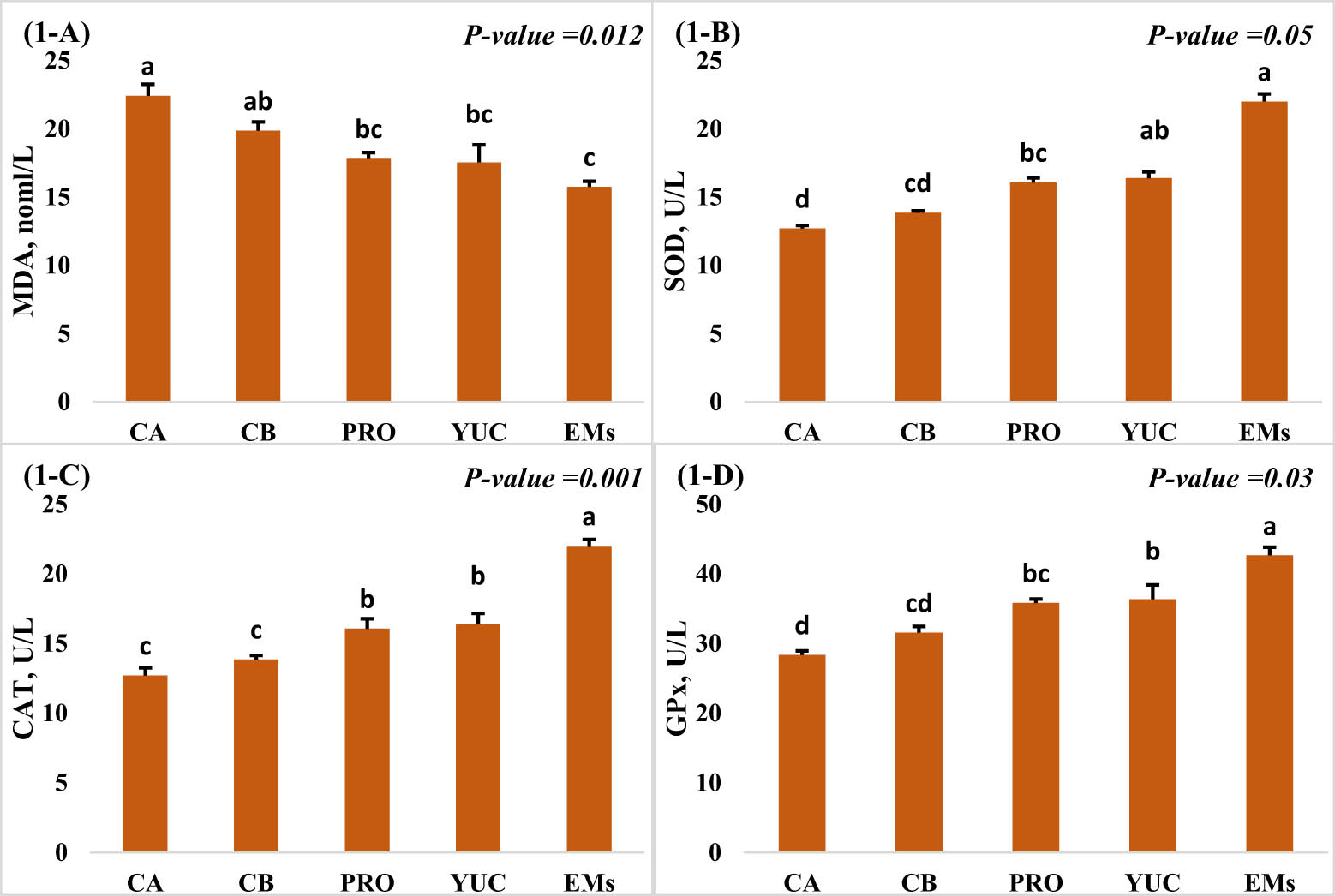
Figure 1
(A, B, C, and D) Effect of watery additives on antioxidant enzymes of Nile tilapia reared under zero-water exchange for 84 days. Significant differences were determined at P ≤ 0.05 for means (± SE) in bar chart with different superscript letters (a, b, c).
3.7. Intestinal digestive enzymes
Figure 2(a–c) displays the concentrations of intestinal digestive enzymes, which varied significantly among the different treatments. EMs exhibited the highest levels of amylase, lipase, and protease, followed by YUC, PRO, and CB, in that order. CA shows the lowest concentrations of these enzymes.
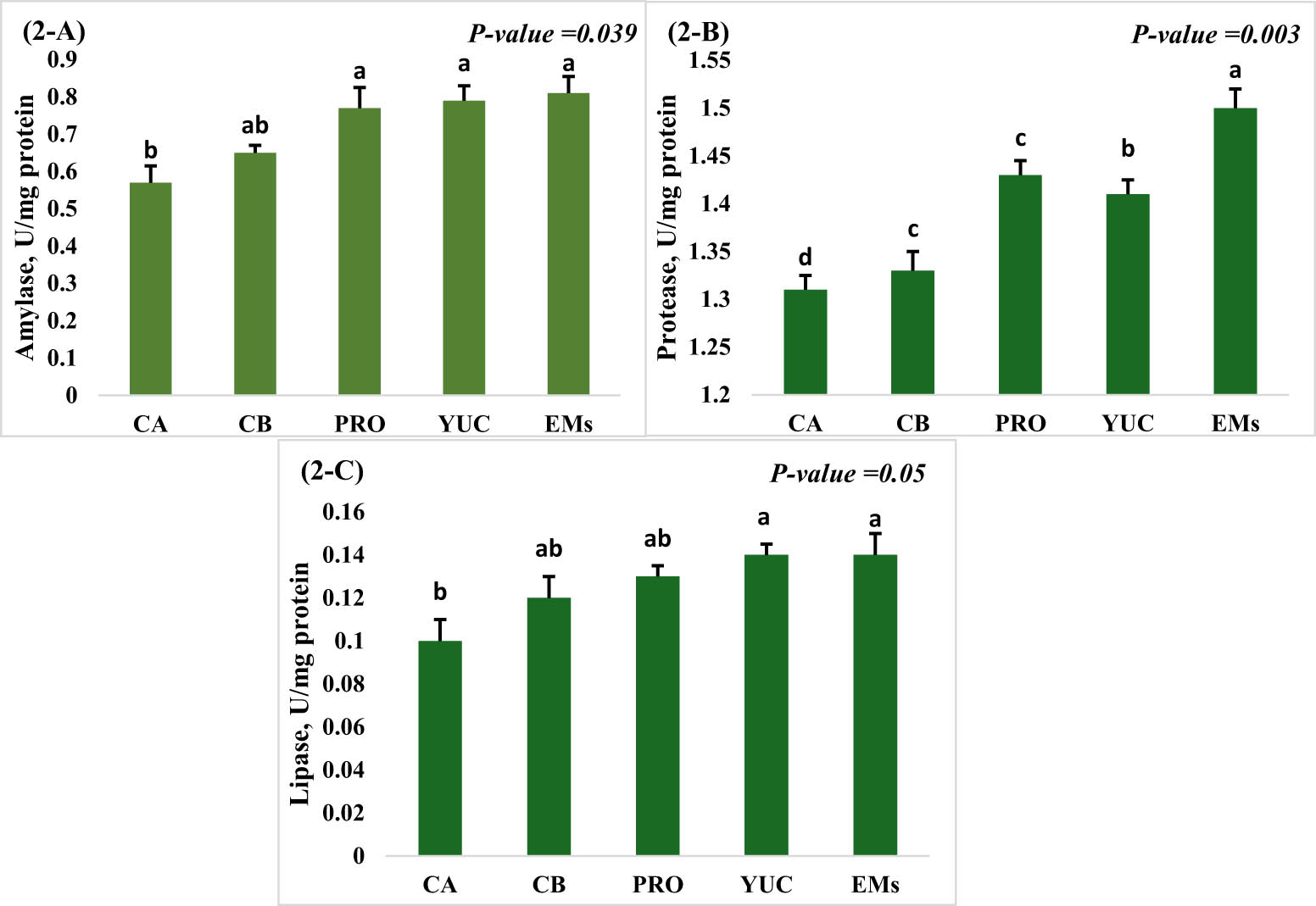
Figure 2
(A, B, and C). Effect of watery additives on intestinal digestive enzymes of Nile tilapia reared under zero-water exchange for 84 days. Significant differences were determined at P ≤ 0.05 for means (± SE) in bar chart with different superscript letters (a, b, c.).
4. Discussion
The maintenance of water quality within the optimum limits is a major goal of commercial aquaculture for achieving sustainability and economic efficiency (Fadel et al., 2024; Abdel-Aziz et al., 2024). Indicators of water quality showed optimum ranges of temperature, pH, and dissolved oxygen for tilapia growth and health according to Kausar, Sultan (2006), Boyd (2017), and Riche & Garling (2003). However, total ammonia nitrogen TAN (NH4 + NH3 −) and unionized NH3-N, both gradually increased with zero-water exchange during the experimental period. TAN at very low concentrations (0.2 mg/L) is harmful to fish and other aquatic life (Randall & Tsui, 2002). At relatively low concentrations, unionized ammonia has negative effects on fish tissues, including gill damage, as well as physiological variables (Francis-Floyd et al., 2009). It was decided that an amount of 0.06 ppm of NH3 can cause damage to the kidneys and gills (Emerson et al., 1975). Also, high concentrations of NO2 can cause hypoxia due to the deactivation of hemoglobin in fish blood (Lawson, 1995). The optimum concentration of NO2 is less than 0.5 mg/L (Swann, 1997).
In light of our results, the biological applications that were used in this study had a substantial portion in boosting the physiological function or performance of fish and a big role in improving the performance or physiological status of fish in the EMs, YUC, and PRO groups, respectively, in comparison to the CB group or CA group, which had the highest NH3, nitrite, and TSS. Our findings affirmed that the formation of dissolved and sedimentary organic substances through the production cycle, which increases NH3-N levels, can be reduced by adding probiotics or prebiotics to cultured ponds. It is believed that bacterial inocula function through the degradation of organic matter, nitrification, ammonia removal, denitrification, sulfide oxidation, and the breakdown of toxic pollutants (Gross & Boyd, 1998).
As mentioned earlier, EMs are mixed cultures composed of beneficial microorganisms, including Lactobacillus (LAB), photosynthetic bacteria, actinomycetes, yeast, and other organisms (Zheng et al., 2020). Narmatha et al. (2017) recommended that Lactobacillus fermentum can be used as a feed additive for the sustainable production of Macrobrachium rosenbergii due to its ammonia reduction capacity.
Also, yeasts and LAB of EMs have the ability to decrease pH levels. This, in turn, leads to lower ammonia (NH3) levels in pond water. In this way, Wang et al. (2005) discovered that nitrifying bacteria Nitrosomonas and Nitrobacter grew in shrimp ponds that were fed with a commercial probiotic. Song et al. (2014) also found notable decreases in NO2, TAN, and sulfide metabolites following the addition of Bacillus sp. to the pond’s water. Moreover, mortality and ammonia levels were considerably lower when Bacillus subtilis had been administered into the rearing water of olive flounder (Paralichthys olivaceus) (Cha et al., 2013). Generally, ammonia removal efficiency using biological processes depends on water temperature, amount of organic substrate, time of retention, and types as well as density of micro-organisms (Caglia, 2013).
On the other side, yucca extracts contain two bioactive fractions, the steroidal saponin and the glycocomponent, which have surface-active properties and the ability to trap ammonia (Cheok et al., 2014). Additionally, Fayed et al. (2019) demonstrated YUC decreased water acidity. The reduced NH3-N levels are associated with lower pH and water temperature degrees (Fayed et al., 2019). Similarly, in Nile tilapia freshwater ponds, yucca extract at a concentration of 1 g/m3 improved water quality by lowering NH3-N. Also, yucca extract (75 mg/L) reduced TAN by 25–85% in the non-aerated setup pond and by 99% in the aerated setup pond of Kuruma shrimp postlarvae (Abdel-Tawwab et al., 2021; Santacruz-Reyes & Chien, 2010).
Consequently, it can be declared that the use of yucca extract should be considered to protect aquatic life from the harmful effects of waterborne ammonia.
Our observations showed that treated groups of EMs, YUC, and PRO had the highest rates of growth and feed utilization compared to the CB and CA groups. Where EMs contain the primary probiotic strains used in fish feeds to boost performance, feeding efficiency, and survival rate, they are LAB (Lactobacillus and Pediococcus) (Ringø &Gatesoupe, 1998). Yeast (Saccharomyces) in EMs significantly contributes to the enhancement of the biological performance of animals. Diab et al. (2006) noted enhancements of fish weight by feeding dietary yeast. Additionally, photosynthetic bacteria of EMs have an important role; they are able to separate the hydrogen from ammonia, hydrogen sulfide, and hydrocarbons and synthesize sugar in the presence of CO2 (Ozkay et al., 2022). EMs are a source of vitamins, digestive enzymes, and fatty acids; they also boost appetite and consumption of feed and reduce the negative effects of antinutritional factors (Abdel-Aziz et al., 2020; Lara-Flores et al., 2003). Yucca supplements may be associated with improved water indicators and better feeding efficiency. This is dependent on intestinal health and nutrient absorption, as yucca contains steroidal saponins and other surface-active compounds that enhance nutrient uptake (Abdel-Tawwab et al., 2021; Saleh et al., 2025a).
Also, the PRO product contains a specific mixture of Bacillus spp./1.5 × 1010 CFU. Bacillus species can have a positive impact on the host by improving nutrient utilization either directly through the production of extraneous enzymes or indirectly through their capacity to modify the gastrointestinal microbiome and support intestinal function (Hai, 2015). In the same context, the inclusion of B. subtilis and Bacillus licheniformis in diets may generate a number of external biocompounds, including vitamins or enzymes, capable of improving nutrient digestion through improvements in the gut microbiological profiles of Oreochromis Niloticus juveniles (Tachibana et al., 2020).
The clinical conditions brought on by stress can be detected in the hemato-biochemical indicators (Abdel-Latif et al., 2022; Hassan et al., 2023). Thereby, reduced RBC counts, Hct, and Hb showed up in Nile tilapia exposed to ammonia toxicity (Zeitoun et al., 2016). This was observed in the CA group. Fayed et al. (2019) noted that hematology and physiology were considerably improved by adding yucca extract to the cultivating water for Dicentrarchus labrax. Additionally, Mansour et al. (2017) found that chronic stress from rising stocking densities or ammonia levels resulted in a decrease in WBC counts. Furthermore, the higher WBCs may result from increased utilization of eaten protein, which in turn may have increased the synthesis of leukocytes in the kidney and spleen, and these leukocytes serve as an infection defense (Abdel-Aziz et al., 2025). El-Ouny et al. (2023) indicate that elevated WBC counts are generally interpreted as a sign of immune activation resulting from exposure to toxic substances, and often neutrophilia and monocytosis are observed, reflecting a stress reaction. This result reflects greater wellness and better health status, especially since some treated groups’ values are substantially higher than those of the control group (El-Dakar et al., 2023). Increasing the release rate of liver enzymes (ALT and AST) into the blood indicates liver damage such as necrosis or inflammation (Saleh et al., 2025b).
Additionally, degenerative changes in the tubules and glomeruli, along with the expansion of Bowman’s capsules, hemorrhage, congestion, and necrosis, were observed (Farhangi & Rostami-Charati, 2012). These changes correspond to the increases in urea and creatinine levels, as this was noted in the control groups. Also, increased blood glucose indicates that fish were exposed to excessive stress (El-Dakar et al., 2023).
Our data indicate that groups treated with EMs, YUC, and PRO exhibited lower concentrations of glucose and decreased liver and kidney functions. This reflects the positive impacts of probiotics and yucca in helping fish recover from stress. According to Lara-Flores et al. (2003), incorporating probiotics into diets reduces stressors’ effects and improves performance. Similarly, Haridas et al. (2001) reported that yucca saponins reduced stress conditions in fish and improved liver health.
In terms of immunity indicators, total protein consists of two key components: albumin and globulin. Changes in their levels can be utilized to assess the functions of immunity and overall health (Patra et al., 2011; Zaki et al., 2023). Since globulins are important components of immunity, an increase in albumin and globulin levels suggests boosted protein synthesis and a more vigorous immunological response (Adam et al., 2023). Similarly, adding yucca to water increased the amounts of albumin and globulin in common carp, improving their resistance to ammonia exposure, wherein elevated levels of them are linked to a stronger nonspecific immune response (Abdel-Tawwab & El-Araby, 2021). Our results align with those of Zhou et al. (2010), who demonstrated that O. niloticus raised in water enriched with Bacillus coagulans B16, had increased levels of total protein and globulin compared to the control group.
By secreting lysozymes, the tilapia can face bacterial challenges and high stress as well as improve body immunity (Gao et al., 2012; Marzouk et al., 2024). A previous work by Han et al. (2015) demonstrated that giving Nile tilapia dietary feed enriched with B. licheniformis improved their nonspecific defense systems and their ability to resist Streptococcus iniae. Additionally, Nile tilapia showed a high survival rate following a challenge with Edwardsiella tarda due to the substantial impact of feeding Bacillus species on raising high lysozyme levels (Taoka et al., 2006). On the other hand, Wang et al. (2020) noted that incorporating yucca extract into the diet can enhance the immunity of Cyprinus carpio through increasing the activity of lysozyme. According to Sun et al. (2010) and Mashoof and Criscitiello (2016), the adaptive immune system of fish is primarily composed of immunoglobulins, of which IgM is the most common class. According to Abarike et al. (2018), elevated IgM expression levels serve as an innate defense mechanism that quickly protects against bacterial infections and indicates an improved state of the fish’s immune system. Previous studies indicate that administering pre/probiotics to fish boosts their immunity, and yucca saponins can activate innate immunity, promote cytokine release, and enhance humoral immune responses (Palatnik-de-Sousa et al., (2004); Abdel-Aziz et al., 2025). Bohlouli and Sadeghi (2016) found that rainbow trout receiving a 2 g kg−1 dose of Ferulago angulata extract showed an increase in total immunoglobulin levels. Likewise, Di et al. (2019) discovered that after 8 weeks, Dabry’s sturgeon fed a food enriched with B. subtilis had significantly higher IgM levels than those fed a control diet. Similarly, after 60 days, groupers (Epinephelus coioides) fed a dietary Bacillus pumilus supplement displayed noticeably greater levels of IgM expression (Liu et al., 2012).
Analyses of blood gas showed elevated pO2 and sO2 with reduced blood ammonia, pCO2, and HCO3 − EMs, YUC, and PRO groups. These could be caused by the active nitrification process in ponds treated with probiotics and EMs, as well as yucca’s ability to lower ammonia levels through its glycol and steroidal saponin components (Yang & Wang, 2015). In the same way, there is a positive correlation between fish blood physiology and water quality. Increased NH3-N in the aqueous ecosystem raises blood pH and reduces O2-carrying capacity (Xu et al., 2022). According to Wang et al. (2019), EMs can be utilized to prevent the water body from becoming eutrophic by lowering the nitrogen and phosphorus content in fish farming ponds. Saleh et al. (2025a) found that water additives, including probiotics and yucca, resulted in a 28% decrease in total ammonia concentration compared to the control group. Kord et al. (2022) emphasized that adding probiotics as watery or feed additives notably reduced levels of NH3-N, NO2, and NO3 in fish ponds. In addition to Hainfellner et al. (2018), Bacillus bacterial strains may modify DO by reducing the stress level of the fish, as shown by antioxidant levels, which lowers oxygen consumption in all bacterial-treated groups. Also, EM’s treatment showed the lowest blood pH; this may be due to EM’s content of LAB, whereas the blend of acids produced by LAB decreased the intracellular pH (Aitzhanova et al., 2021).
Fish immunity and general good health are strongly correlated with the antioxidant response (Khalil et al., 2019). Fish oxidative stress is mitigated by enzymatic processes, including SOD, CAT, and GPx (Adam et al., 2023). When reactive oxygen species (ROS) are out of equilibrium in biological systems, these enzymes can help restore normal redox homeostasis (Abdel-Latif et al., 2022). The increased MDA suggested that the antioxidant defense system was unable to reverse the damage caused by ROS (Alagawany et al., 2018; El-Agri et al., 2026). Pro/prebiotics are crucial for improving antioxidant activities in fish through several processes. These processes involve rapidly eliminating free radicals, inducing the synthesis of oxidative enzymes, regulating immunological responses, and promoting a healthy gut microbiome (Kord et al., 2021). It is crucial to take into account that the precise effects can change based on the fish species, the environment, and the specific probiotic strains utilized (Amenyogbe et al., 2024).
On the other hand, yucca can act as a good antioxidant as a result of its content of phytochemicals, including components of steroidal saponins and polyphenols (resveratrol and yuccaols A, B, C, D, and E). Resveratrol exhibited a powerful scavenging activity against free radicals (Alagawany et al., 2015). In the current work, water additives of EMs, YUC, and PRO showed improvements in antioxidant activities of fish. Similar data have been published by Abdel-Tawwab et al. (2021), who discovered that adding yucca extract and/or yeast to cultivating water considerably elevated SOD, CAT, and GPx activities in tilapia fish, indicating the powerful antioxidant properties of these water additives. Furthermore, malondialdehyde (MDA) levels were lower in fish groups that received yucca extract than in the control group (Paray et al., 2021).
Concerning digestive enzymes, pro/prebiotics were linked to improving intestinal health through modifying the gut microbiota’s composition and function. This is reflected in an improved intestinal microbial balance, which enhances feed digestion by generating digestive enzymes (Zaki et al., 2023). Numerous studies have documented that fish gut microbiota is balanced and improved by EMs, hence increasing the digestive enzyme activity and enhancing feed efficiency (Abdel-Aziz et al., 2020). Additionally, prebiotics serve as a source for beneficial bacteria, which improve the gut environment and, in turn, affect how well digestive enzyme’s function (Munir et al., 2016). Tovar-Ramírez et al. (2004) discovered that feeding sea bass with live yeast boosts the activity of its digestive enzymes. Also, Sankar et al. (2017) suggest that the higher protease and lipase activities obtained in the probiotic-supplemented fish are mainly the outcomes of stimulation by the probiotic itself or by the exogenous enzyme produced by the probiotics.
At the same time, it is believed that the fermentation of prebiotics produces short-chain fatty acids, which in turn promote the secretion of digestive enzymes and contribute to increased carbohydrase activity (Dhanasiri et al., 2023). Yucca extract supplementation led to an increase in protein synthesis, digestive enzymes, and nutrient absorption (Paray et al., 2021).
5. Conclusion
Our study concluded that the use of water additives such as EMs, YUC, and PRO had a positive effect on maintaining water quality and improving fish performance, digestibility, and immune responses under unchanged water conditions, compared with the control group. Among the treatments, the EM group demonstrated the best results across all parameters, which may be attributed to its composition of multiple beneficial microorganisms. These findings highlight the potential of such additives for enhancing aquaculture sustainability. Furthermore, our study provides a foundation for future research aimed at optimizing water use and promoting sustainable aquaculture practices, particularly in desert regions, through the biological application of microorganisms.
Funding information
Authors state no funding involved.
Author contributions
H.H.E.S., B.S.A., M.A.E., H.S.K., N.M.N.E., M.M.A.H., M.M.I.K., A.M.H.K., M.F.A.-A.: Conceptualization, data curation, formal analysis, investigation, methodology, resources, validation, visualization, writing – original draft. M.F.A.-A., H.H.E.S. and H.S.K.: Writing – review and editing.
Conflict of interest statement
The authors declare that they have no known competing financial interests or personal relationships that could have appeared to influence the work reported in this paper.
Data availability statement
All data generated or analyzed during this study are included in this article.