
Research on semen quality is particularly important in breeding of endangered poultry species as the results could be applied to reproductive strategies for both in situ and ex situ conservation programs (Blanco et al., 2009; Sun et al., 2022). In this context, effective short-term liquid storage of semen is of great interest because it can facilitate the transport of semen from superior males and can increase the size of such chicken populations without risks of inbreeding. Intensive work is being carried out all over the world on the optimization of methods for handling semen from indigenous breeds of roosters (Kheawkanha et al., 2023; Di Iorio et al., 2024; Koedkanmark et al., 2024; Pimpa et al., 2024; Ratchamak et al., 2025), but there is no research in this area for Polish breeds. To address this gap, it is worth evaluating the optimal storage time and determining which sperm characteristics in individually collected semen samples from indigenous breeds are affected by various liquid storage periods. Moreover, few studies have been conducted to characterize the multiple variables of liquid preserved sperm from indigenous breeds of roosters using objective and repeatable methods (Kheawkanha et al., 2023; Ratchamak et al., 2025), which may contribute to the improvement of future in vitro storage techniques.
It is known that the breed and/or line of commercially used chickens can affect quantitative and qualitative semen traits (Łukaszewicz et al., 2020; Tesfay et al., 2020; Kopec et al., 2025). Furthermore, basic semen quality parameters have been shown to differ between indigenous breeds (Feyisa et al., 2018) and standard laying chicken strains (Mavi et al., 2019). More recently, Di Iorio et al. (2024) showed differences in some semen parameters in several Italian native chicken breeds. To these authors’ knowledge, modern analytical methods have not yet been used to compare qualitative semen traits between commercial roosters and indigenous breeds that may have unique reproductive traits.
Native breeds are an important genetic resource for niche food products obtained in sustainable agriculture. One such breed is the Polish Crested (PCr) chicken, managed by the University of Agriculture in Krakow (Poland). Protecting this breed is important for national heritage and biodiversity as it serves as a reservoir of adaptive traits suited to local environmental conditions. To date, this breed has been evaluated in terms of occurrence of brooding behavior (Gumułka et al., 2020), meat quality (Węglarz et al., 2020) and physicochemical egg quality parameters (Gumułka et al., 2022; Lewko et al., 2024). In addition, basic semen quality parameters of PCr roosters have been determined using standard analytical methods, and ejaculate volume, sperm concentration and morphology have been estimated in relation to the stage of the breeding season (Czech and Gumułka, 2021). Thus, it seems reasonable to undertake an additional investigation of semen quality parameters in native PCr using computer-assisted semen analysis (CASA) and flow cytometry (FC). The results obtained in such conditions may extend beyond local applications, providing valuable insights for semen evaluation in various indigenous rooster breeds worldwide.
Principal component analysis (PCA) is a multivariate statistics method that reduces the number of associated traits to a small number of independent variables called principal components, while minimizing loss of the original data. PCA analyses of semen quality datasets of Florida goats (Dorado et al., 2010) and Egyptian buffalo bulls (Amin et al., 2024) have shown that it is possible to limit the number of semen features taken into account when assessing the reproductive potential of males, thereby simplifying breeding practice. Moreover, studies have shown that PCA is an effective method for simplifying the classification of breeding bulls (Tamargo et al., 2024) and rams (Yánez-Ortiz et al., 2024) according to sperm cryoresistance, based on different parameters of frozen–thawed sperm datasets. Previous PCA analyses of semen parameters of commercially used (Tesfay et al., 2020) and native breeds of roosters (Di Iorio et al., 2024) indicate the possibility of their practical use to demonstrate differences in semen quality between and within breeds, thus potentially helping to refine the selection of breeder roosters by enabling the comprehensive use of different sperm quality measures.
The study tested the hypothesis that semen from native PCr matched the quality of semen produced by commercial roosters in terms of sperm motility, viability, and chromatin stability. It also investigated whether it was possible to store liquid-preserved semen from these roosters for a short period without significant loss of sperm quality.
The objective of this study was to examine semen quality from native Polish Crested (PCr) in comparison to Hy-Line Brown (HLB) roosters, and to assess the effect of short-term storage on quality parameters of semen collected during the peak of reproductive activity. Moreover, the relationships between different sperm quality parameters were evaluated in order to check the possibility of reducing the number of features taken into account in the semen characterization, which would therefore simplify estimation of future fertilizing potential.
Material and methods
Experimental birds and management
The study was carried out on native Polish Crested (PCr, CP-11 strain) chickens and Hy-Line Brown (HLB) roosters. PCr are kept as part of a poultry genetic resources conservation program (Directive of the Director of National Research Institute of Animal Production, 2023). The roosters were hatched, reared and managed at the Research and Education Centre of the Faculty of Animal Sciences of the Agricultural University in Krakow, Poland. The males (n = 10/genetic group) were kept in pens on litter in an experimental building. Males were photostimulated at 18 weeks of age. A lighting schedule was used that combined natural and artificial light: 16 h L: 8 h D (lights on from 05:00 to 21:00 h; 10–15 lx). The temperature in the building was around 20°C with relative humidity of 65–70%. The housing conditions were in accordance with the standards for laying hens (European Union, 1999). Feed and water were available ad libitum. A commercial granulated layer-breeder mixture was used for feeding. The chemical composition of the mixture was 11.3 MJ/kg ME, 15.0% crude protein, 5.1% crude fat, 4.6% crude fiber, 90.5% dry matter, 18.6% of crude ash.
Semen collection and liquid preservation
All procedures in the study were approved by the II Local Ethical Committee for Animal Experiments in Krakow at the Institute of Pharmacology in Krakow, Poland (PL) – resolution No 154/2022.
Individual semen samples were collected weekly using the abdominal massage procedure (Burrows and Quinns, 1937) during the peak of reproductive activity (from 30 to 37 wk of rooster age). This time period was adopted based on the egg production patterns of PCr hens, as described in previous studies (Gumułka et al., 2020). The roosters were trained to give semen 2 weeks (3 times per week) before the collection. During the experiment, the place, time and operators of the semen collection were the same. Finally, 6 roosters of each genetic group were used in the study. These roosters displayed an optimal response to the semen collection procedure and provided semen with an average volume for a given genetic group and without contamination. A total of 30 semen samples were collected from each genetic groups over five consecutive weeks (5 replicates).
Immediately after semen collection, individual semen samples were fourfold diluted (1 part semen: 3 parts extender) in commercial poultry semen extender (IMV Technologies, L’Aigle, France). The dilution was based on the results of previous studies of semen from roosters of both genetic groups (Czech and Gumułka, 2021). Then semen was cooled at 5ºC and transported to the laboratory for further analyses. Transport occurred within 30 min of collection in a cool transportation box. In the laboratory, the samples were stored for up to 48 h under refrigeration at 5ºC. All individual semen sample analyses were performed immediately after transport (control – 0 h) and after 24 h and 48 h of storage in 5ºC.
Semen evaluation
Sperm motility analysis (CASA)
Sperm motility was measured using a CASA system (Sperm Class Analyzer, Version 6.5.0.44, Microptic S.L., Barcelona, Spain), as previously described by Gogol and Trzcińska (2022) with minor modifications. Image acquisition was performed at 25 frames per second. Each semen sample was diluted at ratio of 1:100 (v/v) using pre-warmed (38ºC) PBS (Sigma-Aldrich Chemie GmbH, Steinheim, Germany), then 1 μL of semen was loaded into a counting chamber with a depth of 20 µm (Leja slide; Leja Products B.V., GN Nieuw-Vennep, Netherlands) on a heated stage (38°C). Per sample, 1000 sperm were analyzed in 3 fields of view. For each individual sample, total motility (MOT; MOT = % of motile sperm) and kinetic parameters were studied. The definitions of kinetic parameters were adopted according to Agarwal et al. (2003). Thus, the kinetic parameters measured included the following: curvilinear velocity (VCL; μm/s) – the time-average velocity of a sperm head along its actual curvilinear path (measured in two dimensions); straight-line velocity (VSL; μm/s) – the time-average velocity of a sperm head along the straight line between its first detected position and its last; average path velocity (VAP; μm/s) – the time-average velocity of a sperm head along its average path. VAP is computed by smoothing the actual path according to algorithms in the CASA instrument; linearity (LIN; LIN % = VSL/VCL × 100) – the linearity of a curvilinear path; straightness (STR; STR % = VSL/VAP × 100) – reflecting the straightness of motion; path wobble (WOB% = VAP/VCL × 100) – the departure of actual sperm track from average path; amplitude of lateral head displacement (ALH; μm) – the magnitude of lateral displacement of a sperm head about its average path.
Measurement of sperm characteristics using flow cytometry (FC)
Sperm with apoptotic changes (YO-PRO-1/PI)
Each semen sample was diluted using PBS to 1 × 10⁶ cells/ml, then mixed with 1 µl YO-PRO-1 (V13243, Thermo Fisher Scientific, Waltham, MA, USA) and incubated at room temperature for 20 minutes in the dark. Next 1 µl propidium iodide (PI) water solution (1 µg/ml) was added, and the samples were analyzed after 2 minutes, as described by Peña et al. (2024) with minor modifications. Fluorescence measurements were carried out using FC. YO-PRO-1 is a cell-impermeant nucleic acid stain that fluoresces green and can be used as an early marker of apoptotic changes in sperm. PI is a conventional dead cell stain which causes cells with damaged membranes to fluoresce red. Sperm population was determined on the forward scatter (FSC) vs side scatter (SSC) dot plot. Debris were identified on the green vs red fluorescence dot plot as the population with the lowest fluorescence. The results are presented as the percentage of viable spermatozoa with apoptotic changes.
Sperm DNA fragmentation index (DFI)
The sperm chromatin structure assay (SCSA) method was used to examine sperm nuclear chromatin integrity, as previously described (Gumułka and Rozenboim, 2015). A sample of 100 µl of semen with a concentration of 1 × 10⁶ cells/ml was placed on ice without access to light and diluted with 200 µl of permeabilizing solution (8 ml 1N HCl, 0.1 ml Triton X-100, 0.877 g NaCl, distilled water up to 100 ml) for 30 seconds to induce DNA denaturation. Then, 600 µl of staining solution with acridine orange (37 ml 0.1 M citric acid, 63 ml 0.2 M Na2HPO4, 0.877 g NaCl, 34 mg EDTA, 0.6 mg acridine orange) was added to stain the DNA chains. Samples were analyzed after 5 minutes of incubation. Fluorescence measurements were carried out using FC. Spermatozoa without detectable levels of DNA fragmentation emitted green fluorescence, while those with DNA fragmentation emitted red fluorescence. Sperm population gating to exclude debris was based on FSC vs SSC plots and was performed on red vs green cytogram. The DNA fragmentation index (DFI) was calculated (DFI = red fluorescence/(red fluorescence + green fluorescence × 100) from the sperm DNA fragmentation histogram. % DFI = % cells outside the main sperm population.
Sperm viability (SYBR-14/PI)
Sperm membrane integrity was assessed using a LIVE/DEAD Sperm Viability Kit (L7011, Thermo Fisher Scientific, Waltham, MA, USA), as previously described (Gumułka and Rozenboim, 2015). Aliquots of 1000 μL of diluted samples (5 × 10⁶ sperm/mL in PBS) were pipetted into cytometric tubes, then 5 μL of SYBR-14 working solution was added. The working solution was obtained by diluting a commercial solution of SYBR-14 in distilled water at a ratio of 1:49. Samples were mixed and incubated at 37°C in the dark for 10 minutes; then, they were stained with 5 μL of PI in a dark place at room temperature for 3 min. Measurements were carried out on an FC. SYBR-14 is a membrane-permeant nucleic acid stain that causes live sperm cells with intact cell membranes to fluoresce bright green. PI is a conventional dead cell stain which causes cells with damaged membranes to fluoresce red. Sperm population gating based on FSC vs SSC dot plots was performed to exclude debris. These gated events were considered to be sperm cells if they retained cell structure (not debris) when stained with SYBR-14 or PI. Based on the analysis, sperms were scored as viable with an intact cell membrane; non-viable with a damaged membrane; and moribund with a damaged cell membrane but still metabolically active.
Flow cytometry (FC) characteristic
The CytoFlex (Beckman Coulter, Brea, CA, USA) FC was used in the following configuration: the blue 488 nm laser for fluorochrome excitation; filter set of 525/40 BP for green fluorescence, and 690/50 BP for red fluorescence. The ‘Slow’ (10 μl/min) sheath flow rate was applied for all samples and 10,000 spermatozoa were acquired. Instrument calibration was checked each day with CytoFLEX Daily QC (Beckman Coulter) fluorospheres. For off-line data analyses, the CytExpert (ver. 2.0) (Beckman Coulter) software was used.
Statistical analysis
In the experiment a research unit was an individual rooster. The data were examined for normal distribution using the Kolmogorov-Smirnov test, and the Fisher-Snedecor test was used to assess the homogeneity of the variances. The assumption of sphericity was checked using the Mauchly test. For data that did not meet the assumptions of sphericity, the Greenhouse-Geisser correction changed the results minimally and did not affect their interpretation. A mixed-design repeated ANOVA (Mixed RM ANOVA) was performed with one between-subjects factor (genetic group) and two within-subjects (repeated measures) factors. The repeated factor was measurements of semen quality on consecutive days of storage. Additionally, the analytical model included another repeated-measurements factor, i.e., semen collection performed weekly for 5 consecutive weeks, but this was not an experimental factor. This factor was included in the model to achieve mathematical correctness. Subsequent semen collections were performed at the peak of reproductive activity, when semen quality remained relatively stable. The effect of individual factors (genetic group – PCr, HLB; storage time – 0 h, 24 h and 48 h) was estimated, as well as interactions between factors (genetic group × storage time). Tukey’s test was performed as a post-hoc analysis. P values of less than 0.05 were considered to be statistically significant. Data are presented as the mean ± standard error of the mean (SE). Moreover, an analysis of the relationship between sperm quality parameters at 0 h storage time point (control) was performed by estimating the Pearson linear correlation coefficients. Calculation coefficients were evaluated for each genetic group, i.e., PCr and HLB. P values of less than 0.05, 0.01 and 0.001 were considered to be statistically significant. The results of Bartlett’s test of sphericity (chi-square=3695.3; df=78; P<0.0001) and the Keiser-Mayer-Olkin coefficient (KMO = 0.6713) indicated the validity of conducting principal component analysis. PCA analyses were performed for sperm parameters at all storage time points and for both genetic groups together. Then, the newly obtained relative semen quality parameters were analyzed as described previously. P values of less than 0.05 were considered to be statistically significant. The statistical analysis was processed using Statistica version 13.3 (TIBCO Software Inc., Palo Alto, CA).
Results
Comparison of total sperm motility and kinetic sperm parameters between genetic groups during storage (CASA)
Storage time had a significant effect on MOT, sperm velocity and movement trajectory, but it had no effect on the LIN parameter (Table 1). MOT was greater than 90% for semen samples evaluated shortly after dilution (0 h). After storage for 24 h and 48 h, MOT decreased on average by 10.7% and 24.9%, respectively, compared to the 0 h storage time point. Moreover, after 48 h of storage MOT was 14.2% lower compared to after 24 h of storage. VCL and ALH values were greater at 0 h than at the 24 h and 48 h storage time points. After 24 h and 48 h of storage, the values of these sperm parameters were similar. However, the VSL and VAP decreased gradually with semen storage time and were lower at 48 h compared to the 0 h and 24 h storage time points. Sperm movement trajectory showed less dynamics of changes with semen storage time than the velocity parameters. The STR and WOB decreased significantly only after 48 h of semen storage; STR at this time point was lower compared to that recorded after 24 h, while WOB was lower than after 0 h and 24 h of storage.
Table 1.
Total motility and kinetic parameters of sperm (mean ± SE) of native Polish Crested chickens and Hy-Line Brown roosters (n= 6/genetic group; number of ejaculate 30/storage time) in relation to short-term storage
| Characteristic | Item | MOT (%) | VCL (µm/s) | VSL (µm/s) | VAP (µm/s) | LIN (%) | STR (%) | WOB (%) | ALH (µm) |
|---|---|---|---|---|---|---|---|---|---|
| PCr | 0 h | 93.9±1.3 c | 53.9±2.5 b | 27.1±1.7 b | 37.3±1.9 bd | 51.9±2.4 a | 71.5±1.9 a | 74.7±1.7 ab | 2.4±0.1 b |
| 24 h | 83.6±1.9 b | 39.9±1.2 a | 21.7±0.5 a | 28.8±0.7 ae | 54.3±1.9 a | 73.3±1.5 a | 76.5±1.2 bc | 1.8±0.1 a | |
| 48 h | 71.4±2.7 a | 36.8±1.0 a | 19.5±0.5 a | 25.9±0.7 a | 48.3±2.5 a | 68.6±1.9 a | 70.4±2.1 a | 1.7±0.1 a | |
| HLB | 0 h | 92.5±1.4 c | 51.4±2.1 b | 25.9±0.9 b | 35.7±1.3 cd | 52.1±2.1 a | 71.4±1.6 a | 74.5±1.5 a | 2.3±0.1 b |
| 24 h | 84.5±2.2 b | 39.9±1.7 a | 22.2±0.6 a | 29.0±1.0 be | 51.8±1.6 a | 73.5±1.9 a | 75.8±1.8 ac | 1.8±0.1 a | |
| 48 h | 65.2±2.8 a | 36.3±1.1 a | 19.2±0.5 a | 24.9±0.7 a | 47.5±2.2 a | 67.5±1.6 a | 68.1±1.6 a | 1.6±0.1 a | |
| Genetic group (G) | PCr | 82.9±1.5 a | 43.6±1.7 a | 22.7±0.7 a | 30.7±0.9 a | 51.5±1.4 a | 71.1±1.1 a | 73.9±1.0 a | 2.0±0.1 a |
| HLB | 79.7±1.7 a | 42.6±1.6 a | 22.4±0.5 a | 29.9±0.8 a | 50.5±1.2 a | 70.8±1.0 a | 72.8±0.1 a | 1.9±0.1 a | |
| Storage time (S) | 0 h | 93.2±0.9 c | 52.6±1.6 b | 26.5±0.9 c | 36.5±1.2 c | 52.0±1.6 a | 71.4±1.3 ab | 74.6±1.1 b | 2.3±0.1 b |
| 24 h | 82.5±1.5 b | 39.9±1.1 a | 21.9±0.4 b | 28.9±0.6 b | 53.0±1.2 a | 73.4±1.2 b | 76.2±1.1 b | 1.8±1.1 a | |
| 48 h | 68.3±2.0 a | 36.6±0.7 a | 19.3±0.4 a | 25.4±0.5 a | 47.9±1.6 a | 68.0±1.3 a | 69.3±1.3 a | 1.7±0.0 a | |
| P-value | |||||||||
| G | 0.1323 | 0.5040 | 0.5606 | 0.3903 | 0.5308 | 0.7672 | 0.4814 | 0.7487 | |
| S | <0.0001 | <0.0001 | <0.0001 | <0.0001 | 0.0625 | 0.0197 | 0.0027 | <0.0001 | |
| G × S | 0.3580 | 0.6914 | 0.6292 | 0.7060 | 0.8285 | 0.9241 | 0.8503 | 0.9903 | |
[i] a, b, c, d, e – values in the same column with different letters differ significantly P<0.05 – PCr vs HLB storage time point; genetic group; storage time.
[ii] Abbreviations: MOT – total motility; VCL – curvilinear velocity; VSL – straight-line velocity; VAP – average path velocity; LIN – linearity (LIN=VSL/VCL × 100); STR – straightness (STR=VSL/VAP × 100); WOB – path wobble (WOB=VAP/VCL × 100); ALH – amplitude of lateral head displacement; Sperm motility parameters were assessed by CASA system; PCr – Polish Crested chickens; HLB – Hy-Line Brown; G – genetic group; S – storage; G × S – interaction genetic group × storage.
Comparison of changes in sperm apoptosis, DNA integrity and viability between genetic groups during storage
The level of apoptotic changes was significantly affected by genetic group and storage time (Table 2). The percentage of these negative changes in sperm was on average 1.3% higher in the HLB compared to the PCr rooster. Moreover, for HLB and semen samples analyzed for both genetic groups together, the level of apoptotic sperm increased after 24 h of storage and was higher than noted at the 0 h storage point. However, for semen collected from PCr, the value of this parameter remained at a stable level of approximately 4.0% during the storage period.
Table 2.
The proportion of apoptotic changes, DNA fragmentation index and membrane integrity of sperm (%, mean ± SE) of native Polish Crested chickens and Hy-Line Brown roosters (n= 6/genetic group; number of ejaculate 30/storage time) in relation to short-term storage
| Characteristic | Item | Apoptotic | DFI | Viable | Non-viable | Moribund |
|---|---|---|---|---|---|---|
| PCr | 0 h | 3.1±0.5 a | 4.8±0.8 a | 93.3±1.0 c | 2.8±0.4 a | 3.9±0.6 a |
| 24 h | 5.1±0.8 ac | 10.3±1.7 b | 92.2±0.9 c | 3.7±0.5 a | 4.1±0.5 a | |
| 48 h | 4.1±0.6 a | 22.2±2.0 d | 92.1±0.8 c | 3.4±0.4 a | 4.5±0.6 a | |
| HLB | 0 h | 3.8±0.6 a | 8.3±0.8 a | 89.7±1.0 b | 4.9±0.6 b | 5.3±0.6 b |
| 24 h | 6.9±1.2 bc | 18.8±2.2 c | 86.9±1.2 a | 6.5±0.8 bc | 6.8±0.7 c | |
| 48 h | 5.6±0.6 ab | 34.7±3.2 e | 86.7±0.8 a | 6.8±0.7 c | 6.5±0.6 c | |
| Genetic group (G) | PCr | 4.1±0.4 a | 12.4±1.2 a | 92.5±0.5 b | 3.3±0.2 a | 4.2±0.3 a |
| HLB | 5.4±0.5 b | 20.6±1.8 b | 87.8±0.6 a | 6.1±0.4 b | 6.1±0.4 b | |
| Storage time (S) | 0 h | 3.5±0.4 a | 6.6±0.6 a | 91.4±0.7 b | 3.9±0.4 a | 4.6±0.5 a |
| 24 h | 6.0±0.7 b | 14.5±1.4 b | 89.5±0.8 a | 5.1±0.5 b | 5.3±0.5 b | |
| 48 h | 4.9±0.4 ab | 28.5±2.1 c | 89.3±0.7 a | 5.1±0.5 b | 5.5±0.4 b | |
| P-value | ||||||
| G | 0.0290 | <0.0001 | 0.0001 | <0.0001 | 0.0015 | |
| S | 0.0004 | <0.0001 | 0.0001 | 0.0041 | 0.0081 | |
| G × S | 0.4981 | <0.0001 | 0.1223 | 0.2313 | 0.2320 | |
[i] a, b, c – values in the same column with different letters differ significantly P<0.05 – PCr vs HLB storage time point; genetic group; storage time.
[ii] Abbreviations: apoptotic sperm –Yo-PRO-1 positive; DFI – DNA fragmentation index; viable – sperm with intact cell membrane; non-viable – sperm with a damaged cell membrane; moribund – sperm with a damaged cell membrane – metabolically active. Semen sample measurement: YO-PRO 1/propidium iodide (PI) staining and flow cytometry (FC) technique; DFI – sperm chromatin structure assay (SCSA) method based on acridine orange test and FC; viable – sperm SYBR-14/PI staining and FC; PCr – Polish Crested chickens; HLB – Hy-Line Brown; G – genetic group; S – storage; G × S – interaction genetic group × storage.
The sperm’s DFI (%) was significantly affected by genetic group, storage time, and the interaction of these two factors (Table 2). The percentage of chromatin damage was on average 8.2% higher for the HLB compared to the PCr rooster. For semen collected from roosters of both genetic groups, DFI (%) increased gradually with semen storage time. After 24 h and 48 h of storage, DFI (%) of semen from PCr increased by 5.5% and 17.4% compared to the 0 h storage point, respectively. For HLB, DFI (%) increased by 10.5% and by 25.9% after 24 h and 48 h of storage compared to 0 h storage point, respectively. Moreover, after 48 h of storage, chromatin damage was 11.9% and 15.9% higher compared to after 24 h of storage for PCr and HLB rooster, respectively.
The values of all sperm viability parameters were affected by genetic group and storage time (Table 2). The percentage of viable sperm was on average 4.7% higher for the PCr compared to the HLB rooster. The share of non-viable and moribund sperm was on average 2.8% and 1.9% lower for PCr than HLB semen. Moreover, for HLB and semen samples analyzed for both genetic groups together, the percentage of viable sperm decreased after 24 h and 48 h of storage and was about 3.0% lower than at the 0 h storage time point. In contrast, the percentage of non-viable and moribund sperm analyzed for both genetic groups together was about 1.0% higher after 24 h and 48 h of storage than at the 0 h storage point. However, for semen collected from PCr, the value of viability parameters remained at a stable level of about 92.0% for viable sperm, about 3.0% for non-viable, and about 4.0% for moribund sperm during the storage period.
Pearson correlation coefficients for sperm quality parameters
The results of the correlation analysis between sperm quality parameters of PCr and HLB roosters are presented in Table 3. For both genetic groups, MOT was estimated to be moderately positively correlated with most of the sperm kinetic parameters, such as VCL, VSL, VAP and ALH. Additionally, for PCr a moderate positive correlation was found between MOT and WOB. Furthermore, sperm kinetic parameters generally displayed a strong to moderate positive correlation when compared with each other. Only ALH was moderately negatively related to STR for both genetic groups and to LIN for HLB. For both genetic groups, apoptotic sperm showed a moderate negative correlation with viable sperm and a moderate positive correlation with moribund sperm. Additionally, for PCr a moderate positive correlation was estimated between apoptotic and non-viable sperm. For both genetic groups, moderate negative correlation coefficients were found between DFI (%) and viable sperm. In contrast, a moderate positive correlation was noted between DFI (%) and non-viable sperm. Additionally, for PCr a moderate positive correlation was found between DFI (%) and moribund sperm.
Table 3.
Pearson correlation coefficients for sperm quality parameters of native Polish Crested chickens (PCr; above the diagonal) and Hy-Line Brown roosters (HLB; below the diagonal) measured at the 0 h storage point
| MOT | VCL | VSL | VAP | LIN | STR | WOB | ALH | Apoptotic | DFI | Viable | Non-viable | Moribund | |
|---|---|---|---|---|---|---|---|---|---|---|---|---|---|
| MOT | 0.620*** | 0.540** | 0.654*** | 0.340 | 0.201 | 0.507** | 0.566** | –0.118 | –0.007 | 0.236 | –0.314 | –0.160 | |
| VCL | 0.560** | 0.758*** | 0.931*** | 0.077 | –0.028 | 0.179 | 0.874*** | –0.197 | 0.293 | 0.052 | –0.178 | 0.037 | |
| VSL | 0.568** | 0.668*** | 0.930*** | 0.634*** | 0.542** | 0.640*** | 0.382* | –0.110 | 0.429* | –0.041 | –0.040 | 0.092 | |
| VAP | 0.608*** | 0.930*** | 0.882*** | 0.401* | 0.261 | 0.476** | 0.689*** | –0.207 | 0.357 | 0.062 | –0.158 | 0.008 | |
| LIN | 0.287 | –0.282 | 0.434** | 0.034 | 0.958*** | 0.952*** | –0.274 | 0.111 | 0.350 | –0.186 | 0.218 | 0.144 | |
| STR | 0.313 | –0.300 | 0.411* | –0.001 | 0.970*** | 0.865*** | –0.404* | 0.152 | 0.342 | –0.280 | 0.285 | 0.248 | |
| WOB | 0.324 | –0.213 | 0.472 | 0.112 | 0.975*** | 0.905*** | –0.111 | 0.067 | 0.350 | –0.089 | 0.089 | 0.080 | |
| ALH | 0.470** | 0.959*** | 0.499** | 0.843*** | –0.448* | –0.477** | –0.357 | –0.261 | 0.175 | 0.225 | –0.295 | –0.155 | |
| Apoptotic | –0.313 | –0.277 | –0.244 | –0.279 | –0.200 | –0.172 | –0.228 | –0.214 | 0.097 | –0.485* | 0.430* | 0.471* | |
| DFI | –0.213 | –0.381 | –0.163 | –0.274 | 0.281 | 0.200 | 0.321 | –0.342 | 0.309 | –0.676*** | 0.701*** | 0.598*** | |
| Viable | 0.286 | 0.134 | 0.130 | 0.145 | 0.172 | 0.157 | 0.182 | 0.105 | –0.657*** | –0.568** | –0.909*** | –0.957*** | |
| Non-viable | –0.243 | –0.203 | –0.131 | –0.196 | –0.041 | –0.040 | –0.059 | –0.180 | 0.309 | 0.566** | –0.770*** | 0.751*** | |
| Moribund | 0.192 | –0.000 | –0.065 | –0.022 | –0.223 | –0.197 | –0.218 | 0.021 | 0.564*** | 0.322 | –0.761*** | 0.173 |
[ii] Abbreviations: MOT (%) – total motility; VCL (µm/s) – curvilinear velocity; VSL (µm/s) – straight-line velocity; VAP (µm/s) – average path velocity; LIN (%) – linearity (LIN=VSL/VCL × 100); STR (%) – straightness (STR=VSL/VAP × 100); WOB (%) – path wobble (WOB=VAP/VCL × 100); ALH (µm) – amplitude of lateral head displacement; apoptotic sperm (%) – Yo-PRO-1 positive; DFI (%) – DNA fragmentation index; viable – sperm with intact cell membrane; non-viable – sperm with a damaged cell membrane; moribund – sperm with a damaged cell membrane – metabolically active.
Principal component analysis summarizing multivariate semen quality patterns (PCA)
The results of the principal component analysis (PCA) for the sperm parameters are presented in Figure 1 and Figure 2 A, B, C. The PCA analysis showed that three principal components (PC1, PC2, PC3) have an eigenvalue above 1.0 and are sufficient to describe the original set of variables (Figure 1). PC1, PC2 and PC3 explained 37.0%, 25.0% and 18.5% of the variance of the studied data, respectively. PC1, PC2 and PC3 together explained 80.6% of the observed cumulative variance of the analyzed sperm parameters. The following semen parameters were most correlated with PC1: MOT, VCL, VSL, VAP, and ALH. On this basis, the term ‘relative motility’ (R-MOT) was adopted as a new characteristic of semen. The LIN, STR, and WOB parameters were highly correlated with PC2. On this basis, the term relative ‘swimming pattern’ (R-SP) was adopted as a new semen characteristic. The sperm viability parameters (viable, non-viable and moribund sperm) were highly correlated with PC3. On this basis, the term ‘relative viability’ (R-viability) was adopted as a new semen characteristic. For the first three PCA components, apoptotic sperm and DFI (%) were poorly represented. The PCA-based results of the relative semen parameters in relation to the genetic group and storage time are presented in Table 4. R-MOT values were higher for the PCr semen compared to the HLB rooster semen but gradually decreased with storage time similarly in both genetic groups. R-SP values did not differ between genetic groups; they decreased after 48 h of storage and were lower than noted at the 24 h storage point. R-viability values were higher for the PCr semen compared to the HLB rooster semen; they increased after 48 h of storage and were higher than noted at the 24 h storage point.
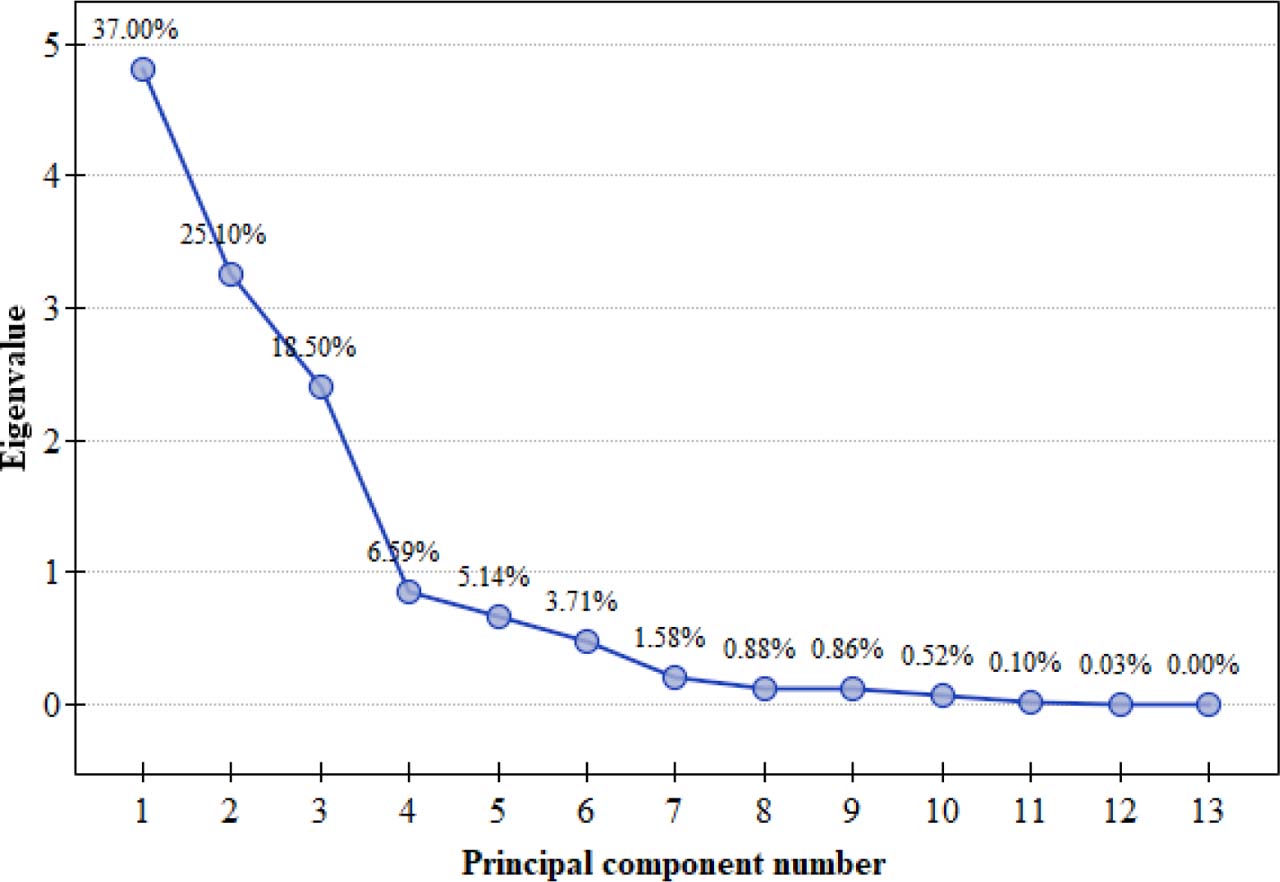
Figure 1.
Scree plot displaying principal components based on eigenvalues. PCA analyses for semen collected from native Polish Crested chickens and Hy-Line Brown roosters
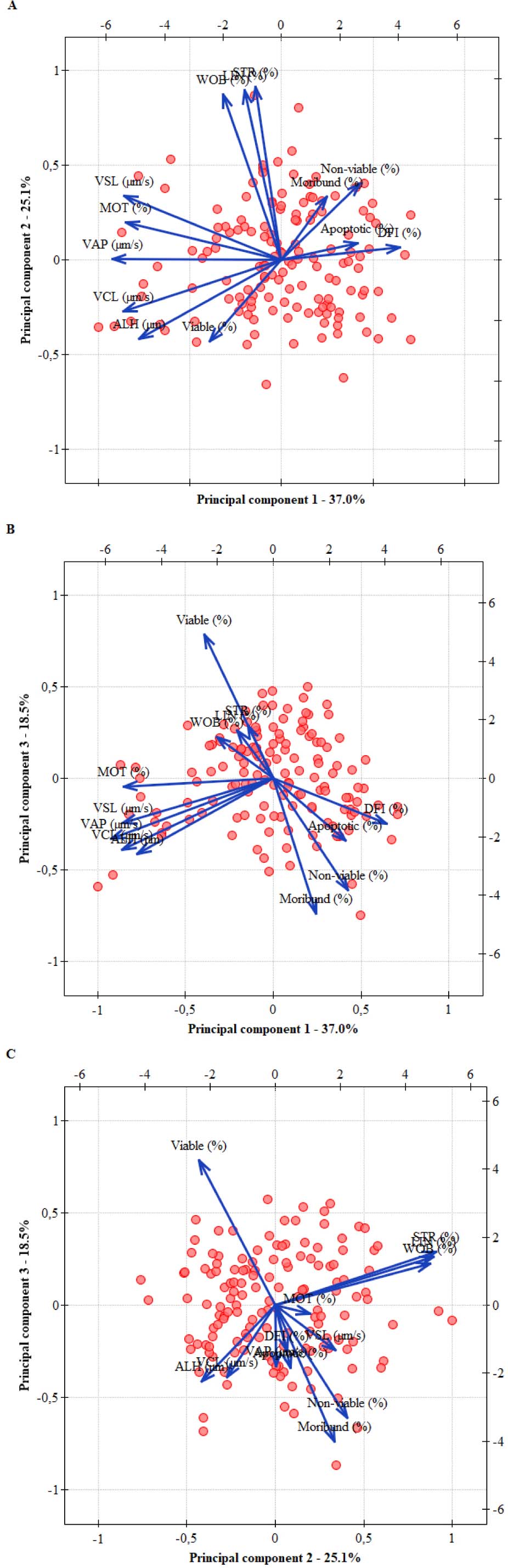
Figure 2.
PCA biplot showing distribution of CASA and flow cytometry-based sperm parameters (red circles) and their contribution to principal components in semen collected from native Polish Crested chickens and Hy-Line Brown roosters (A–C). Abbreviations as in Table 3
Table 4.
PCA-based relative sperm quality parameters (mean ± SE) of semen of native Polish Crested chickens and Hy-Line Brown roosters (n = 6/genetic group; number of ejaculate 30/storage time) in relation to short-term storage
| Characteristic | Item | PC1 R-MOT | PC2 R-SP | PC3 R-viability |
|---|---|---|---|---|
| PCr | 0 h | –2.13±0.4 a | –0.36±0.4 ab | 0.18±0.3 ab |
| 24 h | –0.08±0.3 b | 0.22±0.4 ab | 0.88±0.3 b | |
| 48 h | 1.01±0.3 cd | –0.83±0.3 a | 0.77±0.3 b | |
| HLB | 0 h | –1.60±0.4 a | 0.04±0.4 ab | –0.88±0.3 a |
| 24 h | 0.60±0.4 bc | 0.99±0.4 b | –0.45±0.3 a | |
| 48 h | 2.17±0.3 d | –0.06±0.3 ab | –0.50±0.2 a | |
| Genetic group (G) | PCr | –0.39±0.3 a | –0.32±0.2 a | 0.61±0.2 b |
| HLB | 0.39±0.3 b | 0.32±0.3 a | –0.61±0.2 a | |
| Storage time (S) | 0 h | –1.85±0.3 a | –0.16±0.3 ab | –0.35±0.2 a |
| 24 h | 0.26±0.2 b | 0.61±0.3 b | 0.22±0.2 b | |
| 48 h | 1.59±0.2 c | –0.45±0.2 a | 0.13±0.2 ab | |
| P-value | ||||
| G | 0.0378 | 0.0628 | 0.0005 | |
| S | 0.0001 | 0.0046 | 0.0233 | |
| G × S | 0.4311 | 0.7952 | 0.7928 | |
[i] a, b, c, d – values in the same column with different letters differ significantly P<0.05 – PCr vs HLB storage time point; genetic group; storage time.
[ii] PC1 – R-MOT “relative MOT” correlated with MOT, VCL, VSL, VAP, and ALH; PC2 – R-SP “relative swimming pattern” correlated with LIN, STR, and WOB; PC3 – R-viability “relative viability” correlated with viable sperm with intact cell membrane; Non-viable – sperm with a damaged cell membrane; moribund – sperm with a damaged cell membrane – metabolically active. PCr – Polish Crested chickens; HLB – Hy-Line Brown; G – genetic group; S – storage; G × S – interaction genetic group × storage.
Discussion
Currently, in order to preserve genetic poultry resources, there is great demand for an effective procedure for short-term storage of semen from unique breeds of chickens. To our knowledge, this is the first report presenting semen quality of native PCr after chilling and storage for up to 48 h. It has been shown that PCr semen is characterized by positive motility parameters, low susceptibility to apoptotic changes, and high chromatin structure and membrane integrity. Moreover, this study provides a comprehensive evaluation of differences in semen quality between a native breed and commercially used chickens. For the first time, differences in the storability of semen between native PCr and HLB are demonstrated. Also, it has been shown that PCA enables reduction of the dataset describing the semen quality of these genetic groups of roosters.
Comparison of sperm quality parameters between genetic groups during storage
The present study for the first time indicates that the proportion of negative sperm changes, such as apoptotic, membrane and chromatin damage were lower after chilled storage of semen from native PCr compared to a commercially used chicken (HLB). Moreover, membrane integrity of PCr sperm underwent less dynamic changes during short-term storage compared to HLB sperm. However, previous research by Feyisa et al. (2018) indicated that sperm from native Korean chicken breeds showed more morphological defects than sperm from White Leghorn chickens that were selected for egg production. On the other hand, Mavi et al. (2019) indicated that genetic crosses between native Punjab Red Chicken and commercially used Rhode Island Red are characterized by more desirable basic semen quality parameters and fertility than pure breeds. Therefore, it is recommended to use indigenous laying-type chickens for crossbreeding programs with commercial breeds in order to obtain hybrids with better fertility parameters. Based on quality characteristics of semen obtained from roosters of several Italian breeds, Di Iorio et al. (2024) chose three breeds that produced ejaculates with better semen quality than others. Thus, it may be also reasonable to select PCr roosters with better semen quality for breeding purposes. This issue requires further research, including fertility evaluation. Through the use of objective research methods, this study expands the existing knowledge on differences in semen characteristics between rooster breeds/lines.
It can be hypothesized that native PCr semen may be less sensitive to cooling and storage damage than commercial HLB, in which case these procedures will affect negative changes in sperm quality more slowly. Some of these changes may be the result of oxidative stress, which impairs sperm function through various molecular mechanisms. Chicken sperm contain high levels of long-chain polyunsaturated fatty acids (LCPUFAs); these are highly vulnerable to reactive oxygen species (ROS) created during oxidative stress, which causes lipid peroxidation, resulting in reduction of sperm quality (Sithole et al., 2025). Differences in the lipid profile of semen between rooster genetic groups have been suggested; for example, Mussa et al. (2021) showed higher levels of arachidonic acid (AA) and docosahexaenoic acid (DHA) in a commercial chicken breed than in a native Thai breed; these differences were associated with better sperm motility. Additionally, the endogenous antioxidant defense mechanism of PCr semen can better neutralize and remove ROS. Studies conducted on exotic and indigenous chicken breeds showed differences in their semen’s antioxidant enzyme defense system that are correlated with some semen parameters, lipid peroxidation changes and fertility (Mavi et al., 2020 b). However, in a study by Mussa et al. (2021), frozen semen of commercial chicken breed had a higher level of oxidative stress marker (MDA) than the native breed, but antioxidant enzymes remained similar in both breeds. Based on data from the literature, differences in sperm surface-related proteins between chicken genetic groups have also been suggested; these are primarily related to redox mechanisms and sperm energy processes. Mavi et al. (2020 a) observed variations in sperm surface-related proteins between two breeds of roosters. Also, proteomic analysis conducted by Nonnis et al. (2025) showed that proteins involved in energy metabolism, cytoskeletal dynamics, and membrane integrity were differentially abundant across native Italian breeds and correlated with specific semen parameters. Interestingly, the present study did not demonstrate the effect of genetic group on motility and motility parameters. Sangani et al. (2017) research provides valuable information regarding the importance of mitochondrial enzyme activity, ATP, and ROS production in the progressive motility potential of sperm from commercial and native-strain roosters. Contrary to the present results Łukaszewicz et al. (2020) noted differences in the characteristics of semen motility after liquid storage and the susceptibility of various extenders to storage of semen from meat-type chickens as compared to laying-type roosters. Also, Tesfay et al. (2020) reported variations in MOT and motility parameters between commercially used White Leghorn and Rhode Island Red roosters and showed their positive correlation with fertility rate. Bond et al. (2024) identified differences in lipid class abundance and in individual lipid species between low- and high-sperm-mobility fractions of broiler breeder rooster semen. Through biomarker analysis, eight lipid species were identified as excellent sperm mobility biomarkers.
Changes in sperm quality parameters during storage
In the present study, a time-dependent decrease in MOT was found during liquid preservation of semen. Unfavorable changes in the kinetic parameters of sperm were also demonstrated, with a gradual decrease in sperm velocity as the storage time progressed. However, the sperm movement trajectory remained relatively stable after24 h of semen storage. These findings correspond to other studies which confirmed the unfavorable effect of sperm storage time on MOT in commercially used (Łukaszewicz et al., 2020; Blank et al., 2021) and native breeds of chickens (Kheawkanha et al., 2023). Łukaszewicz et al. (2023) even showed an effect of semen storage for 6 h on motility values and kinetic parameters. Differences in the level of change in sperm motility parameters may result from differences in the composition of the applied extenders and the storability of semen from different breeds of poultry that are associated with the unique metabolic requirements of the sperm. This study also assesses other storage-dependent negative changes in sperm structure that have been investigated in few studies to date. Thus, an increase in apoptotic changes after 24 h of semen storage was shown. This partially corresponds with the study of Vasicek et al. (2015), which showed an increasing trend in phenomena similar to apoptosis in sperm after 2 h of storage. Apoptosis changes caused different degrees of damage to sperm structures that cause cell death. These abnormal cells are sources of ROS in semen (Vasicek et al., 2015) which additionally negatively affects semen under artificial storage conditions. In the present research during liquid storage the integrity of nuclear DNA was negatively affected. After 48 h of storage, approximately 20% of sperm showed DNA fragmentation. Also, Blank et al. (2021) detected DNA damage using SCSA methods, with a significant storage effect noted after just 4 hours. There is a lack of repair mechanisms in sperm, therefore DNA damage is irreversible and may affect fertility. However, there is no data on this subject in roosters and the threshold at which problems may occur in offspring production is not known. Also, in this study the functional properties of rooster semen after liquid storage were not determined. Another semen feature that deteriorates after 24 h of storage is membrane integrity. However, after this period, a relative stabilization of the percentage of viable sperm was observed in this study, which may suggest a more negative impact of cooling than of the storage procedure. Kheawkanha et al. (2023) reported the viability of rooster sperm using dual fluorescent staining with SYBR-14/PI after liquid storage, but with results detected using a fluorescence microscope. These researchers observed that the percentage of viable sperm with intact cell membranes gradually decreased during storage from 0 to 120 h, and only about 50% of the sperm were viable at the end of the storage period, thus affecting fertility.
The most probable mechanism associated with decreased semen quality parameters during liquid storage may be the occurrence of destructive oxidative stress. The pathological ROS cannot be neutralized by the biological antioxidant system and the resulting sperm damage is not possible to repair. It can be assumed that the amount of ROS gradually increases as sperm are exposed to storage procedures, while the ability to neutralize them decreases. Ratchamak et al. (2025) showed that if saline solution was used as an extender in native Thai roosters, a decline in motility and viability accompanied by elevation in oxidative damage indicators (MDA and ROS) was observed after just 12 h of storage. This finding may be also confirmed by the results of studies in which various semen parameters were improved after extender supplementation with different compounds acting as antioxidants (Khodaei-Motlagh et al., 2022; Masoudi et al., 2022; Kheawkanha et al., 2023; Łukaszewicz et al., 2023; Koedkanmark et al., 2024; Pimpa et al., 2024). In this study, a commercial extender was used, but the composition of its components is unknown. For the benefit of future scientific and breeding work, further research is required on the semen quality of PCr using an extender specifically tailored for this native breed.
Correlation coefficients and principal component analysis for summarizing multivariate semen quality patterns
The Pearson correlation coefficients calculated in the present study indicate moderate linear relationships between MOT and sperm kinetic parameters. These data are consistent with the results of previous studies by Tesfay et al. (2020) and Di Iorio et al. (2024). Additionally, Tesfay et al. (2020) noted an association between MOT, some sperm kinetic parameters and fertility in two commercially used chicken breeds. Thus, it may be suggested that these sperm parameters may also be a reliable predictor of the fertility potential of PCr roosters, but this issue requires further study. Furthermore, PCA analysis of sperm parameters revealed three principal components explaining more than 80.0% of the cumulative variance. Thus, the parameters obtained from the CASA analysis can be reduced to two main components, while the viability estimate based on SYBR-14/PI staining can be reduced to one component. It was shown that the newly obtained PCA-based relative semen parameters can be used to assess the influence of experimental factors on the semen characteristics of native PCr roosters. These results highlight the practical value of PCA-based parameters. This confirms the results of the study by Agarwal et al. (2003), in which, based on PCA analysis of various semen parameters, a reduced number of new relative semen sources were obtained. In later research by Nallella et al. (2005), their clinical usefulness was confirmed in infertility assessment in humans. In the assessment of semen of native Italian roosters, Di Iorio et al. (2024) showed the presence of three components which also describe over 80.0% of the total variance. The parameters which mainly influence semen characteristics evaluated a short time after collection were VCL, LIN and total motility. Therefore, it is possible to reduce the number of variables to describe the key information in native roosters’ semen data while minimizing loss of information. This reduction can make the dataset easier to explore and visualize, as well as more useful for evaluation of further fertilizing potential.
In summary, the present results suggest that the native PCr breed has good semen storability. However, reduced MOT after 24 h of storage may decrease the efficiency with which sperm cross the selection area in the vagina, thus decreasing the number that can enter the sperm storage tubules. This should be taken into account when planning future artificial insemination (AI) as it may affect the duration of the fertility period (Gumułka and Kapkowska, 2005). The increase in DFI (%) during semen storage is also problematic. However, there are no data concerning the interrelationships between sperm DNA fragmentation and fertility efficiency in roosters. It can be suggested that PCA-based relative semen parameters can effectively simplify the estimation of the fertilizing potential of native rooster semen. Further studies are needed to elucidate how PCr semen quality characteristics are related to fertility. Based on the results of semen quality parameters obtained, it can be recommended to store PCr semen in a liquid state for a period not longer than 24 hours at 5ºC. This is consistent with current management practice for commercially used poultry (Partyka and Niżański, 2022) and for native breeds of chickens (Ratchamak et al., 2025). However, it has been suggested that the addition of antioxidant compounds to the extender may enable satisfactory fertility even after 72 hours of liquid preservation (Kheawkanha et al., 2023). A schematic summary of the main results of the study is presented in Figure 3.
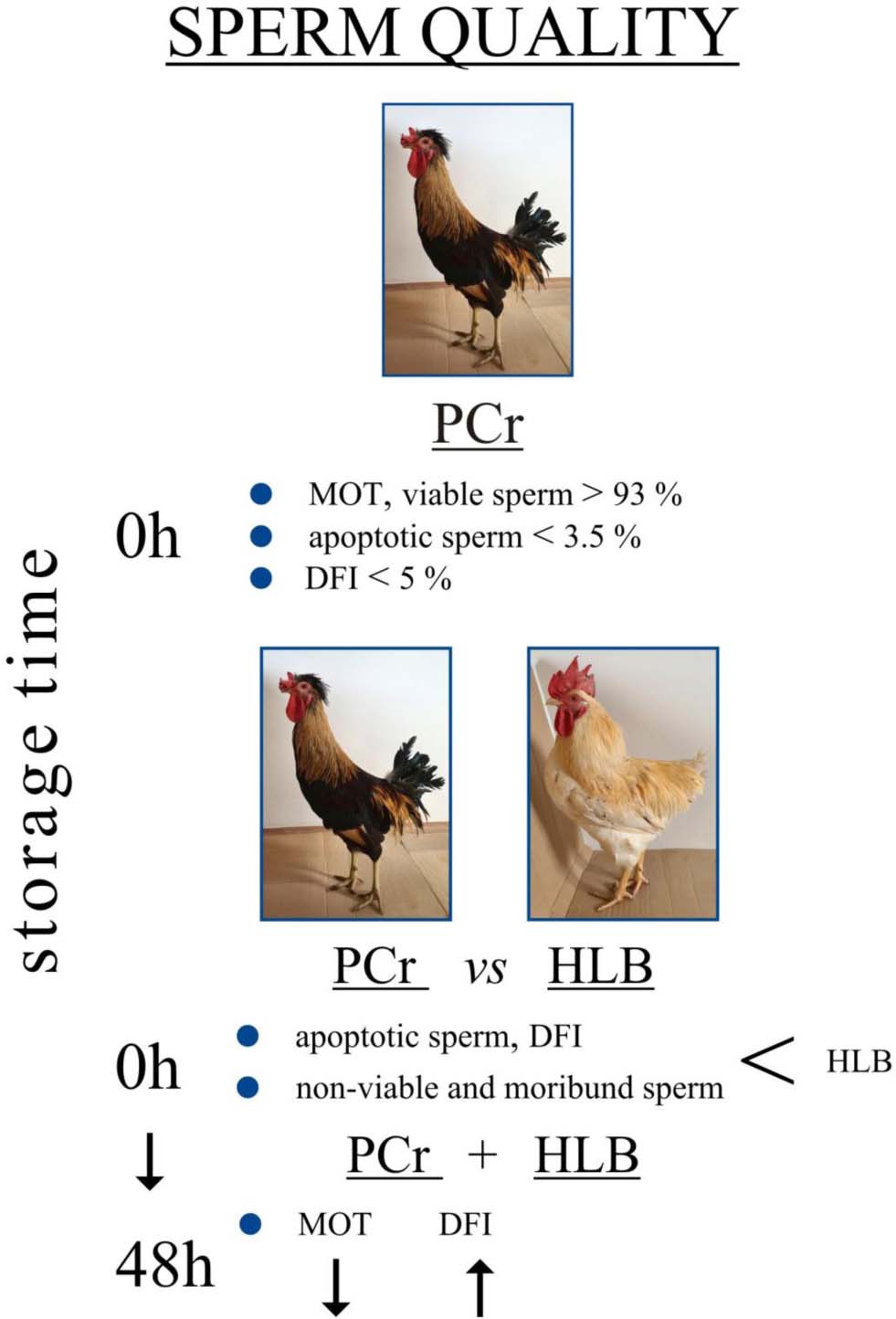
Figure 3.
Schematic summary of main results of the study. Abbreviations as in Table 3
The next step in research should be to develop a procedure for cryopreservation of PCr semen to provide additional partial protection. As this breed is maintained in a single location, its genetic material is at risk of being lost due to unforeseen events.
Notes
[9] Contributed by Author contributions
Małgorzata Gumułka: management of chickens, conceptualization, methodology, formal analysis, investigation, data curation, visualization, writing – original draft preparation, supervision; Krzysztof Andres: management of chickens; Monika Trzcińska: methodology, investigation, writing – reviewing; Magdalena Bryła and Lechosław Gajda: methodology, investigation.