
Table 1.
Mycotoxin contamination in plant ingredients used for formulating fish diets
| Ingredients | Mycotoxins (MQL µg/kg)* | Place | References |
|---|---|---|---|
| Rice | AFB1 (40.0), AFB2 (9.15), NIV (116.0), DAS (12.53), FB1 (75.1), ZEN (114.0), HT2 (32.0), DON (115.0), OTA (24.0) | Pakistan | Majeed et al., 2018 |
| ZEN (126.31) | Brazil | Savi et al., 2018 | |
| Oats | NIV (500.0), T-2 (132.0) | Switzerland | Martin et al., 2018 |
| Corn | AFB1 (24.0) | Japan | Nomura et al., 2018 |
| DON (725) | Turkey | Ünüsan, 2019 | |
| DON (826.0), FB1 (2234.0), FB2 (262.0), FB3 (189.0), FA (266.0), FX (96.0), ZEN (165.0), AFB1 (12.0), AFB2 (19.0), AFG1 (12.0), AFG2 (7.0), OTA (24.0), T-2 (81.0), HT-2 (190.0), NIV (661.0) | Europe | Koletsi et al., 2021 | |
| Soybean | AF (3430.0), OTA (125.0) and FB (4286.0) | Nigeria | Egbuta et al., 2016 |
| DON (2.265) and ZEN (853.0) | Croatia | Pleadin et al., 2017 | |
| DON (85.0), FB1 (371.0), FB2 (83.0), FB3 (50.0), FA (89.0), FX (65.0), ZEN (81.0), AFB1 (1.0), AFB2 (4.0), AFG1 (19.0), AFG2 (2.0), OTA (3.0), T-2 (49.0), HT-2 (155.0), NIV (231.0) | Europe | Koletsi et al., 2021 | |
| Wheat | OTA (34.75) | Algeria | Zebiri et al., 2019 |
| DON (470.0), FB1 (561.0), FB2 (59.0), FB3 (67.0), FA (54.0), FX (91.0), ZEN (64.0), AFB1 (2.0), AFB2 (9.0), AFG1 (3.0), AFG2 (3.0), OTA (6.0), T-2 (46.0), HT-2 (44.0), NIV (275.0) | Europe | Koletsi et al., 2021 |
* AFB1: aflatoxin B1, AFB2: aflatoxin B2, AFG1: aflatoxin G1, AFG2: aflatoxin G2, AF: aflatoxins, NIV: nivalenol, DAS: diacetoxyscirpenol, FB1: fumonisin B1, FB2: fumonisin B2, FB3: fumonisin B3, FB: fumonisins, ZEN: zearalenone, HT2: HT-2 toxin, DON: deoxynivalenol, OTA: ochratoxin A, T-2: T-2 toxin, FA: fusaric acid, FX: fusarenon X.
Table 2.
Prevalence of analytical approaches for mycotoxin detection in aquafeeds
| Method of quantification* | Mycotoxins obtained | References |
|---|---|---|
| 1 | 2 | 3 |
| Aflatest™ and Ochratest ™ | AFB1, OTA | Salama, 2007 |
| TLC and ELISA | AFB, AFB1 | Altuğ and Özyurt, 2003 |
| UPLC | AFB1, B2, G1, G2, M1, T2, HT-2, VCG, CTN, SMC, OTA, 3-ADON, 15-ADON, ZEN, FX, NIV, DON, ZEN+IS, ZEN−IS | Ren et al., 2007 |
| UPLC | AFB1, B2, G1, G2, OTA | Lopez Grio et al., 2010 |
| UPLC and mass spectrometry (MS) | AFB1, B2, G1, G2, OTA, FB1, FB2, HT-2, T-2, ZEN | Nácher-Mestre et al., 2013 |
| ELISA-based analytical test kits | AFs, DON, FUM, OTA, ZEN, T-2 | Greco et al., 2015 |
| LC-DAD AND LC-FL | DON, ZEN | Pietsch et al., 2013 |
| LC-FL | ZEN | Woźny et al., 2013 |
| LC-MS/MS | ENA, ENA1, ENB, ENB1, BEA | Tolosa et al., 2014 |
| ELISA and TLC | AFB1, FB1, OTA | Barbosa et al., 2013 |
| ELISA | AFB1 | Gonçalves-Nunes et al., 2015 |
| LC-MS/MS | AFB1, AFB2, AFG1 AFG2, FB1, FB2, FB3, DON, 3-ADON, 15-ADON, DAS, AOH, T-2, NIV | Marijani et al., 2017 |
| LC-MS/MS | 3-ADON, 15-ADON, AFB1, AFB2, AFG1 AFG2, BEA, DON, DAS, FB1, HT-2, NIV, OTA, T2, ZEN | Modra et al., 2018 |
| LC-MS/MS | AFB1, AFB2, AFG1 AFG2, ZEN, DON, NIV, 3- ADON, 15-ADON, FB1, FB2, FB3, T-2, HT-2, DAS, NEO, OTA | Gonçalves et al., 2018 a |
| ELISA and TLC | AFB1 | Jangampalli Adi and Matcha, 2018 |
| LC-HRMS/MS | AFB1, G1 | Mwihia et al., 2018 |
| HPLC | AFB1, B2, G1, G2, M1 | Michelin et al., 2017 |
| ELISA | AFB1, OTA | Osibona et al., 2018 |
| Multiplexed capillary microfluidic immunoassay | AFB1, OTA, DON | Machado et al., 2018 |
| LC-HRMS/MS | DON, T-2, HT-2, ZEN, ENN | Johny et al., 2019 |
| HPLC-FLD | AFB1, OTA, ZEN | Nogueira et al., 2020 |
| LC-MS/MS | 15-acetyl-DON, 3-acetyl-DON, AFB1, B2, G1, G2, alternariol, BEA, citreoviridin, citrinin, cyclopiazonic acid, DON, diacetoxy-scirpenol, ergometrin(in)e, FB1, FB2, FB3, fusarenon X, T-2 toxin, moniliformin, methylergonovine, NEO, NIV, OTB, OTA, patulin, T-2 toxin, verruculogen, ZEN | Koletsi et al., 2021 |
| HPLC-MS/MS | AFB1, AFM1, T-2 toxin, HT-2 toxin, DON, OTA, ZEN | Bi et al., 2022 |
| HPLC-MS/MS | NIV, DON, AFB1, B2, FB1, FB2, OTA, ZEN, ENNB, BEA, ENNB1, ENNA1, ENNA | Albero et al., 2022 |
| ELISA | AFs, OTA | Bashorun et al., 2023 |
| LC–MS/MS | AFB1, B2, G1, FB (B1+B2), DON, OTA | Terada-Nascimento et al., 2023 |
* UPLC: ultra-performance liquid chromatography; ELISA: enzyme linked immunosorbent assay; TLC: thin layer chromatography; LC-DAD: liquid chromatography with diode array detection; LC-FL: liquid chromatography with fluorescence detection; LC-MS/MS: liquid chromatography–tandem mass spectrometry; LC-HRMS/MS: liquid chromatography–high-resolution tandem mass spectrometry; HPLC: high-performance liquid chromatography; UHPLC-QTOF-MS/MS: ultra-high-performance liquid chromatography–quadrupole time-of-flight–tandem mass spec-trometry; HPLC-MS/MS: high-performance liquid chromatography–tandem mass spectrometry; AFM1: aflatoxin M1; OTB: ochratoxin B; CTN/CIT: citrinin; α-ZEL: alpha-zearalenol; β-ZEL: beta-zearalenol; D3G: deoxynivalenol-3-glucoside; 3-ADON: 3-acetyl-deoxynivalenol; 15-ADON: 15-acetyl-deoxynivalenol; ZEN+IS/ZEN-IS: zearalanone with/without internal standard; BEA: beauvericin; VCG: verrucogemefuranone (verruculogen); AOH: alternariol; SMC: sterigmatocystin; NEO: neosolaniol; ENNA: enniatin A; ENNA1: enniatin A1; ENNB: enniatin B; ENNB1: enniatin B1; MON: moniliformin.
Table 3.
Impact of mycotoxins on fish health across species
| Mycotoxin | Species | Dose and administration | Toxic effects seen | References |
|---|---|---|---|---|
| 1 | 2 | 3 | 4 | 5 |
| OTA | Ictalurus punctatus (juvenile) | 0.5, 1.0, 2.0, 4.0 and 8.0 mg/kg for 8 weeks | Mortality, inadequate feed conversion, decreased haematocrit, and decreased weight growth | Manning et al., 2003 a |
| 2 and 4 mg/kg for 6 weeks | Reduced weight gain | Manning et al., 2005 | ||
| 2, 4 and 8 mg/kg for 8 weeks | Reduced weight gain and growth, low feed conversion | Zahran et al., 2016 | ||
| Colossoma macropomum (juvenile) | 0.8, 1.6 and 2.4 mg/kg for 14 days | Decreased growth performance, hiked muscle oxidative stress (ROS and LPO), decreased antioxidant enzyme activity (SOD and GPx), and deterioration of fillet fatty acid profile. | Baldiserra et al., 2020 a | |
| Colossoma macropomum (juvenile) | 1.6 and 2.4 mg/kg for 14 days | Impaired growth, reduced liver and body weight, and altered liver energy metabolism. Hepatic ATP and adenosine levels increased, while NTPDase (ATP) activity rose and ADA activity declined | Baldissera et al., 2020 b | |
| STG | Oreochromis niloticus (fingerling) | 1.6 µg/kg for 4 weeks | Clastogenic, weight reduction, chromosomal aberrations in the kidneys | Abdel-Wahhab et al., 2005 |
| Aflatoxins | Cyprinus carpio (juvenile) | 0.5, 0.7 and 1.4 mg/kg for 3 weeks | Decrease in lysozyme activity and reduction of immunoglobulin in blood plasma | Bitsayah et al., 2018 |
| AFB1 | Oreochromis niloticus and Oreochromis aureus (juvenile) | 19, 85, 245, 638, 793 and 1641 µg/kg for 20 weeks | Induction of hepatic disorder, resulting in decreased lipid content, hepatosomatic index, cytochrome P450 A1 activity, and elevated plasma alanine aminotransferase activity | Deng et al., 2010 |
| Oreochromis niloticus (fingerling) | 2 mg/kg for 14 weeks | Reduction in weight gain, low feed conversion; decreased hemoglobin concentrations in the blood, total erythrocytes, total proteins, albumin and globulins | Ayyat et al., 2018 | |
| Rhamdia quelen (juvenile) | 1177 µg/kg for 3 weeks | Affects neurotransmitters, hyperlocomotion, increased acetylcholinesterase activity; reduced sodium-potassium pump activity | Baldissera et al., 2018 a | |
| Changes in the cerebral phosphotransferase network | Baldissera et al., 2018 b | |||
| Cyprinus carpio (juvenile) | 50 µg/kg for 8 weeks | Reduced growth and low feed conversion | Fan et al., 2018 | |
| Pangasius hypophthalmus (fingerling) | 50, 100, 250, 500 and 1000 µg/kg for 8 weeks | Reduction in weight gain, increase in hepatosomatic rate, increase in adipose somatic index, elevated levels of alanine aminotransferase and aspartate aminotransferase | Gonçalves et al., 2018 c | |
| Ctenopharyngodon idella (juvenile) | 0, 29, 59, 86, 110 and 147 μg/kg for 60 days | Produced abnormalities and stunted development in young grass carp, with residues building up in the spleen and kidney of the head. Through apoptosis, it altered the structure of immunological organs, decreased antioxidant capability, and weakened intercellular integrity by damaging tight junctions. | Zeng et al., 2019 | |
| Danio rerio (larvae) | 0.01, 0.05, 0.1 mg/kg and 0.1, 0.5, 1 mg/kg for 3 days post fertilization | Developmental abnormalities, disrupted thyroid hormone and vitellogenin levels, induced oxidative stress and lipid peroxidation, and triggered the expression of pro-apoptotic genes in fish larvae | Di Paola et al., 2021 | |
| Ctenopharyngodon idella (juvenile) | 0.04, 29.48, 58.66, 85.94, 110.43 and 146.92 μg/kg for 60 days | Reduced myofiber density, collagen content, and antioxidant enzyme levels while increasing myofiber diameter, oxidative stress, and MMP activity, impairing grass carp muscle growth and meat quality. It suppressed myogenic regulatory pathways and TGF-β/Smads. | He et al., 2024 | |
| DON | Cyprinus carpio L. (juvenile) | 352, 619 and 953 µg/kg for 4 weeks | Cytotoxic effects on immune cells | Pietsch et al., 2014 |
| 352, 619 and 953 µg/kg for 6 weeks | Increased lipid peroxidation in the liver, kidney and spleen | Pietsch et al., 2014 | ||
| Oncorhynchus mykiss (juvenile) | 0.3, 0.8, 1.4, 2.0 and 2.6 ppm/kg for 8 weeks | Reduction in weight gain, low growth rate and feed conversion, morphological changes in the liver | Hooft and Bureau, 2017 | |
| Oncorhynchus mykiss (fingerling) | 4.5 and 10.5 mg/kg for 8 weeks | Reduction in weight gain, low feed conversion, altered proteolytic enzyme activity, elevated messenger RNA levels and nutrient retention | Gonçalves et al., 2018 b | |
| Cyprinus carpio L. (juvenile) | 332, 621 and 797 µg/kg for 4 weeks | Cytotoxic effects on immune cells | Pietsch et al., 2015 | |
| DON and ZEN | Oreochromis niloticus and Oreochromis mossambicus (fingerling) | 0.07, 0.31, 0.50, 0.92, 1.15 mg/kg and 0.01, 0.09, 0.21, 0.37, 0.98 mg/kg for 8 weeks | Reduction in weight gain and growth, low feed conversion | Tola et al., 2015 |
| T-2 | Cyprinus carpio L. | 5.3 mg/kg for 4 weeks | Reduction in weight gain, low feed conversion, anemia, lymphopenia, oxidative stress | Matejova et al., 2017 b |
| I. punctatus | 0.625, 1.25 and 5 mg/kg for 8 weeks | Dose-dependent deficits in survival, hematocrit levels, feed conversion efficiency, and body weight gain. Gastric lesions and a decrease in hematopoietic cells in the head kidney were among the histopathological alterations. There were also more melanomacrophage centers with hemosiderin and lipopigments. | Manning et al., 2003 b | |
| 1 and 2 mg/kg for 6 weeks | Reduction in weight gain | Manning et al., 2005 | ||
| Oncorhynchus mykiss (adult) | 1.0 and 1.8 mg/kg for 4 weeks | Oxidative stress, increased lipid peroxidation, increased ceruloplasmin activity | Modra et al., 2018, 2020 | |
| FB1 and FB2 | Oreochromis niloticus (fingerling) | 20, 40 and 60 mg/kg for 4 weeks | Reduction of messenger RNA levels, reduced expression of the CASP7 gene | Claudino-Silva et al., 2018 a, b |
| AFB1 and FB1 | Clarias gariepinus (juvenile) | 2.0, 7.3, 17.6, 48.0, 93.0 µg/kg and 3.0, 15.0, 24.5, 43.0, 83.0 mg/kg for 8 weeks | Reduction in weight gain and length, low feed conversion | Adeyemo et al., 2018 |
| Mixed mycotoxins (low levels) | Oreochromis niloticus (juvenile) | 40 µg/kg AFB1, 600 µg/kg FB, 50 µg/kg ZEN, and 150 µg/kg DON | Liver degeneration, intestinal and renal tissue damage, splenic lymphoid depletion, and clinical signs like fin rot and ascites; impaired immune responses and disrupted normal growth and biochemical parameters | Hussein et al., 2024 |
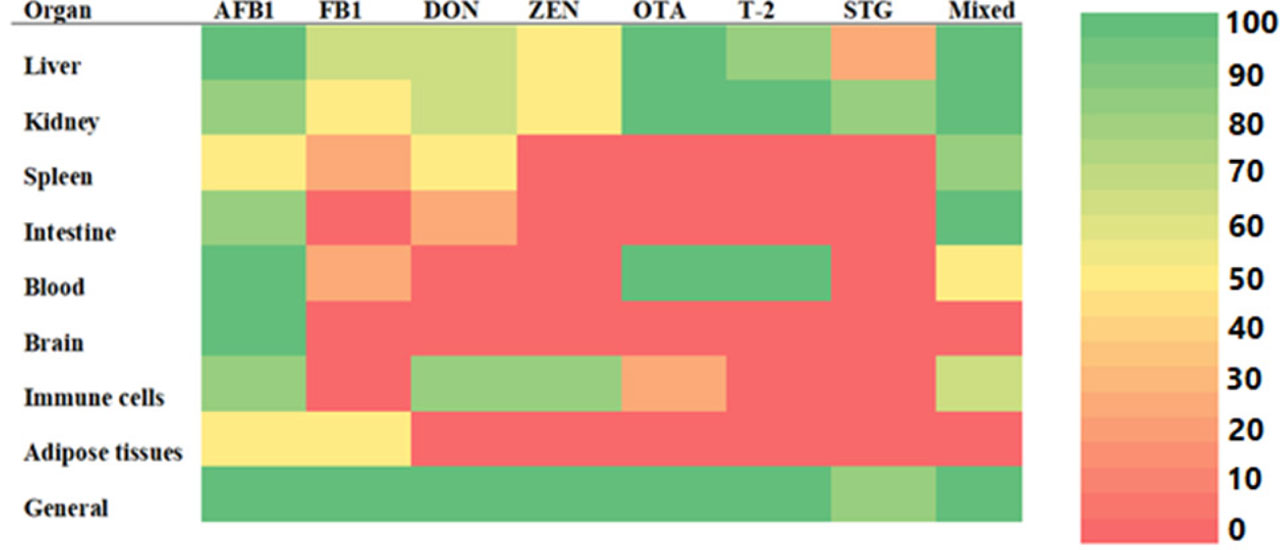
Figure 1.
Heat map summarizing the frequency of reported organ specific effects induced by individual and mixed mycotoxins based on a systematic literature review. The color scale represents the percentage frequency of studies reporting effects for a given organ mycotoxin combination, normalized to a 0 to 100 scale. Red (0 percent) indicates no available data or no reports of effects. Light orange (1 to 25 percent) denotes very low frequency of reported effects. Yellow (26 to 50 percent) indicates low to moderate frequency. Light green (51 to 75 percent) represents moderate to high frequency, while dark green (76 to 100 percent) indicates a high frequency of reported effects across studies. “Mixed” refers to studies evaluating combinations of two or more mycotoxins. “General” denotes systemic or non-organ specific alterations reported in the literature rather than changes confined to a single organ.
Table 4.
Comprehensive control strategies for mycotoxins in food and aquafeed
| Control method | Remarks/Mode of action | Reference |
|---|---|---|
| 1 | 2 | 3 |
| Tri-octahedral bentonite | Clay mineral with high adsorption capacity for multiple mycotoxins; suitable for inclusion in fish feed | Pascari et al., 2025 |
| Calcium and sodium bentonite | Clays effectively bind ochratoxin A both in vitro and in vivo, reducing its bioavailability and potential toxicity | Hamad et al., 2022 |
| Pulse electric field (PEF) | Electrical pulses permeabilize cell membranes, leading to fungal inactivation and partial mycotoxin degradation | Gavahian et al., 2022 |
| Supercritical CO2 (SC-CO2) | SC-CO2 penetrates fungal cells and mycotoxins, causing structural damage and facilitating toxin extraction | Gavahian et al., 2022 |
| Ultrasound (USN)/Sonication | Cavitation generates microbubbles that physically disrupt fungal cells and degrade mycotoxins via shear forces and ROS | Gavahian et al., 2022 |
| Water-assisted microwave treatment (WMT) | Effectively reduces aflatoxin B1 in corn by combining thermal and moisture-driven degradation while minimizing heat damage to kernels | Zhang et al., 2025 |
| High-pressure processing (HPP) | High hydrostatic pressure disrupts fungal cell structures and can inactivate mycotoxins without heating | Gavahian et al., 2022 |
| Tri-octahedral smectite + lignocellulose additive | Dual-action: smectite adsorbs toxins; lignocellulose supports gut health | Greco et al., 2022 |
| Yeast cell wall extract (e.g., β-glucans) | Effectively adsorb aflatoxin B1, ochratoxin A, and fumonisins – demonstrated in vitro and in animal studies | Xu et al., 2023 |
| Saccharomyces cerevisiae cell wall | Reduced aflatoxin B1 absorption in rodent model; considered for broader feed applications | Imani et al., 2017 |
| Postbiotic yeast blends | Mitigated multi-mycotoxins and improved gut health and performance in livestock | Lázaro et al., 2024 |
| Mixed-origin biocontrol agents (LAB, yeasts) | Bind and degrade mycotoxins via enzymatic activity or cell wall adsorption | Bashorun et al., 2023 |
| Bacillus cereus VOCs | VOCs suppress fungal growth and sporulation; reduce mycotoxin biosynthesis | Bashorun et al., 2023 |
| Proper feed storage and moisture control | Reduces fungal proliferation by controlling humidity and temperature | Pietsch et al., 2020 |
| Botanical phenolic extracts | Inhibit mycotoxin synthesis via antioxidant action and downregulation of toxin genes | Ahmed et al., 2022 |
| Cold atmospheric plasma and gamma irradiation | Effectively degrade aflatoxins while preserving food quality | Misra et al., 2019 |
| Natural essential oils (NEOs) | Disrupt fungal membranes; antifungal and antimycotoxigenic effects | Mirza Alizadeh et al., 2022 |
| Natural phenolics against Fusarium | Inhibit trichothecene biosynthesis; eco-friendly method to control food contamination | Chtioui et al., 2022 |
| Thiol compounds (–SH) | Efficient detoxification of patulin in juice via nucleophile binding (–SH, –OH, –NH2) | Diao et al., 2022 |
| Fatty acids and oxylipins | Broad antifungal effect targeting fungal enzymes and membranes; eco-friendly with low resistance potential | Qiu et al., 2021 |
| Active food packaging (biopolymer-based) | Inhibits fungal growth via polysaccharide/lipid/protein matrices; biodegradable and sustainable | Ghobish et al., 2025 |
| Lactic acid bacteria (LAB) as biodetox agents | Reduce mycotoxin biosynthesis and promote degradation in food matrices | Nasrollahzadeh et al., 2022 |
| Biogenic Trichoderma harzianum-derived selenium nanoparticles | Stronger antifungal and anti-mycotoxigenic effect compared to nanoparticles alone | Hu et al., 2019 |
| Cold plasma treatment of jujube juice (for Alternaria toxins) | Effectively degrades mycotoxins while preserving juice quality and physical characteristics | Wang et al., 2022 |
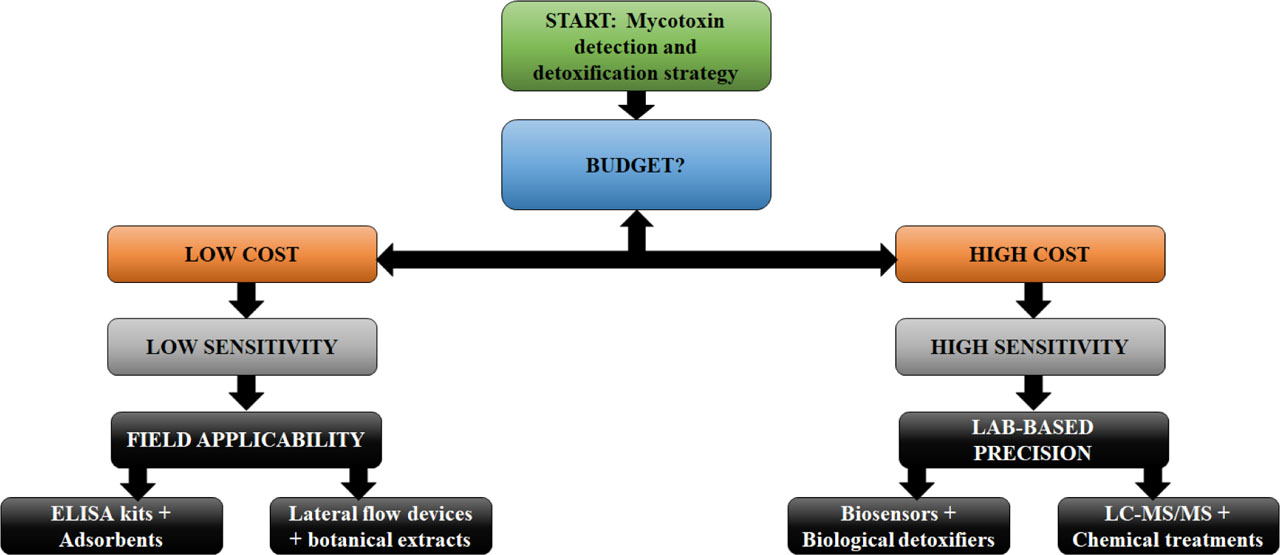
Figure 2.
A decision tree figure showing how users can choose appropriate detection and detoxification strategies.