
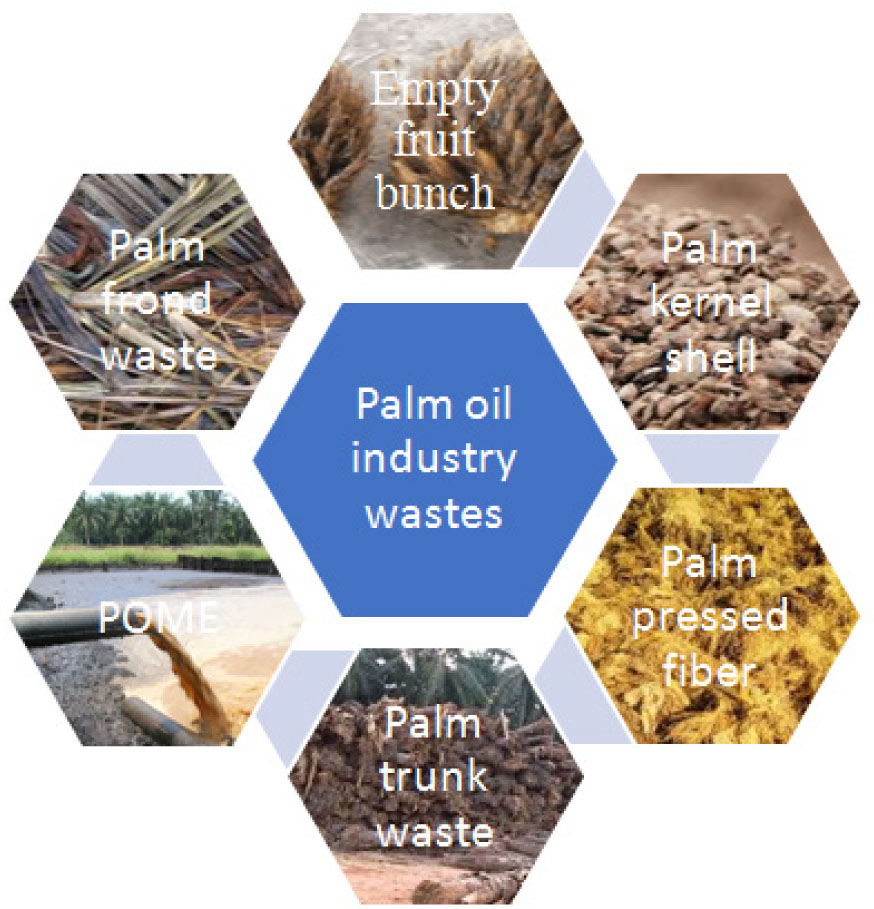
Figure 1.
Wastes from palm oil industry.
Long description: A central blue hexagon labeled “Palm oil industry wastes” is surrounded by six image-based hexagons representing major waste streams: empty fruit bunches at the top, palm kernel shells at the upper right, palm pressed fiber at the lower right, palm trunk waste at the bottom, POME at the lower left, and palm frond waste at the upper left.
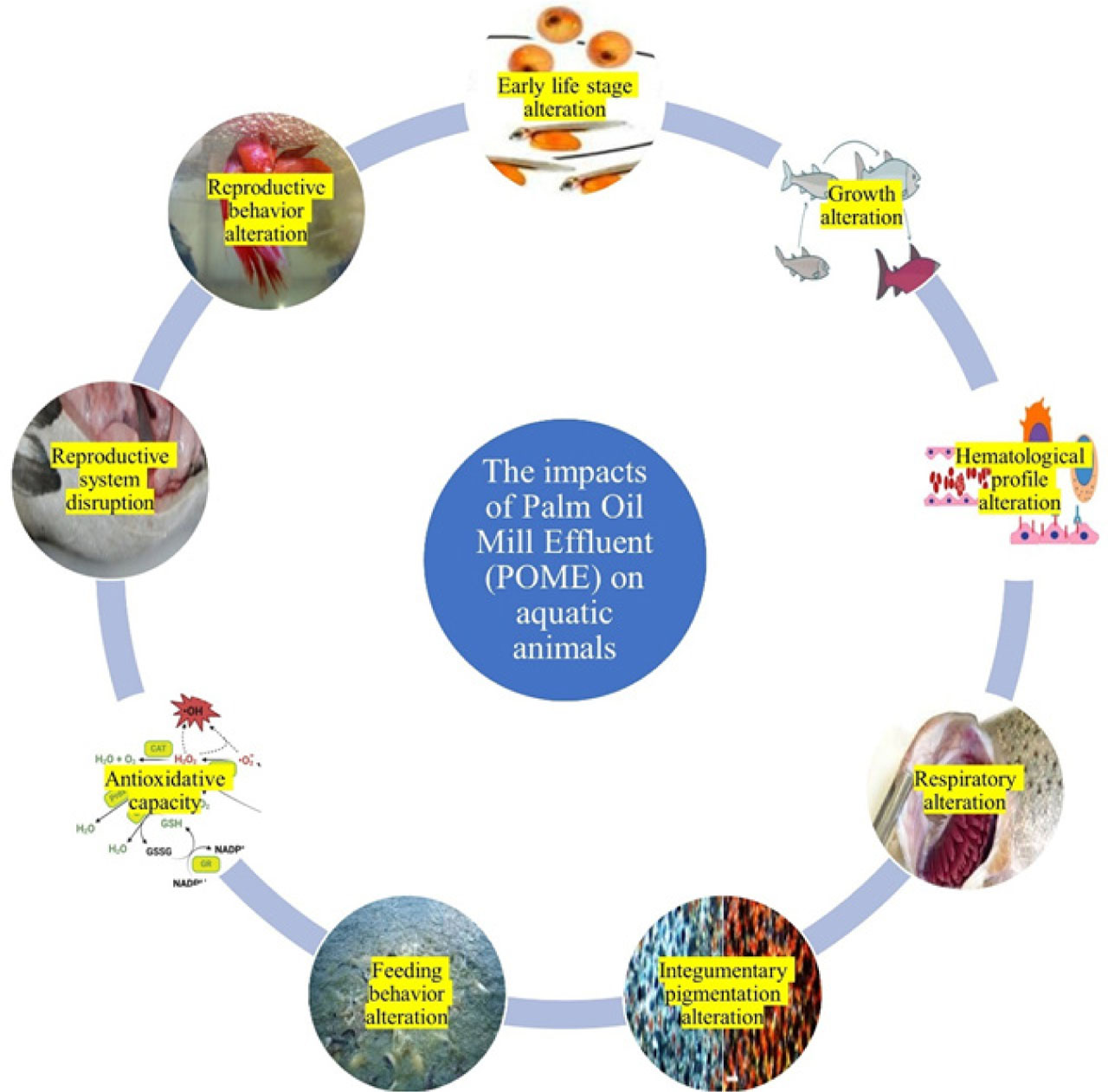
Figure 2.
The impacts of palm oil mill effluent (POME) on aquatic animals.
Long description: A circular diagram places “The impacts of Palm Oil Mill Effluent (POME) on aquatic animals” in a central blue circle. Around it are nine connected impact categories: early life stage alteration, growth alteration, hematological profile alteration, respiratory alteration, integumentary pigmentation alteration, feeding behavior alteration, antioxidative capacity, reproductive system disruption, and reproductive behavior alteration.
Table 1.
The impacts of palm oil mill effluent (POME) on aquatic animals
| Species | Weight (g) | Dose of POME and exposure duration | Impacts | References |
|---|---|---|---|---|
| Female Nile tilapia (Oreochromis niloticus) | 9 to 10 | 1.565 to 3.130 ppm, 45 days | Negatively affected reproductive system | Zulfahmi et al. (2018) |
| Fertilized egg of Nile tilapia (Oreochromis niloticus) | – | 1.565 to 3.130 ppm, 10 days | Early life stage alteration | Muliari et al. (2020) |
| Hybrid catfish (♂ Clarias angullaris × ♀ Heterobranchus bidorsalis) | 11.9 | 4 to 12 ppm, 28 days | Negatively affected hematological profile | Owolabi et al. (2021) |
| Elevated antioxidative capacity | ||||
| Nile tilapia (Oreochromis niloticus) | 28 to 33 | 1.565 to 3.130 ppm, 45 days | Negatively affected hematological profile | Muliari et al. (2022) |
| Male Siamese fighting fish (Betta splendens) | 1 to 2 | Turbidity 20 to 100 NTU, 15 minutes | Negatively affected feeding behavior | Zulfahmi et al. (2022) |
| Siamese fighting fish (Betta splendens) | 1.53 to 2.10 g | Turbidity 20 to 60 NTU, 15 hours | Negatively affected reproductive behavior | Zulfahmi et al. (2024) |
| Zebrafish (Danio rerio) | 0.227 to 0.24 g | 0.5 to 1 ppt, 28 days | Growth impairment | Zulfahmi et al. (2025) |
| Negatively affected respiratory system | ||||
| Skin discoloration |