
Palm oil, a widely used edible oil, holds a substantial global market share. In 2020, its consumption reached approximately 74 million metric tons, representing a significant 31.4% of the global vegetable oil production (Imam et al., 2025). As the preeminent plant-based oil industry, palm oil exerts a profound influence on the socioeconomic landscapes of numerous nations, notably Nigeria, Malaysia, and Indonesia (Anyaoha and Zhang, 2021; Hassan et al., 2024; Yuslaini et al., 2023). However, the industry’s trajectory towards further expansion is increasingly impeded by a confluence of environmental challenges stemming from its waste products. Deforestation for palm oil cultivation leads to a discernible decline in biodiversity, exacerbates anthropogenic wildlife conflicts, and underscores the importance of robust waste management protocols (Cisneros et al., 2021; Rokhim et al., 2020; Tang and Al Qahtani, 2020). Among these pressing concerns, the management of industrial byproducts has emerged as a subject of intense contemporary discourse.
The palm oil industry generates a plethora of residual biomass, encompassing oil palm trunks, fronds, palm pressed fibers, palm kernel shells, empty fruit bunches (EFB), and palm oil mill effluent (POME). Of particular salience, POME constitutes the predominant waste stream emanating from palm oil processing operations. This effluent presents a significant environmental hazard due to its inherent characteristics, exhibiting inordinately elevated levels of biochemical oxygen demand (BOD), chemical oxygen demand (COD), and suspended solids (Aryanti et al., 2024). Furthermore, POME has been shown to harbor a suite of potentially deleterious heavy metals, including cadmium, copper, mercury, and lead (Hashiguchi et al., 2020). Consequently, a substantial body of toxicological research has been undertaken to elucidate the impacts of POME contamination on aquatic fauna, encompassing both acute and chronic exposure scenarios. These studies have investigated a spectrum of physiological and behavioral endpoints, including growth performance, respiratory function, integumentary pigmentation, hematological profiles, antioxidative enzyme activity, reproductive physiology, and alterations in behavior.
POME has emerged as a critical concern within the palm oil industry, prompting investigations into its remediation, potential resource recovery, and ecological effects on aquatic animals. This review first contextualizes POME as a major environmental and aquaculture-related waste stream, highlighting its generation processes and hazardous properties. It then consolidates existing literature on palm oil industry byproducts and POME composition. Furthermore, it examines the multifaceted impacts of POME exposure on aquatic fauna, including alterations in growth, respiration, pigmentation, blood profile, antioxidant activity, reproduction, behavior (including feeding and mating), and early development.
Palm oil industry wastes
In the palm oil industry, waste is generated primarily during the processing of fresh fruit bunches (FFB) into crude palm oil (Figure 1). Solid wastes such as EFB, palm kernel shells, and fibrous residues are produced when fruits are separated and pressed. Meanwhile, liquid waste, known as POME, is generated mainly during sterilization, clarification, and purification processes. POME contains a mixture of water, oil residues, and high levels of organic matter, making it highly polluting if not properly treated. These wastes arise at various processing stages, including sterilization (steam softening of fruit), threshing and pressing (separating fruit and extracting oil), and clarification (separating oil from water). Improper disposal of these wastes can lead to significant environmental problems, particularly affecting soil and aquatic ecosystems (Imam et al., 2025; Sakai et al., 2022).
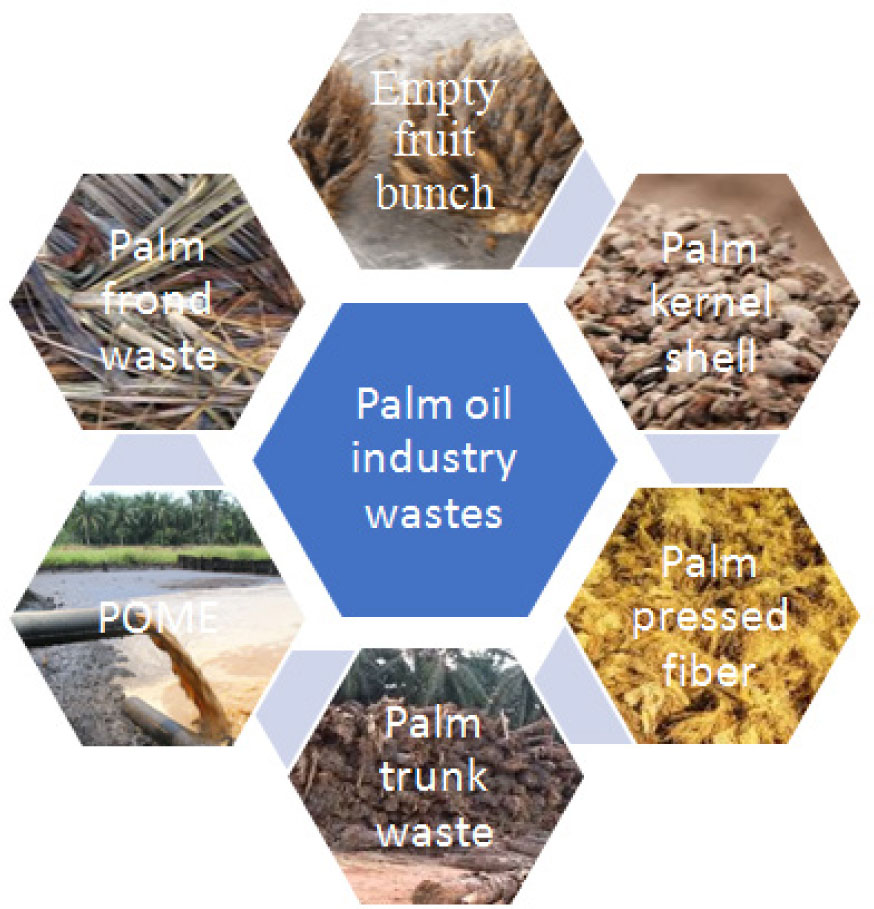
Figure 1.
Wastes from palm oil industry.
Long description: A central blue hexagon labeled “Palm oil industry wastes” is surrounded by six image-based hexagons representing major waste streams: empty fruit bunches at the top, palm kernel shells at the upper right, palm pressed fiber at the lower right, palm trunk waste at the bottom, POME at the lower left, and palm frond waste at the upper left.
The extraction process commences with the harvesting of fresh fruit bunches, followed by steam sterilization and fruit stripping, yielding EFB. Subsequent mashing and pressing facilitate crude palm oil extraction. Further kernel cracking and thermal processing produce palm kernel oil, alongside the generation of palm kernel shells, palm pressed fiber, and POME.
Quantitatively, the processing of one metric ton of fresh fruit bunches results in approximately 230 kg (23%) of EFB, 140–150 kg (14–15%) of palm pressed fiber, and 60–70 kg (6–7%) of palm kernel shells (Abdulrazik et al., 2017; Ng and Ng, 2013; Sakai et al., 2022). Furthermore, the extraction process necessitates substantial water consumption, with estimates ranging from 5 to 7.5 metric tons per metric ton of crude palm oil (Ni et al., 2012). Specifically, each metric ton of palm oil production generates approximately 2500 L of POME (Imam et al., 2025; Zulfahmi et al., 2021). Water usage in palm oil mills is substantial, and the resulting POME generated contains high levels of organic matter and pollutants. If this effluent is not properly treated, it can lead to significant wastewater management challenges, causing contamination of water bodies, depletion of oxygen levels, and harm to aquatic ecosystems. Consequently, excessive water consumption and POME discharge pose serious threats to environmental sustainability in palm oil-producing regions, necessitating effective waste treatment and sustainable water management practices.
Palm oil mill effluent (POME) contents
As a process byproduct of palm oil extraction, POME presents a significant environmental exigency, particularly in aquatic ecosystems, due to its inordinately high concentrations of BOD (10,250–43,750 ppm), COD (15,000 to 100,000 ppm), and suspended solids (Muhamad et al., 2022; Soo et al., 2022). Furthermore, POME has been documented to sequester a range of heavy metals, including copper, cadmium, lead, selenium, and mercury (Zulfahmi et al., 2023). POME has been reported to contain various heavy metals such as lead (Pb), cadmium (Cd), chromium (Cr), copper (Cu), and zinc (Zn), which can pose serious environmental threats if not properly treated. Typical reported concentrations of heavy metals include Pb: 0.19 mg/L (Osman et al., 2020), Fe: 2.03 mg/L, Cd: 0.700 mg/L, Cu: 0.366 mg/L, and Zn: 1.989 mg/L (Jijingi et al., 2025). When compared to international environmental standards – for instance, the WHO limit for Pb in wastewater is 0.01 mg/L, for Cu it is 0.25 mg/L, for Zn it is 0.8 mg/L, and for Cd it is 0.003 mg/L (Gupta and Mukhopadhyay, 2025; Oladimeji et al., 2024) – it is evident that the levels found in POME often exceed safe thresholds. This highlights the significant ecological risk posed by improper POME discharge, potentially leading to bioaccumulation in the food chain and degradation of overall water quality. Macroscopically, POME manifests as a viscous, fuscous liquid, exhibiting an acidic pH within a range of 4 to 5. The coloration is primarily attributable to the presence of tannins, pectins, phenolic compounds, lignin, and carotenes (Imam et al., 2025). Moreover, POME liberates malodorous volatiles upon thermal perturbation (Saad et al., 2021). Additional key constituents identified within POME encompass oil and grease (130–18,000 ppm), volatile fatty acid (350 ppm), volatile suspended solids (8,400–12,000 ppm), methane, sulfur dioxide, and ammonia (Islam et al., 2018; Malakahmad and Yee, 2014; Mohammad et al., 2021).
Impacts of palm oil mill effluent (POME) on aquatic animals
POME poses significant threats to aquatic animals across various biological functions (Figure 2). Its high organic load, suspended solids, and toxic constituents such as heavy metals and phenolic compounds can impair growth by disrupting metabolism and reducing nutrient uptake. The respiratory system is stressed due to oxygen depletion caused by POME’s high BOD and COD, often leading to gill damage and hypoxia. Pigmentation may be altered as toxins and turbidity affect skin health and color expression. Changes in the blood profile, such as reduced red blood cells and hemoglobin, reflect compromised oxygen transport, while elevated white blood cells indicate immune stress. POME also induces oxidative stress, altering antioxidant enzyme activities like SOD and CAT, thereby weakening cellular defenses. Reproductive functions are disrupted through hormonal imbalances, reduced fecundity, and lower gamete quality. Behavioral changes are evident, including reduced feeding and mating behaviors, often due to stress or sensory impairment. During early development, embryos and larvae are especially vulnerable, with exposure causing delayed hatching, deformities, or mortality. Altogether, POME contamination severely affects aquatic health, survival, and ecosystem balance.
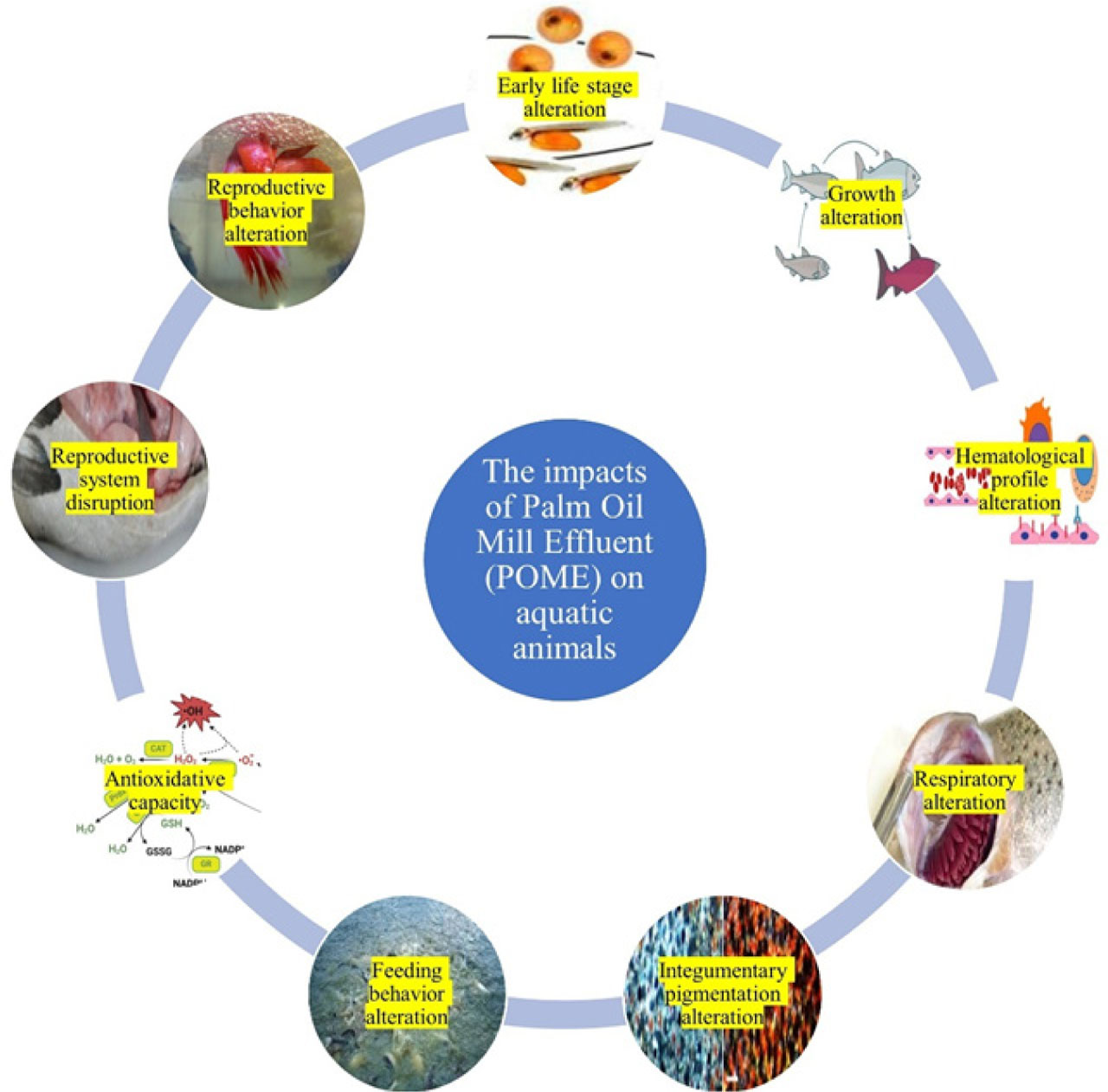
Figure 2.
The impacts of palm oil mill effluent (POME) on aquatic animals.
Long description: A circular diagram places “The impacts of Palm Oil Mill Effluent (POME) on aquatic animals” in a central blue circle. Around it are nine connected impact categories: early life stage alteration, growth alteration, hematological profile alteration, respiratory alteration, integumentary pigmentation alteration, feeding behavior alteration, antioxidative capacity, reproductive system disruption, and reproductive behavior alteration.
Growth alteration
Pollutant exposure often disrupts physiological homeostasis, consequently impairing growth (Saha et al., 2021; Zulfahmi et al., 2025). Growth retardation has been consistently observed in aquatic animals following POME exposure. For example, zebrafish exhibited a statistically significant (P<0.05) reduction in both weight and length compared to control groups (Zulfahmi et al., 2025). Analogous observations have been documented in various aquatic species exposed to other pollutants, such as the lead in Mozambique tilapia (Oreochromis mossambicus), microplastics in Malabar glassy perchlet (Ambassis dussumieri) (Naidoo and Glassom, 2019), sulfate in zebrafish (Cao et al., 2022), diazinon in walking cat-fish (Clarias batrachus) (Saha et al., 2021), and carbamazepine in common carp (Cyprinus carpio) (Liang et al., 2022). The observed growth inhibition in aquatic animals exposed to POME may be attributed to a combination of factors: diminished oxygen consumption indicative of physiological perturbation, dysregulation of respiratory and digestive systems, metabolic suppression, reduced energy intake, and induction of oxidative stress responses (Shahjahan et al., 2022; Xu et al., 2021; Zhao et al., 2021).
Hematological profile alteration
Exposure to POME elicits significant alterations in the hematological profiles of aquatic animals. In a study by Owolabi et al. (2021), hybrid catfish (Heteroclarias) subjected to POME concentrations ranging from 4 to 12 ppm for 28 days exhibited marked deviations. Specifically, a statistically significant (P<0.05) decrease was observed in red blood cells, hemoglobin, mean cell hemoglobin, mean cell volume, mean cell hemoglobin concentration, and packed cell volume. Concurrently, white blood cell counts were significantly elevated in POME-exposed fish. The observed reduction in erythrocytic parameters is attributed to compromised hemoglobin synthesis, a consequence of pollutant exposure. This disruption engenders a state of hypoxia, potentially culminating in severe anemia. The resultant oxygen deficit impairs physiological functions, including locomotory activity, thereby compromising predation efficacy (Owolabi et al., 2021). These findings are consistent with hematological perturbations reported in various aquatic animals exposed to diverse industrial pollutants, including Tilapia guineensis exposed to industrial effluents (Dahunsi, 2013), Labeo rohita exposed to plywood effluent (Juginu, 2017), African catfish (Clarias gariepinus) exposed to bitumen-contaminated river water (Ayandiran and Dahunsi, 2016), rubber processing effluent (Dahunsi, 2013), and pharmaceutical industry effluent (Alimba et al., 2019). However, we are unable to directly compare the specific effluents to POME due to the lack of detailed compositional information. Our intention was merely to demonstrate that these effluents have shown similar hematological impacts on aquatic animals.
Conversely, a study of Nile tilapia exposed to POME concentrations of 1.565 to 3.565 ppm for 15 days revealed a statistically significant (P<0.05) elevation in hemoglobin levels compared to the control (Muliari, 2022). However, this elevation in hemoglobin levels was not sustained at 30 and 45 days post-exposure. A similar temporal pattern was discerned in leukocyte counts, with a significant (P<0.05) increase observed at 30 days, but not at 15 or 45 days.
The augmentation of leukocyte counts following POME exposure is a recurring observation in aquatic fauna. This is supported by reports of increased leukocytes in hybrid catfish (Owolabi et al., 2021) and Nile tilapia exposed to POME (Zulfahmi et al., 2017), as well as Mastacembellus armatus exposed to heavy metals (Cu, Ni, Fe, Co, Mn, Cr, and Zn) (Javed, 2012), whose profile resembles POME constituents. This leukocytosis can be attributed to the potential for POME’s constituents, particularly suspended solids, to adhere to gill lamellae, inducing physical injury and oxidative stress. This insult triggers an immune response, culminating in the heightened production of leukocytes (Owolabi et al., 2021).
Respiratory alteration
The respiratory system plays a vital role in maintaining oxygen balance, which supports key physiological processes, such as osmoregulation, metabolism, and excretion in aquatic animals. However, pollutants present in POME can adversely affect respiratory function, disrupting these essential biological activities (Morgenroth et al., 2022). Previous studies have documented that POME disrupts respiratory physiology in zebrafish, manifesting as aberrant opercular movement rates, which subsequently compromise oxygen consumption and induce hypoxic symptomatology (Zulfahmi et al., 2025). While gill tissue alterations are posited as a potential consequence of these irregular opercular movements, the precise etiology remains inconclusive due to constrained experimental duration. Furthermore, no statistically significant (P>0.05) disparities in gill weight were observed between POME-exposed and control groups. The observed perturbations in opercular movement, despite their apparent compensatory nature, fail to enhance oxygen assimilation due to concomitant impairment of gill tissue, thereby impeding efficient gas exchange. Similar anomalies in opercular movement have been reported in diverse aquatic taxa exposed to a spectrum of pollutants, including walking catfish exposed to fluoride (Kishore et al., 2022), guppy (Poecilia reticulate) exposed to silver nanoparticles (Mohsenpour et al., 2020), and rohu (L. rohita) exposed to organophosphates (Zulfahmi et al., 2025). Aquatic organisms experiencing respiratory dysfunction following pollutant exposure may exhibit a constellation of indicative parameters, including diminished enzymatic activity (Zulfahmi et al., 2025), reduced oxygen consumption (Hussan et al., 2018), aberrant opercular rhythms (Soman et al., 2024), and structural gill anomalies (Chinnadurai et al., 2022).
POME is known to harbor heavy metals (Cu, Zn, and Fe) and suspended solids, both of which can precipitate gill tissue alterations. Suspended solids may create a physical barrier, impeding the diffusion of oxygen and carbon dioxide across gill lamellae, thereby reducing oxygen uptake. Analogous effects on gill morphology have been documented in Tor tambra exposed to tannins (Ihsan et al., 2021), Cyprinus carpio exposed to antimony chloride (Chen and Yang, 2007), and Catla catla exposed to mercury and cadmium (Hussan et al., 2018). The gill impairment observed in aquatic animals exposed to POME aligns with previous research, which has shown that exposure to various heavy metals induces gill tissue damage, resulting in reduced oxygen consumption rates in aquatic organisms. Exemplary studies include Piaractus mesopotamicus exposed to chromium (Castro et al., 2014), O. niloticus exposed to cadmium (Nursanti et al., 2017), L. rohita exposed to iron (Singh et al., 2019), and C. carpio exposed to cadmium, copper, and zinc (Delahaut et al., 2020).
Integumentary pigmentation alteration
Integumentary pigmentation plays a pivotal role in aquatic organisms, encompassing reproductive signaling, intraspecific communication, thermoregulation, and photoprotection (Yuan et al., 2023). Exposure to POME elicits discernible alterations in the integumentary pigmentation of aquatic organisms. For instance, zebrafish subjected to a 28-day POME challenge exhibited a marked attenuation of red chromaticity, accompanied by generalized melanism compared to control specimens (Zulfahmi et al., 2025).
Furthermore, heavy metal constituents within POME can induce histopathological changes in dermal tissues, ultimately leading to dyschromia (Zulfahmi et al., 2025). For instance, Heteropneustes fossilis exposed to cadmium chloride exhibited a significant reduction in chromatophore density, thereby compromising skin coloration (Shareef et al., 2018). The ramifications of integumentary depigmentation are profound, disrupting fundamental ecological functions such as foraging, courtship, and predator evasion. Moreover, compromised pigmentation can reduce the market value of aquatic organisms, particularly ornamental fish. However, empirical data on economic losses in the ornamental fish trade resulting from pigmentation compromise are currently unavailable; therefore, the full extent of the impact on the industry cannot be determined.
Feeding behavior alteration
Turbidity caused by POME significantly alters the feeding behavior of aquatic animals. This assertion is supported by a study in which male Siamese fighting fish experienced a statistically significant (P<0.05) change in foraging behavior after a 15-minute exposure to POME turbidity (≥ 20 NTU) (Zulfahmi et al., 2022). The study found that the experimental fish took significantly longer to capture prey (P<0.05), exhibited prolonged aggressive behavior towards prey (P<0.05), and displayed reduced swimming activity. Other studies have corroborated these findings, reporting that various pollutants alter feeding behavior in aquatic animals. For example, emerald shiner exposed to turbidity due to algal sedimentation showed altered foraging (Nieman and Gray, 2019), zebrafish exposed to turbidity from crude oil showed impaired feeding (Magnuson et al., 2020), and Mozambique tilapia exposed to turbidity from mercury chloride showed abnormal feeding (Aliza et al., 2022). These changes in foraging behavior may be related to poor visual clarity in turbid water and potential retinal damage. Indeed, histological analysis demonstrated retinal degeneration in Siamese fighting fish exposed to high POME-induced turbidity, characterized by a decrease in granular spherical cells and detachment of bipolar cells from the photoreceptors (Zulfahmi et al., 2022). These behavioral and physiological impacts can result in reduced food intake, which negatively affects the growth and health of aquatic organisms.
Antioxidative capacity
Exposure to POME can elicit complex, bidirectional responses in the antioxidative capacity of aquatic animals. On one hand, POME can trigger a defensive activation of this system. For instance, hybrid catfish (♂ Clarias angullaris × ♀ Heterobranchus bidorsalis) exposed to increasing POME concentrations demonstrated a significant (P<0.05) elevation in antioxidative enzymes, including catalase, glutathione peroxidase, and superoxide dismutase as the concentration of POME increased (Owolabi et al., 2021). This response is a recognized compensatory mechanism; POME induces oxidative stress (Owolabi et al., 2021), which in turn activates the antioxidant defense system to mitigate its effects (Kaptaner et al., 2016; Ogueji et al., 2020). Similar increases in these enzymes have been observed in other aquatic organisms exposed to pollutants, such as Hyalella azteca exposed to plant effluent (Novoa-Luna et al., 2016) and crucian carp (Carassius auratus) exposed to sewage treatment plant effluent (Chang et al., 2020).
Conversely, POME can also overwhelm or inhibit this defense mechanism system. Components such as suspended solids and heavy metals can induce gill lamellar disruption, compromising gaseous exchange (de Castro Sachi et al., 2021). This hypoxia impedes oxygen uptake and can consequently disrupt the synthesis of anti-oxidant enzymes, undermining the organism’s ability to mitigate oxidative stress. This inhibitory effect has been observed in various pollutant-exposure studies; for example, inhibited antioxidant enzyme biosynthesis was observed in large yellow croaker (Larimichthys crocea) exposed to ammonia (Chinnadurai et al., 2022) and Mozambique tilapia exposed to fumaronitrile (Guo et al., 2023). This disruption may occur at multiple levels: transcriptionally [by downregulating the genes encoding for superoxide dismutase (SOD), catalase (CAT), and glutathione peroxidase (GPx)]; translationally (by impairing protein synthesis); and post-translationally (through oxidative modifications that reduce enzyme stability or catalytic activity). Furthermore, excessive reactive oxygen species (ROS) generated under stress can directly impair enzyme function. When this defense system is compromised, the resulting imbalance in ROS homeostasis leads to severe oxidative stress, lipid peroxidation, and impaired physiological processes, ultimately affecting the growth, reproduction, and survival of aquatic animals (Chinnadurai et al., 2022; Guo et al., 2023).
Reproductive system disruption
Exposure to POME has been demonstrated to induce reproductive dysfunction in aquatic animals. Following a 45-day exposure to POME at 3.130 ppm, Nile tilapia exhibited a significant reduction in gonadosomatic index (GSI) and oocyte diameter. Notably, while GSI and oocyte size were compromised, fecundity remained unaffected (Zulfahmi et al., 2018). Comparable reductions in GSI have been documented in diverse aquatic species, including Rutilus rutilus (Gerbron et al., 2014), Gobius niger (Tolussi et al., 2018), and Astyanax fasciatus (Louiz et al., 2009). Furthermore, pollutants have been implicated in the disruption of reproductive endocrine signaling (Ebrahimi and Taherianfard, 2011), the attenuation of oocyte growth (Alquezar et al., 2006), the perturbation of mating behaviors (Bertram et al., 2015), and the induction of larval abnormalities (Zhang et al., 2016).
The observed decline in GSI is attributed to the reduction in oocyte diameter. This decrease in oocyte size is primarily mediated by a decrease in reproductive hormone levels and impaired vitellogenesis (Yamamoto et al., 2017). Oocyte size is a critical factor in determining the size of newly hatched larvae. Larger larvae generally exhibit higher survival rates, faster growth, and greater resistance to predation; however, to date, no studies have specifically examined this relationship in species exposed to POME. Pollutant exposure that reduces oocyte and larval size can potentially compromise population dynamics in aquatic ecosystems (Hinckley, 1990).
Table 1.
The impacts of palm oil mill effluent (POME) on aquatic animals
| Species | Weight (g) | Dose of POME and exposure duration | Impacts | References |
|---|---|---|---|---|
| Female Nile tilapia (Oreochromis niloticus) | 9 to 10 | 1.565 to 3.130 ppm, 45 days | Negatively affected reproductive system | Zulfahmi et al. (2018) |
| Fertilized egg of Nile tilapia (Oreochromis niloticus) | – | 1.565 to 3.130 ppm, 10 days | Early life stage alteration | Muliari et al. (2020) |
| Hybrid catfish (♂ Clarias angullaris × ♀ Heterobranchus bidorsalis) | 11.9 | 4 to 12 ppm, 28 days | Negatively affected hematological profile | Owolabi et al. (2021) |
| Elevated antioxidative capacity | ||||
| Nile tilapia (Oreochromis niloticus) | 28 to 33 | 1.565 to 3.130 ppm, 45 days | Negatively affected hematological profile | Muliari et al. (2022) |
| Male Siamese fighting fish (Betta splendens) | 1 to 2 | Turbidity 20 to 100 NTU, 15 minutes | Negatively affected feeding behavior | Zulfahmi et al. (2022) |
| Siamese fighting fish (Betta splendens) | 1.53 to 2.10 g | Turbidity 20 to 60 NTU, 15 hours | Negatively affected reproductive behavior | Zulfahmi et al. (2024) |
| Zebrafish (Danio rerio) | 0.227 to 0.24 g | 0.5 to 1 ppt, 28 days | Growth impairment | Zulfahmi et al. (2025) |
| Negatively affected respiratory system | ||||
| Skin discoloration |
Reproductive behavior alteration
POME has been shown to disrupt the reproductive behavior of aquatic animals. For instance, a study (Zulfahmi et al., 2024) using Siamese fighting fish found that turbidity from POME significantly reduced total egg production and decreased mating displays, including chasing, fin spreading, and tail movement. Other pollutants have also been reported to cause changes in reproductive behavior in aquatic animals, such as sewage effluent (Sebire et al., 2011), algal blooms (Engström-Öst and Candolin, 2007), and crude oil (Bautista et al., 2019).
High turbidity in aquatic environments, such as that caused by POME, can interfere with predation, feeding, and reproductive behavior of aquatic animals (Kaewpranee et al., 2023; Magnuson et al., 2020; Wright et al., 2020). This effect is attributed to impaired visual acuity caused by turbidity, as this visual impairment been shown to affect various aquatic species such as Siamese fighting fish (Zulfahmi et al., 2024), Rhinecanthus aculeatus (Newport et al., 2021), guppy (Poecilia reticulata) (Borner et al., 2015; Kimbell and Morrell, 2015), three-spined stickleback (Gasterosteus aculeatus) (Chamberlain and Ioannou, 2019; Sohel et al., 2017), emerald shiner (Notropis atherinoides), and walleye (Sander vitreous) (Nieman and Gray, 2019). Reduced visual perception in turbid environments limits pre-copulatory behaviors, decreasing egg production and potentially disrupting reproduction and population dynamics (Maan et al., 2010).
Early life stage alteration
Exposure to POME elicits toxicity in the early life stages of aquatic organisms. A previous investigation documented significant (P<0.05) developmental abnormalities in Nile tilapia, including a marked reduction in egg hatching rate, diminished larval survival, cardiac arrhythmia, and malformations following a 10-day exposure to POME at concentrations ranging from 1.565 to 3.130 ppm (Muliari et al., 2020). Larval malformations included kyphosis, lordosis, and caudal curvature. Similar developmental perturbations have been observed in diverse aquatic species exposed to various heavy metals, such as Pagrus major exposed to mercury (Huang et al., 2011), Java medaka (Oryzias javanicus) exposed to cadmium and mercury (Ismail and Yusof, 2011), and zebrafish (Danio rerio) exposed to mercuric chloride (Zhang et al., 2016). Furthermore, exposure to pesticides has been implicated in adverse developmental outcomes, as exemplified by banded gourami (Trichigaster fasciata) exposed to chlorpyrifos (Sumon et al., 2017), African catfish (Clarias gariepinus) exposed to buprofezin (Marimuthu et al., 2013), and zebrafish exposed to alphamethrin (Ansari and Ansari, 2012).
The observed reduction in egg hatching rate may be attributed to the inhibition of chorionase enzyme activity. Additionally, pollutants may induce hypoxia in the developing embryo, thereby impeding chorion degradation (Aksakal and Ciltas, 2019; Sumon et al., 2017). Furthermore, diminished larval survival may be linked to pollutant-mediated oxidative stress, leading to compromised growth, physiological performance, and overall health. Pollutants can also disrupt larval nutrient assimilation, culminating in elevated mortality (Houck and Cech, 2004). The incidence of larval malformations (such as lordosis) is often attributed to pollutant-induced oxidative stress, organ dysfunction, or broader disruptions to embryo-genesis (Newman et al., 2015; Islam et al., 2019).
Conclusion
This review synthesizes evidence of the multifaceted toxicity of palm oil mill effluent (POME) on aquatic organisms. Exposure to POME demonstrably induces deleterious effects on growth, respiration, integumentary pigmentation, hematological parameters, antioxidant enzyme activity, reproductive function, mating and foraging behaviors, and early developmental stages. However, this review also highlights that current knowledge of POME’s ecotoxicological impacts remains limited, largely due to the narrow scope of existing studies, which have primarily focused on a small range of model organisms. To comprehensively elucidate the ecological footprint of POME and inform effective mitigation strategies, future research must prioritize the expansion of toxicological assessments to encompass a broader diversity of aquatic taxa. Such investigations should aim to delineate the underlying mechanisms of POME toxicity, explore synergistic effects with other environmental stressors, and rigorously evaluate the efficacy of novel POME treatment technologies. Findings from these expanded studies will be instrumental in formulating evidence-based guidelines for POME management, thereby safeguarding the integrity of the aquatic ecosystem and promoting the sustainable coexistence of industrial activities and environmental preservation.