
Aquaculture, the farming of aquatic organisms including fish, crustaceans, mollusks, and aquatic plants, is one of the world’s fastest-growing food production sectors (Okasha et al., 2025). It significantly enhances food security, fosters economic growth, and alleviates constraints on wild fish supplies resulting from overuse (Janči and Putnik, 2025). Aquaculture currently contributes more than half of the world’s aquatic food consumption, a proportion expected to increase as wild fisheries face biological and legal constraints (FAO, 2024; Sharma et al., 2025). Despite its rapid expansion, aquaculture faces persistent challenges that threaten sustainability and productivity. Intensified farming systems often expose aquatic animals to suboptimal water quality, high stocking densities, and environmental stressors, which impair immunity, feed efficiency, and disease resistance (Ashley, 2007; Dawood et al., 2018; Yang et al., 2019; Shehata et al., 2024 a). Historically, these issues have been mitigated through the use of antibiotics and synthetic growth promoters. However, such approaches are increasingly associated with antimicrobial resistance (AMR), chemical residue accumulation, and environmental degradation, prompting regulatory restrictions and consumer pushback (Cabello et al., 2013; Reverter et al., 2014; Tawfeek et al., 2024). Consequently, attention has shifted toward sustainable strategies, including the incorporation of functional feed additives like bioactive compounds that enhance physiological performance, immune function, and stress resilience beyond basic nutrition (Marimuthu et al., 2022; Kuebutornye et al., 2024; Shehata et al., 2025 a). Among these, phytogenic feed additives (PFAs), or botanicals, derived from herbs, spices, and medicinal plants, incorporate compounds like essential oils, flavonoids, alkaloids, phenolics, terpenoids, and saponins, known for their antimicrobial, antioxidant, anti-inflammatory, and immunostimulant activities (Yang et al., 2015; Encarnação, 2016; Shehata et al., 2022; Onomu and Okuthe, 2024).
Unlike synthetic chemicals, PFAs are generally regarded as safe, biodegradable, and compatible with sustainable aquaculture goals. They modulate gut microbiota, improve nutrient utilization, reduce oxidative stress, and enhance disease resistance across various species such as tilapia, carp, and prawns (Citarasu, 2010; Awad and Awaad, 2017; Tran et al., 2020). Certain plant species have shown beneficial effects on growth and immunity, including neem (Azadirachta indica), thyme (Thymus vulgaris), garlic (Allium sativum), and turmeric (Curcuma longa) (Dawood et al., 2018, 2022; Fagnon et al., 2020; Alagawany et al., 2021; Valenzuela-Gutiérrez et al., 2021; Ferreira et al., 2024). Furthermore, phytogenics align with consumer preferences for natural, residue-free aquaculture products and contribute to sustainability goals by reducing chemical inputs (Makkar et al., 2014; Li et al., 2019; Tacon et al., 2022; Woodgate et al., 2022). Integrating ethnoveterinary knowledge and traditional medicinal plants also enhances regional applicability and acceptance (Hashemi and Davoodi, 2011; Liang et al., 2023; Iqbal et al., 2024; Ivanova et al., 2024).
Among the emerging PFAs, milk thistle (Silybum marianum) is gaining recognition for its hepatoprotective, antioxidant, and anti-inflammatory potential, primarily attributed to its active flavonolignan complex, silymarin, and thus has a long history of use in both human and veterinary medicine (Abdel-Latif et al., 2023; Elnesr et al., 2023; Guerrini and Tedesco, 2023; Shehata et al., 2024 b). These attributes now point to its promising role in supporting fish health, improving resilience to stress, and reducing reliance on synthetic treatments in aquaculture systems. Several studies have begun to explore its potential in aquatic animals; for instance, dietary silymarin improved liver enzyme profiles and antioxidant capacity in Nile tilapia (Oreochromis niloticus) and enhanced immune gene expression and survival in Pacific white shrimp (Litopenaeus vannamei) under pathogenic stress (Veisi et al., 2021; Shahin et al., 2023; Hasanthi et al., 2024).
The review compiles current research results and highlights information gaps that need to be addressed to fully maximize the benefits of S. marianum in aquatic animal health and nutrition. Although numerous phytogenic feed additives have been explored in aquaculture, S. marianum warrants special attention due to its unique composition of flavonolignans (silymarin complex), which exerts multifunctional effects on liver protection, oxidative stress mitigation, and immune regulation. Unlike many botanicals with primarily antimicrobial or growth-promoting actions, milk thistle directly targets hepatic and metabolic health, a critical determinant of performance and resilience in aquatic species. Furthermore, the compound’s extensive documentation in human and terrestrial animal medicine contrasts with the limited and fragmented evidence in aquaculture, underscoring the need for a comprehensive synthesis. Accordingly, the objectives of this review are: (1) to critically summarize the existing knowledge on the biological and functional roles of S. marianum in aquatic species; (2) to evaluate the current evidence regarding its bioavailability, formulation strategies, and synergistic applications; and (3) to identify research gaps and future directions for its practical, sustainable integration into aquafeeds.
Major bioactive constituents and mechanistic relevance of Silybum marianum
The pharmacological efficacy of Silybum marianum is primarily attributed to the silymarin complex, a mixture of flavonolignans and polyphenolic compounds concentrated mainly in the plant’s seeds and pericarp (Gazak et al., 2007; Abenavoli et al., 2018; Fanai et al., 2024) (Figure 1). Silymarin generally comprises 65–80% flavonolignans and 20–35% polymeric or oxidized polyphenols. Among the flavonolignan fraction, silybin (silibinin) is the predominant component, accounting for 50–70% of total flavonolignans, followed by silychristin (~20% of flavonolignans) and silydianin (~10% of flavonolignans), each exhibiting distinct yet complementary biological functions (Anthony and Saleh, 2013; Viktorová et al., 2019). Silybin exists as two diastereomers, silybin A and silybin B, which exhibit potent antioxidant, antifibrotic, anti-inflammatory, and hepatoprotective activities through free radical scavenging, cytokine modulation, and stabilization of hepatocyte membranes (Jacobs et al., 2002).
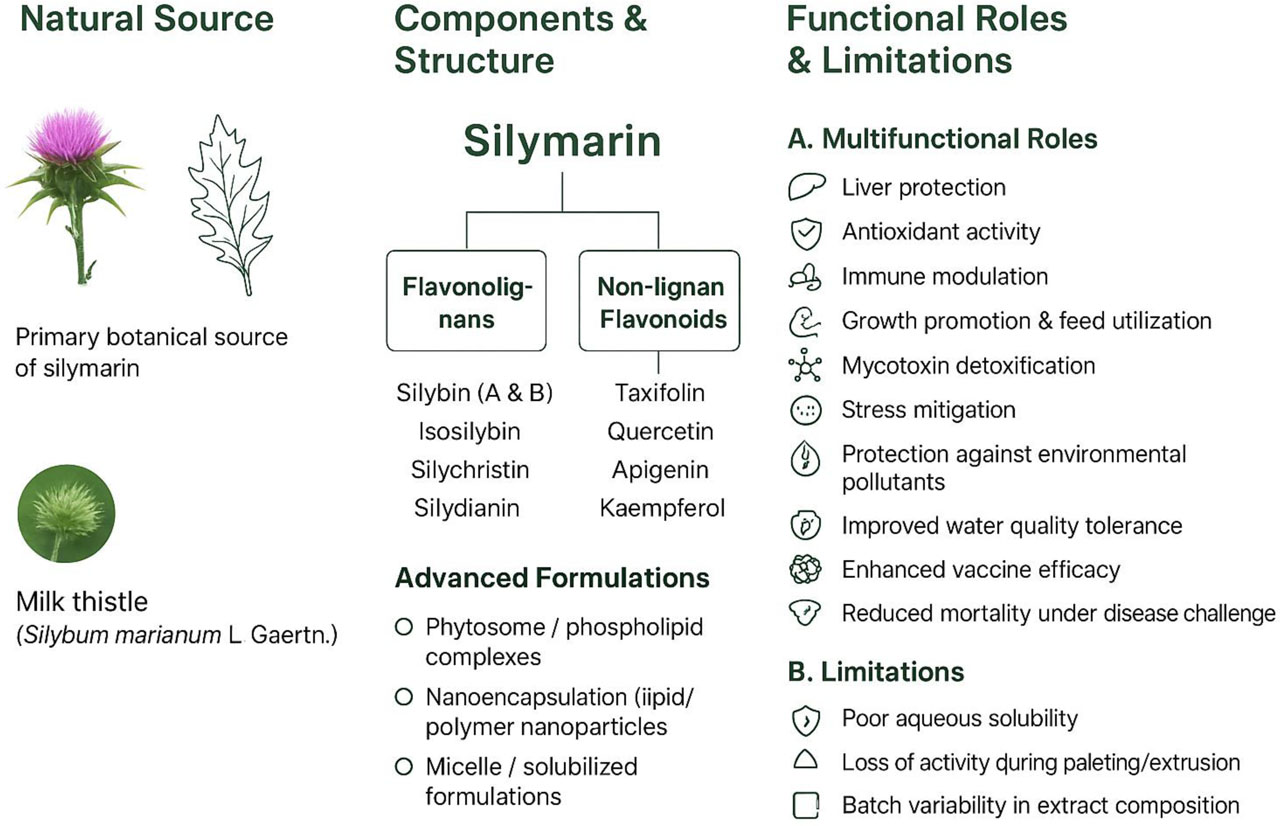
Figure 1.
Silymarin: components, structure, multifunctional roles in aquaculture, and limitations
Collectively, these compounds confer a multi-target hepatoprotective effect, enhancing the liver’s resistance to metabolic and oxidative stress. The biosynthesis of flavonolignans occurs through oxidative coupling between the flavonoid taxifolin and the phenylpropanoid coniferyl alcohol, yielding the characteristic silymarin scaffold (Surai, 2015; Porwal et al., 2019). Minor constituents, including isosilybin A and B, dehydrosilybin, and taxifolin itself, further contribute to the extract’s antioxidant capacity, with taxifolin serving as both a biosynthetic precursor and a radical-scavenging agent. In addition, S. marianum seed oil contains unsaturated fatty acids (oleic and linoleic acids), tocopherols, and phytosterols, which augment its nutritional and hepatoprotective potential (Surai, 2015).
Despite silymarin’s potent bioactivity, its therapeutic efficacy is limited by poor oral bioavailability due to low aqueous solubility and extensive first-pass metabolism. Advanced delivery systems, including phospholipid complexes, nanoparticles, and encapsulation, significantly improve absorption compared to conventional extracts (Bhattacharya, 2020; Song et al., 2021; Tvrdý et al., 2021; Zhang et al., 2022), with species-specific metabolism and dietary factors further influencing systemic availability (Xie et al., 2019; Jaffar et al., 2024). These bioavailability considerations are critical for optimizing silymarin’s therapeutic efficacy in aquaculture species.
Medicinal uses of S. marianum for animal health
S. marianum has been used for over 2,000 years in traditional medicine systems, including Ayurvedic, Persian, and Greco-Roman practices, primarily for the treatment of gallbladder and liver disorders. Traditionally, milk thistle has been employed for its hepatoprotective properties, particularly in the treatment of liver-related conditions such as hepatitis, cirrhosis, and toxin-induced liver damage (e.g., from mushroom poisoning) (Abenavoli et al., 2018). It has also been used as a digestive aid and anti-inflammatory agent in both internal and topical applications (Eita, 2022). Its anti-inflammatory effects are mediated through suppression of nuclear factor-κB (NF-κB) signaling, inhibition of COX-2, and downregulation of pro-inflammatory cytokines such as tumor necrosis factor-α (TNF-α) and interleukin-1β (IL-1β) (Surai and Surai, 2023 b; Surai et al., 2024). As evidenced in livestock, silymarin modulates the immune system by boosting the white blood cell counts, improving the antibody production, and microbial clearance (Esmaeil et al., 2017; Owatari et al., 2018; Wang et al., 2019; Abdel-Latif et al., 2023). Furthermore, it supports metabolic regulation by improving lipid and carbohydrate utilization, thereby aiding stress management in aquaculture species, which is helpful for controlling stress induced by diets in fish farming species (Xiao et al., 2017; El-Houseiny et al., 2022 b; Shehata et al., 2024 b).
In recent years, veterinary and animal nutrition research has expanded these traditional uses to livestock and aquaculture species, leveraging their hepatoprotective, antioxidant, and immunomodulating effects to position them as natural feed additives in animal health (Gazak et al., 2007; Khazaei et al., 2022). Moreover, silymarin enhances the activity of endogenous antioxidant enzymes, including superoxide dismutase (SOD), catalase (CAT), and glutathione peroxidase (GPx), thereby contributing to the reduction of oxidative stress (Surai, 2015). Immunologically, milk thistle administration has been associated with increased leukocyte counts, elevated antibody titers and enhanced cytokine production (Guerrini and Tedesco, 2023; Tedesco and Guerrini, 2023). In aquaculture studies, the dietary inclusion of milk thistle extract has shown improved feed utilization, growth performance, and disease resistance in Nile tilapia, Oreochromis niloticus (Hassaan et al., 2019; El-Houseiny et al., 2022 b; Chaklader et al., 2024), Pacific white shrimp, Litopenaeus vannamei (Hasanthi et al., 2024), mullet, Liza ramada (Shehata et al., 2024 b), carp, Cyprinus carpio (Al-Jubouri and Al-Obaydi, 2021; Al-Shawi et al., 2022), and trout, Oncorhynchus mykiss (Nazdar et al., 2018).
Functional roles of S. marianum in aquatic species
Traditionally valued for its hepatoprotective and antioxidant properties in mammals, S. marianum is now gaining attention in aquaculture for its potential to enhance the health and growth performance of fish and crustaceans (Tables 1, 2, 3). Its major bioactive component, silymarin, a complex of flavonolignans, exerts multiple physiological effects, including liver protection, immunomodulation, and oxidative stress reduction (Surai, 2015; Khazaei et al., 2022). In aquatic species, dietary supplementation with S. marianum, primarily through silymarin-rich extracts has been shown to improve growth performance, feed utilization, and disease resistance, largely through the stabilization of hepatocyte membranes, upregulation of antioxidant enzymes, and modulation of immune-related gene expression (Shahin et al., 2023; Chaklader et al., 2024). Multiple studies conducted in Nile tilapia, European seabass (Dicentrarchus labrax), and Pacific white shrimp have consistently demonstrated that dietary inclusion of silymarin enhances hepatic function and improves stress resilience under intensive farming conditions (Veisi et al., 2021; Shahin et al., 2023; Hasanthi et al., 2024). Owing to its botanical origin, favorable safety profile and negligible environmental impact, S. marianum is emerging as a viable phytogenic alternative to synthetic additives and antibiotics in functional aquafeeds. Nevertheless, its efficacy is closely influenced by species-specific physiological response, delivery methods, and bioavailability, which are further elaborated in the subsequent section.
Table 1.
Milk thistle (Silybum marianum) applications on fish species performance
| Name | Product type and source | Tested dosage | Period | Route of administration | Fish species | Growth, feed utilization and survival | Biochemical variables | Immune-enhancing effects | Antioxidant effects | Gene expression | Challenges resistance | References |
|---|---|---|---|---|---|---|---|---|---|---|---|---|
| Milk thistle (Silybum marianum) extract | Powder – purchased from Trade Company | 0, 0.1, 0.2, and 0.3% | 60 d | In diet | Striped catfish (Pangasianodon hypophthalmus) | WG, FI and SGR (↑), FCR, and SR (↔) | ALP, ALT, and AST (↓), urea, uric acid, and creatinine (↔) | LYZ and total Ig (↑) | SOD and CAT (↑), MDA (↓), GPx (↔) | ND | NM | (Abdel-Latif et al., 2023) |
| Silybum marianum extract | Powder – purchased from Trade Company | 0. 1, 2, 3, and 4 g/kg | 60 d | In diet | Nile tilapia (Oreochromis niloticus) | WG and SGR (↑), FCR and FI (↓), SR (↔) | ALP, ALT, and AST (↓), creatinine urea, albumin, globulin, and total protein (↔) | ND | MDA (↓), GPx, and T- AOC (↑), GST (↔) | IFN-γ1, LYZ, hepcidin, SOD, CAT, and GPx (↑) | NM | (Chaklader et al., 2024) |
| Silybum marianum seeds | Seeds; Egypt (Benha Univ., NIOF) | 0, 2.5, 5, 7.5, and 10 g/kg | 10 wks | In diet | Nile tilapia (Oreochromis niloticus) | SR, FBW, WG, SGR, PER, and APU (↑), FCR (↓), FI (↔) | AST and ALT (↓), total protein, globulin, and albumin (↑) | ND | T-AOC and CAT (↑), SOD (↑) | GH, IGM-2, SOD, and CAT (↑) | NM | (Hassaan et al., 2019) |
| Milk thistle (Silybum marianum) | Legalon Silymarin® 140 mg; Madaus GmbH, Köln, Germany. | 0, 200, 400, and 600 mg/kg | 60 d | In diet | European seabass (Dicentrarchus labrax) | FBW, ADG, SGR, SR, and PER (↑), FCR (↓) | ND | ND | TBARS and CAT (↑), SOD (↔) | ND | NM | (Shahin et al., 2023) |
| Silymarin extract (Silybum marianum) | Seed powder; silymarin extract per Banaee et al. (2011) | 0, 0.1, 0.4, and 0.8 g/kg | 30 d | In diet | Rainbow trout (Oncorhynchus mykiss) | ND | Total protein, globulin, and albumin (↑) | ACH50 and LYZ (↑) | ND | ND | NM | (Ahmadi et al., 2012) |
| Silymarin extract (SIE) | Powder – locally sourced, extracted per Hajirezaee et al. (2019) | 400, 1400, 2400 mg SIE/kg | 60 d | In diet | Common carp (Cyprinus carpio) | FBW, FWG, FCR, and SR (↔) | ALT, AST, ALP, CK, and LDH (↔) | ND | T-AOC, GPx, CAT, and SOD (↑), MDA and AChE (↔) | ND | Exposed to cadmium chloride | (Al-Shawi et al., 2022) |
| Dried plant and seed meal of Silybum marianum | Leaves, stems, and seeds from Univ. of Baghdad | 0%, 5%, 10%, 15%, 20% (plants); 5%, 10% (seeds) for T1–T7 respectively | 90 d | In diet | Common carp (Cyprinus carpio L.) | FBW, TWG, and SGR (↑) | ND | ND | ND | ND | NM | (Al-Jubouri and Al-Obaydi, 2021) |
| Milk thistle (Silybum marianum L.) | Capsules (140 mg), manufactured by Safe, Egypt; packed by SEDICO (Batch No. 0920468/2020). | 0.1% (1 g/kg) | 8 wks | In diet | Nile tilapia (Oreochromis niloticus) | SR (↑) | Total protein, albumin, and globulin (↑), ALT (↓), AST, ALP, TG, CH, HDL, and LDL (↔) | IL-1β, TNF-α, and IL-10 (↑)(↓) | GPx and CAT (↑)(↓) | ND | Oxytetracycline and Aeromonas hydrophila | (Sherif et al., 2023) |
| Milk thistle (Silybum marianum) | 70% silymarin from Zenith Nutrition, Medizen Labs, Bangalore, India. | 1 g/kg | 30 d | In diet | Common carp (Cyprinus carpio) | ND | ALT, AST, ALP (↓) | ND | ND | ND | Deltamethrin exposure | (Jindal et al., 2024) |
| Micelle silymarin | Synergen Inc. (Bucheon, South Korea). | Micelle silymarin: 0.025–0.4%; regular silymarin: 0.1 and 0.2% (M0025–M04, S01, S02). | 70 d | In diet | Olive flounder (Paralichthys olivaceus) | FBW, WG, and SGR (↑), FCR and SR (↔) | Glucose and total protein (↑), AST and ALT (↓) | LYZ, anti-protease, MPO, and TIg (↑) | SOD and GPx (↑), MDA (↓) | ND | NM | (Kim et al., 2023) |
| Milk thistle (Silybum marianum) | Purchased from Gol Drug Co., Iran | 0, 100, 400, and 800 mg/kg | 4 wks | In diet | Rainbow trout (Oncorhynchus mykiss) | ND | Total protein, albumin, and globulin (↑), glucose, cholesterol, triglyceride, AST, ALT, ALP, and creatinine (↓), uric acid and urea (↔) | ND | T-AOC (↑) | ND | NM | (Banaee et al., 2011) |
| Milk thistle (Silybum marianum) | (95%, Leader Bio-technology Co., Ltd., Guangzhou, China) | 0, 20, 40, 60, 80, and 100 mg/kg | 70 d | In diet | Grass carp (Ctenopharyngodon idella) | FBW, SGR, PWG, FI and FE (↑) | ND | ND | ND | ZO-1, occludin, JAM-A, claudin-b, −c, −f, −3c and – 11 (↑)(↓), claudin-7a, −7b, and 15b (↔), ZO-2b (↑)(↓)(↔). E- cadherin, α-catenin, β-catenin, nectin and afadin (↑)(↓), RhoA, MLCK and NMII (↓)(↑) | NM | (Wei et al., 2020) |
| Free and nanoencapsulated silymarin | Free silymarin (FS) from Sami Labs, India; nanoencapsulated silymarin (NS, Sinalive®) from Exir Nano Sina Co., Iran. | 50 and 200 mg/kg | 50 d | In diet | Nile tilapia (Oreochromis niloticus) | WG, FCR, and SGR (↔) | AST, ALT, LDH, and TP (↔) | ND | SOD and GPx (↑), MDA (↓) | ND | Silver nanoparticles (AgNPs) | (Veisi et al., 2021) |
| Milk thistle (Silybum marianum) | (95%, Leader Bio-technology Co., Ltd., Guangzhou, China) | 0, 20, 40, 60, 80, and 100 mg/kg | 70 d | In diet | Grass carp (Ctenopharyngodon idella) | ND | ND | LYZ, ACP, C4, and IgM (↑) | ND | Hepcidin, LEAP-2 A, – 2B, β-defensin-1, Mucin-2, TGF-β1, − β2, IL-4/13 A, and IL-10 (↑)(↓), JAK1, JAK2, STAT3b1, STAT3b2, and STAT6 (↑)(↓), TYK2 and STAT1 (↓)(↑), TNF-α, IL-12p40, IL-6, and IL-15 (↓)(↑), IL-1β, IL-12p35, and IL-17D (↔) | Aeromonas hydrophila | (Jia et al., 2025) |
[i] Variation in the treated crustaceans compared with controls: (↑), significantly increases; (↓), significantly decreased; (↔), no significant change.
[ii] Where, AChE: acetylcholinesterase, ACP: acid phosphatase, ADG: average daily gain, AFADIN: actin filament-associated protein, ALB: albumin, ALP: alkaline phosphatase, ALT: alanine aminotransferase, APU: apparent protein utilization, AST: aspartate aminotransferase, β-catenin: beta-catenin, β-defensin-1: beta defensin 1, CAT: catalase, C4: complement component 4, CH: cholesterol, CK: creatine kinase, Claudinb/c/f/3c/7a/7b/11/15b: claudin tight junction proteins (various isoforms), E-cadherin: epithelial cadherin, FE: feed efficiency, FBW: final body weight, FI: feed intake, FCR: feed conversion ratio, FWG: final weight gain, GH: growth hormone, GPx: glutathione peroxidase, GSH: glutathione, GST: glutathione S-transferase, HDL: high-density lipoprotein, IgM: immunoglobulin M, IGM-2: immunoglobulin heavy chain-2, IL-1β: interleukin-1 beta, IL-4/13 A: interleukin 4 and interleukin 13 isoform A, IL-6: interleukin 6, IL-10: interleukin 10, IL-12p35: interleukin 12 subunit p35, IL-12p40: interleukin 12 subunit p40, IL-15: interleukin 15, IL-17D: interleukin 17D, JAK1: Janus kinase 1, JAK2: Janus kinase 2, JAM-A: junctional adhesion molecule-A, LDH: lactate dehydrogenase, LEAP-2A: liver-expressed antimicrobial peptide 2A, LEAP-2B: liver-expressed antimicrobial peptide 2B, LYZ: lysozyme, MDA: malondialdehyde, MLCK: myosin light chain kinase, MPO: myeloperoxidase, Mucin-2: mucin-2, NECTIN: nectin cell adhesion molecule, NMII: non-muscle myosin II, PER: protein efficiency ratio, PWG: percentage weight gain, RhoA: Ras homolog family member A, SGR: specific growth rate, SOD: superoxide dismutase, SR: survival rate, STAT1: signal transducer and activator of transcription 1, STAT3b1: signal transducer and activator of transcription 3b1, STAT3b2: signal transducer and activator of transcription 3b2, STAT6: signal transducer and activator of transcription 6, T-AOC: total antioxidant capacity, TBARS: thiobarbituric acid reactive substances, TG: triglyceride, TIg: total immunoglobulin, TNF-α: tumor necrosis factor-alpha, TP: total protein, TWG: total weight gain, TYK2: tyrosine kinase 2, WG: weight gain, ZO-1: zonula occludens 1, ZO-2b: zonula occludens 2b.
Table 2.
Milk thistle (Silybum marianum) applications with other additions on fish species performance
| Name | Product type and source | Tested dosage | Other additions | Period | Route of admin istrati on | Fish species | Growth, feed utilization and survival | Biochemical variables | Immune-enhancing effects | Antioxidant effects | Gene expression | Challenges resistance | References |
|---|---|---|---|---|---|---|---|---|---|---|---|---|---|
| Silybum marianum (SLM) | NM | 10 g SLM/kg | Co-enzyme Q10 (40 mg Co-Q10 mg/kg) | 40 d | In diet | Nile tilapia (Oreochromis niloticus) | FBW, BWG, DWG, SGR, and K (↑), SR (↔) | ALT, AST, ALP, urea, and creatinine (↓) | C3 and IgM (↑), LYZ (↔), | T-AOC (↑), MDA (↓), NO (↔) | TNF-α, IL-1B, CC, and CXC (↓), IL10 (↑), | Pseudomonas aeruginosa and Ni accumulation | (El-Houseiny et al., 2022 b) |
| Silybum marianum | Free Trade Egypt Co. (Alexandria, Egypt). | 1.0 and 2.0 g/kg | Ginkgo biloba, Moringa oleifera, Myristica fragrans, and Astragalus membranaceus | 56 d | In diet | Pangasianodon hypophthalmus | FBW, WG, and SGR (↑), FCR (↓), SR (↔) | TP, ALB, GLO, and A/G ratio (↑) | Total Ig, LYZ, C3, and BA (↑) | ND | ND | Acute ammonia stress | (Abdelaziz et al., 2023) |
| Milk thistle (Silybum marianum) | Legalon Silymarin® 140 mg; Madaus GmbH, Köln, Germany. | 250, 450, 650, 850, 1050 mg/kg | Selenium (Se, 0.5 mg/kg) | 60 d | In diet | Thinlip mullet (Lizaramada) | WG, ADG, SGR, and PER (↑), FCR (↓), SR (↔) | Total protein, albumin, and globulin (↑), glucose, total cholesterol, triglyceride, ALT, AST, and urea (↓), creatinine (↔) | LYZ, BA, NBT% and ACH50 (↑) | SOD, CAT, and GPx (↑) | IL-1β and hepcidin (↓) | NM | (Shehata et al., 2024 b) |
| Milk thistle (Silybum marianum) | Purchased from Swanson Health Products (SHP), Fargo, ND, USA. | 1 g/kg | Berberine (100 and 200 mg/kg feed) | 9 wks | In diet | Common carp (Cyprinus carpio) | FW and SGR (↑), FCR (↓) | TG, CHOL, and LDL (↓), HDL (↑), AST, ALP, and GGT (↔) | LYZ (↑) | T-AOC and MDA (↔) | ND | Acetaminophen (APAP) | (Grădinariu et al., 2024) |
| Milk thistle (Silybum marianum) | Milk thistle seeds from Goldaru Pharmaceutic al Co. farm, Isfahan, Iran. | 400 mg/kg | Diazinon exposed (0.1 mg/L) | 21 d | In diet | Rainbow trout (Oncorhynchus mykiss) | ND | Total protein, albumin, and globulins (↑), AST, LDL, ALP, glucose, triglycerides, cholesterol, creatinine, urea, uric acid, and ammonia (↓) | ND | T-AOC, SOD and CAT (↑), GPx and MDA (↔) | ND | NM | (Banaee et al., 2023) |
| Milk thistle (Silybum marianum) | NM | 0 and 1 g/kg | Nickel oxide nanoparticles (NiO-NPs, 0, 100 and 500 mg/kg) | 60 d | In diet | Rainbow trout (Oncorhynchus mykiss) | ND | Alkaline protease (↑)(↓) | ND | ND | ND | NM | (Nazdar et al., 2018) |
| Milk thistle (Silybum marianum) | NM | 10 g/kg | Co-enzyme Q10 (CQ10, 40 mg/kg) | 60 d | In diet | African catfish (Clarias gariepinus) | FBW, BWG, DWG, and SGR (↑), | Total protein, albumin, and globulins (↑), AST, ALT, and ALP, urea and creatinine (↓) | LYZ and C3 (↑) | SOD, CAT, and GPX (↑), MDA (↔) | ND | Aeromonas sobria | (El-Houseiny et al., 2022 a) |
| Milk thistle (Silybum marianum) | Provided by Beijing Sunpu Biochem. Tech.Co., Ltd. (Beijing, China) | 0, 100, or 200 mg/kg | 4 or 8 % lipid level (low lipid, LL, and high lipid, HL, respectively) | 82 d | In diet | Grass carp (Ctenopharyngodon idella) | WG, SGR, and PER (↑), FCR (↓) | T-cholesterol LDLc, and Tbil (↓) | ND | SOD (↔), MDA (↓) | FAS and ACC (↔), HSL (↑), CPT1 (↓), HMGCR and CYP7A1 (↑), ATGL (↔) | NM | (Xiao et al., 2017) |
| Milk thistle (Silybum marianum) | NM | 10 g/kg | Co-enzyme Q10 (CQ10, 40 mg/kg) | 40 d | In diet | Nile tilapia (Oreochromis niloticus) | ND | ND | AChE (↑) | SOD, CAT, GPx, GSH, and GST (↑), MDA (↓) | ND | Nickel water pollution (Ni) | (Khalil et al., 2022) |
| Milk thistle (Silybum marianum, S) | Legalon Silymarin® 140 mg; Madaus GmbH, Köln, Germany | 850 mg/kg | L-carnitine (LC, 500 mg/kg) | 84 d | In diet | Nile tilapia (Oreochromis niloticus) | WG, ADG, SGR, and PER (↑), FCR (↓), SR (↔) | Total protein, albumin, and globulin (↑), glucose, total cholesterol, triglyceride, ALT, AST, and urea (↓), creatinine (↔) | LYZ, BA, NBT%, and IgM (↑), MDA (↓) | SOD, CAT, and GPx (↑) | IGF-1, IFNA-1, SOD, CAT, and Gsr (↑) | NM | (Shehata et al., 2025 b) |
[i] Variation in the treated crustaceans compared with controls: (↑), significantly increases; (↓), significantly decreased; (↔), no significant change.
[ii] Where, A/G ratio: albumin/globulin ratio, AChE: acetylcholinesterase, ACC: acetyl-CoA carboxylase, ACH50: alternative complement hemolytic activity 50, ADG: average daily gain, ALB: albumin, ALP: alkaline phosphatase, ALT: alanine aminotransferase, AST: aspartate aminotransferase, ATGL: adipose triglyceride lipase, BA: bactericidal activity, BWG: body weight gain, C3: complement component 3, CAT: catalase, CHOL: cholesterol, CPT1: carnitine palmitoyltransferase I, CXC: CXC chemokines (a chemokine subfamily), CYP7A1: cholesterol 7 alpha-hydroxylase, DWG: daily weight gain, FAS: fatty acid synthase, FBW: final body weight, FCR: feed conversion ratio, FW: final weight, GGT: gamma-glutamyl transferase, GH: growth hormone (previously defined), GLO: globulin, GPx: glutathione peroxidase, GSH: glutathione, GST: glutathione S-transferase, Gsr: glutathione reductase, HDL: high-density lipoprotein, HMGCR: 3-hydroxy-3-methylglutaryl-CoA Reductase, HSL: hormone-sensitive lipase, IgM: immunoglobulin M, IL-1β/IL-1B: interleukin 1 beta, IL-10: interleukin 10, LDL / LDLc: low-density lipoprotein (cholesterol), LYZ: lysozyme, MDA: malondialdehyde, NBT%: nitroblue tetrazolium reduction percentage, NO: nitric oxide, PER: protein efficiency ratio, SOD: superoxide dismutase, SR: survival rate, SGR: specific growth rate, TG: triglycerides, T-AOC: total antioxidant capacity, Tbil: total bilirubin, TNF-α: tumor necrosis factor-alpha, Total Ig: total immunoglobulin, TP: total protein, WG: weight gain.
Table 3.
Milk thistle (Silybum marianum) applications on crustacean species performance
| Name | Product type and source | Tested dosage | Period | Route of administration | Crustacean species | Growth, feed utilization and survival | Biochemical variables | Immune-enhancing effects | Antioxidant effects | Gene expression | Challenges resistance | References |
|---|---|---|---|---|---|---|---|---|---|---|---|---|
| Silymarin and micelle silymarin (MS) | Silymarin and MS from Synergen, Bucheon, Korea. | MS: 0.25–4.0 g/kg; Silymarin: 1.0 and 2.0 g/kg in basal diet (Con, M0.25– M4, S1, S2). | 42 d | In diet | Pacific white shrimp (Litopenaeus vannamei) | FBW, SGR, and WG (↑), FCR (↓), SR (↔) | Total protein (↑), AST and ALT (↓), Glucose (↔) | LYZ and PO (↑) | SOD and GPx (↑), MDA (↓) | proPO and TLR-3 (↑), TNF-α (↓), TGF-β (↔) | Vibrio parahaemolyticus | (Hasanthi et al., 2024) |
[i] Variation in the treated crustaceans compared with controls: (↑), significantly increases; (↓), significantly decreased; (↔), no significant change.
[ii] Where, ALT: alanine aminotransferase, AST: aspartate aminotransferase, FBW: final body weight, FCR: feed conversion ratio, Glucose: blood glucose, GPx: glutathione peroxidase, LYZ: lysozyme, MDA: malondialdehyde, PO: peroxidase activity, proPO: prophenoloxidase, SGR: specific growth rate, SOD: superoxide dismutase, SR: survival rate, TGF-β: transforming growth factor-beta, TLR-3: toll-like receptor 3, TNF-α: tumor necrosis factor-alpha, total protein: serum total protein, WG: weight gain.
For instance, in Nile tilapia, dietary inclusion at 92.25 and 123 mg/kg has been shown to optimally enhance growth performance and liver function (Hassaan et al., 2019). Chaklader et al. (2024) reported that this dosage (1–4 g/kg) increased weight gain by 23% and decreased ALT (alanine aminotransferase) and AST (aspartate aminotransferase) levels, attributed to silymarin’s ability to improve hepatocyte membranes stability and upregulation of growth-regulatory genes such as growth hormone receptor (GHR), and insulin-like growth factor 1 (IGF-1) in Nile tilapia. In European seabass, higher inclusion levels of 200–400 mg/kg were required to elicit similar physiological improvement, particularly in improving feed conversion ratio (FCR) and protein efficiency ratio (PER) (Shahin et al., 2023). These interspecies variations likely stem from differences in feed composition, gastrointestinal architecture, nutrient absorption efficiency and flavonoid metabolism.
The formulation and delivery system of S. marianum plays a pivotal role in determining the bioavailability, bioactivity, and functional stability of its constituents in aquafeed applications. Conventional powder-based preparations of silymarin often exhibit poor aqueous stability, with less than 15% of bioactive compounds remaining stable following 30 minutes of aqueous immersion, and are prone to thermal degradation with bioactive loss reaching up to 40% during pelleting at 80°C. Recent advances in formulation technology have addressed these limitations (Bijak, 2017). For instance, nanoencapsulation significantly enhances intestinal absorption, as demonstrated by Veisi et al. (2021) who reported a 3.2-fold greater bioavailability in Nile tilapia mediated by endocytotic uptake mechanisms. In crustaceans such as Pacific white shrimp, micelle-based formulations employing food-grade surfactants have shown high delivery efficiency, retaining over 80% of bioactivity during feeding trials by creating protective molecular assemblies (Hasanthi et al., 2024). These advanced delivery strategies not only preserve silymarin integrity but also facilitate site-specific release along the intestinal segments, thereby improving physiological outcomes.
Further, the co-application of S. marianum with other bioactive substances has demonstrated considerable potential in amplifying therapeutic efficacy across aquatic species. In thinlip mullet, co-administration of silymarin with selenium (0.5 mg/kg) led to a 53% greater reduction in oxidative stress markers compared to silymarin alone, attributed to the enhancement of selenoprotein-dependent antioxidant pathways (Shehata et al., 2024 b). Additionally, dietary supplementation with silymarin (425 mg/kg) and L-carnitine (250 mg/kg), particularly when administered in combination, exerted synergistic effects on growth performance, immune competence, antioxidant capacity, and the regulation of growth- and immunity-related genes in Nile tilapia (Shehata et al., 2025 b). Similarly, probiotic–silymarin combinations containing Bacillus subtilis strains have shown synergistic benefits in Pacific white shrimp, enhancing flavonoid biotransformation, maintaining gut microbial balance, and upregulating immune-related genes such as proPO and TLR-3 (Hasanthi et al., 2024). These synergistic effects occur through multiple pathways, including enhanced nutrient absorption, improved gut barrier function, and coordinated modulation of immune responses.
Despite these advances, significant knowledge gaps remain, particularly in crustacean applications, where the chitinous gut lining and molting-associated metabolic shifts pose unique challenges for silymarin delivery and efficacy. To date, only a single study has investigated micelle-formulated silymarin in Pacific white shrimp, demonstrating improvements in health and performance (Hasanthi et al., 2024). Economic considerations also play a crucial role, particularly for small-scale farmers, where novel spray-dried emulsion technologies may reduce production costs by 35% while maintaining bioactive stability (López-Carvallo et al., 2022; Vijayaram et al., 2022; Presenza et al., 2023). Future research directions should prioritize several key areas: (1) the development of molting-synchronized delivery systems that account for cyclical changes in crustacean metabolism, (2) large-scale validation of cost-effective production methods suitable for diverse farming systems, and (3) advanced omics approaches to fully elucidate the gut-microbe-flavonoid interactions that underlie silymarin’s therapeutic effects. These advancements will be critical for realizing the full potential of S. marianum as a sustainable alternative to synthetic compounds in global aquaculture practices.
Environmental and economic implications of Silybum marianum in aquaculture
Reducing dependency on antibiotics and synthetic chemicals
The rising concerns over the excessive use of antibiotics and synthetic chemotherapeutics in aquaculture, owing to their role in promoting antimicrobial resistance (AMR), environmental contamination, and residue accumulation in edible tissue has driven the industry towards safer and more sustainable alternatives. S. marianum offers a phytogenic substitute that aligns with global mandates for lessening antibiotic reliance (Tvrdý et al., 2021; Mihailović et al., 2023). Its integration into aquafeeds contributes to disease mitigation not by direct AMR action but by enhancing innate immunity, modulating inflammatory pathways, and supporting hepatic detoxification, which collectively reduce infection susceptibility and the need for therapeutic interventions (Owatari et al., 2018; El-Houseiny et al., 2022 b; Jindal et al., 2024). Multiple studies in finfish and crustaceans have reported enhanced pathogen resistance, reduced bacterial loads and upregulated immune-related gene expression following dietary supplementation with S. marianum, thus reinforcing its prophylactic potential in functional feed programs (Wei et al., 2020; Sherif et al., 2023; Chaklader et al., 2024; Hasanthi et al., 2024). Also, silymarin boosts endogenous antioxidant enzymes (such as SOD, CAT, and GPx), protecting against stress-induced immunosuppression and liver damage. It aids in maintaining homeostasis under bacterial or environmental stress, lowering the risk of opportunistic infections (Surai, 2015; Camini and Costa, 2020; Abdel-Latif et al., 2023; Surai and Surai, 2023 a). Thus, adding S. marianum to aquafeeds provides a safe, natural, and efficient substitute for synthetic chemicals and antibiotics. It addresses the main causes of antibiotic abuse by promoting functional immunity, liver health, and resistance to infection.
Contribution to sustainable and eco-friendly aquaculture
There is increasing pressure on aquaculture to supply the world’s demand for premium animal protein while minimizing its environmental impact. Using phytogenic feed additives, like S. marianum, offers a viable way to produce food in an environmentally responsible manner without compromising the performance or health of the animals (Marceddu et al., 2022; Guerrini and Tedesco, 2023; Seidavi et al., 2023; Asnan et al., 2024). S. marianum is a non-toxic, biodegradable feed ingredient that comes from plants (Andrzejewska et al., 2015). Unlike antibiotics or synthetic chemotherapeutics, its active ingredients, primarily the silymarin complex (e.g., silybin, silydianin, and silychristin), do not leave toxic residues in aquatic habitats or animal tissues (Gazak et al., 2007; Mihailović et al., 2023; Shahsavan, 2025). Additionally, S. marianum improves water quality, lowers FCR, decreases the excretion of organic and nitrogenous waste, and lowers the danger of eutrophication by improving feed digestibility and nutrient absorption (Hassaan et al., 2019). Eco-labels, sustainable seafood certifications, and organic aquaculture rules all support the use of natural, plant-based chemicals that meet sustainability and animal welfare criteria. By helping producers achieve these requirements, S. marianum can increase consumer trust and market access. By guaranteeing both financial sustainability and environmental care, it promotes the shift to environmentally responsible aquaculture (Schmidt and Haccius, 2020; Beg et al., 2024).
Economic feasibility and cost-benefit analysis of S. marianum in aquaculture
The usage of phytogenic additions like S. marianum must be financially feasible as the aquaculture sector moves towards more health-conscious and sustainable feeding methods. Assessing whether the gains in fish health, survival, and performance outweigh the higher expenses sometimes linked to herbal feed additives is made easier with the aid of cost-benefit analysis (Yang et al., 2015; Presenza et al., 2023; Samat et al., 2024). Despite phytogenic additives like S. marianum sometimes costing more per kilogram than synthetic alternatives, they offer favorable cost–benefit ratios due to a reduced need for antibiotics, vaccines, and chemical treatments. Benefits include improved survival rates, enhanced feed efficiency and growth performance, lower disease-related losses, and greater market acceptance of residue-free products. According to studies, adding milk thistle extract at the right dosages (usually 0.5–1.5%) increased feed efficiency and decreased mortality, which resulted in financial gains (Shehata et al., 2022; Guerrini and Tedesco, 2023). Antibiotics, vaccines, synthetic hepatotonics, and veterinary procedures are less necessary due to S. marianum hepatoprotective and immunomodulatory properties. This increases consumer trust in “antibiotic-free” or “naturally fed” fish products while reducing overall health management expenses (Bahmani et al., 2015; Datta et al., 2023). When utilized at ideal inclusion levels and obtained from reputable suppliers, S. marianum offers an affordable functional supplement in aquaculture. The economic viability is justified by its capacity to lower disease-related expenses, promote growth, and higher market value, particularly in premium markets and high-value species (Hassaan et al., 2019).
Potential role of Silybum marianum in organic aquaculture certification
As consumers worldwide seek more sustainable and chemical-free seafood, organic aquaculture is emerging as a promising growth sector. This production strategy requires the use of natural, non-synthetic inputs. S. marianum, due to its plant origin and vast health advantages, matches well with the principles of organic aquaculture and has significant promise as a certifiable functional feed supplement (Barad et al., 2024; Sumana et al., 2025). Organic aquaculture standards, including those established by the United States Department of Agriculture (USDA) and the European Union (EU), emphasize the use of natural, non-GMO, and biodegradable inputs. The use of chemical preservatives, artificial colorants, and antibiotics is strictly prohibited, with a strong focus on environmental integrity, natural growth, and animal welfare. S. marianum meets the requirements for organic feed supplements since it is a traditionally recognized medicinal herb that does not require synthetic processing. Its use can enhance product labelling value (“herbal-fed”, “antibiotic-free”, “organic-certified”), increasing consumer trust and market price premiums (Andrzejewska et al., 2015). Plant-based feed additives for disease prevention and welfare are supported by organic standards (such as EU Regulation 2018/848), particularly in integrative systems (Schmidt and Haccius, 2020). Because of its natural origin, lack of residues, and demonstrated functional benefits, S. marianum blends in perfectly with organic aquaculture frameworks. Its application fulfils consumer demands for ecologically conscientious, health-sensitive aquaculture goods as well as regulatory compliance.
Scalability and market feasibility
The practical adoption of Silybum marianum in aquaculture depends not only on biological efficacy but also on agricultural supply, extract standardization, formulation stability, and economic competitiveness. At present, milk thistle appears most feasible for high-value species and premium or certified organic markets, where producers can justify higher input costs for demonstrable health or certification benefits (e.g., reduced antibiotic usage, “herbal-fed” labelling). Several factors support this near-term niche adoption: (1) the established cultivation and seed-oil or nutraceutical industries for S. marianum provide an underlying supply chain (e.g. as used in phytopharmaceuticals) (Abd El-Alim et al., 2025); (2) standardized extracts (e.g. silymarin-rich) are commercially available and methods for chemical standardization (UHPLCMS/MS) exist (Muchiri and van Breemen, 2024); and (3) premium or niche markets are less sensitive to feed cost increases and place higher value on residue-free, “natural” or certified products. However, important barriers limit broad, low-cost implementation in commodity aquafeeds. These include variability in extract composition across suppliers, harvests, or batches (Muchiri and van Breemen, 2024); costs associated with advanced delivery systems (e.g. phospholipid complexes, micro-encapsulation) (Tedesco and Guerrini, 2023); potential losses or activity degradation during feed processing (extrusion or pelleting) (Tedesco and Guerrini, 2023). In summary, while S. marianum is practically viable today for targeted, high-value applications and organic systems, its adoption in lower-margin, large-scale production will depend on advances in formulation, economies of scale in production, and demonstration of clear, reproducible economic benefits in commercial settings.
Research gaps and future prospects
Although there is an increasing amount of evidence endorsing the use of Silybum marianum in aquaculture, numerous significant scientific and practical obstacles must be overcome before its complete potential as a functional feed supplement can be achieved. The principal restriction is the inadequate oral bioavailability and thermolabile characteristics of silymarin. Despite the potential of developing techniques like Nano formulations, lipid carriers, and microencapsulation to enhance stability and intestinal absorption, there remains a deficiency of scalable and cost-effective delivery systems appropriate for commercial aquafeed production. Comparative assessments of various formulation processes under aquaculture-relevant conditions, including high-temperature pellet extrusion, prolonged storage, and nutrient leaching in water, are scarce and require thorough examination.
Although there are not many long-term feeding trials in aquatic species, S. marianum is typically considered a low-toxicity plant from a safety and regulatory standpoint. More research is required to assess tissue residue dynamics, palatability effects, and the possible impacts on growth trajectories, reproductive performance, and endocrine regulation. Such information is crucial for regulatory approval and risk assessment, as well as for promoting acceptability in the markets for organic and functional feed.
The molecular basis of these interactions is yet unclear, although milk thistle extracts have shown potential synergistic effects when mixed with probiotics, immunostimulants, or other phytogenic substances. More research is needed to determine whether silymarin affects intestinal barrier function, nutritional absorption, or gut microbial composition, as well as make sure that combinatorial approaches do not unintentionally jeopardize fish health or digestive efficiency.
The fundamental cellular, molecular, and genetic processes that underpin the hepatoprotective, immunomodulatory, and anti-stress effects of silymarin in fish remain little defined. Considering that its bioactive constituents influence several physiological systems, the next study should progressively implement integrated multi-omics methodologies, encompassing transcriptomics, proteomics, and metabolomics. These methodologies would offer a comprehensive understanding of host responses, facilitate the development of molecular biomarkers for efficacy, and inform the rational optimization of dosages and formulations.
There is still a significant gap in translational research. Although preliminary data suggests favorable cost-benefit profiles, relatively few farm-scale trials have assessed S. marianum under commercial aquaculture circumstances so far. To evaluate performance outcomes, health resiliency, and economic viability across various production methods, including recirculating aquaculture systems, earthen ponds, and offshore cages, extensive validation studies are required. Thorough cost modelling and market acceptability studies should support industry adoption of these initiatives.
Lastly, there is still regional variation in the regulatory environment for phytogenic feed additives. Harmonizing regulatory definitions and approval processes is urgently needed, especially in the context of organic aquaculture. In addition to establishing quality control standards, standardized documentation for botanical origin, extract composition, and traceability would enable wider international acceptability and encourage the ethical use of S. marianum in sustainable aquafeed practices.
Conclusion
The global aquaculture sector faces the dual challenge of increasing production while maintaining environmental, health, and regulatory standards. Sustainable, residue-free, and welfare-focused aquafeeds are now essential. Within this context, S. marianum emerges as a multifunctional phytogenic supplement, promoting growth, immunomodulation, oxidative stress mitigation, and hepatoprotection across various freshwater and marine species. Its use supports reduced reliance on synthetic chemicals and aligns with organic and environmentally responsible aquaculture practices. However, challenges remain, including species-specific dosage optimization, feed formulation stability, economic feasibility, and mechanistic validation. The potential of S. marianum in crustaceans, in particular, requires further investigation to account for physiological differences, molting stages, and immune responses. Collaborative research among academics, feed manufacturers, regulators, and producers will be critical to optimize delivery strategies and integrate S. marianum into mainstream aquafeeds. With targeted research and technological refinement, S. marianum has the potential to become a cornerstone of sustainable, high-performance, and ethically aligned aquaculture nutrition.
Notes
[10] Data availability statement
This review article utilized publicly available and cited data sources, including scholarly articles, books, reports, and online repositories. No new data was generated as part of this review. All sources referenced in this article are appropriately cited in the references section.
[12] CRediT authorship contribution statement
All authors contributed equally to this manuscript. All authors reviewed and approved the review.
[13] Financial disclosure Funding
This work was supported by grants from Guangxi Key R&D Program of China (AB24010115), National Natural Science Foundation of China (42476099, 32303052), Guangxi Science and Technology Major Special Project (AA23062047), Li Ka Shing Foundation Cross-Disciplinary Research Grant (2024LKSFG04).