
Plants contain various bioactive compounds that, although not directly related to nutrients, can elicit various pharmacological effects, including antibacterial, anti-inflammatory, and antioxidant properties (Bourais et al., 2023). Over the past few decades, there has been an increased focus on research aimed at reducing enteric methane (CH4) emissions and improving nutrient utilization (Gouda et al., 2025; Gray et al., 2025). However, it is important to note that greenhouse gases (GHG) from ruminants are primarily biogenic, as ruminant-derived enteric CH4 originates from biological compounds they consume, rather than from fossil fuels (Wuebbles and Hayhoe, 2002). Another key factor to consider is the type of animal species that produce CH4. Studies show that small ruminants account for about 6.5% of the total greenhouse gas emissions generated by livestock (Marino et al., 2016). Globally, CH4 emissions from sheep and goats are approximately 90% lower, and their carbon dioxide (CO2) equivalent emissions are about 70% lower, compared to those from cattle (FAO, 2024), and their emission intensity is 90% lower than that of beef cattle (Forabosco et al., 2017). Despite a lower amount and intensity of CH4 emissions from small ruminants, sheep and goats account for over half of the world’s ruminant population (FAO, 2024). The potential for population growth, the possibility of future carbon taxes, and the necessity of efficient use of resources all highlight the importance of reducing CH4 emissions from small ruminants and improving feed efficiency.
In recent decades, there has been increasing interest in the use of natural feed additives, such as plant leaves and seeds, plant extracts, microalgae, herbs and spices, and essential oils, to improve animal performance and decrease CH4 emissions (Morsy et al., 2024; Olagunju et al., 2025). Essential oils, which are plant secondary metabolites derived from the volatile fractions of plants (Kholif and Olafadehan, 2021), have been shown to alter rumen fermentation and improve nutrient utilization efficiency (Bach et al., 2023). They also exhibit antimicrobial properties against Gram-positive bacteria (Carrazco et al., 2020) and have been associated with a decrease in CH4 emissions (Zhou et al., 2020). An example of this type of compound is rose-scented geranium. Scented geranium (P. graveolens), a member of the medicinal geranium family (Mainardi et al., 2009), is commonly found in tropical regions, particularly in mountainous regions at high altitudes, and is cultivated across North America and Eurasia (Graça et al., 2020). Rose-scented geranium essential oil (GEO) contains a complex mixture of volatile phytochemicals, including eugenol, geraniol, citronellol, geraniol, linalool, citronellyl formate, citral, myrtenol, terpineol, methone, and sabinene (Rajesh et al., 2023). These compounds contribute to its therapeutic and pharmacological properties (M’hamdi et al., 2024), which are effective against gastrointestinal microbes (Abdel-Tawab et al., 2024; Kholif et al., 2026). Łysakowska et al. (2015) reported that geranium oil possesses antimicrobial activity. In the gastrointestinal tract, plant metabolites can improve gut microbial functions by either reducing harmful pathogens, allowing beneficial microbes to dominate, or by directly promoting the growth of beneficial microbes.
Despite the well-documented health and antimicrobial properties of geranium, its application in ruminant nutrition remains limited. Very few studies have investigated the use of rose-scented geranium parts, GEO, or GEO-supplemented diets in ruminants, whether in vivo or in vitro. Notably, only a few studies – such as those by Bampidis et al. (2023) and Elwakeel et al. (2019) – have explored the use of GEO in animal feed or its potential effects on rumen fermentation. This highlights a significant gap in knowledge regarding the impact of rose-scented GEO in ruminant diets. Given its antimicrobial properties, GEO is a promising candidate for testing in ruminant nutrition, which could expand the natural resources available in regions where the plant is cultivated, thereby boosting local agricultural production.
Therefore, the objective of this study was to determine the effects of GEO (P. graveolens L.) at different inclusion levels on in vitro gas production (GP), CH4 and CO2 production, and the in vitro ruminal fermentation of a total mixed ration (TMR) for ruminants. We hypothesized that the phytochemicals and active compounds in GEO would affect the ruminal microbes, alter ruminal fermentation, and improve nutrient degradability.
Material and methods
Ingredients and treatments
A basal TMR was formulated to simulate a typical diet used for lactating dairy ruminants under Egyptian feeding conditions. It consisted of (per kg DM on DM basis): 500 g concentrate feed mixture, 400 g berseem (Trifolium alexandrinum) hay, and 100 g rice (Oryza sativa) straw. The concentrate feed mixture (CFM) contained per kg DM: 170 g soybean meal, 395 g wheat bran, 395 g maize, 20 g limestone, 10 g vitamins and minerals mixture, and 10 g salt. The formulated TMR provided approximately 13.8% CP and a balanced energy content, supporting the nutritional requirements for dairy animals during early to mid-lactation, in accordance with NRC (2001) guidelines. The full nutrient composition of the individual ingredients and the TMR is shown in Table 1.
Table 1.
Chemical composition of incubated diet (g/kg DM)
| Ingredients | CFM1 | Berseem hay | Rice straw | Diet2 |
|---|---|---|---|---|
| Dry matter | 903 | 890 | 940 | 902 |
| Organic matter | 923 | 884 | 851 | 900 |
| Crude protein | 165 | 128 | 42 | 138 |
| Ether extract | 47 | 54 | 19 | 47 |
| Nonfibrous carbohydrates | 414 | 224 | 166 | 313 |
| Neutral detergent fiber | 297 | 478 | 624 | 402 |
| Acid detergent fiber | 175 | 381 | 394 | 279 |
| Metabolizable energy (Mcal/kg DM)3 | 3.60 | 2.65 | 1.98 | 3.06 |
1 Concentrate feed mixture (CFM) contained per kg DM: 170 g soybean meal, 395 g wheat bran, 395 g maize, 20 g limestone, 10 g vitamins and minerals mixture, and 10 g salt.
3 Calculated (NRC, 2001).
Geranium essential oil was sourced from a local supplier in Egypt. The essential oil components were analyzed at the Central Laboratory of the National Research Centre (Egypt) using a Perkin Elmer Auto System XL GC/MS (Agilent, USA), equipped with a ZB-5 capillary column (60 m × 0.32 mm i.d.; Agilent, USA). The injector temperature was initially set to 50°C for 1 min, then gradually increased to 240°C at 3°C/min. Helium was used as the carrier gas at the rate of 1 mL/min with a split vent flow of 1:10. The GC column was directly introduced into the MS source. Spectra were acquired in electron ionization (EI) mode with an ionization energy of 70 eV. The sector mass analyzer was set to scan from 40 to 300 amu for 1 second. Tentative compound identification was conducted by comparing retention time and mass spectra against the NIST, WILEY library databases of the GC-MS system.
In vitro fermentation and biodegradation
The rumen fluid was collected from the rumens of three fattened Barki male sheep (42 ± 0.6 kg body weight, 25 ± 3 weeks old) at a local slaughterhouse in Cairo (Egypt). Before slaughter, the sheep were fed a diet consisting of concentrates, berseem hay, and rice straw at 500:400:100 (DM basis) ad libitum, with free access to water. Rumen contents were collected following the standardized procedure for sampling, storage, and use of ruminal contents recommended by Fortina et al. (2022). The interval between the animals’ death and the rumen fluid collection was less than 10 minutes. Approximately 250 g of rumen contents were manually collected and squeezed into a plastic beaker using a colander, and this process was repeated until about 1000 mL of rumen fluid was collected. To maintain anaerobic conditions and preserve microbial viability, the entire process was conducted swiftly under a continuous stream of CO2. The collected ruminal fluid was then filtered through a two-layered cheesecloth to remove large feed particles, and the remaining particulate materials were squeezed to extract microbes attached to the feed particles. The initial pH of the inoculum ranged from 6.8 to 6.9.
The in vitro fermentation medium was prepared according to Goering and Van Soest (1975). A reducing solution containing sodium sulfide (2 mL) was added to the buffer shortly after the rumen fluid was introduced. All procedures were carried out under strict anaerobic conditions by continuously flushing with CO2. For each 250 mL fermentation bottle, 20 mL of rumen fluid and 80 mL of buffer solution were mixed.
For incubations, a 1 g ± 10 mg sample of the TMR was weighed into filter bags (ANKOM F57; 25 µm porosity; Ankom Technology, Macedon, NY, USA) and placed in 250 mL ANKOM bottles (AnkomRF Gas Production System) equipped with an automatic wireless in vitro GP module (Ankom Technology, Macedon, NY, USA) with pressure sensors. Geranium essential oil was added directly to the diet sample inside the filter bag at levels of 0% (control), 0.5%, 1%, and 1.5% of diet DM. The oil was carefully dispensed using a micropipette to ensure accurate dosing, and the bags were sealed immediately after oil application to minimize evaporation and ensure consistent contact between the oil and the substrate before being placed in the fermentation bottles. To establish baseline fermentation GP, three bottles with inoculum but no feed were used as blanks. Gas pressure was recorded every 10 minutes over a 48-h period, and cumulative pressure was calculated from these measurements. The gas pressure was then converted to volume (mL) at standard pressure and temperature (0°C and 1 bar), and the volume of gas was adjusted by subtracting the volume from the blanks to determine net GP. Gas samples (5 mL) were collected from the sampling vent at 2, 4, 6, 8, 10, 12, 24, 36 and 48 h of incubation, and the concentrations of CH4 and CO2 were analyzed using a Gas-Pro detector (Gas Analyzer CROWCON Model Tetra 3, Abingdon, UK). Each dose of GEO was tested in triplicate, and all incubations were repeated on three separate runs.
Sampling and analysis of fermentation variables
After 48 h of incubation, the fermentation was halted by placing the bottles on ice for 5 minutes, followed by immediate pH measurement using a pH meter (Thermo Scientific, Orion StarTM A121, Beverly, MA, USA). The ANKOM F57 filter bags were rinsed and then dried in a forced-air oven at 55°C for 48 h. Dry matter, neutral detergent fiber (NDF), and acid detergent fiber (ADF) degradation were determined by subtracting the weight of the dried residue from the initial weight of the dried substrate. The following equations were applied to calculate degradability: DM degradability (dDM, %) = [(initial DM – residual DM)/initial DM] × 100; NDF degradability (dNDF, %) = [(initial NDF – residual NDF)/initial NDF] × 100; and ADF degradability (dADF, %) = [(initial ADF – residual ADF)/initial ADF] × 100. Total GP, CH4, and CO2 production were expressed relative to the amount of dDM, dNDF, and dADF measured at the end of the 48 h incubation period.
Samples of the supernatant fermented fluid (5 mL per bottle) were collected in glass tubes for the determination of ammonia-N (NH3-N) and total and individual short-chain fatty acids (SCFAs) concentrations. For NH3-N measurement, a 3 mL subsample was preserved with an equal volume (3 mL) of 0.2 M hydrochloric acid solution, following the AOAC (1997) method (method ID 954.01). For titrimetric NH3-N determination, 200 mg of the sample was digested in 5 mL of concentrated H2SO4 for 1.5 h using a micro Kjeldahl digestion unit. The resulting digest was diluted to 50 mL and subjected to steam distillation. The distillate was collected in an Erlenmeyer flask containing 50 mL of 4% boric acid and Tashiro indicator, and titration was performed using 0.1 M HCl.
For SCFA analysis [acetate (C2), propionate (C3), and butyrate (C4)], an aliquot of 0.8 mL was mixed with 0.2 mL of metaphosphoric acid solution (250 g/L) and analyzed using a high-performance liquid chromatography (HPLC). Separation was achieved with an Eclipse AQC18 HP column (4.6 mm × 150 mm i.d., 3 μm). The mobile phase comprised 0.005 N H2SO4, and the flow rate was programmed in a linear gradient as follows: 0–4.5 min (0.8 mL/min); 4.5–4.7 min (1 mL/min); 4.7–4.71 min (1 mL/min); 4.71–8.8 min (1.2 mL/min); 8.8–9 min (1.3 mL/min); 9–23 min (1.3 mL/min); 23–25 min (0.8 mL/min). A diode array detector (DAD) was set to monitor at 210 nm, with an injection volume of 5 μL for each sample solution. The column temperature was maintained at 55°C. Calibration was performed using a mixture of known concentrations of individual SCFAs as external standards (Sigma Chemie GmbH, Steinheim, Germany). The analysis was conducted at the Chromatography Laboratory, Central Laboratories Network, National Research Centre, Egypt.
Chemical analysis
The TMR samples were analyzed for ash content by combustion in a muffle furnace at 550°C for 12 h (method ID 942.05), CP using the Kjeldahl method (method ID 954.01), and ether extract (EE) using petroleum ether in Soxhlet extractors (method ID 920.39), according to AOAC (1997) procedures. Neutral detergent fiber content was determined with a heat-stable alpha-amylase and sodium sulfite following the procedure of Van Soest et al. (1991). Acid detergent fiber content was analyzed according to AOAC (1997) (method ID 973.18) and expressed exclusive of residual ash. Non-fibrous carbohydrate (NFC = 1000 − NDF − CP − EE − ash) and organic matter (OM = 100 − ash) concentrations were calculated.
Calculations and statistical analyses
For the estimation of GP, CH4 and CO2 kinetics, data from the GP, CH4 and CO2 (mL/g DM) were fitted to the following model of France et al. (2000) using the nonlinear (NLIN) regression procedure of SAS (Version 9.4, SAS Inst., Inc., Cary, NC):
where y represents the volume of total GP, CH4 or CO2 production at time t (h); A is the asymptotic GP, CH4 or CO2 (mL/g DM); c is the fractional rate of GP, CH4 or CO2 (/h), and Lag (h) is the discrete lag time before any gas, CH4 or CO2 release. The partitioning factor at 24 h (PF24; mg dDM: mL gas) was estimated following the method of Blümmel et al. (1997). Gas yield at 24 h (GY24) was calculated based on the volume of gas produced (mL/200 mg DM) at 24 h of incubation as GY24 = mL GP per g DM/g apparent degraded substrate (ADS). Metabolizable energy (ME = 2.20 + 0.136 × GP + 0.057 × CP) and microbial crude protein (MCP = mg ADS-(mL gas × 2.2 mg/mL) were calculated according to the methods of Menke et al. (1979) and Blümmel et al. (1997), respectively.Statistical analysis was conducted using the GLM procedure in SAS, based on a completely randomized design with the model: Yij = μ + Li + εij, where Yij represents the observation, μ is the overall mean, Li is the effect of GEO supplementation level, and εij is the residual error. Data from each of the three runs of the same sample (bottle) of the additive were averaged before analysis, and the mean values of each run (three runs) were used as the experimental unit. Means were compared and separated using Tukey’s multiple comparison test. Linear and quadratic contrasts were applied to evaluate the responses at different levels of GEO supplementation. Significance was declared at a level of P<0.05.
Results
Geranium essential oil
In this study, 16 compounds were identified in GEO, with five of them – linalool, isomenthone, trans-geraniol, citronellyl formate, and citronellol – each present at concentrations exceeding 7.0% (Table 2). Trans-geraniol, citronellyl formate, and citronellol collectively accounted for over 60% of the GEO’s constituents. Citronellol was the most abundant compound at 32.4%, exceeding the concentration of the next most prevalent compound, citronellyl formate, which accounted for 15.4%.
Table 2.
Volatile compounds in geranium oil (Pelargonium graveolens L.) identified by GC-MS analysis
| Compound1 | RT2 | Concentration3 (%) |
|---|---|---|
| α-Pinene | 5.19 | 1.1 |
| Myrcene | 7.94 | 0.5 |
| Linalool | 10.18 | 7.9 |
| Menthone | 10.99 | 2.0 |
| Isomenthone | 12.89 | 8.3 |
| α-Terpineol | 13.86 | 1.1 |
| Citronellol | 15.41 | 32.4 |
| Trans-geraniol | 16.55 | 13.3 |
| Citronellyl formate | 17.21 | 15.4 |
| Geranyl formate | 18.39 | 3.4 |
| β-Caryophyllene | 23.20 | 1.8 |
| Isoledene | 24.07 | 4.0 |
| Muurolene | 25.56 | 1.7 |
| Guaia-6,9-diene | 27.29 | 0.8 |
| Phenylethyltiglate | 29.62 | 1.4 |
| Eudesmol | 30.84 | 4.9 |
Biogases production
Figure 1 shows GP in mL per gram of incubated DM. The highest GP was observed with the inclusion of 1.5% essential oil followed by 1.0% and 0.5% in the diet. Gas production increased linearly (P<0.001) over the incubation period, with all essential oil treatments generating more gas compared to the control group. The control treatment with no GEO inclusion had the lowest GP. As presented in Table 3, the inclusion of 1.5% GEO resulted in the highest asymptotic GP, with both linear and quadratic effects (P<0.001). This was followed by the 1.0% and 0.5% levels, which produced comparable GP values. Notably, despite its highest GP, the 1.5% GEO treatment exhibited the lowest rate of GP per hour (quadratic, P=0.044), whereas the other GEO-treatments showed rates similar to the control. The inclusion of GEO had no significant effects (P=0.852) on the lag time before GP began.
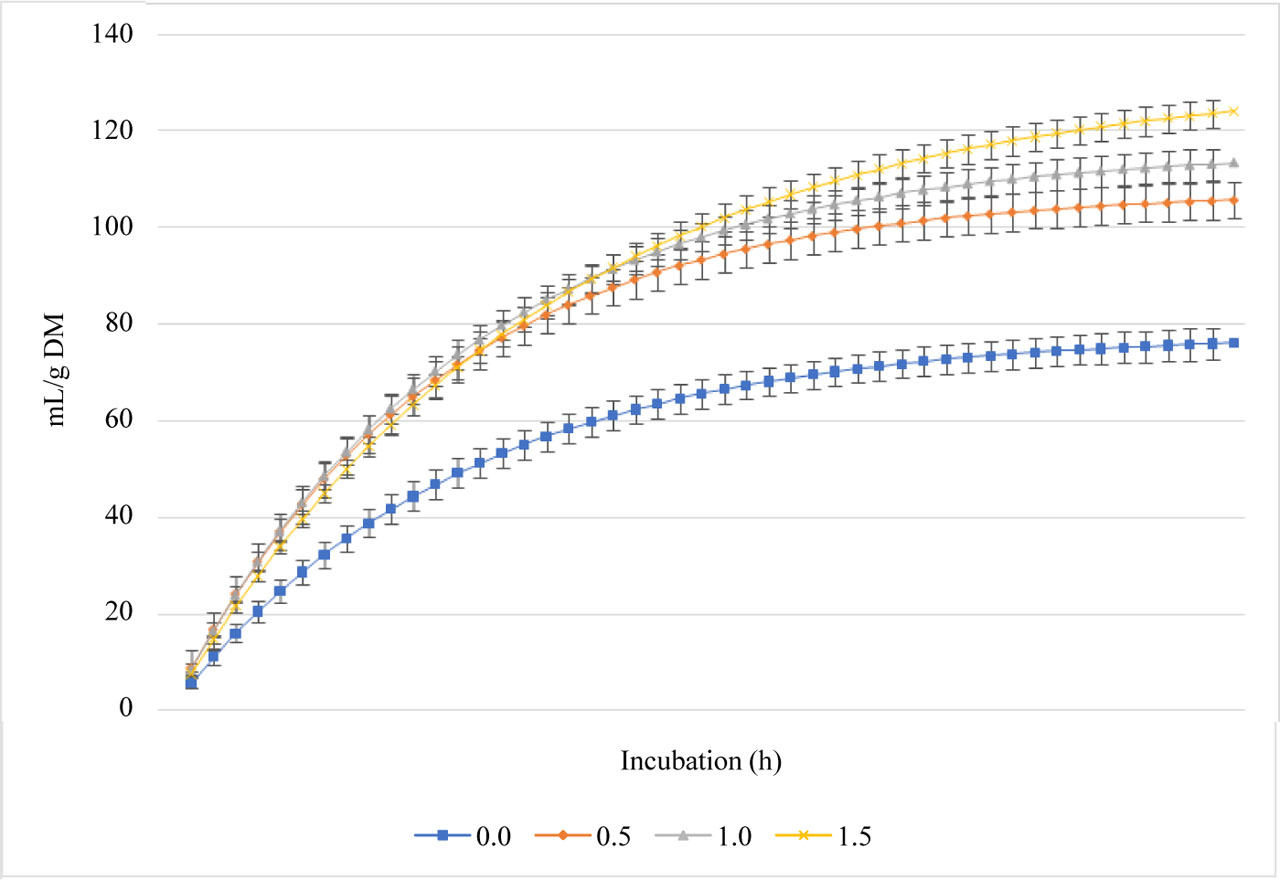
Figure 1.
In vitro ruminal gas production (mL/g incubated DM) of a total mixed ration supplemented with different levels of geranium oil.
Table 3.
In vitro rumen gas production (GP), methane (CH4) and carbon dioxide (CO2) kinetics as affected by increasing levels of geranium oil (%, dry matter basis)
| Level | GP parameters1 | CH4 parameters2 | CO2 parameters3 | ||||||||
|---|---|---|---|---|---|---|---|---|---|---|---|
| A | C | Lag | A | C | Lag | %4 | A | C | Lag | %4 | |
| 0 | 78 c | 0.076 a | 1.55 | 28.6 b | 0.035 | 1.42 | 29.3 a | 58.8 c | 0.036 c | 2.47 | 63.5 |
| 0.5 | 108 b | 0.084 a | 1.62 | 35.6 b | 0.036 | 1.56 | 27.5 ab | 75.0 b | 0.045 b | 2.37 | 62.5 |
| 1 | 116 b | 0.078 a | 1.56 | 36.5 b | 0.042 | 1.54 | 27.9 ab | 79.1 b | 0.048 ab | 2.18 | 62.7 |
| 1.5 | 132 a | 0.060 b | 1.65 | 38.9 a | 0.035 | 1.56 | 25.4 b | 88.3 a | 0.053 a | 2.35 | 65.5 |
| SEM | 2.0 | 0.0020 | 0.09 | 1.05 | 0.0037 | 0.061 | 0.77 | 1.65 | 0.0017 | 0.241 | 1.28 |
| P value | |||||||||||
| treatment | <0.001 | 0.001 | 0.852 | 0.007 | 0.519 | 0.356 | 0.045 | <0.001 | 0.008 | 0.859 | 0.392 |
| linear | <0.001 | 0.563 | 0.962 | 0.007 | 0.212 | 0.193 | 0.231 | <0.001 | 0.002 | 0.420 | 0.683 |
| quadratic | <0.001 | 0.044 | 0.425 | 0.002 | 0.460 | 0.228 | 0.025 | <0.001 | 0.004 | 0.883 | 0.493 |
{ label (or @symbol) needed for fn[@id='j_aoas-2025-0118_tfn_007'] } Means in the same column with different letters differ (P<0.05). The P-value represents the observed significance level of the F-test for the treatment effect; SEM stands for the standard error of the mean.
1 GP parameters: A is the asymptotic GP (ml/g DM), C is the rate of GP (/h), Lag is the initial delay before GP begins (h).
2 Methane (CH4) production parameters: A is the asymptotic CH4 production (ml/g DM), C is the rate of CH4 production (/h), Lag is the initial delay before CH4 production begins (h).
Figure 2 shows CH4 in mL per gram of incubated DM. Methane production increased with higher inclusion levels of GEO. The control group exhibited the lowest ruminal CH4, while the diet with 1.0% essential oil produced the highest CH4 per gram of DM. Geranium essential oil increased the asymptotic CH4 production (linear, P=0.007; quadratic, P=0.002) as shown in Table 3. The 1.5% essential oil inclusion resulted in the highest CH4, while CH4 levels for the 1.0% and 0.5% inclusions were comparable to the control. Essential oil inclusion did not affect the rate of CH4 per hour or the lag time. After 48 h of incubation, GEO significantly decreased the proportion of CH4, with the lowest proportion observed at 1.5% inclusion level (quadratic, P=0.025).
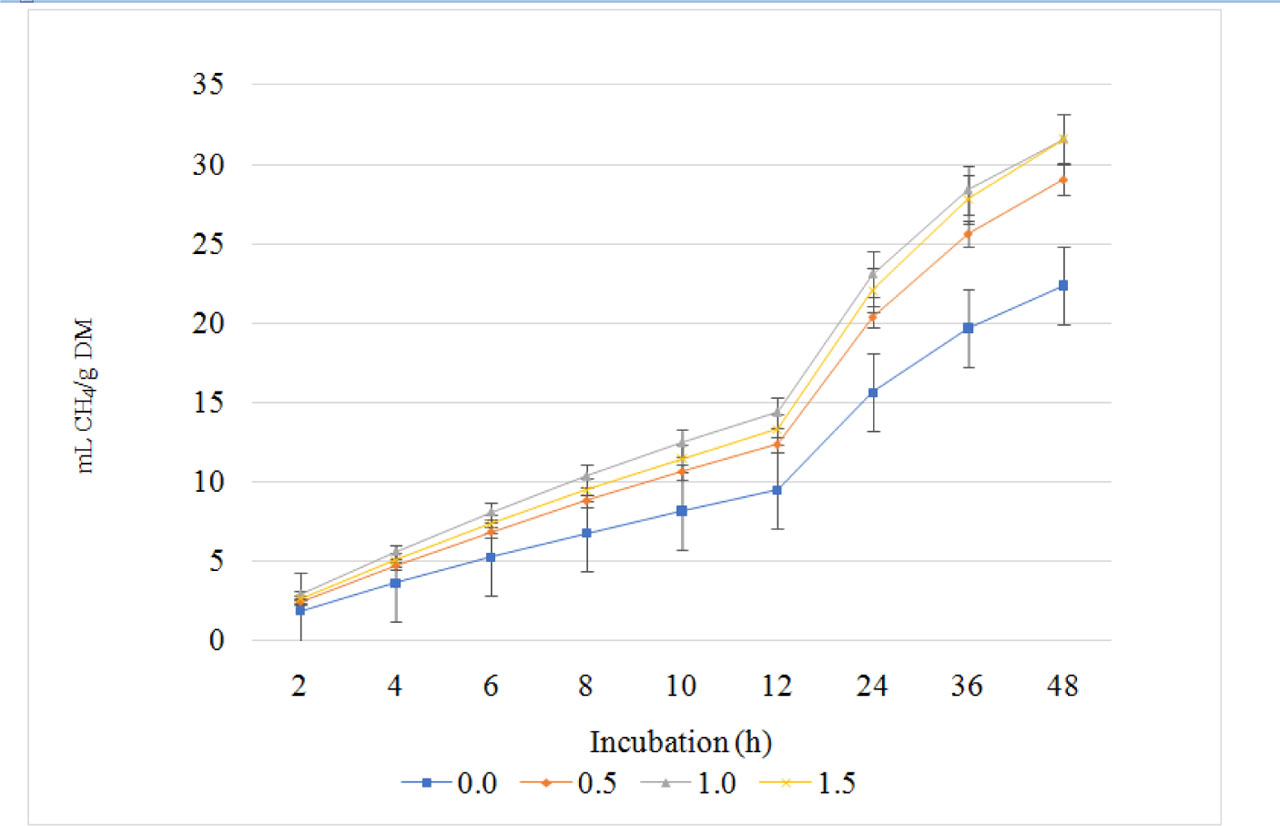
Figure 2.
In vitro ruminal methane (CH4) production (mL/g incubated DM) of a total mixed ration supplemented with different levels of geranium oil.
Table 4.
In vitro rumen fermentation profile of diet with increasing levels of geranium oil (%, dry matter basis)
| Level | Degradability1 | SCFAs2 | Fermentation3 | ||||||||||||||
|---|---|---|---|---|---|---|---|---|---|---|---|---|---|---|---|---|---|
| dDM | dNDF | dADF | Total | C2 | C2 (%) | C3 | C2 (%) | C2: C3 | C4 | C2 (%) | pH | NH3-N | ME | PF24 | MCP | GY24 | |
| 0 | 473 c | 439 b | 412 c | 23.4 c | 11.4 c | 48.9 | 7.90 b | 33.7 | 1.47 | 4.08 | 17.4 | 6.27 b | 10.4 | 4.68 b | 6.22 a | 328 | 139 b |
| 0.5 | 511 bc | 489 ab | 463 bc | 27.4 b | 13.7 b | 50.0 | 9.25 a | 33.8 | 1.48 | 4.42 | 16.1 | 6.60 a | 10.6 | 5.31 a | 4.83 b | 306 | 183 a |
| 1 | 536 ab | 510 a | 492 ab | 27.3 b | 13.9 b | 51.1 | 9.80 a | 35.9 | 1.42 | 3.54 | 12.9 | 6.53 a | 10.7 | 5.44 a | 4.74 b | 321 | 183 a |
| 1.5 | 574 a | 539 a | 524 a | 30.5 a | 15.8 a | 52.0 | 9.80 a | 32.1 | 1.62 | 4.84 | 15.8 | 6.50 ab | 10.8 | 5.50 a | 4.63 b | 354 | 175 a |
| SEM | 11.0 | 12.0 | 12.3 | 0.34 | 0.40 | 2.00 | 0.292 | 1.21 | 0.100 | 0.517 | 1.73 | 0.055 | 0.28 | 0.046 | 0.151 | 12.5 | 5.3 |
| P value | |||||||||||||||||
| treatment | 0.001 | 0.002 | 0.001 | <0.001 | 0.004 | 0.716 | 0.005 | 0.258 | 0.577 | 0.395 | 0.376 | 0.013 | 0.804 | <0.001 | 0.002 | 0.126 | 0.001 |
| linear | 0.003 | 0.003 | 0.002 | <0.001 | 0.002 | 0.446 | 0.002 | 0.239 | 0.732 | 0.487 | 0.106 | 0.009 | 0.468 | <0.001 | 0.001 | 0.679 | 0.004 |
| quadratic | 0.008 | 0.011 | 0.010 | <0.001 | 0.008 | 0.624 | 0.049 | 0.168 | 0.345 | 0.151 | 0.649 | 0.027 | 0.645 | <0.001 | 0.001 | 0.689 | 0.009 |
{ label (or @symbol) needed for fn[@id='j_aoas-2025-0118_tfn_012'] } Means in the same column with different letters differ (P<0.05). The P-value represents the observed significance level of the F-test for the treatment effect; SEM stands for the standard error of the mean.
1 dDM is dry matter degradability (mg/g incubated), dNDF is neutral detergent fiber degradability (mg/g incubated), dADF is acid detergent fiber degradability (mg/g incubated).
Figure 3 illustrates CO2 in mL per gram of incubated DM. Carbon dioxide production increased with the higher levels of GEO in a dose-dependent response. The 1.5% inclusion yielded the highest CO2 production per gram of DM while the control group produced the lowest CO2. The inclusion of GEO at 0.5%, 1.0%, and 1.5% increased asymptotic CO2 production (linear, P<0.001; quadratic, P<0.001) compared to the control, with no significant difference between 1.0% and 0.5% inclusions. All inclusion levels of GEO increased the rate of CO2 production; however, they did not significantly (P>0.05) affect either the lag time prior to CO2 production or the proportion of CO2 measured at the end of the 48 h incubation period. The 1.5% GEO treatment exhibited the highest CO2 production rates (linear, P=0.004; quadratic, P=0.002), with the 1.0% and 0.5% levels showing comparable results, and the control group producing the least CO2.
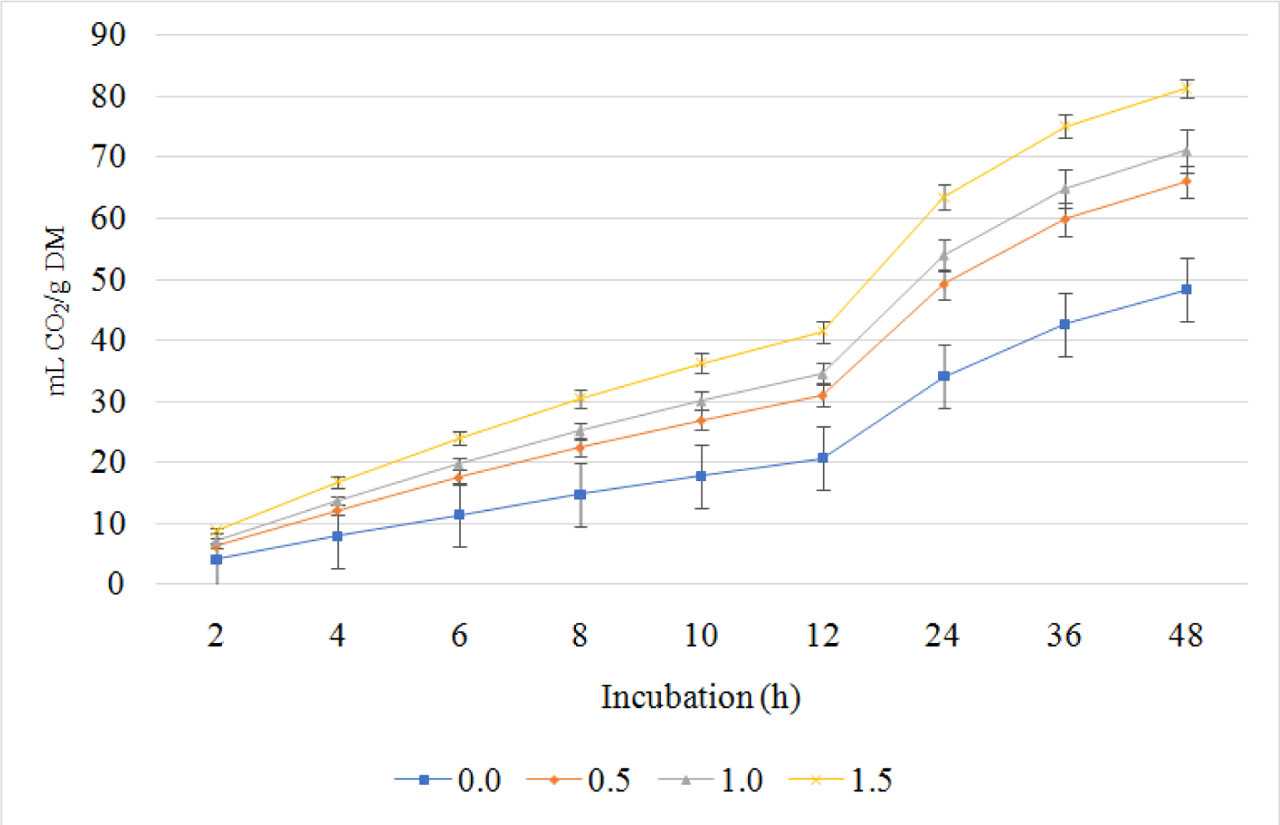
Figure 3.
In vitro ruminal carbon dioxide (CO2) production (mL/g incubated DM) of a total mixed ration supplemented with different levels of geranium oil.
Degradability and fermentation
Including GEO in the diet increased dDM, dNDF, and dADF in a dose-dependent manner. The GEO-supplemented treatments exhibited the highest dDM, dNDF, and dADF (linear, P≤0.003; quadratic, P≤0.011), whereas the 1.5% inclusion resulted in the highest degradability observed, compared to the control treatment. Additionally, the 0.5% and 1.0% inclusions of GEO had similar effects on dDM, dNDF, and dADF. Neutral detergent fiber degradability was comparable among all GEO groups but remained higher than the control (linear P=0.002; quadratic, P=0.011).
Compared to the control, the addition of GEO significantly increased total SCFAs, C2, and C3, while having no significant effect on the C2:C3 ratio or C4 level. The increases in total SCFAs, C2 and C3 were dose-dependent, with the 1.5% GEO inclusion yielding the highest concentrations (linear and quadratic, P<0.001), followed by the 1.0% and 0.5% levels, which produced comparable results. A significant linear (P=0.002) and quadratic (P=0.008) response was observed for C2 concentration with increasing levels of GEO, indicating a dose-dependent increase. The highest C2 concentration was observed at the 1.5% inclusion level, with progressively lower values at 1.0% and 0.5%, and the lowest concentration in the control diet. Increasing levels of GEO led to a significant linear (P=0.002) and quadratic (P=0.049) increase in C3 concentration compared to the control. However, the differences among the various GEO inclusion levels were not statistically significant, indicating that the enhancement in C3 was primarily relative to the control.
The fermentation parameters indicated that the rumen pH increased both linearly (P=0.009) and quadratically (P=0.027) as GEO was added to the diet (Table 4). The control diet had the lowest pH, while 0.5% inclusion resulted in the highest pH. Metabolizable energy and GY24 followed a similar pattern. Diets supplemented with GEO exhibited similar ME values among treatments but were significantly higher than the control treatment (linear and quadratic, P<0.001). Gas yield at 24 h (i.e., GY24) showed a significant linear (P=0.004) and quadratic (P=0.009) response, with the 0.5% and 1.0% GEO inclusions producing the greatest yields, followed by the 1.5% level; the control diet had the lowest GY24. Partitioning factor at 24 h (i.e., PF24) indicated that more substrate was degraded per unit of gas produced in the control treatment compared to the GEO-supplemented (linear, P=0.002; quadratic, P=0.005). However, GEO inclusion had no significant effect on NH3-N or MCP production (P>0.05).
Discussion
Geranium essential oil
Essential oils exert a range of pharmacological effects due to their bioactive constituents, predominantly terpenoid derivatives, with monoterpenes and sesquiterpenes being the main compounds responsible for their biological activities (Martinez-Velazquez et al., 2011). Monoterpenes, in particular, are known for their phytotherapeutic properties, including antifungal, antibacterial, and antioxidant activities (de Oliveira e Lima et al., 2021; Kholif et al., 2026). These compounds and their active components hold significant potential for treating issues such as parasitic infections and bacterial growth, while also serving as probiotics, which has increased interest in phytogenics (Rocha et al., 2019).
In our study, we identified 16 compounds in GEO. Narnoliya et al. (2019), however, reported that GEO contains up to 120 phytoconstituents, with linalool, citronellol, and geraniol being the dominant components. Our analysis revealed that the major compounds were citronellol, trans-geraniol, and citronellyl formate, which together accounted for more than 60% of the GEO. These results align with those of de Mello et al. (2023), who found that GEO contains citronellol (31.37%), geraniol (10.34%), linalool (7.74%) and citronellyl formate (6.51%). A study on crude essential oil of P. graveolens grown in Morocco reported other compounds such as epi-γ-eudesmol (16.67%), geraniol (12.54%), β-citronellol (12.34%), citronellyl formate (7.70%), and geranyl tiglate (5.21%), some of which were absent in the GEO used in the present study (M’hamdi et al., 2024). Similarly, research on GEO from Belgrade identified citronellol (24.54%), geraniol (15.33%), citronellyl formate (10.66%), and linalool (9.80%) as the major constituents (Dzamic et al., 2014). Hsouna and Hamdi (2012) found that linalool (6.54%), citronellol (27.53%), geraniol (25.85%), 6-Octen-1-ol, 3,7-dimethyl-, formate (8.75%) and Δ-selinene (8.15%) were the major components in GEO. Additionally, local cultivars from Rwanda and Egypt contained citronellol (30.3%), linalool (11.5%), geraniol (8.6%) and 10-epi-γ-eudesmol (5.7%) (Juliani et al., 2006).
The presence of compounds such as β-citronellol, geraniol, and linalool in GEO highlights its antimicrobial effects. This study confirms that terpenes, particularly β-citronellol, are key contributors to the composition of GEO. Other compounds, including eugenol, citral, myrtenol, terpineol, methone, and sabinene (Rajesh et al., 2023), have been detected in some GEO samples but were absent in the oil used in this study, which may be related to variations in environmental growth conditions and agricultural practices.
The variation in composition can be attributed to non-genetic factors, such as environmental conditions, plant physiology, distillation method, the plant parts used for extraction, the growth season, and plant age (Cannon et al., 2013; Verma et al., 2013). These factors all affect the concentration of phytochemicals in essential oils. Notably, younger leaves tend to have higher concentrations of geraniol and yield greater oil output (Bhattacharya et al., 1993). Regional growth conditions also play a significant role in the concentration of certain compounds. For instance, Rajeswara Rao et al. (1990) reported that plants grown in temperate, high-altitude regions produced citronellol-, nerol-, geraniol- and menthone-rich oil, while those grown in lower altitudes yielded isomenthone-, linalool-, and citronellyl formate-rich oils. The detection of linalool in this study could indicate an influence of temperature during the extraction process. According to Gomes et al. (2007), linalool is formed from the degradation of geraniol, suggesting an extraction temperature above 40°C may have facilitated this conversion (Gaaffar et al., 2021). The bioactive components in plants are crucial for their therapeutic and nutritional value. Therefore, the limited application of the geranium plant and GEO in ruminant nutrition highlights the necessity for additional studies to explore their potential.
Gas production
In this study, GP increased with GEO in a dose-dependent manner. Although compounds such as citronellol, geraniol, linalool, and epi-γ-eudesmol are generally known for their antimicrobial properties (Hassane et al., 2012), the observed enhancement in GP suggests a different mode of action under the conditions of this study. Specifically, certain essential oil components, particularly monoterpene alcohols and hydrocarbons, may serve as additional carbon sources for rumen microbes, thereby stimulating microbial fermentation and feed degradation (Kahvand and Malecky, 2018). This potential fermentative use of EO compounds could explain the increased GP despite their known antimicrobial activity. If the GEO bioactive ingredients had exerted significant antimicrobial effects, one would expect an inverse relationship between their concentration and nutrient degradation. Jack (2019) demonstrated that increasing the inclusion of plants with antimicrobial properties can negatively affect rumen fermentation and microbial activity. The dose-dependent increase in GP due to the bioactive components in GEO indicates that, when administered to ruminants in vivo, they have the potential to enhance both microbial and enzymatic activities involved in breaking down feed components.
The ability of phenolic compounds to either suppress or stimulate specific members of the microbial community can influence gut microbial population dynamics (Tzounis et al., 2008; Kholif et al., 2026). Many studies demonstrating the antimicrobial effects of GEO are conducted in aerobic environments with isolated microbes, where these microbes are exposed to the oil’s bioactive ingredients for a fixed period. However, microbes in the gut are not isolated; they are constantly moving and affected by varying passage rates, changing pH levels, and other factors. Additionally, the rumen is an anaerobic environment, which may alter the functionality or efficacy of herbs and spices compared to what is observed under aerobic conditions. While much of the research on essential oils in the rumen emphasizes their antimicrobial properties, certain studies (Morsy et al., 2022; Ike et al., 2024; Kholif et al., 2024 b, a) have demonstrated that some herbs, seeds, and essential oils with known antimicrobial activity, such as fennel seeds, rhizomes, Moringa oleifera, can boost rumen fermentation activity. This apparent contradiction arises because plants and essential oils behave differently inside the complex rumen ecosystem compared to controlled laboratory settings, where antimicrobial effects are often evaluated under isolated or simplified conditions.
M’hamdi et al. (2024) reported the selective antimicrobial activity of GEO, demonstrating that it impacts certain microbes while leaving others unaffected. In this study, the beneficial effects of GEO bioactive components might be due to their ability to support rumen microbes. Similarly, Fahmi (2016) demonstrated that sinapine, a phenolic derivative from mustard, promoted microbial growth when tested as an antimicrobial agent. Al-Sagheer et al. (2018) also found that GEO bioactive components enhanced lysozyme activity – a digestive enzyme – while reducing pathogenic intestinal microbes such as coliforms, E. coli, and Aeromonas spp. This suggests that in the rumen, the bioactive components in GEO may promote the fermentation process, which could lead to increased GP (Azzaz et al., 2025). Kholif (2024) provided further evidence that certain components in essential oils, particularly those with lower antimicrobial potential like the monoterpenoid citronellol, can serve as carbon sources for specific rumen microorganisms. It is important to note that the antimicrobial mechanisms observed in controlled laboratory settings, where a single microbe is targeted, may differ from those in the complex rumen environment, which hosts a diverse microbial community. This difference in the microbial ecology might explain the varying antimicrobial activity in the rumen. The dose-dependent increase in GP observed with GEO could be due to the ability of one of its bioactive components, such as citronellol, to provide carbon to beneficial rumen microbes. The lack of differences in lag time between treatments suggests that all treatments created favorable conditions for microbial activity, allowing microbes to quickly adapt to the feed and initiate digestibility (Kholif and Olafadehan, 2021). The dose-dependent increase in GP up to 1.5% GEO incorporation may be attributed to the stimulatory effects of certain bioactive compounds in geranium essential oil on specific rumen microbial populations, as supported by studies showing that some essential oils enhance microbial fermentation and fiber degradation at moderate doses (Kholif et al., 2024 b, a).
Emissions of greenhouse gases from livestock are detrimental to the environment and indicate poor utilization of feed resources. Although CH4 and CO2 emissions from ruminants are biogenic, as opposed to those from petrochemical industries, their direct impact on heat retention and radiation trapping underscores the importance of minimizing these emissions. In this study, GEO led to a dose-dependent increase in asymptotic CH4 and CO2 production as digestion progressed, indicating active H2 sinking by methanogens. However, after 48 h of incubation, the 1.5% GEO resulted in the lowest CH4 proportion, while CO2 proportion remained unaffected by the treatments. This suggests the presence of alternative hydrogen (H2) sinks during the 48-hour period that bypassed methanogenesis.
Hook et al. (2010) suggested that essential oils may reduce H2 availability or its utilization for methanogenesis due to their antimicrobial properties on methanogens or protozoa. This activity is likely attributed to the bio-active secondary metabolites present in essential oils – such as monoterpenes, alcohols, and phenols – which can disrupt microbial membranes and inhibit protozoal and archaeal populations. Since CO2 levels remained stable across treatments after 48 h, it is unlikely that CO2 served as an alternative H2 sink. In the rumen, H2 can be utilized in pathways such as methanogenesis, reductive acetogenesis, biohydrogenation, and C3 formation. Among volatile fatty acids, only C3 formation acts as a true H2 sink by consuming reducing equivalents. In contrast, C2 and C4 production typically generate H2 rather than consume it. Ungerfeld et al. (2024) noted that shifting fermentation towards propionate rather than methane could serve as an effective H2 disposal pathway in ruminants. However, given that neither CO2 production nor C3 concentrations were significantly altered by GEO inclusion, it is unlikely that C3 production served as a major alternative H2 sink under the conditions of this study. The increase in C2 across GEO-treated groups indicates a fermentation shift favoring acetate production, which typically correlates with increased H2 generation rather than redirection toward propionate synthesis or reduced methanogenesis. Interestingly, while all levels of GEO increased C3 production compared to the control, the similarity across GEO doses suggests that the effect plateaued, with no additional enhancement at higher inclusion levels. Instead, acetogenesis likely contributed, as shown by the higher proportion of C2 in the group supplemented with 1.5% essential oil. Although acetogenesis is a potential alternative H2 sink, methanogenesis remains thermodynamically more favorable (ΔG = −67.4 kJ/mol vs. −8.8 kJ/mol for acetogenesis), and methanogens typically outcompete acetogens due to their higher affinity for H2 (Leng, 2018). The increase in both C2 and C3 concentrations across GEO-treated groups appears to be associated with enhanced rumen DM degradability, as evidenced by the significant increases in dDM, dNDF, and dADF values. However, since the C2:C3 ratio remained unchanged, the data do not support a clear shift in fermentation pattern toward either acetogenesis or propionogenesis as alternative H2 sinks. Inhibiting methanogenesis typically leads to increased H2 accumulation, which may limit C2 production in the ruminal fluid due to end-product inhibition. As a result, alternative pathways such as propionogenesis or reductive acetogenesis may become more favorable to maintain redox balance and energy metabolism in the rumen (Nollet et al., 1997). Although Leng (2018) also found that acetogenesis as the primary H2 sink usually results in reduced GP, gas output increased in this study. This suggests that H2 was distributed across multiple pathways, including methanogenesis, C3 production, and acetogenesis. Additionally, the unsaturated fatty acids in the essential oil may have contributed to H2 utilization, further limiting its availability for methanogens. Yang et al. (2019) demonstrated that certain fatty acids in oils can act as alternative H2 sinks, thereby reducing CH4 production. However, this mechanism typically leads to a decrease in total GP rather than an increase. Thus, the elevated GP observed in the present study may be more closely associated with enhanced substrate degradability rather than a redirection of H2. Moreover, the dose-dependent increase in CO2 might indicate improved nutrient absorption in vivo. Studies have shown that elevated CO2 levels can increase blood flow to local tissues (Kontos et al., 1967), and improved blood flow to the ruminal epithelium can enhance nutrient absorption (Von Engelhardt and Hales, 1977). Therefore, the increased CO2 production observed in this study could reflect better nutrient absorption, potentially boosting overall feed efficiency in ruminants.
Degradability and fermentation
Dry matter degradability (i.e., dDM) is an important indicator of the nutritional quality of feeds, representing how efficiently rumen microorganisms break down their components to provide animals with energy. The study found that the increases in dDM, dNDF and dADF suggest that GEO enhances microbial growth and activity, resulting in more effective diet colonization and digestion (Garcia-Santos et al., 2021). In particular, diets supplemented with 1% and 1.5% GEO showed similar improvements in digestibility, indicating the role of the bioactive components of the GEO in improving microbial activity and overall feed digestibility. These bioactive components are believed to promote the growth of rumen bacteria, including fibrolytic bacteria, thereby enhancing feed degradation. While specific studies on GEO are limited, similar effects have been documented with other essential oils rich in bioactive compounds (e.g., terpenes and phenols) that stimulate rumen microbial activity (Kholif and Olafadehan, 2021).
It is important to note that essential oils generally have antimicrobial properties; however, their effects are dose-dependent and can vary based on the specific compounds and concentrations used (Kholif and Olafadehan, 2021). In this study, supplementation with GEO up to 1.5% did not negatively affect rumen pH or overall fermentation, but instead enhanced digestibility and GP. This suggests that GEO’s bioactive compounds may selectively inhibit less efficient or harmful microbes while promoting beneficial fibrolytic bacteria involved in fiber degradation (Castillejos et al., 2007; Benchaar et al., 2008).
This increased microbial activity leads to higher GP and CH4 production, likely resulting from the degradation of the DM, NDF, and ADF. This correlation between fiber degradation and CH4 production explains the observed increase in GP and CH4 output. The increased fiber breakdown, evidenced by higher NDF and ADF digestion, likely accounts for the rise in C2 production (Vallejo et al., 2016). In this study, a clear relationship was observed between GP and dDM, dNDF and dADF. The increase in GP and dDM may be attributed not only to enhanced microbial activities but also to the ability of GEO’s bioactive compounds to modulate rumen fermentation conditions. Specifically, monoterpenes like citronellol may disrupt microbial cell membranes, selectively inhibiting undesirable microbes while favoring fibrolytic species, thereby improving cell wall degradation and nutrient availability (Golbotteh et al., 2022).
The observed increases in C2 and C3 production alongside CH4 reflect a balanced shift in rumen fermentation pathways. Acetate production, mainly from fiber digestion, was enhanced due to increased fiber degradability, while C2, a glucogenic precursor, also increased, supporting better energy metabolism. Although CH4 production was elevated with increased fiber digestion, it is likely a byproduct of enhanced microbial fermentation rather than an indicator of inefficient fermentation (Kholif and Olafadehan, 2021).
The fermentation process not only boosted the level of major SCFA but also likely impacted the other minor ones that were not measured in this study. Diets supplemented with GEO exhibited higher C2 concentrations than the control, which may reflect enhanced fermentation activity associated with increased GP and dADF, rather than direct microbial proliferation. A consistent pattern was observed among dDM, dADF, GP, and C2 concentration, where the 1.5% GEO-supplemented diet resulted in the highest dDM and dADF values, accompanied by the greatest C2 concentration. Similarly, C3 concentration followed a pattern similar to dNDF. As expected, the diet without GEO exhibited the lowest GP, dDM, dNDF, and dADF, which was associated with reduced total SCFA, C2, and C3 productions. These findings reflect the well-established relationship between fermentation intensity and SCFA production, suggesting that GEO inclusion enhanced fermentative activity. Furthermore, the stable rumen pH observed indicates that rumen microbial communities were able to adapt or were selectively modulated by GEO’s bioactive components without overall disruption of rumen function. Such selective modulation may improve feed degradation efficiency, as seen in other studies where essential oils at moderate doses enhanced digestibility and fermentation without harming rumen microbiota or pH (Morsy et al., 2024). Morsy et al. (2024) found similar results, where the addition of phytogenic feed additive increased dDM, dNDF, and dADF, which in turn led to higher total SCFA, C2, and C3. In dairy animals, C2 is vital for fatty acid synthesis, particularly in adipose tissue and milk production (Azzaz et al., 2024). Additionally, the observed increase in C3 is noteworthy, as C3 is a major precursor for glucose synthesis in the liver through gluconeogenesis, which aids in blood glucose regulation and energy metabolism – essential for meeting the energy demands of lactating animals (Azzaz et al., 2023).
Rumen pH is influenced by dissolved CO2, which affects rumen microbial activity, CH4 reduction, SCFA proportions, and overall fermentation efficiency (Laporte-Uribe, 2016). In addition, rumen pH plays a role in determining milk yield and quality, the C2 to C3 ration, ruminal epithelium health, and blood flow (Rodrigues, 2016). Dissolved CO2 in the rumen refers to CO2 that is present in solution within the ruminal fluid, originating primarily from microbial fermentation processes. It plays a key role in maintaining rumen pH and acts as a substrate for methanogenesis, as hydrogenotrophic methanogens utilize CO2 and H2 to produce CH4. Therefore, the concentration of dissolved CO2 can influence both fermentation dynamics and CH4 production (Liu et al., 2023). In this study, the slightly elevated rumen pH in the GEO treatments, compared to the control, suggests that the essential oil may act as a buffer, preventing a sharp decline in acidity despite increased C3 production (Lin et al., 2012). An optimal rumen pH (6.0–6.8) supports efficient fermentation and microbial activity, as seen in this study (Kamra, 2005). The higher levels of SCFAs and increased ME in the treatments supplemented with GEO indicate enhanced feed fermentation and energy availability, which are vital for meeting the daily energy requirements of ruminants (Fellner, 2004). The rise in ME, coupled with increased GP, suggests that GEO improves both feed fermentability and nutrient availability for microbial growth, leading to better digestibility and energy efficiency (Menke et al., 1979). The increased dDM indicates that the microbes effectively degraded the nonstructural carbohydrate and NDF, thereby making more metabolizable energy available.
The PF24, which reflects the partitioning of digested OM between GP and microbial protein synthesis, was lower in the GEO-supplemented treatments. This suggests that a greater proportion of degraded substrate was directed toward fermentative gas and SCFA production, rather than microbial biomass, potentially indicating a reduction in the efficiency of energy utilization for microbial protein synthesis. Additionally, the higher GY24 in the GEO treatments demonstrates that more gas was produced per gram of dDM, further supporting the enhanced fermentability of the diet (Kholif et al., 2024 c).
Conclusions
The inclusion of geranium essential oil in the diet positively influenced fiber degradation, SCFA production, and overall energy availability, highlighting its potential to enhance the nutritional quality and digestibility of ruminant feed. Supplementing up to 1.5% geranium essential oil in the diet can reduce ruminal CH4 production and increase GP in vitro, which may help reduce the environmental impact of ruminants (e.g., sheep) and promote eco-friendly production. Furthermore, this study demonstrated that adding up to 1.5% geranium essential oil can improve total and individual SCFA concentrations, as well as nutrient digestibility (dDM, dNDF, and dADF), ME, PF24, and GY24. These findings provide valuable insights into the use of geranium oil in ruminant diets, making it a useful resource for sustainable ruminant farming.